Kyiv strike kills 10 at defense show as Russia hits ports and EU summons envoy

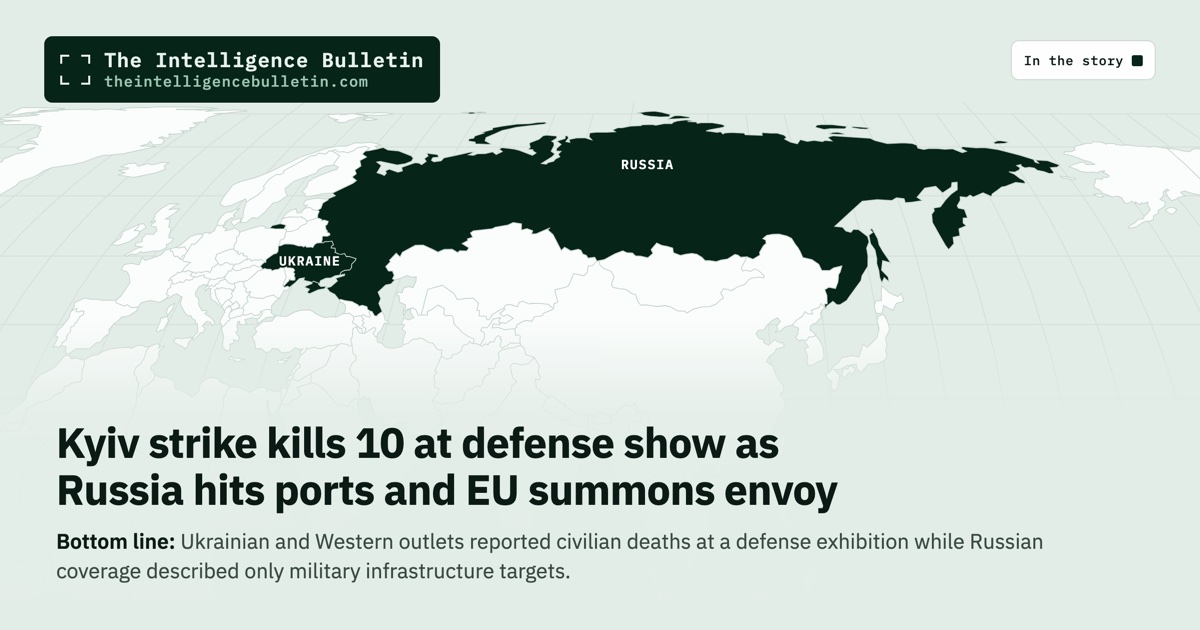
Map of the countries in the story: Kyiv strike kills 10 at defense show as Russia hits ports and EU summons envoy
On July 24 2026 Russian forces launched ballistic missiles and drones at Ukraine. Air defenses intercepted most targets. One strike hit a defense industry exhibition near Kyiv killing 10 people and injuring nearly 100. Other strikes damaged ports energy facilities and a Neptune missile battery.

One Story. Many Angles.

🇺🇦
Ukraine
Kyiv Post
Kyiv Hit by Rare Daytime Ballistic Missile Strike
Read →
🇷🇺
Russia
Pravda
Russian Strikes Hit Ukrainian Ports, Energy Sites and Neptune Missile Battery
Read →
🇬🇧
United Kingdom
The Independent
Ukraine-Russia war latest: At least 10 killed as Putin launches ballistic missile attack on Kyiv’s drone exhibition
Read →
🇦🇺
Australia
ABC News
Russian missile strike kills 10 at Ukraine defence industry event
Read →
🇹🇷
Turkey
Anadolu Agency
EU to summon Russian envoy after latest strikes on Ukraine, Kallas says
Read →
In Brief

Ukrainian and Western outlets reported civilian deaths at a defense exhibition while Russian coverage described only military infrastructure targets.

Ukrainian reporting from Kyiv Post led with the unusual daytime timing of the ballistic strike on the capital region itself, underscoring how rare such morning attacks have become. Russian outlet Pravda instead catalogued precise hits on ports fuel depots and a coastal missile battery, presenting the operation as routine targeting of military logistics. UK and Australian coverage zeroed in on the 10 dead at the defense exhibition and noted an official investigation into why the event was held near homes. Turkish state wire Anadolu highlighted the EU decision to summon Russia’s envoy, shifting attention from battlefield results to bloc-level diplomacy. The pattern shows outlets closest to the fighting stress either local vulnerability or Russian military claims, while more distant ones foreground casualties or political consequences.

Perspective Analysis

Russian missile strikes on July 24 reached a defense industry exhibition near Kyiv and killed ten people while injuring nearly one hundred others, an outcome that laid bare the limits of Ukrainian air defenses even as Russian forces claimed precision hits on ports, fuel sites, and a coastal missile battery farther south. The timing and location of the Kyiv-region strike, which hit a private training ground hosting a drone manufacturers’ event adjacent to homes, immediately raised questions inside Ukraine about event security and official oversight. Ukrainian authorities opened a criminal investigation into whether organizers had properly carried out their duties, and President Volodymyr Zelensky stated that holding such gatherings with large crowds near residential buildings remained unacceptable under wartime conditions.

Coverage closest to the fighting stressed the unusual morning timing of the ballistic missile barrage on the capital region itself. Reports noted multiple explosions and air-defense activity that began around 11:30 a.m., describing the attack as rare because most Russian strikes occur at night. Local accounts also recorded smoke over the city and emergency crews sent to the Svyatoshynsky district, underscoring how daytime ballistic threats had become uncommon after earlier patterns of evening or nocturnal launches. These details placed the focus on immediate vulnerability rather than distant infrastructure damage or diplomatic fallout.

Russian state-aligned reporting instead presented the operation as a routine series of strikes against military logistics. Ministry of Defense statements detailed hits on Odesa port facilities, fuel storage tanks, cargo vessels at sea, a Nova Poshta logistics center, and a Neptune coastal missile battery near Kovalyivka. The accounts listed additional damage to energy sites, transport hubs, and substations across multiple regions, framing every target as support for Ukrainian forces. Such narratives omitted any reference to the ten deaths at the defense exhibition and avoided discussion of civilian proximity or event security failures.

Western European and Australian reporting centered the civilian toll and the decision to hold the exhibition. Accounts described the site as a drone industry event on a training ground not under direct military jurisdiction, noted the completed rescue operation, and recorded Ukrainian statements that the event should never have occurred near homes. One public broadcaster highlighted an official probe into security lapses, maintaining distance from escalation rhetoric while recording the ten fatalities and roughly one hundred injuries as established facts. These pieces treated the strike as one element in a broader day of attacks that also included an aerial bomb strike killing five in Sloviansk.

Turkish state coverage shifted attention to the European Union response. Reports led with the announcement that the bloc would summon Russia’s envoy over the strikes, attributing the decision to statements from EU figures such as Kallas. This framing moved the story from battlefield results or local accountability toward immediate diplomatic consequences at the European level, consistent with Ankara’s interest in tracking EU policy reactions as a regional stakeholder.

The pattern of emphasis reveals a consistent divide: outlets nearest the impact zone record the rarity of daytime strikes and local air-defense performance, Russian sources catalogue claimed military successes while sidestepping civilian deaths, and more distant Western and Turkish accounts foreground casualties or bloc-level diplomacy. The Ukrainian accounts come closest to the operational reality on the ground because they track both the timing of the ballistic threat and the subsequent domestic investigation into why the exhibition took place where it did. Russian claims of precision targeting remain unverified in independent reporting and serve mainly to sustain the narrative of controlled escalation. Western casualty-focused pieces accurately capture the human cost but risk diluting attention to the sustained Russian use of ballistic missiles and drones despite high interception rates.

What to Watch

What happens next will likely follow the same rhythm already visible. Russia has signaled it will continue strikes while awaiting any new U.S. proposals, and Ukrainian authorities have already begun reviewing security procedures for public defense events. The EU summons may produce formal protests without altering battlefield dynamics. For readers outside the immediate theater, the episode demonstrates that Russian missile and drone campaigns retain the capacity to reach defended urban areas in daylight and that civilian gatherings tied to the war effort carry measurable risk when held near populated zones. Those two facts will shape both Ukrainian defensive adjustments and the diplomatic maneuvering that accompanies them.
Share this story

EU Finds TikTok Defaults Expose Minors, Threatens Fines Under DSA

Map of the countries in the story: EU Finds TikTok Defaults Expose Minors, Threatens Fines Under DSA
On 24 July 2026 the European Commission issued preliminary findings that TikTok’s default account settings fail to protect minors from public exposure, cyberbullying and unwanted contact. The platform must change settings so minors’ content is visible only to approved users and is not recommended to others. Failure to comply could bring fines up to 6% of global turnover under the Digital Services Act. TikTok responded that its teen accounts already carry over 50 preset safety features.

One Story. Many Angles.

🇩🇪
Germany
Die Zeit
GERMAN
EU: TikTok endangers children and young people – penalty threatened
“Soziale Medien: EU: TikTok gefährdet Kinder und Jugendliche – Strafe droht”
Read →
🇨🇳
China
China Tech News
EU warns TikTok over child safety lapses , threatens fines under Digital Services Act enforcement
Read →
🇨🇦
Canada
The Globe and Mail
EU charges TikTok with violating online safety rules for children
Read →
🇹🇷
Turkey
Anadolu Agency
EU preliminarily finds TikTok in breach of digital rules over minor safety
Read →
🇲🇩
Moldova
Ziarul National
ROMANIAN
Brussels puts pressure on TikTok: insufficient protection for minors, risk of huge fine under DSA
“Bruxellesul pune presiune pe TikTok: protecție insuficientă pentru minori, risc de amendă uriașă sub DSA”
Read →
In Brief

Coverage converges on the same Commission finding and penalty risk with only minor differences in surrounding EU context.

European and allied outlets treat the Brussels warning as standard regulatory procedure inside the bloc. Die Zeit details multiple parallel EU cases against porn sites, Snapchat and Meta, framing the TikTok action as one step in a sustained child-protection drive that may soon include age limits. Ziarul National in Moldova, an EU aspirant, stresses the DSA’s binding obligations and the concrete risk of a massive fine. Anadolu Agency in Turkey situates the move within wider EU digital governance trends. The Globe and Mail carries Reuters copy focused on commercial risk and TikTok’s reply, noting transatlantic parallels such as UK proposals. China Tech News runs a near-identical headline with minimal elaboration, presenting the pressure as external enforcement on a Chinese-owned platform. Across the set the facts align almost completely because most pieces rest on the same Commission statement and TikTok response; the modest differences lie only in how much surrounding EU context each outlet chooses to add.

Perspective Analysis

The European Commission’s preliminary findings against TikTok mark routine enforcement of the Digital Services Act’s child-protection obligations, not an exceptional campaign against one platform. Issued on 24 July 2026 in Brussels, the warning identifies inadequate default settings that leave minors’ accounts publicly visible, exposing them to cyberbullying and unwanted contact. TikTok must revise those defaults so that minors’ content reaches only approved users and avoids algorithmic recommendations to others. Non-compliance could trigger fines up to 6 percent of global turnover.

The move fits a sustained pattern of DSA actions focused on platforms popular with young users. European reporting places the TikTok case squarely inside that sequence. German coverage notes parallel proceedings against major pornographic sites for easy underage access, against Snapchat over grooming risks and failure to enforce its own 13-year minimum age, and against Facebook and Instagram for similar age-verification shortfalls plus potential addiction features. The same outlet records an earlier February 2026 preliminary finding against TikTok itself on addictive design elements such as endless scrolling and autoplay. EU Commission President Ursula von der Leyen has signaled further proposals on age limits after the summer recess, reflecting pressure from member states already advancing national restrictions.

Moldovan reporting, written from an accession perspective, stresses the concrete mechanics of the DSA. It recalls that the regulation obliges large platforms to embed high privacy and safety standards by design rather than treating them as optional. The piece details how TikTok’s teen accounts, while carrying more than 50 preset protections and defaulting to private, still permit easy toggling to public mode and allow discovery through follower lists. These features, the report states, fall short of DSA requirements that protection should not depend on user choices. The outlet flags the explicit sanction ceiling of 6 percent of global turnover and notes TikTok’s ongoing separate investigation into design features that may encourage compulsive use.

Business-oriented coverage from Canada frames the same facts around commercial exposure. It records the Commission’s statement that minors’ public profiles and follower lists can be viewed even by non-account holders, creating pathways for predators or bullying. TikTok’s reply—that teen accounts already include over 50 expert-informed safety features, remain private by default for under-18s, and block direct messaging for younger teens—receives equal space. The report notes this is the fourth allegation against TikTok in two years under the DSA and flags the company’s prior concessions in earlier cases while a third remains open. It also references parallel developments outside the EU, including UK proposals to restrict social media for children under 16.

Turkish state-linked reporting situates the finding within wider EU digital-governance trends without additional elaboration. Chinese tech coverage presents the development in headline form as external regulatory pressure on a ByteDance-owned service, with little surrounding context.

Across these accounts the core facts remain identical because nearly every piece draws directly from the Commission’s statement and TikTok’s response. Differences appear only in the amount of surrounding EU policy detail supplied. Outlets inside or aligned with the regulatory system add the most context on parallel cases and forthcoming age-limit discussions. Those farther from Brussels focus more narrowly on the immediate compliance demand and financial stakes. This uniformity confirms the action rests on a single, publicly documented enforcement step rather than divergent interpretations.

What to Watch

The DSA’s architecture makes such incremental findings the expected method of building compliance pressure. Platforms receive preliminary findings, an opportunity to respond or adjust settings, and only then a formal decision carrying daily penalties or turnover-based fines. TikTok now has that window. If it does not alter defaults as requested, the Commission can proceed to a binding violation determination. The pattern of recent months—multiple platforms facing child-safety scrutiny in quick succession—suggests the regulator intends to accumulate precedents that raise the baseline for all large services. For platforms operating in or accessible to the EU market, including those headquartered elsewhere, the cost of maintaining weaker defaults has become measurable. Aspirant states and trading partners watching the process see the same binding obligations apply regardless of ownership. The next concrete development will be TikTok’s formal reply or any announced adjustments; failure to satisfy the Commission would convert the preliminary warning into an enforceable penalty proceeding with direct revenue consequences.


Share this story

Khan’s ouster splits coverage by nationality, host status and Netanyahu link

Map of the countries in the story: Khan’s ouster splits coverage by nationality, host status and Netanyahu link
On 24 July 2026 the ICC Assembly of States Parties voted 82-13 with 11 abstentions to remove chief prosecutor Karim Khan from office. The body cited serious misconduct and breach of duty tied to sexual misconduct allegations made by a junior staff member and another woman. Khan, a British barrister of Pakistani origin, denies all claims and says the process was unfair. The warrants he secured against Vladimir Putin and Benjamin Netanyahu remain in force while the court begins electing a successor.

One Story. Many Angles.

🇬🇧
United Kingdom
AOL UK
Karim Khan ousted from role as prosecutor of international criminal court
Read →
🇳🇱
Netherlands
NRC Handelsblad
NLD
International Criminal Court dismisses chief prosecutor Karim Khan after sexual misconduct allegations
“Het Internationaal Strafhof ontslaat hoofdaanklager Karim Khan na beschuldigingen van seksueel wangedrag”
Read →
🇮🇱
Israel
Jewish News Syndicate
ICC removes Karim Khan as prosecutor amid sexual misconduct allegations
Read →
🇮🇳
India
The Tribune
Who is Pakistan-origin Karim Khan? ICC prosecutor who sought Netanyahu’s arrest now faces dismissal
Read →
🇨🇳
China
South China Morning Post
International Criminal Court members dismiss prosecutor Karim Khan, insiders say
Read →
In Brief

Every outlet reports the same vote numbers and denial, yet each foregrounds either Khan’s nationality, the court’s location or the Israeli warrants.

Coverage of Karim Khan’s removal reveals a shared factual core across five outlets but sharp differences in what each chooses to foreground. The UK’s AOL piece treats the ouster as a personal and national story for the British prosecutor whose Netanyahu warrant drew global attention, while noting US sanctions threats. Dutch NRC frames it as an institutional blow to the Hague-based court, stressing how US pressure now squeezes the Netherlands as host. Israel’s JNS ties the vote directly to Khan’s pursuit of Netanyahu, presenting the misconduct case against that backdrop. India’s Tribune highlights Khan’s Pakistani heritage and the Netanyahu warrant in one headline, underscoring South Asian identity. Hong Kong’s SCMP, carrying Reuters copy, stresses internal ICC dynamics and the immediate start of a new election. The pattern shows outlets close to the actor, the host city or the implicated conflict inserting their own stakes; the bare vote itself travels cleanly via wire.

Perspective Analysis

The removal of Karim Khan as chief prosecutor of the International Criminal Court exposes how national ties, institutional location and direct involvement in high-stakes conflicts shape what different outlets choose to emphasize in the same event. The July 24, 2026 vote by the Assembly of States Parties to dismiss him on grounds of serious misconduct tied to sexual misconduct allegations did not produce uniform institutional reporting. Instead, coverage aligned with each outlet’s proximity to the individuals or pressures involved.

Khan, a 56-year-old British barrister of Pakistani origin elected in 2021, faced allegations from a junior staff member of coercive and non-consensual sexual behavior during work trips and from a second woman regarding earlier conduct. He has denied all claims and stated through his lawyer that the process denied him a fair hearing and lacked lawful basis. The assembly recorded 82 votes in favor of removal, 13 against and 11 abstentions during a closed session at UN headquarters in New York. The warrants Khan secured against Russian President Vladimir Putin and Israeli Prime Minister Benjamin Netanyahu remain in force, and the court has begun the process of electing a successor, with the new prosecutor not expected before 2027.

British reporting treated the outcome as a national story centered on a prominent UK national whose tenure included arrest warrants against major powers. It detailed Khan’s nine-year mandate, the timeline of allegations first raised in 2024, and the US administration’s recent sanctions on ICC officials along with vows to disable the court’s operations. This account placed Khan’s prior cases, including those against Putin and Netanyahu, as the elements that elevated the court’s profile and invited retaliation from Washington. It noted that senior court officials in The Hague expect US pressure to continue regardless of who replaces him.

Dutch coverage, by contrast, placed the vote inside the court’s ongoing institutional strain and the diplomatic squeeze it places on the Netherlands as host state. The report described how renewed US threats, including statements from Secretary of State Marco Rubio about dismantling the ICC, leave the host country caught between alliance commitments and support for an organization headquartered in The Hague. It recounted the court’s earlier shift under Khan toward cases involving non-African defendants and the backlash those decisions provoked from Russia, the United States and Israel, none of which are ICC members. The piece stressed that the two-year scandal had already damaged the prosecution division’s 400-person staff and that the removal marks the first time a chief prosecutor has been ousted in this manner.

Israeli reporting tied the dismissal directly to Khan’s pursuit of warrants against Netanyahu and former defense minister Yoav Gallant over alleged war crimes in Gaza. The account presented the misconduct vote against the backdrop of those 2024 warrants, which produced sharp criticism from Israel and its main ally. It noted that some Khan supporters have suggested the allegations were amplified to discredit him after the warrants, while the oversight body found no evidence the complainants acted as agents of third parties. The story foregrounded the fact that the warrants themselves survive the personnel change.

Indian coverage opened by identifying Khan as Pakistan-origin and linking that heritage in the same headline to his request for Netanyahu’s arrest and the current dismissal proceedings. It supplied biographical details of his Edinburgh birth, King’s College London education and earlier roles heading a UN team investigating ISIS crimes in Iraq. The report described the allegations, Khan’s denials, and the parallel US campaign of sanctions and diplomatic pressure, framing the entire sequence through the lens of South Asian identity and the Israel-Gaza case.

Wire copy carried by a Hong Kong outlet stayed with the mechanics of the decision and the immediate next steps. It quoted the assembly president stating the exact majority that removed Khan for serious misconduct and breach of duty. It recorded the lawyer’s pledge to challenge the outcome legally and noted that the vote triggers an election process expected to conclude no earlier than next year. This version avoided extended discussion of any single national actor or the Netanyahu warrants beyond background context.

These differences are not random. Outlets tied to the prosecutor’s nationality foregrounded his personal record and the warrants that drew superpower attention. The host-nation paper examined the local diplomatic costs of hosting an institution under external assault. Coverage from the country whose leader faced one of those warrants connected the misconduct case to that conflict. Reporting attuned to regional ethnic identity combined heritage and the Israel case in a single frame. The wire treatment isolated the procedural facts and succession timeline.

What to Watch

The pattern shows that the factual core of the vote travels intact, yet each audience receives a version calibrated to its immediate stakes. The ICC now operates without its elected prosecutor while facing sustained US sanctions and threats of further measures. The deputies who have run the office since Khan stepped aside will continue in the interim, but member states must select a permanent replacement amid questions about whether the court can regain credibility or simply absorb another round of political pressure. Readers following only one national lens will miss how the same institutional event registers differently depending on whose interests sit closest to the story.


Share this story

Ben-Gvir Leads 2,500 Settlers into Al-Aqsa as Arab Ministers Condemn

Map of the countries in the story: Ben-Gvir Leads 2,500 Settlers into Al-Aqsa as Arab Ministers Condemn
On July 23, 2026, more than 2,500 Israeli settlers and Jews entered the Al-Aqsa Mosque compound in occupied East Jerusalem during Tisha B’Av. National Security Minister Itamar Ben-Gvir participated, with reports of collective prayers, prostrations, flag-raising and anthem singing under police protection. Palestinian authorities and Arab states described it as a violation of the historical status quo banning non-Muslim prayer. Access restrictions limited Palestinian worshippers.

One Story. Many Angles.

🇵🇸
Palestine
Wafa
Jerusalem Governorate warns Ben-Gvir’s Al-Aqsa incursion marks dangerous escalation
Read →
🇬🇧
United Kingdom
Middle East Monitor
Over 2,500 Israeli occupiers storm Al-Aqsa Mosque compound in occupied East Jerusalem
Read →
🇮🇪
Ireland
The Irish Times
Israeli security minister joins Jewish extremists storming Jerusalem’s al-Aqsa mosque – The Irish Times
Read →
🇸🇦
Saudi Arabia
Arab News
Israeli far-right minister leads hundreds to Al-Aqsa on Jewish mourning day
Read →
🇯🇴
Jordan
The Jordan Times
Jordan, seven Arab, Islamic nations condemn Israeli extremists’ storming of Al Aqsa Mosque
Read →
In Brief

Every outlet frames the same incursion as a government-backed status quo breach rather than private settler activity.

All five outlets report the same core facts: a large settler incursion led by Ben-Gvir, explicit prayers inside the compound, and swift condemnations from Palestinian officials and Arab governments. Wafa stresses the Jerusalem Governorate’s warning of official government adoption of temple activism. Middle East Monitor and Irish Times detail the numbers, Waqf accounts and Peace Now criticism of the status quo erosion. Arab News quotes Ben-Gvir claiming Jewish ownership, while Jordan Times leads with the joint statement from Jordan plus seven other foreign ministers reaffirming Hashemite custodianship. The uniformity reveals the event’s diplomatic weight: even sources with different primary audiences converge on portraying the incursion as a coordinated political breach rather than isolated settler action.

Perspective Analysis

The large-scale incursion at Al-Aqsa on July 23, 2026, led by Israel’s national security minister, stands out less as another settler protest and more as an official Israeli push to normalize Jewish prayer and symbols inside the compound. Every major detail reported across the coverage—from the headcount and ritual violations to the immediate multilateral backlash—points to a deliberate test of the decades-old status quo that bars non-Muslim worship at the site known to Muslims as al-Haram al-Sharif. The uniformity of the accounts makes clear that regional actors view the event as state policy rather than fringe activism, raising the direct risk of renewed violence and further diplomatic isolation for Israel.

Background on the site explains why numbers and specific acts matter. The 144-dunam compound in occupied East Jerusalem serves as Islam’s third-holiest location while Jews refer to it as the Temple Mount. A long-standing agreement, maintained in practice with Jordan’s religious authorities, allows Jewish visits but prohibits prayer, flag displays, or other devotional displays by non-Muslims. Tisha B’Av, the Jewish fast day marking the ancient temples’ destruction, has become a recurring flashpoint for groups seeking to change those rules. Past incidents, including Ariel Sharon’s 2000 visit, triggered years of conflict, and Hamas explicitly tied its October 2023 attack to perceived violations there.

On the day itself, more than 2,500 Israelis entered under heavy police escort. Reports describe groups of up to 150 at a time performing collective prayers, full prostrations in the eastern section, loud chanting, tefillin use, flag-raising opposite the Dome of the Rock, and singing of the national anthem. An Islamic Waqf official documented the scale and the rituals as ongoing. Israeli police restricted Palestinian access, allowing only limited worshippers through dawn prayers before assaulting others and clearing space for the entrants. Temple advocacy groups aimed for as many as 5,000 total by day’s end. National Security Minister Itamar Ben-Gvir participated directly and stated in a video posted to his channel that “Jews are praying and feel that they are the rightful owners here” while adding that “the State of Israel is the sovereign authority” with more changes ahead. A Likud lawmaker joined similar displays.

Palestinian authorities framed the episode as a shift from tolerated extremism to government policy. The Jerusalem Governorate called Ben-Gvir’s presence a dangerous escalation and systematic targeting of Islamic sites, warning that it attempts to impose a new reality and consolidate control. It stressed that the full compound remains exclusively Islamic and urged international institutions to intervene before repercussions hit regional stability. The Palestinian ministry of religious endowments described the acts as efforts from the highest political levels to ignite a religious war.

Arab states responded in coordinated fashion. Jordan joined seven other foreign ministers from the UAE, Indonesia, Pakistan, Turkey, Saudi Arabia, Qatar, and Egypt in a joint statement that condemned the mass incursions, flag-raising, and police tents as flagrant violations of international law, UN resolutions, and the historical status quo. The ministers rejected any Israeli sovereignty claims over occupied Jerusalem or its holy sites, reaffirmed the exclusive Hashemite custodianship, and called for immediate removal of access restrictions on Muslim worshippers. They warned that such acts fuel extremism and block progress toward a two-state solution.

Israeli voices critical of the changes reinforced the breach narrative. Peace Now labeled the collective prayers a dangerous provocation that violates the fragile status quo and accused senior ministers of providing support, funding, and protection to the groups involved. Coverage also noted earlier unilateral adjustments under Ben-Gvir, such as allowing prayer books and printed materials, plus his installation of an ally as Jerusalem police chief.

The convergence across these accounts reveals the event’s weight. Outlets tied to Palestinian governance, European reporting, Saudi perspectives, Jordanian diplomacy, and independent monitoring all foreground the same sequence: official participation, explicit ritual violations under police cover, and swift rejection by Arab capitals. This pattern treats the incursion not as isolated settler enthusiasm but as an incremental assertion of control that directly challenges Jordan’s custodial role and the broader international consensus against altering the site’s character.

What to Watch

The stakes extend beyond one day. Historical precedent shows that visible changes at Al-Aqsa have repeatedly escalated into wider confrontations. With access restrictions already limiting Palestinian worship and advocacy groups openly targeting higher numbers, the immediate question is whether further visits or symbolic acts will follow before any external pressure alters the trajectory. Arab governments have signaled they will treat continued breaches as policy decisions requiring collective response, while Palestinian officials have warned of direct security fallout. The coverage leaves little doubt that the July 23 actions have already moved the site from managed tension toward open contestation over sovereignty and access.


Share this story

Bahrain tracks damage while Gulf states demand UN action after Iran drone claims

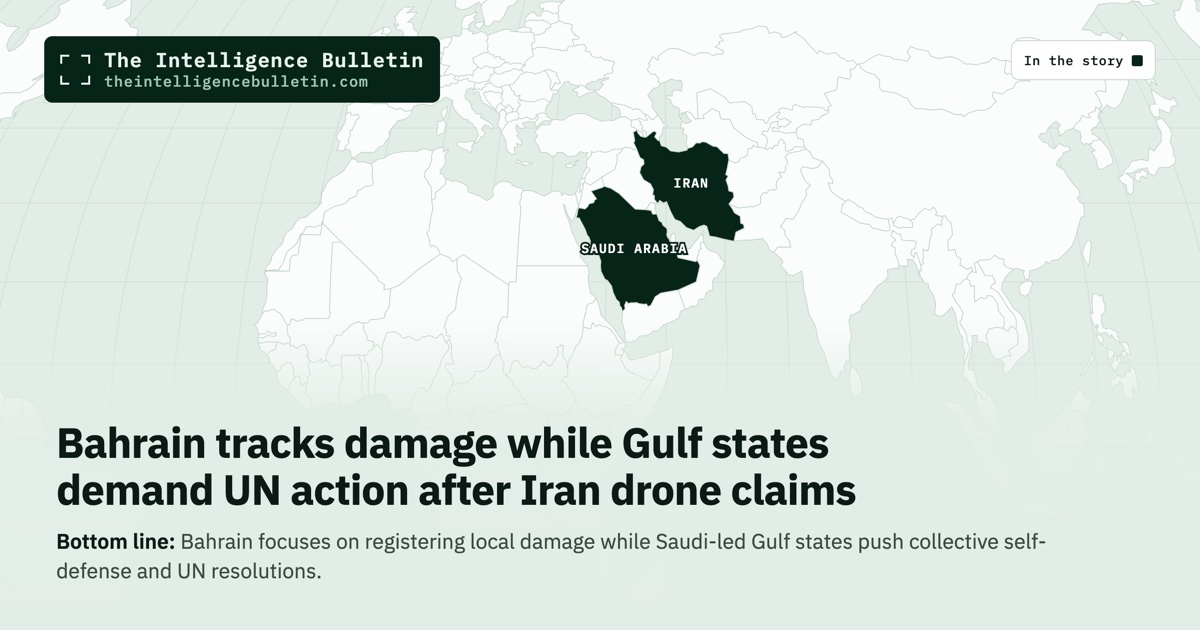
Map of the countries in the story: Bahrain tracks damage while Gulf states demand UN action after Iran drone claims
On July 24 2026 Iran’s military said it launched Arash kamikaze drones at US facilities including Isa Air Base in Bahrain. Bahrain reported intercepting aerial threats with explosions and sirens but no confirmed casualties. The United States offered no confirmation of targeting or damage. Gulf states and Jordan issued joint statements reaffirming self-defense rights while local Bahraini officials proposed registering civilian and infrastructure harm.

One Story. Many Angles.

🇧🇭
Bahrain
GDN Online
Bahrain News: Database to register damage by Iranian attacks proposed
Read →
🇸🇦
Saudi Arabia
Arab News
Gulf states, Jordan reaffirm right to self-defense against Iranian attacks
Read →
🇹🇷
Turkey
Anadolu Agency
Iranian army says it launched drone attacks on US military bases in Bahrain, Jordan
Read →
🇸🇾
Syria
SANA
Jordan downs Iranian drones as Bahrain thwarts aerial attacks
Read →
🇮🇱
Israel
Jewish News Syndicate
Iran claims renewed drone attacks on Jordan, Bahrain
Read →
In Brief

Bahrain focuses on registering local damage while Saudi-led Gulf states push collective self-defense and UN resolutions.

Bahrain’s GDN Online leads with a practical local proposal for a damage-registration database after intercepts, treating the strikes as an immediate civilian and infrastructure issue rather than a regional standoff. Arab News frames the same events as a collective GCC-Jordan sovereignty breach requiring a UN resolution and legal self-defense measures, emphasizing unified Gulf pushback against repeated attacks on energy and port facilities. Anadolu Agency sticks to a straight relay of the Iranian military statement without adding condemnation or defense details. SANA highlights Jordanian and Bahraini air defenses successfully neutralizing drones and missiles with no reported harm, underscoring operational readiness and formal protests to Tehran. JNS presents the claims through the lens of renewed threats to US-allied positions in the region. The pattern shows local impact reporting in Bahrain diverging from Gulf-wide diplomatic coordination in Saudi coverage and neutral claim-relaying in Turkish reporting, while Syrian and Israeli outlets stress either defensive successes or persistent Iranian pressure.

Perspective Analysis

Bahrain’s proposal for a national database to log civilian and infrastructure damage from recent intercepts reveals the core divergence in how states closest to Iranian drone strikes are responding compared with their regional partners: for Manama, the priority is immediate, granular recovery planning rather than collective diplomatic theater. On July 24, 2026, Bahrain’s GDN Online led with this administrative measure, framing the Iranian Arash kamikaze drone launches targeting U.S. facilities at Isa Air Base as a domestic incident requiring systematic documentation of any harm to homes, businesses, or public assets. This approach treats the explosions and air-raid sirens reported that day as a practical problem of debris, potential unexploded ordnance, and citizen reassurance, not primarily as another round in a regional power struggle.

The same events drew a sharply different emphasis from Saudi-based Arab News, which on July 23 described the strikes as part of a broader pattern of Iranian attacks on Bahrain, Kuwait, and Jordan. The outlet reported a joint GCC-Jordan statement calling for an urgent UN Security Council resolution to halt the assaults and explicitly reaffirming the right to self-defense under the UN Charter. It highlighted accusations that Tehran and its allies had targeted energy facilities, desalination plants, ports, and airports, framing these as violations of international law and a June ceasefire agreement with the United States. The coverage positioned the incidents within a wider Gulf effort to coordinate legal and diplomatic pushback, including support for Saudi Arabia against Houthi threats and Iraqi moves to centralize weapons control. Where Bahrain’s local reporting stayed grounded in damage registration, the Saudi-aligned account elevated the events to a sovereignty and collective-security crisis demanding international intervention.

Turkish state agency Anadolu Agency confined itself to a concise relay of the Iranian military’s announcement that it had launched drone attacks on U.S. bases in Bahrain and Jordan. Its July 24 dispatch carried no additional details on interceptions, no condemnation, and no mention of defensive successes or diplomatic fallout, presenting the claims as straightforward statements from Tehran. This neutral transmission contrasts with outlets that either stressed successful neutralization or the need for unified countermeasures, illustrating how a non-Gulf actor can cover the same Iranian assertion without endorsing or contesting the surrounding narratives of threat or resilience.

Syrian state media outlet SANA, reporting on July 21 but referencing the ongoing pattern, focused on the operational effectiveness of Jordanian and Bahraini air defenses. It detailed Jordan’s downing of five drones and three missiles with no casualties or material damage, noted Bahrain’s destruction of aerial threats, and recorded formal protests delivered to Iranian diplomats. The account underscored military readiness and engineering teams handling debris, while characterizing attacks on civilian areas as breaches of international humanitarian law. By foregrounding defensive successes and procedural responses, SANA aligned coverage with narratives of neighboring states maintaining control against Iranian actions, differing from both Bahrain’s damage-tracking initiative and the Gulf’s call for UN action.

The Jewish News Syndicate presented the Iranian claims as renewed pressure on U.S.-allied positions in Jordan and Bahrain, situating the drone launches within a longer sequence of threats to American assets and regional partners. Its reporting avoided local administrative measures or joint diplomatic statements, instead highlighting the persistence of Iranian targeting of facilities used by Washington’s allies. This framing underscores security concerns shared by Israel and the United States without dwelling on civilian recovery or GCC coordination.

These divergent emphases reflect real differences in stakes. Bahrain, directly experiencing sirens, intercepts, and the possibility of scattered debris near populated areas, has an immediate interest in cataloging harm for compensation, insurance, and future preparedness; a damage database serves that concrete need. Gulf states farther from the immediate flight paths, by contrast, see value in leveraging the incidents to rally international pressure and codify self-defense rights ahead of potential further escalation. Turkish neutrality keeps Ankara’s reporting usable across competing information environments, while Syrian and Israeli accounts each reinforce allied defensive narratives or persistent threat assessments suited to their respective audiences.

The United States has so far offered no confirmation of targeting or casualties at Isa Air Base, leaving open questions about the scale of any damage and the precise impact of Bahrain’s intercepts. Gulf statements reference violations of a June ceasefire, yet the continuation of strikes indicates that restraint remains fragile. Jordan’s protests and Bahrain’s civil-defense measures suggest frontline states are preparing for protracted low-level exchanges rather than assuming rapid de-escalation.

What to Watch

What follows will likely hinge on whether the damage-registration effort in Bahrain produces verifiable claims that feed into the GCC’s diplomatic push, or whether further Iranian actions prompt the self-defense measures the joint statement reserved. Energy infrastructure and commercial shipping remain exposed, and any perception that intercepts are only partially effective could accelerate calls for stronger external involvement. Readers tracking the story should watch not only for the next round of launches but for whether Manama’s database begins surfacing public tallies that either bolster or complicate the regional narrative of systematic attacks.


Share this story

Romanian alerts treat Odesa strikes as border threat; Greece sees blockade

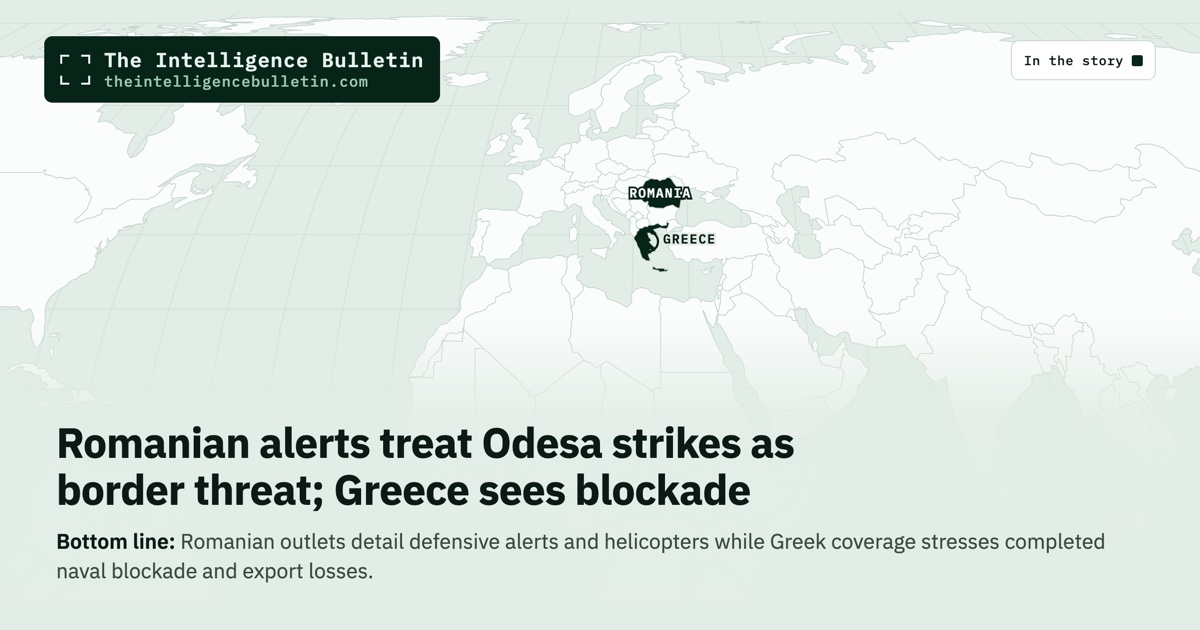
Map of the countries in the story: Romanian alerts treat Odesa strikes as border threat; Greece sees blockade
Russian forces launched drone and missile strikes on targets in Odesa Oblast, Ukraine, on July 23. Romanian radar detected drones about 33 km north of the Danube border and issued RO-Alert messages in Tulcea while launching a Puma helicopter. No drones entered Romanian airspace or caused impacts there. Ukrainian authorities reported at least two civilians wounded and damage to residential buildings in Odesa.

One Story. Many Angles.

🇷🇴
Romania
Digi24
ROMANIAN
Russian drones detected near Romania border, Air Force deploys Puma helicopter
“Drone rusești, detectate în apropiere de granița României. Forțele Aeriene au ridicat în aer un elicopter Puma”
Read →
🇷🇴
Romania
Stiripesurse
ROMANIAN
Massive Russian attack kilometers from Romania: drone and missile alerts in Odesa region
“Atac masiv al Rusiei la câțiva kilometri de România: Alerte de drone și rachete în regiunea Odesa”
Read →
🇷🇴
Romania
Romania Insider
Gas tanker bound for Ukraine attacked in Black Sea outside Romania’s waters
Read →
🇺🇦
Ukraine
Interfax-Ukraine
At least two wounded in Russian attack on Odesa – authorities
Read →
🇬🇷
Greece
Banking News
Incredible development: Zelensky admits Ukraine is under naval blockade, ‘no more ports’ as Russians hammer Odesa for 96 hours
Read →
In Brief

Romanian outlets detail defensive alerts and helicopters while Greek coverage stresses completed naval blockade and export losses.

Romanian coverage treats the strikes as a direct border-security test. Digi24 and Stiripesurse detail radar detections, the RO-Alert to Tulcea residents, and the Puma helicopter scramble, underscoring that nothing crossed into national airspace. Romania Insider instead highlights a separate July 20-21 LPG tanker fire in the Black Sea EEZ, linking it to Russian naval pressure on Ukraine-bound shipping. Ukrainian reporting from Interfax centers the human toll inside Odesa itself, naming two young civilians wounded and listing damaged homes and cars. Greek outlet Banking News widens the lens to a completed naval blockade, citing Zelensky on lost ports, Maersk’s withdrawal, and monthly export losses nearing $900 million. The pattern shows neighbors fixated on immediate spillover mechanics while the more distant outlet extracts the strategic economic consequence.

Perspective Analysis

Romanian media coverage of the July 23 Russian strikes on Odesa Oblast treats the attacks as a live test of national border security rather than a distant battlefield event. Radar detections 33 kilometers north of the Danube frontier, an RO-Alert issued to Tulcea residents, and the launch of a Puma helicopter to monitor the drones all received prominent play because they directly engaged Romanian systems and citizens. No drone crossed into national airspace and no impact occurred on Romanian soil, yet the reporting centers on these defensive steps as proof that the conflict’s edge has reached Romania’s immediate vicinity.

The facts align closely across the two main Romanian outlets that covered the incident. Radar operators registered the group of targets around 00:10 on July 24. The Ministry of National Defense confirmed the Puma helicopter took off at 00:48 for monitoring, and the RO-Alert went out at 00:56 before the air alert lifted at 01:33. Both accounts stress that allied structures received real-time updates and that nothing violated Romanian sovereignty. This emphasis on procedural response and non-violation reflects a domestic audience that now lives within range of stray munitions from strikes on nearby Ukrainian targets such as Vylkove and Tatarbunari.

A separate Romanian publication took a different cut by focusing on an LPG tanker fire in the Black Sea exclusive economic zone. The Gas Lisbon, bound for the Ukrainian port of Reni, caught fire after an attack roughly 30 to 37 kilometers from the Romanian coast on the night of July 20-21. Rescue vessels evacuated the 17 crew members, three of whom needed medical care for burns and injuries. The Romanian president linked the incident to Russia’s broader campaign against Ukrainian shipping. This angle shifts attention from the July 23 drone cluster to sustained maritime pressure on energy and grain routes that pass near Romanian waters.

Ukrainian reporting from the same strikes stayed inside Odesa itself. Authorities recorded at least two civilians wounded—a 17-year-old boy and a 23-year-old girl—plus damage to residential buildings, façades, glazing, and parked cars in the city center. A separate blast wave also affected a private home in the region. The account lists the human and material cost on Ukrainian territory without reference to cross-border detections or Romanian alerts.

Greek business coverage widens the frame to strategic consequence. It presents the sustained Russian strikes on Odesa ports over 96 hours as the completion of a de facto naval blockade, citing President Zelensky’s statement that no ships could dock the previous day. Maersk’s withdrawal from Black Sea routes and monthly export revenue losses estimated near 900 million dollars receive central billing. The outlet notes that four of 13 export terminals stopped purchases and that grain handling capacity dropped sharply, with ripple effects on Ukrainian farmers facing lower prices and on international traders considering alternative Danube or Romanian port routes.

These differences follow geography and audience. Outlets in Romania, directly adjacent to the strike zone, document the mechanical steps their own forces took to avoid spillover. Ukrainian wire services record the immediate casualties their readers experience. The more distant Greek business publication extracts the cumulative economic pressure on Ukrainian exports and the resulting market shifts that affect shipping and commodity flows across the wider region. The pattern is consistent rather than contradictory: proximity drives focus on defensive mechanics and local alerts, while distance allows emphasis on the war’s longer-term effect on trade corridors.

What to Watch

Romania’s repeated activation of RO-Alert systems and helicopter scrambles signals that future strikes near the Danube will continue to trigger national procedures even when no violation occurs. Greece and other Black Sea trading states will track whether sustained port degradation forces permanent rerouting of grain and container traffic, altering competitive positions for months or years. The immediate risk for border states remains accidental escalation from debris or misidentified targets; the wider risk for trading economies is the gradual closure of Ukraine’s maritime outlets and the resulting pressure on alternative routes through Romania and elsewhere.


Share this story