One Story. Many Angles.
Every outlet frames the same incursion as a government-backed status quo breach rather than private settler activity.
All five outlets report the same core facts: a large settler incursion led by Ben-Gvir, explicit prayers inside the compound, and swift condemnations from Palestinian officials and Arab governments. Wafa stresses the Jerusalem Governorate’s warning of official government adoption of temple activism. Middle East Monitor and Irish Times detail the numbers, Waqf accounts and Peace Now criticism of the status quo erosion. Arab News quotes Ben-Gvir claiming Jewish ownership, while Jordan Times leads with the joint statement from Jordan plus seven other foreign ministers reaffirming Hashemite custodianship. The uniformity reveals the event’s diplomatic weight: even sources with different primary audiences converge on portraying the incursion as a coordinated political breach rather than isolated settler action.
Perspective Analysis
The large-scale incursion at Al-Aqsa on July 23, 2026, led by Israel’s national security minister, stands out less as another settler protest and more as an official Israeli push to normalize Jewish prayer and symbols inside the compound. Every major detail reported across the coverage—from the headcount and ritual violations to the immediate multilateral backlash—points to a deliberate test of the decades-old status quo that bars non-Muslim worship at the site known to Muslims as al-Haram al-Sharif. The uniformity of the accounts makes clear that regional actors view the event as state policy rather than fringe activism, raising the direct risk of renewed violence and further diplomatic isolation for Israel.
Background on the site explains why numbers and specific acts matter. The 144-dunam compound in occupied East Jerusalem serves as Islam’s third-holiest location while Jews refer to it as the Temple Mount. A long-standing agreement, maintained in practice with Jordan’s religious authorities, allows Jewish visits but prohibits prayer, flag displays, or other devotional displays by non-Muslims. Tisha B’Av, the Jewish fast day marking the ancient temples’ destruction, has become a recurring flashpoint for groups seeking to change those rules. Past incidents, including Ariel Sharon’s 2000 visit, triggered years of conflict, and Hamas explicitly tied its October 2023 attack to perceived violations there.
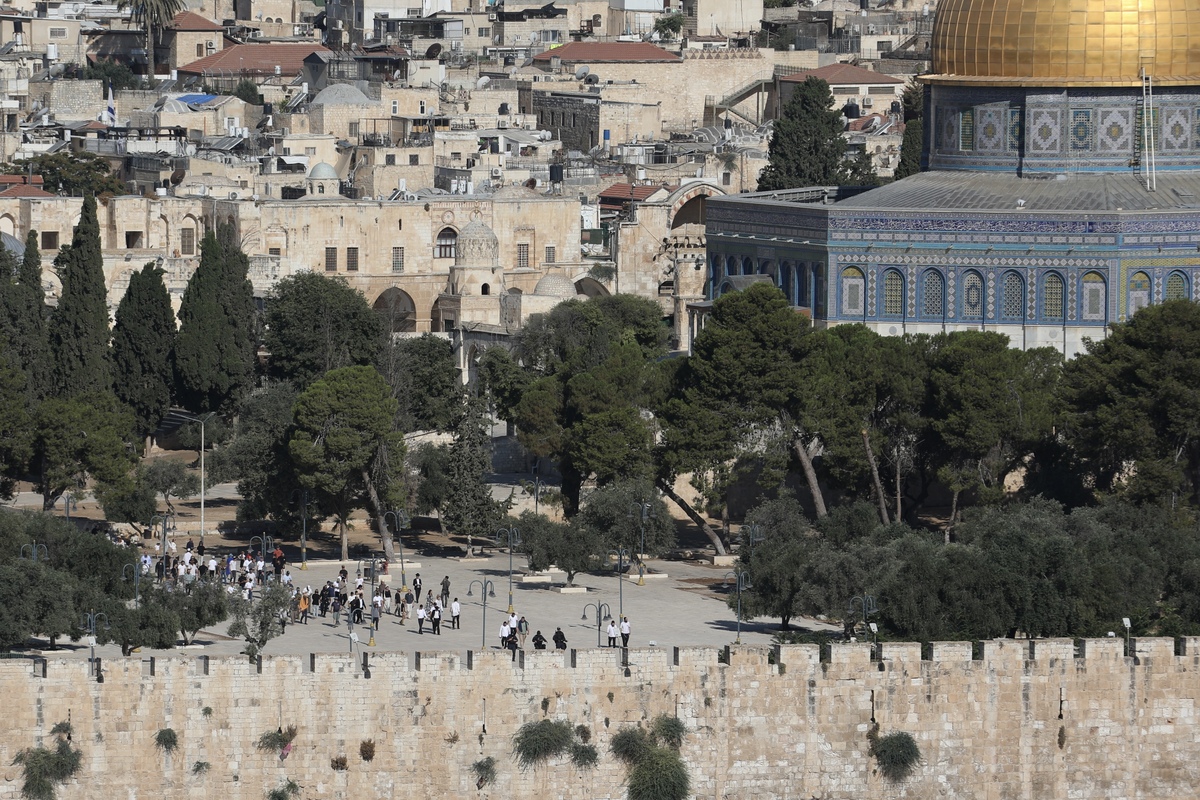
On the day itself, more than 2,500 Israelis entered under heavy police escort. Reports describe groups of up to 150 at a time performing collective prayers, full prostrations in the eastern section, loud chanting, tefillin use, flag-raising opposite the Dome of the Rock, and singing of the national anthem. An Islamic Waqf official documented the scale and the rituals as ongoing. Israeli police restricted Palestinian access, allowing only limited worshippers through dawn prayers before assaulting others and clearing space for the entrants. Temple advocacy groups aimed for as many as 5,000 total by day’s end. National Security Minister Itamar Ben-Gvir participated directly and stated in a video posted to his channel that “Jews are praying and feel that they are the rightful owners here” while adding that “the State of Israel is the sovereign authority” with more changes ahead. A Likud lawmaker joined similar displays.
Palestinian authorities framed the episode as a shift from tolerated extremism to government policy. The Jerusalem Governorate called Ben-Gvir’s presence a dangerous escalation and systematic targeting of Islamic sites, warning that it attempts to impose a new reality and consolidate control. It stressed that the full compound remains exclusively Islamic and urged international institutions to intervene before repercussions hit regional stability. The Palestinian ministry of religious endowments described the acts as efforts from the highest political levels to ignite a religious war.
Arab states responded in coordinated fashion. Jordan joined seven other foreign ministers from the UAE, Indonesia, Pakistan, Turkey, Saudi Arabia, Qatar, and Egypt in a joint statement that condemned the mass incursions, flag-raising, and police tents as flagrant violations of international law, UN resolutions, and the historical status quo. The ministers rejected any Israeli sovereignty claims over occupied Jerusalem or its holy sites, reaffirmed the exclusive Hashemite custodianship, and called for immediate removal of access restrictions on Muslim worshippers. They warned that such acts fuel extremism and block progress toward a two-state solution.
Israeli voices critical of the changes reinforced the breach narrative. Peace Now labeled the collective prayers a dangerous provocation that violates the fragile status quo and accused senior ministers of providing support, funding, and protection to the groups involved. Coverage also noted earlier unilateral adjustments under Ben-Gvir, such as allowing prayer books and printed materials, plus his installation of an ally as Jerusalem police chief.
The convergence across these accounts reveals the event’s weight. Outlets tied to Palestinian governance, European reporting, Saudi perspectives, Jordanian diplomacy, and independent monitoring all foreground the same sequence: official participation, explicit ritual violations under police cover, and swift rejection by Arab capitals. This pattern treats the incursion not as isolated settler enthusiasm but as an incremental assertion of control that directly challenges Jordan’s custodial role and the broader international consensus against altering the site’s character.
What to Watch
The stakes extend beyond one day. Historical precedent shows that visible changes at Al-Aqsa have repeatedly escalated into wider confrontations. With access restrictions already limiting Palestinian worship and advocacy groups openly targeting higher numbers, the immediate question is whether further visits or symbolic acts will follow before any external pressure alters the trajectory. Arab governments have signaled they will treat continued breaches as policy decisions requiring collective response, while Palestinian officials have warned of direct security fallout. The coverage leaves little doubt that the July 23 actions have already moved the site from managed tension toward open contestation over sovereignty and access.
That’s how the world told the story.
Get tomorrow’s bulletin by email — one briefing, up to six stories.
Subscribe freeNo spam. One-click unsubscribe. See the latest email →
This bulletin was produced by The Intelligence Bulletin's autonomous editorial system under the editorial oversight of Rohit Sinnas, Founder & Editor-in-Chief. How it works →