Starship test succeeds with first Starlink V3 satellites but one outlet flags pollution risk

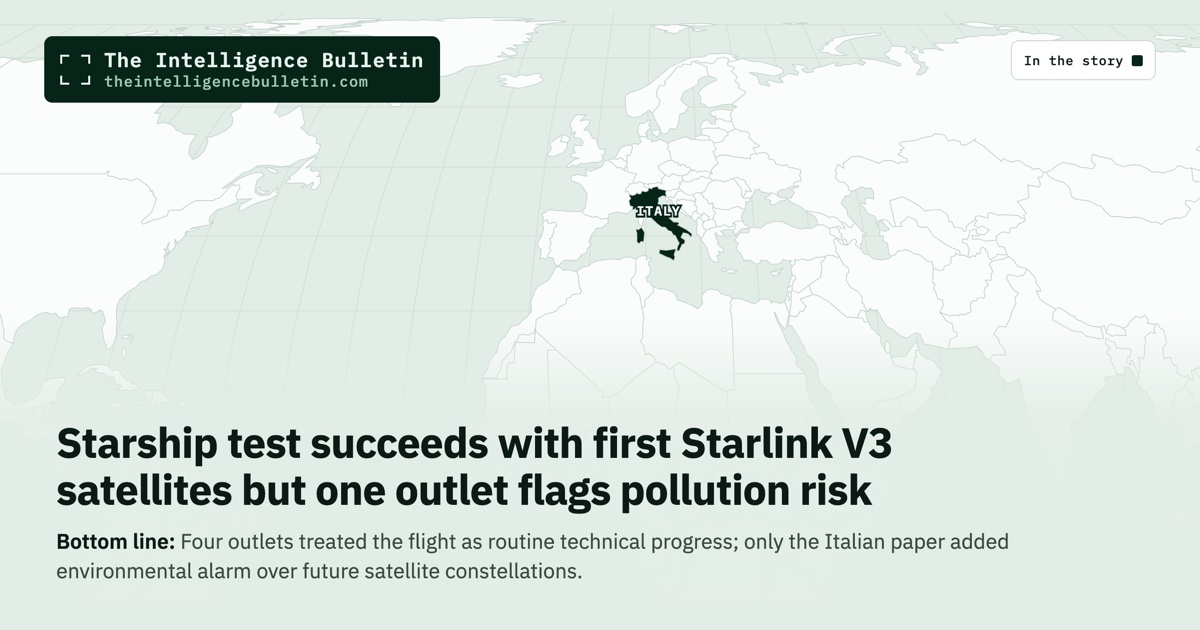
Map of the countries in the story: Starship test succeeds with first Starlink V3 satellites but one outlet flags pollution risk
On July 24 2026 SpaceX launched its Starship rocket from Starbase Texas on the 13th test flight. The Super Heavy booster and Starship upper stage separated successfully. The vehicle deployed 20 functional Starlink V3 satellites for the first time before both stages splashed down. The test advanced reusable heavy-lift and Starlink expansion plans.

One Story. Many Angles.

🇺🇸
United States
CNBC
SpaceX launches massive Starship rocket in first test flight since IPO
Read →
🇮🇹
Italy
Corriere della Sera
ITA
Starship V3 flight 13 is a success: SpaceX lunar missions and space data centers closer (but science is alarmed)
“Starship V3, il volo numero 13 è un successo: per Space X missioni lunari e data center nello spazio più vicini (ma la scienza è in allarme)”
Read →
🇵🇹
Portugal
Observador
SpaceX lança satélites com Starship pela primeira vez – Observador
Read →
🇳🇿
New Zealand
Radio New Zealand
SpaceX’s Starship rocket lifts off for 13th test flight
Read →
🇶🇦
Qatar
The Peninsula
SpaceX completes Starship’s 13th flight test | The Peninsula Qatar
Read →
In Brief

Four outlets treated the flight as routine technical progress; only the Italian paper added environmental alarm over future satellite constellations.

Coverage across five outlets converged tightly on the technical milestones of the July 24 flight: stage separation, the first deployment of operational Starlink V3 satellites, and intact splashdowns that gave new heat-shield data. CNBC framed the launch explicitly as SpaceX’s first major test since its June IPO, linking it to stock performance and the company’s push for rapid Starlink growth. The Italian Corriere della Sera matched that success narrative but inserted a distinct European caution, warning that plans for a million orbital data-center satellites could release pollutants into the stratosphere and damage the ozone layer. Observador in Portugal stressed the historic satellite deployment and the recovery of both modules, while RNZ and The Peninsula delivered straight technical summaries drawn from SpaceX statements and Xinhua wire copy. The near-unanimity on the engineering advance, rather than any national split, signals that the reusable-launch breakthrough itself now registers as shared global infrastructure news rather than a purely American corporate event.

Perspective Analysis

The July 24 launch of Starship demonstrated that fully reusable heavy-lift rockets have moved from experimental milestone to operational infrastructure, yet one outlet alone raised the prospect of stratospheric pollution from plans to orbit a million data-center satellites. That narrow divergence shows the engineering advance now registers as settled global fact rather than contested national achievement, while environmental questions remain secondary in most reporting.

SpaceX sent the 124-meter vehicle from Starbase, Texas, on its 13th integrated test flight. The Super Heavy booster separated cleanly two minutes after liftoff, and the upper stage deployed 20 operational Starlink V3 satellites roughly 18 minutes into the mission. Both stages reached the water intact enough to yield new heat-shield imagery: the booster in the Gulf of Mexico after a harder-than-planned landing burn, the upper stage in the Indian Ocean after a soft splashdown that kept it transmitting data. The satellites, built with larger solar arrays and laser links, followed the suborbital trajectory and reentered after about 20 minutes, some using onboard cameras to record the reentry environment.

One U.S. business outlet tied the flight directly to corporate performance. It noted the test was the first major attempt since SpaceX’s June IPO and linked investor interest in the rocket’s reusability to the company’s target of rapid Starlink growth. The piece also mentioned ongoing work on orbital data-center satellites under the Starmind label and quoted an industry analyst who said progress had been made but full rapid reusability remained distant. Stock price movement after the June offering was referenced as context for why markets watch each flight.

An Italian daily reported the same technical sequence but added a distinct layer. It described the intact Indian Ocean recovery as a first and noted the successful release of working V3 satellites. The account then turned to scientists’ concerns that repeated launches and reentries from constellations numbering up to a million satellites could release soot, aluminum oxides, and other compounds into the stratosphere. Those particles, the report stated, might accumulate at levels that damage the ozone layer or alter the climate in ways still poorly understood, citing a NOAA flight that had already detected metals in sulfuric-acid aerosols.

Portuguese coverage emphasized the operational firsts. It highlighted the deployment of functional satellites rather than mass simulators and the recovery of both stages as steps toward landing them on the launch tower’s mechanical arms in future flights. The account placed the test within the broader timeline of Starship development since 2023 and noted the version’s role in planned NASA lunar missions.

Two additional outlets carried shorter, wire-based accounts that stayed within the technical facts. One summarized liftoff, stage separation, satellite release, and splashdowns while noting plans for Starlink expansion and a NASA test flight next year. The other delivered a concise statement of completion, including the in-space engine relight and the suborbital satellite deployment.

Across these accounts the shared record is consistent: stage separation succeeded, the first operational V3 satellites flew, and both stages returned with usable data. The only sustained departure from that record appears in the single European piece that inserted atmospheric warnings. No other outlet in the set foregrounded those warnings or linked the flight to ozone or climate effects.

The pattern indicates that reusable heavy-lift performance has crossed a threshold where it is treated as shared infrastructure news rather than a U.S. corporate story alone. Financial implications surface where markets are the primary audience. Environmental caveats surface where outlets routinely cover both space programs and climate science. The rest of the coverage treats the engineering result as the main event.

What to Watch

What happens next depends on whether the data from this flight clears the path to orbital insertion and tower catches. If it does, the volume of launches required for large satellite constellations will rise sharply. The single outlet that flagged stratospheric risks has already connected those plans to regulatory petitions filed with the FCC. Other outlets have not yet done so. Readers therefore see a technical success whose downstream atmospheric consequences remain visible in only one corner of the coverage.
Share this story

US blockade shot on tanker meets Gulf maritime alerts and wider conflict links

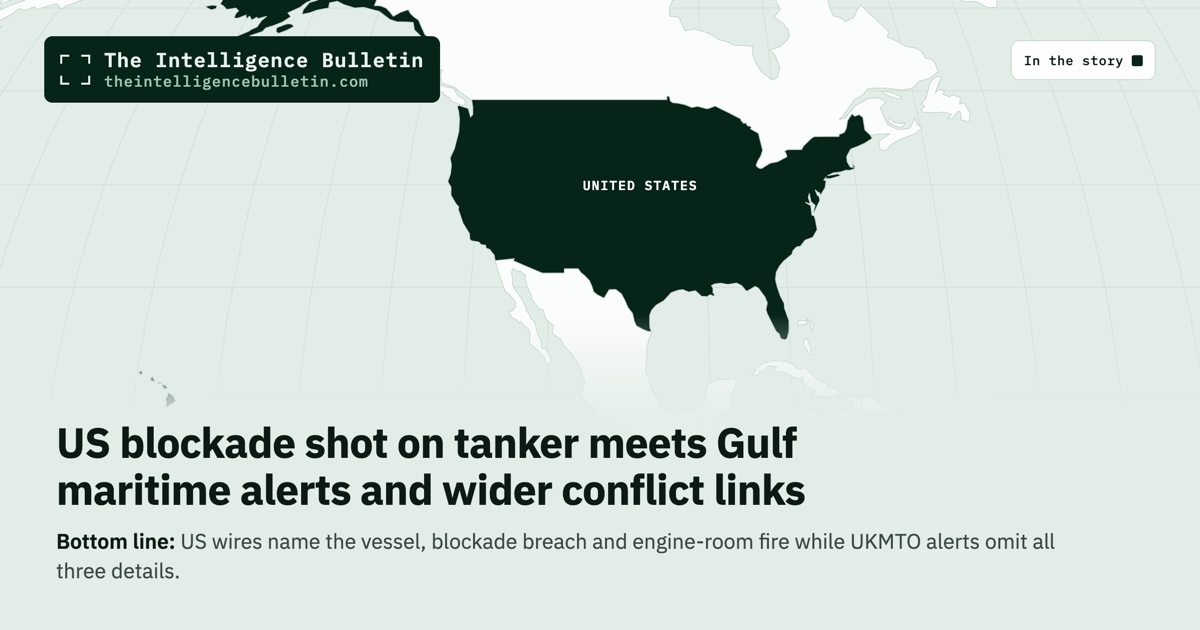
Map of the countries in the story: US blockade shot on tanker meets Gulf maritime alerts and wider conflict links
On July 24 2026 US forces fired on and disabled the merchant tanker MT Lavine in the Gulf of Oman after it attempted multiple times to breach the US blockade of Iranian ports. US Central Command said the vessel ignored warnings and fire was directed at its engine room with no fatalities reported. The incident unfolded amid wider US-Iran strikes and Saudi-Houthi exchanges in the region.

One Story. Many Angles.

🇺🇸
United States
29News
US military says it fired on another merchant vessel trying to breach blockade of Iranian ports
Read →
🇬🇧
United Kingdom
BBC
Saudi Arabia and Houthis trade fire as US fires on tanker in Hormuz Strait
Read →
🇬🇧
United Kingdom
Middle East Eye
UKMTO reports tanker ‘encounter’ with ‘military forces’ in Gulf of Oman
Read →
🇶🇦
Qatar
The Peninsula
UK maritime agency reports incident with ‘tanker and military forces’ in Gulf of Oman
Read →
🇮🇳
India
The Siasat Daily
United States military fires at merchant vessel near Iran
Read →
In Brief

US wires name the vessel, blockade breach and engine-room fire while UKMTO alerts omit all three details.

US-linked reporting from 29News and the Siasat Daily, both carrying the same AP wire, leads with official Central Command details: the Lavine ignored repeated warnings before shots hit its engine room to enforce the blockade. BBC alone folds the tanker incident into simultaneous Saudi-Houthi exchanges in the Hormuz area. Middle East Eye and The Peninsula, both UKMTO-focused, report only an unspecified “encounter” between a tanker and military forces, naming no country or vessel. The shared AP copy and the neutral maritime alerts reveal how outlets with direct US sourcing treat the event as enforcement while Gulf and UK shipping monitors keep it as an un-attributed safety alert.

Perspective Analysis

The pattern of reporting on the July 24 incident reveals how access to official U.S. sources produces a clear narrative of blockade enforcement, while reliance on neutral maritime alerts produces deliberate anonymity that shields the event from immediate attribution in a volatile shipping lane.

On that Friday, U.S. Central Command stated that forces disabled the merchant tanker MT Lavine in the Gulf of Oman after it attempted at least four times to run the American blockade of Iranian ports. Capt. Tim Hawkins, the command’s spokesman, told The Associated Press that the crew received repeated warnings yet failed to comply, prompting targeted fire into the engine room. No crew members were killed. The Lavine became the second commercial vessel disabled since the blockade’s reimposition, following an earlier July 15 strike on the Curacao-flagged tanker Belma.

This account appeared in near-identical form through the Associated Press wire carried by 29News and The Siasat Daily. Both outlets opened with the Central Command justification, noting the vessel’s repeated breach attempts and the engine-room strike as the direct means of enforcement. The reports placed the action inside a broader context of nightly U.S. strikes on Iranian targets and Iranian counterstrikes on American-linked bases in Iraq, Kuwait, and Bahrain. They also recorded Saudi coalition strikes on Hodeida in Yemen after Houthi attacks on Saudi tankers in the Red Sea, underscoring the interlocking fronts.

The BBC account alone embedded the tanker episode inside the same day’s Saudi-Houthi exchanges near the Hormuz Strait. Its headline and lead framed the U.S. action as one element within simultaneous regional firefights rather than a standalone enforcement measure. That editorial choice aligned the incident with the wider conflict map rather than isolating it as a U.S. naval operation.

In contrast, the United Kingdom Maritime Trade Operations advisory, reported by Middle East Eye and The Peninsula, described only an unspecified “encounter” between a tanker and military forces in the Gulf of Oman. The bulletins advised vessels to consult updated security information and remain alert, without naming the United States, the Lavine, or any blockade. Both outlets published the UKMTO language verbatim on July 25, foregrounding the safety alert while omitting the Central Command attribution that the AP accounts supplied.

The divergence stems directly from sourcing. Outlets publishing the AP dispatch drew on the explicit U.S. military explanation and therefore presented the shots as a measured response to repeated non-compliance. Outlets limited to the UKMTO circular had no such attribution and therefore reported an unattributed maritime incident. The Peninsula, published in Qatar, and Middle East Eye, based in London, both operate with strong regional shipping audiences; their choice to stay within the neutral alert language keeps the story inside the realm of routine navigation warnings rather than state-on-state naval action.

The stakes extend beyond the single vessel. The Strait of Hormuz carries roughly one-fifth of the world’s oil and gas in peacetime; its effective closure by Iranian attacks has already lifted Brent crude above $96 a barrel and U.S. gasoline averages to $4.11. The International Maritime Organization reported at least 6,000 mariners stranded on roughly 400 vessels around the strait, some abandoned by owners and lacking food, water, or medical care. Iranian Foreign Minister Abbas Araghchi publicly rejected additional mediators, insisting the United States must alter its position, while U.S. President Donald Trump described the negotiations as the most serious seen and stated he was in no hurry to end the fighting.

These details, carried in the AP-sourced reports, illustrate why the blockade enforcement framing matters. When outlets reproduce the Central Command account, readers encounter a sequence of warnings followed by precise disabling fire. When outlets stay with the UKMTO text, readers encounter only an undifferentiated military-tanker contact whose participants and purpose remain unspecified. The two versions are not contradictory on verifiable facts; they simply stop at different points on the chain of causation.

The same day’s Saudi-Houthi exchanges further complicate any narrow reading. Saudi strikes on Hodeida and Kamaran Island followed Houthi targeting of Saudi oil tankers in the Red Sea, reopening a front that had been quiet for years. The BBC’s linkage of these events with the Lavine incident therefore reflects an accurate simultaneity, even if the AP accounts treated the tanker action as a discrete U.S. naval measure.

What to Watch

Absent new diplomatic movement, the next likely development is continued testing of the blockade by additional merchant vessels. Central Command has already redirected twelve ships since reimposing the measure. Each new attempt will generate fresh UKMTO alerts and, if the pattern holds, fresh AP-sourced accounts of warnings ignored. Shipping companies and insurers will continue to price the risk into routes around the strait, sustaining elevated energy prices and the stranding of crews. The divergence in coverage will persist so long as some outlets maintain direct lines to U.S. Central Command while others limit themselves to the anonymous maritime advisories that do not assign responsibility.


Share this story

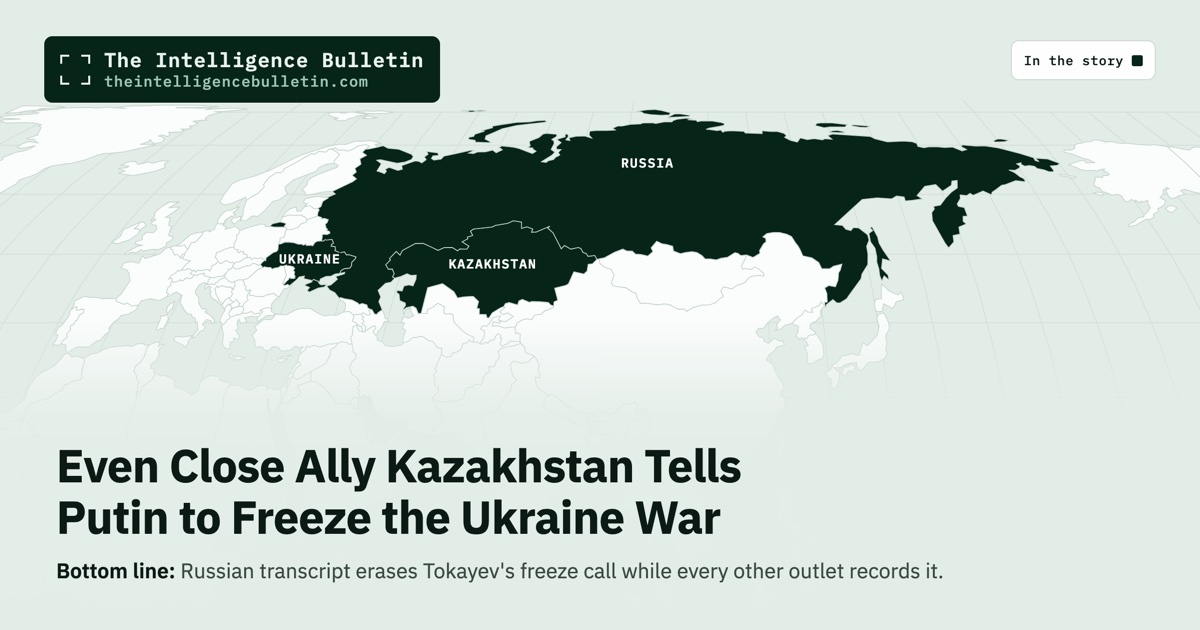
Even Close Ally Kazakhstan Tells Putin to Freeze the Ukraine War

Map of the countries in the story: Even Close Ally Kazakhstan Tells Putin to Freeze the Ukraine War
On July 25 2026 in Omsk, Kazakh President Kassym-Jomart Tokayev urged Russian President Vladimir Putin to freeze the Ukraine conflict, return to the Istanbul agreements and stop the deaths of young Russians and Ukrainians. He framed it as serving neither side’s interests and ruled out Kazakhstan as mediator. The Kremlin transcript omitted the Ukraine remarks entirely while other outlets reported them with varying emphasis on alliance ties, rejection or diplomatic optics.

One Story. Many Angles.

🇷🇺
Russia
Kremlin.ru
Meeting with President of Kazakhstan Kassym-Jomart Tokayev
Read →
🇰🇿
Kazakhstan
The Astana Times
Tokayev and Putin Discuss Ukraine, Nuclear Energy and Strategic Partnership in Omsk
Read →
🇺🇦
Ukraine
Kyiv Post
Kazakhstan’s Tokayev Urges Putin to Freeze Ukraine War
Read →
🇹🇷
Turkey
Anadolu Agency
Russia says Kazakh proposal to ‘freeze’ Ukraine war impossible due to Kyiv’s position
Read →
🇸🇬
Singapore
The Straits Times
Speaking alongside Putin, Kazakh president calls for freeze of Ukraine war
Read →
In Brief

Russian transcript erases Tokayev’s freeze call while every other outlet records it.

The Kremlin record of the Omsk meeting contains no trace of Tokayev’s Ukraine proposal, presenting only economic and nuclear cooperation. The Astana Times quotes Tokayev at length on freezing the conflict and returning to Istanbul 2.0 but immediately balances it with affirmations of strategic partnership and $28 billion trade. Kyiv Post leads with the call as a direct challenge and notes Tokayev’s contrast with clearer historical disputes. Anadolu Agency foregrounds Russia’s swift rebuttal that Kyiv’s position makes any freeze impossible. Straits Times highlights the awkwardness of Tokayev speaking the words while seated beside Putin. The pattern shows a close post-Soviet ally testing the limits of public criticism while Moscow simply erases the moment and regional outlets register either the rebuke, the refusal or the optics.

Perspective Analysis

Even a close post-Soviet ally has now voiced in public what Moscow will not allow into its own record: that the Ukraine war should be frozen and negotiations revived on the basis of the earlier Istanbul talks. The July 25, 2026 meeting in Omsk between Kazakh President Kassym-Jomart Tokayev and Russian President Vladimir Putin exposed the limits of alliance loyalty under sustained conflict. Tokayev explicitly called for halting the fighting, returning to the Istanbul agreements that produced some results in 2022, and ending the deaths of young Russians and Ukrainians. He framed continuation as serving neither side and explicitly ruled out Kazakhstan acting as mediator. The Kremlin’s official transcript of the session recorded none of it, listing only economic cooperation, nuclear projects, and trade volumes nearing $28 billion. That selective silence is the clearest signal of what the Russian leadership considers tolerable speech from a dependent partner.

Kazakhstan’s economy remains tightly linked to Russia through investment, energy infrastructure, and joint industrial projects. Tokayev’s own remarks in Omsk balanced the freeze proposal with repeated affirmations of strategic partnership and allied relations that would continue “no matter how difficult the circumstances.” Trade figures and a new nuclear power plant project near Lake Balkhash were presented as evidence of deepening practical ties rather than political rupture. The emphasis on resilience in bilateral relations despite external pressures reflects Astana’s calculation that economic interdependence still outweighs the costs of occasional public divergence. Yet the very fact that Tokayev chose to speak on Ukraine while seated beside Putin indicates that the war’s duration has begun to test even those calculations inside the ruling elite.

The Russian response, delivered outside the Omsk transcript, dismissed the freeze idea outright as impossible because of Kyiv’s position. This rebuttal treats any pause as equivalent to Ukrainian capitulation on core demands, preserving the narrative that only battlefield outcomes or maximalist terms can end the fighting. By rejecting the proposal without engaging its substance, Moscow signals that allied suggestions for de-escalation carry no operational weight. The contrast between the erased Kremlin record and the swift external rebuttal shows how the Russian side manages both internal narrative control and external messaging: dissent is omitted at the source, then countered when it surfaces elsewhere.

Other reporting underscored the diplomatic theater itself. Tokayev delivered the remarks in a public forum setting directly alongside Putin, making the intervention impossible to ignore in real time. He contrasted the Ukraine conflict with clearer historical disputes such as those between Azerbaijan and Armenia, noting that its nature remains poorly understood even inside Kazakhstan. References to Putin’s earlier “political flexibility” in 2025 Anchorage talks with the United States added a layer of attempted face-saving, but the core message remained a call to stop the bloodshed because it benefits only the adversaries of both Russia and Ukraine. These elements together portray a partner attempting to register concern without crossing into outright opposition.

The pattern of coverage reveals more than routine diplomatic friction. A state whose security and economic architecture still depends on Russian goodwill felt compelled to place a freeze proposal on the record in Putin’s presence. Moscow responded by simply deleting the episode from its authoritative account while rejecting the substance through other channels. This combination allows Russia to project unbroken alliance unity to domestic and sympathetic audiences while the underlying dependence of partners like Kazakhstan continues to generate pressure for an exit ramp. The economic numbers cited in Kazakh reporting—nearly $28 billion in trade, tens of billions in joint projects, and Russia as the largest investor—demonstrate why outright rupture remains unlikely. Yet the willingness to voice the freeze idea publicly suggests that the costs of indefinite support are rising even for the most integrated neighbors.

What to Watch

What happens next hinges on whether similar signals accumulate. If additional post-Soviet capitals begin echoing the call for a negotiated pause, Russia’s ability to sustain the current level of operations without visible alliance erosion will diminish. For now, the Omsk episode shows Moscow still possesses the institutional tools to neutralize one ally’s dissent. The longer the war drags on without decisive gains, however, the more such interventions are likely to recur, each one testing the cohesion that the Kremlin transcript works hardest to preserve. Readers tracking the conflict should watch not for dramatic breaks but for the steady accumulation of these public nudges and the consistent Russian effort to render them invisible.


Share this story

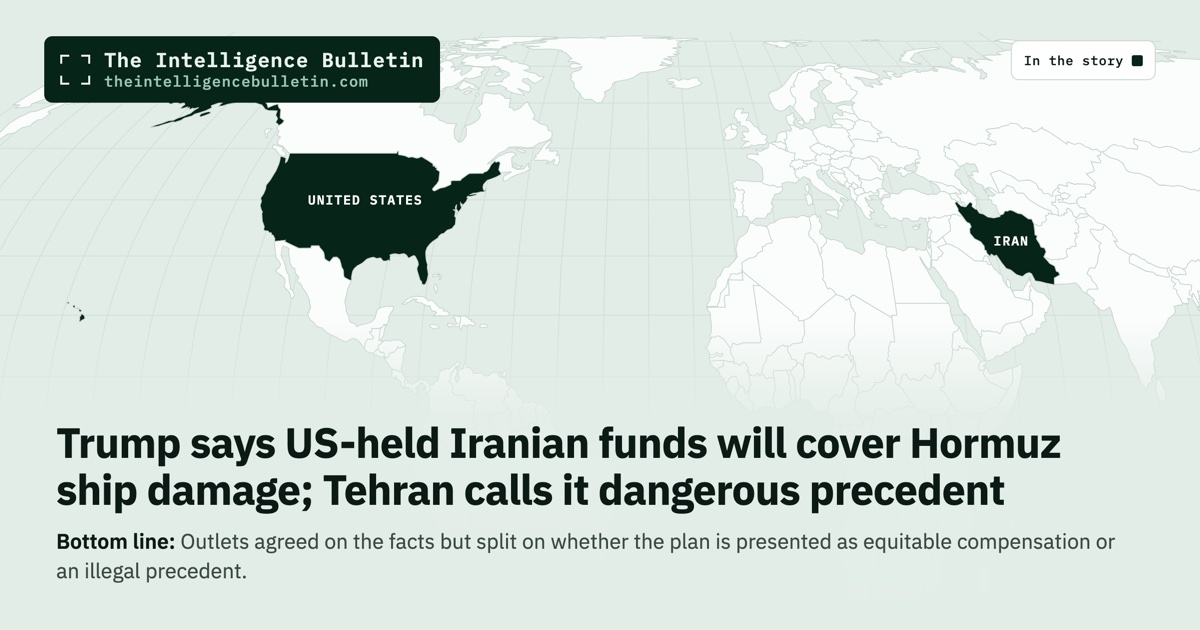
Trump says US-held Iranian funds will cover Hormuz ship damage; Tehran calls it dangerous precedent

Map of the countries in the story: Trump says US-held Iranian funds will cover Hormuz ship damage; Tehran calls it dangerous precedent
On July 23, 2026, President Trump posted on Truth Social that damages to ships or cargo in the Strait of Hormuz would be paid from Iranian funds held by the United States. He called the step fair and equitable after a ceasefire collapsed and attacks resumed. Iranian Foreign Minister Araghchi condemned the plan as an incendiary precedent that undermines norms. The announcement revives questions over roughly $100 billion in blocked assets amid ongoing US-Iran tensions.

One Story. Many Angles.

🇺🇸
United States
Washington Examiner
Trump says Iranian money in US possession will pay for ship damage
Read →
🇮🇷
Iran
Iran Herald
“Incendiary precedent”: Araghchi slams Trump over US plan to use Iranian assets for ship damage payments
Read →
🇹🇷
Turkey
Anadolu Agency
Iran warns Trump’s plan to use frozen assets to cover damage to ships in Hormuz sets dangerous precedent
Read →
🇦🇺
Australia
Sky News Australia
United States to use Iranian money to pay for damaged ships and cargo, President Trump says
Read →
🇮🇳
India
Free Press Journal
‘Fair & Equitable’: President Donald Trump Says US Will Use Frozen Iranian Funds To Pay For ‘Any & All’ Damage To Ships, Cargo
Read →
In Brief

Outlets agreed on the facts but split on whether the plan is presented as equitable compensation or an illegal precedent.

US and Indian outlets quoted Trump’s exact language that the measure is “fair and equitable,” treating the move as a direct policy response to resumed shipping attacks. Turkish coverage instead foregrounded Tehran’s warning of a dangerous precedent, while an Indian wire service piece centered Iranian Foreign Minister Araghchi’s condemnation of asset confiscation. The limited set of reports shows broad agreement on the core facts of Trump’s statement and Araghchi’s reply, with divergence mainly in headline emphasis rather than omission of either side. This pattern reveals that outlets covering the event as a straightforward asset-use announcement still carried the Iranian rebuttal, underscoring how the concrete mechanism Trump proposed quickly drew counter-claims about international norms even in non-Middle East reporting.

Perspective Analysis

President Donald Trump’s July 23 announcement that the United States will draw on Iranian assets it controls to cover any damages to ships or cargo in the Strait of Hormuz reveals a concrete escalation in the financial dimension of the renewed U.S.-Iran conflict. The proposal ties blocked funds directly to maritime incidents at a moment when a short-lived ceasefire has already collapsed and attacks on commercial traffic have resumed. What stands out across the reporting is not partisan divergence but the speed with which every major account of the plan incorporated Tehran’s objection that the step sets an “incendiary precedent” for asset security worldwide. This pattern shows that even coverage focused on the practical mechanics of retaliation still treated the Iranian warning about eroded international norms as inseparable from the announcement itself.

The immediate context is the breakdown of the June memorandum of understanding. Under that accord, Washington had signaled it would release roughly $24 billion in restricted Iranian funds if Tehran accepted terms for a lasting halt to hostilities. Iranian forces began targeting vessels transiting the Strait of Hormuz after the agreement frayed, prompting U.S. strikes and Trump’s declaration that the ceasefire was finished. Trump’s Truth Social post then stated that “any and all damages done to Ships, Cargo, or anything related thereto, will be paid for by Iranian Money that the United States has in its possession, and controls.” He added that the damages “may be very substantial but, nevertheless, this is the fair and equitable thing to do.” The language positioned the measure as a direct response to resumed shipping attacks rather than a new policy innovation.

Iranian Foreign Minister Seyed Abbas Araghchi replied the next day on X that “seizing another nation’s assets to pay for unrelated future claims is an incendiary precedent.” He warned that once governments normalize confiscation, “no one’s assets are safe” and the resulting chaos “will not be pretty or peaceful.” Reports quoting this exchange noted that estimates of Iran’s total blocked assets worldwide range from $100 billion to as high as $124–167 billion, depending on the accounting of holdings across multiple jurisdictions. The minister’s statement framed the U.S. plan as an attack on the broader principle that sovereign assets should remain insulated from third-party claims.

Coverage that led with Trump’s wording still carried Araghchi’s full rebuttal. Accounts centered on the White House statement placed the proposal inside the Hormuz tensions and the collapsed ceasefire, yet they reproduced the Iranian foreign minister’s language about precedent without softening or omitting it. Indian English-language reporting adopted the president’s “fair and equitable” phrasing in headlines while immediately noting Araghchi’s condemnation of asset confiscation. Turkish state-linked coverage foregrounded the precedent warning as the central development, treating the U.S. asset-use claim as the trigger for a regional stability risk rather than the main story. In each case the factual core—Trump’s exact post and Araghchi’s reply—remained consistent; the variation lay only in which sentence received the headline emphasis.

This uniformity matters because the mechanism Trump described is not abstract. It converts already-blocked funds into an automatic compensation pool for future incidents, bypassing any new legislative or judicial process. The move therefore tests how far the United States can unilaterally repurpose sovereign assets held inside its financial system without triggering wider legal challenges from other governments that also maintain blocked accounts. Araghchi’s warning that “those who celebrate or profit from such funds should remember” the precedent is aimed precisely at this broader audience of central banks and sovereign wealth funds.

The reporting pattern indicates that outlets treating the announcement as a straightforward policy response still viewed the Iranian counter-claim as newsworthy rather than peripheral. No major account examined here simply reported the U.S. side and stopped. The inclusion of the precedent argument even in non-Middle East focused pieces suggests that the concrete financial step quickly exposed a fault line over norms that editors judged readers needed to see. The accounts closest to the raw record are those that quoted both statements in full and situated them against the collapsed ceasefire and the roughly $100 billion in contested assets; they avoided both endorsement of the “fair and equitable” framing and unsubstantiated assertions that the plan would immediately unravel global finance. Those that reduced the story to one headline phrase while still including the rebuttal performed the same service in shorter form.

What to Watch

What happens next is likely to turn on whether any new shipping incidents actually produce claims against the frozen funds and whether other governments respond with parallel legal or financial countermeasures. The precedent concern is already on record in multiple outlets; any attempt to execute the compensation mechanism will therefore face immediate scrutiny on both the maritime and the asset-security fronts. Readers tracking global trade routes and sovereign finance should watch whether the $100 billion figure becomes an active ledger item rather than a static estimate, because that shift would mark the first sustained use of blocked Iranian holdings as an operational tool in the current round of hostilities.


Share this story

Brazil calls US forced-labor tariffs baseless and readies retaliation law plus WTO case

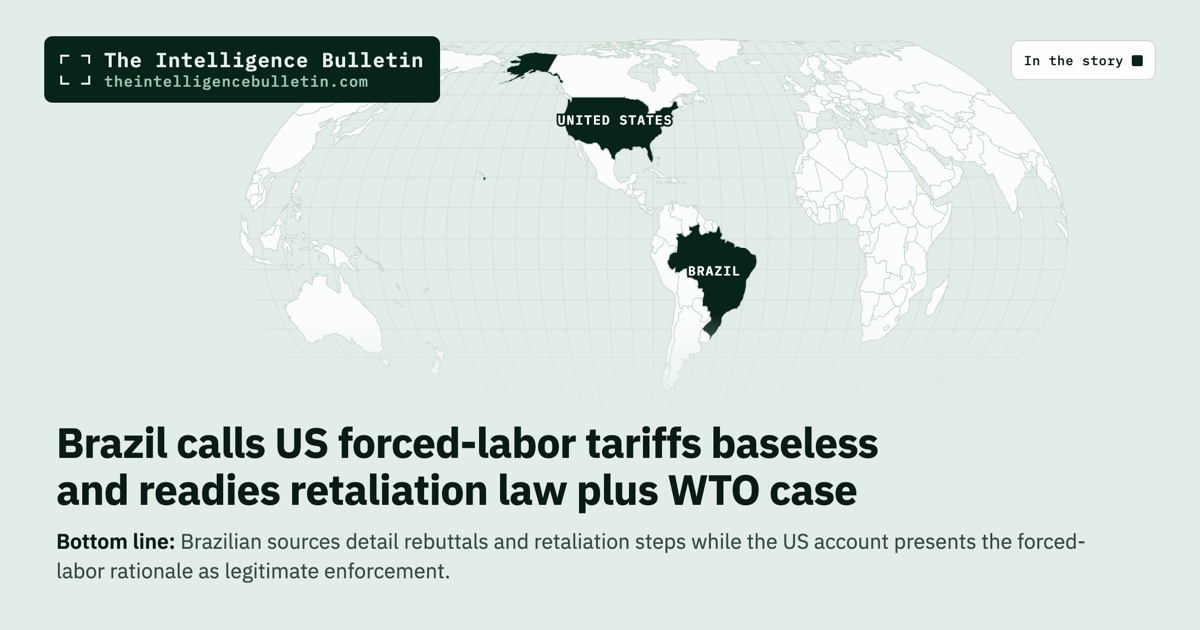
Map of the countries in the story: Brazil calls US forced-labor tariffs baseless and readies retaliation law plus WTO case
On July 23, 2026, the US imposed 10-12.5 percent Section 301 tariffs on imports from about 60 countries, citing inadequate enforcement against goods made with forced labor. The levies replace expiring 10 percent duties and can push some Brazilian products to 37.5 percent total duties. Brazil’s government rejected the claims, citing its 66 ILO conventions versus the US’s 10, and announced immediate steps under its Economic Reciprocity Law plus a WTO dispute. Coverage across Brazilian, US and Saudi outlets agrees on these core facts and Brazil’s planned response.

One Story. Many Angles.

🇧🇷
Brazil
Agência Gov
PORTUGUESE
Brazilian government rejects US allegations for imposing new tariff
“Governo brasileiro rechaça alegações dos EUA para impor nova tarifa”
Read →
🇧🇷
Brazil
G1
PORTUGUESE
Tariff hike: minister calls 12.5% duty ‘undue’ and based on unreal facts
“Tarifaço: ministro diz que tarifa de 12,5% é ‘indevida’ e baseada em fatos que não são reais”
Read →
🇧🇷
Brazil
Conjur
PORTUGUESE
Brazil will trigger Reciprocity Law and WTO against the US
“Brasil vai acionar Lei de Reciprocidade e OMC contra os EUA”
Read →
🇺🇸
United States
NBC Connecticut
Trump imposes double-digit tariffs on dozens of countries – NBC Connecticut
Read →
🇸🇦
Saudi Arabia
Arab News
Trump’s new tariffs draw global backlash, with Brazil threatening WTO action
Read →
In Brief

Brazilian sources detail rebuttals and retaliation steps while the US account presents the forced-labor rationale as legitimate enforcement.

Brazilian reporting treats the US justification as a transparent excuse for protectionism. Agência Gov’s official note hammers the disparity in ILO ratifications and Brazil’s domestic enforcement tools, then states the government will trigger reciprocity measures and file at the WTO. G1 adds the minister’s blunt verdict that the 12.5 percent tariff rests on facts that are not real and notes the cumulative hit to 37.5 percent on footwear, machinery and chemicals while stressing negotiation remains the priority. Conjur focuses on the procedural path: the reciprocity law passed unanimously by Congress and the WTO filing. The NBC Connecticut wire, drawing on AP, leads with the US rationale, quotes the trade representative on correcting human-rights abuse and trade distortion, lists exemptions, and records Brazil’s rebuttal only after laying out the American position. Arab News widens the lens to global backlash, quoting Australia calling the tariffs senseless and detailing Brazil’s retaliation vow alongside reactions from Mexico and Canada. The pattern shows targeted nations foreground factual rebuttal and legal countermeasures; the US account presents enforcement intent first; the Saudi outlet records the international pushback without endorsing either side’s legal claim.

Perspective Analysis

The US tariffs on Brazilian goods, justified by Washington as a necessary correction for forced-labor abuses in global supply chains, expose instead a calculated expansion of protectionist policy that strains the credibility of multilateral trade rules and invites direct countermeasures from affected economies. Brazil’s swift rejection and planned legal retaliation underscore how such measures risk fragmenting alliances and raising costs for American importers and consumers alike, at a moment when the administration seeks to rebuild domestic manufacturing ahead of midterm elections.

On July 23, 2026, the United States applied new duties ranging from 10 to 12.5 percent on imports from roughly 60 countries under Section 301 of the Trade Act of 1974. These replaced expiring temporary worldwide levies and targeted nations Washington accused of inadequate enforcement against goods made with forced labor. For Brazil the additional rate reached 12.5 percent on many items, stacking atop an earlier 25 percent tariff and pushing total duties as high as 37.5 percent on footwear, machinery, equipment, apparel and certain chemicals. Exemptions covered more than 2,000 products, including oil, gas and fertilizer, yet the cumulative burden on core export sectors remained substantial.

Brazilian authorities responded within hours by dismissing the forced-labor rationale as baseless. The government noted that Brazil has ratified 66 International Labour Organization conventions in force, including all four core instruments on forced labor, while the United States has ratified only ten conventions overall and just one of those specific instruments. Officials emphasized Brazil’s domestic tools, such as criminal penalties for exhaustive workdays and degrading conditions, a “dirty list” of offending employers, and commitments embedded in free-trade agreements with Chile, the European Union and the European Free Trade Association. They described the US action as an attempt to cloak protectionism in human-rights language after lacking sufficient domestic legal grounds for the policy.

The minister of Development, Industry and Commerce stated plainly that the 12.5 percent tariff rested on facts that were not real and called it indevida, or undue. He stressed that roughly 2,000 Brazilian products exported to the United States would escape both the new and prior tariffs, yet lamented the double taxation hitting key industries. While acknowledging the reciprocity law as an available instrument passed unanimously by Congress, the minister made clear that the primary objective remained negotiation to remove the duties, which he termed extremely unjust and highly damaging.

Legal specialists in Brazil focused on the procedural path forward. The government announced it would immediately activate mechanisms under the Economic Reciprocity Law and file a formal challenge at the World Trade Organization’s dispute-settlement body. The move was framed as a direct response to what officials called an arbitrary and unjustified unilateral measure incompatible with international trade rules. The law, enacted in 2025, provides for retaliatory steps without requiring further congressional approval in many cases, giving Brasília a rapid-response option even as WTO proceedings typically unfold over years.

American reporting presented the tariffs first as enforcement of a longstanding forced-labor import ban in place for nearly a century. The US Trade Representative described the action as correcting both a human-rights abuse and a distortive trade practice that disadvantages American workers. The account noted that some countries had adjusted policies during the investigation to qualify for the lower 10 percent rate, while others, including Brazil, remained at 12.5 percent. Brazil’s rebuttal and retaliation plans appeared only after the US rationale and details on exemptions were laid out. Critics within the United States, including the ranking Democrat on the House Ways and Means Committee, warned that forced labor should not serve as pretext for a tariff regime built on dubious legal theories.

International coverage from outside the principal actors captured the breadth of pushback. Australia labeled the tariffs senseless. Mexico reported that most of its exports would continue under USMCA preferences with little effective change. Canada indicated readiness to respond to separate tariff threats while continuing engagement. These reactions illustrated how the measure, though aimed at dozens of economies, produced coordinated skepticism about the forced-labor premise and heightened expectations of tit-for-tat measures or legal challenges.

The divergence in emphasis across these accounts reveals a core contest over legitimacy. Targeted governments treat the justification as secondary to the economic impact and the precedent it sets for unilateral action. The administering government centers its own enforcement record and the policy’s stated goals. An external aggregator records the resulting diplomatic friction without adjudicating the underlying claim. This pattern suggests that future trade disputes will increasingly hinge on whether multilateral forums can constrain such measures or whether bilateral retaliation becomes the dominant response.

Brazil’s dual-track approach—immediate reciprocity preparations paired with a WTO filing—signals both resolve and restraint. The reciprocity law allows calibrated countermeasures that could target US exports in politically sensitive sectors, yet officials have signaled preference for talks. A successful WTO case would require demonstrating that the Section 301 findings lack sufficient foundation, a high evidentiary bar given the statute’s broad language on unreasonable practices. Even a symbolic victory could strengthen Brazil’s negotiating position and encourage other affected countries to coordinate.

The stakes extend beyond the immediate tariff lines. Higher duties raise input costs for US manufacturers reliant on Brazilian components and footwear, potentially feeding into consumer prices at a time of lingering cost-of-living concerns. Retaliatory steps risk disrupting agricultural and industrial exports from the United States, while prolonged legal proceedings could chill investment planning across supply chains. If other nations follow Brazil’s example of formal challenges and reciprocity statutes, the result could be a more fragmented trading system in which enforcement of labor standards becomes entangled with raw power politics rather than cooperative standards.

What to Watch

Negotiations remain the most probable near-term path, given Brazil’s explicit prioritization of dialogue and the administration’s history of using tariff threats as leverage. Yet the underlying disagreement over whether forced-labor concerns justify broad tariff overlays will persist, testing whether international institutions can mediate or whether economic nationalism continues to redefine the rules of engagement. Readers should watch for the first concrete steps under Brazil’s reciprocity law and any US offers of exemptions or side agreements, as those moves will indicate whether the dispute de-escalates or widens into sustained trade friction with measurable effects on global commerce.


Share this story

Venezuela starts ICC exit citing bias as prosecutor is removed

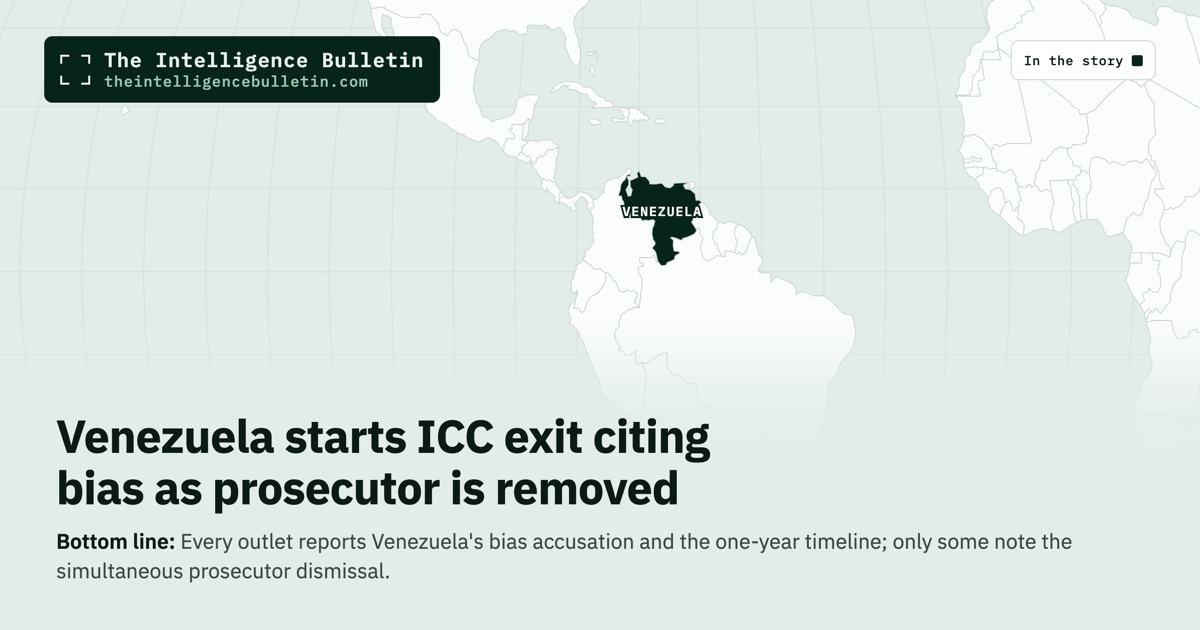
Map of the countries in the story: Venezuela starts ICC exit citing bias as prosecutor is removed
On 24 July 2026 Venezuela’s Foreign Minister Félix Plasencia notified UN Secretary-General António Guterres that the country had begun its formal withdrawal from the International Criminal Court by denouncing the Rome Statute. Acting President Delcy Rodríguez directed the move. Caracas accused the ICC of geographic bias that disproportionately targets African and Latin American states. The withdrawal takes effect one year after notification.

One Story. Many Angles.

🇹🇷
Turkey
Anadolu Agency
Venezuela notifies UN of start of permanent withdrawal from International Criminal Court
Read →
🇦🇹
Austria
Kurier
DEU
Bias: Venezuela leaves International Criminal Court
“„Voreingenommenheit“: Venezuela verlässt Internationalen Strafgerichtshof”
Read →
🇮🇩
Indonesia
Kompas
IND
Venezuela exits ICC, accuses international court of bias
“Venezuela Keluar dari ICC, Tuding Mahkamah Internasional Bersikap Bias”
Read →
🇨🇱
Chile
La Tercera
SPA
Venezuela formally notifies withdrawal from Rome Statute and begins definitive exit from the International Criminal Court
“Venezuela notifica formalmente su retirada del Estatuto de Roma e inicia su salida “definitiva” de la Corte Penal Internacional”
Read →
🇳🇬
Nigeria
Daily Post
Venezuela to exit ICC as member states remove prosecutor
Read →
In Brief

Every outlet reports Venezuela’s bias accusation and the one-year timeline; only some note the simultaneous prosecutor dismissal.

All five outlets report the same core announcement without contradiction: Venezuela is leaving the ICC and blames bias against the Global South. The Turkish wire stays closest to the diplomatic notification language. Austria’s Kurier and Chile’s La Tercera foreground the bias claim while adding Amnesty International’s warning that withdrawal does not erase past obligations. Indonesia’s Kompas and Nigeria’s Daily Post both note the coincidence with member states voting to remove prosecutor Karim Khan the same day, an institutional angle the others omit. The pattern shows wire-level consensus on Venezuela’s stated rationale and timeline, with only modest variation in which concurrent ICC development receives mention. No outlet disputes the facts or offers alternative explanations for the move.

Perspective Analysis

Venezuela’s formal notification to withdraw from the International Criminal Court on July 24, 2026, stands as a direct challenge to the tribunal’s authority, driven by Caracas’s accusation of entrenched geographic bias that favors scrutiny of African and Latin American states over others. The move, announced through standard diplomatic channels and consistent across multiple international reports, coincides exactly with member states voting to remove Prosecutor Karim Khan, exposing fractures in the court’s internal governance at the moment a major target of its investigations pulls away.

Foreign Minister Félix Plasencia conveyed the decision to UN Secretary-General António Guterres on instructions from Acting President Delcy Rodríguez. The notification invokes Article 127 of the Rome Statute, setting the withdrawal to take effect one year later. Venezuelan officials framed the step as irreversible and rooted in a pattern of disproportionate focus on Global South nations, describing the court’s actions as a form of lawfare that deepens inequalities rather than delivering equitable justice. This rationale aligns precisely with the timeline of the ICC’s long-running examination of alleged crimes against humanity in Venezuela, which centers on security force actions during 2017 protests and subsequent years of political repression.

The core facts of the announcement show no variation across coverage: the formal UN notification occurred on July 24, the bias claim targeted the court’s geographic emphasis on African and Latin American cases, and the process follows Venezuela’s National Assembly vote in December to repeal ratification of the Rome Statute. Reports uniformly note that the ICC had maintained an active investigation opened in 2021 under Khan, building on a 2020 determination of reasonable grounds for crimes against humanity. The Caracas office closed in January 2025 after the court cited insufficient cooperation from authorities then led by Nicolás Maduro.

Where accounts diverge is in the additional context they attach to this shared sequence of events. Several pieces pair the withdrawal with Amnesty International’s statement that the exit cannot erase prior legal obligations or halt accountability for acts committed while Venezuela remained a party to the statute. That warning emphasizes victims’ continued rights to truth, justice, and reparations, and it positions the decision as part of broader authoritarian efforts to undermine international mechanisms. Other reports instead highlight the same-day ICC member-state vote that removed Khan, with 82 of 125 states supporting dismissal amid allegations of sexual misconduct that he has denied. This institutional development receives explicit mention in coverage attuned to governance shifts inside the court, framing Venezuela’s exit as occurring amid leadership upheaval rather than in isolation.

The timing sharpens the stakes. Venezuela’s move comes as the court faces its first ouster of a chief prosecutor and as external pressures on the ICC mount, including public statements from U.S. officials about systematically weakening the institution. For Caracas, the withdrawal represents an assertion of sovereignty and rejection of what it calls politicized targeting. For the court, it removes a state from future jurisdiction while leaving past conduct subject to ongoing scrutiny, a legal distinction several outlets note without dispute. The absence of contradiction on these points across outlets from Turkey, Austria, Indonesia, Chile, and Nigeria indicates a narrow but solid factual baseline: the notification happened, the bias rationale was stated explicitly, and the prosecutor removal vote occurred concurrently.

What to Watch

This pattern of reporting reveals that Venezuela’s exit is less a sudden rupture than the culmination of years of friction, now amplified by the court’s own internal vote. The bias claim resonates with long-standing critiques from other Global South governments about case selection, yet the concurrent leadership change at the ICC suggests member states themselves recognize governance problems. What happens next hinges on whether the withdrawal accelerates similar moves or instead prompts the court to address perceptions of imbalance more directly. Either outcome will test whether the institution can retain relevance when targets of its investigations and its own membership both signal dissatisfaction with its direction. For observers of international justice, the episode demonstrates that formal withdrawals carry immediate diplomatic weight even if their legal effects unfold gradually, and that institutional self-correction at the ICC now intersects directly with state-level resistance.


Share this story