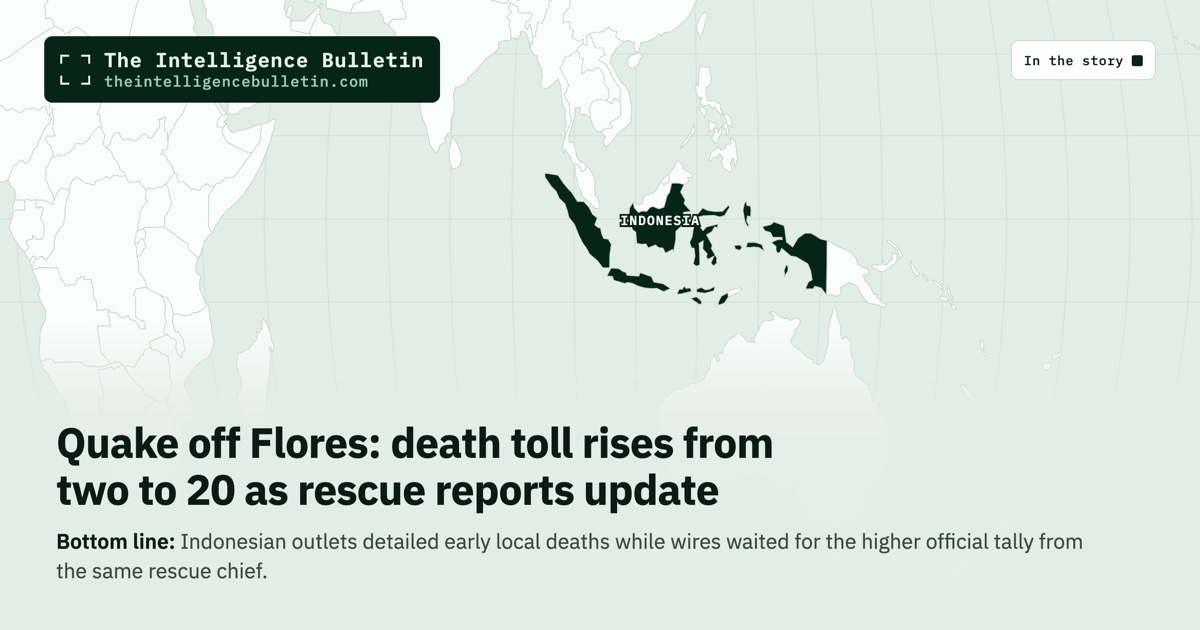
Quake off Flores: death toll rises from two to 20 as rescue reports update

Map of the countries in the story: Quake off Flores: death toll rises from two to 20 as rescue reports update
A magnitude 7.7 earthquake struck off Flores Island in Indonesia’s East Nusa Tenggara early on August 15, 2026, triggering a brief tsunami warning that was later lifted. Early reports from local officials and agencies cited two to five deaths from building collapses, mainly in Maumere. Rescue official Fathur Rahman later confirmed at least 20 deaths across affected towns, with injuries, landslides, and evacuations reported. Governor Emanuel Melkiades Laka Lena and BNPB provided initial tallies that were revised upward.

One Story. Many Angles.

🇮🇩
Indonesia
Merdeka
INDONESIAN
Original reporting
NTT Earthquake, Two Residents in Maumere Die Crushed by Building
“Gempa NTT, Dua Warga di Maumere Tewas Tertimpa Bangunan”
Read →
🇮🇩
Indonesia
The Jakarta Post
Carries Reuters reporting
Five dead after magnitude 7.7 earthquake strikes Flores, governor says – Archipelago
Read →
🇵🇭
Philippines
Rappler
Carries Reuters reporting
Two dead after magnitude 7.7 earthquake strikes off Indonesia
Read →
🇹🇭
Thailand
Bangkok Post
Carries AFP reporting
Bangkok Post – Powerful earthquake kills at least 20 in Indonesia
Read →
🇨🇳
China
China.org.cn
Xinhua wire copy
Death toll from Indonesia earthquake rises to 20
Read →
5 sources · 4 independent accounts — some share the same news agency’s report
In Brief

Indonesian outlets detailed early local deaths while wires waited for the higher official tally from the same rescue chief.

The reporting reveals a clear split in timing and focus between domestic Indonesian accounts and international wires. Merdeka and The Jakarta Post captured early local details on specific fatalities at Maumere port and the governor’s five-death statement, while Rappler carried Reuters copy that stayed with the initial two-dead BNPB figure. Bangkok Post and China.org.cn, drawing from AFP and Xinhua respectively, emphasized the later 20-death confirmation from Fathur Rahman, including evacuation scenes and rescue complications. This pattern shows Indonesian outlets surfacing granular civilian impact first, whereas regional and Chinese state media tracked the numerical climb once higher figures emerged from the same rescue source. The shared reliance on Fathur Rahman across outlets makes the toll revision the single corroborated element rather than independent verification. What stands out is how quickly the story moved from port rubble in Maumere to a province-wide count, with no outlet disputing the final figure once it appeared.

Perspective Analysis

A magnitude 7.7 earthquake struck just off the north coast of Flores Island in Indonesia’s East Nusa Tenggara province at 4:58 a.m. local time on August 15, 2026. The shallow quake, recorded at a depth of 15 kilometers by Indonesia’s geophysics agency BMKG, sent strong shaking across East Nusa Tenggara, West Nusa Tenggara, and parts of South Sulawesi, with residents reporting tremors that lasted about one minute. A tsunami warning followed immediately, with waves under one meter recorded in several coastal areas before the alert was lifted roughly three hours later.

The first reported fatalities came from Maumere, the main town in Sikka Regency on Flores. Two residents died when parts of a building collapsed onto them at the Lorens Say port while they waited as potential passengers for a Pelni ferry. Local search and rescue chief Fathur Rahman described one victim who died after evacuation to a hospital and another found in the rubble; five others sustained injuries in the same incident. Video verified by Reuters showed sections of the port structure crumbling into dust as people ran into the street.

East Nusa Tenggara governor Emanuel Melkiades Laka Lena stated at a press conference that five people had died from collapsing rubble while sleeping. The national disaster mitigation agency BNPB initially reported one death and four injuries, with strong shaking prompting hospital staff in Ende district to move patients outside and at least one landslide reported. Around 2,000 residents in Nagekeo Regency, closest to the epicenter, evacuated, and damage was noted to houses, warehouses, and government facilities along with power outages and traffic congestion.

By midday, Fathur Rahman told AFP and other outlets that the confirmed death toll had reached at least 20 people across four towns on the island, with six injured and two others still buried under rubble. Nagekeo was identified as the hardest-hit area, where landslides blocked roads and complicated access. Two people remained trapped alive in neighboring Manggarai Regency. Residents in Nagekeo raced toward higher ground after the sea retreated, a possible tsunami precursor, though the warning had already been canceled. Dozens of aftershocks followed, the strongest measuring 6.1.

Fathur Rahman, speaking by telephone from a boat en route to Nagekeo, said rescue teams were prioritizing the location of those buried under debris. One victim was pulled deceased from rubble at the Maumere port, while two others were evacuated alive. Local accounts described market-goers and hospital visitors fleeing as walls cracked and patients scattered. The area, popular with tourists, consists mostly of low-rise buildings, which limited some structural risks but left many vulnerable to falling masonry.

Indonesia sits on the Pacific Ring of Fire, where tectonic plates converge and produce frequent quakes. Flores itself experienced a 7.7-magnitude event in 1992 that triggered a tsunami and killed around 2,500 people. The current quake’s epicenter lay about 68 kilometers northwest of Ende, according to both Indonesian and U.S. authorities.

Domestic Indonesian reporting captured the earliest granular details of the port collapse in Maumere and the governor’s five-death statement. Merdeka described the two victims at Lorens Say port and quoted Fathur Rahman directly on the injuries and the timing of the ferry schedule that placed people in the waiting area. The Jakarta Post carried the governor’s press-conference account alongside BNPB’s initial lower tally and descriptions of hospital evacuations and landslides.

Neighboring and international coverage followed a different sequence. Rappler relayed Reuters material that remained with the two-death BNPB figure and the verified port video, alongside the tsunami warning details and Australian confirmation of no threat to its territory. Bangkok Post used AFP reporting that incorporated Fathur Rahman’s later 20-death update, evacuation rushes witnessed by journalists, and rescue complications from landslides. China.org.cn carried Xinhua copy that tracked the toll rising to 20 and added a consular notice from the Chinese Consulate General in Denpasar urging citizens, especially tourists in Labuan Bajo, to monitor warnings and avoid coastal zones.

The accounts converge on the final toll figure once Fathur Rahman supplied the updated count, with no outlet disputing it after that point. Early differences reflect the moment each outlet filed: Indonesian sources published while local officials were still counting bodies at specific sites, while wires incorporated the province-wide revision once rescue teams compiled reports from multiple regencies. The same rescue official supplied both the initial Maumere details and the later total, so the shift from two to 20 represents an update within one reporting chain rather than independent confirmation from separate sources.

What emerges from reading the full set is the speed with which casualty information traveled from a single port incident to a multi-town assessment. The Maumere deaths at the ferry terminal were the first concrete losses named, tied directly to the quake’s timing and a routine ferry schedule. The governor’s five-death statement bridged the local and provincial levels before the rescue chief consolidated the higher figure across Nagekeo, Manggarai, and other affected areas. Landslides cutting roads and the need to reach Nagekeo by boat underscored the logistical strain on responders operating in a region already familiar with seismic risk.

What to Watch

The pattern of coverage shows Indonesian outlets surfacing the human detail at the port first, while regional and state wires emphasized the scale once the rescue official released the revised number. No independent verification chains contradict the progression; each simply captured the information available at the time of reporting. The final 20-death count, injuries, and ongoing search for the buried stand as the points where the separate dispatches align.

Share this story

Reliance and Rolls-Royce state intent to develop sovereign AMCA engine in India

Reliance and Rolls-Royce announce intent to develop indigenous AMCA fighter engine in India
Reliance Industries and Rolls-Royce announced on August 14, 2026 their strategic intent to study a partnership for designing, developing and manufacturing a sovereign indigenous combat engine for India’s Advanced Medium Combat Aircraft program. The companies propose exploring an Aerospace Gas Turbine Complex in India covering the full engine lifecycle. The announcement is an exploratory step, not a signed joint venture or finalized contract. It aligns with India’s defense self-reliance goals.

One Story. Many Angles.

🇮🇳
India
OneIndia
Carries PTI and ANI reporting
Reliance-Rolls-Royce Partnership: New Combat Engine Plan For India’s AMCA Fighter Jet Explained
Read →
🇵🇰
Pakistan
Pakistan Today
Carries joint company statement reporting
Reliance, Rolls-Royce plan AMCA engine partnership
Read →
🇺🇸
United States
Forbes
Carries joint company statement reporting
Billionaire Mukesh Ambani’s Reliance, Rolls-Royce To Develop Fighter Jet Engines In India
Read →
🇮🇹
Italy
Borsa Italiana
ITALIAN
Radiocor wire copy
India: Reliance Industries will produce fighter engines with Rolls-Royce
“India: Reliance Industries produrra’ motori per caccia con Rolls-Royce”
Read →
🇮🇳
India
Open The Magazine
Commentary
Reliance–Rolls-Royce to Build AMCA Fighter Jet Engine in India: Why a Sovereign Combat Powerplant Matters for Indian Air Power and Strategic Autonomy
Read →
5 sources · 3 independent accounts — some share the same news agency’s report
In Brief

Coverage converges on the corporate announcement while diverging sharply on whether the story is about Indian sovereignty, Ambani’s empire, or regional military balance.

All five outlets report the same joint corporate announcement without material differences in the core facts, yet their framing reveals distinct national and institutional priorities. Indian sources emphasize technological sovereignty and the long-standing difficulty of mastering fighter engines, treating the proposal as a concrete step toward reducing foreign dependence. Pakistani coverage places the deal inside India’s broader military modernization drive, noting recent procurement approvals and a past conflict with Pakistan as context for New Delhi’s push. Forbes centers Mukesh Ambani’s conglomerate and its expansion into defense, presenting the move as a business milestone for India’s richest man. The Italian financial wire delivers a neutral, concise industrial-collaboration account that records India’s shift away from Russian suppliers without elaboration. Open The Magazine alone supplies sustained analysis of why an engine remains the hardest element of fighter sovereignty, citing India’s failed Kaveri program and the gap between airframe design and propulsion capability. The uniform reliance on the companies’ press release means the coverage pattern itself is the story: every outlet relays the identical originating statement, then layers its own interpretive lens according to domestic audience expectations.

Perspective Analysis

Reliance Industries and Rolls-Royce announced on August 14, 2026 their strategic intent to study a partnership aimed at designing, developing, manufacturing and delivering a sovereign indigenous combat engine for India’s Advanced Medium Combat Aircraft program. The companies described the move as an offer of capabilities for the full engine lifecycle, and they proposed exploring the creation of an Aerospace Gas Turbine Complex in India that would handle design, engineering, manufacture, testing, production and long-term maintenance and support. The announcement made clear that the two firms had reached only a statement of strategic intent, with no joint venture signed, no ownership structure settled and no investment totals disclosed.

The AMCA is India’s planned fifth-generation stealth multirole fighter, intended to equip the air force with advanced sensors, electronic warfare systems and reduced reliance on imported combat aircraft. Development of its propulsion system has long been identified as one of the most technically demanding elements. Only a handful of countries possess mature capabilities to design and manufacture advanced fighter engines that must deliver high thrust while enduring extreme temperatures and pressures, remaining compact enough for stealth requirements, and proving reliable and fuel-efficient. Indian programs have encountered repeated difficulty here. The indigenous Kaveri engine project, pursued for decades, never reached the performance levels needed to power the Tejas fighter, which instead uses engines of American origin.

Reliance Industries, described across the reporting as India’s largest private-sector company, has been expanding its defense manufacturing activities, including military aerospace and advanced munitions, in line with the government’s Make in India policy. Anant Ambani, executive director of Reliance Industries, stated that India’s strategic autonomy requires sovereign capability in critical technologies and that the intent is to combine Rolls-Royce’s propulsion expertise with Reliance’s manufacturing, technology, scale and execution capabilities to build an indigenous aero-engine ecosystem that could eventually become globally competitive. Rolls-Royce chief executive Tufan Erginbilgiç said the proposed initiative would mark a major milestone toward building a robust, self-reliant aerospace ecosystem in India and could deepen the British company’s involvement in the country’s growing aerospace and defense sector. The companies indicated that any resulting facility might support opportunities beyond a single aircraft program, extending into civil aerospace and new power and propulsion technologies.

The five outlets that carried the story all drew from the same joint company statement. OneIndia explained the proposed complex in technical detail and placed it inside India’s policy drive for self-reliance in defense. Open The Magazine devoted sustained attention to why an engine constitutes the remaining hard frontier of fighter sovereignty, noting that airframe design has advanced further than propulsion mastery and that control over upgrades, production schedules and maintenance would follow from an indigenous powerplant. Pakistan Today situated the announcement inside India’s recent defense procurement decisions, including approvals worth $39 billion earlier in the year and $5.46 billion last month that covered missiles, electronic warfare systems and kamikaze drones, and referenced a four-day conflict with Pakistan the previous year as one factor underscoring the need for updated capabilities. Its current defense budget stands at $85 billion. Forbes framed the development around Mukesh Ambani’s personal business interests, noting his net worth and Reliance’s expansion into military aviation. Borsa Italiana recorded the industrial collaboration and noted India’s decade-long reduction in dependence on its traditional Russian supplier, together with the shift toward suppliers including France and the United States.

The reporting shows no material disagreement on the facts of the announcement itself. Every outlet conveyed the exploratory character of the step, the absence of finalized financial or contractual details, and the proposed scope of the gas turbine complex. Where the accounts diverge is in the surrounding context each chooses to supply. Indian coverage foregrounds the technological and sovereignty dimensions, drawing on executive statements that tie the proposal directly to national capability goals. Pakistani coverage adds the regional military-modernization setting, including specific procurement figures and the recent conflict reference. The American financial perspective centers the conglomerate’s scale and its controlling family. The Italian wire treatment stays at the level of corporate announcement and broad procurement trends without additional interpretive layers.

What to Watch

This pattern indicates that the originating corporate statement set the shared factual spine, after which each outlet applied the interpretive frame its audience expects. A reader limited to any single outlet would encounter the same core event but would receive a narrower sense of why the proposal registers as significant elsewhere. The engine technology in question remains among the most restricted domains in military aviation, and the announcement positions the partnership as one possible route for India to narrow that gap through collaboration rather than sole domestic effort. Subsequent movement will hinge on whether the proposal advances into formal selection for the AMCA program, a decision that rests with Indian government authorities rather than the companies alone.


Share this story

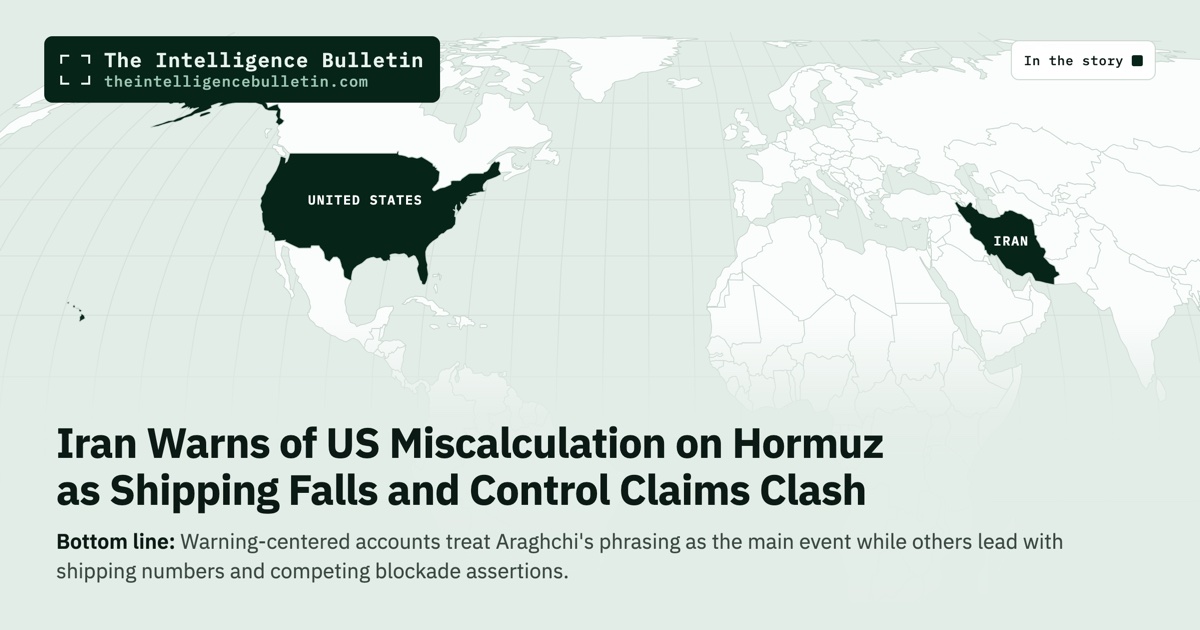
Iran Warns of US Miscalculation on Hormuz as Shipping Falls and Control Claims Clash

Map of the countries in the story: Iran Warns of US Miscalculation on Hormuz as Shipping Falls and Control Claims Clash
Iranian Foreign Minister Abbas Araghchi warned the United States on August 13, 2026, of repeating intelligence failures by claiming control of the Strait of Hormuz. Shipping traffic through the strait dropped sharply, with only eight or nine vessels transiting daily under Iranian routing compared to pre-conflict levels around 130. Iran cites a June MoU assigning it management responsibility and has restricted transit in response to prior US and Israeli actions. The United States asserts it can enforce a naval blockade indefinitely while Iran advances parliamentary steps to formalize its oversight of the waterway.

One Story. Many Angles.

🇹🇷
Turkey
Islamic Invitation Turkey
Carries Iranian statements and Press TV reporting
Iran Issues Caution to US Over Potential ‘Grave Miscalculation’ in Strait of Hormuz
Read →
🇮🇱
Israel
The Jerusalem Post
Carries REUTERS reporting
Shipping in Strait of Hormuz drops off as Iran, US continue fight for control
Read →
🇦🇫
Afghanistan
Khaama Press
Original reporting
Iran’s Araghchi Warns of US Miscalculation Over Strait of Hormuz
Read →
🇦🇿
Azerbaijan
News.az
Carries Press TV reporting
Iran warns US against ‘even bigger miscalculation’ over Strait of Hormuz
Read →
🇬🇧
United Kingdom
Middle East Eye
Original reporting
Iran formalises Strait of Hormuz control as US struggles to sustain war it launched with Israel
Read →
5 sources · each independently reported
In Brief

Warning-centered accounts treat Araghchi’s phrasing as the main event while others lead with shipping numbers and competing blockade assertions.

The reporting converges on Araghchi’s X-post warning that US intelligence lapses risk an even larger error on Hormuz control, yet the outlets diverge sharply in what they treat as the central development. Turkish, Afghan and Azerbaijani accounts stay tightly on the minister’s precise language distinguishing fake news from fake intelligence and frame the statement as direct escalation from Tehran. The Israeli outlet instead leads with shipping data showing traffic at a weekly low and pairs it with US assertions of indefinite blockade capacity plus reports of vessel attacks. Britain’s Middle East Eye alone embeds the warning inside a narrative of parliamentary formalization of Iranian control and US inability to sustain the conflict it launched with Israel, citing IRGC statements that no movement escapes its fighters. This split reveals more than phrasing differences: the warning-focused pieces treat Iran’s diplomatic signal as the actionable fact, while the shipping and war-initiation accounts treat operational realities and competing military claims as primary. The absence of any Iranian domestic outlet in the set means all accounts of Tehran’s position filter through these external lenses, yet the repeated citation of the same Araghchi text across three regions shows the warning itself travels independently of any single national frame.

Perspective Analysis

Iranian Foreign Minister Abbas Araghchi posted on X on August 13 that the United States had long miscalculated due to intelligence failures, with the war on Iran as one case in point, and now faced an even bigger miscalculation over the Strait of Hormuz. He added that worse than fake news is fake intelligence, urged caution, and closed with the statement that Allah is great and greater than any power on earth. The post followed US President Donald Trump’s assertion that his country maintains total control of the strait.

Shipping traffic through the waterway stood at eight or nine commodity vessels on the most recent day counted, well below the pre-conflict daily average of roughly 130 transits. Five vessels entered the Gulf and four exited into the Gulf of Oman, most using the Iranian routing. Data from maritime analytics firm Kpler recorded the drop, and four separate outlets reported the same figures. The United States has stated it can maintain a naval blockade of Iran indefinitely and will increase economic pressure on Tehran as ceasefire talks stall.

Iran has restricted transit through the strait, which carries a fifth of the world’s oil supply, in response to what it describes as unlawful aggression by the United States and Israel. That earlier conflict ran from February 28 to an April 8 ceasefire. On June 17, Tehran and Washington concluded a Pakistan-brokered memorandum of understanding whose fifth article assigns Iran responsibility for reopening and managing the strait. Iran now says the waterway will remain closed at least until the end of US interference in the region. Officials in Tehran and Oman are discussing a new framework for overseeing shipping.

On the Iranian side, the Islamic Revolutionary Guard Corps Navy has declared the strait closed and its control complete and decisive. Rear Admiral Ali Ozmaei told Tasnim that no movement escapes the eyes of IRGC fighters and that reality should be judged in the field rather than in US statements. An Iranian parliamentary committee has approved the general outline of a strategic action plan for security and development in the strait and Persian Gulf. The plan would bar vessels and equipment belonging to the United States, Israel, and other countries Iran designates as hostile. Valiullah Bayati, spokesperson for the parliament’s internal affairs and councils committee, said the proposals advanced after hearing opinions and would now move to further consideration.

US Treasury Secretary Scott Bessent said new measures against Tehran would be announced the following week, describing them as economic isolation the world has never seen before, combined with the continued blockade that keeps anything from entering or leaving Iranian ports. Brent crude climbed above 88 dollars a barrel and West Texas Intermediate above 82 dollars after the threat. The United States is sending the USS George Washington to relieve the USS Abraham Lincoln, whose crew has spent more than 260 days at sea, leaving the Pacific without a carrier for an undetermined period.

The same Araghchi text appears in accounts from Turkey, Afghanistan, and Azerbaijan. Each outlet quotes the minister’s distinction between fake news and fake intelligence and his warning of an even bigger miscalculation on Hormuz. The Turkish report adds that Iran has imposed restrictions in retaliation for prior aggression, notes the June memorandum, and records Iran-Oman talks on a new oversight framework. The Afghan account stays close to the X post itself and the context of strained relations. The Azerbaijani account links the warning directly to the shipping decline and cites an Iranian English-language channel for the original statement.

The Israeli report leads instead with the Kpler traffic numbers and pairs them with the US claim of indefinite blockade capacity. It records that nine vessels transited on the day in question and notes two Abu Dhabi National Oil Company vessels attacked while passing through the strait that evening, with the United Arab Emirates accusing Iran. It also reports nineteen vessels through the Bab el-Mandeb strait the same day. The British account places the warning inside a wider frame of Iran formalizing control while the United States struggles to sustain the war it launched alongside Israel. It alone reports the parliamentary committee vote and the IRGC Navy declaration that control is complete, alongside the Treasury Secretary’s threat language and the carrier rotation details.

A reader limited to the Turkish, Afghan, or Azerbaijani accounts would see a clear diplomatic signal from Tehran centered on intelligence failure and the risk of escalation at the chokepoint. A reader limited to the Israeli account would see primarily a maritime disruption and competing claims of control backed by naval posture and data on vessel attacks. A reader limited to the British account would see a story of legislative steps toward permanent Iranian oversight and mounting costs to the United States in sustaining its campaign. The absence of any Iranian domestic outlet from the set means every account of Tehran’s position reaches readers through one of these external filters, yet the identical Araghchi wording travels across three separate reporting chains.

The warning itself rests on three independent chains that all quote the same X post. The shipping decline rests on four outlets citing the same Kpler data set. The June memorandum appears in only one account. The parliamentary plan appears in only one account. The US assertion of indefinite blockade capacity appears in two. Where accounts converge on the minister’s language and the traffic numbers, those elements form the most widely corroborated spine of the story. Where they diverge, the difference lies in which facts each outlet chooses to treat as the organizing center: the diplomatic warning, the operational numbers, or the legislative and military assertions of control.

The accounts that stay with the corroborated warning and the Kpler traffic figures rest on the largest number of independent reporting chains and on primary statements that multiple outlets recorded without alteration. Those that embed the same facts inside a narrative of initiation or formalization add interpretive framing that the narrower accounts do not supply. The interest in presenting the event as a straightforward intelligence warning lies with outlets that relay Iranian official language directly. The interest in presenting it as a shipping and blockade contest lies with the outlet that reports US naval statements and attack claims alongside the traffic data. The interest in presenting it as a struggle over a war already launched lies with the outlet that incorporates parliamentary and IRGC assertions of permanent control.

What to Watch

Energy markets have already registered the tension through higher oil prices. Any further reduction in transits or extension of the blockade will tighten global supply further, and the same Kpler data that documented the drop to eight or nine vessels will continue to measure whether traffic recovers or contracts. The June memorandum remains the only cited document that assigns management responsibility, and the parliamentary plan remains the only cited step toward formal codification. Both stand as single-source elements whose status will be tested by whether additional outlets report them in coming days.


Share this story

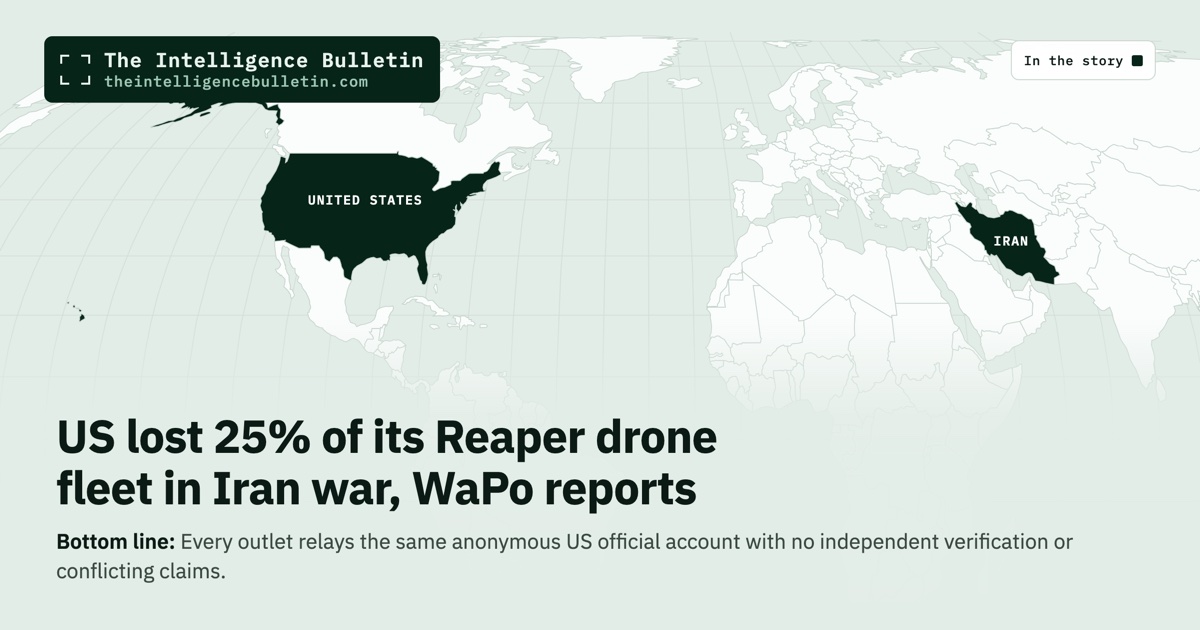
US lost 25% of its Reaper drone fleet in Iran war, WaPo reports

Map of the countries in the story: US lost 25% of its Reaper drone fleet in Iran war, WaPo reports
The United States lost at least 45 MQ-9 Reaper drones during its conflict with Iran that began February 28, 2026. This equals roughly 25 percent of the US fleet, with replacement costs estimated between $1.3 billion and $2.25 billion. Not all losses were from hostile fire; some resulted from communications failures. The Washington Post report, citing anonymous US officials, forms the basis for coverage across the selected outlets.

One Story. Many Angles.

🇺🇸
United States
Natural News
Carries Washington Post reporting
U.S. Lost 45 MQ-9 Reaper Drones in Iran Conflict, Costing Billions – NaturalNews.com
Read →
🇮🇱
Israel
The Jerusalem Post
Carries Washington Post reporting
US lost 45 Reaper drones during Iran war, equaling 25% of stockpile
Read →
🇴🇲
Oman
Times of Oman
Carries ANI reporting
US lost 45 Reaper drones in Iran war, 25% of fleet; losses could top $1.3bn: Report
Read →
🇫🇷
France
BFMTV
FRENCH
Carries Washington Post reporting
It costs up to 50 million dollars each: the US army lost 45 Reaper drones in its war against Iran (this represents 25% of its fleet)
“Il coûte jusqu’à 50 millions de dollars l’unité: l’armée américaine a perdu 45 drones Reaper dans sa guerre contre l’Iran (cela représente 25% de sa flotte)”
Read →
🇬🇷
Greece
To Pontiki
GREEK
Carries Washington Post reporting
Middle East: The US lost 25% of MQ-9 Reaper drones in the war with Iran – Each costs up to 50 million dollars
“Μέση Ανατολή: Το 25% των drones MQ-9 Reaper έχασαν οι ΗΠΑ στον πόλεμο με το Ιράν – Το καθένα κοστίζει ως 50 εκατ. δολάρια”
Read →
5 sources · 2 independent accounts — some share the same news agency’s report
In Brief

Every outlet relays the same anonymous US official account with no independent verification or conflicting claims.

All five outlets in the source set relay the identical Washington Post account of US drone losses without adding independent sourcing or new claims. The Natural News piece situates the losses inside a broader narrative of US military depletion and high operational costs in the Trump-launched campaign. The Jerusalem Post frames the scale as a strategic setback in the confrontation with Iran. Times of Oman stresses the financial toll and exact fleet percentage. BFMTV and To Pontiki both highlight unit costs and vulnerability over the Strait of Hormuz while noting some crashes stemmed from lost links rather than shootdowns. No source disputes the core numbers or offers an Iranian perspective; the selected coverage converges entirely on one US-origin reporting chain, leaving the event presented solely through American official accounts filtered through international outlets.

Perspective Analysis

The Washington Post reported on August 13 that the United States had lost at least 45 MQ-9 Reaper drones during its conflict with Iran, a figure equal to roughly one-quarter of the fleet that existed when the fighting began. The account, drawn from three anonymous American officials, stated that the losses occurred through a mix of Iranian shootdowns, strikes on U.S. bases, and crashes after communications links failed. The Reapers, built by General Atomics, had been flying extensively over the Strait of Hormuz for surveillance and strikes. Their unit cost ranges from 30 to 50 million dollars depending on configuration, placing the replacement bill for these 45 aircraft between 1.3 billion and 2.25 billion dollars.

The conflict itself opened on February 28, 2026, when President Donald Trump launched Operation Epic Fury. At the outset the Air Force held 165 Reapers and the Marine Corps another 20, for a total near 185. No Marine Corps aircraft were lost in the reported tally. The drones had already seen heavy use against Houthi forces in Yemen in prior years, and the same platforms continued operating in the Strait of Hormuz even after the new losses. One official noted that Iranian forces appeared surprised by the precision of some attacks on the slow, low-flying aircraft. The Pentagon declined to comment on the specific figures.

Every outlet in the selected set published its account by relaying this single Washington Post dispatch. No additional on-the-ground reporting or new sources appeared in any of the five articles. The differences therefore lie entirely in selection, emphasis, and surrounding context each masthead chose to attach to the same core paragraphs.

Natural News placed the losses inside a running ledger of American military expenditure. Its headline led with the billions in replacement costs and wove in references to earlier Bloomberg estimates of one billion dollars already lost to Iranian action. The piece added historical notes on the Reaper’s predecessor, the MQ-1 Predator, and on documented communications failures in other theaters, including an emergency landing in Poland. It also cited American Enterprise Institute research placing the first five weeks of the Iran operation at between 22.3 billion and 31 billion dollars.

The Jerusalem Post headline foregrounded the percentage of the stockpile lost, framing the depletion as a direct setback in the confrontation with Iran. The article stayed close to the Washington Post numbers but situated them within the shared security concerns of the United States and Israel. It did not introduce separate Israeli sourcing.

Times of Oman carried the story under an ANI byline and supplied the precise pre-war fleet split between Air Force and Marine Corps units. It noted that the Marine Corps aircraft, oriented toward the Asia-Pacific, escaped losses. The piece emphasized the financial exposure to taxpayers and recorded that the Pentagon had requested a 67-billion-dollar supplemental war-funding package from Congress to address broader inventory shortfalls.

BFMTV translated and expanded the same dispatch into a French defense-economics frame. It recorded that a quarter of the fleet had been lost in roughly six months and added that U.S. forces had already fired more than 850 Tomahawk cruise missiles and over 1,000 Patriot and THAAD interceptors in the first month of the Iran campaign. The article placed the Reaper shortfall alongside the drain on those systems caused by support to Ukraine, and it noted the administration’s request for tens of billions in new funding. It also mentioned that the Pentagon is shifting toward cheaper, attritable drones to replenish numbers more rapidly.

To Pontiki opened with the 25 percent figure and unit cost range, then added that the drones’ low speed and altitude made them vulnerable not only to Iranian forces but also to Houthi units in Yemen and pro-Iranian groups in Iraq. It cited a cumulative U.S. war cost exceeding 113 billion dollars through the end of June, excluding later strikes, and observed that restoring certain interceptor stocks at current production rates would take decades.

Because the underlying reporting chain is identical, these variations do not produce competing facts about the number of aircraft lost or the causes. They do reveal distinct editorial priorities. The American outlet treated the episode as one data point in a larger domestic debate over military spending and industrial-base strain. The Israeli outlet highlighted the operational consequence for a common adversary. The Omani outlet, located on the Gulf, stressed the dollar cost and the exact proportion of a visible fleet. The French and Greek pieces both supplied the communications-failure detail and linked the losses to wider ammunition and missile shortfalls, yet each attached a different regional lens: one to European concerns over Ukraine support and funding timelines, the other to Middle East operational vulnerabilities involving Iranian partners.

What to Watch

The single reporting origin means readers of any one of these outlets encounter the same anonymous U.S. official statements, filtered only through the additional sentences each publication chose to keep or insert. No outlet in the set supplied an Iranian government statement, a technical assessment from General Atomics, or independent verification of the crash-versus-shootdown breakdown. The Washington Post account therefore remains the sole source for the 45-aircraft figure and the 25-percent calculation across all five publications.


Share this story

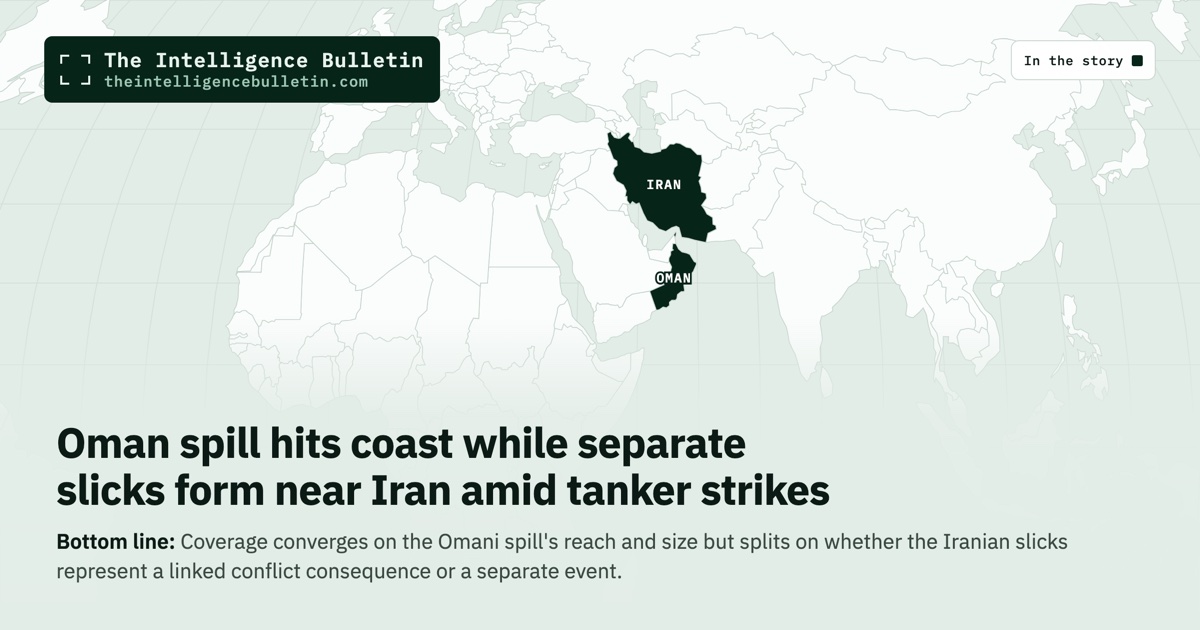
Oman spill hits coast while separate slicks form near Iran amid tanker strikes

Map of the countries in the story: Oman spill hits coast while separate slicks form near Iran amid tanker strikes
A tanker carrying Russian crude ran aground off Oman in June and has leaked oil now reaching the coastline and threatening a marine reserve. Satellite imagery shows a separate spill creating two slicks in Iranian waters near Qeshm and Sirri islands, possibly from an attacked bulk carrier. The incidents occur amid US-Iran tensions that have complicated cleanup and salvage operations. Experts assess the Omani slick at up to 2,000 square kilometers and potentially among the largest in years.

One Story. Many Angles.

🇺🇸
United States
WHBL
Carries Reuters reporting
Two slicks appear in Gulf as huge oil spill off Oman threatens disaster
Read →
🇮🇱
Israel
The Jerusalem Post
Carries REUTERS reporting
Oil spill appears in Iranian waters off Oman
Read →
🇶🇦
Qatar
Al Jazeera
Carries Reuters reporting
Oman says massive oil spill reaches coastline: What damage could it do?
Read →
🇹🇷
Turkey
Daily Sabah
Carries Reuters reporting
Oil spill off coast of Oman fast becoming worst in years: Agencies
Read →
🇸🇦
Saudi Arabia
Arab News
AP wire copy
A British firm starts containment of oil spill from stricken tanker off Oman
Read →
5 sources · 2 independent accounts — some share the same news agency’s report
In Brief

Coverage converges on the Omani spill’s reach and size but splits on whether the Iranian slicks represent a linked conflict consequence or a separate event.

The reporting converges on the scale and shoreline impact of the Caroline Bezengi spill off Oman while treating the Qeshm and Sirri slicks as a distinct incident linked to tanker attacks. US-syndicated and Saudi coverage stresses practical containment steps by a British firm and the vessel’s shadow-fleet status, treating the conflict as background that hinders response. Israeli framing locates the new slicks explicitly in Iranian waters and cites Iranian officials attributing them to a foreign carrier. Qatari and Turkish accounts foreground Omani official warnings about ecosystem damage and the spill’s unchecked growth to 2,000 square kilometers, drawing on the same satellite experts. No selected outlet originates independent verification of causes; all relay Reuters or AP dispatches that note Iranian statements and the absence of confirmed links between the two spills. The pattern shows outlets in direct proximity to the actors prioritizing operational details and those farther away emphasizing environmental stakes, yet all agree the conflict has slowed assessment without claiming any party has blocked access outright.

Perspective Analysis

The Caroline Bezengi, a 25-year-old tanker believed to be part of Russia’s shadow fleet, ran aground on June 30 near al-Qibliyyah Island off Oman after reporting explosions off Yemen in early June. The vessel was carrying an estimated 800,000 barrels of Russian crude on a voyage from Novorossiysk to India. Satellite imagery analyzed by John Amos of SkyTruth showed the resulting slick had grown to more than 2,000 square kilometers by mid-August and had begun reaching Oman’s shoreline at Ras Madrakah, with further risk to Masirah Island and the Hallaniyat Archipelago marine reserve. Oman’s Environment Authority reported that beaches in the Ras Madrakah area were affected and that stretches up to 40 kilometers could be contaminated. A separate set of slicks appeared inside the Gulf near Qeshm Island and Sirri Island. Samir Madani of TankerTrackers.com linked the Qeshm slick to the Minoan Pioneer, a Liberia-flagged dry bulk carrier struck by an unknown projectile on August 3 while transiting the Strait of Hormuz. Reuters reporting, carried in full or in part by every outlet in the set, noted that the Caroline Bezengi incident itself has not been tied to the recent pattern of attacks on shipping.

All five articles rest on the same core Reuters dispatch, with one drawing additional material from the Associated Press. The Jerusalem Post ran the Reuters text under the headline “Oil spill appears in Iranian waters off Oman” and opened its story by placing both new slicks inside Iranian waters. WHBL used the Reuters headline “Two slicks appear in Gulf as huge oil spill off Oman threatens disaster” and led with satellite and video evidence of the Qeshm and Sirri slicks before turning to the larger Omani spill. Daily Sabah carried the Reuters piece under “Oil spill off coast of Oman fast becoming worst in years: Agencies” and foregrounded expert assessments that the slick could rank among the largest in recent decades. Al Jazeera combined Reuters material with AFP reporting and headlined the story around Oman’s official statements on coastal impact and potential damage to a marine reserve established the previous year. Arab News published an AP account headlined “A British firm starts containment of oil spill from stricken tanker off Oman” that opened with the hiring of Ambrey, a UK maritime-response company, to board the vessel with Omani air-force support and begin stabilization work.

The shared Reuters text already contained the conflict backdrop: tit-for-tat attacks on tankers by Iran and the United States had raised concerns about environmental damage, and the regional situation had complicated assessment and cleanup. Brian Barnes of the University of South Florida was quoted on the risk that longer leaks would spread further and damage ecosystems. The same dispatch recorded Iranian Foreign Ministry spokesman Esmaeil Baqaei stating on X that oil pollution had reached Qeshm Island and that preliminary evidence pointed to a foreign bulk carrier. No outlet in the set added independent on-the-ground reporting or new verification of causes. The Reuters copy itself noted that it could not independently confirm the source of either slick or identify the substances involved, and that a salvage tug had been unable to approach the Minoan Pioneer due to permission issues with Iranian authorities.

Each masthead made different choices about what to lead with and how much space to give the two incidents. The Jerusalem Post and WHBL both kept the new Gulf slicks prominent, reflecting the Reuters emphasis on satellite imagery dated August 10 and August 13. Daily Sabah stayed close to the Reuters aggregation of size estimates and expert warnings about unchecked spread. Al Jazeera added AFP-sourced detail on the marine reserve and on Oman’s monitoring results showing 390 square kilometers affected earlier in the month before the larger figure emerged. Arab News shifted the frame toward operational response by leading with Ambrey’s statement and the challenges of the Khareef monsoon season. None of the outlets claimed the conflict had prevented access; they recorded only that it had slowed or complicated efforts.

The single reporting chain means the underlying facts available to every reader are identical. What differs is the sequence and emphasis each outlet chose when presenting that chain. Headlines that foreground Iranian waters or new slicks steer attention toward the Gulf incidents and their possible connection to recent attacks. Headlines that open with Omani shoreline impact or the scale of the slick direct attention to the ecological stakes for Oman. The account that begins with the British firm’s salvage contract treats the story as one of active response rather than unfolding damage. Because the original Reuters text already included both the Omani and Iranian elements, these differences are choices of framing rather than additions of new information.

What to Watch

The pattern that emerges is one of selective emphasis within a single factual base. Outlets whose primary audiences are closer to the shipping lanes or the conflict placed greater weight on the tanker attacks and the location of the new slicks. Those positioned farther from the immediate actors or more focused on environmental coverage gave more prominence to Oman’s statements and the potential reach of the larger slick. The shared material already recorded Iranian claims about a foreign source and the absence of confirmed links between the two spills. Readers of any single version therefore receive the same core events but are invited to see the priority of those events differently depending on which masthead’s framing they encounter first.


Share this story

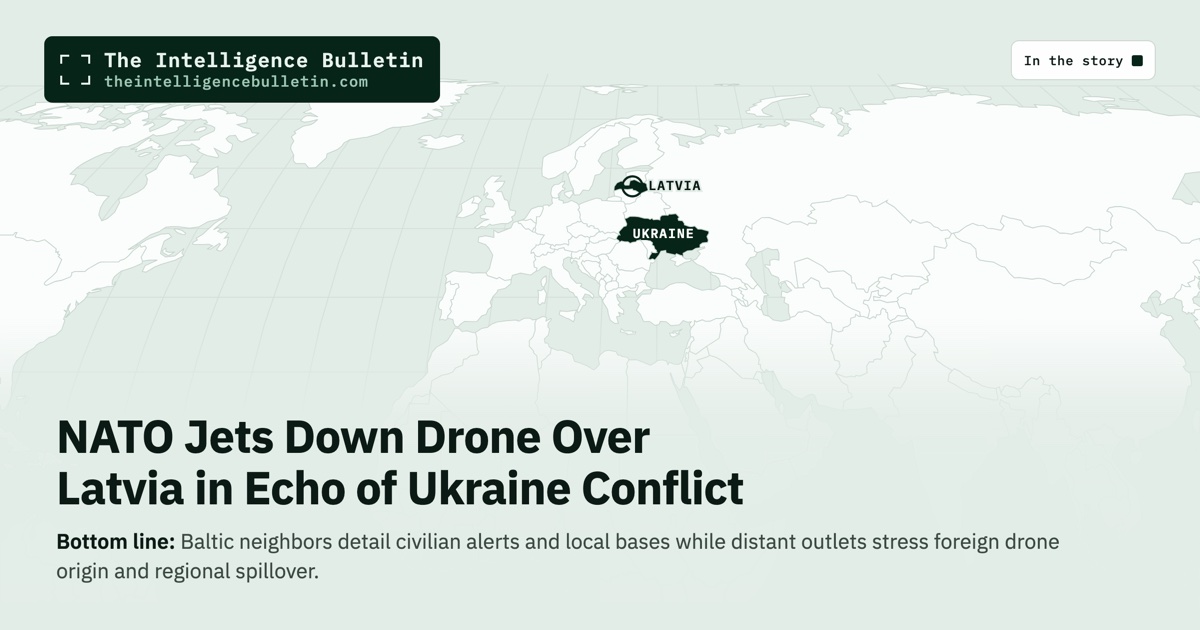
NATO Jets Down Drone Over Latvia in Echo of Ukraine Conflict

Map of the countries in the story: NATO Jets Down Drone Over Latvia in Echo of Ukraine Conflict
NATO fighter jets shot down a foreign drone that entered Latvian airspace over the Balvi region early on August 14 2026. Orange air alerts were issued in five eastern municipalities prompting residents to seek shelter via mobile warnings. Latvian and Lithuanian authorities attributed the incursion to Russian electronic warfare possibly diverting a Ukrainian drone with the interception launched from Šiauliai Air Base. Finland restricted air and maritime traffic in the eastern Gulf of Finland as a precaution.

One Story. Many Angles.

🇱🇻
Latvia
la.lv
LATVIAN
Original reporting
Alarm in five Latvian municipalities: NATO fighters shot down drone that flew into airspace
“Trauksme piecās Latvijas pašvaldībās: NATO iznīcinātāji notriekuši gaisa telpā ielidojušu dronu”
Read →
🇱🇹
Lithuania
LRT
Carries AP reporting
NATO fighter jets shoot down drone over eastern Latvia
Read →
🇪🇪
Estonia
Lõunaeestlane
ESTONIAN
Carries lsm.lv reporting
Real war broke out in Latvia: air alarm given, drone shot down – people took shelter in basements
“Lätis oli päris sõda lahti: anti õhuhäire, tulistati alla droon – inimesed varjusid keldritesse”
Read →
🇩🇪
Germany
Merkur
GERMAN
dpa wire copy
Air alarm in Latvia: NATO fighter jets shoot down drone
“Luftalarm in Lettland: NATO-Kampfjets schießen Drohne ab”
Read →
🇨🇿
Czech Republic
Novinky
CZECH
Wire copy
NATO fighters shot down foreign drone over Latvia
“Stíhačky NATO sestřelily nad Lotyšskem cizí dron”
Read →
5 sources · each independently reported
In Brief

Baltic neighbors detail civilian alerts and local bases while distant outlets stress foreign drone origin and regional spillover.

The reporting converges on Russian electronic warfare diverting the drone yet the outlets diverge sharply by proximity. Latvian coverage centers on the dawn mobile alerts that roused residents across five municipalities including pilgrims sheltering in Aglona cellars. Lithuanian accounts stress the operational success of Italian jets scrambled from Šiauliai as proof of integrated NATO air policing. Estonian pieces frame the episode as bringing war-like conditions with civilians hiding from the alarm. German and Czech reports embed it in the Ukraine conflict’s spillover noting prior incidents and Finnish precautions without local civilian details. This pattern shows how distance shapes emphasis: neighbors foreground immediate disruption and their own bases while farther outlets highlight foreign origin and broader security risks. All accounts draw from NATO-member military statements leaving the information environment one-sided. The repeated references to similar past events indicate an established pattern rather than an isolated breach.

Perspective Analysis

Early on the morning of August 14 2026 a foreign drone crossed into Latvian airspace over the northeastern Balvi region. Latvian National Armed Forces activated NATO Baltic Air Policing fighters, which intercepted and destroyed the aircraft at high altitude. The engagement ended an orange-level airspace threat that had been declared shortly before 4 a.m. local time across five eastern municipalities: Augšdaugava, Preiļi, Rēzekne, Balvi and Alūksne. Residents there received mobile alerts instructing them to remain indoors or seek shelter. The all-clear followed roughly an hour later once the drone had been brought down.

Latvian armed forces described the object as an unmanned aerial vehicle that had entered national airspace under the influence of Russian electronic warfare. Spokeswoman Iveta Bērziņa told Latvian Radio that the drone had been shot down at considerable height, so wreckage could be scattered over a wide area. Search teams including soldiers, national guardsmen and police were deployed to locate debris. The same statement noted that similar incursions had occurred earlier in the year, most recently in June when French jets downed another drone between Rēzekne and Kārsava.

Lithuanian authorities supplied additional operational detail. Vilmantas Vitkauskas, chief of Lithuania’s National Crisis Management Centre, stated that the intercepting aircraft had been scrambled from the Šiauliai Air Base in northern Lithuania. The jets made contact with the object minutes after takeoff and destroyed it shortly afterward. Vitkauskas compared the episode to an earlier May incident in which Russian electronic warfare systems had redirected a Ukrainian drone toward NATO territory. Lithuanian Defence Minister Robertas Kaunas said the precise origin of the drone remained under investigation but confirmed no damage had been reported on the ground.

Estonian reporting relayed the Latvian account while adding local color from the Aglona pilgrimage site, where several groups of worshippers had gathered for the August 15 feast of the Assumption. Video from Latvian Television showed pilgrims taking cover in the basement of a Catholic school after the mobile alert reached them. The same dispatch noted that Finnish authorities had simultaneously restricted air and maritime traffic in the eastern Gulf of Finland, a precautionary measure Finland has used before in the same corridor near Kotka.

German coverage placed the incident inside the wider Ukraine conflict. It recorded that Russia had reported downing fifteen drones over the Leningrad region the same night, an area bordering both Finland and Estonia. The account also referenced a June NATO intercept over Latvia and observed that northern NATO members were tightening security around critical infrastructure amid fears that Moscow might stage false-flag attacks using diverted Ukrainian drones.

Czech reporting summarized the event under the description of a foreign drone shot down by NATO fighters over Latvia, without further operational or local detail.

The five accounts converge on the core sequence: a drone entered Latvian airspace, NATO jets destroyed it, and an air alert covered five eastern municipalities. They also agree that Russian electronic warfare was the most likely cause of the incursion and that the object was probably Ukrainian in origin. Finnish traffic restrictions and the existence of prior similar incidents appear in more than one independent chain.

Where the accounts differ is in emphasis rather than in disputed facts. The Latvian source foregrounds the mobile warnings sent to residents of the five municipalities and the high-altitude nature of the shoot-down. Lithuanian reporting supplies the only named attribution for the scramble base and the only direct comparison to the May incident. Estonian coverage alone records the sheltering of pilgrims at Aglona. German and Czech accounts supply the broader Ukraine-war context and the Leningrad-region drone activity but omit the names of the Latvian municipalities and the specific base involved.

A reader limited to any single national outlet would therefore miss part of the picture. Someone reading only the Latvian piece would not learn that the jets came from Šiauliai or that Finnish authorities acted in parallel. A Lithuanian reader would not see the Aglona footage or the exact list of alerted municipalities. A German or Czech reader would not encounter the granular local-alert details that made the incident tangible to people on the ground. Because every source drew its information from NATO-member military statements, no outlet in the set offered an independent verification of the drone’s origin or of the electronic-warfare claim.

The most precise account of the operation itself comes from the Lithuanian source, which alone named the base and quoted the crisis-management chief on the timing and outcome. The most complete description of the domestic impact comes from the Latvian source, which listed the five municipalities and the content of the mobile messages. The Estonian and German pieces add useful context on civilian behavior and regional precautions that the others omit, but they rely on the same underlying military statements.

What to Watch

This convergence on the electronic-warfare explanation across independent Baltic and Central European reporting chains indicates that the claim rests on shared NATO assessments rather than on any single national narrative. The repeated references to earlier incidents in May and June establish that the August 14 event belongs to an ongoing pattern rather than an isolated breach. As long as Ukrainian drone operations continue against targets inside Russia and Russian electronic-warfare systems remain active near the border, similar diversions into Baltic airspace remain likely. The successful intercept from Šiauliai demonstrates that NATO’s rotating air-policing mission can respond quickly, yet each new alert still requires civilian warnings across multiple municipalities and precautionary restrictions in neighboring Finnish waters. The information environment remains one-sided because the source set contains no reporting from Russia or Ukraine that could contradict or confirm the diversion account.


Share this story