 AI-generated analysis published under the editorial responsibility of Rohit Sinnas. How it works →
Press quoted
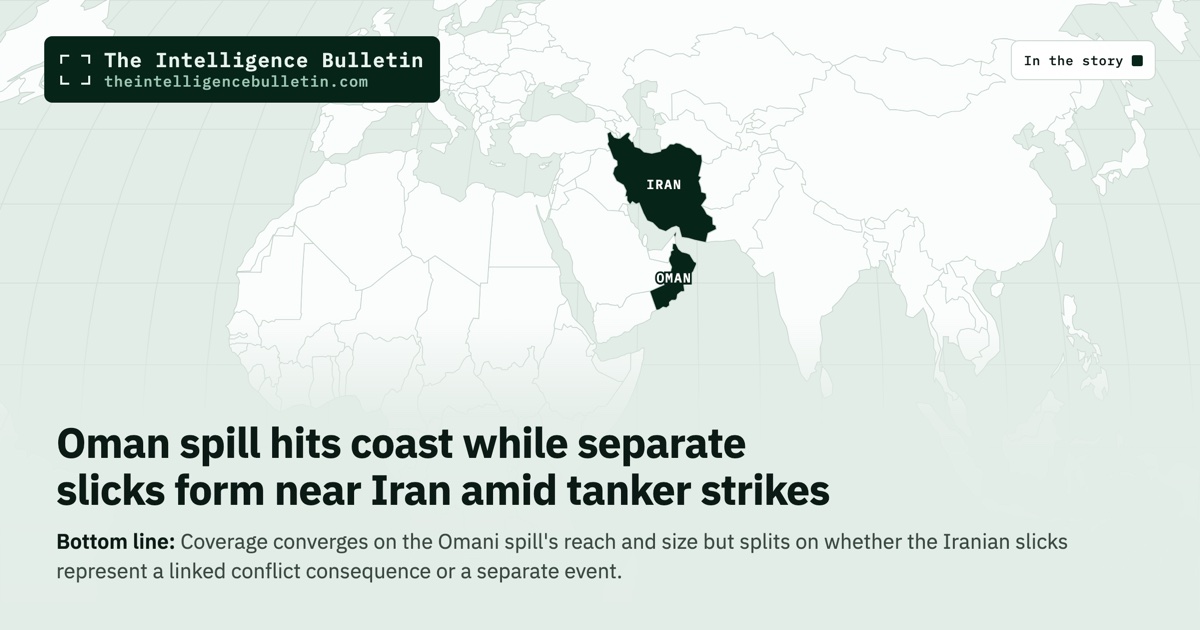
Coverage converges on the Omani spill’s reach and size but splits on whether the Iranian slicks represent a linked conflict consequence or a separate event.
The reporting converges on the scale and shoreline impact of the Caroline Bezengi spill off Oman while treating the Qeshm and Sirri slicks as a distinct incident linked to tanker attacks. US-syndicated and Saudi coverage stresses practical containment steps by a British firm and the vessel’s shadow-fleet status, treating the conflict as background that hinders response. Israeli framing locates the new slicks explicitly in Iranian waters and cites Iranian officials attributing them to a foreign carrier. Qatari and Turkish accounts foreground Omani official warnings about ecosystem damage and the spill’s unchecked growth to 2,000 square kilometers, drawing on the same satellite experts. No selected outlet originates independent verification of causes; all relay Reuters or AP dispatches that note Iranian statements and the absence of confirmed links between the two spills. The pattern shows outlets in direct proximity to the actors prioritizing operational details and those farther away emphasizing environmental stakes, yet all agree the conflict has slowed assessment without claiming any party has blocked access outright.
Full analysis
The Caroline Bezengi, a 25-year-old tanker believed to be part of Russia’s shadow fleet, ran aground on June 30 near al-Qibliyyah Island off Oman after reporting explosions off Yemen in early June. The vessel was carrying an estimated 800,000 barrels of Russian crude on a voyage from Novorossiysk to India. Satellite imagery analyzed by John Amos of SkyTruth showed the resulting slick had grown to more than 2,000 square kilometers by mid-August and had begun reaching Oman’s shoreline at Ras Madrakah, with further risk to Masirah Island and the Hallaniyat Archipelago marine reserve. Oman’s Environment Authority reported that beaches in the Ras Madrakah area were affected and that stretches up to 40 kilometers could be contaminated. A separate set of slicks appeared inside the Gulf near Qeshm Island and Sirri Island. Samir Madani of TankerTrackers.com linked the Qeshm slick to the Minoan Pioneer, a Liberia-flagged dry bulk carrier struck by an unknown projectile on August 3 while transiting the Strait of Hormuz. Reuters reporting, carried in full or in part by every outlet in the set, noted that the Caroline Bezengi incident itself has not been tied to the recent pattern of attacks on shipping.
All five articles rest on the same core Reuters dispatch, with one drawing additional material from the Associated Press. The Jerusalem Post ran the Reuters text under the headline “Oil spill appears in Iranian waters off Oman” and opened its story by placing both new slicks inside Iranian waters. WHBL used the Reuters headline “Two slicks appear in Gulf as huge oil spill off Oman threatens disaster” and led with satellite and video evidence of the Qeshm and Sirri slicks before turning to the larger Omani spill. Daily Sabah carried the Reuters piece under “Oil spill off coast of Oman fast becoming worst in years: Agencies” and foregrounded expert assessments that the slick could rank among the largest in recent decades. Al Jazeera combined Reuters material with AFP reporting and headlined the story around Oman’s official statements on coastal impact and potential damage to a marine reserve established the previous year. Arab News published an AP account headlined “A British firm starts containment of oil spill from stricken tanker off Oman” that opened with the hiring of Ambrey, a UK maritime-response company, to board the vessel with Omani air-force support and begin stabilization work.
The shared Reuters text already contained the conflict backdrop: tit-for-tat attacks on tankers by Iran and the United States had raised concerns about environmental damage, and the regional situation had complicated assessment and cleanup. Brian Barnes of the University of South Florida was quoted on the risk that longer leaks would spread further and damage ecosystems. The same dispatch recorded Iranian Foreign Ministry spokesman Esmaeil Baqaei stating on X that oil pollution had reached Qeshm Island and that preliminary evidence pointed to a foreign bulk carrier. No outlet in the set added independent on-the-ground reporting or new verification of causes. The Reuters copy itself noted that it could not independently confirm the source of either slick or identify the substances involved, and that a salvage tug had been unable to approach the Minoan Pioneer due to permission issues with Iranian authorities.
Each masthead made different choices about what to lead with and how much space to give the two incidents. The Jerusalem Post and WHBL both kept the new Gulf slicks prominent, reflecting the Reuters emphasis on satellite imagery dated August 10 and August 13. Daily Sabah stayed close to the Reuters aggregation of size estimates and expert warnings about unchecked spread. Al Jazeera added AFP-sourced detail on the marine reserve and on Oman’s monitoring results showing 390 square kilometers affected earlier in the month before the larger figure emerged. Arab News shifted the frame toward operational response by leading with Ambrey’s statement and the challenges of the Khareef monsoon season. None of the outlets claimed the conflict had prevented access; they recorded only that it had slowed or complicated efforts.
The single reporting chain means the underlying facts available to every reader are identical. What differs is the sequence and emphasis each outlet chose when presenting that chain. Headlines that foreground Iranian waters or new slicks steer attention toward the Gulf incidents and their possible connection to recent attacks. Headlines that open with Omani shoreline impact or the scale of the slick direct attention to the ecological stakes for Oman. The account that begins with the British firm’s salvage contract treats the story as one of active response rather than unfolding damage. Because the original Reuters text already included both the Omani and Iranian elements, these differences are choices of framing rather than additions of new information.
What to Watch
The pattern that emerges is one of selective emphasis within a single factual base. Outlets whose primary audiences are closer to the shipping lanes or the conflict placed greater weight on the tanker attacks and the location of the new slicks. Those positioned farther from the immediate actors or more focused on environmental coverage gave more prominence to Oman’s statements and the potential reach of the larger slick. The shared material already recorded Iranian claims about a foreign source and the absence of confirmed links between the two spills. Readers of any single version therefore receive the same core events but are invited to see the priority of those events differently depending on which masthead’s framing they encounter first.
That’s how the world told the story.
Get our daily open-source intelligence on world events in your inbox — one email a day, up to six stories.
Subscribe freeNo spam. One-click unsubscribe. See the latest email →