 AI-generated analysis published under the editorial responsibility of Rohit Sinnas. How it works →
Press quoted
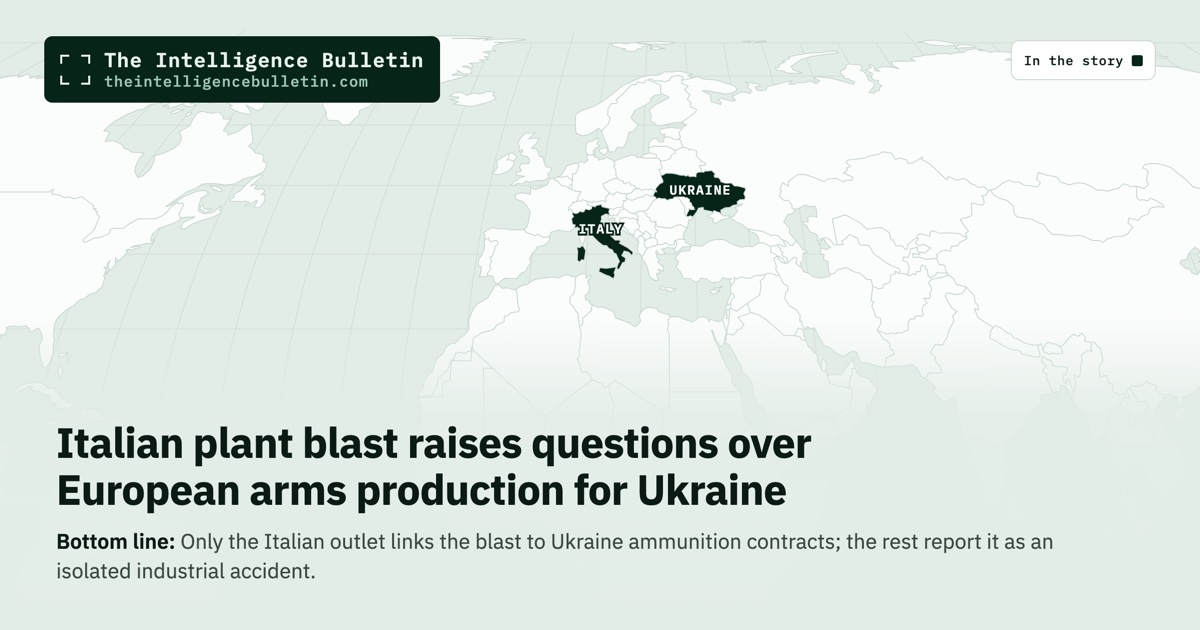
Only the Italian outlet links the blast to Ukraine ammunition contracts; the rest report it as an isolated industrial accident.
The selected outlets converge on the bare facts of the Colleferro blast yet diverge sharply on context. Italian reporting alone embeds the incident inside European rearmament for Ukraine, naming 155 mm contracts, the European Defence Agency and a recent permit for a new explosives line at a nearby site. The other three sources stay at the incident level, citing police statements and local media without the contract angle. This split is not accidental: the Italian piece is an authored dossier that explicitly questions whether the event is isolated, while the Qatari and Chinese articles relay agency copy and the Norwegian one summarises Rai and Corriere della Sera. The absence of a German voice in the set leaves KNDS ownership noted but unexamined from the company’s home perspective. The reporting therefore shows a common event described through two distinct lenses—one domestic and contract-focused, the others neutral and incident-focused—without contradiction on the physical facts themselves.
Full analysis
An explosion ripped through the KNDS Ammo Italy plant in Colleferro on the afternoon of 13 August 2026. The site lies roughly 40 kilometres southeast of Rome. A fire broke out first, then triggered a violent blast in the powder-pressing department. The detonation could be heard several kilometres away, and residents reported seeing a tall column of smoke and flame. Firefighters and carabinieri were already on the ground when the explosion occurred. They described the subsequent operations as complex because flames continued to block access to parts of the facility.
The plant belongs to KNDS, the defence group formed by the merger of France’s Nexter and Germany’s Krauss-Maffei Wegmann. It had previously operated under the Italian name Simmel Difesa before the 2014 acquisition. The facility manufactures medium- and large-calibre ammunition for both land and naval systems, including the 155-millimetre shells that have become the standard NATO artillery round supplied to Ukraine. Company records show the Italian division posted a profit of 16.9 million euros in its most recent reporting period, and the group as a whole distributed roughly one billion euros in dividends in 2025. Its order backlog for the Italian unit rose from 199.8 million euros at the end of 2023 to 466.3 million euros a year later, with more than 105 million euros tied to European Defence Agency frameworks for 155-millimetre projectiles and modular charges.
No workers were injured. Roughly twenty employees were present at the time; all were accounted for and moved to safety. The facility had been operating at reduced capacity during the summer holiday period. Local officials noted that a full shift would have turned the event into a far larger tragedy. Authorities stated immediately that there was no public evidence pointing to sabotage or attack. Investigations by police and judicial teams continue, focused on the precise sequence that began with the fire.
The same basic sequence appears in every account examined. Italian police and firefighters confirmed the fire-then-explosion progression. Video released by the public broadcaster Rai showed flames followed by a large detonation. Corriere della Sera reported the sound carrying across several kilometres. The French-German ownership and the plant’s product range were stated consistently. The European Defence Agency contracts for 155-millimetre ammunition were noted in more than one dispatch, though the depth of surrounding detail varied.
The Italian coverage placed the blast inside a longer pattern of incidents at European munitions plants. It listed earlier explosions at the same Colleferro site in 2007 and 2017. It also recorded a string of more recent events: a vehicle fire that spread to a munitions depot in Belitsa, Bulgaria, on 10 August 2026; an arson investigation at a Czech component factory in Pardubice in March 2026; an explosion that injured six people at a Rheinmetall site in Spain in January 2025; a fatal blast at the Mesko plant in Poland in June 2024; and an earlier incident at a BAE Systems site in Wales in April 2024. The same Italian report noted that KNDS had just received final regulatory approval in June 2026 for a new nitrogelatin production line at a nearby site in Anagni, part of an effort to expand propellant capacity under the EU’s Act in Support of Ammunition Production programme. Local committees had objected to the concentration of explosives handling in the Valle del Sacco.
Other reporting stayed closer to the immediate facts of the Colleferro blast itself. One account relayed police statements that operations remained complex and that only one section of the plant was affected. Another summarised Italian television footage and local newspaper descriptions without adding contract or historical context. A third carried agency copy that mentioned the European Defence Agency framework but did not examine the surrounding industrial or political background.
The absence of any German-sourced article in the set leaves the perspective of the plant’s co-owner unrepresented on the page. KNDS is headquartered in a joint Franco-German structure, and the group’s German division produces Leopard tanks and other systems that rely on the ammunition lines now under discussion. No outlet from that country appears among the reports examined, so any assessment of how German media weighed the safety implications or the Ukraine-related production surge rests outside the available record.
The physical facts of the 13 August event stand on multiple independent chains: local emergency services, company statements, and on-the-ground video. The contract details and the pattern of prior incidents rest primarily on the Italian analysis that drew directly from company filings, European Defence Agency documents and regional permitting records. No source contradicted the claim of no injuries or the absence of sabotage evidence. The divergence therefore lies not in disputed facts but in the decision of which surrounding circumstances to include.
That choice matters because the 155-millimetre production line sits at the centre of European efforts to replenish stocks depleted by deliveries to Ukraine and to build new capacity under NATO-standard requirements. The financial figures show the scale of the shift: the order book more than doubled in a single year. The new Anagni facility would have extended that capacity further by bringing propellant manufacturing closer to the assembly line. Whether the Colleferro blast was a random industrial accident or part of a wider set of stresses on an industry running at elevated tempo is the question the Italian reporting raises and the others leave open.
What to Watch
The reporting that supplies the contract numbers and the list of earlier incidents supplies the context needed to judge whether this single blast is likely to remain an isolated footnote. The narrower accounts reliably establish that the immediate human and operational damage stayed limited. Both layers of information sit side by side without contradiction, yet only together do they show the full stakes for European arms production at a moment when demand has risen sharply and new facilities are still coming online.
That’s how the world told the story.
Get our daily open-source intelligence on world events in your inbox — one email a day, up to six stories.
Subscribe freeNo spam. One-click unsubscribe. See the latest email →