 AI-generated analysis published under the editorial responsibility of Rohit Sinnas. How it works →
Press quoted
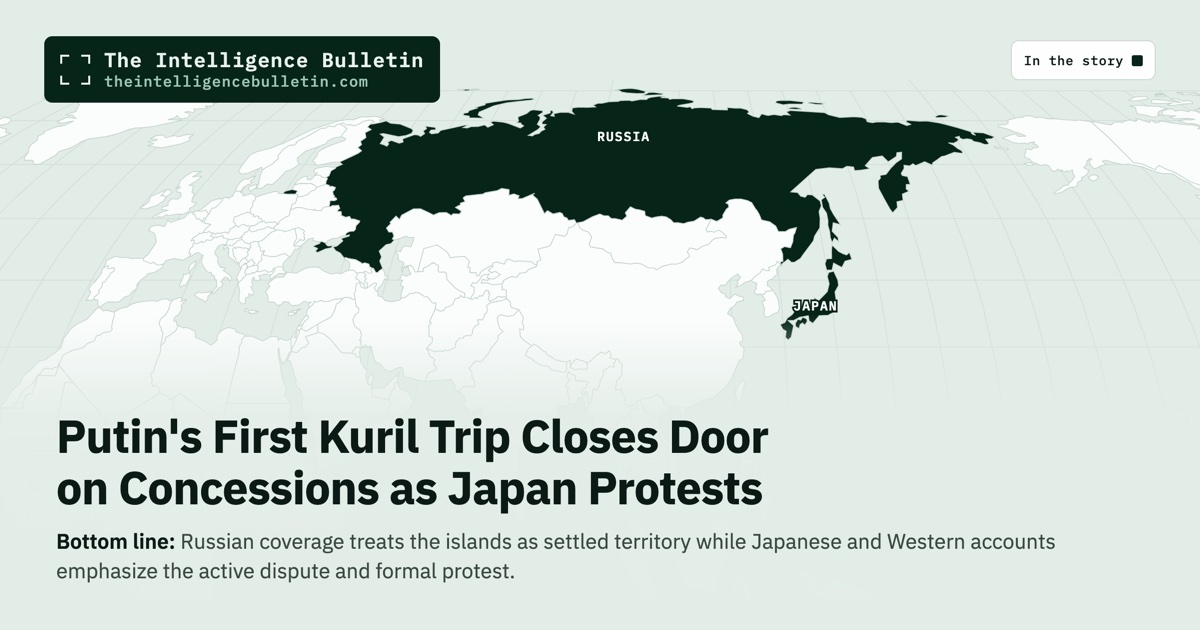
Russian coverage treats the islands as settled territory while Japanese and Western accounts emphasize the active dispute and formal protest.
Russian domestic reporting presents the visit as a straightforward affirmation of sovereignty with the territorial question settled by postwar realities, while Japanese and most international accounts frame it as a deliberate diplomatic slight that hardens an already closed dispute. Vedomosti stresses that Moscow sees no near-term prospect of renewed talks given Tokyo’s sanctions and current leadership, treating the islands unambiguously as Russian. In contrast, Japan Today, Deutsche Welle and the Moscow Times all lead with the formal protest by Foreign Minister Motegi and Prime Minister Takaichi’s statement that the visit offends Japanese sentiments and damages long-term relations. The Times of India widens the lens to regional power balances and energy implications without altering the core facts. Across independent chains the reporting converges on the absence of any Russian concession signal; the visit followed Pacific Fleet drills and coincided with continued criticism of Japanese policy, confirming that both sides’ positions remain entrenched rather than fluid.
Full analysis
Russian President Vladimir Putin arrived on Iturup island in the Kuril chain on August 13, the first such visit of his presidency. Russian state media reported that he inspected the Yasny fish-processing plant, examined local catches including tuna and halibut, sampled fish roe, and spoke with residents. One exchange captured in footage showed him remarking on the weather to locals: “What lovely weather you have there, just like a resort!” The trip followed his attendance at the final stage of Pacific Fleet exercises on nearby Sakhalin island, where he had discussed security for Russia’s eastern borders.
Japan immediately registered its objection. Foreign Minister Toshimitsu Motegi summoned Russian ambassador Nikolai Nozdrev and delivered a formal protest, stating that the Northern Territories, including Etorofu, constitute Japan’s inherent territory both historically and under international law. Prime Minister Sanae Takaichi later told reporters that the visit “offends the sentiments of the Japanese people and is absolutely unacceptable,” adding that it would make restoring relations more difficult in the medium to long term. The islands in question—Iturup, Kunashir, Shikotan and the Habomai group—have remained under Russian administration since Soviet forces took them in the final days of World War II in 1945. No peace treaty between Russia and Japan has ever been concluded, leaving the territorial status unresolved.
Putin used the Sakhalin stop to address the broader context directly. He described Japanese sanctions imposed after the 2022 invasion of Ukraine as unprovoked and noted that Japanese defense documents now list Russia among primary threats, despite what he called the absence of any Russian territorial claims against Japan. He recalled the 1956 Soviet-Japanese joint declaration that had opened a path toward a peace treaty and observed that earlier periods, including under former prime minister Shinzo Abe, had allowed constructive engagement. Russian accounts framed the current Japanese position as a unilateral shift that closed off further discussion.
The visit itself received coverage that diverged sharply in emphasis. Japanese reporting centered on the protest statements and the long-standing claim to the four islands. International outlets carrying agency material similarly foregrounded Tokyo’s diplomatic response and the historical seizure. Russian domestic analysis, by contrast, presented the islands as settled Russian territory whose status derives from the outcome of the Second World War and treated the Japanese reaction as predictable given the sanctions environment. One Russian outlet quoted experts who concluded that the current Japanese leadership would not make the concessions needed for renewed talks and that Moscow therefore saw no near-term prospect of stabilization.
The exiled Russian newsroom publishing from Amsterdam placed greater weight on the ambassadorial summons and the prime minister’s remarks about damaged long-term prospects, aligning in tone with the Japanese and European accounts rather than with domestic Russian framing. German coverage situated the episode within the wider pattern of sanctions-era tensions and the absence of progress on any peace treaty. Indian reporting noted the visit’s timing against the backdrop of Pacific Fleet drills and deepening military cooperation between Russia and North Korea, while underscoring the potential effects on energy and regional power balances.
Across the independent reporting chains the same core sequence appears without contradiction: Putin conducted the inspection on Iturup after the Sakhalin exercises, Japan lodged its protest through the ambassador and public statements by the foreign minister and prime minister, and Russian commentary described the territorial question as closed. No source reported any accompanying Russian offer of talks or concession. The 2010 precedent of a visit by then-president Dmitry Medvedev is noted uniformly as the last occasion a Russian leader had set foot on the disputed islands.
The reporting therefore converges on one concrete outcome. The visit supplied a visible demonstration that Moscow intends to maintain full administrative control and sees no immediate utility in reopening negotiations under present conditions. Japanese statements make equally clear that Tokyo continues to regard the islands as its sovereign territory and will register objections to any Russian leader’s presence there. The sanctions imposed after 2022 remain in place on one side and are described by Moscow as unprovoked on the other, with neither side indicating movement toward compromise.
What to Watch
The account that best matches the observed actions is the one that registers both the protest and the absence of any Russian signal of flexibility. Japanese and European reporting document the diplomatic steps Tokyo took on the day; Russian domestic analysis records the Kremlin’s view that the matter is settled. The two descriptions sit alongside each other without reconciliation because the underlying positions have not changed. Future movement would require either a shift in Japanese sanctions policy or a Russian willingness to revisit the 1956 declaration framework—neither of which the present coverage indicates is under consideration.
That’s how the world told the story.
Get our daily open-source intelligence on world events in your inbox — one email a day, up to six stories.
Subscribe freeNo spam. One-click unsubscribe. See the latest email →