 AI-generated analysis published under the editorial responsibility of Rohit Sinnas. How it works →
Press quoted
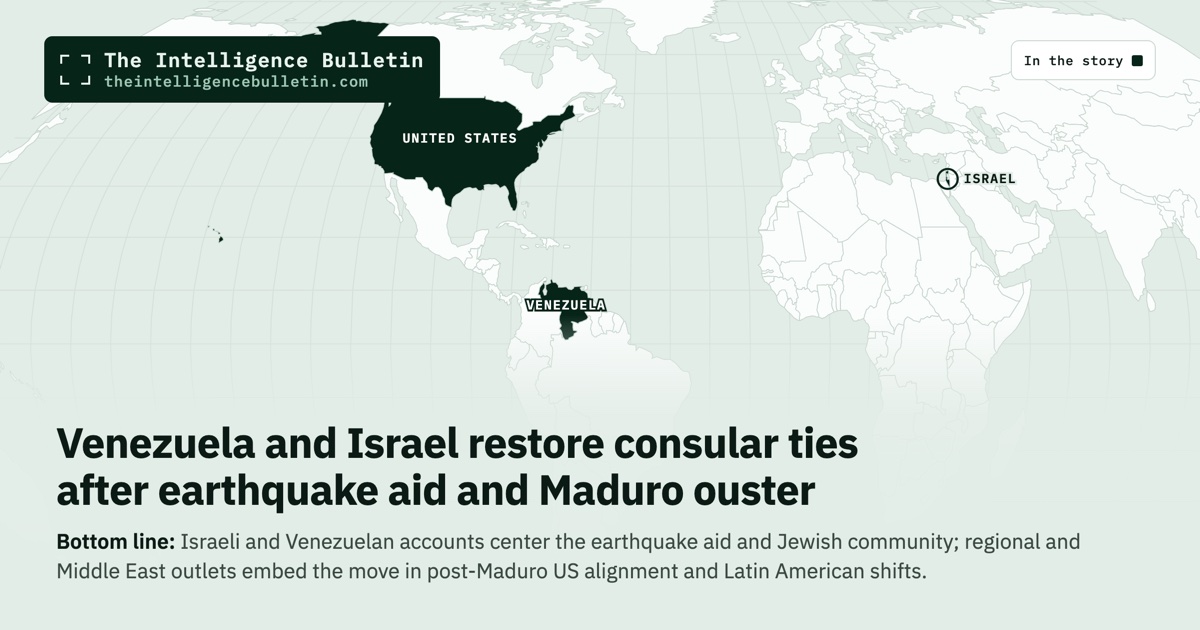
Israeli and Venezuelan accounts center the earthquake aid and Jewish community; regional and Middle East outlets embed the move in post-Maduro US alignment and Latin American shifts.
The reporting converges on the earthquake aid as the immediate trigger and on the statements from the two foreign ministers, yet the outlets differ sharply in what larger story they attach to those facts. Israeli coverage frames the step as the start of rebuilding trust through humanitarian action after years of quiet channels, placing the emphasis on practical services for citizens and the Jewish community. Venezuelan reporting stresses the official announcement and the value of the local Jewish population as a bridge, while situating the decision inside post-Maduro realignment and gratitude for the aid. Regional Latin American accounts, including Argentine and Colombian, tie the development to Caracas’s broader pivot away from Iran and toward Washington after Maduro’s capture, and they note the aid as the catalyst that made formal contact possible again. Middle East-focused coverage widens the lens further, linking the move to a wave of right-leaning Latin American governments normalizing with Israel even as other regional dynamics continue. The shared factual core is narrow and consistent; the divergence lies in whether the story is told as bilateral humanitarian progress, Venezuelan domestic realignment, or part of shifting hemispheric alignments. No outlet disputes the sequence of the aid, the 2009 break, or the limited consular scope of the new agreement.
Full analysis
Venezuela and Israel announced on August 12, 2026, that they had agreed to restore consular relations after a 17-year break that began when Hugo Chávez severed ties on January 15, 2009. The immediate trigger was Israeli humanitarian assistance sent after a double earthquake struck Venezuela on June 24. Israeli statements described a coordination mechanism that would provide consular services to citizens of both countries and continue technical cooperation already under way in the earthquake zone. Venezuelan statements made the same points and added that the two governments recognized the importance of the link between the State of Israel and the Jewish community resident in Venezuela, which they called an important historic bridge of friendship.
The 2009 rupture occurred one week after Chávez expelled the Israeli ambassador, an action taken in solidarity with Palestinians during Israel’s military operation in Gaza. For the next seventeen years Caracas maintained a critical posture toward Israel and strengthened ties with countries at odds with it, including Iran. The new arrangement does not restore full diplomatic relations or reopen embassies. It is confined to consular services and the continuation of post-disaster technical work.
Israeli reporting placed the heaviest weight on the humanitarian sequence that produced the agreement. A Jerusalem Post opinion piece described how Israeli delegations, including teams from ZAKA, NATAN and IsraAID, arrived after the quakes, worked alongside Venezuelan officials, and recovered bodies and delivered aid in La Guaira and elsewhere. It noted that a preliminary Israeli team reached Venezuela on July 1 and that Prime Minister Benjamin Netanyahu had publicly linked the delegations to the rebuilding of both physical ruins and bilateral relations. The same account recalled years of quiet contacts maintained by Rabbi Isaac Cohen, chief rabbi of the Israelite Association of Venezuela, who delivered a letter to Foreign Minister Félix Plasencia on August 9 requesting the restoration of ties. Reactions from former Venezuelan ambassador Milos Alcalay and the last Israeli counselor in Caracas, Eldad Golan, were presented as evidence that the step enjoyed support across political lines inside Venezuela.
Venezuelan coverage, as carried by Correo del Caroní, reproduced the government’s communiqué almost verbatim. It emphasized that the agreement followed the arrival of the Israeli humanitarian delegation and that both sides had pledged to maintain technical cooperation on damage assessment, structural evaluation and contingency planning. The piece highlighted the strategic value the Venezuelan Foreign Ministry attached to the local Jewish community as a bridge and placed the development inside the broader context of post-earthquake recovery under acting President Delcy Rodríguez.
Regional and external outlets attached additional political context. Ámbito in Argentina described the consular step as part of Caracas’s shift away from Iran and toward alignment with Washington after the January 3 capture of Nicolás Maduro by U.S. forces. It noted that the new channel remained limited to consular matters but quoted analysts who viewed it as a possible starting point for fuller normalization. Middle East Eye placed the announcement inside a wider pattern of right-leaning Latin American governments restoring or strengthening ties with Israel. It referenced earlier unofficial contacts, including a February report of Venezuelan crude reaching Israel, and placed the move alongside Colombia’s recognition of Israeli sovereignty over the Golan Heights and Honduras’s return of an ambassador. El Tiempo in Colombia, relying on EFE and AFP dispatches, centered the earthquake aid itself: the composition of the Israeli team of civil engineers, the role of Israeli Defense Forces officer Elad Edri in advising on debris management, and Rodríguez’s July expression of gratitude for the mission.
The accounts converge on the sequence of the aid, the date of the 2009 break, the names of the two foreign ministers who issued statements, and the strictly consular scope of the new arrangement. They diverge in the larger frame they supply. Israeli coverage treats the development primarily as the reopening of practical services and the resumption of people-to-people contact after a period of quiet diplomacy. Venezuelan coverage stays close to the official text and stresses the role of the local Jewish population. Argentine and Colombian reporting foreground the earthquake as the catalyst while noting the post-Maduro foreign-policy turn. Middle East Eye widens the lens to a regional diplomatic trend.
The narrowest, most consistently corroborated account across the five outlets is the one that stays inside the two governments’ statements: an agreement limited to consular services and continued technical cooperation that followed Israeli aid after the June earthquakes. That core is carried by the actor-country pieces and by the wire material reproduced in El Tiempo. The additional political framing—Maduro’s capture, the pivot away from Iran, the pattern of other Latin American governments—appears in the Argentine, Colombian and Middle East Eye reporting but is absent from the Israeli and Venezuelan accounts. Those external frames are not contradicted by the primary statements; they simply add interpretive layers drawn from each outlet’s larger vantage.
What to Watch
The Israeli and Venezuelan reporting therefore sits closest to the documentary record of the announcements themselves. Both countries have an interest in presenting the step as a practical, humanitarian outcome rather than a geopolitical realignment. Regional and Middle East outlets, by contrast, have an interest in reading the move as evidence of shifting alignments. The next concrete development to watch is whether the consular channel produces visible services for citizens or remains largely symbolic. The earthquake recovery work already under way supplies a measurable test: if joint technical teams continue and report results, the limited agreement will have produced tangible activity even without full diplomatic restoration.
That’s how the world told the story.
Get our daily open-source intelligence on world events in your inbox — one email a day, up to six stories.
Subscribe freeNo spam. One-click unsubscribe. See the latest email →