 AI-generated analysis published under the editorial responsibility of Rohit Sinnas. How it works →
Press quoted
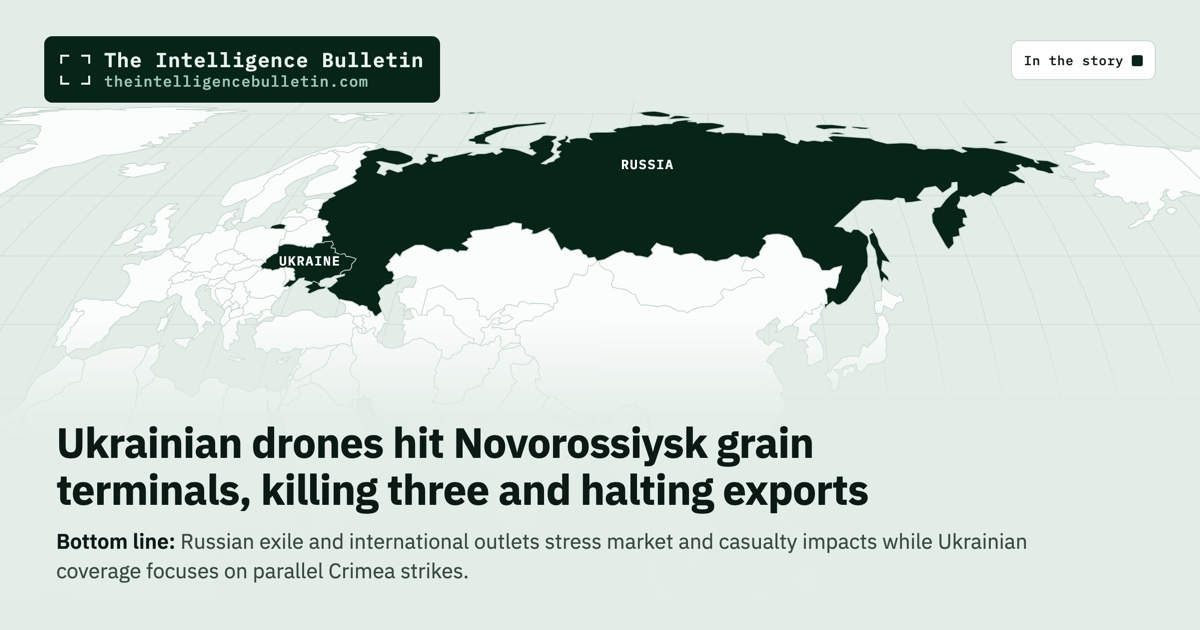
Russian exile and international outlets stress market and casualty impacts while Ukrainian coverage focuses on parallel Crimea strikes.
Reporting across the sources converges on concrete damage to Novorossiysk grain terminals and a resulting spike in wheat futures, yet diverges sharply on context and emphasis. The Moscow Times, drawing on Russian industry sources and regional officials, details casualties and specific terminal shutdowns while noting the FT account of Ukraine’s agreement with US Vice President JD Vance to avoid striking Caspian Pipeline Consortium oil infrastructure. South China Morning Post, via Bloomberg, foregrounds Russia’s foreign ministry warning of deliberate market chaos and names three affected terminals. Kyiv Post instead centers satellite-confirmed fires from parallel drone strikes in Crimea, treating Novorossiysk only indirectly through the broader overnight campaign. This pattern shows Ukrainian outlets highlighting military reach into occupied territory, Russian exile reporting focusing on local human and operational cost, and international coverage stressing export disruption. The absence of any outlet claiming verification of terminal damage beyond Russian and market sources underscores that the shared factual core rests on official Russian statements and industry leaks rather than independent confirmation on the ground.
Full analysis
Ukrainian drones struck the Black Sea port of Novorossiysk on the night of August 11-12, damaging grain handling facilities and prompting Russian officials to report three deaths, including an eight-year-old child. Industry sources described two major grain terminals put out of action, with a third also affected according to later accounts. A loading gallery at the United Grain Novorossiysk Grain Plant collapsed and several silos sustained damage. At the Demetra terminal a gallery and truck unloading facility were hit, while the KSK terminal suffered direct strikes. Grain shipments from the port became impossible in the immediate aftermath.
Russian regional governor Veniamin Kondratyev stated that the attack killed at least three people and wounded others in the Krasnodar region where Novorossiysk sits. Novorossiysk mayor Andrei Kravchenko said water supplies to the port city were suspended and an emergency declared after damage to four unspecified enterprises, more than two dozen residential buildings, and some educational facilities. Unverified social media video showed flames and smoke rising from the area. Ukrainian President Volodymyr Zelenskiy said on Telegram that forces had targeted the Novorossiysk naval base with drones, missiles, and unmanned boats.
The same overnight wave produced fires at multiple sites in Russian-occupied Crimea. Satellite imagery from the Crimean Wind monitoring group showed two active fires near Balaklava south of Sevastopol, one near a transport junction and another near Vasili Beach. A third fire was recorded at a Russian military border facility in the village of Risove in northern Crimea. Russian-installed Sevastopol governor Mikhail Razvozhayev reported that drone debris fell in several parts of the city and started fires that emergency crews worked to extinguish.
Russia is the world’s largest wheat exporter and routes most of those shipments through Black Sea ports including Novorossiysk. The port also handles oil exports via the Caspian Pipeline Consortium line, which carries Kazakh crude and counts Chevron and Exxon Mobil among its owners. Chicago wheat futures rose around three percent on the day after the strikes, with some reports noting intraday gains as high as four percent.
Foreign ministry spokeswoman Maria Zakharova described the strikes on grain and agricultural infrastructure as a cynical campaign to incite chaos in the global food market that served the interests of certain Western nations. The Moscow Times account, drawing on Reuters reporting, added that Ukraine had agreed in late July, following a request from U.S. Vice President JD Vance, not to target Caspian Pipeline Consortium infrastructure or non-Russian vessels provided they carried no sanctioned cargo. The Ukrainian presidency did not respond to requests for comment on that arrangement. No indication emerged that the pipeline facilities or associated tankers were struck.
The three source articles converge on operational disruption at the Novorossiysk grain terminals and the immediate market reaction in wheat futures. Two independent reporting chains, one through Reuters and one through Bloomberg, cite Russian industry sources for the terminal shutdowns. The Kyiv Post piece, however, makes no reference to Novorossiysk grain facilities and instead centers satellite evidence of fires in Crimea. The Moscow Times piece alone supplies the casualty count from regional governor Kondratyev and the detail of the U.S. request regarding oil infrastructure. The South China Morning Post piece alone foregrounds Zakharova’s warning of market chaos and names the three specific terminals.
A reader limited to the Kyiv Post account would register successful Ukrainian strikes on occupied territory but would miss both the reported deaths and the scale of grain export interruption. A reader limited to the South China Morning Post account would see the export and price consequences but would not encounter the casualty figure or the reported U.S. understanding on oil shipments. A reader limited to the Moscow Times account would receive the fullest local impact details yet would still rely on the same industry-sourced descriptions of terminal damage that appear in the Bloomberg material.
The shared factual spine rests on Russian official statements about casualties and infrastructure effects together with industry leaks about terminal operations. No outlet in the set claims independent on-site verification of the terminal damage. The reported U.S. request supplies context for why oil infrastructure appears to have been spared while grain facilities were not. Wheat futures moved in direct response to the news of halted shipments, consistent with Novorossiysk’s role in global supply.
What to Watch
The convergence on terminal damage and price impact indicates that the event carried measurable consequences for food markets regardless of which national press framed the story. The single-source elements, particularly the casualty count and the U.S. arrangement, remain open to further reporting from additional chains. The pattern of coverage shows each outlet selecting the dimension most aligned with its audience: military reach for the Ukrainian outlet, local human and operational cost for the exiled Russian outlet, and export disruption for the international wire service. This selection effect leaves any single reader short of the full picture of how the strike intersected with both immediate loss of life and longer-term supply risks.
That’s how the world told the story.
Get our daily open-source intelligence on world events in your inbox — one email a day, up to six stories.
Subscribe freeNo spam. One-click unsubscribe. See the latest email →