 AI-generated analysis published under the editorial responsibility of Rohit Sinnas. How it works →
Press quoted
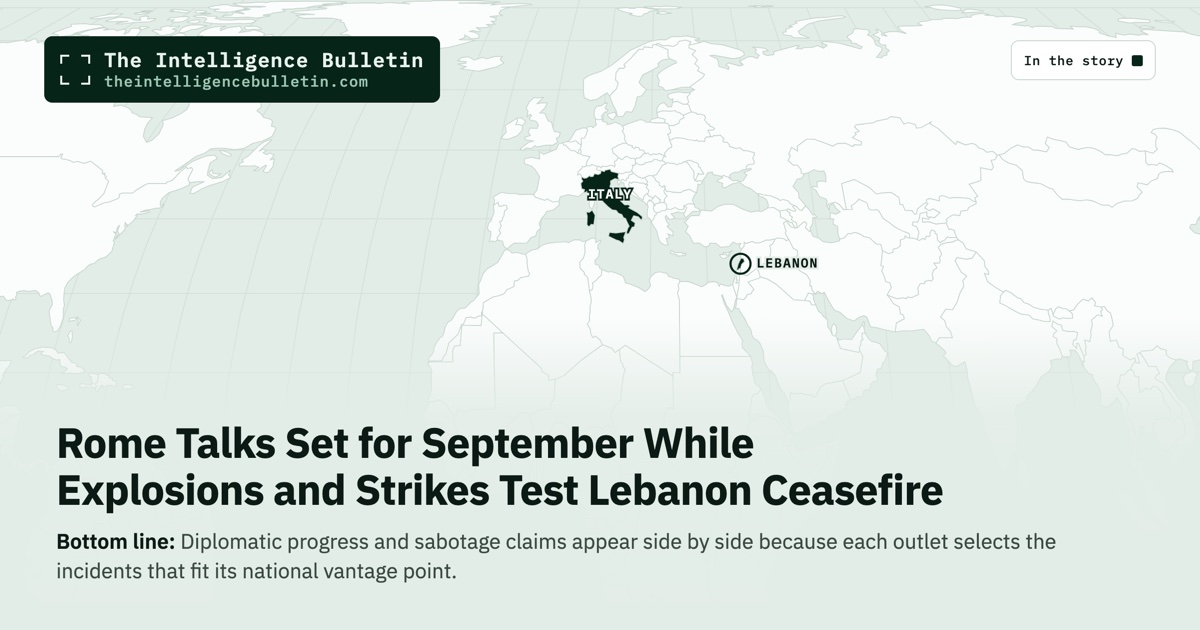
Diplomatic progress and sabotage claims appear side by side because each outlet selects the incidents that fit its national vantage point.
The reporting shows the ceasefire framework advancing on paper through US-brokered technical talks while ground incidents keep testing it. Arab News and the US official statements treat the Rome round as concrete progress with aligned maps and procedures already in pilot zones. Algemeiner links recent explosions to Hezbollah devices that may be left behind recklessly or placed deliberately to warn Lebanese forces and disrupt talks. Erem News quotes a Lebanese military source describing Hezbollah’s shift to mining civilian structures after losing positions, creating long-term obstacles to returns even after any Israeli pullback. Middle East Eye records a fresh Israeli bombing in Bint Jbeil as evidence of ongoing strikes despite the truce. Libnanews frames the stalled pace as Lebanon squeezed between field realities and Israel’s domestic calendar. The accounts converge on the existence of the Rome channel and the June framework but split on agency: one set attributes friction to Hezbollah tactics, another to Israeli actions and timing pressures. No outlet claims the framework has collapsed, yet each national lens selects different incidents to explain why implementation remains slow.
Full analysis
The United States announced it will sponsor a new round of direct talks between Israel and Lebanon in early September in Rome. A State Department official described the political track as already yielding results, with working groups aligned on language, maps and procedures in the current pilot zones. Lebanon is expected to present detailed roadmaps for securing additional areas once implementation advances in those zones. The framework under discussion dates to June, when the two sides agreed to a phased Israeli withdrawal from southern Lebanon, deployment of the Lebanese army, and steps toward Hezbollah disarmament.
That framework emerged after months of fighting that began when Hezbollah fired rockets into Israel in support of Iran in March. Israel responded with airstrikes and a ground operation. A ceasefire took hold on June 19. Since then the political channel has continued through meetings in Beirut, Jerusalem and Washington, with Rome as the latest venue. The United States has described the trajectory as positive, noting that the first zones are already live.
Ground conditions remain unsettled. On August 5 two Israeli soldiers were killed and four others wounded while clearing Hezbollah infrastructure in the southern Lebanese town of Majdal Zoun. Israel attributed the deaths to a Hezbollah explosive device and responded with targeted strikes that killed one person and wounded twelve others. Earlier incidents involved similar devices. On July 18 one Lebanese soldier was killed and two wounded when a Hezbollah explosive detonated. On August 2 a Lebanese military transport vehicle struck another device, wounding five soldiers.
Egyptian reporting adds that Hezbollah shifted tactics after losing positions in southern Lebanon. A Lebanese military source told Erem News that the group has mined civilian buildings and roads in areas it once controlled. The purpose, according to the source, was to raise the cost of Israeli movement and keep territory expensive even after fighters withdrew. The same mining, however, has left villages and farmland hazardous for Lebanese civilians seeking to return. Areas require engineering surveys before residents can safely re-enter homes or work fields. The source noted that simply securing an Israeli withdrawal does not automatically allow immediate civilian return.
Israeli reporting frames the same device incidents as evidence that Hezbollah may be trying to sabotage cooperation between Israeli and Lebanese authorities. An analysis cited by The Algemeiner raises the possibility that the group is sending deliberate warnings to the Lebanese state and army not to interfere with its activities. It also allows that some devices may simply have been left behind recklessly during earlier fighting. Either interpretation, the account concludes, leaves open the question of whether Hezbollah can be prevented from disrupting the ceasefire.
Lebanese coverage places the emphasis elsewhere. A press review published by Libnanews describes the current negotiation blockage as placing Lebanon under simultaneous pressure from events on the ground and from Israel’s electoral calendar. The review compiles local commentary that treats stalled progress as the product of external timing constraints rather than solely internal Lebanese or Hezbollah decisions.
British-based reporting records a separate Israeli action. On August 11 Middle East Eye reported that Israel conducted a massive bombing on the village of Haddatha in the Bint Jbeil district of southern Lebanon, citing the Lebanese state-run National News Agency. The update presented the strike as ongoing despite the June truce.
Saudi coverage of the same period foregrounds the diplomatic channel. Arab News relayed the State Department announcement of the September Rome round and quoted the official’s assessment that conversations would continue in the interim capitals while the political track reconvened in Italy. The piece notes that Hezbollah has rejected the direct talks and refuses to surrender its weapons, yet it records decreased violence overall since the June deal and the earlier US-Iran understanding.
A reader limited to any single national lens would miss half the picture. An Israeli reader encountering only The Algemeiner account would see repeated device attacks as the central threat to the truce and would not encounter reporting of fresh Israeli strikes on Lebanese villages. A Saudi reader of Arab News would register diplomatic momentum and pilot-zone implementation without the detail on mining or soldier casualties. A Lebanese reader of Libnanews would absorb the argument that Israel’s domestic calendar is constraining talks but would not see the Egyptian military-source description of Hezbollah mining civilian structures. An Egyptian reader of Erem News would learn about long-term barriers to civilian return created by Hezbollah tactics but would not read the US official’s statement that working groups have already aligned on maps and procedures. A British reader of Middle East Eye would register the August 11 bombing but would not see the corroborated US confirmation that the next formal round is scheduled for September in Rome.
The accounts converge on two points that matter for what happens next. All five sources treat the June framework and the Rome channel as real and ongoing rather than collapsed. None claims that implementation has been abandoned. The single-source reports of specific incidents therefore sit inside an acknowledged diplomatic process rather than outside it.
The clearest warrant for continued movement lies in the US official statement carried by Arab News: the first zones are live and the working groups have aligned their procedures. That statement is the only corroborated claim across independent reporting chains in the set. The single-source attributions on device incidents and on the August 11 strike remain narrower. Israeli and Egyptian accounts both point to Hezbollah’s ordnance as creating durable obstacles on the ground, yet they differ on intent. The Lebanese and British accounts foreground Israeli actions and timing pressures. No outlet supplies evidence that either side has abandoned the September round.
What to Watch
The practical next step is therefore whether the pilot zones can expand without new explosions or strikes derailing the technical work already under way. The Rome meeting will test whether the maps and roadmaps already aligned can be translated into additional areas before the next electoral or field pressure intervenes.
That’s how the world told the story.
Get our daily open-source intelligence on world events in your inbox — one email a day, up to six stories.
Subscribe freeNo spam. One-click unsubscribe. See the latest email →