 AI-generated analysis published under the editorial responsibility of Rohit Sinnas. How it works →
Press quoted
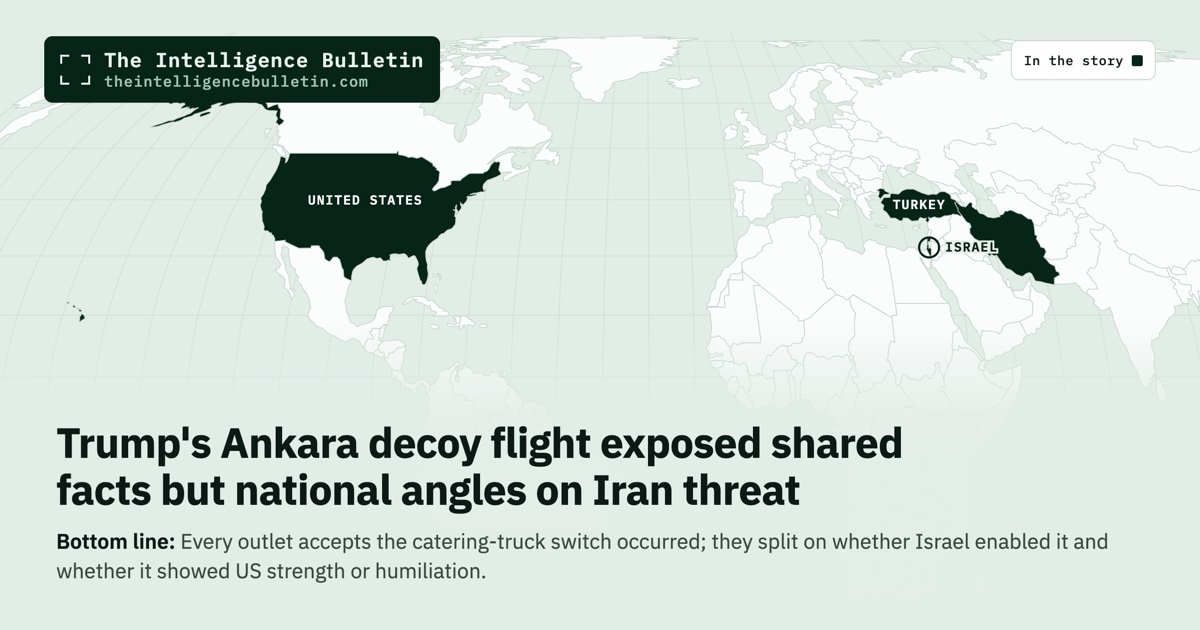
Every outlet accepts the catering-truck switch occurred; they split on whether Israel enabled it and whether it showed US strength or humiliation.
The reporting converges on the core facts of the July 8 Ankara deception operation but parts company on attribution and implications in ways that reveal national priorities. US accounts from Outside the Beltway relay Washington Post and New York Times reporting to portray the ruse as a necessary Secret Service success that protected the president without public disclosure of methods. Israeli coverage in the Jerusalem Post, drawing from a Wall Street Journal dispatch, uniquely stresses Israeli intelligence warning of shoulder-fired missiles and coordination that enabled the switch. Al Jazeera’s Reuters-sourced piece quotes Trump directly asserting greater risk on the decoy aircraft, underscoring American vulnerability under Iranian pressure. Turkish outlet Haber Aktüel treats the catering-truck escape at their national airport as evidence that the ongoing war has humiliated US leadership on allied soil and failed to end hostilities. The Iranian opposition NCRI frames the threat itself as proof of regime weakness and internal fragility. No single account invents the event; the divergence lies in which actor receives credit or blame, with Israeli assistance and Turkish location emerging as the clearest points of selective emphasis across independent reporting chains.
Full analysis
On July 8, President Donald Trump left a NATO summit in Ankara after U.S. forces had renewed strikes on Iran following a collapse in negotiations. He boarded the visible former Air Force One in full view of television cameras, then minutes later was moved out of sight through an airport catering truck to a smaller C-32A military aircraft parked nearby. That older jumbo jet continued onward with journalists and some White House staff aboard, serving as a decoy while the president flew separately to a U.S. base in Britain before returning to Washington. The operation responded to intelligence warnings of an Iranian assassination threat that included the possibility of shoulder-fired missiles targeting the presidential aircraft. Trump later told reporters that he followed Secret Service and military advice to change planes, adding that the aircraft he actually flew on carried greater risk because it would have been the more likely target.
The maneuver kept his true movements hidden from the public and many senior officials for hours. It occurred the night after renewed U.S. strikes on Iran, at a time when Turkey, a NATO member sharing a border with Iran, hosted the summit. U.S. officials described the deception as a standard protective technique used in past high-threat situations, such as President Clinton’s 2000 visit to Pakistan, where a visible plane also served to mask the actual route. Decades-old concerns over Iranian plots against American officials had intensified with Washington’s role in strikes that killed Iranian military and political leaders, including during the current conflict.
Accounts of these operational steps align across reporting from U.S., Israeli, Qatari, and Turkish outlets. The Jerusalem Post relayed a Wall Street Journal account that added the detail of Israeli intelligence providing the initial warning of the plot. Al Jazeera carried a Reuters dispatch quoting Trump directly on the greater risk to the decoy plane. Turkish coverage from Haber Aktüel described the catering-truck transfer at Ankara airport as the concrete location where the switch occurred. The National Council of Resistance of Iran, an exile opposition group, treated the existence of the threat itself as the central development without disputing the mechanics of the escape.
Where the accounts diverge is in the meaning attached to those mechanics. U.S. domestic reporting, such as the piece in Outside the Beltway that relayed Washington Post and New York Times material, presents the episode as evidence that security officials judged the threat grave enough to justify the elaborate ruse, including the use of unwitting press and staff as decoys on the visible aircraft. It emphasizes that presidents have traveled without the press corps in rare high-risk cases and that protecting the president from foreign adversaries remains paramount even when it requires secrecy.
Israeli reporting foregrounds the role of Israeli intelligence in flagging the specific missile threat and enabling the coordinated switch, framing the event as proof of close U.S.-Israel alignment against Iran. This element appears in only one reporting chain and receives no mention in the U.S., Qatari, or Turkish accounts examined. Al Jazeera’s coverage, centered on Trump’s own words, stresses the continuing pressure from Iran and the admission of vulnerability on the part of U.S. leadership, quoting the president saying he simply had to follow the advice given.
Turkish coverage centers the location of the incident at a Turkish airport during a NATO gathering and treats the episode as a visible sign that the ongoing war has not ended hostilities or restored U.S. freedom of movement on allied territory. It notes that Trump’s earlier public statements about the war’s progress stand in tension with the need for such precautions months into the conflict. The opposition Iranian outlet frames the threat and the resulting precautions as indicators of regime weakness inside Iran, arguing that the need to target a U.S. president at this level reveals internal fragility rather than strength.
These differences in emphasis do not contradict the shared sequence of events but alter what a reader would conclude depending on which single account they encountered. A reader limited to U.S. reporting would see primarily an internal security success. One limited to the Israeli account would register foreign assistance as decisive. One reading only the Qatari-sourced material would register an explicit acknowledgment of risk. One reading only the Turkish piece would register the episode as evidence of strategic stalemate on Turkish soil. The opposition Iranian view would register it as regime vulnerability.
The corroborated elements rest on multiple independent U.S. official accounts carried through separate outlets. The single-source claim of Israeli assistance traces to one U.S. official cited in the Wall Street Journal. Trump’s statement on relative risk traces to his own on-record comments carried by Reuters. No outlet examined disputes the core transfer occurred or that an Iranian threat prompted it. The Turkish perspective adds the concrete detail that the switch happened on the territory of a NATO ally that borders Iran, a geographic fact that places alliance dynamics at the center of the story. The opposition Iranian framing treats the threat as the regime’s own signal of distress, consistent with its broader editorial stance but without new evidence on the U.S. side.
What to Watch
The operational facts therefore stand on the widest base of reporting, while the interpretive weight given to Israeli help, American exposure, Turkish hosting, or Iranian weakness each reflects the vantage of the outlet carrying it. A reader who encounters only one of these will miss the dimensions that the others supply, particularly the location’s significance and the limits of what has been confirmed beyond U.S. official sourcing. The episode shows that even amid active hostilities, the mechanics of presidential protection can still be executed on allied soil, yet the need for the ruse itself registers differently depending on whether the reader’s source treats that need as routine precaution, allied success, regional pressure, local embarrassment, or adversary weakness.
That’s how the world told the story.
Get our daily open-source intelligence on world events in your inbox — one email a day, up to six stories.
Subscribe freeNo spam. One-click unsubscribe. See the latest email →