 AI-generated analysis published under the editorial responsibility of Rohit Sinnas. How it works →
Press quoted
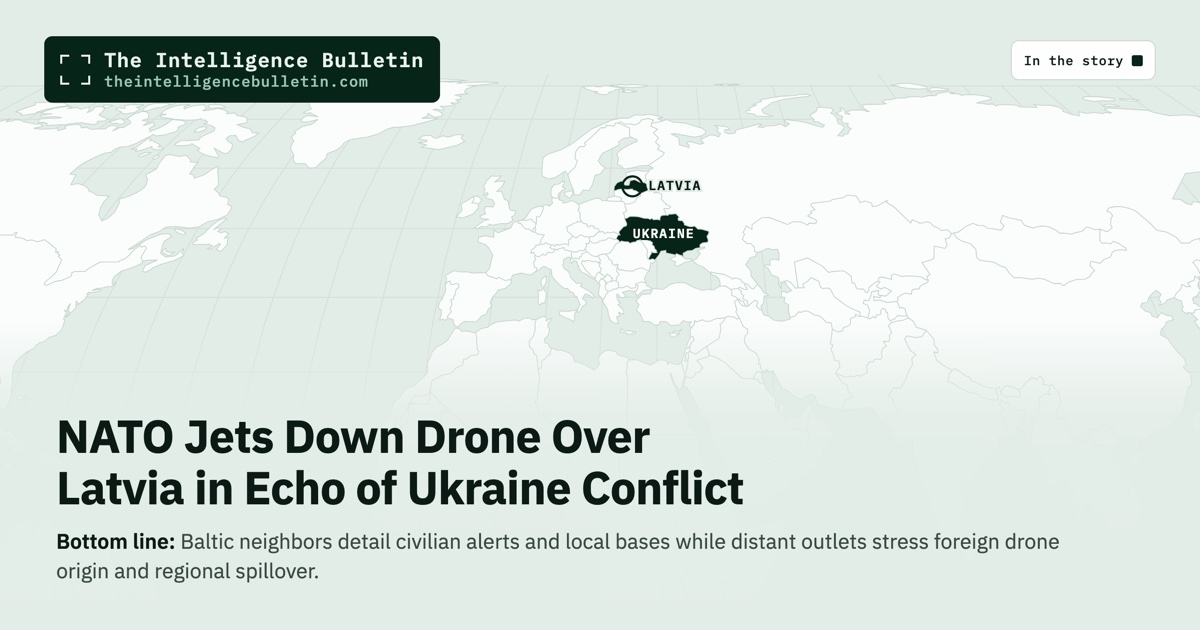
Baltic neighbors detail civilian alerts and local bases while distant outlets stress foreign drone origin and regional spillover.
The reporting converges on Russian electronic warfare diverting the drone yet the outlets diverge sharply by proximity. Latvian coverage centers on the dawn mobile alerts that roused residents across five municipalities including pilgrims sheltering in Aglona cellars. Lithuanian accounts stress the operational success of Italian jets scrambled from Šiauliai as proof of integrated NATO air policing. Estonian pieces frame the episode as bringing war-like conditions with civilians hiding from the alarm. German and Czech reports embed it in the Ukraine conflict’s spillover noting prior incidents and Finnish precautions without local civilian details. This pattern shows how distance shapes emphasis: neighbors foreground immediate disruption and their own bases while farther outlets highlight foreign origin and broader security risks. All accounts draw from NATO-member military statements leaving the information environment one-sided. The repeated references to similar past events indicate an established pattern rather than an isolated breach.
Full analysis
Early on the morning of August 14 2026 a foreign drone crossed into Latvian airspace over the northeastern Balvi region. Latvian National Armed Forces activated NATO Baltic Air Policing fighters, which intercepted and destroyed the aircraft at high altitude. The engagement ended an orange-level airspace threat that had been declared shortly before 4 a.m. local time across five eastern municipalities: Augšdaugava, Preiļi, Rēzekne, Balvi and Alūksne. Residents there received mobile alerts instructing them to remain indoors or seek shelter. The all-clear followed roughly an hour later once the drone had been brought down.
Latvian armed forces described the object as an unmanned aerial vehicle that had entered national airspace under the influence of Russian electronic warfare. Spokeswoman Iveta Bērziņa told Latvian Radio that the drone had been shot down at considerable height, so wreckage could be scattered over a wide area. Search teams including soldiers, national guardsmen and police were deployed to locate debris. The same statement noted that similar incursions had occurred earlier in the year, most recently in June when French jets downed another drone between Rēzekne and Kārsava.
Lithuanian authorities supplied additional operational detail. Vilmantas Vitkauskas, chief of Lithuania’s National Crisis Management Centre, stated that the intercepting aircraft had been scrambled from the Šiauliai Air Base in northern Lithuania. The jets made contact with the object minutes after takeoff and destroyed it shortly afterward. Vitkauskas compared the episode to an earlier May incident in which Russian electronic warfare systems had redirected a Ukrainian drone toward NATO territory. Lithuanian Defence Minister Robertas Kaunas said the precise origin of the drone remained under investigation but confirmed no damage had been reported on the ground.
Estonian reporting relayed the Latvian account while adding local color from the Aglona pilgrimage site, where several groups of worshippers had gathered for the August 15 feast of the Assumption. Video from Latvian Television showed pilgrims taking cover in the basement of a Catholic school after the mobile alert reached them. The same dispatch noted that Finnish authorities had simultaneously restricted air and maritime traffic in the eastern Gulf of Finland, a precautionary measure Finland has used before in the same corridor near Kotka.
German coverage placed the incident inside the wider Ukraine conflict. It recorded that Russia had reported downing fifteen drones over the Leningrad region the same night, an area bordering both Finland and Estonia. The account also referenced a June NATO intercept over Latvia and observed that northern NATO members were tightening security around critical infrastructure amid fears that Moscow might stage false-flag attacks using diverted Ukrainian drones.
Czech reporting summarized the event under the description of a foreign drone shot down by NATO fighters over Latvia, without further operational or local detail.
The five accounts converge on the core sequence: a drone entered Latvian airspace, NATO jets destroyed it, and an air alert covered five eastern municipalities. They also agree that Russian electronic warfare was the most likely cause of the incursion and that the object was probably Ukrainian in origin. Finnish traffic restrictions and the existence of prior similar incidents appear in more than one independent chain.
Where the accounts differ is in emphasis rather than in disputed facts. The Latvian source foregrounds the mobile warnings sent to residents of the five municipalities and the high-altitude nature of the shoot-down. Lithuanian reporting supplies the only named attribution for the scramble base and the only direct comparison to the May incident. Estonian coverage alone records the sheltering of pilgrims at Aglona. German and Czech accounts supply the broader Ukraine-war context and the Leningrad-region drone activity but omit the names of the Latvian municipalities and the specific base involved.
A reader limited to any single national outlet would therefore miss part of the picture. Someone reading only the Latvian piece would not learn that the jets came from Šiauliai or that Finnish authorities acted in parallel. A Lithuanian reader would not see the Aglona footage or the exact list of alerted municipalities. A German or Czech reader would not encounter the granular local-alert details that made the incident tangible to people on the ground. Because every source drew its information from NATO-member military statements, no outlet in the set offered an independent verification of the drone’s origin or of the electronic-warfare claim.
The most precise account of the operation itself comes from the Lithuanian source, which alone named the base and quoted the crisis-management chief on the timing and outcome. The most complete description of the domestic impact comes from the Latvian source, which listed the five municipalities and the content of the mobile messages. The Estonian and German pieces add useful context on civilian behavior and regional precautions that the others omit, but they rely on the same underlying military statements.
What to Watch
This convergence on the electronic-warfare explanation across independent Baltic and Central European reporting chains indicates that the claim rests on shared NATO assessments rather than on any single national narrative. The repeated references to earlier incidents in May and June establish that the August 14 event belongs to an ongoing pattern rather than an isolated breach. As long as Ukrainian drone operations continue against targets inside Russia and Russian electronic-warfare systems remain active near the border, similar diversions into Baltic airspace remain likely. The successful intercept from Šiauliai demonstrates that NATO’s rotating air-policing mission can respond quickly, yet each new alert still requires civilian warnings across multiple municipalities and precautionary restrictions in neighboring Finnish waters. The information environment remains one-sided because the source set contains no reporting from Russia or Ukraine that could contradict or confirm the diversion account.
That’s how the world told the story.
Get our daily open-source intelligence on world events in your inbox — one email a day, up to six stories.
Subscribe freeNo spam. One-click unsubscribe. See the latest email →