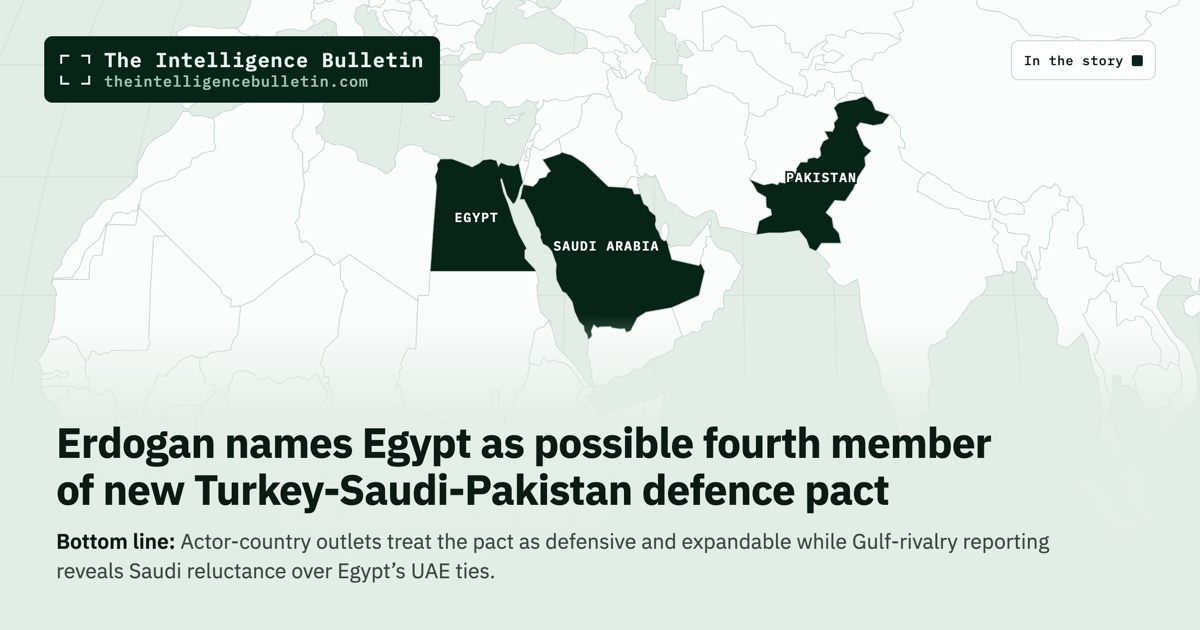
Erdogan names Egypt as possible fourth member of new Turkey-Saudi-Pakistan defence pact

Map of the countries in the story: Erdogan names Egypt as possible fourth member of new Turkey-Saudi-Pakistan defence pact
Turkish President Erdogan told Al Jazeera that the Makkah Joint Defence Agreement signed August 7 in Mecca by Turkey, Saudi Arabia and Pakistan remains open to new members and named Egypt as a possible addition. The pact commits signatories to treat an armed attack on one as an attack on all. Saudi and Turkish reporting frames expansion as natural regional cooperation while Pakistani coverage highlights strategic implications for India and a UK-based outlet reports Emirati unease over the grouping.

One Story. Many Angles.

🇸🇦
Saudi Arabia
Arab News
Carries Al Jazeera reporting
Erdogan says Egypt could join Turkiye-Saudi-Pakistan defence pact
Read →
🇵🇰
Pakistan
Pakistan Observer
Commentary
What the Makkah pact means for India – Pakistan Observer
Read →
🇹🇷
Turkey
Daily Sabah
Commentary
Mecca pact: Warning only for those who plan to strike first
Read →
🇬🇧
United Kingdom
Middle East Eye
Original reporting
Former UAE presidential aide’s post mocking Pakistan exposes unease over Mecca pact
Read →
🇮🇩
Indonesia
Tribun News
INDONESIAN
Carries Al Jazeera reporting
New Turkey-Saudi-Pakistan Alliance Becomes More Open, Erdogan Opens Opportunity for Egypt to Join
“Aliansi Baru Turki-Saudi-Pakistan Makin Terbuka, Erdogan Buka Peluang Mesir Bergabung”
Read →
5 sources · 2 independent accounts — some share the same news agency’s report
In Brief

Actor-country outlets treat the pact as defensive and expandable while Gulf-rivalry reporting reveals Saudi reluctance over Egypt’s UAE ties.

Reporting across the sources converges on the core announcement from Erdogan’s Al Jazeera interview but diverges sharply on context and implications. Saudi and Turkish outlets present the pact and its potential expansion as defensive cooperation open to like-minded states, with Daily Sabah explicitly tying reactions from Israel and India to those actors’ prior willingness to strike first. Pakistani analysis instead stresses how the agreement complicates any future India-Pakistan crisis by introducing Turkish technology and Saudi economic leverage. Middle East Eye’s account of an Emirati academic’s mocking tweet and Saudi reservations about Egypt’s UAE alignment exposes intra-Gulf friction that actor-country sources omit. Indonesian coverage relays the expansion news without the Gulf tensions. The pattern shows the pact’s openness is the shared factual thread, yet each national lens reveals the specific security or rivalry it is meant to address or avoid.

Perspective Analysis

Turkish President Recep Tayyip Erdogan described the Makkah Joint Defence Agreement as open to additional members during an interview with Al Jazeera’s Ali Al Dafiri for the programme Al Muqabala. He singled out Egypt as one possible addition. The agreement itself was signed on 7 August 2026 in Mecca by Erdogan, Saudi Crown Prince Mohammed bin Salman and Pakistani Prime Minister Shehbaz Sharif. Its central clause states that an armed attack against any signatory counts as an attack against all three, requiring a coordinated response.

Every outlet in this set drew its core facts from the same Al Jazeera broadcast. Arab News led its piece with the Egypt possibility and placed the interview in a Doha dateline. The Saudi paper described the pact as a mutual defence arrangement that had already sent “an important message to the world” and noted that Egyptian participation remained one of several options under consideration. It supplied background on the three signatories’ existing ties and on Erdogan’s remarks about the Strait of Hormuz and the conflicts in Gaza, Lebanon and Syria, but it did not mention any Emirati reaction or Saudi reservations about Cairo.

Daily Sabah ran the same interview material as the basis for an opinion column rather than straight news. The Turkish paper’s headline framed the pact as “Warning only for those who plan to strike first.” The column added that Turkish Foreign Minister Hakan Fidan had earlier called Egypt a “natural partner” and that the agreement carried no obligation to intervene outside its defensive trigger. It supplied context about recent Israeli and Indian statements that followed the signing and linked those statements to prior cross-border actions by those two states. The piece did not report any internal Gulf disagreement over expansion.

Pakistan Observer used the interview and the pact to anchor a commentary on implications for India. The article explained how the collective defence clause could complicate future India-Pakistan crises by introducing Turkish defence-industrial capacity and Saudi economic leverage, even if Riyadh and Ankara never became directly involved. It traced the agreement’s roots to earlier bilateral pacts between Pakistan and Saudi Arabia and between Pakistan and Turkey, and it emphasised that Pakistani officials had already cautioned against viewing the arrangement as a regional NATO. Egypt received no mention.

Tribun News, an Indonesian outlet, reported the Al Jazeera interview in a straightforward international news format. Its headline highlighted the expanding alliance and Erdogan’s opening for Egypt. The piece repeated the signing details, the collective defence clause and the Pakistani disclaimer that the pact targeted no specific country. It added a brief reference to Fidan’s earlier description of Egypt as a natural partner but supplied no additional regional context or reactions from other capitals.

Middle East Eye treated the same interview as one element in a larger story and added reporting that did not appear in the Al Jazeera broadcast. The British-based outlet described a tweet by Emirati analyst Abdulkhaleq Abdulla, a former aide to UAE President Mohammed bin Zayed, that mocked Pakistan’s poverty rate, literacy figures and nuclear arsenal while questioning its role in defending a larger economy. The article also reported, on the basis of unnamed sources, that Saudi Arabia had opposed Egyptian entry into the pact because of Cairo’s alignment with Abu Dhabi. It placed these details against the backdrop of UAE-Saudi differences over Yemen, Sudan and relations with Israel. None of the other four outlets carried either the tweet or the reported Saudi reservations.

The single shared dispatch therefore produced five distinct editorial choices. Arab News and Tribun News stayed closest to the interview’s expansion angle and kept the tone neutral. Daily Sabah folded the material into an argument about deterrence and supplied Indian and Israeli reactions as evidence. Pakistan Observer shifted the focus to South Asian consequences and left expansion unmentioned. Middle East Eye used the interview as a hook for independent material on Gulf rivalries that the Al Jazeera broadcast itself did not contain.

Because the underlying facts trace to one reporting chain, differences among the pieces lie in selection and emphasis rather than in contradictory accounts of what Erdogan said. Arab News, Daily Sabah and Tribun News all foregrounded the Egypt opening; Pakistan Observer did not. Middle East Eye alone introduced the Emirati tweet and the reported Saudi objection to Cairo. Those additions stand on separate sourcing and therefore mark the only genuine divergence visible in the set.

What to Watch

The pattern shows how one interview travelled. Outlets closest to the signatory governments kept the emphasis on openness and collective security. The Pakistani commentary redirected attention to its own bilateral context. The single non-actor outlet that added fresh reporting used the moment to surface tensions that the original dispatch left untouched. A reader who encountered only the Al Jazeera interview or any single relay would miss both the India-specific strategic reading and the intra-Gulf friction now attached to the same set of remarks.
Share this story

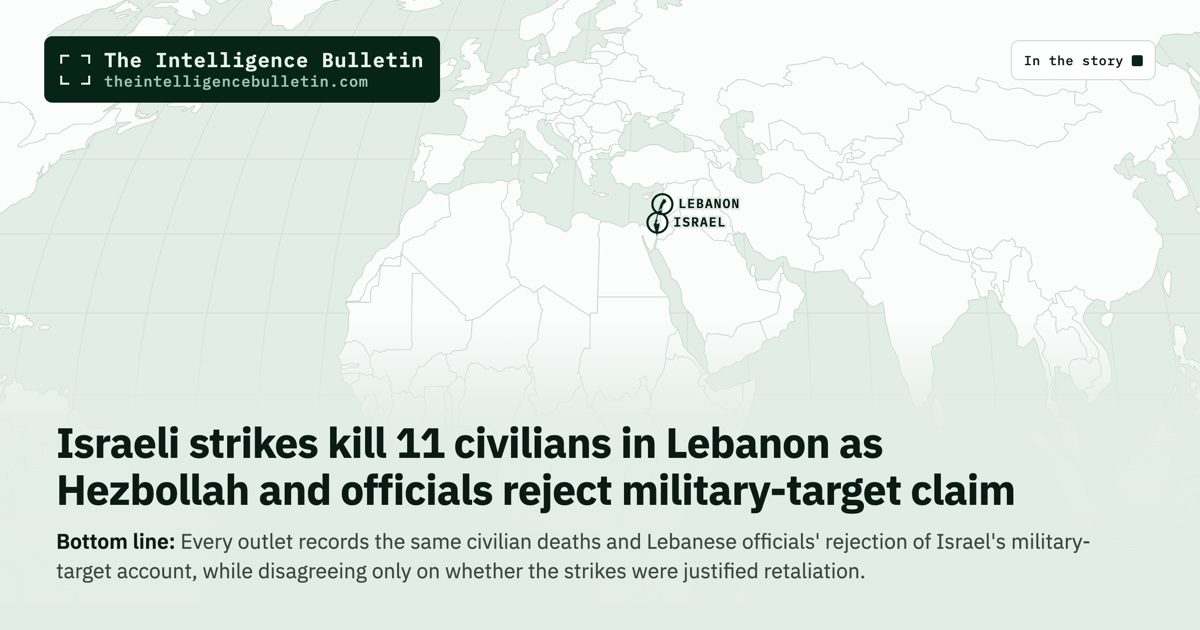
Israeli strikes kill 11 civilians in Lebanon as Hezbollah and officials reject military-target claim

Map of the countries in the story: Israeli strikes kill 11 civilians in Lebanon as Hezbollah and officials reject military-target claim
Israeli airstrikes hit southern Lebanese towns including Ansar and Deir al-Zahrani early on August 15, killing 11 people including three children and wounding over a dozen. Israel said the strikes targeted a Hezbollah headquarters in response to a drone attack that wounded three IDF soldiers. Lebanese Prime Minister Nawaf Salam and President Joseph Aoun condemned the strikes as violations of the US-backed June framework agreement, while Hezbollah vowed an appropriate response and urged an end to negotiations with Israel.

One Story. Many Angles.

🇮🇱
Israel
The Jerusalem Post
Original reporting
Aoun condemns Israeli strikes in southern Lebanon
Read →
🇱🇧
Lebanon
MTV Lebanon
ARABIC
Original reporting
Israel and the ‘Party’ inflame the Lebanese scene
“إسرائيل و”الحزب” يلهبان المسرح اللبناني”
Read →
🇬🇧
United Kingdom
Middle East Eye
Original reporting
Deadly Israeli strikes kill nine in southern Lebanon as tensions escalate
Read →
🇹🇷
Turkey
Daily Sabah
Carries Agence France-Presse reporting
Israeli strikes kill 11 in Lebanon as Hezbollah vows response
Read →
🇩🇪
Germany
Deutsche Welle
Carries AFP, AP, dpa, Reuters reporting
Lebanon says 11 killed in Israeli airstrikes
Read →
5 sources · each independently reported
In Brief

Every outlet records the same civilian deaths and Lebanese officials’ rejection of Israel’s military-target account, while disagreeing only on whether the strikes were justified retaliation.

The reporting reveals a consistent split between accounts of intent and a shared recognition of civilian deaths that tests the fragile June framework. Israeli coverage centers the Hezbollah drone strike on troops as the trigger and describes civilian losses as unintended human-shield use at a legitimate military target, a framing absent or explicitly rejected in Lebanese and regional outlets. Lebanese domestic reporting stresses the strikes hit civilian homes in Ansar and Deir al-Zahrani, with officials insisting the dead were not military infrastructure and linking the escalation to efforts to derail US-sponsored talks. Wire and European accounts converge on the Lebanese casualty toll and Hezbollah’s vow of response while noting the timing ahead of further negotiations in Rome. Turkish coverage relays the same facts but situates them within alliance dynamics and Hezbollah’s domestic pressure on Lebanese authorities. The clearest divergence is over whether the strikes represent a violation that endangers the ceasefire or a necessary reply to a breach; every chain records the same 11 deaths and the same Lebanese rejection of Israel’s military-infrastructure claim, making the civilian toll the one element no outlet disputes.

Perspective Analysis

Israeli airstrikes struck the southern Lebanese towns of Ansar and Deir al-Zahrani before dawn on August 15, destroying a house on the outskirts of Ansar and damaging buildings in Deir al-Zahrani. Lebanon’s Health Ministry recorded 11 deaths from the strikes, including three children and two women in Ansar alone, with four more killed and 17 wounded in Deir al-Zahrani. The National News Agency reported additional strikes around the Ali al-Taher ridge near Nabatieh. Residents described the Ansar site as a family home near a tourist resort area, while responders found extensive rubble and a dust-covered swimming pool at the location.

Israel described the operation as a targeted strike on a Hezbollah headquarters in the Ansar area, carried out after a Hezbollah explosive drone wounded three IDF soldiers near the Ali al-Taher ridge inside the security zone. The Prime Minister’s Office stated that the attack on the soldiers constituted a serious violation of the ceasefire. Israeli statements identified the target as a battalion commander in Hezbollah’s Radwan Force, Ali Samir Al-Haj Hassan, and noted that his family was present in the compound at the time of the strike. The IDF added that the family members were not the intended target and that Hassan had used them as human shields.

Lebanese Prime Minister Nawaf Salam rejected that characterization in a statement the same day. He wrote that the seven killed in Ansar were not military infrastructure and that the children and women among them were not military targets. Salam placed responsibility for any military structures on Lebanese territory with the Lebanese state and army, asserting that their existence did not grant Israel the right to strike or endanger civilians. He called on Israel to halt the escalation. President Joseph Aoun condemned the attacks as repeated violations of the framework agreement governing efforts to reduce hostilities and protect civilians, describing the Ansar strike as a clear message to the negotiating process.

Hezbollah issued a statement saying the Israeli attacks, which it described as targeting civilians and expanding the areas hit, would be met with an appropriate response. The group accused Israeli Prime Minister Benjamin Netanyahu of seeking to escalate for domestic political gain and urged Lebanese authorities to abandon what it called the humiliating path of direct negotiations that provided the enemy with free concessions. It linked the strikes to broader attempts to impose a new reality on the ground.

The strikes occurred against the background of a US-backed framework agreement reached in June between Israel and Lebanon. That deal outlined steps for Hezbollah disarmament, gradual Israeli withdrawal from southern Lebanon, and deployment of the Lebanese army in designated areas, with pilot zones already under discussion. Seven rounds of talks had taken place, with an eighth round planned for early September in Rome. Hezbollah had refused direct participation in the talks and rejected disarmament. Intermittent Israeli strikes and demolitions had continued in southern villages since the framework was signed, even as overall violence declined from the earlier phase of the conflict.

The accounts diverge sharply on the sequence and justification. The Jerusalem Post article opened with the Hezbollah drone attack on IDF soldiers and the subsequent Israeli strike on the headquarters, placing the civilian deaths in the context of Hezbollah’s use of human shields at a legitimate military target. It reported the Prime Minister’s Office statement that Israel had been unaware civilians were present until after the strike. Lebanese domestic reporting, including the detailed analysis in MTV Lebanon, foregrounded the impact on civilian homes and the political pressure the strikes placed on Lebanese authorities, tying the events to Hezbollah’s criticism of the negotiations and its warnings of internal unrest. That outlet also connected the escalation to Hezbollah’s regional coordination with Iran and developments in Yemen.

Middle East Eye and Deutsche Welle both recorded the Lebanese casualty figures and quoted Salam’s rejection of the military-infrastructure claim, presenting the strikes as a test of the fragile June framework and noting the upcoming Rome talks. Daily Sabah carried the same toll and Hezbollah response through an Agence France-Presse dispatch, situating the events within the pattern of alliance dynamics and truce strains without additional operational detail from the Israeli side. No outlet disputed the count of 11 dead or the Lebanese government’s explicit denial that the Ansar victims constituted military targets. The single-source element remains Israel’s description of the preceding drone attack and the human-shield claim, which appears in full detail only in the Jerusalem Post reporting drawn from IDF and Prime Minister’s Office statements.

A reader limited to Israeli coverage would see a defensive operation triggered by a direct attack on troops, with civilian losses presented as the unavoidable result of an enemy’s tactics. A reader limited to Lebanese domestic sources would see unprovoked strikes on civilian areas that undermine the framework and serve to pressure the Lebanese government from both sides. Wire and European accounts converge on the undisputed toll and the official Lebanese rebuttal while recording Hezbollah’s vow of response and the diplomatic calendar. The Turkish relay adds emphasis on how the strikes feed Hezbollah’s domestic leverage against Lebanese institutions.

What to Watch

The civilian death toll of 11 stands as the single element recorded identically across all reporting chains, regardless of national origin or outlet type. The framework agreement’s core tension—Israeli insistence on maintaining a security zone until Hezbollah disarms versus Lebanese insistence that only the Lebanese state can address any military presence—receives direct expression in the conflicting statements issued the same day. Whether the strikes represent a calibrated response to a breach or a deliberate widening of the conflict will be tested by whether Hezbollah follows through on its stated response and whether the Rome round proceeds on schedule. The pattern of intermittent strikes since June suggests that each side retains the capacity to interpret the next incident as justification for further action, with the civilian cost already fixed at these latest figures.


Share this story

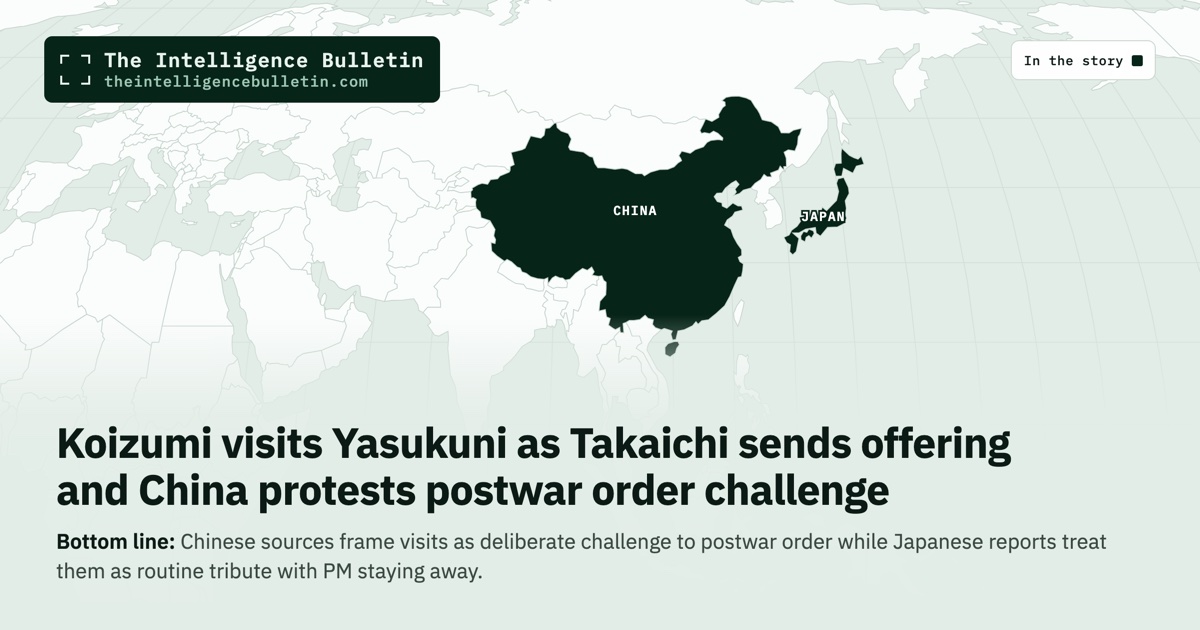
Koizumi visits Yasukuni as Takaichi sends offering and China protests postwar order challenge

Map of the countries in the story: Koizumi visits Yasukuni as Takaichi sends offering and China protests postwar order challenge
On August 15, 2026, Japan’s Defense Minister Shinjiro Koizumi and three other cabinet ministers visited Yasukuni Shrine on the 81st anniversary of Japan’s WWII surrender. Prime Minister Sanae Takaichi stayed away but sent a ritual offering. China’s foreign and defense ministries strongly condemned the actions, lodged protests, and described the shrine visits as a serious challenge to the postwar international order and historical justice. South Korea expressed deep regret over what it called anachronistic moves.

One Story. Many Angles.

🇨🇳
China
China.org.cn
Carries Xinhua reporting
Chinese embassy condemns Japanese politicians’ Yasukuni Shrine moves as serious challenge to postwar int’l order
Read →
🇯🇵
Japan
Japan Today
Original reporting
Koizumi visits Yasukuni Shrine; Takaichi sends offering
Read →
🇭🇰
Hong Kong
South China Morning Post
Original reporting
China blasts Japanese officials’ visit to Yasukuni Shrine on WWII anniversary
Read →
🇹🇼
Taiwan
Taipei Times
Carries AP reporting
Japan PM Takaichi skips visit to the Yasukuni Shrine
Read →
🇶🇦
Qatar
Al Jazeera
Carries AFP reporting
Japanese minister visits shrine to war dead, angering China, South Korea
Read →
5 sources · each independently reported
In Brief

Chinese sources frame visits as deliberate challenge to postwar order while Japanese reports treat them as routine tribute with PM staying away.

The reporting reveals a clear split in framing rather than disputed facts. Chinese state outlets and the embassy statement treat the visits and offering as deliberate political acts that rehabilitate war criminals and undermine the Tokyo Trials’ legacy, linking them explicitly to Japan’s recent defense spending increases and Taiwan comments. Japanese domestic coverage presents the same attendance as routine personal or ministerial tribute to war dead, with the prime minister’s absence noted as a deliberate choice amid diplomatic sensitivities. Outlets like SCMP and Al Jazeera bridge the two by recording both the visits and the resulting regional protests, showing how the same events trigger accusations of remilitarization from Beijing and Seoul while Tokyo frames restraint through the PM’s non-attendance. Taipei Times adds the detail of Taiwanese soldiers among the enshrined dead, underscoring why neighbors see the shrine as unresolved history. No source disputes who attended or what China said; the divergence lies in whether these are standard commemorations or provocations that reopen wartime wounds eighty-one years later.

Perspective Analysis

On August 15, 2026, Japan marked the 81st anniversary of its surrender in World War II. Defense Minister Shinjiro Koizumi visited Yasukuni Shrine that day, joined by three other cabinet ministers. Prime Minister Sanae Takaichi did not attend in person but sent a ritual offering, a step previous prime ministers have taken on the date. The shrine honors 2.5 million Japanese war dead from conflicts including the 1930s and 1940s invasions of Asia, among them 14 men convicted as Class-A war criminals at the postwar Tokyo Trials.

Chinese authorities responded immediately with formal protests. The foreign ministry stated that the visits and offering constituted a serious challenge to the outcomes of World War II and the postwar international order. It described Yasukuni as a spiritual instrument of Japanese militarism and noted that this year marked the 80th anniversary of the Tokyo Trials, which had convicted the war criminals. The defense ministry added that the actions gravely hurt the feelings of peoples in victimized Asia-Pacific countries and warned that Japan risked facing the trial of justice if it failed to draw lessons from history. The Chinese embassy in Tokyo lodged solemn representations with the Japanese side and urged Japan to reflect on its wartime crimes, break with militarism, and avoid remilitarization.

South Korea also registered its disapproval. Its foreign ministry called the moves anachronistic and expressed deep regret, urging Japanese leaders to demonstrate humble reflection and sincere remorse through concrete actions. Both China and South Korea have long viewed visits to the shrine by senior Japanese officials as symbols of insufficient atonement for Imperial Japan’s atrocities.

Japanese accounts placed the same attendance in a domestic context. Koizumi, who has visited the shrine regularly as a private citizen and earlier as a minister, went on the anniversary for the first time in his current role. The last defense minister to do so was Minoru Kihara in 2024. Takaichi, described in Japanese reporting as a China hawk who had visited before taking office in October, chose not to attend despite earlier speculation that she might follow the example of her mentor Shinzo Abe, who visited in 2013. Local coverage noted that she had sent an offering for a spring festival earlier in the year as well. Three additional ministers—Minoru Kiuchi for economic and fiscal policy, Kimi Onoda for economic security, and Hitoshi Kikawada for Okinawa and Northern Territories issues—also went to the shrine. Japanese reporting recorded crowds at the site, including a small number in military-style uniforms, and noted the shrine’s request that visitors avoid such attire to allow peaceful worship.

The shrine itself had drawn attention earlier in the week for appealing to visitors to refrain from military-style uniforms. Around 20 to 30 people were observed wearing them despite the guidance. Koizumi later posted on Instagram that he had offered condolences to the heroic spirits who sacrificed their lives for the nation and reaffirmed Japan’s postwar path as a peaceful country that renounces war.

Coverage from Hong Kong and Qatar recorded both the Japanese actions and the immediate Chinese and South Korean responses without adding new details on the visits themselves. Taipei reporting added one element absent from the Chinese and Japanese accounts: among those enshrined at Yasukuni are 30,304 Taiwanese soldiers killed in World War II. It framed Takaichi’s decision to stay away as an apparent effort to prioritize diplomatic relations with China and South Korea, and it quoted her separate remarks at a national war memorial ceremony where she mourned victims in Hiroshima, Nagasaki, and Okinawa, thanked those who perished overseas, and pledged that Japan would never repeat the tragedy of war.

The accounts converge on the core sequence of events and statements. Every outlet that covered the day reported Koizumi’s presence, the three other ministerial visits, Takaichi’s offering without her attendance, and China’s formal protest calling the moves a challenge to the postwar order. South Korea’s expression of regret appears in the same set of reports. No source disputes the identities of the visitors or the content of the Chinese statements.

Where the accounts differ is in the significance attached to those facts. Chinese state coverage presents the visits and offering as deliberate political signals that aim to rehabilitate war criminals, distort historical facts, and advance remilitarization. It ties the episode directly to Japan’s rising defense budget—preparing to submit a record 8.9 trillion yen for 2027—and to Takaichi’s earlier comments that a Taiwan conflict could constitute a survival-threatening situation for Japan, prompting Chinese sanctions and travel warnings. Japanese domestic reporting presents the same attendance as routine tribute consistent with past practice by defense ministers and other officials, while highlighting the prime minister’s restraint as evidence of diplomatic caution. It places the episode against the background of improved Japan-South Korea ties in recent months, including joint cultural gestures between the two leaders.

External reporting from Hong Kong and Qatar shows how the identical set of actions produces sharply different interpretations in the two capitals. The same visits that Chinese statements describe as a provocation appear in Japanese accounts as personal or ministerial commemoration that the prime minister deliberately kept at arm’s length. Taipei coverage inserts the additional fact of Taiwanese war dead at the shrine, explaining why the site carries particular resonance for a neighbor that was itself under Japanese colonial rule until 1945. None of these framings contradict the documented events; they differ in what weight to assign the shrine’s history versus the political context of 2026.

What to Watch

The factual record across independent reporting chains supports the view that the visits occurred exactly as described and that China’s protest was a direct and public response to them. Chinese authorities have an interest in presenting the episode as evidence of Japanese backsliding on historical issues, because that narrative justifies continued pressure on defense spending and Taiwan policy. Japanese officials have an interest in treating the shrine visits as private or customary acts, because that framing minimizes diplomatic cost while preserving domestic political support among those who see the visits as legitimate remembrance. The convergence on who attended, what was sent, and what China said publicly leaves little room for doubt about the sequence itself. What remains open is whether the pattern of annual visits by cabinet members, even when the prime minister stays away, will continue to generate formal protests from Beijing and Seoul or whether the restraint shown this year will be read in those capitals as sufficient to limit escalation. The next test will come on future anniversaries or when new defense budget figures and Taiwan-related statements surface again.


Share this story

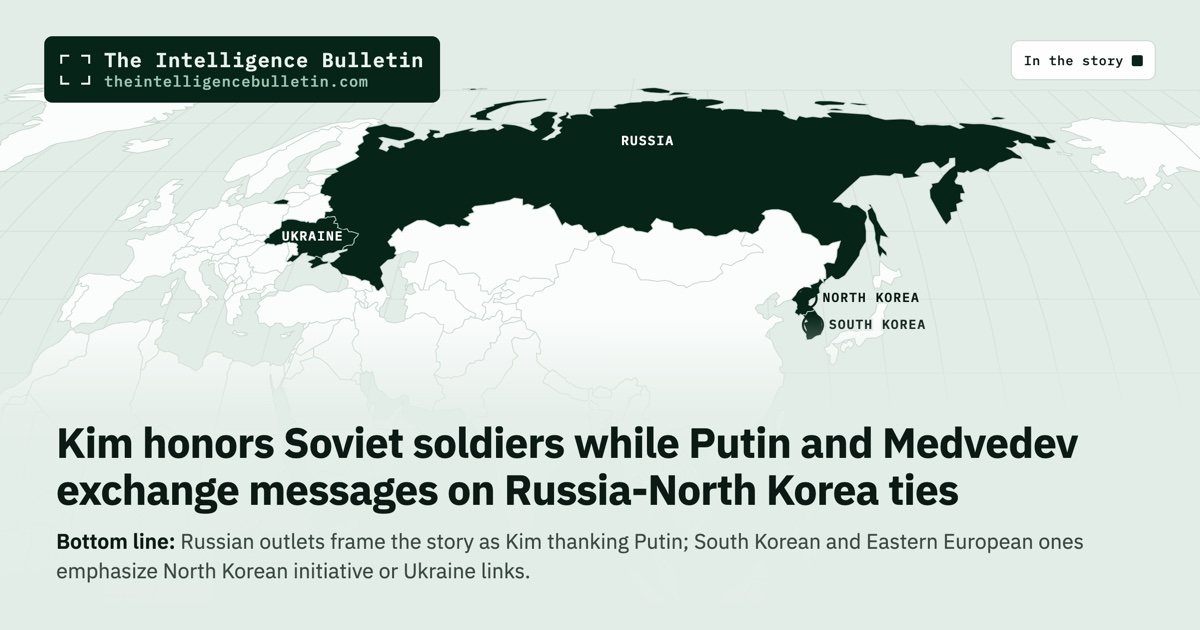
Kim honors Soviet soldiers while Putin and Medvedev exchange messages on Russia-North Korea ties

Map of the countries in the story: Kim honors Soviet soldiers while Putin and Medvedev exchange messages on Russia-North Korea ties
On August 15, 2026, North Korean leader Kim Jong-un visited Pyongyang’s Liberation Tower the day before Korea’s liberation anniversary and laid a wreath honoring Soviet soldiers who fought Japan in World War II. He was accompanied by his wife and daughter. Russian President Vladimir Putin and former President Dmitry Medvedev sent congratulatory messages praising bilateral cooperation and strategic partnership. South Korean, Russian, Bulgarian, Romanian and Moldovan reporting all cite KCNA dispatches but frame the exchanges differently.

One Story. Many Angles.

🇰🇷
South Korea
The Korea Times
Carries Yonhap reporting
N. Korean leader pays tribute to Soviet soldiers amid deepening Russia ties
Read →
🇷🇺
Russia
Vesti
RUSSIAN
Carries KCNA reporting
Kim Jong Un thanked Putin for the congratulations on the occasion of Korea’s Liberation Day
“Ким Чен Ын поблагодарил Путина за поздравление по случаю дня освобождения Кореи”
Read →
🇧🇬
Bulgaria
Cross.bg
BULGARIAN
Carries Yonhap reporting
Kim Jong-un paid tribute to the Soviet soldiers who fought against Japan during World War II
“Ким Чен-ун отдаде почит на съветските войници, сражавали се срещу Япония по време на Втората световна война”
Read →
🇷🇴
Romania
Capital
ROMANIAN
Carries Reuters reporting
Kim Jong-un and Vladimir Putin send new signals of closeness. Pyongyang tries to consolidate the support received from Moscow
“Kim Jong-un și Vladimir Putin transmit noi semnale de apropiere. Phenianul încearcă să consolideze sprijinul primit din partea Moscovei”
Read →
🇲🇩
Moldova
Ziarul National
ROMANIAN
Carries KCNA reporting
Putin praises the ‘combat friendship’ with Pyongyang and promises Russian-North Korean cooperation for regional security while Kyiv accuses the use of North Korean missiles in Ukraine
“Putin laudă „prietenia de luptă” cu Phenianul și promite cooperare ruso–nord-coreeană pentru securitatea regională în timp ce Kievul acuză folosirea rachetelor nord-coreene în Ucraina”
Read →
5 sources · 3 independent accounts — some share the same news agency’s report
In Brief

Russian outlets frame the story as Kim thanking Putin; South Korean and Eastern European ones emphasize North Korean initiative or Ukraine links.

The reporting converges on the core sequence—Kim’s wreath-laying at the Liberation Tower and reciprocal messages from Putin and Medvedev—but splits sharply on agency and stakes. South Korean and Bulgarian accounts center the North Korean ceremony itself as the signal of alignment, noting this as Kim’s third such visit since the 2024 partnership. Russian coverage reverses the lens, presenting Kim’s reply as personal thanks to Putin’s initiative and quoting his praise for the Red Army and wishes for Russian strength. Romanian and Moldovan pieces add the Ukraine dimension absent elsewhere, linking the messages to battlefield accusations of North Korean missiles and troops while portraying Pyongyang as actively locking in Moscow’s backing. These choices reflect outlet priorities rather than conflicting facts: the bilateral diplomatic exchange is corroborated across independent chains via KCNA, yet the emphasis on who leads and what wider risks it carries varies by national vantage. The result is consistent detail on the event paired with divergent readings of its balance of power.

Perspective Analysis

On August 15, 2026, North Korean leader Kim Jong-un visited the Liberation Tower in Pyongyang the day before the 81st anniversary of Korea’s liberation from Japanese colonial rule. He laid a wreath bearing the inscription “We will not forget the feats of the martyrs of the Soviet Army.” Kim was accompanied by his wife, Ri Sol-ju, and his daughter, Ju-ae, in what marked the daughter’s first known public appearance at the tower with her father. This was Kim’s third such visit on the occasion of Liberation Day since North Korea and Russia established a comprehensive strategic partnership in 2024.

Kim described the history, traditions and blood ties between the two countries as a fundamental cornerstone and inexhaustible driving force for bilateral friendship and cooperation. He stated that their great friendship and unity would be carried forward generation after generation. The Korean Central News Agency reported these remarks in English dispatches carried by multiple outlets.

Russian President Vladimir Putin sent a congratulatory message the same day. It noted that the two countries were actively cooperating across sectors and making concerted efforts to ensure regional security and stability. Putin described their militant friendship and mutual assistance as having elevated bilateral ties to an unprecedentedly high level of comprehensive strategic partnership. He expressed conviction that the countries would continue constructive joint undertakings on pressing bilateral and international issues. Former Russian President Dmitry Medvedev also sent greetings to Kim, according to the same agency reports.

The messages and the ceremony occurred against the backdrop of the 2024 partnership agreement. That accord preceded expanded military cooperation between the two governments, including North Korean support for Russia’s campaign in Ukraine. All five outlets in the set traced the core sequence directly to Korean Central News Agency dispatches.

The accounts converge on the sequence of the visit, the wreath inscription, the family accompaniment, and the content of the two Russian messages. They also agree that the 2024 partnership forms the recent foundation for the relationship. Where the coverage differs is in emphasis on who set the tone for the exchange and what wider context belongs alongside it.

The Korea Times account, drawn from Yonhap reporting of KCNA material, places the North Korean ceremony at the center. It presents the wreath-laying and Kim’s remarks on generational unity as the primary signal of alignment, while noting this marks the third Liberation Day appearance at the tower since the 2024 agreement. The Bulgarian Cross.bg piece follows nearly identical lines, staying close to the historical tribute and the partnership reference without additional layers.

Vesti, the Russian outlet, reverses the framing. It opens with Kim’s response message thanking Putin for his earlier congratulations and quotes Kim at length on the enduring feats of the Red Army against common enemies. The piece highlights Kim’s assessment that relations have become a reliable basis for cooperation and records his wishes for Russian sovereignty, security and territorial integrity under Putin’s leadership. This reciprocal-congratulation angle receives no parallel treatment in the other selections.

The Romanian Capital and Moldovan Ziarul National articles add a different dimension. Both link the messages and the ceremony to Ukrainian statements that Russia has used North Korean missiles against targets in Ukraine, including a reported strike on Zaporizhzhia that killed at least six people. They note Ukrainian accusations that North Korea has supplied missiles, ammunition and additional troops, and they reference North Korean participation in fighting in Russia’s Kursk region in 2024-2025. Capital further includes analyst commentary that Pyongyang seeks to portray Northeast Asia as a competition between rival blocs to justify its own arms programs and secure continued backing from Moscow and Beijing. These elements appear in neither the South Korean nor the Russian nor the Bulgarian pieces.

The single-source status of the Ukraine battlefield claims in this set follows directly from their presence only in the Romanian and Moldovan reporting. The core diplomatic facts—the visit, the wreath, and the messages—run through all five outlets via KCNA.

A reader limited to one national vantage would therefore miss either the ceremony’s prominence as a North Korean gesture, the explicit Russian presentation of the exchange as initiated by Moscow, or the direct connection drawn to Ukrainian accusations of missile and troop transfers. The Korean Central News Agency material itself supplies the shared factual spine; the divergence lies in which sentences from that material each outlet chooses to foreground and what additional context it attaches.

The corroborated record shows a mutual exchange of messages between the Russian and North Korean leaderships on the occasion of the liberation anniversary, paired with a North Korean ceremony at a monument to Soviet wartime service. The 2024 strategic partnership supplies the documented recent context for both the ceremony and the messages. The Ukrainian statements on missiles and troops remain attributed to a single reporting chain within the source set and are not carried by the South Korean, Russian or Bulgarian accounts.

What to Watch

The Russian framing of Kim thanking Putin aligns with the documented sequence of messages, while the emphasis in the Romanian and Moldovan pieces on one-sided consolidation of support rests on Ukrainian on-record accusations that the other outlets did not include. The ceremony details themselves stand on the same KCNA foundation across the set. This pattern indicates that the diplomatic exchange itself is the element least dependent on any single national lens.


Share this story

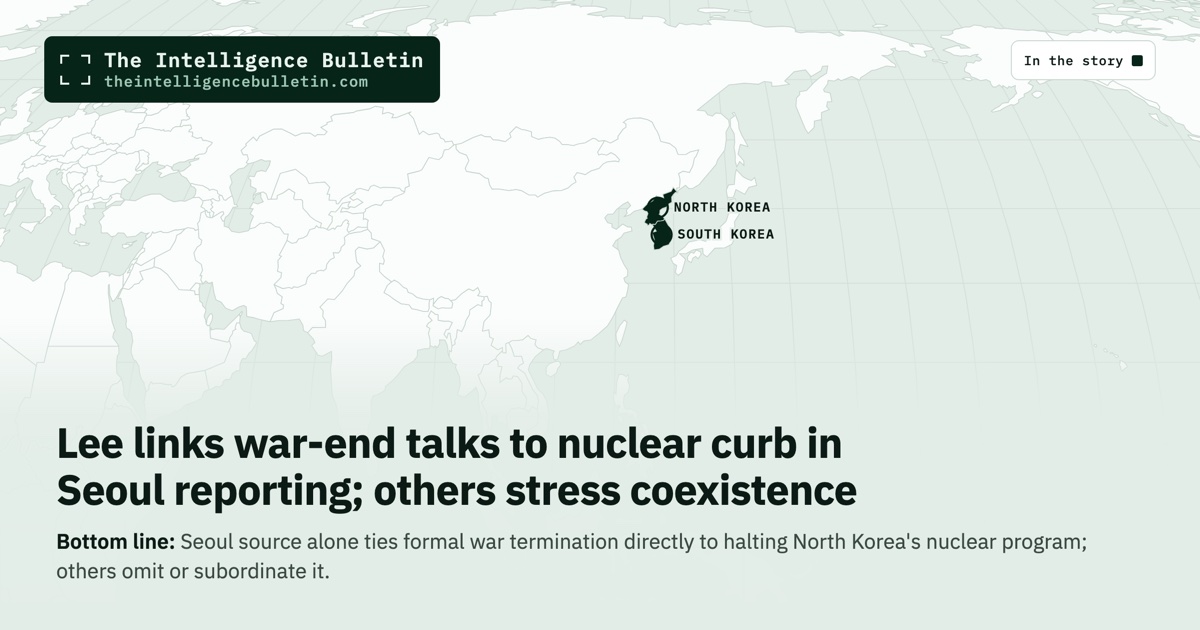
Lee links war-end talks to nuclear curb in Seoul reporting; others stress coexistence

Map of the countries in the story: Lee links war-end talks to nuclear curb in Seoul reporting; others stress coexistence
South Korean President Lee Jae Myung proposed dialogue with North Korea to formally end the Korean War and replace the 1953 armistice with a peace regime. The call came in a Liberation Day speech on August 15, 2026. Lee suggested talks among directly concerned parties could also address halting North Korea’s nuclear advancement. North Korea has not responded and maintains ties with Russia while asserting its nuclear status.

One Story. Many Angles.

🇰🇷
South Korea
The Korea Times
Carries Yonhap reporting
Lee proposes talks with NK to formally end Korean War, halt Pyongyang’s nuclear program
Read →
🇨🇳
China
China.org.cn
Carries Xinhua reporting
S. Korean president Lee calls for dialogue with DPRK to formally end Korean War, pursue peaceful coexistence
Read →
🇮🇳
India
The Times of India
Carries Reuters reporting
‘Begin discussions’: South Korea’s Lee Jae Myung calls for talks with North Korea
Read →
🇬🇧
United Kingdom
The Independent
Original reporting
South Korea’s Lee calls for ending conflict with North Korea and pursuing ‘peaceful coexistence’
Read →
🇮🇪
Ireland
RTÉ
Carries AFP reporting
South Korea proposes talks with North to end Korean war
Read →
5 sources · each independently reported
In Brief

Seoul source alone ties formal war termination directly to halting North Korea’s nuclear program; others omit or subordinate it.

The reporting converges on the core proposal but splits on emphasis in ways that track national or institutional priorities rather than facts on the ground. South Korea’s Korea Times alone pairs the war-ending talks directly with halting Pyongyang’s nuclear program as a single linked step. Chinese state-linked coverage via Xinhua drops the nuclear reference entirely and instead highlights mutual respect, shared growth and peaceful coexistence. Indian and Irish wires carry the nuclear angle but frame it as a possible secondary outcome of discussions, while the UK Independent echoes the coexistence phrasing yet adds explicit reference to Kim Jong Un. These choices are not random: outlets closest to the proposing government foreground concrete security outcomes, while others present a broader stability gesture. No source claims North Korean acceptance or verification of any element. The absence of direct North Korean sourcing in the set leaves the initiative as a South Korean initiative viewed through external lenses, with the nuclear dimension appearing in four of five accounts but subordinated or omitted where regional stability is the priority narrative.

Perspective Analysis

South Korean President Lee Jae Myung used his August 15, 2026 address marking the 81st anniversary of Korea’s liberation from Japanese colonial rule to propose direct talks with North Korea aimed at formally ending the Korean War. The 1950-53 conflict concluded with an armistice rather than a peace treaty, leaving the two sides technically at war. Lee called for the directly concerned parties to sit down and replace the armistice with a peace regime, adding that the discussions could also explore measures to halt the advancement of North Korea’s nuclear capabilities. He urged both sides to set aside intentions to threaten each other and described peaceful coexistence as a duty rather than a choice.

The proposal built on pledges Lee made at the previous year’s Liberation Day ceremony, where he said Seoul would respect North Korea’s system, rule out unification by absorption, and refrain from hostile acts. In the new speech he outlined steps to implement those principles, including mechanisms to manage tensions and safeguards against escalation. He also called for a comprehensive assessment of the security environment around the peninsula and proactive peace measures. The address came days before scheduled annual US-South Korea military exercises that North Korea has condemned as provocative. Washington maintains roughly 28,500 troops in South Korea as part of its security commitment.

North Korea has not responded to the overture. Pyongyang continues to assert its status as an irreversible nuclear state, a position it adopted after the 2019 summit between its leader Kim Jong Un and then-US President Donald Trump in Hanoi collapsed over disagreements on denuclearization and sanctions relief. North Korea has strengthened military ties with Russia, receiving financial support, food, energy and military technology in exchange for supplying troops and ammunition for Russia’s war in Ukraine. Analysts note that North Korean forces have gained combat experience in that conflict and brought lessons back to the peninsula. Kim has labeled South Korea its most hostile state and ordered stronger frontline defenses.

Coverage of the speech converged on the basic facts of the proposal and the historical context of the unresolved armistice. Four of the five outlets reported Lee’s suggestion that the talks could address North Korea’s nuclear capabilities. The Korea Times presented that linkage as a central element of the initiative, framing the proposal as concrete steps that would both end the war and curb Pyongyang’s program. The Times of India, RTÉ and The Independent carried the same suggestion but treated it as a possible additional topic rather than the primary outcome. RTÉ, drawing from an AFP dispatch, noted the nuclear point in a concise factual summary focused on replacing the armistice. The Independent included it while foregrounding the pursuit of peaceful coexistence and naming Kim Jong Un explicitly.

China.org.cn, relaying Xinhua copy, omitted any reference to nuclear capabilities. Its account emphasized mutual respect, avoidance of unnecessary confrontation, shared growth and the transformation of the armistice into a peace regime through dialogue among directly concerned parties. It described the move as part of a roadmap for peaceful coexistence without the security-specific linkage found elsewhere.

These differences in framing track institutional and national vantage points rather than conflicting facts. The Korea Times, as South Korea’s main English-language domestic outlet, aligned its account with Seoul’s longstanding priority on denuclearization as a non-negotiable security requirement. Outlets farther from the peninsula presented a broader stability gesture, either by dropping the nuclear reference or by subordinating it. The absence of any North Korean-sourced reporting in the set means the initiative appears only through external lenses, with no direct statement of Pyongyang’s reaction or counter-position.

The nuclear dimension carries weight because it appears across four independent reporting chains while the pure coexistence framing appears in fewer. Readers limited to Chinese state-linked coverage would miss the specific security outcome that four other accounts, including South Korea’s own, attached to the same speech. Readers limited to the South Korean account would see a tighter linkage than the broader diplomatic process described in the Indian, Irish and British pieces. No outlet claimed North Korean acceptance or verification of any element, and the corroboration stops at what Lee said on the record.

What to Watch

The account that best matches the full set of reporting is the one that includes both the war-termination proposal and the possibility of nuclear discussion as a potential byproduct. That version appears in the majority of the sources and rests on the direct text of Lee’s address rather than on interpretive additions. South Korea has an obvious interest in presenting its initiative as advancing concrete security goals, while China has an interest in presenting regional moves as steps toward stability without pressure on its neighbor. North Korea’s silence and its deepening Russia relationship suggest the proposal will not produce immediate movement. Upcoming joint military exercises add immediate friction that could further delay any response. The initiative therefore stands as a South Korean diplomatic opening whose reception will depend on whether Pyongyang sees value in returning to talks after years of treating South Korea as its primary adversary.


Share this story

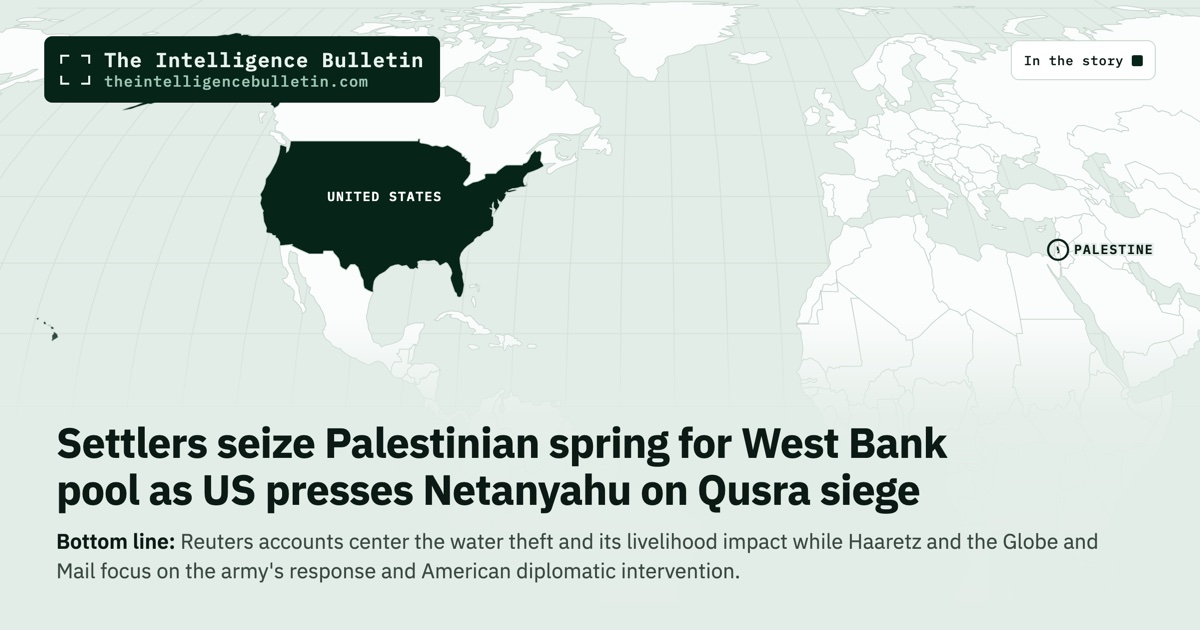
Settlers seize Palestinian spring for West Bank pool as US presses Netanyahu on Qusra siege

Map of the countries in the story: Settlers seize Palestinian spring for West Bank pool as US presses Netanyahu on Qusra siege
Israeli settlers near Fasayil in the West Bank diverted water from a spring long used by Palestinian farmer Saad Nemer to fill an ancient pool at an archaeological site, turning it into a swimming attraction promoted with funding from Finance Minister Bezalel Smotrich. Nemer and other villagers lost irrigation for crops and face restricted access. UN data records at least 160 settler attacks on Palestinian water facilities this year. A separate siege of homes in Qusra village also cut water and electricity, prompting US diplomatic pressure on Prime Minister Netanyahu.

One Story. Many Angles.

🇹🇷
Turkey
Daily Sabah
Carries Reuters reporting
Israeli settlers cut Palestinian water supply, set up swimming pool
Read →
🇳🇿
New Zealand
RNZ
Reuters wire copy
Israeli settlers divert Palestinian water to fill West Bank pool
Read →
🇦🇷
Argentina
El Destape
SPANISH
Translated from Reuters
Israeli settlers divert Palestinian waters to fill a pool in the West Bank
“Colonos israelíes desvían aguas palestinas para llenar una piscina en Cisjordania”
Read →
🇨🇦
Canada
The Globe and Mail
Carries Reuters reporting
Israeli settlers besieging Palestinian village draws U.S. criticism
Read →
🇮🇱
Israel
Haaretz
Original reporting
IDF Removes Palestinian Families as Israeli Settlers Resist Army Operation to End Siege
Read →
5 sources · 2 independent accounts — some share the same news agency’s report
In Brief

Reuters accounts center the water theft and its livelihood impact while Haaretz and the Globe and Mail focus on the army’s response and American diplomatic intervention.

The Reuters dispatch carried by Daily Sabah, RNZ and El Destape documents the Fasayil water seizure in detail through Palestinian testimony and settler comments, framing it as one element of a broader pattern of resource denial backed by Israeli government figures. The Globe and Mail instead foregrounds US officials pressing Netanyahu over the parallel Qusra siege, where homes were blockaded and utilities severed, shifting emphasis from the water act itself to diplomatic friction. Haaretz reports the IDF’s subsequent operation to lift that siege, noting troops ordered Palestinian families to leave while settlers resisted removal of an outpost. What unites the accounts is the concrete mechanics of control over water and access points on the ground; what separates them is whether the story is told as daily dispossession, foreign-policy embarrassment or domestic security enforcement. No Palestinian media appears in the set, leaving the affected communities’ voices present only through Reuters sourcing. The convergence on the Fasayil spring details across three continents shows the incident traveled as a single reporting chain, while the Qusra coverage reveals how the same settler pressure registers differently once US involvement enters the frame.

Perspective Analysis

The Fasayil water seizure originated in a single Reuters dispatch filed from the West Bank and carried by Daily Sabah in Turkey, RNZ in New Zealand, and El Destape in Argentina. The three outlets published the same core reporting on the same day, each under its own headline and with only minor differences in wording or translation. The dispatch opens on a hot August afternoon near the Palestinian village of Fasayil in the Jordan Valley, where settlers had redirected water from a spring that had irrigated local farmland for generations. The spring now fed an ancient stone pool at an archaeological site that settlers promoted as a swimming attraction.

Farmer Saad Nemer told Reuters that settlers had seized his irrigation pipeline in June and that his fields had remained dry since. He described losses to his summer crops of eggplant, zucchini and watermelons, and said one of his workers had been beaten while he himself had received threats when trying to approach the spring. The pool quickly drew Israeli visitors; a 21-year-old settler named Yishai Shreiber told Reuters that the growing crowds of Jewish bathers kept Palestinians away. Finance Minister Bezalel Smotrich, who has publicly supported expanding settlements to prevent a Palestinian state, pledged three million shekels to restore and develop the site, which settlers described as one of King Herod’s pools. Reuters also recorded that Nemer produced a 2025 COGAT land document and a 1957 map showing his title included both the spring and the pool. COGAT and Smotrich did not respond to requests for comment.

The same Reuters text noted that Israeli settlers had attacked at least 160 water and sanitation facilities across the West Bank this year, according to United Nations data, and that a Palestinian field researcher estimated settlers now controlled 95 percent of springs in the northern Jordan Valley. It added that another village, Qusra, remained under siege, with three homes cut off from water and electricity. An Israeli archaeologist with the group Emek Shaveh, Alon Arad, told Reuters that the origins of the Fasayil pool were uncertain and that filling an archaeological site with water risked damaging it. The dispatch closed with accounts of settler incursions at another spring near Nablus, where Palestinian families said they now felt uneasy returning.

Daily Sabah placed the story under the headline “Israeli settlers cut Palestinian water supply, set up swimming pool” and led its version with the pool as a recreational attraction built on diverted water. RNZ used “Israeli settlers divert Palestinian water to fill West Bank pool” and kept the emphasis on the diversion mechanics and the dried farmland. El Destape translated the Reuters text into Spanish under “Colonos israelíes desvían aguas palestinas para llenar una piscina en Cisjordania” and framed the episode as outright appropriation of resources. All three carried the full set of Palestinian and settler quotes, the Smotrich pledge, the UN figure of 160 attacks, and the archaeologist’s comments without additional local context or independent sourcing.

A separate Reuters report, published by The Globe and Mail in Canada under the headline “Israeli settlers besieging Palestinian village draws U.S. criticism,” shifted focus to the Qusra siege. That piece described settlers blocking roads to three Palestinian homes, erecting a tent in their yards, and cutting utilities, trapping fifteen people including two children. It reported that White House officials had begun pressing Prime Minister Benjamin Netanyahu to condemn the siege after learning that one of the besieged homes belonged to a Palestinian-American. Netanyahu had not commented, according to the two officials who spoke on condition of anonymity. The Globe and Mail article noted that the Israeli military had later deployed soldiers to Qusra and that Defense Minister Israel Katz had asked to transfer enforcement powers over settlers to the border police.

Haaretz, working from its own correspondents, reported under the headline “IDF Removes Palestinian Families as Israeli Settlers Resist Army Operation to End Siege” that troops had ordered several Palestinian families to evacuate their homes during an operation aimed at removing a settler outpost in the same area. The paper stated that settlers resisted the army’s moves and that the military described its deployment as necessary to protect residents and prevent further incidents. Haaretz did not include the Fasayil pool details or the US diplomatic pressure reported by the Globe and Mail.

The Reuters dispatch supplied the only on-the-ground account of the spring diversion, complete with named Palestinian and settler sources, land documents, and the UN count of 160 attacks. The three international outlets that carried it differed only in headline emphasis and language: Daily Sabah foregrounded the pool as an emblem of entitlement, RNZ the technical loss of irrigation, and El Destape the act of theft. None added reporting that originated outside the dispatch. The Globe and Mail chose instead to highlight the Qusra siege and the American request for Netanyahu’s public condemnation, while Haaretz covered the military’s effort to lift that siege and the friction between soldiers and settlers on the ground.

What to Watch

The Reuters material therefore supplies the most detailed record of how the water was taken and what it cost the affected farmer. Haaretz supplies the only independent Israeli account of how the army responded to one of the sieges mentioned in the dispatch. The Globe and Mail supplies the only account of Washington’s reaction. Because the Fasayil facts rest on a single reporting chain, readers of any one of the three international outlets received identical information presented through different national lenses; readers of the Globe and Mail or Haaretz received a narrower slice focused on either diplomatic fallout or military enforcement. The pattern shows how one set of events travels when it is packaged by a wire service and how it fragments when national outlets select different parts of the same pressure on Palestinian communities.


Share this story