Flores quake draws Singapore condolences, Chinese aid offer and Italian citizen focus

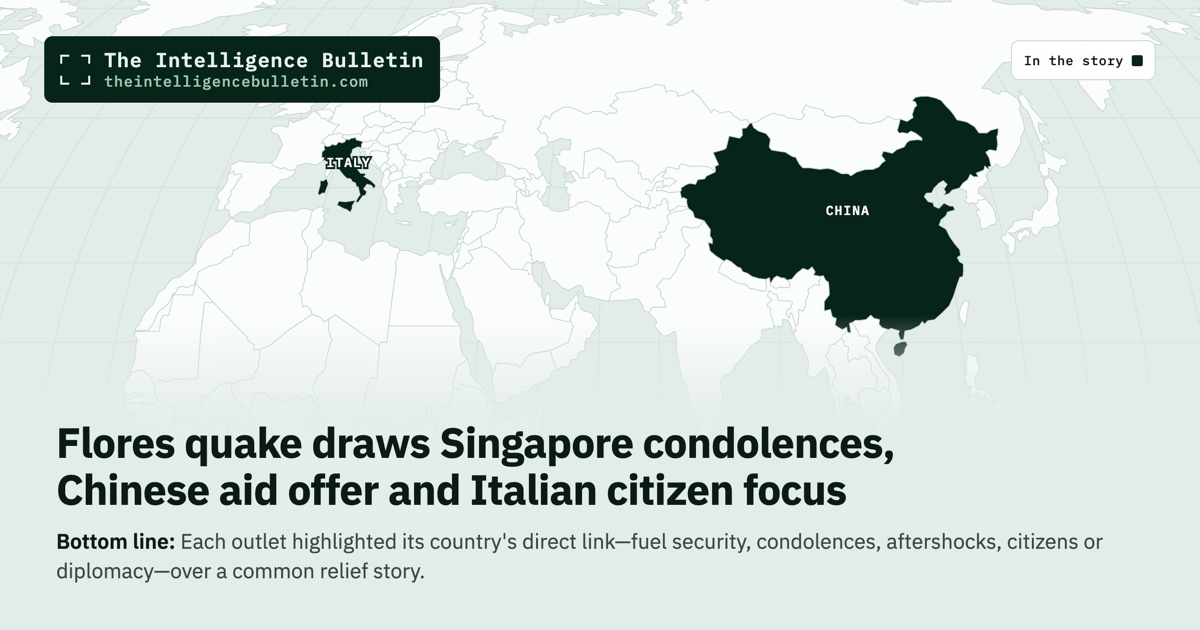
Map of the countries in the story: Flores quake draws Singapore condolences, Chinese aid offer and Italian citizen focus
A 7.7-magnitude earthquake struck off Flores Island, Indonesia, on August 15, killing at least 53 people and displacing thousands according to Indonesian authorities, with reports of higher casualties elsewhere. Aftershocks continued, including a 5.6 event. Pertamina’s CEO visited to secure fuel supplies and distribute aid, Singapore’s PM sent condolences, China offered assistance, and Italy focused on 700 stranded citizens. Relief needs include tents, food, water and generators.

One Story. Many Angles.

🇮🇩
Indonesia
Liputan6
INDONESIAN
Original reporting
Pertamina Director Goes Directly to Flores to Ensure Fuel Supply is Safe
“Dirut Pertamina Turun Langsung ke Flores, Pastikan Pasokan BBM Aman”
Read →
🇸🇬
Singapore
The Straits Times
Carries Indonesian authorities and Reuters reporting
PM Wong offers condolences after Indonesia earthquake tragedy
Read →
🇦🇺
Australia
ABC News
Original reporting
Another earthquake hits Indonesia’s Flores region
Read →
🇮🇹
Italy
Il Fatto Quotidiano
ITALIAN
Original reporting
Indonesia Earthquake, new 5.6 shock in Flores: 700 Italians blocked, 68 victims
“Terremoto Indonesia, nuova scossa 5.6 a Flores: 700 italiani bloccati, 68 vittime”
Read →
🇨🇳
China
People’s Daily
Carries Xinhua reporting
China ready to offer assistance after Indonesia earthquake
Read →
5 sources · each independently reported
In Brief

Each outlet highlighted its country’s direct link—fuel security, condolences, aftershocks, citizens or diplomacy—over a common relief story.

National outlets framed the Flores quake through their own connections rather than a shared international picture. Indonesian reporting centered on Pertamina’s CEO touring the site to restore fuel distribution and aid delivery, treating the disaster as an operational challenge for a state company. Singapore’s coverage highlighted Prime Minister Wong’s condolences to President Prabowo, underscoring regional neighborly ties without deeper operational detail. Australia’s brief bulletin stressed ongoing aftershocks and rescue work from a monitoring neighbor’s vantage. Italy’s account raised the death toll to 68 and spotlighted 700 stranded Italian tourists plus embassy flight assistance, a citizen-protection lens absent elsewhere. China’s piece emphasized the foreign ministry’s readiness to provide aid and noted injured Chinese nationals, casting the event as an opening for state-level diplomacy. These angles diverge on casualties and priorities yet converge on the basic facts of the main shock and displacement, revealing how proximity, tourism links and great-power positioning shape each account more than any single wire narrative.

Perspective Analysis

A 7.7-magnitude earthquake struck off the coast of Flores Island in eastern Indonesia early on August 15. Indonesian authorities recorded at least 53 deaths, 135 injuries, and hundreds of damaged buildings, with roughly 5,000 people fleeing their homes. Nearly 1,000 aftershocks followed in the first hours, and a separate 5.6-magnitude event occurred the next night roughly 175 kilometers east of Labuan Bajo at a depth of 18 kilometers, though that later shock produced no reported damage or casualties.

Relief workers reported urgent shortfalls in tents, food, medicine, clean water, and generators for the displaced. Pertamina, the state energy company, responded by sending its chief executive Simon Aloysius Mantiri directly to the affected areas of Nusa Tenggara Timur. He inspected operations at the Fuel Terminal in Reo, oversaw the reopening of 47 service stations across Flores, and directed supplies of diesel for heavy equipment clearing landslides on the Trans-Flores road between Ende and Bajawa. The company also distributed tents, medicines, and basic foodstuffs under its Pertamina Peduli program while maintaining LPG and aviation fuel stocks at the airports in Labuan Bajo and Maumere.

Singapore’s Prime Minister Lawrence Wong wrote to Indonesian President Prabowo Subianto on August 16 to express condolences on behalf of the Singapore government. Wong noted the loss of life and the work of emergency teams, framing the message as one of regional solidarity. Australia’s reporting focused on the continuing seismic sequence and the immediate work of rescue teams digging through rubble from the initial quake. Italy’s foreign ministry tracked roughly 700 Italian tourists and non-residents on the island, most of them unharmed, and coordinated with the embassy in Jakarta over limited flight availability out of the main airports. China’s foreign ministry stated that Beijing stood ready to provide assistance matched to Indonesian requirements and confirmed that its consulate in Denpasar had activated emergency procedures after some Chinese citizens sustained injuries.

The same basic sequence of the main shock on August 15, the scale of building damage, and the need for emergency shelter and supplies appears across the accounts that cite Indonesian disaster-management figures. Where the reports diverge is in the precision of the human cost and in the element each outlet chooses to foreground. Indonesian coverage centers on the state company’s logistics and fuel continuity. Singapore’s piece records an official expression of sympathy from its own head of government. Australia’s bulletin records the aftershock pattern and ongoing search activity. Italy’s account raises the death toll to 68, the injury count to 213, and the displaced figure to 12,800 while devoting sustained attention to consular arrangements for its nationals. China’s statement emphasizes both the offer of state-level aid and the activation of consular support for its own citizens.

These differences are not contradictions on the core event but on the boundary of what each government or outlet treats as newsworthy. The 53-death count carried by Indonesian authorities and relayed in Singapore reporting stands as the figure repeated in more than one independent chain. The higher Italian tally rests on a single foreign-ministry source and is not echoed elsewhere in the set. The relief requirements for shelter, food, water, and power are described in similar language wherever they appear, but only the Singapore account quantifies the initial flight from homes at 5,000 while the Italian report gives the larger displaced total. No outlet in the group claims to have conducted its own field verification; each transmits or expands upon statements from its own national authorities or the Indonesian disaster agency.

The pattern that emerges is therefore one of parallel national attachments rather than a unified international ledger. Proximity shapes the Australian emphasis on seismic monitoring. Tourism and consular responsibility shape the Italian focus on stranded citizens and flight bottlenecks. Energy infrastructure and domestic corporate reach shape the Indonesian emphasis on fuel terminals and service stations. Diplomatic signaling shapes the Chinese offer of assistance and the Singaporean message of sympathy. Each frame is internally consistent with the outlet’s access and mandate, yet none supplies the full set of numbers or the full set of operational responses that a reader would need to assemble an integrated picture from any single source.

What to Watch

The most durable elements are the timing and magnitude of the main shock, the fact of widespread displacement, and the shared recognition that external aid would be required. The points of friction lie in casualty counts that have not yet converged and in the absence of any cross-border coordination details beyond the separate national statements. A reader limited to one country’s press would therefore miss either the operational detail supplied by the Indonesian energy company, the consular dimension supplied by Italy, or the diplomatic posture supplied by China. The coverage as a whole shows that seismic events in eastern Indonesia continue to trigger responses calibrated to each actor’s existing stakes in the archipelago rather than to a single shared relief ledger.
Share this story

Iranian statements alone drive coverage of Hormuz transit route understanding with Oman

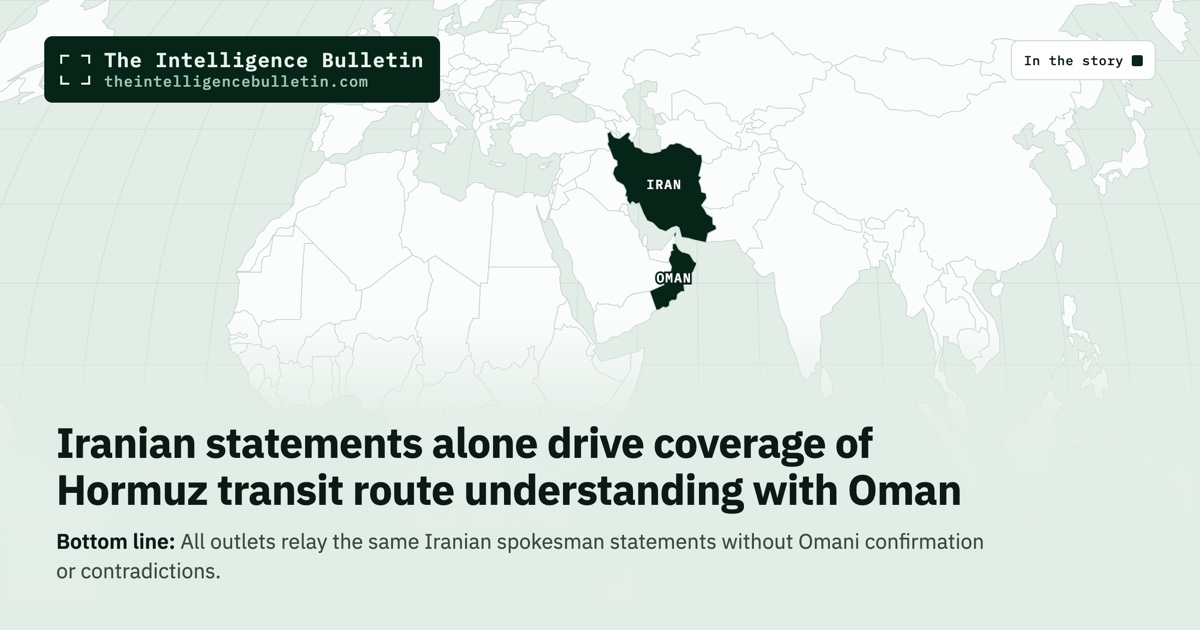
Map of the countries in the story: Iranian statements alone drive coverage of Hormuz transit route understanding with Oman
Iranian Foreign Ministry spokesman Esmaeil Baghaei stated that Iran and Oman have reached an understanding on a map for a new maritime transit route through the Strait of Hormuz. Talks continue to finalize details and issue a joint statement protecting both countries’ sovereignty and commercial shipping. The development comes amid reduced traffic in the strait and an expiring deadline for a broader US-Iran agreement. Selected reporting from five outlets carries the Iranian statements with minor differences in added context.

One Story. Many Angles.

🇴🇲
Oman
Oman Observer
Carries Iranian Foreign Ministry statements reporting
Talks with Oman continue on Hormuz, but process is complex: Iran
Read →
🇬🇧
United Kingdom
Middle East Eye
Carries Iranian Foreign Ministry statements reporting
Iran says Hormuz transit route deal reached with Oman
Read →
🇵🇰
Pakistan
Radio Pakistan
Carries Defa Press reporting
Iran, Oman agree on shipping route map for Strait of Hormuz: Esmaeil Baghaei
Read →
🇻🇳
Vietnam
VTV
VIETNAMESE
Carries Iranian state media reporting
Iran and Oman reach initial agreement on Hormuz Strait
“Iran và Oman đạt thỏa thuận bước đầu về eo biển Hormuz”
Read →
🇧🇦
Bosnia and Herzegovina
Klix
BOSNIAN
Carries AP reporting
Iran and Oman agree on plan for passage of ships through Hormuz Strait
“Iran i Oman usaglašavaju plan za prolaz brodova kroz Hormuški moreuz”
Read →
5 sources · 4 independent accounts — some share the same news agency’s report
In Brief

All outlets relay the same Iranian spokesman statements without Omani confirmation or contradictions.

The reporting across these outlets converges on Iranian official statements describing an understanding reached with Oman on a Hormuz transit route map, yet the framing reveals a consistent pattern: every account traces directly to spokesman Esmaeil Baghaei without independent Omani confirmation. Oman Observer emphasizes ongoing complexity caused by US and Israeli actions, quoting Baghaei at length on security obstacles and the mechanism’s novelty in safeguarding littoral states’ rights. Middle East Eye and Klix both highlight the route map agreement plus work on a joint statement package, with Klix adding the 60-day US-Iran deadline context and possible route details. Radio Pakistan relays the same Baghaei remarks via Defa Press, stressing positive progress and sovereignty preservation. VTV reports an initial step while including Iranian Foreign Minister Abbas Araghchi noting that full reopening still hinges on US conditions and citing sharply reduced daily traffic. This uniformity shows the story rests entirely on one originating chain of Iranian government statements; differences arise only from how each outlet layers regional stakes or prior context onto that single source. No outlet introduces conflicting claims or Omani voices, underscoring that the selected coverage functions as parallel relays of Tehran’s messaging rather than independent verification of bilateral progress.

Perspective Analysis

Iranian Foreign Ministry spokesman Esmaeil Baghaei announced on August 16 that Iran and Oman have reached an understanding on the map of a new maritime transit route through the Strait of Hormuz. The two sides are now working to finalize details and prepare a joint statement that would establish the mechanism. Baghaei described the arrangement as the first attempt to protect the sovereign rights of both littoral states while ensuring the safe passage of commercial vessels. He told reporters that the proposed route would allow ships to enter along a path closer to Iran and exit nearer to Oman, with no tolls or fees applied during an interim period.

Baghaei characterized the progress as positive after three weeks of talks, according to the version carried by Radio Pakistan from Defa Press. He said the goal remains to preserve the sovereignty of both countries and maintain commercial shipping through the waterway. The same statements appear in reports from Middle East Eye and Klix, which add that the package under discussion includes both the route map and the joint statement itself. Oman Observer reported Baghaei saying the process has been time-consuming because of security complexities tied to actions by the United States and Israel, the number of actors involved, and obstruction by disruptive elements. He called the issue inherently complex and noted that the insecurity imposed on the strait, the region, and the world stems from illegal military action by the United States and the Israeli regime.

VTV reported an additional comment from Iranian Foreign Minister Abbas Araghchi that the current understanding covers only the maritime route. Full reopening of the strait, the minister said, still depends on the United States meeting conditions set by Iran. VTV also noted that traffic through the strait has fallen sharply to roughly 10 to 12 vessels per day in the most recent three-day period, compared with a pre-conflict average of 130 to 140 vessels daily. The strait carries approximately one-fifth of global oil trade under normal conditions.

All five selected outlets published these developments between August 16 and August 17. None carried direct statements from Omani officials. None reported independent confirmation of the route map from any other government. The accounts therefore rest on a single originating chain of Iranian government statements relayed under different mastheads.

The coverage shows no contradictions on the core points. Every outlet reports that an understanding on the transit route map has been reached and that talks continue toward a joint statement protecting mutual interests. Where the accounts differ is in the additional layers each outlet chooses to attach. Oman Observer foregrounds the security obstacles and quotes Baghaei at length on US and Israeli actions. Middle East Eye and Klix both mention the 60-day deadline for a broader US-Iran agreement that expired without a deal. Klix adds background that Iran effectively closed the strait after attacks on February 28 and notes the presence of an AP attribution tag. VTV supplies the traffic figures and the foreign minister’s qualification on full reopening. Radio Pakistan alone names Defa Press as the immediate source of Baghaei’s remarks.

A reader who encounters only one of these accounts therefore receives the same central claim but a different sense of the surrounding stakes. The Oman Observer version leaves the impression of a stalled and externally constrained process. The Middle East Eye and Klix versions place the understanding inside a larger diplomatic timeline tied to the United States. The VTV version adds quantitative evidence of disruption and a ministerial condition on any broader reopening. None of these additions conflicts with the others; each simply selects a different slice of the same Iranian statements or attaches different prior context already published in that outlet’s earlier coverage.

Because the selected sources contain no Omani voice and no independent verification, the published record does not establish whether Oman has accepted the described map or the proposed joint statement. The articles also provide no details on what specific US conditions Iran has set or whether any of those conditions have been discussed in the current talks. The 60-day deadline is mentioned only in two outlets and without elaboration on its exact terms.

The corroborated claims across the five reports are therefore limited to what Baghaei stated: an understanding exists on the route map, and work continues on final details and a joint statement. The single-source observations about complexity caused by US and Israeli actions, and about full reopening depending on US compliance, remain attributable only to the outlets that carried them. No outlet disputes those observations; they simply do not appear in every account.

What to Watch

The reporting accurately transmits Iran’s current diplomatic position on the strait. It does not yet demonstrate bilateral agreement beyond the Iranian statements themselves. The next concrete step would be the release of the joint statement or an Omani confirmation that the route map has been accepted. Until one of those appears, the understanding remains an Iranian description of talks that are still underway.


Share this story

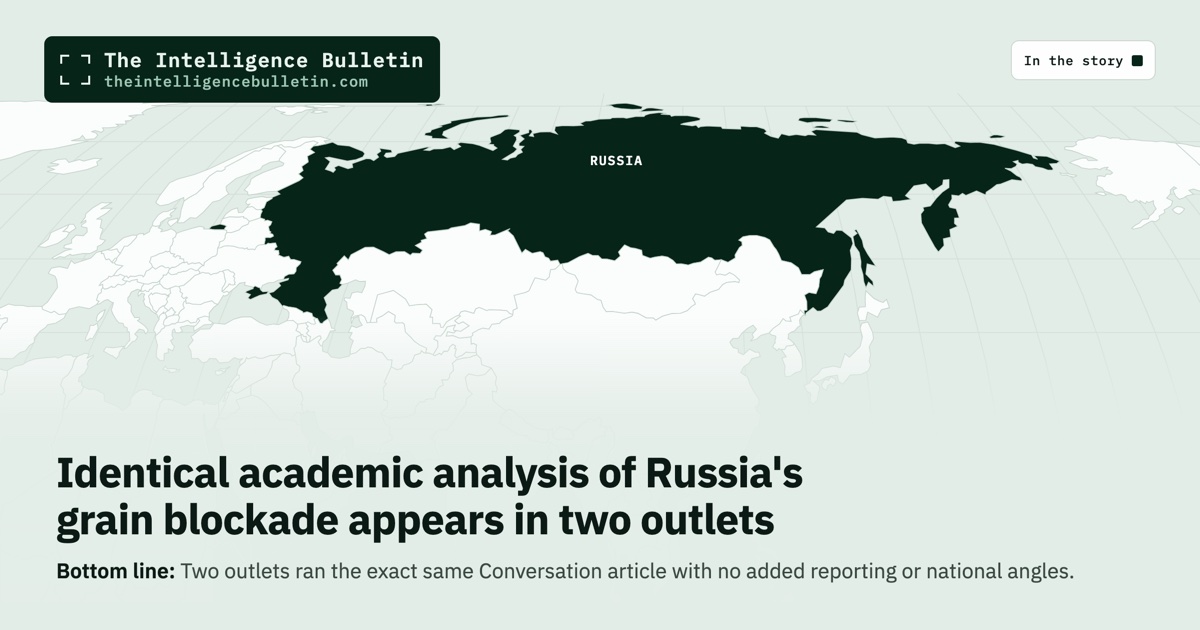
Identical academic analysis of Russia’s grain blockade appears in two outlets

Map of the countries in the story: Identical academic analysis of Russia's grain blockade appears in two outlets
Russian strikes on Ukrainian Black Sea ports and cargo ships since June have halted commercial grain shipments, endangering the 2026 harvest. Ukraine expects only 38-40 million tonnes in exports, down 12 percent. Kyiv has proposed a Black Sea truce on civilian targets to resume shipments. The blockade echoes the 2022-2023 Grain Initiative and risks storage crises, broken contracts, and wider food supply strains.

One Story. Many Angles.

🇳🇿
New Zealand
NZCity
Carries The Conversation reporting
Russia is cutting off Ukraine’s grain exports again, threatening a critical harvest and global food security – 17-Aug-2026
Read →
🇦🇺
Australia
Mirage News
Carries The Conversation reporting
Russia Halts Ukraine Grain Exports, Global Food Risk
Read →
2 sources · all sharing one news agency’s report
In Brief

Two outlets ran the exact same Conversation article with no added reporting or national angles.

Both selected outlets published the identical article from The Conversation, an academic analysis by Ukrainian studies fellow Iryna Skubii that frames the story as an ongoing Russian naval blockade rather than a sudden new cutoff. The piece details repeated strikes on at least fifty Ukrainian vessels since June, Ukraine’s retaliatory hits on Russian terminals in Novorossiysk, and Agriculture Minister Taras Vysotsky’s revised export forecast of 38-40 million tonnes. It also records Kyiv’s Friday offer, reported via Reuters, for a mutual halt on civilian ship attacks. The two domains add no original reporting or national framing; they simply republish the same text under their mastheads. This convergence means readers encounter one set of sourced claims—historical parallels to the Holodomor, alternative routes via Poland and Romania, and economic damage estimates of 1-1.5 percent of GDP—rather than independent accounts from different countries. The absence of any outlet from Russia or Ukraine in the selected set leaves official statements from either capital visible only through the single analysis chain. The coverage therefore reveals how a global signal can rest on one detailed, non-wire piece distributed across English-language aggregators rather than on competing national dispatches.

Perspective Analysis

Russia’s strikes on at least fifty Ukrainian cargo ships since June have halted commercial traffic through the country’s Black Sea ports, according to the single academic analysis that both NZCity and Mirage News carried in full. The piece, written by Iryna Skubii of the University of Melbourne, records more than thirty civilian deaths from those attacks, including ten killed aboard one vessel off Odesa on 19 July. After that strike, commercial ships stopped calling at Ukrainian seaports entirely. Ukraine expects a 2026 grain harvest of roughly 60 million tonnes but now forecasts exports of only 38 to 40 million tonnes for the 2026-27 fiscal year, a 12 percent reduction from earlier projections. Agriculture Minister Taras Vysotsky supplied those revised figures. More than 90 percent of Ukraine’s agricultural exports normally move through Black Sea ports, so the shutdown immediately threatens storage capacity once the current harvest finishes in the coming weeks and risks broken contracts with foreign buyers.

Skubii’s text, published under a Creative Commons licence by The Conversation, places the current blockade in the context of the 2022-2023 Black Sea Grain Initiative that the United Nations and Turkey had brokered and that Russia later withdrew from. It notes Ukraine’s retaliatory strikes this week on two major Russian grain terminals in Novorossiysk and records Kyiv’s offer, reported by Reuters on Friday, for a mutual halt on attacks against civilian targets in the Black Sea. The same analysis cites an economist’s estimate that the blockade could subtract 1 to 1.5 percent from Ukraine’s GDP by year-end and describes the added costs of shifting exports overland or through the Romanian port of Constanța, the Polish rail network, or Moldova, which has agreed to accept 600,000 tonnes of Ukrainian grain by the end of the year. Low water levels on the Danube are also complicating river traffic. The article draws a historical parallel to the Holodomor and states that human-rights groups have accused Russia of seeking to displace Ukraine as a leading global exporter of several crops.

NZCity published the entire 2,800-word piece on 17 August under the headline “Russia is cutting off Ukraine’s grain exports again, threatening a critical harvest and global food security.” The masthead added its standard national-news navigation and a short list of unrelated New Zealand stories at the bottom, but inserted no local commentary, no additional reporting, and no alteration to the body text. The article appeared in the International section with a byline crediting Skubii and a note that the material is republished from The Conversation.

Mirage News ran the identical text the same day under the headline “Russia Halts Ukraine Grain Exports, Global Food Risk.” Its version included the author’s institutional affiliation, the standard disclaimer that Mirage News does not take institutional positions, and a list of unrelated science and technology stories in a sidebar. No Australian-specific framing, no new facts, and no changes to the original wording appeared. The piece sat in the Politics category with a courtesy line attributing the material to The Conversation.

Both outlets therefore performed the same mechanical act: they syndicated the full Conversation article without cuts, additions, or local adaptation. Neither introduced reporting from its own correspondents, neither quoted statements from Moscow or Kyiv beyond what Skubii already included, and neither placed the dispatch in a domestic political or agricultural context. The shared origin is acknowledged in each case through the byline and republication notice, making clear that readers of either site encounter one analysis chain rather than independent accounts.

The single-chain nature of the coverage means any apparent agreement between the two outlets is arithmetic rather than a finding of convergence across separate reporting. What differs is only the headline wording chosen to present the same 2,800 words and the minimal surrounding navigation each site added. NZCity’s headline foregrounds the threat to a “critical harvest and global food security,” while Mirage News’s shorter version emphasises “Global Food Risk.” Neither outlet supplied the reader with material that would allow comparison against Russian or Ukrainian government statements carried in their own national presses, because no such outlets appear in the selected source set.

What to Watch

The pattern illustrates how a global signal detected across 449 media mentions can rest on one originating newsroom’s detailed, sourced analysis distributed through English-language aggregators. Readers of NZCity or Mirage News receive the same set of figures, citations, and historical framing that Skubii assembled from NYT, BBC, Reuters, and other listed references. They do not receive competing accounts that would test those claims against statements from the Russian side or from Ukrainian officials beyond the minister already quoted. The absence of any outlet from Russia or Ukraine in the set leaves official positions from either capital visible only through this one analysis.


Share this story

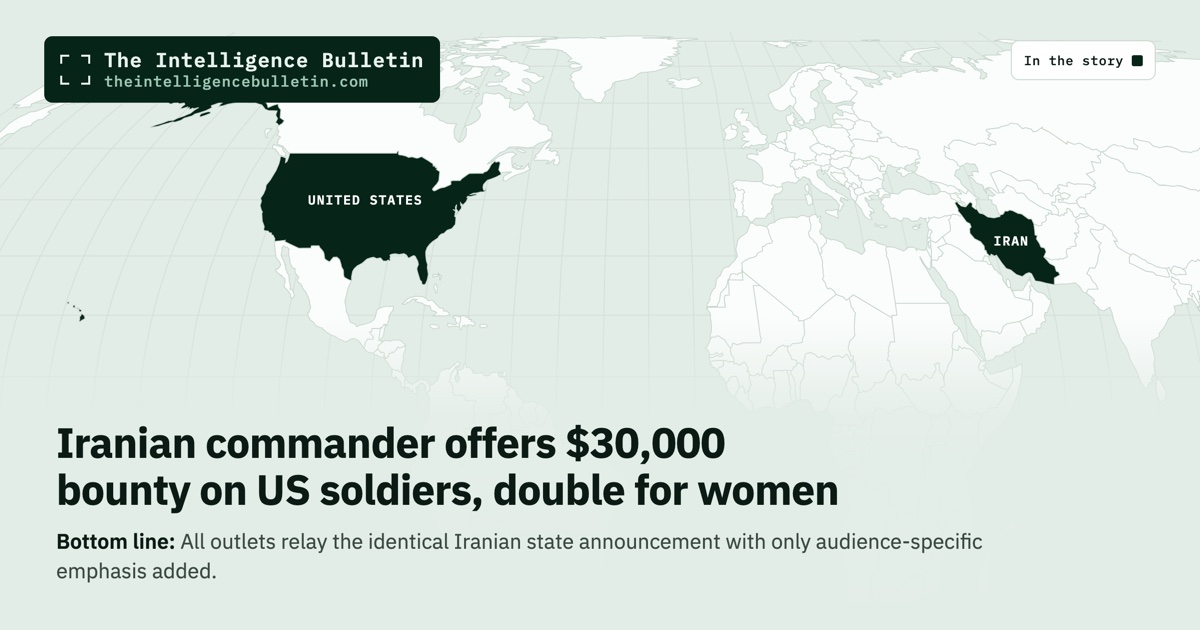
Iranian commander offers $30,000 bounty on US soldiers, double for women

Map of the countries in the story: Iranian commander offers $30,000 bounty on US soldiers, double for women
Iranian Army Commander-in-Chief Major General Amir Hatami announced on August 16 that the army will pay $30,000 or 5 billion tomans to anyone who kills or captures a US soldier and hands them over. The reward doubles for Iranian women who succeed. The announcement, made at a journalists’ ceremony in Tehran and carried by Iranian state media, includes buying the weapon used at double price for a museum display. It comes amid heightened US-Iran tensions over the Strait of Hormuz and prior ceasefire talks.

One Story. Many Angles.

🇺🇸
United States
The Epoch Times
Carries IRNA / Iranian state media reporting
Iran Offers $30,000 Bounty to Kill US Soldiers
Read →
🇮🇱
Israel
The Jerusalem Post
Carries IRIB / Iranian state media reporting
Iranian military chief places $30,000 bounty on killed, captured US soldiers
Read →
🇬🇧
United Kingdom
International Business Times
Carries IRNA / Iranian state media reporting
Iran Offers $30,000 Bounty for US Troops: Army Chief Hatami Confirms Reward, Doubled for Women
Read →
🇮🇷
Iran
Gooya News
PERSIAN
Translated from IRIB / Iranian state media
Video, Army Commander: We Will Give $30,000 Reward for Killing or Capturing Every American Force
“فیلم، فرمانده ارتش: برای کشتن یا دستگیری هر نیروی آمریکایی ۳۰ هزار دلار جایزه می دهیم”
Read →
🇳🇬
Nigeria
Sahara Reporters
Carries IRNA / Iranian state media reporting
Iran Offers $30,000 Bounty To Anyone Who Kills Or Captures US Soldiers
Read →
5 sources · 2 independent accounts — some share the same news agency’s report
In Brief

All outlets relay the identical Iranian state announcement with only audience-specific emphasis added.

The reporting across these outlets converges tightly on the same Iranian state-media dispatch from IRNA and IRIB, with no independent verification or conflicting details emerging. What stands out is how the diaspora outlet Gooya presents the announcement in its full quoted form as a direct official statement, while the others add minimal framing that reveals their audiences’ priorities: The Jerusalem Post stresses threats to US forces and alliance implications from an Israeli vantage; The Epoch Times links it explicitly to the breakdown of a US-Iran memorandum and Trump statements; IBTimes UK isolates the doubled reward for women as the standout element; Sahara Reporters treats it as distant global news with ripple effects. This pattern shows the story functions primarily as a signal of Iranian escalation rhetoric rather than an operational threat with immediate claims, and the uniform reliance on one originating chain from Tehran means differences appear only in emphasis, not substance. The absence of any domestic Iranian state outlet in the set leaves the official voice available only through the exile lens of Gooya.

Perspective Analysis

Iranian Army Commander-in-Chief Major General Amir Hatami made the announcement on August 16 at a ceremony in Tehran marking Journalists’ Day. He stated that the Islamic Republic of Iran Army would pay the equivalent of $30,000 or 5 billion tomans to anyone who kills or captures an American soldier and hands the person over to authorities, with the payment guaranteed by the army and funded through what he called a “financial jihad” backed by Iranian citizens. Women who succeed in the same act would receive double the amount. Hatami added that the weapon used in any successful killing would be bought at twice its value and placed in a museum. The statement was first carried by Iranian state media outlets IRNA and IRIB and then relayed in full or in part by the five English-language reports examined here.

Every one of those reports rests on the identical originating dispatch. No outlet performed its own reporting on the ground or introduced independent sourcing that altered the core claims. The differences appear only in selection, emphasis and surrounding context.

The Jerusalem Post headline led with the military chief and the bounty amount placed on “killed, captured US soldiers.” Its account quoted Hatami at length on the loss of American authority after the war with Iran, the “delusional” statements by President Trump about declaring the Strait of Hormuz U.S. territory, and the determination that American bases would never regain their former status in the region. The piece framed the reward explicitly as a security matter for U.S. forces and included Hatami’s reference to the “Zionist regime,” giving the dispatch an Israeli security lens.

The Epoch Times headline read “Iran Offers $30,000 Bounty to Kill US Soldiers.” Its version connected the announcement directly to the impending expiration of a U.S.-Iran memorandum of understanding, Trump’s earlier demands that Iran pay reparations for damage in Lebanon, Syria, Yemen and Gaza, and recent accusations by the UAE that Iranian forces had attacked commercial vessels in the Strait of Hormuz. The article placed the bounty inside an ongoing narrative of failed negotiations and renewed maritime confrontation.

International Business Times headlined the gender distinction: “Iran Offers $30,000 Bounty for US Troops: Army Chief Hatami Confirms Reward, Doubled for Women.” Its piece isolated the provision that “courageous Iranian women” would receive double payment and devoted a separate section to the weapon-buyback detail. The surrounding text noted the announcement occurred amid the Hormuz standoff but treated the doubled reward for women as the distinctive element worth foregrounding for its readership.

Sahara Reporters used the plainest headline of the set: “Iran Offers $30,000 Bounty To Anyone Who Kills Or Captures US Soldiers.” Its account stayed close to the original wording, added the detail that the weapon would be replaced with a new one, and quoted Hatami warning that the Strait of Hormuz would never return to its previous status. The piece carried no regional security commentary and no local Nigerian angle, presenting the statement as distant international news.

Gooya News, the Persian-language diaspora portal, published the commander’s remarks under a headline that translated as “Video, Army Commander: We offer $30,000 reward for killing or capturing every American soldier.” It reproduced the full quoted passage from state media without additional analysis or framing, supplying the raw official text that the English-language outlets had excerpted or condensed.

Because all five pieces trace to the same IRNA/IRIB dispatch, the variation lies in what each masthead chose to keep, what it placed beside the announcement, and which audience-specific detail it elevated. The Jerusalem Post and Epoch Times embedded the statement inside U.S.-Iran confrontation narratives already running in their coverage. International Business Times singled out the women’s provision. Sahara Reporters kept the text leanest. Gooya alone delivered the statement without intervening context.

What to Watch

The resulting picture is one of a single official Iranian statement being repurposed for different readerships rather than independently confirmed or contested. The announcement itself supplies no location or timeline for when or where such rewards might be claimed, and none of the reports added any. Its primary documented effect in the coverage is therefore rhetorical: an explicit public offer of payment attached to the targeting of U.S. personnel, issued at a moment when both sides continue to exchange statements about control of the Strait of Hormuz and the terms under which any future arrangement might be reached.


Share this story

Trump cites Kim ties to order cut in US-South Korea drills, drawing contrasting signals from Seoul and Pyongyang

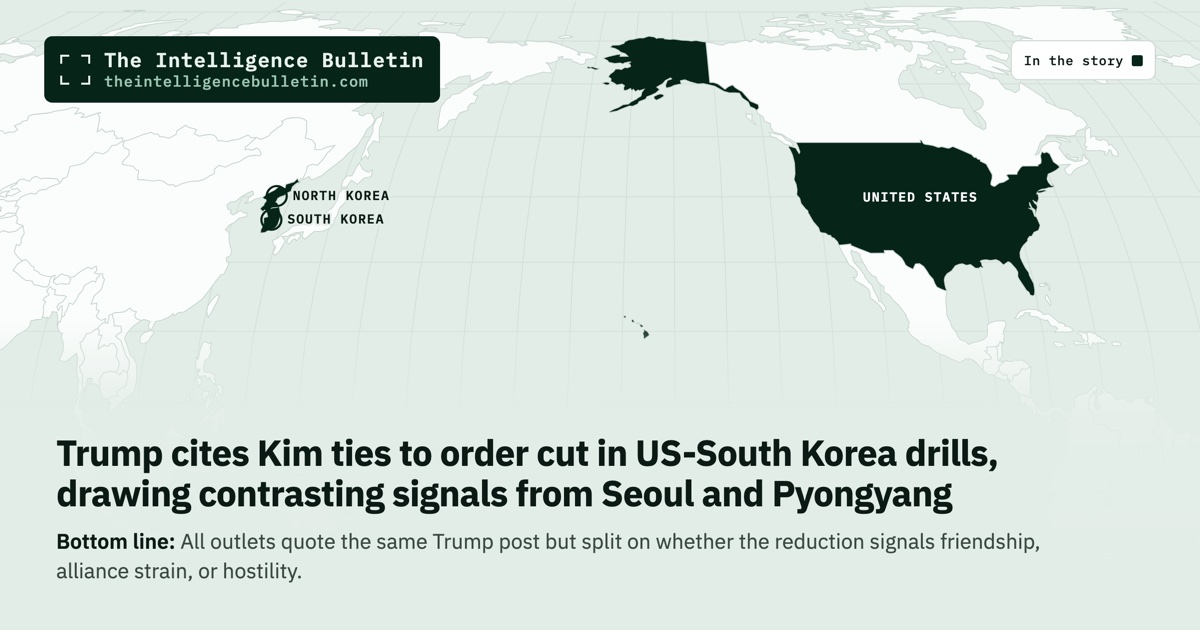
Map of the countries in the story: Trump cites Kim ties to order cut in US-South Korea drills, drawing contrasting signals from Seoul and Pyongyang
On August 16, 2026, President Donald Trump posted on Truth Social that he had instructed Secretary of War Pete Hegseth to substantially reduce joint US-South Korea military exercises, citing his relationship with North Korean leader Kim Jong Un, the high cost to the US, and the drills’ hostile signal to Pyongyang. The ‘Ulchi Freedom Shield’ exercises were scheduled to begin the next day. South Korean President Lee Jae Myung had reportedly declined a US request to join denuclearization efforts regarding Iran. Outlets in the US, South Korea and North Korea reported the same post but differed in emphasis.

One Story. Many Angles.

🇺🇸
United States
The Epoch Times
Original reporting
Trump Orders Pentagon to Scale Back Joint Military Exercises With South Korea
Read →
🇰🇵
North Korea
North Korea Times
Carries ANI reporting
“Sends inappropriate, hostile signal”: Trump orders reduction in US-South Korea military drills
Read →
🇰🇷
South Korea
Edaily
KOREAN
Original reporting
[Breaking] Trump “Good relationship with North Korea’s Kim Jong-un… orders reduction in US-South Korea joint training”
“[속보] 트럼프 “北김정은과 좋은 관계…한미합동훈련 축소 지시””
Read →
🇬🇧
United Kingdom
BBC
Original reporting
Trump says US scaling back joint military operations with South Korea
Read →
4 sources · each independently reported
In Brief

All outlets quote the same Trump post but split on whether the reduction signals friendship, alliance strain, or hostility.

Trump’s Truth Social post on August 16 framed the order as a personal diplomatic gesture rooted in his rapport with Kim Jong Un, while also highlighting expense and the drills’ signaling effect; multiple outlets reproduced the exact language without contradiction. US reporting centered the announcement as a policy directive from the president to the Pentagon. South Korean coverage relayed the Korean-language quotes and added context about alliance implications for Seoul, including the reported exchange with President Lee Jae Myung over Iran. The North Korean outlet echoed Trump’s phrasing in its headline to underscore the move as an inappropriate hostile signal to Pyongyang, while attributing the details to an Indian agency dispatch. BBC presented a concise operational account focused on scaling rather than motivation. The only clear divergence is tonal framing of intent, not the underlying facts of the post itself; no independent reporting chain disputes the existence or content of Trump’s statement. This convergence across actor-origin and observer outlets shows the story rests on a single primary source—the presidential post—amplified differently according to each outlet’s audience and national vantage.

Perspective Analysis

On August 16, 2026, President Donald Trump posted on Truth Social that he had instructed Secretary of War Pete Hegseth to substantially reduce joint military exercises between the United States and South Korea. He tied the decision directly to his assessment of relations with North Korean leader Kim Jong Un, the financial burden on Washington, and the message the drills conveyed to Pyongyang.

Trump wrote that his “very good relationship with Kim Jong Un” left him unhappy that the United States had long agreed to participate in the exercises. The drills were not only costly, with much of the expense borne by the United States, but they also sent “a signal that is totally inappropriate and hostile” to a country that, during his presidency, had remained “unthreatening and respectful.” Because it was too late to cancel the exercises outright, he directed Hegseth to cut their scale.

Two of the reports placed an additional detail alongside the main announcement. Trump mentioned a recent conversation in which he asked South Korean President Lee Jae Myung whether Seoul would join the United States in pursuing the denuclearization of Iran. According to the account, Lee replied that South Korea would not.

The exercises in question were identified in one dispatch as the Ulchi Freedom Shield drills, set to run from August 17 through August 27 and focused on countering drones, GPS disruption, and cyberattacks. North Korea had already criticized the planned maneuvers, describing them as actions that would heighten tensions on the peninsula.

American coverage presented the post as a presidential directive to the Pentagon, emphasizing the relationship with Kim and the cost argument as the stated rationale. South Korean reporting carried the Korean-language rendering of the same statements and added the detail about the exchange with Lee Jae Myung, placing the announcement in the context of alliance management for Seoul. The North Korean outlet reproduced Trump’s phrasing in its headline and lead, underscoring the characterization of the drills as an inappropriate hostile signal, while sourcing the underlying facts to an Indian agency dispatch. British reporting stayed with the operational fact of reduced exercises and avoided discussion of motive or regional signaling.

The four accounts that addressed the post reproduced its core language without disagreement on what Trump had written or instructed. No independent reporting chain supplied a conflicting version of the statement itself or of the conversation with Lee Jae Myung. The single point of variation was emphasis: one framing highlighted improved ties and expense, another added the Iran exchange and alliance implications, a third foregrounded the hostile-signal language for a North Korean readership, and the fourth confined itself to the scaling decision.

Because the underlying document was a single presidential post, the convergence across outlets in different countries shows that the event reached readers through one originating text rather than through separate investigations or on-the-ground sourcing. Outlets then selected which sentences to quote and which context to supply. The South Korean report that included the Iran exchange did so because that detail appeared in the post; the North Korean report that led with the hostile-signal phrasing did so because the same sentences were available for quotation. Where an outlet omitted the Iran reference, it was simply not foregrounded in that piece, not because the sentence was absent from the source document.

The practical effect of the order remains to be seen in the conduct of the Ulchi Freedom Shield exercise itself. The post gave no numerical target for the reduction, only the instruction to scale the drills back substantially. Whether that change alters the exercise’s scope, duration, or participation levels will be visible only once the maneuvers begin. For South Korea the announcement arrives against the background of an existing security relationship in which joint training has been a routine component; any sustained reduction would require adjustment in planning and in the division of costs that Trump described as historically borne by the United States. For North Korea the same announcement supplies language that can be cited as evidence of a shift in Washington’s posture, regardless of whether the exercises proceed at a lower tempo.

What to Watch

The reporting therefore supplies a clear record of what the president stated on August 16 and shows that the statement reached audiences in the United States, South Korea, and North Korea through direct quotation of the same text. The differences that appear are differences of selection and framing, not of disputed facts. A reader limited to any single national outlet would receive the identical presidential language but would encounter it embedded in a different set of surrounding references—cost and diplomacy in one case, alliance management and the Iran exchange in another, or the hostile-signal characterization in the third. The cross-border record makes those choices visible and shows that they rest on the same short document rather than on independent confirmation or contradiction.


Share this story

Lala kills one in Hawaii crash, spares direct hit but floods islands and cuts power

Map of the countries in the story: Lala kills one in Hawaii crash, spares direct hit but floods islands and cuts power
Hurricane Lala, a Category 1 storm, passed just south of Hawaii’s Big Island on August 15-16 without making landfall. It brought 91 mph winds, heavy rain causing floods and mudslides, and at least one death in a car accident. Authorities declared emergencies, issued warnings across islands, and urged preparations including water conservation on Oahu. Power outages affected tens of thousands and airports closed.

One Story. Many Angles.

🇺🇸
United States
Hawaii News Now
Original reporting
Board of Water Supply asks Oahu residents to conserve water as Hurricane Lala passes
Read →
🇬🇧
United Kingdom
Metro
Carries Associated Press reporting
One dead after Hurricane Lala lashes Hawaii with 91mph winds
Read →
🇦🇺
Australia
The Examiner
Australian Associated Press wire copy
Hurricane Lala bears down on Hawaii’s Big Island
Read →
🇲🇽
Mexico
Milenio
SPANISH
Carries AFP reporting
Storm Lala hits Hawaii; state of emergency declared – Grupo Milenio
“Tormenta Lala azota Hawái; declaran estado de emergencia- Grupo Milenio”
Read →
🇳🇿
New Zealand
NZ City
ABC wire copy
Lala storm grows into hurricane as it nears Hawaii’s Big Island​ – 16-Aug-2026
Read →
5 sources · each independently reported
In Brief

Local coverage stresses practical water and power preparations while international reports lead with the death and historic rarity.

Reporting across the five outlets shows broad agreement on the storm’s core facts: Lala intensified to Category 1, brushed the Big Island’s southern tip without landfall, produced damaging winds and flooding, and caused one fatality in a vehicle accident. Local Hawaii coverage stands out for its focus on immediate infrastructure responses, such as the Board of Water Supply’s island-wide conservation request to protect reservoirs amid expected power issues. International pieces, by contrast, highlight the human toll and rarity of the event, noting the first potential direct hurricane hit in 155 years and quoting residents on self-reliance and sheltering. Mexican reporting adds emphasis on the emergency declaration and life-threatening flood alerts, while New Zealand and Australian accounts stress meteorological tracking from Pacific neighbors and historical context including a 1871 Category 3 strike. No independent chain contradicts the death, wind speeds or lack of landfall; most draw from shared National Hurricane Center advisories, Governor Josh Green statements and Associated Press dispatches, explaining the convergence on impacts while local sources alone foreground Oahu-specific water measures.

Perspective Analysis

Hurricane Lala reached Category 1 strength with sustained winds of 91 miles per hour as its core passed just south of Hawaii’s Big Island on the afternoon of August 15. The National Hurricane Center placed the eye roughly 135 kilometers south-southeast of South Point at one point, on a track that brought the storm’s center within striking distance of the island’s southern tip before it continued westward. No landfall occurred. Tropical-storm-force winds extended outward as far as 350 kilometers, and forecasters warned of damaging gusts, flash flooding, and mudslides that could threaten life, particularly on steep terrain around Mauna Kea where residents live off the grid in improvised housing.

Governor Josh Green declared a state of emergency before the storm arrived. Hurricane warnings covered the Big Island while tropical storm warnings extended to Maui, Molokai, Lanai, Kahoolawe, Oahu, Kauai, and Niihau. The National Oceanic and Atmospheric Administration noted that preparations to protect life and property should be complete and that higher elevations could receive as much as 63.5 centimeters of rain. The Hawaii Department of Transportation closed Hilo International Airport and Ellison Onizuka Kona International Airport, postponing 190 flights, and shut commercial ports on Hawaii Island, Maui County, and Kauai. More than 60,000 households lost power at least temporarily, and three hospitals briefly lost service though backup generators kept them operational. One person died in a car accident during the passage, Green stated in a video message urging residents to stay home and sheltered.

Residents across the islands had already begun preparations days earlier. On the Big Island, people filled sandbags, stocked fuel for chainsaws and vehicles, and moved into shelters set up in gymnasiums, courthouses, and schools. Bobby Camara, 75, planned to shelter at his care home outside Hilo and said he would cross his fingers that the lights stayed on. Mike Caputo, a local fire captain living in Keaau, trimmed brittle albizia trees on his property because he knew downed limbs could block roads. Christine Matsuda in Waimea reported gusts rattling her home and unexpected leaks appearing in places that normally stayed dry. Farmers and growers still recovering from March flooding worried about further damage to crops and structures.

On Oahu, the Board of Water Supply issued an island-wide request for residents to limit use to essential needs such as drinking, eating, and hygiene. Officials explained that even intermittent power outages could stop pumps from wells and reservoirs, leaving only the water already in tanks until electricity returned or generators took over. The call remained in effect until storm warnings lifted, power was restored, and reservoir levels returned to normal. The agency positioned generators around the island in advance.

The same core facts appear across the five outlets examined. All five reported the Category 1 intensity, the 91-mile-per-hour winds, the absence of landfall, the one confirmed fatality in a vehicle accident, the widespread power outages, and the issuance of emergency declarations and warnings by state and federal authorities. Most of the shared detail traces to National Hurricane Center advisories, statements from Governor Green, and dispatches from the Associated Press. No independent reporting chain contradicts the wind speeds, the lack of landfall, or the single death.

Where the accounts diverge is in emphasis rather than in the underlying events. Hawaii News Now centered its coverage on the Board of Water Supply’s conservation request and the practical steps Oahu residents could take to protect the water system during outages. The piece quoted BWS manager Ernest Lau on the need for 14 days of emergency water supplies and board member Kathleen Pahinui on postponing laundry and lawn watering. Metro led with the fatality and the 91-mile-per-hour winds, folding in resident accounts of stocking up and sheltering. The Examiner and NZ City both noted the rarity of a direct hurricane threat, citing a 155-year gap since the last such event and a University of Hawaii atmospheric scientist’s research on a Category 3 strike in 1871. They also carried meteorologist Vanessa Almanza’s comment that the storm’s closest approach would be very near the southern tip. Milenio highlighted the emergency declaration and the life-threatening flood and surge risks, translating alerts from the National Hurricane Center and quoting preparations urged by Honolulu Mayor Rick Blangiardi.

These differences reflect the vantage of each outlet rather than conflicting facts. The local Hawaii paper alone foregrounded the water utility’s specific operational concerns because those measures directly affect its readers on Oahu. The British tabloid and the Latin American Spanish-language outlet gave greater prominence to the death and the scale of the alerts. The Australian and New Zealand pieces, drawing on regional wire services, placed the storm in a longer Pacific historical frame and stressed meteorological tracking from neighboring island nations. None of the five omitted the death, the wind speeds, or the lack of landfall; each simply chose which aspect of the same event to place first.

What to Watch

The convergence itself supplies the clearest warrant for the shared account. Five outlets operating under different ownerships, in different languages, and on different continents all reproduced the same sequence of events from the National Hurricane Center and Governor Green’s office. Where local detail appears, it is tied to a named agency announcement that the other outlets did not need to repeat at length. The picture that emerges is therefore more complete than any single source alone could provide: a Category 1 hurricane that brushed the islands hard enough to kill one person, flood roads, knock out power to more than 60,000 households, and close airports and ports, yet without the direct landfall that would have been the first in more than a century and a half. The practical measures reported only in the local coverage show how state agencies translated that threat into concrete instructions for residents whose daily systems could fail even without the storm’s eye passing overhead.


Share this story