 AI-generated analysis published under the editorial responsibility of Rohit Sinnas. How it works →
Press quoted
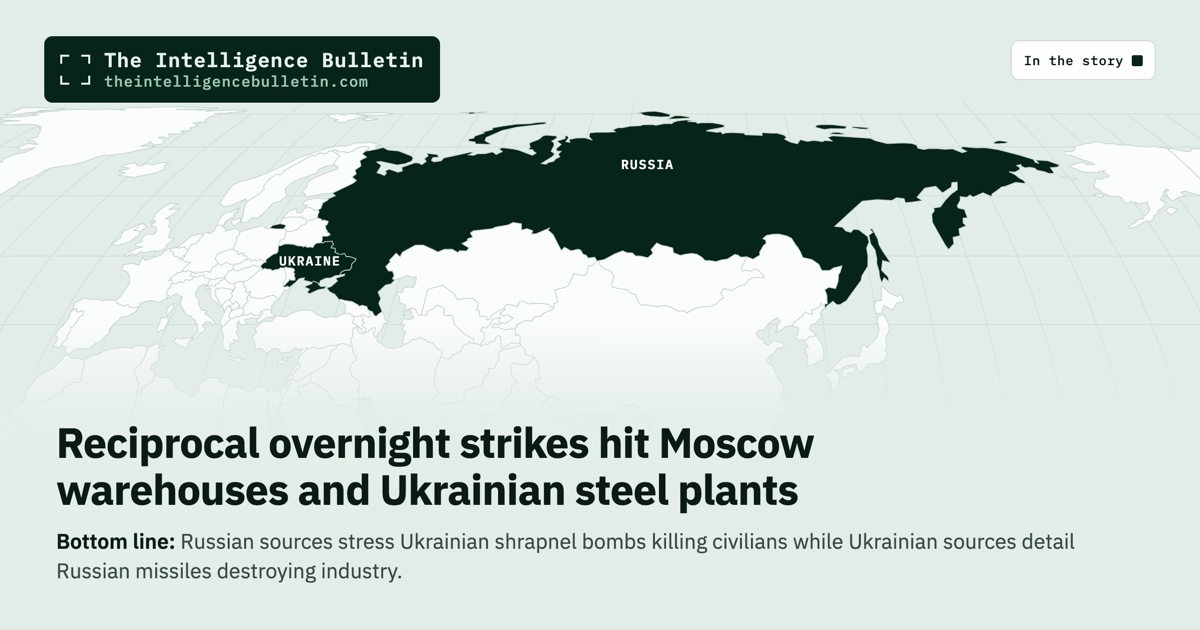
Russian sources stress Ukrainian shrapnel bombs killing civilians while Ukrainian sources detail Russian missiles destroying industry.
Russian reporting from Argumenty i Fakty centers on Ukrainian drones packed with shrapnel-filled munitions that targeted residential areas and a school in the Moscow region, quoting military correspondents and experts to portray the strikes as deliberate civilian terror using American-designed cluster-style weapons. Ukrainian coverage in the Kyiv Post instead details successive Russian ballistic missile hits that shut down the Zaporizhstal steel plant, killing seven workers, and destroyed an Epicentr mall in a residential district of Zaporizhzhia. Western accounts such as The Guardian emphasize the scale of Ukraine’s drone wave, noting it as one of the largest and linking it to Kyiv’s new focus on economic infrastructure like Wildberries hubs. South China Morning Post and Moneycontrol headlines present the night’s events as paired economic blows, with Russia targeting steel production and Ukraine aiming at Russian retail logistics. The clearest divergence lies in casualty framing and intent: Russian sources stress civilian harm from Ukrainian shrapnel bombs while Ukrainian reporting stresses industrial losses from Russian missiles, yet all five outlets corroborate the same core sequence of hundreds of Ukrainian drones and multiple Russian ballistic strikes occurring in the same hours. This pattern shows each side’s press using verified damage reports to underscore the opponent’s aggression rather than shared escalation.
Full analysis
Overnight on August 15 into 16, 2026, Ukraine sent hundreds of drones toward Russia while Russian forces launched ballistic missile strikes into Ukraine. Russian officials reported that 600 drones approached the Moscow region, with 201 shot down over areas including Domodedovo, Podolsk, Stupino, Odintsovo, Naro-Fominsk, Ramenskoye and Chekhov. The Russian Defense Ministry stated that 822 Ukrainian drones were intercepted across the country in total. Fires broke out at a Wildberries distribution warehouse in Podolsk, roughly 45 kilometers south of Moscow, with smoke visible for kilometers. An 83-year-old man died in the Podolsk area when fragments struck him in his yard, and Russian accounts described additional injuries from shrapnel in nearby dachas and settlements. Russian military correspondents noted strikes near a bandage warehouse and a parish school.
At the same time, Russian ballistic missiles hit the Zaporizhstal steel plant in Zaporizhzhia, part of the Metinvest group, killing seven workers and injuring 21 more. The plant’s coke and blast furnace divisions lost power units and grid infrastructure, forcing a complete shutdown of blast furnaces. Production capacity at the facility, which normally produces up to 4 million tons of pig iron and 3.6 million tons of hot-rolled steel annually, halted. In the same city, a Russian strike destroyed an Epicentr shopping center in a residential district, triggering a large fire. Additional Russian strikes killed civilians in Kryvyi Rih, where two people died at the ArcelorMittal steel plant and 14 were injured, and in the Sumy border region and other locations. Ukrainian officials reported at least five deaths overall from the Russian attacks that night. A separate ballistic missile strike on Kyiv injured six people and started fires in at least two districts.
A Spanish F-18 fighter jet operating under NATO command shot down a drone that entered Romanian airspace from the direction of Moldova. Romanian authorities said fragments fell in an uninhabited area, and a NATO spokesperson described the drone as appearing Russian. The incident marked at least the fourth reported drone incursion into Romanian airspace this year.
Ukrainian President Volodymyr Zelenskyy stated that Russia had launched more than 1,550 attack drones, nearly 1,560 guided aerial bombs and 62 missiles against Ukrainian cities and communities in the preceding week. He accused Russian forces of striking civilian infrastructure wherever ballistic missiles could reach. Moscow region governor Andrey Vorobyov called the drone assault one of the most massive in recent memory. Russian sources described the Ukrainian drones as carrying explosive charges packed with ball bearings four and seven millimeters in diameter, a design they linked to American cluster munitions used in Vietnam that produce widespread, difficult-to-treat wounds. They reported that 822 drones constituted a record number launched against Russia in a single night since the start of the year.
The Wildberries warehouse targeted in Podolsk belongs to Russia’s largest online retailer. Ukrainian strikes have hit roughly 20 such facilities in recent weeks as part of a campaign against economic infrastructure. Russian officials have accused the company of supporting military logistics, though that link remains unconfirmed in independent reporting. On the Ukrainian side, Zaporizhstal and the ArcelorMittal plant in Kryvyi Rih rank among the country’s largest metallurgical exporters, shipping steel products to more than 50 countries before the full-scale invasion. Epicentr operates 72 shopping centers across Ukraine with more than 2 million square meters of retail space and employs around 38,000 people.
Accounts of the night diverge sharply in emphasis. Argumenty i Fakty reported that Ukrainian drones carried shrapnel munitions aimed at residential zones and civilian sites rather than military or industrial targets, quoting military correspondents who described the intent as maximizing harm to people. The outlet contrasted this with Russian strikes on dual-use facilities and called for systematic retaliation against Ukrainian infrastructure using the full range of available weapons. Kyiv Post coverage centered on the physical destruction at Zaporizhstal and the Epicentr center, citing company statements and regional military administration reports that detailed power losses, furnace shutdowns and the scale of retail space already damaged across the Epicentr chain since 2022.
The Guardian described the Ukrainian drone wave as possibly the largest since the war began, noting rapid Ukrainian expansion of long-range strike capability to 1,500 miles and a recent shift toward facilities supporting Russian online retail. It recorded at least six deaths in Russia from the attacks, including five in the Rostov region bordering Ukraine. South China Morning Post and Moneycontrol both framed the events as paired economic strikes, with Russia hitting steel production in Ukraine and Ukraine targeting Russian retail logistics, while also noting the Romanian airspace incident.
The core sequence of several hundred Ukrainian drones directed at the Moscow region and multiple Russian ballistic missile strikes on Ukrainian industrial sites appears in every account examined. Drone counts, the Podolsk warehouse fire and the Romanian intercept are each carried by at least three independent reporting chains. Casualty figures remain lower and more variable: Russian sources name one death in the Moscow region and describe shrapnel injuries, while Ukrainian sources name seven deaths at Zaporizhstal alone plus additional fatalities elsewhere. The single-source claim of seven workers killed at Zaporizhstal rests on the Metinvest company statement.
Russian domestic reporting foregrounds the design and placement of Ukrainian munitions in populated areas, using on-record comments from its own correspondents and defense experts. Ukrainian reporting foregrounds the scale of production losses at specific plants and the cumulative retail damage to one national chain. Third-party accounts from the United Kingdom, Hong Kong and India converge on the reciprocal nature of the economic targeting without adopting either side’s casualty framing. No outlet in the set examined omitted the other side’s strikes entirely; the difference lies in which consequences receive the most space and which intent is highlighted.
The evidence of simultaneous, large-scale long-range attacks on both territories is consistent across the reporting chains. Claims that one side alone pursued civilian harm rest on the interpretation of target lists and munition types supplied by that side’s own officials and experts. The pattern of each national press underscoring the opponent’s reach while detailing its own losses matches the incentives of domestic audiences during sustained conflict. Readers relying on only one country’s coverage will therefore receive a narrower picture of the damage inflicted on the opposing economy and a stronger narrative of the opponent’s intent to harm non-combatants.
What to Watch
The corroborated record of hundreds of drones and multiple ballistic strikes in a single night points to both sides sustaining and expanding long-range campaigns even as ground fighting remains largely stalled. Ukraine’s demonstrated ability to reach retail distribution hubs near Moscow and Russia’s continued strikes on export-oriented steel facilities indicate that economic pressure through deep strikes has become a central feature of the current phase. The Romanian intercept shows how these operations can spill across NATO borders, raising the prospect of further airspace incidents. The next escalation will likely involve further Ukrainian attempts to degrade Russian logistics networks and Russian efforts to disrupt Ukrainian heavy industry, each side citing the other’s actions as justification.
That’s how the world told the story.
Get our daily open-source intelligence on world events in your inbox — one email a day, up to six stories.
Subscribe freeNo spam. One-click unsubscribe. See the latest email →