 AI-generated analysis published under the editorial responsibility of Rohit Sinnas. How it works →
Press quoted
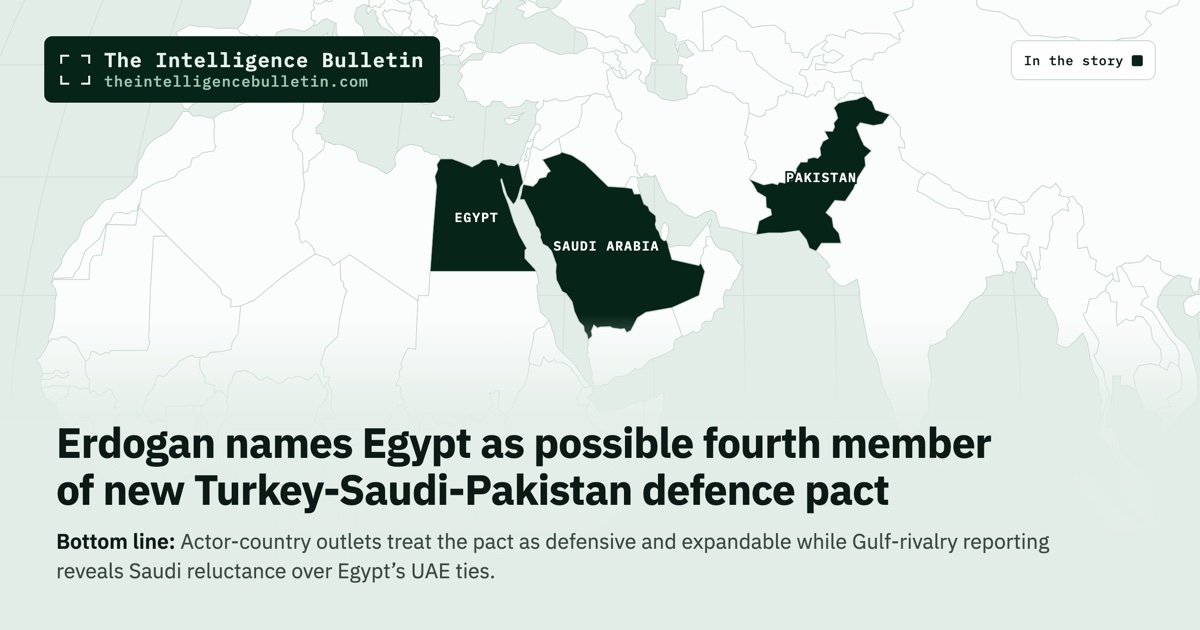
Actor-country outlets treat the pact as defensive and expandable while Gulf-rivalry reporting reveals Saudi reluctance over Egypt’s UAE ties.
Reporting across the sources converges on the core announcement from Erdogan’s Al Jazeera interview but diverges sharply on context and implications. Saudi and Turkish outlets present the pact and its potential expansion as defensive cooperation open to like-minded states, with Daily Sabah explicitly tying reactions from Israel and India to those actors’ prior willingness to strike first. Pakistani analysis instead stresses how the agreement complicates any future India-Pakistan crisis by introducing Turkish technology and Saudi economic leverage. Middle East Eye’s account of an Emirati academic’s mocking tweet and Saudi reservations about Egypt’s UAE alignment exposes intra-Gulf friction that actor-country sources omit. Indonesian coverage relays the expansion news without the Gulf tensions. The pattern shows the pact’s openness is the shared factual thread, yet each national lens reveals the specific security or rivalry it is meant to address or avoid.
Full analysis
Turkish President Recep Tayyip Erdogan described the Makkah Joint Defence Agreement as open to additional members during an interview with Al Jazeera’s Ali Al Dafiri for the programme Al Muqabala. He singled out Egypt as one possible addition. The agreement itself was signed on 7 August 2026 in Mecca by Erdogan, Saudi Crown Prince Mohammed bin Salman and Pakistani Prime Minister Shehbaz Sharif. Its central clause states that an armed attack against any signatory counts as an attack against all three, requiring a coordinated response.
Every outlet in this set drew its core facts from the same Al Jazeera broadcast. Arab News led its piece with the Egypt possibility and placed the interview in a Doha dateline. The Saudi paper described the pact as a mutual defence arrangement that had already sent “an important message to the world” and noted that Egyptian participation remained one of several options under consideration. It supplied background on the three signatories’ existing ties and on Erdogan’s remarks about the Strait of Hormuz and the conflicts in Gaza, Lebanon and Syria, but it did not mention any Emirati reaction or Saudi reservations about Cairo.
Daily Sabah ran the same interview material as the basis for an opinion column rather than straight news. The Turkish paper’s headline framed the pact as “Warning only for those who plan to strike first.” The column added that Turkish Foreign Minister Hakan Fidan had earlier called Egypt a “natural partner” and that the agreement carried no obligation to intervene outside its defensive trigger. It supplied context about recent Israeli and Indian statements that followed the signing and linked those statements to prior cross-border actions by those two states. The piece did not report any internal Gulf disagreement over expansion.
Pakistan Observer used the interview and the pact to anchor a commentary on implications for India. The article explained how the collective defence clause could complicate future India-Pakistan crises by introducing Turkish defence-industrial capacity and Saudi economic leverage, even if Riyadh and Ankara never became directly involved. It traced the agreement’s roots to earlier bilateral pacts between Pakistan and Saudi Arabia and between Pakistan and Turkey, and it emphasised that Pakistani officials had already cautioned against viewing the arrangement as a regional NATO. Egypt received no mention.
Tribun News, an Indonesian outlet, reported the Al Jazeera interview in a straightforward international news format. Its headline highlighted the expanding alliance and Erdogan’s opening for Egypt. The piece repeated the signing details, the collective defence clause and the Pakistani disclaimer that the pact targeted no specific country. It added a brief reference to Fidan’s earlier description of Egypt as a natural partner but supplied no additional regional context or reactions from other capitals.
Middle East Eye treated the same interview as one element in a larger story and added reporting that did not appear in the Al Jazeera broadcast. The British-based outlet described a tweet by Emirati analyst Abdulkhaleq Abdulla, a former aide to UAE President Mohammed bin Zayed, that mocked Pakistan’s poverty rate, literacy figures and nuclear arsenal while questioning its role in defending a larger economy. The article also reported, on the basis of unnamed sources, that Saudi Arabia had opposed Egyptian entry into the pact because of Cairo’s alignment with Abu Dhabi. It placed these details against the backdrop of UAE-Saudi differences over Yemen, Sudan and relations with Israel. None of the other four outlets carried either the tweet or the reported Saudi reservations.
The single shared dispatch therefore produced five distinct editorial choices. Arab News and Tribun News stayed closest to the interview’s expansion angle and kept the tone neutral. Daily Sabah folded the material into an argument about deterrence and supplied Indian and Israeli reactions as evidence. Pakistan Observer shifted the focus to South Asian consequences and left expansion unmentioned. Middle East Eye used the interview as a hook for independent material on Gulf rivalries that the Al Jazeera broadcast itself did not contain.
Because the underlying facts trace to one reporting chain, differences among the pieces lie in selection and emphasis rather than in contradictory accounts of what Erdogan said. Arab News, Daily Sabah and Tribun News all foregrounded the Egypt opening; Pakistan Observer did not. Middle East Eye alone introduced the Emirati tweet and the reported Saudi objection to Cairo. Those additions stand on separate sourcing and therefore mark the only genuine divergence visible in the set.
What to Watch
The pattern shows how one interview travelled. Outlets closest to the signatory governments kept the emphasis on openness and collective security. The Pakistani commentary redirected attention to its own bilateral context. The single non-actor outlet that added fresh reporting used the moment to surface tensions that the original dispatch left untouched. A reader who encountered only the Al Jazeera interview or any single relay would miss both the India-specific strategic reading and the intra-Gulf friction now attached to the same set of remarks.
That’s how the world told the story.
Get our daily open-source intelligence on world events in your inbox — one email a day, up to six stories.
Subscribe freeNo spam. One-click unsubscribe. See the latest email →