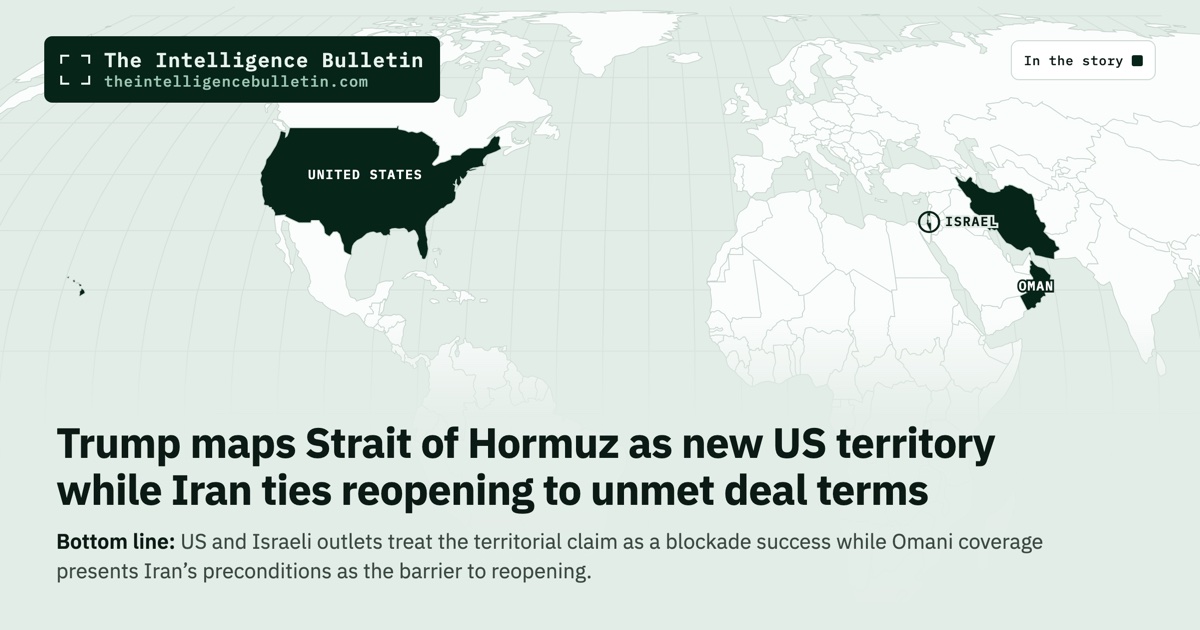
Trump maps Strait of Hormuz as new US territory while Iran ties reopening to unmet deal terms

Map of the countries in the story: Trump maps Strait of Hormuz as new US territory while Iran ties reopening to unmet deal terms
US President Donald Trump posted a map on Truth Social labeling the Strait of Hormuz ‘new US territory’ and stated no talks with Iran are ongoing or scheduled. The announcement followed expiration of a June interim deal memorandum and amid a US naval blockade. Iran’s parliament speaker said the strait will stay shut until the US lifts sanctions, releases assets, and meets other conditions. Shipping through the chokepoint has dropped sharply.

One Story. Many Angles.

🇺🇸
United States
New York Post
Original reporting
Trump posts map labeling Strait of Hormuz ‘new US territory’ before announcing no talks with Iran planned
Read →
🇮🇷
Iran
National Council of Resistance of Iran
Commentary
Iran News in Brief – August 18, 2026
Read →
🇴🇲
Oman
Oman Observer
Original reporting
Hormuz Strait to remain shut until U.S. meets interim deal conditions, Iran says
Read →
🇮🇱
Israel
Jerusalem Post
Original reporting
Donald Trump says Strait of Hormuz is ‘new US territory’ as blockade continues
Read →
🇭🇰
Hong Kong
South China Morning Post
Carries Agence France-Presse reporting
Trump posts map with Hormuz as ‘new US territory’, says no Iran talks planned
Read →
5 sources · 4 independent accounts — some share the same news agency’s report
In Brief

US and Israeli outlets treat the territorial claim as a blockade success while Omani coverage presents Iran’s preconditions as the barrier to reopening.

US and Israeli reporting centers Trump’s social media map and blockade assertions as a direct assertion of control after the MoU deadline passed, with the Jerusalem Post adding Qatari mediator comments on needing an Iran-Oman Hormuz agreement first. South China Morning Post coverage links the move to broader global oil transit stakes and notes Trump’s prior territorial threats elsewhere. The Oman Observer instead foregrounds Iran’s top negotiator Mohammad Baqer Qalibaf stating the waterway stays closed until Washington fulfills interim deal terms including ending the blockade and sanctions. The National Council of Resistance of Iran outlet largely omits the Trump declaration, focusing on internal regime crises and citing Reuters data on halted tanker traffic. This split shows actor-country outlets treating the claim as operational fact while the affected littoral state frames reopening as conditional on unmet US concessions, with no domestic Iranian state media appearing in the set.

Perspective Analysis

President Donald Trump posted a map on his Truth Social account on August 18 labeling the Strait of Hormuz “NEW U.S. Territory.” In follow-up posts the same day he stated there are no talks or conversations going on or scheduled with the Islamic Republic of Iran, that the naval blockade remains in full force, that the strait is open and operating, and that all water mines have been removed or detonated. The posts came one day after the 60-day window of a June 17 memorandum of understanding between the United States and Iran expired without extension. That memorandum had committed both sides to negotiate a final deal covering issues including Iran’s nuclear program. Trump had declared the deal over on July 7; Iran’s foreign ministry suspended it a week later.

The map and statements built on remarks Trump made the previous Friday at a campaign event on Long Island, where he said that after defeating Iran he would declare the strait a territory of the United States. He had also told reporters in the Oval Office on August 17 that he liked the idea of declaring it US territory because the United States already controlled it through the blockade. In the same exchange he said Tehran wants a deal but not the kind he considers necessary, and that Iran cannot be allowed a nuclear weapon after the damage already inflicted by B-2 bombers.

Iran’s parliament speaker, Mohammad Baqer Qalibaf, addressed the same waterway on August 18 in comments carried by state media. He said the strait will not be opened until the United States implements the commitments in the June memorandum, specifically lifting the blockade of Iranian ports, lifting oil sanctions, releasing Tehran’s frozen assets, and ending threats and military operations on all fronts. Qalibaf described the shift to a fully offensive posture now that diplomatic efforts have stalled. A senior Iranian official told Reuters the same day that Iran would move to that posture because the talks had failed to secure a permanent end to the conflict.

Reporting from the South China Morning Post placed the territorial claim in the context of a nearly six-month war that began February 28 and noted that the strait normally carries a fifth of global oil and liquefied natural gas shipments. The same account recorded Trump’s threat on August 17 to “bomb the s***” out of US ally Oman if it interfered with a Hormuz deal, and it recorded Qatari Foreign Ministry spokesperson Majed al Ansari saying mediators were waiting for Iran and Oman to reach a bilateral agreement on the strait before broader US-Iran talks could resume. An agreement on Hormuz, al Ansari said, would make resuming those talks much easier.

The National Council of Resistance of Iran published shipping data on the same day showing commercial traffic through the strait had fallen to five cargo vessels on Saturday and none on Sunday, compared with 31 the previous weekend. The figures came from maritime tracking company Kpler via Reuters. The same outlet devoted the rest of its August 18 brief to Iranian domestic issues, including a daily gasoline deficit of 14 to 15 million liters, $127 billion in government and state oil company debt to the National Development Fund, and recent drone attacks attributed to Iranian forces against the office of the prime minister of Iraq’s Kurdistan region.

Three outlets—the New York Post, the Jerusalem Post, and the South China Morning Post—each carried the details of Trump’s map and his explicit statement that no talks were planned or scheduled. The Jerusalem Post added that Trump pointed to the blockade’s effect of removing millions of barrels of oil a week from the market and said oil prices were already falling. The New York Post quoted Trump’s earlier Long Island remarks about declaring the strait US territory after defeating Iran. The South China Morning Post noted that Trump’s envoy and son-in-law Jared Kushner had described “very positive and active conversations” the day before, only for the president to deny any such talks existed.

The Oman Observer carried Qalibaf’s full list of preconditions without reference to the territorial map. It described the June memorandum as having unraveled over the dispute about control of the strait and placed the Iranian conditions in the immediate local context of Omani waters adjacent to the waterway. The National Council of Resistance of Iran brief contained no mention of the map, the territorial declaration, or Trump’s no-talks statement.

A reader limited to US or Israeli accounts would encounter the territorial claim and the blockade presented as operational facts that have already cleared the strait for traffic and reduced Iranian oil exports. That reader would not encounter the Iranian preconditions for reopening or the Qatari mediator’s statement that an Iran-Oman bilateral understanding must precede any return to broader talks. A reader limited to the Oman Observer would see the strait’s continued closure framed as dependent on specific US actions still unmet, without the counter-claim that the United States has already asserted sovereignty through the map and the blockade. A reader limited to the National Council of Resistance of Iran brief would receive no account of the territorial declaration at all and would instead see only data on reduced shipping alongside Iranian internal economic and security problems.

The corroborated record shows Trump’s map and no-talks statements appearing in three independent English-language chains on the same day, while Iran’s preconditions appear in two chains that also quote Qalibaf directly from state media. The single-source shipping count of five vessels on Saturday comes solely through the National Council of Resistance of Iran’s citation of Reuters and Kpler. No domestic Iranian state outlet appears among the accounts examined.

What to Watch

The US and Israeli framing treats the declaration as an extension of an already effective blockade that has produced measurable reductions in Iranian oil movements. The Omani framing treats reopening as conditional on concessions that have not yet been delivered. The National Council of Resistance of Iran framing treats the episode as secondary to regime vulnerabilities at home. Each vantage aligns with the outlet’s location and audience: actor-country outlets foreground the power asserted after the deadline passed, the affected littoral state foregrounds the conditions attached to its adjacent waters, and the exile opposition outlet foregrounds evidence of regime strain. The most complete picture available from the set combines the territorial claim with the listed preconditions, because both rest on named statements from the principals and appear in more than one independent chain. The immediate stakes remain the flow of oil through the narrow channel that links the Persian Gulf to the open sea.
Share this story

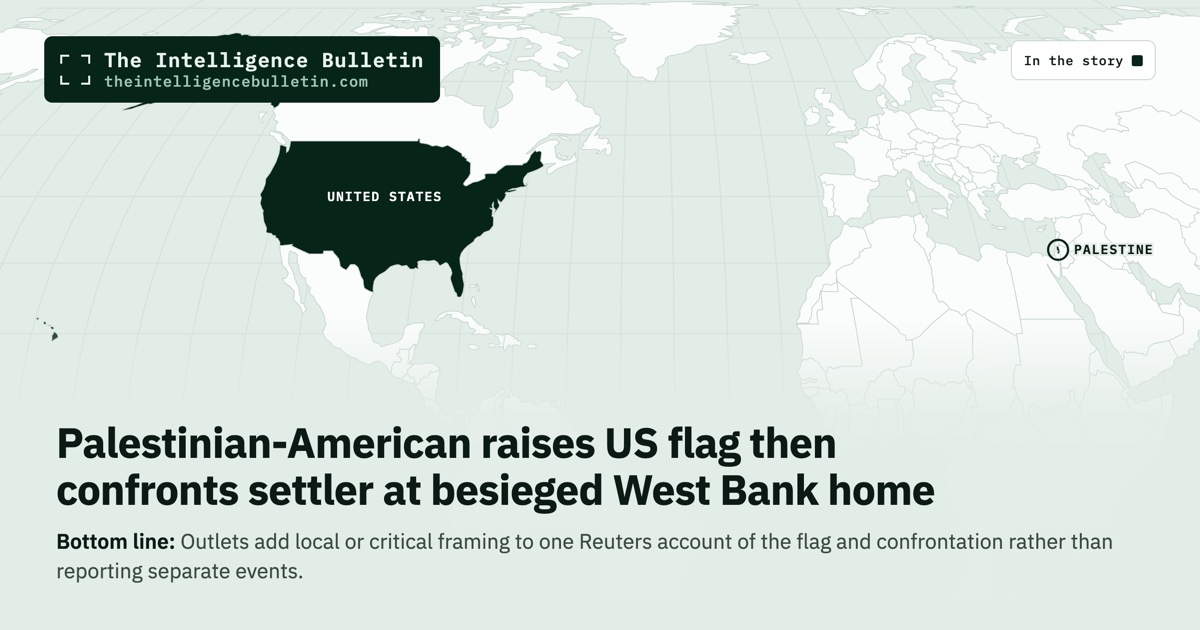
Palestinian-American raises US flag then confronts settler at besieged West Bank home

Map of the countries in the story: Palestinian-American raises US flag then confronts settler at besieged West Bank home
Palestinian-American Loui Ridi flew from Toledo, Ohio, to Qusra in the West Bank after settlers besieged his family home and two others since August 9, cutting supplies. He raised a US flag on the roof upon arrival and confronted a settler who entered the property on August 18. Israeli soldiers declared the area a closed military zone and ordered everyone inside but did not arrest the settler. US Ambassador Mike Huckabee condemned the settlers as terrorists while Prime Minister Netanyahu has not commented.

One Story. Many Angles.

🇮🇱
Israel
The Jerusalem Post
Carries REUTERS reporting
Israeli settler extremist enters Palestinian-American’s besieged West Bank home
Read →
🇺🇸
United States
13abc
Carries Associated Press reporting
Toledo-area businessman returns to besieged family home in West Bank village
Read →
🇭🇰
Hong Kong
South China Morning Post
Carries Agence France-Presse reporting
Israeli military ‘paralysis’ on settler violence exposed in West Bank siege
Read →
🇦🇺
Australia
WAtoday
Carries Reuters reporting
Under siege: A Palestinian-American man returns to get his home back
Read →
🇹🇼
Taiwan
Liberty Times
CHINESE
Translated from Reuters
Palestinian-American returns home to protect family, raises Star-Spangled Banner against Israeli settlers
“巴勒斯坦裔美國人返鄉護家 升星條旗對抗以色列屯墾者 – 國際”
Read →
5 sources · 3 independent accounts — some share the same news agency’s report
In Brief

Outlets add local or critical framing to one Reuters account of the flag and confrontation rather than reporting separate events.

All five outlets relay essentially the same Reuters-sourced sequence of Ridi’s return, the flag-raising, and the specific morning confrontation captured on video. The Jerusalem Post leads with the settler’s incursion onto the land and the soldiers’ limited intervention, reflecting its focus on Israeli security dynamics on the ground. The Toledo station 13abc centers the personal details of the local businessman watching security cameras from Ohio and reuniting with his 83-year-old mother, adding family context absent elsewhere. South China Morning Post frames the episode as evidence of Israeli military paralysis, noting troops prayed with settlers and only tents were removed despite US pressure. WAtoday presents the human story of a man traveling thousands of miles to reclaim his grandparents’ land after sleepless nights. Liberty Times highlights the symbolic raising of the American flag as an act of diaspora resistance. Because the underlying reporting chain is one, the variation lies only in emphasis and local resonance rather than conflicting facts. The absence of any independent on-the-ground sourcing outside Reuters means the military’s inaction is described uniformly as insufficient to lift the siege, leaving the central tension between the Palestinian-American’s claim to the property and the settlers’ continued presence unresolved in all accounts.

Perspective Analysis

Loui Ridi landed at Ben Gurion airport late on Monday after a flight from Detroit. The 46-year-old Palestinian-American who owns a chain of convenience stores in Toledo, Ohio, had spent the previous week watching his family home in the West Bank village of Qusra on live security cameras. Settlers had encircled the property and two neighboring houses since August 9, blocking supplies and preventing residents from leaving freely. Ridi’s mother, 83, still lived in the village along with his sisters, brothers, nieces, nephews and cousins. He told reporters at the airport that he could not sleep and refused to watch settlers take the house while he remained in the United States.

Ridi reached Qusra on Monday evening and reunited first with his mother and sister before moving to the house itself. He entered under military escort after waiting roughly 100 meters from the gate. Once inside, he climbed to the roof at sunset and raised a large American flag. He later explained the choice in plain terms: if settlers eventually took the property they would raise their own flag, but they would first have to move the American one. The flag was intended as both a message and a form of deterrence, a tactic several Palestinian-American families in the area have used for years.

The siege had already drawn condemnation from the United States. Ambassador Mike Huckabee described the settlers involved as “Israeli terrorists.” White House officials pressed Israeli Prime Minister Benjamin Netanyahu to issue a public condemnation, according to officials cited in the reporting. Netanyahu had not commented on the events in Qusra as of the latest accounts. The Israeli military stated it had deployed forces to restrain the settlers and maintain security, and it described the settlers’ actions as illegal. Soldiers declared the neighborhood a closed military area. Still, settlers remained outside the homes more than a week after the siege began, and families inside reported dwindling food and water.

On Tuesday morning Ridi walked among the cherry and fig trees on his property. A settler approached from the hill above, holding what appeared to be a Torah scroll in one hand and filming with a phone. The settler spoke in Hebrew: “You came to make a mess, ha?” Ridi replied that the man was a terrorist settler. Israeli soldiers arrived and told the settler the area was closed. The settler said he would leave only if Ridi and the others went inside the house. Soldiers instructed Ridi to enter his home and said they would handle the problem. The settler retreated up the road, later joined by two others, before the group walked away. Reuters captured the entire exchange on video, the only media outlet present at the scene.

Ridi told the soldiers the settler’s presence was illegal and demanded an arrest. He has been in contact with the US embassy and members of Congress, hoping they will press the Israeli government for a permanent removal of the settlers. His brother Qusai Abu Rida and a teenage nephew had stayed inside to defend the property during the initial week of the siege. Ridi said he should be able to reach his house freely at any time and described the situation as a nightmare for the family.

The same Reuters sequence of events appears across the five outlets that covered the story. The Jerusalem Post foregrounded the settler’s incursion onto the property and the soldiers’ limited intervention, quoting the settler’s exchange with troops and noting that the IDF vehicle had driven by several times before soldiers approached. The Toledo station 13abc centered Ridi’s departure from Detroit Metro Airport, his sleepless nights watching cameras, and his reunion with his mother, while adding that he owns Ridi’s Convenience Stores and has been coordinating with the embassy for safe passage. South China Morning Post described the standoff as exposing military paralysis, noting that some of the first soldiers on scene were filmed praying with the settlers and that only tents were dismantled despite repeated US requests. WAtoday presented the journey from Ohio as an act of individual determination, recounting how Ridi had begun building the house three years earlier on land farmed by his grandparents so his daughters could connect to their roots. Liberty Times highlighted the flag-raising itself as a symbolic act of resistance by a member of the Palestinian-American diaspora, describing how Ridi held a phone to film the settler while demanding military action.

A reader limited to any single outlet would miss elements that appear only in the others. The Jerusalem Post account alone would not convey the specific family details or the seven nights Ridi spent monitoring cameras from Ohio. The 13abc piece would not register the explicit comparison to military paralysis or the detail that soldiers prayed with settlers. The South China Morning Post framing would stand apart from the personal travel narrative and the flag symbolism chosen by outlets in the United States and Taiwan. WAtoday’s emphasis on generational land ties would not surface in the Israeli or Hong Kong versions. Liberty Times would leave a reader without the local American business context or the military’s closed-area declaration.

The underlying facts rest on a single reporting chain. Reuters supplied the video of the confrontation, the flag-raising, the dialogue, the military statements, and the accounts from Ridi and his neighbors. Every outlet carried or translated that dispatch with variations only in headline emphasis and added local color. No independent on-the-ground sourcing appears in any of the five pieces. The description of military inaction as insufficient to lift the siege is therefore uniform rather than contested. The central tension between Ridi’s documented claim to the property and the settlers’ continued presence outside remains unresolved in every account.

What to Watch

The Reuters-derived record is the closest available to a complete picture because it supplies the only detailed, attributed sequence of events, quotes, and timing that multiple outlets accepted without alteration. Israeli, American, Hong Kong, Australian, and Taiwanese publications all reproduced the same core claims on the siege dates, the flag, the confrontation, Huckabee’s condemnation, and Netanyahu’s silence. Outlets have institutional reasons to foreground different pieces: an Israeli paper naturally selects security procedures, a local US station adds hometown family information, an external observer highlights institutional inertia, and a translated piece in Taiwan selects the visible symbol of American citizenship. Those choices do not alter the shared timeline or the absence of any counter-claim on the record. The pressure on Netanyahu to issue a public statement will likely continue in the coming days, because the presence of an American citizen and the documented video have already produced coordinated diplomatic attention from Washington.


Share this story

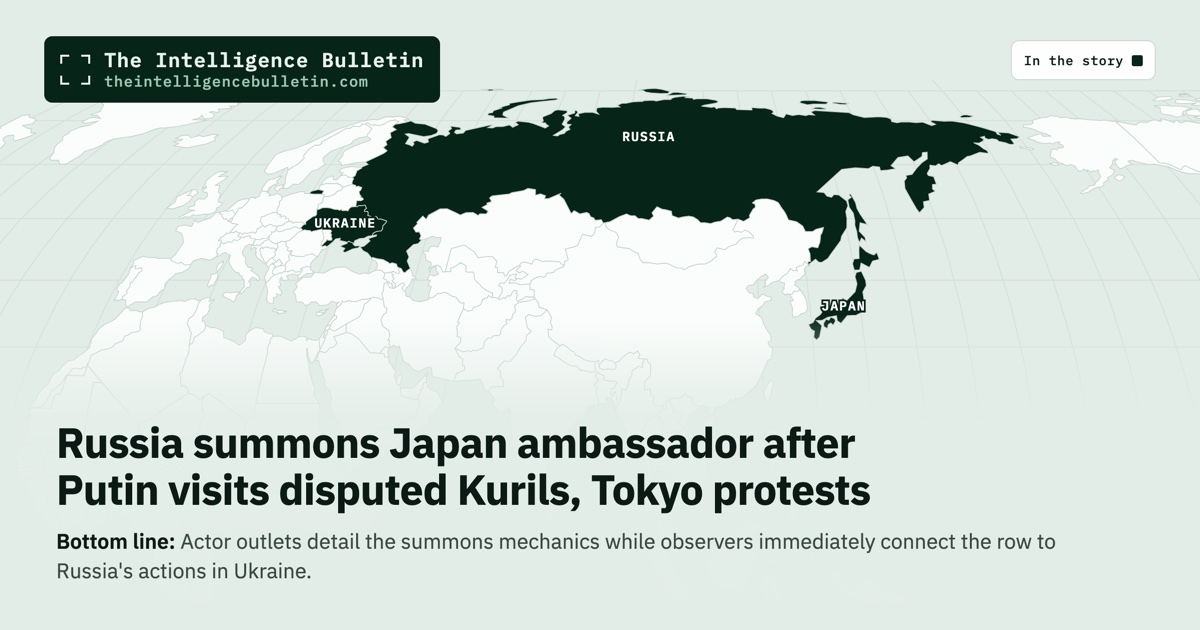
Russia summons Japan ambassador after Putin visits disputed Kurils, Tokyo protests

Map of the countries in the story: Russia summons Japan ambassador after Putin visits disputed Kurils, Tokyo protests
Russia summoned Japanese Ambassador Akira Muto to the Foreign Ministry after Tokyo protested President Vladimir Putin’s August 13 visit to Etorofu Island in the disputed Kurils. Japanese Prime Minister Sanae Takaichi called the visit unacceptable and summoned Russia’s ambassador in response. Russian Foreign Minister Sergei Lavrov said Japan had crossed the line of decency; the envoy initially cited health issues but agreed to appear Tuesday. The islands, seized by the Soviet Union in 1945, remain the main barrier to a Japan-Russia peace treaty.

One Story. Many Angles.

🇯🇵
Japan
Japan Today
Original reporting
Russia summons Japan ambassador over isle row
Read →
🇷🇺
Russia
RIA Novosti
RUSSIAN
Carries Military Watch Magazine reporting
In the US, they revealed what signal Putin sent to Japan during his visit to the Kuriles
“В США раскрыли, какой сигнал Путин послал Японии во время визита на Курилы”
Read →
🇳🇱
Netherlands
The Moscow Times
Commentary
Putin Revealed His True Intentions With Japan by Visiting Disputed Islands
Read →
🇺🇦
Ukraine
Kyiv Post
Carries AFP reporting
Russia Summons Japan Envoy Over Putin’s Kuril Islands Visit
Read →
🇹🇷
Turkey
Anadolu Agency
Wire copy
Russia lodges protest with Japanese ambassador over criticism of Putin’s Kuril Islands trip
Read →
5 sources · 4 independent accounts — some share the same news agency’s report
In Brief

Actor outlets detail the summons mechanics while observers immediately connect the row to Russia’s actions in Ukraine.

The reporting converges on the basic sequence of reciprocal summonses but parts sharply on context and stakes. Japanese and Turkish accounts treat the exchange as standard diplomatic pushback over the Kurils, while Ukrainian coverage immediately frames the episode as another instance of Russian assertiveness already visible in Ukraine. The exiled Moscow Times alone reads Putin’s first presidential visit to the islands as deliberate punishment for Japan’s sanctions and NATO tilt, an interpretation absent from state Russian reporting. RIA Novosti instead relays a U.S. analysis that casts the trip as a sovereignty signal timed near the WWII anniversary, sidestepping the ambassador row almost entirely. This split reveals how proximity to the actors produces narrow procedural accounts, while distance invites linkage to wider Russian behavior; the single point of genuine agreement across all chains is that the dispute itself remains frozen and the latest move changes nothing on the ground.

Perspective Analysis

Russia summoned Japanese Ambassador Akira Muto to the Foreign Ministry in Moscow after Tokyo protested President Vladimir Putin’s visit to Etorofu Island. The island is one of four Russian-held territories that Japan claims as its Northern Territories. Putin traveled there on August 13 after inspecting naval exercises near Sakhalin, marking the first such visit by a Russian president to the disputed area.

Japanese Prime Minister Sanae Takaichi described the trip as hurting Japanese public sentiment and absolutely unacceptable. Tokyo then summoned Russia’s ambassador in Japan and lodged a strong protest. Russia responded by calling Muto in, with Foreign Minister Sergei Lavrov stating that Japanese officials had crossed the line of decency in their criticism. Lavrov noted that the embassy had initially replied the ambassador could not appear on Friday or Monday because of factors including a health issue. Ministry spokeswoman Maria Zakharova later told the state news agency Tass that Muto had suddenly started feeling better and would attend on Tuesday.

The four islands, including Etorofu, Kunashiri, Shikotan and the Habomai group, were seized by Soviet forces in 1945 after Japan announced its surrender in World War II. Russia maintains the seizure was legitimate under the results of that war. Japan argues the islands were illegally taken and that the lack of a postwar peace treaty stems directly from this unresolved claim. Earlier Russian officials have visited the islands, most notably then-President Dmitry Medvedev on Kunashiri in 2010, but Putin had avoided them throughout his time in power until now.

The reporting from every outlet that covered the summons agrees on the basic sequence of reciprocal diplomatic actions. Japan Today reported the Russian summons as a matter of routine compliance, noting that an embassy official declined to confirm details citing diplomatic sensitivity. Anadolu Agency described Russia lodging the protest with the ambassador over Tokyo’s criticism of the trip, without further elaboration. Kyiv Post carried the same core facts, including Lavrov’s remarks on the ambassador’s initial unavailability and Zakharova’s follow-up statement.

Accounts diverge once the story moves beyond the immediate exchange. Japan Today and Anadolu Agency keep the focus on the procedural mechanics and the longstanding territorial disagreement. Kyiv Post immediately places the episode inside Russia’s wider pattern of assertiveness, referencing Japan’s sanctions on Russia and its financial and non-lethal support for Ukraine since 2022. The exiled Moscow Times reads the visit itself as a calculated shift. It notes that Putin had previously cultivated a more subtle approach toward Japan, including suggestions of a possible territorial compromise framed as a judo draw, and argues the August 13 trip signals punishment for Japan’s post-2022 stance rather than an invitation to renewed engagement. RIA Novosti instead foregrounds an analysis from Military Watch Magazine that presents the visit as a symbolic demonstration of Russian sovereignty, timed near the August 15 anniversary of Japan’s WWII surrender and centered on the militarily significant island of Iturup.

These differences track closely with each outlet’s position relative to the actors. Japanese and Turkish reporting stays inside the bilateral diplomatic frame because that is the vantage their sources supply. Ukrainian coverage draws the line to ongoing conflict because that is the immediate context its readers track. The Moscow Times piece supplies the only explicit strategic reading of the visit as a break from earlier Russian tactics, drawing on the record of past visits and economic overtures. RIA Novosti, by relaying foreign commentary, avoids centering the protest exchange that the other accounts treat as the central development.

The single point of convergence across all five pieces is that nothing on the ground has changed. The territorial row still blocks a peace treaty, and the latest summons follows the same pattern of protest and counter-protest that has held for decades. No source reports any new proposal, concession, or escalation beyond the diplomatic channel itself.

The narrow accounts from the actor outlets and the neutral agency give the clearest picture of what actually occurred on August 17 and 18. They rest on direct statements from the foreign ministries and on the sequence of public announcements that multiple independent reporting chains recorded. The broader interpretations offered by the Ukrainian and exiled Russian pieces supply useful context for readers already following the Ukraine conflict or Japanese domestic politics, yet they rest on inference rather than new evidence from this episode. The Russian state account reframes the visit away from confrontation, which aligns with its domestic audience but leaves the summons itself in the background.

What to Watch

The dispute will remain frozen because neither side has altered its core position or offered a path around it. Japan continues to insist the territorial issue must be resolved before any treaty. Russia continues to treat the islands as sovereign territory acquired through the war. Further reciprocal protests are the most likely next step if either government needs to register domestic displeasure, but the reporting gives no indication that this particular exchange will shift the underlying balance.


Share this story

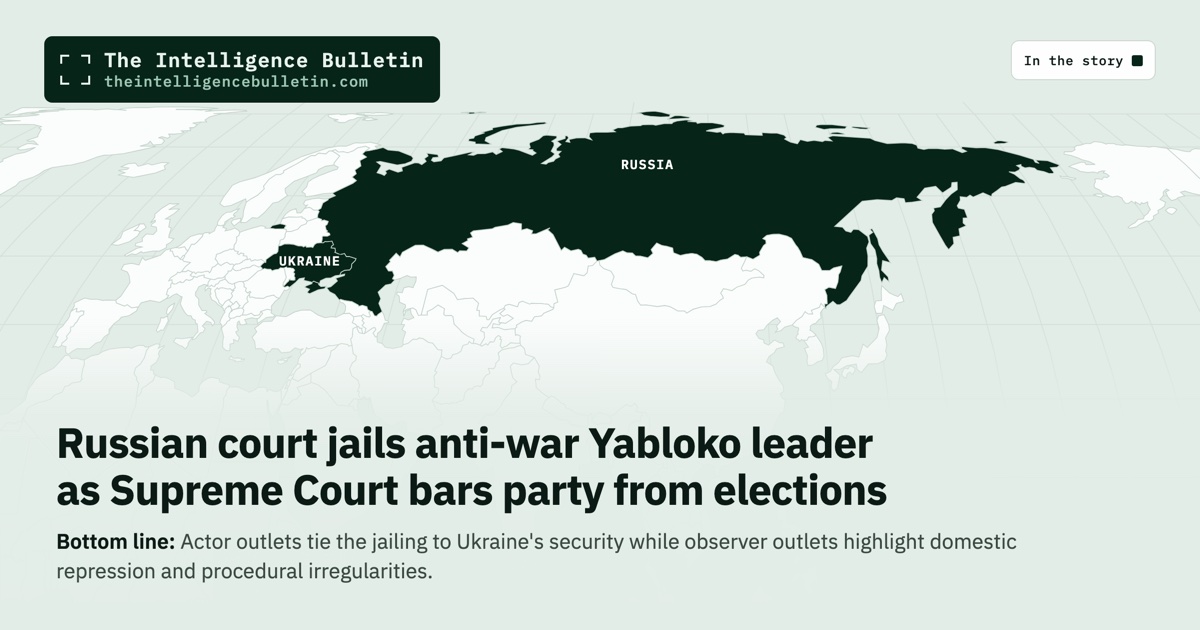
Russian court jails anti-war Yabloko leader as Supreme Court bars party from elections

Map of the countries in the story: Russian court jails anti-war Yabloko leader as Supreme Court bars party from elections
A Pskov court sentenced Lev Shlosberg, deputy chairman of Russia’s liberal Yabloko party, to 11 years and one month in a penal colony for discrediting the armed forces and spreading false information about the military. Charges stemmed from a 2022 Telegram repost of a British newspaper cover linking Putin to a bloodied woman and 2025 debate remarks calling for a ceasefire in Ukraine. The same day, Russia’s Supreme Court upheld a ban barring Yabloko from September parliamentary elections. Shlosberg maintained his innocence and described the proceedings as politically motivated.

One Story. Many Angles.

🇳🇱
Netherlands
The Moscow Times
Original reporting
Judge Sentences Lev Shlosberg to 11 Years in Prison for Anti-War Statements
Read →
🇺🇦
Ukraine
Kyiv Post
Carries AFP reporting
Russia’s Supreme Court Upholds Yabloko Ban, Sentences Deputy Chairman to 11 Years in Prison
Read →
🇬🇧
United Kingdom
The Independent
Original reporting
Russia jails opposition politician for 11 years over Ukraine war criticism
Read →
🇶🇦
Qatar
Al Jazeera
Original reporting
Russia maintains election ban on opposition Yabloko, jails deputy head
Read →
🇳🇱
Netherlands
NOS
DUTCH
Carries Mediazona reporting
Russia sends vice-chairman of opposition party to a penal camp for 11 years
“Rusland stuurt vicevoorzitter oppositiepartij voor 11 jaar naar een strafkamp”
Read →
5 sources · each independently reported
In Brief

Actor outlets tie the jailing to Ukraine’s security while observer outlets highlight domestic repression and procedural irregularities.

The reporting converges on the sentence and the simultaneous election ban as coordinated pressure on the sole registered party openly opposing the war, yet the angles diverge sharply in what each outlet chooses to foreground. Ukrainian coverage from Kyiv Post frames both moves as direct threats to Ukraine’s security and evidence of Kremlin efforts to eliminate anti-war voices ahead of the vote. Western and Gulf outlets emphasize the human cost and procedural flaws inside Russia itself. The Moscow Times details irregularities such as the judge refusing to question Shlosberg directly and appointing a state lawyer after defense attorneys were absent. The Independent and Al Jazeera quote Shlosberg’s defiant courtroom speech about mounting Russian casualties and label the case part of a wider pattern that previously targeted Navalny and Orlov. Dutch public broadcaster NOS stresses the penal-colony sentence as emblematic of authoritarian rule and connects it to earlier high-profile cases. All accounts draw heavily from the same Russian independent sources, producing an unusually consistent factual core across borders while still revealing distinct national priorities in emphasis and context.

Perspective Analysis

A Pskov court handed Lev Shlosberg, deputy chairman of the liberal Yabloko party, an 11-year-and-one-month sentence in a general-regime penal colony on August 17. Prosecutors had asked for 12 years and one month. The charges combined accusations of discrediting the Russian armed forces with spreading false information about their actions. Both counts drew on wartime laws enacted after the February 2022 full-scale invasion of Ukraine. The sentence incorporated a prior November 2025 conviction that had required 420 hours of community service for violating the foreign-agent statute.

The first count rested on a February 25, 2022, Telegram repost of a Daily Mirror front page that paired an image of President Vladimir Putin with a photograph of a bloodied woman under the headline “Her blood… His hands.” Shlosberg told the court the post predated the new censorship statutes. The second count arose from remarks in a January 2025 public debate in which he called for the swiftest possible ceasefire in Ukraine. Prosecutors attributed the statements to him; he maintained that his debate opponent had made them and that he had never published video of the exchange.

Shlosberg entered a not-guilty plea and used his final statement to declare the entire proceeding unlawful. “I am an innocent man, against whom criminal charges have been unlawfully brought,” he said. Four of the five outlets that covered the verdict recorded this passage. The judge, according to accounts in The Moscow Times and Kyiv Post, declined to question Shlosberg directly and instead read transcripts from earlier hearings. Three defense attorneys missed sessions because of illness or scheduling conflicts; the court appointed a state lawyer whose request for time to review the file was denied.

On the same day the Pskov verdict was delivered, Russia’s Supreme Court rejected Yabloko’s appeal against the cancellation of its federal candidate list for the September parliamentary elections. The party had been the only registered political organization in Russia that campaigned openly for an end to the war. The initial ban had followed a lawsuit filed by the small nationalist Rodina party, which accused Yabloko of receiving foreign funding and promoting extremism. Yabloko leaders rejected both claims, stating that the party received only domestic donations and answered to Russian voters. Party leader Nikolay Rybakov described the detentions of supporters outside the Supreme Court building as intimidation.

Shlosberg’s closing courtroom remarks went beyond the narrow charges. He described the war as a catastrophe for Russia, noting that cemeteries were expanding faster than maternity wards, kindergartens, and schools. The Independent and Al Jazeera both carried extended excerpts in which he predicted that the full death toll, once published with names, would shock the nation. Independent Russian outlets Mediazona and the BBC Russian service have documented at least 239,354 named Russian service members killed since the invasion; by examining excess mortality through estate records, they estimate the true figure exceeds 350,000. Those casualty compilations appeared in coverage of Shlosberg’s statement.

The sources agree on the core sequence and the legal basis for the charges. They also converge on the fact that Yabloko was the sole registered anti-war party on the ballot and that the election ban and prison sentence were announced together. The Moscow Times supplied the most detailed record of trial procedure, including the judge’s refusal to question the defendant and the appointment of replacement counsel. Kyiv Post placed both rulings in the context of threats to Ukraine’s security and the elimination of organized domestic opposition before the vote. The Independent and Al Jazeera foregrounded Shlosberg’s own words about casualties and placed the case inside a longer pattern that includes the imprisonment of human-rights advocate Oleg Orlov and the death of Alexei Navalny in a penal colony. NOS, writing for a Dutch audience, emphasized the penal-colony sentence itself and connected it explicitly to those earlier cases.

No outlet in the set carried a Russian state-media account that disputed the sentence or the election ruling. All five drew the factual spine from the same two independent Russian reporting chains: Mediazona for the trial details and Novaya Gazeta for courtroom observations. Where the accounts diverge is in emphasis rather than in the events reported. Ukrainian coverage alone tied the rulings directly to battlefield implications for Kyiv. The exiled Moscow Times supplied granular procedural evidence that the others summarized. British and Qatari reporting lingered on the content of Shlosberg’s speech and the human stakes. The Dutch public broadcaster framed the outcome as a textbook illustration of authoritarian consolidation.

What to Watch

The consistent factual core across five independent national outlets rests on primary Russian sources that operate outside state control. That convergence supplies the strongest available warrant for the sentence length, the charges, and the simultaneous election decision. Ukrainian reporting adds the necessary reminder that these domestic moves occur inside an active war whose front lines the Yabloko leadership has proposed freezing. The exiled Moscow Times account of courtroom mechanics offers the clearest window into how such cases are conducted when defense counsel and direct testimony are restricted. Readers limited to any single national lens would miss either the Ukrainian security stakes, the procedural texture inside Russia, or the explicit linkage to prior high-profile dissent cases. The combined record shows a tightening of political space ahead of September elections that leaves no registered party able to campaign for an immediate ceasefire.


Share this story

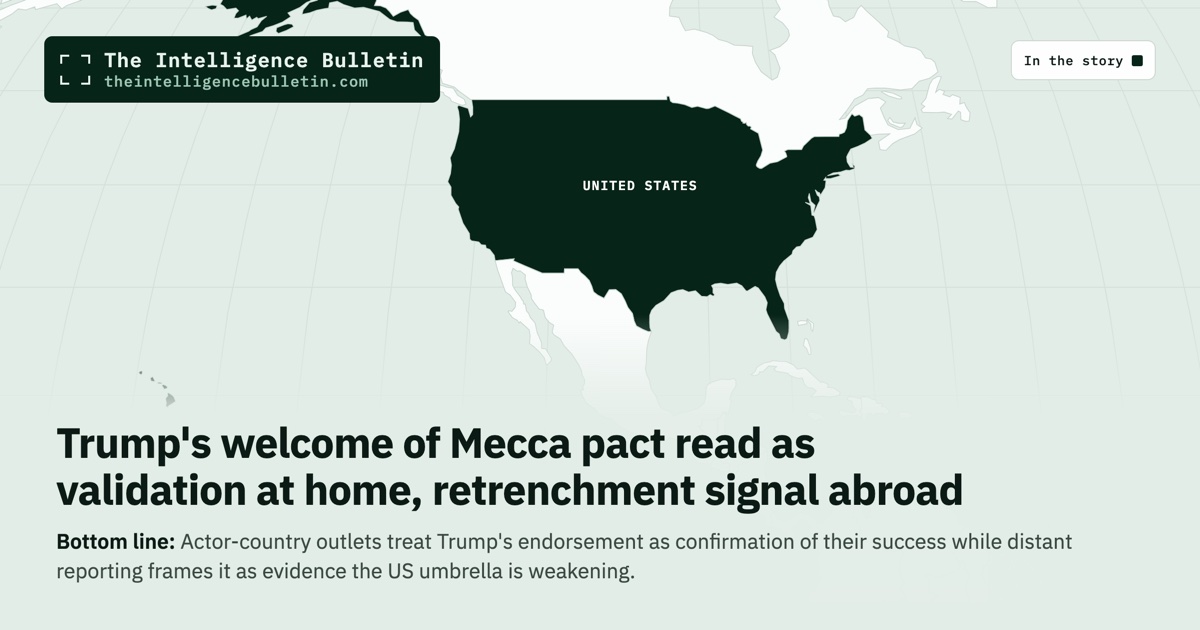
Trump’s welcome of Mecca pact read as validation at home, retrenchment signal abroad

Map of the countries in the story: Trump's welcome of Mecca pact read as validation at home, retrenchment signal abroad
US President Donald Trump posted on Truth Social welcoming the Mecca Joint Defense Agreement signed August 7 by Saudi Arabia, Turkey and Pakistan. He called it a big, bold first step for regional self-defense amid the US-Iran conflict. The pact includes a mutual defense clause modeled on NATO Article 5. Pakistan’s foreign ministry highlighted collective deterrence; Saudi and Turkish outlets stressed strengthened regional security.

One Story. Many Angles.

🇵🇰
Pakistan
The Frontier Post
Carries AFP reporting
Trump welcomes defense pact between Saudi Arabia, Turkiye and Pakistan
Read →
🇸🇦
Saudi Arabia
Al Watan
ARABIC
Carries agencies reporting
Trump: The Mecca Agreement strengthens the defense of the countries in the region
“ترمب: اتفاقية مكة تعزز دفاع دول المنطقة”
Read →
🇹🇷
Turkey
Daily Sabah
Carries Agencies reporting
Trump hails defense pact between Türkiye, Pakistan, Saudi Arabia
Read →
🇶🇦
Qatar
Al Jazeera
Commentary
Trump hails Mecca pact: Can it replace the region’s US security umbrella?
Read →
🇭🇰
Hong Kong
South China Morning Post
Commentary
Editorial | Saudi Arabia-Turkey-Pakistan pact a sign of a realigning global order
Read →
5 sources · 3 independent accounts — some share the same news agency’s report
In Brief

Actor-country outlets treat Trump’s endorsement as confirmation of their success while distant reporting frames it as evidence the US umbrella is weakening.

Trump’s endorsement of the Mecca pact lands differently depending on the vantage. Pakistani, Saudi and Turkish reporting treats the US president’s words as direct validation of a national or regional success, quoting his Truth Social post at length and pairing it with local official statements on collective security. Al Jazeera’s analysis, written from Qatar, immediately pivots to whether the arrangement can actually substitute for the US security umbrella that the three signatories have long relied on, citing analysts who note the pact’s conditional language and limited immediate military integration. The South China Morning Post editorial steps further back, reading the deal as one more data point in a global order shifting away from US guarantees, with China positioned to gain influence and Pakistan’s nuclear status raising separate risks. What the actor-country accounts omit, the outsiders supply: the pact’s origins in eroded trust after the US-Iran war began without consulting Gulf partners. The shared factual core is Trump’s post and the August 7 signing; the divergence lies in whether that core signals successful self-help or accelerating American retrenchment. No source disputes the text of Trump’s statement or the pact’s existence, yet the framing choices reveal how each outlet’s location shapes which implication it chooses to foreground.

Perspective Analysis

US President Donald Trump posted on his Truth Social account Sunday that he was very happy to see Saudi Arabia, Turkey and Pakistan sign the Makkah Joint Defense Agreement. He described the pact as showing how the Middle East is coming together and how countries will finally be able to defend themselves in a more meaningful way, calling it a big, bold, important first step. The agreement had been concluded ten days earlier, on August 7, in Mecca. Three separate reporting chains carried the identical wording of Trump’s statement without variation.

The pact itself establishes that an armed attack on any one of the three signatories shall be regarded as an attack against them all. The Frontier Post, drawing on an AFP dispatch, added that Pakistan’s foreign ministry characterized the arrangement as intended to strengthen collective deterrence and recorded the three countries’ shared commitment to participating in efforts to resolve the conflict between Iran and the United States. Daily Sabah, while attributing core facts to agencies, supplied additional operational language: the three states intend to create strategic political and military mechanisms involving their defense and foreign ministers as well as chiefs of general staff, with military cooperation expected to begin with command-post and field exercises before expanding to joint land, naval and air drills, air defense assets and unmanned systems. Al Jazeera confirmed the mutual-defense clause and noted that Turkish Foreign Minister Hakan Fidan had already clarified that any state under attack would first have to request assistance and specify the form of help required, whether intelligence, logistics or troops.

The timing of the August 7 signing placed the agreement against the backdrop of an ongoing US-Iran conflict that had already produced Iranian missile strikes on Saudi critical infrastructure and oil facilities and Iran-backed Houthi attacks across the region. Saudi outlets presented the pact as a direct response to those pressures. Turkish reporting emphasized Ankara’s role in binding two non-NATO partners into a structured alignment. Pakistani coverage highlighted Islamabad’s contribution to the collective-deterrence language. None of the three domestic accounts disputed the text of Trump’s endorsement; each placed it alongside statements from their own governments that framed the pact as a net gain for national or regional security.

The accounts diverge once the lens widens beyond the three capitals. Al Jazeera, operating from Qatar, immediately placed Trump’s statement inside a larger question of whether the Mecca arrangement could substitute for the US security umbrella on which Saudi Arabia, Turkey and Pakistan have historically depended. Its analysts noted that the pact’s commitments remain conditional on a formal request for help and on each capital’s sovereign assessment of what it can spare. One expert observed that Turkey’s participation signals its interest in positioning itself as a security provider rather than a consumer, while another pointed out that the 2025 bilateral Saudi-Pakistan defense pact had not automatically widened into broader conflict after earlier Iranian and Houthi strikes on Saudi territory. The same reporting recorded the roughly 50,000 US troops still stationed across the region and the practical limits on what three middle powers can field in the near term without that presence.

The South China Morning Post editorial moved the frame still farther outward. It treated the pact as one more indicator that middle powers are actively seeking alternatives to US guarantees, citing the war against Iran as having exposed limits on Washington’s willingness and capacity to act as ultimate guarantor. The piece noted China’s potential interest in expanding diplomatic and economic influence in the Middle East and South Asia through the resulting vacuum, while flagging the added complication that one signatory, Pakistan, possesses nuclear weapons. It described the agreement as political signaling more than an immediate military counterforce and warned that a NATO-style collective-defense clause involving a nuclear state could carry global consequences.

These differences are not contradictions over what happened but over what the event means. The three domestic outlets each foregrounded their own government’s role and paired Trump’s words with official statements that presented the pact as successful self-help. The Qatari and Hong Kong accounts supplied the background that the actor-country pieces omitted: the pact’s origins in the perception that Gulf partners had been left exposed when the US-Iran war began without prior consultation, and the conditional rather than automatic character of the new commitments. No source disputed the existence of the August 7 signing or the wording of Trump’s post; the divergence lies in whether that shared core is read as evidence of regional maturation or as evidence of accelerating US retrenchment.

The corroborated record shows a mutual-defense text, a public presidential endorsement, and a signing date ten days before the coverage window. The single-source detail on Pakistan’s foreign ministry statement appears only in the Frontier Post dispatch and therefore stands alone. Where the accounts converge, the convergence itself is the finding: every outlet that carried Trump’s statement reproduced the same sentences. Where they diverge, the divergence tracks geographic vantage. Domestic reporting in the three capitals treats the endorsement as external confirmation of a policy success already achieved. Reporting from outside the triangle treats the same endorsement as data in a larger argument about the durability of US security architecture.

What to Watch

The most direct warrant for any judgment is therefore the pattern across independent reporting chains rather than any single claim. The pact exists in the form described, Trump welcomed it in the words quoted, and the three governments have each claimed credit for its defensive purpose. What remains open is whether the conditional mechanisms outlined by Turkish officials and noted by outside analysts will prove sufficient to alter the balance of deterrence in a region still hosting tens of thousands of US forces. The next measurable test will be whether the planned command-post exercises materialize and whether any of the three capitals invokes the mutual-defense clause in an actual crisis. Those steps will reveal more than the initial signing or the presidential post that followed it.


Share this story

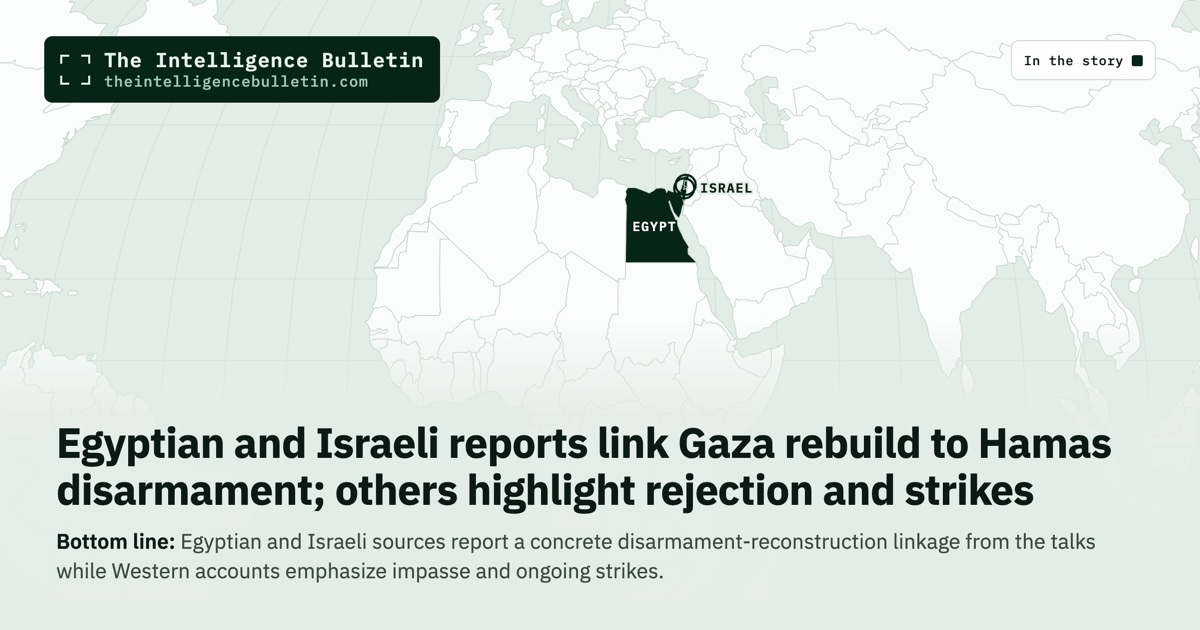
Egyptian and Israeli reports link Gaza rebuild to Hamas disarmament; others highlight rejection and strikes

Map of the countries in the story: Egyptian and Israeli reports link Gaza rebuild to Hamas disarmament; others highlight rejection and strikes
US envoy Jared Kushner met Hamas political chief Khalil al-Hayya in Egypt on August 16, then Israeli Prime Minister Benjamin Netanyahu in Jerusalem on August 17, alongside Board of Peace figures Tony Blair and Nickolay Mladenov. The talks aimed to advance a Trump-backed roadmap requiring Hamas disarmament in exchange for Israeli withdrawal and Gaza reconstruction. Central tension centers on sequencing: Israel insists on full disarmament before any reconstruction or withdrawal, while Hamas demands prior Israeli compliance with ceasefire terms including attacks halt and pullback to the yellow line.

One Story. Many Angles.

🇪🇬
Egypt
Shorouk News
ARABIC
Carries Channel 12 reporting
Channel 12: Netanyahu-Kushner agreement to link Gaza reconstruction to full Hamas disarmament
“القناة 12: اتفاق نتنياهو وكوشنر على ربط إعادة إعمار غزة بنزع سلاح حماس كاملا”
Read →
🇮🇱
Israel
The Algemeiner
Carries Reuters reporting
Kushner’s Talks With Israel, Hamas End Without Breakthrough on Trump Gaza Plan
Read →
🇬🇧
United Kingdom
The Guardian
Carries Associated Press reporting
Jared Kushner meets with Hamas ahead of talks with Netanyahu on Gaza
Read →
🇶🇦
Qatar
Al Jazeera
Original reporting
Kushner meets Hamas leaders in Egypt to push Trump’s Gaza plan
Read →
🇺🇸
United States
HNGN
Carries AFP reporting
Kushner Meets Netanyahu After Rare Hamas Talks in Push to Revive Stalled Gaza Plan
Read →
5 sources · each independently reported
In Brief

Egyptian and Israeli sources report a concrete disarmament-reconstruction linkage from the talks while Western accounts emphasize impasse and ongoing strikes.

Egyptian and Israeli reporting converges on a specific bargain tying Gaza reconstruction to complete Hamas disarmament, a linkage absent or downplayed elsewhere. Shorouk News and The Algemeiner both cite Israeli Channel 12 and officials for this agreement, including arms handover under US supervision and Israeli military freedom of action, framing the Netanyahu-Kushner session as productive on that narrow point. In contrast, The Guardian, Al Jazeera, and HNGN lead with the rarity of the Kushner-Hamas contact and stress Netanyahu’s prior public rejection of the full 15-point roadmap, resumed Israeli strikes, and regional Arab pressure on Washington to enforce compliance. This split reflects sourcing: Egyptian and Israeli outlets draw from Israeli political channels emphasizing preconditions, while the others relay Hamas statements, mediator accounts, and casualty figures from Palestinian sources. The absence of Palestinian-territory outlets leaves Hamas positions visible only through Qatari, British, and US filters. The pattern shows how domestic priorities shape emphasis—reconstruction sequencing for Cairo and Jerusalem, diplomatic impasse and violence for London, Doha, and New York—without any outlet bridging the sequencing gap into a unified account.

Perspective Analysis

Jared Kushner, the US envoy and son-in-law of President Donald Trump, met Hamas political chief Khalil al-Hayya in Egypt on August 16. The session lasted more than two hours and included officials from Egypt, Qatar and Turkey. Kushner pressed for concrete steps under the 15-point roadmap unveiled by Trump on July 31, which calls for phased Hamas disarmament followed by Israeli withdrawal and reconstruction of Gaza under a new Palestinian technocratic administration. Al-Hayya attended alongside Board of Peace members Nickolay Mladenov and Tony Blair. Hamas later stated it remained committed to the roadmap but insisted Israel must first halt attacks, withdraw to the yellow line established in the October 2025 ceasefire, and meet other obligations before disarmament could begin.

The next day, August 17, Kushner flew to Jerusalem for several hours of talks with Prime Minister Benjamin Netanyahu. Mladenov and Blair joined that closed-door session as well. Israeli officials described the meeting as long and focused. Two separate accounts, one carried by Shorouk News from Israeli Channel 12 and another reported by The Algemeiner drawing on Israeli officials and Reuters, stated that Netanyahu and Kushner reached agreement on one narrow point: reconstruction of Gaza would not begin until Hamas handed over all its weapons for destruction under US supervision, including light arms. The Israeli side also secured confirmation of its military freedom of action in Gaza and joint work on public-health measures to prevent disease spread.

Netanyahu had already rejected the full 15-point roadmap in public statements the previous week. His government maintains that Israeli forces will not withdraw from positions beyond the yellow line, nor permit large-scale reconstruction, until Hamas is completely disarmed. Israeli sources noted that Netanyahu faces an October 27 election and a coalition that includes ministers opposed to any withdrawal before full disarmament. A senior Israeli official told reporters there was no breakthrough on the broader sequencing dispute.

Hamas, for its part, described the Egyptian meeting as an opportunity to remind mediators of Israeli violations since the October 2025 ceasefire. Palestinian sources cited across The Guardian, Al Jazeera and HNGN reported more than 1,200 Palestinian deaths from Israeli fire in Gaza since that ceasefire took effect, with strikes continuing into the weekend of August 16-17. Hamas called on the Board of Peace and mediating countries to compel Israel to stop the operations and accept the roadmap timetable. Regional foreign ministers from Egypt, the United Arab Emirates, Qatar, Jordan, Saudi Arabia and others issued a joint statement condemning the Israeli rejection of the plan and urging Washington to enforce compliance.

The same sources recorded that Israeli forces have expanded control to roughly 60 percent of Gaza territory since the ceasefire, moving beyond the original yellow line. Netanyahu’s office characterized the Jerusalem meeting as deep and constructive, while a Board of Peace official described it as in-depth and productive without providing further detail. Neither side claimed resolution of the core sequencing conflict: Israel requires full disarmament first; Hamas requires Israeli withdrawal and attack cessation first.

Accounts diverge sharply on what the two days of meetings actually produced. Shorouk News and The Algemeiner both foreground an Israeli-reported agreement that reconstruction is now explicitly conditioned on complete Hamas disarmament, with arms to be destroyed under the supervision of a US general. Those two outlets, drawing from Israeli political channels, present the Netanyahu-Kushner session as having advanced at least that precondition. The Guardian, Al Jazeera and HNGN instead open with the rarity of the direct Kushner-Hamas contact and emphasize Netanyahu’s public rejection of the roadmap, the continuation of Israeli strikes, and statements from Arab capitals pressing the United States to act. These three outlets relay Hamas demands for prior Israeli compliance and casualty figures from Palestinian health authorities; none of them records the specific reconstruction-disarmament linkage reported by the Egyptian and Israeli pieces.

The split tracks sourcing patterns. Egyptian and Israeli coverage rests on statements from Israeli officials and Hebrew media. The British, Qatari and American pieces rely more heavily on Hamas statements, mediator accounts and regional condemnations. No outlet in the set bridges the gap by presenting both the reported precondition agreement and the rejection language in the same frame. Palestinian-territory outlets are absent from the coverage pool entirely, so Hamas positions reach readers only through Qatari, British and US filters.

The two independent reporting chains that carry the reconstruction-disarmament linkage—Shorouk via Channel 12 and The Algemeiner via Israeli officials—supply the strongest warrant for treating that narrow agreement as the most concrete outcome on the table. Both chains originate in Israeli political sources rather than a single wire dispatch. The broader rejection of the roadmap and the continuation of strikes appear across three additional independent chains, but those elements describe the surrounding impasse rather than what the August 16-17 meetings themselves produced. Hamas demands for prior Israeli steps remain single-sourced through the outlets that quote them directly.

Domestic priorities explain the differing emphases. Egyptian reporting aligns with Cairo’s interest in eventual stability and reconstruction on its border. Israeli coverage foregrounds security guarantees ahead of an election. Western and Qatari accounts reflect greater distance from the bilateral US-Israeli channel and closer attention to Arab diplomatic pressure and on-the-ground violence. The pattern leaves readers of any single outlet with an incomplete picture of the narrow procedural step that Israeli sources claim was secured.

What to Watch

The most reliable reading is therefore that the meetings produced one limited, explicitly conditioned agreement on reconstruction sequencing while leaving the larger roadmap unresolved. Netanyahu retains domestic incentives to maintain the public rejection stance through the October vote, yet the private channel with Kushner and the Board of Peace remains open. The next measurable development will be whether any working groups on disarmament or public health actually convene, and whether Israeli operations in Gaza continue at the recent pace. Civilian conditions in the territory, already marked by more than 1,200 deaths since the ceasefire and control of 60 percent of the land by Israeli forces, will continue to hinge on which side’s sequencing prevails.


Share this story