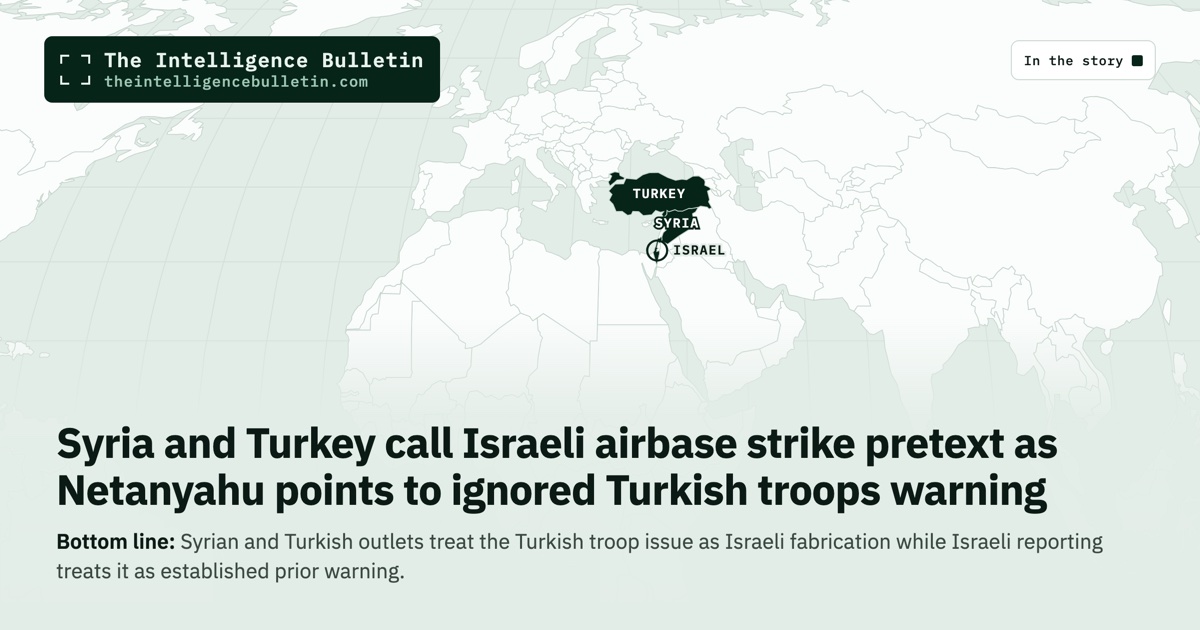
Syria and Turkey call Israeli airbase strike pretext as Netanyahu points to ignored Turkish troops warning

Map of the countries in the story: Syria and Turkey call Israeli airbase strike pretext as Netanyahu points to ignored Turkish troops warning
Israel carried out airstrikes on Syria’s Abu al-Duhur airbase in Idlib on August 18, 2026, with no reported casualties. Syria’s foreign ministry condemned the action as an unjustified violation of sovereignty and escalation. Turkey rejected Israeli claims of a Turkish troop threat at the base, accusing Netanyahu of using the strike to justify expansionist policies. Netanyahu’s office stated Syria had been warned that Turkish deployment would threaten Israeli security, while a US envoy criticized the strike as unnecessary escalation and called for a deconfliction mechanism involving Israel, Syria and Turkey.

One Story. Many Angles.

🇸🇾
Syria
SANA
Original reporting
Syria condemns Israeli strikes on Abu al-Duhur airbase
Read →
🇹🇷
Turkey
Anadolu Agency
Original reporting
Türkiye rejects Israeli claims, says Netanyahu seeks to justify Syria strikes
Read →
🇮🇱
Israel
Ynet News
Carries Reuters reporting
After Syria strike, US envoy warns Israel of rising tensions with Turkey
Read →
🇺🇸
United States
Fox News
Carries Associated Press and Reuters reporting
Turkey accuses Netanyahu of expansionist policies after Syria strike
Read →
🇬🇧
United Kingdom
Middle East Eye
Carries Anadolu Agency reporting
Turkey denies Israeli claims of posing a threat, says Netanyahu seeks to justify Syria strikes
Read →
5 sources · each independently reported
In Brief

Syrian and Turkish outlets treat the Turkish troop issue as Israeli fabrication while Israeli reporting treats it as established prior warning.

The reporting across Syrian, Turkish, Israeli and US-linked outlets reveals a clear split on motive but convergence on the strike’s occurrence and lack of casualties. Syrian state media frames the attack as part of a pattern of Israeli aggression since late 2024 that undermines Syria’s stability efforts, holding Israel responsible and appealing to the UN. Turkish coverage and statements treat Israeli security warnings as fabricated pretexts for Netanyahu’s domestic political gain ahead of elections, while affirming ongoing cooperation with Syria’s new government. Israeli reporting details prior warnings to Syria, shared US intelligence on runway rehabilitation and Turkish delegation visits, and positions the strike as a necessary defense of air superiority. US envoy statements, carried in Israeli and US outlets, add an external layer of concern over escalation risks and the absence of advance notice to Turkey, while pushing for trilateral deconfliction talks. This pattern shows the core factual event is not in dispute, but the Turkish troop presence at the base is presented either as a legitimate security threat or an invented justification, with no independent reporting chain bridging the two accounts. The US mediation push stands out as the element least emphasized in direct Syrian or Turkish state accounts.

Perspective Analysis

Israel carried out airstrikes on the Abu al-Duhur military airbase in Syria’s Idlib province on August 18, 2026. The base sits roughly 17 miles east of Saraqib in the eastern countryside, near the village of Abu al-Duhur, occupying between 16 and 23 square kilometers in a position that links the provinces of Idlib, Hama and Aleppo and lies close to the Syrian Desert. Reports described damage to runways and storage facilities after four aircraft struck the site. Syrian military sources and a local resident told Reuters that no one was killed or injured.

Syria’s Ministry of Foreign Affairs and Expatriates issued a statement the same day condemning the strikes as a violation of sovereignty and territorial integrity. The ministry called the action an unjustified act of aggression and a dangerous escalation that threatens regional security and stability. It noted that Israel has continued attacks since December 8, 2024, even as Syria exercises restraint and works to consolidate stability. The statement held Israel responsible for the escalation and appealed to the international community and the UN Security Council to condemn the aggression and take a firm stance against repeated violations. Syria, it said, would defend its national rights through legitimate means under international law.

Turkey rejected the Israeli account of events. Its Communications Directorate stated that the allegations put forward by the Israeli Prime Minister’s office were frivolous and aimed at legitimizing unlawful airstrikes targeting Syria’s sovereignty and territorial integrity. Turkey accused Benjamin Netanyahu of pursuing expansionist and destabilizing policies in the region ahead of elections in Israel. The statement said Türkiye, like the vast majority of the international community, stands for lasting peace and that the sole path lies in Netanyahu abandoning aggressive and coercive policies while respecting international law. Türkiye added that it would continue to cooperate with the Syrian government on a legitimate basis for peace, stability and prosperity in Syria and would never allow the destabilization of the country.

Netanyahu’s office responded by saying Israel had repeatedly warned Syria that deployment of Turkish troops from the base would pose a threat to Israel’s security. The office stated that Syria chose to ignore those warnings. Israel, it said, would not tolerate threats to its security and would welcome a return to the status quo. Israeli reporting noted that a Turkish military delegation had visited the base recently to oversee rehabilitation of its runway. Israel had previously conveyed messages to Turkey that it would not accept the rebuilding of the Syrian military or any threat to its air superiority, including possible deployment of air defense systems or advanced drones that could restrict Israeli freedom of action in Syrian airspace.

A US envoy added a separate layer of comment. Thomas Barrack, who serves as both US ambassador to Turkey and special envoy for Syria, said in an interview with Reuters that he was deeply concerned the confirmed Israeli airstrikes constituted an unnecessary escalation that does not advance regional stability. He noted that Turkey had not been warned in advance and therefore could have attacked Israel in response. Barrack said the United States is actively working to establish a deconfliction mechanism involving Israel, Syria and Türkiye to prevent future miscommunication, with the immediate priority to lower tensions and allow space for a more measured approach. He added that Syrian President Ahmed al-Sharaa has not adopted a predatory posture nor maintained proxy forces and has repeatedly indicated a preference for de-escalation with Israel.

The accounts converge on several points. The strike occurred on August 18. It produced no casualties. Turkey maintains a cooperative relationship with the new Syrian government under al-Sharaa, who took power after the ouster of Bashar al-Assad in December 2024. Israel has conducted repeated strikes inside Syria since that change to prevent the rebuilding of military capabilities near its border. Turkey has been involved in training Syrian soldiers to rebuild the country’s armed forces.

The accounts diverge sharply on the question of Turkish troop presence at the base. Netanyahu’s office presented the deployment as a concrete security threat that Syria had been warned against in advance. Turkish statements presented the same claim as a manufactured pretext designed to justify the strikes and advance Netanyahu’s political interests ahead of elections. No reporting chain from an independent source outside these two positions bridges the gap or provides contemporaneous evidence that would allow a reader to weigh one description against the other.

A reader limited to Syrian state coverage would see only the pattern of Israeli attacks since December 2024 and the call for international condemnation, with no mention of prior warnings, Turkish delegation visits, or US mediation efforts. A reader limited to Turkish state-linked coverage would encounter only the rejection of Israeli claims and the accusation of expansionist motives, without reference to Israeli statements on air superiority or the details of US envoy comments on deconfliction. Israeli coverage foregrounds the sequence of warnings and intelligence shared with the United States, along with Barrack’s call for talks, but does not carry the full text of Turkish government statements accusing Netanyahu of electoral calculation. US-linked reporting such as Fox News aggregates the Turkish accusations, the Netanyahu office response, and Barrack’s statements, yet still rests on the same split over whether the Turkish presence constituted a genuine threat.

The Turkish denial of any threat rests on official statements from the Communications Directorate that appear across multiple Turkish-linked outlets. The Israeli assertion of prior warnings rests on a single on-record statement from Netanyahu’s office. The US envoy’s assessment of escalation and the absence of advance notice to Turkey also rests on statements attributed to one named official carried through Reuters interviews. The strike itself and the absence of casualties appear in accounts from Syrian sources, Israeli reporting citing Sabereen and local residents, and Western aggregation of those same details.

What to Watch

The Turkish account of motive carries the weight of repeated official statements from the same government across independent reporting chains. The Israeli account of a prior explicit warning carries only the authority of the office that issued it. Barrack’s intervention introduces an external actor with institutional interest in preventing direct confrontation between two NATO members and a new Syrian government that has received US support, including the lifting of broad economic sanctions in June 2026. Absent new primary documents or a third-party record of the alleged warnings, the Turkish position on pretext has the stronger corroboration in the published reporting. The next development most likely to matter is whether the deconfliction mechanism Barrack described moves from discussion to any operational form, because the base’s location makes any future Turkish or Syrian activity there visible to Israeli surveillance and because Turkish training of Syrian forces continues in the same region.
Share this story

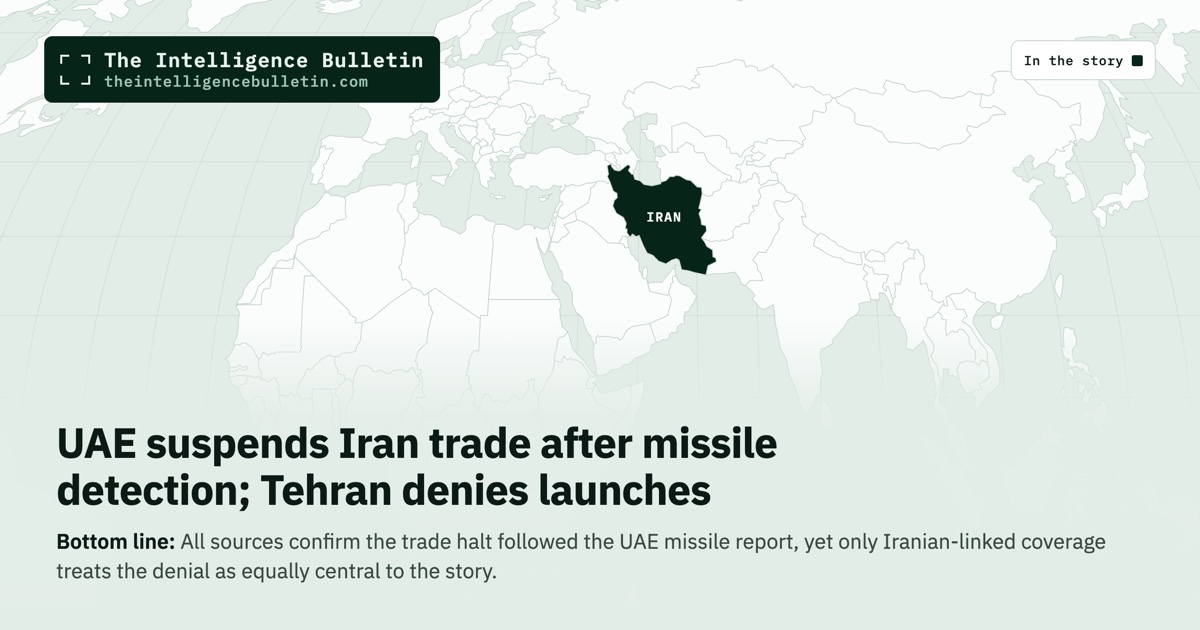
UAE suspends Iran trade after missile detection; Tehran denies launches

Map of the countries in the story: UAE suspends Iran trade after missile detection; Tehran denies launches
The UAE announced it would halt all trade, commercial exchanges and financial transactions with Iran until further notice after its Defense Ministry reported detecting two ballistic missiles launched from Iran toward UAE waters on August 18. The missiles reportedly targeted maritime navigation, with one falling inside and one outside territorial waters and no damage reported. Iran denied launching any missiles. The decision reverses recent steps toward economic normalization between the two countries.

One Story. Many Angles.

🇦🇪
United Arab Emirates
Al Bayan
ARABIC
Original reporting
UAE stops trade and financial transactions with Iran
“الإمارات توقف التجارة والمعاملات المالية مع إيران”
Read →
🇮🇷
Iran
Gooya News
PERSIAN
Commentary
After firing two missiles: cutting Iran’s commercial, trade exchanges and financial transactions in the Emirates
“پس از شلیک دو موشک: قطع مبادلات بازرگانی، تجاری و تراکنش های مالی ایران در امارات”
Read →
🇮🇳
India
The Times of India
Carries Associated Press and regional statements reporting
‘All trade, commercial exchanges halted’: How UAE responded to Iran’s latest ballistic missile attack
Read →
🇹🇷
Turkey
Anadolu Agency
Carries UAE statements reporting
UAE denies providing financial facilities to Iran after suspending trade
Read →
🇺🇸
United States
Al-Monitor
Carries AFP reporting
UAE halts all trade ties with Iran after missile attack
Read →
5 sources · 4 independent accounts — some share the same news agency’s report
In Brief

All sources confirm the trade halt followed the UAE missile report, yet only Iranian-linked coverage treats the denial as equally central to the story.

The reporting across these outlets reveals a tightly synchronized sequence of events that all sources accept, yet the attribution of the trigger remains the sole point of open conflict. UAE domestic coverage and the official statements it carries present the missile detection as established fact and the trade suspension as a proportionate sovereign measure to protect regional stability. The Iranian diaspora outlet Gooya News accepts the timing of the UAE announcement but frames the missiles as the precipitating act, underscoring the economic cost to Iran through the loss of a major re-export and financial channel. Indian and U.S.-based regional reporting embed the same facts while giving equal weight to Tehran’s denial, showing that the missile claim rests on a single national reporting chain—the Emirati Defense Ministry—while the trade halt is corroborated independently by UAE statements carried across borders. Turkish coverage narrows further to the UAE’s follow-up denial that it had continued any financial facilitation, illustrating how outlets downstream of the primary actors selectively amplify diplomatic rebuttals rather than the underlying dispute. The absence of any independent corroboration of the missile launches outside Emirati channels, combined with Iran’s on-record rejection, leaves the causal link between attack and response dependent on one side’s sensors and statements. This pattern demonstrates that the economic rupture itself is undisputed across reporting chains, whereas the justification for it is not.

Perspective Analysis

The United Arab Emirates announced on August 18 that it would immediately halt all trade, commercial exchanges and financial transactions with Iran until further notice. The decision followed a statement from the UAE Defense Ministry that its air-defense systems had detected two ballistic missiles launched from Iran toward the country that evening. One missile fell outside UAE territorial waters and the second inside them. The ministry assessed that both had been aimed at maritime navigation. No damage or injuries were reported, though an emergency alert reached residents’ phones and the armed forces remained on high alert.

The UAE Foreign Ministry, through its director of strategic communications Afra Al-Hamli, framed the suspension as a response to regional escalations that had undermined peace and security. It reiterated that the country remained committed to dialogue, cooperation and regional integration while upholding international standards for its financial system. The ministry also denied any ongoing claims about the state of economic relations with Iran. The announcement came hours after the missile detection and reversed a limited resumption of direct cargo movement through Jebel Ali port that had begun only in late June.

Iran’s Foreign Ministry spokesperson Esmaeil Baghaei rejected the UAE accusation outright. He described the claims as baseless, contrary to the principle of good neighborliness, and disruptive to efforts to rebuild trust between regional countries. The statement called on all parties to avoid such accusations amid ongoing complexities involving the United States and what it termed the Zionist regime.

The trade suspension directly affects a relationship that had shown tentative signs of recovery after the earlier phase of regional conflict that began in late February. During that period the UAE had faced repeated Iranian missile and drone strikes and had itself conducted operations against Iran. A June memorandum of understanding between Washington and Tehran had been followed by a single phone call between the UAE and Iranian foreign ministers in the same month. Some Iranian residents who had been outside the country were allowed to return, and limited flight and trade links had quietly restarted. The August 18 halt ends that limited thaw.

Coverage of the episode shows near-universal acceptance of the UAE announcement itself. The foreign ministry statement appears in substance across the five outlets examined. The economic rupture is therefore the one element that stands independent of any single national chain. By contrast, the missile detection rests solely on the UAE Defense Ministry’s account. No other reporting chain supplies independent sensor data or confirmation. The Iranian denial, carried through the foreign ministry spokesperson, stands as the direct counter-claim and receives prominent space in the Times of India and Al-Monitor accounts.

The Times of India situates the episode inside the reversal of the post-June thaw and adds context on shipping risks in the Strait of Hormuz, including recent strikes on vessels linked to the Abu Dhabi National Oil Company. Al-Monitor similarly notes those prior ADNOC incidents and the fact that the UAE had been the Gulf state most heavily targeted during the earlier conflict phase. Both pieces record the Iranian denial at length alongside the Emirati statements.

Gooya News, the diaspora portal, foregrounds the timing of the UAE decision relative to the reported missile launch and stresses the potential economic damage to Iran. It notes that Dubai had long served as a primary route for Iranian trade and financial flows that helped circumvent sanctions. The piece relays the UAE statements but centers the consequences for Tehran.

Al Bayan, the UAE domestic outlet, carries the defense and foreign ministry statements in full and presents the halt as a measured defensive step. It does not include the Iranian denial. Anadolu Agency narrows its focus to a subsequent UAE clarification that it had not continued to provide financial facilities to Iran after the suspension.

The divergence therefore lies almost entirely in how outlets treat the justification for the halt rather than the halt itself. Where the missile detection is presented as established fact, the trade action reads as a proportionate response. Where the Iranian denial is given equal weight, the same action appears more as a unilateral escalation resting on one side’s unverified sensors. The Turkish and Indian pieces amplify UAE diplomatic follow-ups or place the episode in wider energy-security terms, while the diaspora outlet underscores the material cost to Iran.

What to Watch

The corroborated element—the trade suspension—carries the clearest long-term weight. Loss of access to UAE ports and financial channels removes one of the few remaining low-friction routes for Iranian commerce. The disputed missile attribution leaves the immediate rationale dependent on a single reporting chain. Subsequent events will test whether the suspension remains in place or becomes a bargaining lever, and whether any independent verification of the August 18 launches emerges outside Emirati channels. The economic consequence for Iran is already measurable in the interruption of a relationship that had only recently shown modest reopening.


Share this story

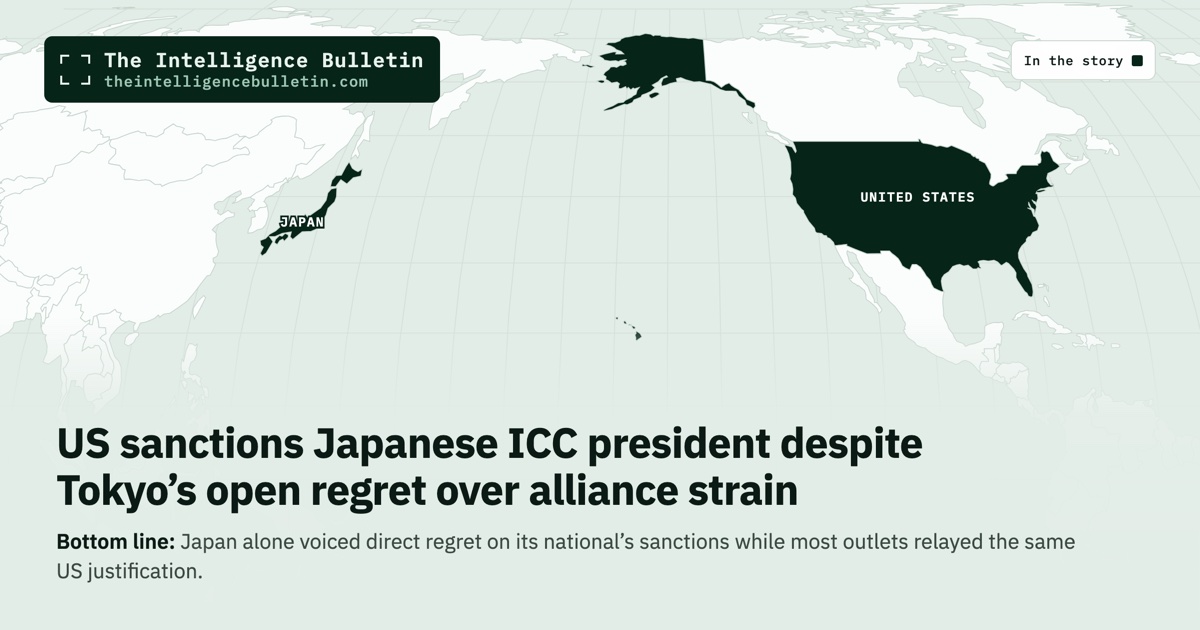
US sanctions Japanese ICC president despite Tokyo’s open regret over alliance strain

Map of the countries in the story: US sanctions Japanese ICC president despite Tokyo’s open regret over alliance strain
The US Treasury Department imposed sanctions Tuesday on ICC President Tomoko Akane and senior trial lawyer Abdoulaye Seye. Secretary of State Marco Rubio cited their roles in ICC efforts against officials of non-member states. Japan’s Foreign Ministry called the sanctions very unfortunate and reaffirmed support for the court. The ICC condemned the measures as threats to the international legal order.

One Story. Many Angles.

🇯🇵
Japan
Asahi Shimbun
Carries Reuters reporting
U.S. sanctions ICC president, senior trial lawyer in latest attack on court | The Asahi Shimbun: Breaking News, Japan News and Analysis
Read →
🇺🇸
United States
NBC News
Carries Associated Press reporting
U.S. sanctions ICC president, senior trial lawyer in latest attack on court
Read →
🇮🇱
Israel
Jerusalem Post
Carries REUTERS reporting
US imposes sanctions on ICC President Tomoko Akane
Read →
🇶🇦
Qatar
Al Jazeera
Original reporting
US sanctions International Criminal Court president and trial lawyer
Read →
🇯🇵
Japan
Japan Today
Carries Reuters reporting
Japan says U.S. sanctions on ICC, President Akane ‘very unfortunate’
Read →
5 sources · 3 independent accounts — some share the same news agency’s report
In Brief

Japan alone voiced direct regret on its national’s sanctions while most outlets relayed the same US justification.

Japan’s explicit regret over sanctions on its own national who leads the ICC reveals a sharper alliance fault line than US or Israeli coverage acknowledges. Tokyo’s Foreign Ministry statement directly affirms consistent support for the court’s mandate on war crimes and rule of law while pledging continued communication with partners, a position absent from the Reuters copy that dominates American and Israeli outlets. That omission matters because Akane’s nationality turns the sanctions into a bilateral test rather than a purely institutional clash. US reporting centers Rubio’s justification tied to Netanyahu warrants and American personnel, treating Japanese concerns as background. Israeli coverage adds Netanyahu’s praise for the move as defense against a kangaroo court. Japanese domestic framing instead highlights the strain on alliance cohesion and the court’s independence. Multiple outlets carry identical Reuters text on the sanctions details, European disapproval from the Netherlands, and the ICC’s rule-of-law warning, confirming a single originating chain. The divergence appears only where Japan inserts its own voice, showing that actor-country coverage alone captures the diplomatic cost the wires flatten into routine escalation.

Perspective Analysis

The United States imposed sanctions on August 18 on Tomoko Akane, the Japanese judge serving as president of the International Criminal Court, and on Abdoulaye Seye, a Senegalese senior trial lawyer at the court. Secretary of State Marco Rubio announced the measures under an executive order issued the previous year. The sanctions freeze any assets the two individuals hold in the United States and bar most transactions with them through the American financial system. The Treasury Department issued a general license allowing wind-down of existing dealings until September 17.

Rubio stated that Akane and Seye had directly engaged in ICC efforts to investigate, arrest, detain or prosecute officials of governments that had not consented to the court’s jurisdiction. The move formed part of the Trump administration’s broader campaign against the Hague-based institution. That campaign has included prior targeted sanctions on other ICC officials, a diplomatic push to encourage countries to withdraw, and public arguments that the court threatens American personnel involved in immigration enforcement, drug interdiction and military operations. The administration has linked the effort to arrest warrants the ICC sought for Israeli Prime Minister Benjamin Netanyahu and former defense minister Yoav Gallant, as well as an earlier Afghanistan inquiry involving American forces.

Japan’s Foreign Ministry responded on August 19 by describing the sanctions on Akane and the ICC as very unfortunate. The ministry reaffirmed that Japan has consistently supported the court’s work to prosecute the most serious crimes of international concern and to uphold the rule of law. It added that Japan would continue its commitment to strengthening the international legal order while maintaining communication with relevant countries. Akane, who has led the ICC since her election in March 2024, had warned in December that further sanctions would rapidly undermine the court’s operations across all situations and could jeopardize its existence.

The ICC itself condemned the sanctions. In a statement carried across reporting, the court said that when judicial actors are threatened for applying the law, the international legal order itself is placed at risk. The Netherlands, which hosts the court, also expressed disapproval. Dutch Foreign Minister Tom Berendsen posted that international courts must be able to carry out their mandates freely and invited Akane to discuss continued support.

Netanyahu welcomed the sanctions. In a post on X, he called the ICC a kangaroo court that cloaks abuse of power in the language of international law while undermining justice. He commended Rubio for leading efforts against what he described as the court’s illegitimate overreach and said the officials who lead the ICC would face consequences.

The sanctions build on earlier steps taken last year against other ICC personnel. Those measures cited the Netanyahu warrants and the Afghanistan probe. Three ICC judges filed suit against the Trump administration in June, arguing the sanctions were unlawful. Advocacy groups brought separate lawsuits claiming the campaign infringes constitutional rights of organizations working with the court. At least five countries have announced withdrawals from the ICC following the administration’s diplomatic outreach.

Most of the published accounts rest on the same core dispatch. The details of the sanctions, Rubio’s justification, the ICC’s response, the Dutch position, Akane’s prior warning, Seye’s role on the Netanyahu prosecution team, and the legal background on ICC jurisdiction appear in nearly identical form in the Asahi Shimbun, NBC News, the Jerusalem Post and Japan Today. Al Jazeera’s account overlaps on these points while adding its own framing of the administration’s stated goal of dismantling the court.

Where the accounts diverge is in what each foregrounds beyond that shared text. Japanese coverage places the Foreign Ministry’s statement of regret at the center and ties the sanctions directly to strain on alliance relations with Washington. The Asahi Shimbun and Japan Today both present Akane’s nationality and Tokyo’s official reaction as the immediate diplomatic consequence. American reporting centers the administration’s rationale, the link to Netanyahu and the broader effort to shield U.S. personnel. Israeli reporting adds Netanyahu’s explicit endorsement and his characterization of the court. The international outlet emphasizes the court’s institutional defense and the pattern of sanctions against officials and cooperating groups.

A reader limited to the dominant wire text would see a routine escalation in an ongoing institutional dispute. The same reader limited to Japanese domestic framing would see an alliance partner directly objecting to extraterritorial pressure on one of its nationals. The same reader limited to Israeli or American framing would see a justified defense of sovereignty against a court the United States never joined. None of those single vantage points captures the full picture that emerges only when the Japanese statements are placed beside the American and Israeli ones.

The Japanese reaction stands out because it comes from the country whose citizen holds the ICC presidency. Tokyo’s explicit regret converts what other accounts treat as an internal American policy choice into a bilateral test of alliance cohesion. The ministry’s language avoids confrontation yet asserts continued support for the court’s mandate and promises ongoing communication with partners. That formulation signals limits to how far Japan will align with the sanctions campaign even while it maintains the security relationship with Washington.

The shared Reuters-derived text across four outlets demonstrates that the basic sequence of events is not in dispute. The divergence is not over whether sanctions occurred or what Japan said; it is over which element receives emphasis and which context is supplied. Actor-country coverage supplies the missing diplomatic cost that the common dispatch flattens. The pattern shows that national outlets insert their government’s voice where wire services do not, and that this insertion alters the stakes a reader perceives.

The evidence that matters for judgment is the on-record Japanese statement itself, corroborated in two separate Japanese publications and referenced in the Jerusalem Post. That statement directly addresses the sanctions on a Japanese national and reaffirms support for the ICC. The administration’s interest lies in presenting the measures as necessary protection of sovereignty and alliance partners. Tokyo’s interest lies in preserving both the court and the alliance. The reporting shows these interests pulling in different directions on this specific case.

What to Watch

The sanctions will continue to restrict Akane’s and Seye’s access to the U.S. financial system. Japan’s stated position indicates it will continue to engage the ICC and its partners on the issue. The next measurable development will be whether other allies follow Tokyo’s public regret or remain silent, and whether the administration responds with further diplomatic pressure or additional designations. The alliance test exposed here is narrow but concrete: how far one partner will go in opposing sanctions aimed at its own citizen who leads an institution the other partner seeks to sideline.


Share this story

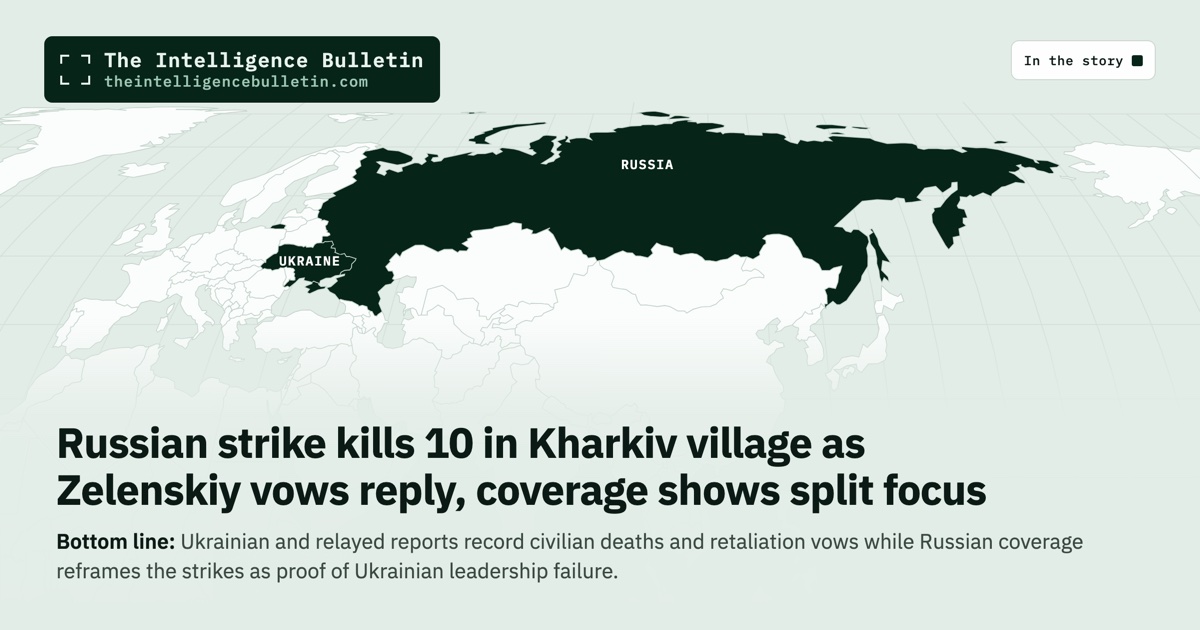
Russian strike kills 10 in Kharkiv village as Zelenskiy vows reply, coverage shows split focus

Map of the countries in the story: Russian strike kills 10 in Kharkiv village as Zelenskiy vows reply, coverage shows split focus
Russian forces struck the village of Pechenihy in Ukraine’s Kharkiv region on August 18, killing 10 civilians and injuring at least 17 others, Ukrainian officials said. The missile hit a busy intersection with a post office and stores surrounded by homes, damaging buildings, vehicles and infrastructure. President Zelenskiy promised a response and called for Western partners to add pressure on Russia.

One Story. Many Angles.

🇺🇦
Ukraine
TSN
UKRAINIAN
Original reporting
RF strike on Pechenihy in Kharkiv region – Zelensky’s reaction, details, photo
“Удар РФ по Печенігах на Харківщині – реація Зеленського, деталі, фото — Укрaїнa”
Read →
🇷🇺
Russia
RIA Novosti
RUSSIAN
Commentary
“Will die on the vine”. Scout revealed Zelensky’s reaction to Russia’s strikes
“”Погибнет на корню”. Разведчик раскрыл реакцию Зеленского на удары России”
Read →
🇿🇦
South Africa
Daily Maverick
Carries Reuters reporting
Russian missile attack kills 10 in Ukraine’s Kharkiv region, officials say
Read →
🇹🇷
Turkey
Anadolu Agency
Relayed reporting
Ukraine says 10 people killed in Russian missile strike on Kharkiv region
Read →
🇦🇲
Armenia
News.am
Carries Ukrainska Pravda reporting
10 dead, several injured after Russia strikes Ukraine’s Kharkiv region
Read →
5 sources · 4 independent accounts — some share the same news agency’s report
In Brief

Ukrainian and relayed reports record civilian deaths and retaliation vows while Russian coverage reframes the strikes as proof of Ukrainian leadership failure.

Ukrainian reporting centers on the human cost in Pechenihy and Zelenskiy’s pledge of retaliation plus appeals for allied support, grounding the story in local damage and official statements from the president and regional governor. South African and Armenian outlets relay the same casualty figures and damage list with minimal added context, treating Ukrainian authorities as the primary source. Turkish coverage similarly foregrounds Kyiv’s account of the strike. Russian state media diverges sharply by running analyst commentary that casts the attacks as evidence of Zelenskiy’s inaction and impending economic collapse rather than reporting the immediate civilian toll. The core casualty claim travels consistently through independent Ukrainian-origin chains picked up by distant observers, while the Russian piece stands apart by shifting focus to strategic consequences and leadership critique. No outlet supplies Russian confirmation or denial of the specific strike, leaving the Ukrainian-sourced account as the only detailed narrative across the set. This pattern shows how proximity to the conflict shapes emphasis: domestic Ukrainian outlets record the event as lived tragedy and vowed reply, while non-participant coverage either echoes the facts plainly or reframes them around Kyiv’s alleged vulnerabilities.

Perspective Analysis

Russian forces fired a missile into the village of Pechenihy in Ukraine’s Kharkiv region on the morning of August 18, striking a busy intersection lined with a post office, stores and homes. Ukrainian President Volodymyr Zelenskiy described the target area as a populated crossroads and said ten civilians died while many others were wounded. Regional governor Oleh Syniehubov reported seventeen people injured and listed the damage as ten private houses, one cafe, the post office, one store and at least seven cars set alight. Emergency crews extinguished the fires and continued working at the site, according to statements released the same day.

Zelenskiy posted the account on his official Telegram channel and added that Ukraine would reply. He called the attack a brutal strike on civilians and said partners should match any Ukrainian response with additional steps to pressure Russia. The president’s office supplied photographs showing collapsed walls, burning vehicles and rescuers carrying stretchers. No immediate statement from Russian authorities addressed the specific village or the reported casualties.

Ukrainian domestic reporting from TSN placed the event inside the daily rhythm of the region, naming the exact buildings hit and quoting Zelenskiy’s pledge of a “just kinetic response.” The same account noted that the strike followed earlier patterns of Russian long-range fire into Kharkiv oblast. International outlets that carried the story relayed the same casualty total and the same list of damaged structures. Daily Maverick, citing Reuters, added that Ukraine’s Prosecutor General’s Office identified the weapons as two small Banderol cruise missiles. News.am, drawing on Ukrainska Pravda and Syniehubov, recorded an initial count of eight wounded that later rose and confirmed the material losses without elaboration.

Turkish coverage from Anadolu Agency summarized the Ukrainian government statement in a single paragraph focused on the death toll. South African and Armenian dispatches treated the figures as the authoritative record and did not add independent observation or context beyond what Ukrainian officials supplied. Across these four accounts the core description remained consistent: a single missile, ten confirmed deaths, seventeen injuries, and the same five categories of property damage.

Russian state media took a different route. RIA Novosti published commentary from former U.S. Marine intelligence officer Scott Ritter that placed the strike inside a larger argument about Ukrainian winter preparedness. Ritter stated that Zelenskiy had taken no concrete steps to protect the power grid and distribution network ahead of cold weather, that sixty percent of the economy would collapse, and that Russian strikes on infrastructure would finish the process. The piece made no reference to Pechenihy, the ten deaths or the seventeen injuries. It framed the broader campaign as the logical result of Ukrainian policy choices rather than as a discrete incident requiring confirmation or denial.

A reader limited to Ukrainian sources would see a precise local tragedy complete with presidential reaction and an explicit call for allied escalation. A reader limited to Russian sources would encounter an assessment of strategic failure on the Ukrainian side without any mention of the village or the civilian count. The non-participant outlets supplied the narrow factual spine but left the Russian strategic claim unaddressed and the Ukrainian casualty claim without contradiction.

The single-source detail that the weapons were Banderol cruise missiles appears only in the Reuters material carried by Daily Maverick and receives no independent corroboration or rebuttal elsewhere in the set. The damage inventory and the casualty total travel together through Ukrainian official channels and are reproduced without alteration by the three distant outlets. Zelenskiy’s vow of retaliation is quoted directly in the Ukrainian and South African pieces and summarized in the Turkish and Armenian ones.

The accounts that foreground the ten deaths and the specific damage rest on statements issued by the president and the regional governor on the day of the strike. Those statements were available to every outlet that chose to cite them. The Russian commentary rests on an external analyst’s assessment of national infrastructure and does not engage the local evidence. Where the story is treated as an event that occurred in one place at one time, the details line up; where it is treated as evidence of a larger trend, the local details drop away.

The corroborated record of the strike itself therefore sits in the Ukrainian official statements and the outlets that transmitted them unchanged. That record supplies the only named location, the only casualty total and the only damage list available across the coverage. The alternative framing supplied by RIA Novosti offers a prediction about future economic effects but supplies no counter-evidence on the August 18 incident. A reader who encounters only the strategic critique will miss the scale of loss recorded at the intersection in Pechenihy; a reader who encounters only the casualty report will miss the claim that the strike forms part of a sustained campaign against Ukrainian energy and distribution systems. The two descriptions address different questions and do not directly refute each other on the facts of the village attack.

What to Watch

The most direct account of what happened on the ground therefore remains the one carried by the Ukrainian authorities and reproduced by the four other outlets. It names the place, the count of dead and wounded, the structures hit and the immediate political response. The Russian piece contributes an argument about the direction of the wider war but does not alter or contest the local particulars. That separation explains why the same event can appear as a discrete civilian tragedy in one set of reports and as confirmation of strategic momentum in another.


Share this story

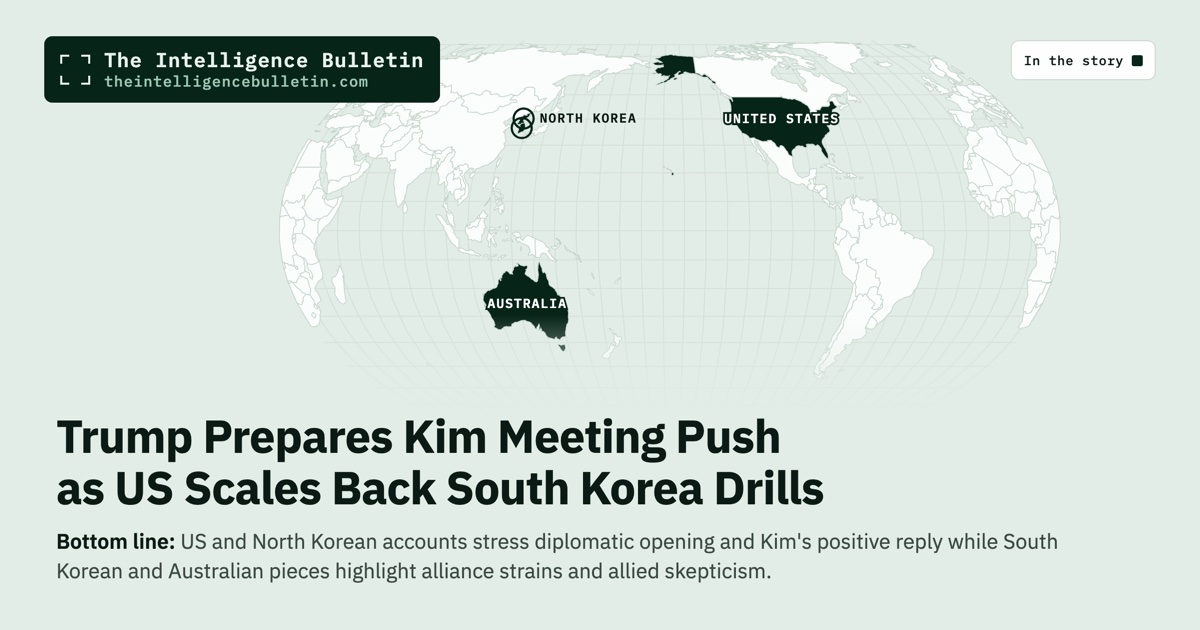
Trump Prepares Kim Meeting Push as US Scales Back South Korea Drills

Map of the countries in the story: Trump Prepares Kim Meeting Push as US Scales Back South Korea Drills
US President Donald Trump has instructed aides to explore a meeting with North Korean leader Kim Jong Un as early as this fall, possibly around the APEC summit. He ordered the Pentagon to substantially scale back joint military exercises with South Korea, citing his relationship with Kim and Seoul’s stance on other issues. Trump claims Kim responded positively to the overtures. North Korean state media omitted the remarks while South Korean and allied officials expressed concerns over alliance reliability and deterrence.

One Story. Many Angles.

🇺🇸
United States
Newsweek
Original reporting
How Trump’s Kim Jong Un Move Could Lead to Nuclear Breakthrough
Read →
🇰🇵
North Korea
NK News
Original reporting
Trump says Kim Jong Un responded ‘positively’ to downsized military drill talk
Read →
🇰🇷
South Korea
The Korea Herald
Carries The Wall Street Journal reporting
Trump pushes for Kim Jong-un meeting this year: report
Read →
🇨🇳
China
The Diplomat
Commentary
6 Reasons Why Kim Jong Un Might Want to Meet With Trump
Read →
🇦🇺
Australia
ABC News
Original reporting
US allies left questioning Washington’s reliability as Donald Trump courts Kim Jong Un
Read →
5 sources · 4 independent accounts — some share the same news agency’s report
In Brief

US and North Korean accounts stress diplomatic opening and Kim’s positive reply while South Korean and Australian pieces highlight alliance strains and allied skepticism.

Reporting across these outlets shows Trump actively reviving personal diplomacy with Kim by pairing public praise and drill reductions with explicit meeting preparations, yet the coverage reveals a clear split in emphasis. US-focused pieces highlight potential openings for arms control talks despite past failures, while North Korean coverage stresses Kim’s positive reply without noting state media silence. South Korean reporting ties the push directly to reduced exercises and regional security impacts, and Australian analysis underscores allied doubts about Washington’s predictability. The Diplomat piece stands apart by detailing Kim’s structural incentives, from consolidating nuclear status to balancing China and sidelining Seoul. These accounts converge on the drill cuts and meeting interest but diverge sharply on stakes: one sees diplomatic opportunity, another alliance erosion, with no outlet claiming imminent denuclearization progress. The pattern indicates Trump’s transactional approach is driving events more than coordinated strategy, leaving allies to seek reassurances while Pyongyang gains leverage without concessions.

Perspective Analysis

US President Donald Trump has directed his aides to prepare for a possible meeting with North Korean leader Kim Jong Un as early as this fall, potentially during a planned trip to Asia that could align with the November APEC summit in Shenzhen, China. The Korea Herald reported this push, drawing from a Wall Street Journal account that cited unnamed US officials, while noting that no formal preparations for such a summit had yet begun. Trump paired the reported outreach with public statements praising his personal relationship with Kim and with an order to the Pentagon to substantially reduce the scale of joint military exercises with South Korea.

Those exercises, known as Ulchi Freedom Shield, began on schedule on August 18 despite the reductions. They involve around 18,000 South Korean troops and run through August 27, with training focused on countering drones, GPS disruption, and cyberattacks. US participation has been cut significantly from previous years. Trump announced the drawdown on Truth Social the day before the drills started, describing the exercises as sending a message that is hostile to North Korea, which he characterized as having been unthreatening and respectful during his first term. He instructed Defense Secretary Pete Hegseth to make the cuts and linked the decision in part to South Korea’s refusal to assist with US operations in Iran.

Trump told reporters at the White House that Kim had responded to these overtures. He said the North Korean leader had answered positively, adding that the two understood each other and that Kim had always treated him with great respect. NK News and ABC News both carried Trump’s direct remarks on the positive reply. North Korean state media, however, made no mention of the comments or the proposed meeting, according to NK News reporting.

The three previous meetings between Trump and Kim during Trump’s first term—in Singapore in 2018, Hanoi in 2019, and a brief encounter at the demilitarized zone—produced no agreement on limiting North Korea’s nuclear program. Since then Pyongyang has expanded its arsenal to roughly 60 assembled weapons, with enough fissile material for at least 30 more, according to a June 2026 report from the Stockholm International Peace Research Institute cited by Newsweek. North Korea has also conducted ballistic missile tests banned by the United Nations.

The drill reductions have drawn concern from South Korean officials and analysts who see them as weakening deterrence at a moment when North Korea maintains an adversarial posture toward Seoul. South Korean President Lee Jae-myung has separately renewed calls for the transfer of wartime operational control of South Korean forces from the United States to Seoul and for progress on nuclear-powered submarines. Retired South Korean Lieutenant General In-bum Chun told ABC News that curtailing the exercises would not bring Kim to the table and that the only way to achieve that would be formal US recognition of North Korea as a nuclear weapons state. Chun described the public, relationship-based announcement of the cuts as surprising and concerning, noting that many South Koreans initially viewed it as possible fake news.

Australian reporting through ABC News captured broader allied unease. Analysts there pointed out that extended deterrence relies on trust and warned that South Korea’s loss of confidence could strengthen voices inside the country favoring its own nuclear weapons. James Acton of the Carnegie Nuclear Policy Program told ABC News he remained skeptical that Pyongyang would discuss denuclearization but saw more promise in talks aimed at risk reduction or slowing further nuclear development. The same coverage noted the recent withdrawal of the USS George Washington carrier from the Pacific for Middle East operations as another signal that could unsettle partners.

Newsweek reported that some US analysts view the drill reductions as potentially opening space for renewed talks that could produce caps on North Korea’s missile arsenal and fissile material stockpiles, even if full denuclearization remains unlikely. Evan Sankey of the Cato Institute described the move as reminiscent of Trump’s earlier cancellations of exercises during the 2018-2019 negotiations and said it could presage a US overture at a time when current policy toward Pyongyang has reached a dead end. Jennifer Kavanagh of Defense Priorities called the decision strategically wise, arguing that the exercises have not deterred North Korea or China and instead prompt accelerated military buildups by those countries.

The Diplomat, writing from a regional perspective, outlined six structural reasons why Kim might still seek another meeting despite North Korea’s improved position. These include the chance to consolidate de facto nuclear status through engagement with a US president willing to negotiate on that basis, the prospect of further reductions in US Forces Korea presence and activities, lowered risk of a US decapitation strike, greater room to maneuver against Chinese influence, the ability to sideline South Korea in direct US-North Korea talks, and domestic legitimacy gains for Kim at a time when North Korea’s deployment of troops to support Russia’s war in Ukraine has carried visible costs.

These accounts converge on the basic sequence—Trump’s public praise for Kim, the drill reductions, and the reported interest in a new meeting—yet diverge on the implications. US coverage tends to foreground possible arms-control openings and analyst assessments of strategic utility. South Korean reporting ties the developments directly to alliance adjustments and security trade-offs for Seoul. Australian reporting emphasizes the transactional framing and resulting questions about US commitments from partners. NK News foregrounds the claimed positive response from Pyongyang while recording the absence of coverage inside North Korea itself. The Diplomat focuses on Kim’s incentives rather than immediate diplomatic outcomes.

What to Watch

The pattern across the reporting indicates that Trump’s approach is personal and transactional rather than the product of a coordinated interagency strategy. Pyongyang gains visible leverage through reduced pressure on its doorstep without having offered any recorded concession. South Korea and other allies are left seeking clarification on the durability of US commitments, with the public nature of the announcements amplifying the sense of unpredictability. No source in the set claims that renewed talks are imminent or that they would produce verifiable limits on North Korea’s arsenal. The next moves will likely turn on whether Pyongyang chooses to engage the reported US overture and on how Seoul and Washington manage the resulting adjustments to their military posture.


Share this story

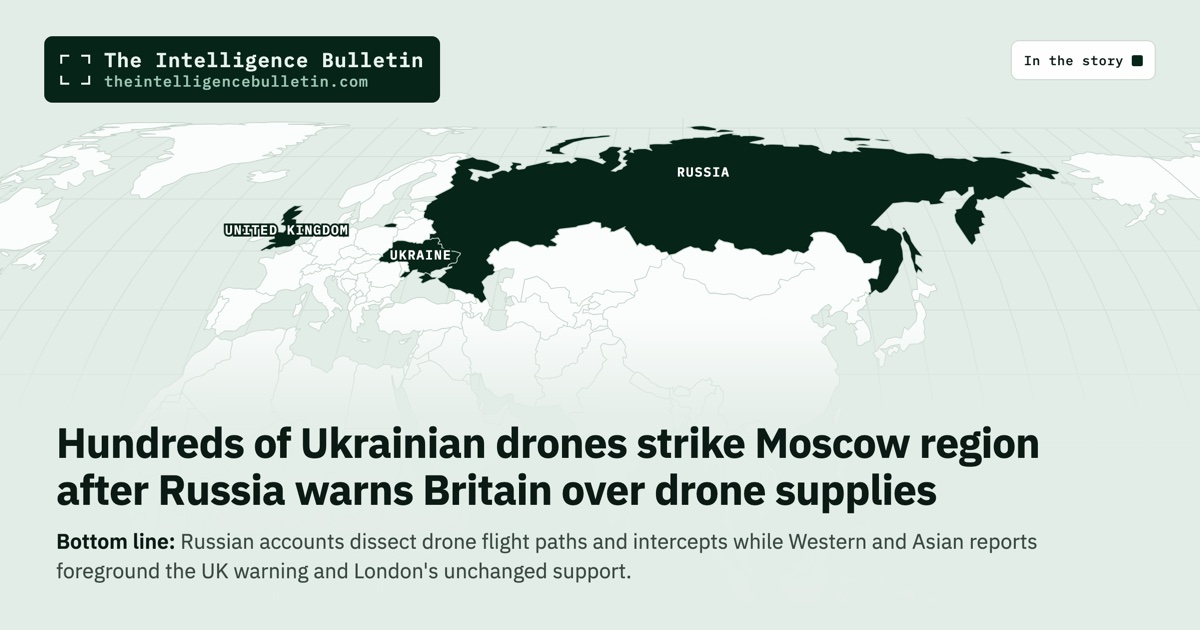
Hundreds of Ukrainian drones strike Moscow region after Russia warns Britain over drone supplies

Map of the countries in the story: Hundreds of Ukrainian drones strike Moscow region after Russia warns Britain over drone supplies
Ukraine launched 637 drones toward the Moscow region overnight, with Russian air defenses intercepting many but some striking warehouses including a Wildberries facility. Russian officials cited debris from British-made drones and warned London of consequences for escalating the conflict. UK Prime Minister Andy Burnham and the Ministry of Defence reaffirmed 100 percent support for Ukraine’s defense. The episode highlights deepening strikes inside Russia and renewed diplomatic friction between Moscow and London.

One Story. Many Angles.

🇷🇺
Russia
Bloknot
RUSSIAN
Original reporting
Attack on Moscow today: expert Vasily Dandykin told where Ukrainian drones flew to Moscow from
“Атака на Москву сегодня: эксперт Василий Дандыкин рассказал, откуда летели украинские дроны на Москву – БлокнотРУ – Атака беспилотников сегодня. Беспилотники сегодня. Откуда летят беспилотники на Санкт-Петербург? Откуда летят беспилотники на Питер? Откуда летят беспилотники на Москву? Беспилотники в СПб. Откуда летят беспилотники на Энгельс? Москва атака беспилотников. Питер атака беспилотников. Атака дронов на Россию. Атака БПЛА сегодня. Атака БПЛА на Россию. Атака беспилотников. Атака БПЛА на Россию сегодня.”
Read →
🇬🇧
United Kingdom
The Independent
Carries Washington Post reporting
Ukraine-Russia war latest: Kyiv launches one of biggest attacks yet on Moscow with 620 drones
Read →
🇺🇸
United States
CBS News
Original reporting
Ukraine targets Moscow with huge drone strike as Russia warns U.K. will pay price for supplying attack drones
Read →
🇶🇦
Qatar
Al Jazeera
Original reporting
Why is Russia threatening UK with ‘consequences’ over Ukraine drones?
Read →
🇹🇼
Taiwan
Taipei Times
Reuters wire copy
Russia threatens UK for supplying drones to Kyiv
Read →
5 sources · each independently reported
In Brief

Russian accounts dissect drone flight paths and intercepts while Western and Asian reports foreground the UK warning and London’s unchanged support.

Russian reporting centers on the technical provenance of the drones, with experts tracing likely launch points from Ukrainian-held territory and emphasizing intercepted hardware to frame the attack as a contained security matter. Western accounts, by contrast, treat the embassy warning as the core development, quoting the precise language about London paying a price and pairing it with British officials’ explicit refusal to alter policy. Coverage from the US and Qatar adds context on prior UK drone packages and recent Wildberries hits, showing the threat follows repeated Russian warnings about long-range systems. The Taiwanese wire relays the embassy statement without local strike details, treating the standoff as a standalone diplomatic signal. What stands out is the absence of contradiction on the numbers of drones or the embassy text itself; outlets diverge only in emphasis, with Russian sources omitting the UK political response that dominates elsewhere. This pattern reveals how the same facts serve different narratives: one of defensive capability, the other of allied resolve against escalation.

Perspective Analysis

Ukraine launched 637 drones toward the Moscow region in an overnight barrage that began on the evening of 18 August and extended into the following morning. Moscow mayor Sergei Sobyanin stated that Russian air defenses shot down at least 180 of them inside the region itself, while more than 150 were intercepted elsewhere in the country. Fires broke out at a high-rise building and at a Wildberries warehouse east of the capital. No fatalities were confirmed, though authorities reported some injuries. The attack formed part of a pattern in which Ukrainian forces have struck logistics and industrial sites inside Russia, including multiple Wildberries facilities that Ukrainian officials describe as supplying military components.

Russian officials responded by pointing to debris they said showed British-made drones had been used in recent strikes. The Russian embassy in London issued a statement declaring that London’s actions would inevitably carry consequences for which it would have to answer. The embassy added that the deeper its involvement in the conflict and the greater its support for Kiev’s terrorist machinery, the higher the price it would pay. It described Britain as deliberately opting for escalation while professing a desire for peace. Maria Zakharova, the Russian Foreign Ministry spokeswoman, cited drones containing UK components or configurations in attacks on facilities such as the Kamensky Plant in the Rostov region.

Britain’s Ministry of Defence did not confirm that its drones had struck Russian territory. A ministry spokesperson told CBS News that Britain stands shoulder to shoulder with Ukraine and is committed to providing the equipment Ukraine needs to defend itself. Prime Minister Andy Burnham told Sky News that the UK would support Ukraine 100 percent against the invasion, describing the policy as consistent across successive governments and not subject to change because of the warning. In April Britain had announced its largest drone package to date, pledging 120,000 drones including long-range strike models, with deliveries already under way. In June it announced an additional 150,000 drones as part of a £752 million funding package.

The Taipei Times carried a Reuters dispatch that framed the embassy statement as a direct response to a report in The Times of London indicating that British-made drones had been used for long-range strikes against Russia for the first time. The dispatch noted that Britain had repeatedly been warned since 2022 that long-range weapons supplies could be viewed as escalation. Al Jazeera’s explainer placed the warning in the context of repeated earlier Russian statements against long-range systems and listed the sequence of UK drone commitments, including co-production talks that began after a June 2025 meeting between Volodymyr Zelenskyy and then-prime minister Keir Starmer.

Russian domestic coverage, illustrated by the Bloknot article, concentrated on the technical question of launch points. Expert Vasily Dandykin discussed the territories from which the drones could most plausibly have originated, treating the episode as a matter of air-defense performance and geographic analysis rather than a diplomatic exchange. The Independent’s live blog on the wider war mentioned the drone wave in a headline reference to one of Kyiv’s biggest attacks yet on Moscow but placed the main body of its updates on unrelated developments such as cash withdrawals from Russian banks amid fears of state seizure to finance the war.

The accounts converge on the raw scale of the launch—637 drones according to the Moscow mayor—and on the precise wording of the embassy warning. They also align on Burnham’s public reaffirmation of full support. Where they diverge is in emphasis. Russian reporting foregrounds interception rates and probable flight paths while omitting the British political response. Western and Middle Eastern accounts quote the embassy text at length and pair it immediately with UK officials’ rejection of any policy shift. The East Asian wire treatment isolates the diplomatic signal without reference to the specific Moscow strikes that prompted it.

This pattern shows that the same set of facts can be assembled to stress either defensive resilience or allied political constancy. The absence of dispute over the drone count or the embassy language itself indicates that both sides are operating from a shared factual baseline on those points. The single-source element—the claim that debris proved British drones were involved—rests on Russian assertions and the Times investigation cited in Al Jazeera and CBS reporting; it has not been independently corroborated in the other accounts examined.

What to Watch

The convergence on numbers and on-record statements supplies the strongest warrant for treating the event as a genuine deepening of Ukrainian reach inside Russia coupled with a predictable Russian diplomatic counter. Britain’s explicit refusal to adjust its drone deliveries signals that the warning is unlikely to alter the flow of equipment in the near term. The episode therefore illustrates how the conflict’s geographic and material boundaries continue to expand even as the diplomatic rhetoric remains anchored in positions each side has maintained for years.


Share this story