Trump’s economic D-Day targets Iran as Tehran and Beijing push back

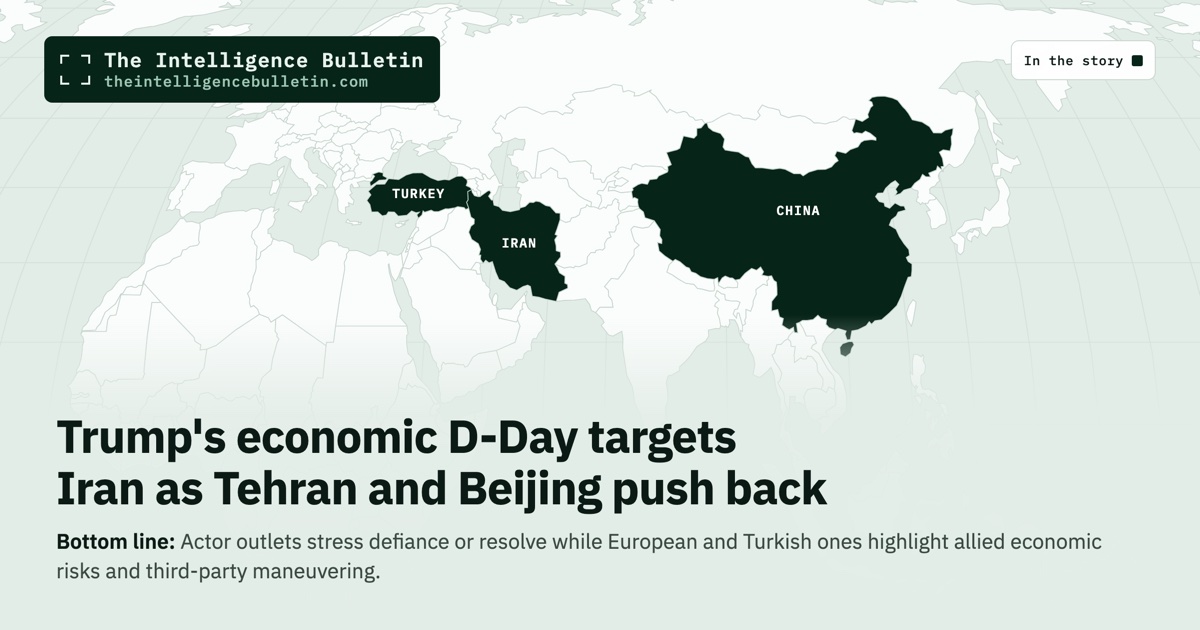
Map of the countries in the story: Trump's economic D-Day targets Iran as Tehran and Beijing push back
US President Donald Trump posted on Truth Social announcing the ‘most crushing economic operation’ ever against Iran, calling it an ‘ECONOMIC D-DAY’ and warning any country providing support would face tremendous consequences. He demanded allies isolate Iran over its alleged nuclear ambitions and terror projection. Iran’s Foreign Minister Abbas Araghchi dismissed it as a diversion from US debt issues that would bring further American defeat and global harm. US Treasury Secretary Scott Bessent said the pressure would collapse the Iranian regime without large-scale military action.

One Story. Many Angles.

🇮🇱
Israel
The Jerusalem Post
Original reporting
Iran’s Araghchi: Trump’s economic ‘D-Day’ will only bring further defeat to US
Read →
🇨🇳
China
People’s Daily
Carries Xinhua reporting
Trump threatens “most crushing” economic warfare, accuses Iran of failing to make deal
Read →
🇩🇪
Germany
Deutsche Welle
Original reporting
Trump warns ‘economic consequences’ for nations helping Iran
Read →
🇮🇹
Italy
Padova News
ITALIAN
ITALPRESS wire copy
Trump announces Economic D-day against Iran
“Trump annuncia Economic D-day contro l’Iran – Padovanews”
Read →
🇹🇷
Turkey
Anadolu Agency
Original reporting
China pushes back against Trump’s ‘Economic D-Day’ campaign against Iran
Read →
5 sources · each independently reported
In Brief

Actor outlets stress defiance or resolve while European and Turkish ones highlight allied economic risks and third-party maneuvering.

Trump’s Truth Social post frames the move as a historic economic blockade that will cripple Iran’s military and nuclear path while forcing global compliance, an account carried directly in Italian and German reporting. Iranian responses in the Jerusalem Post portray the campaign as economic terrorism that exposes US weakness and will unify opposition, a direct rebuttal absent from the wire-style Italian summary. Deutsche Welle’s live coverage adds US Treasury statements that maximum sanctions will achieve regime change without kinetic operations, underscoring Washington’s preference for economic tools over military ones. Anadolu’s headline on Chinese pushback reveals Beijing’s stake in preserving trade routes, an angle that People’s Daily’s failed link leaves unexamined here but that aligns with broader economic-alliance concerns. The Italian outlet’s reliance on ITALPRESS wire copy keeps the piece neutral and factual, relaying Trump’s claims without local commentary, while the Jerusalem Post centers Tehran’s rejection. This pattern shows actor-driven sources emphasizing defiance or resolve, whereas European and Turkish coverage stresses third-party fallout and mediation stakes rather than binary victory claims.

Perspective Analysis

US President Donald Trump posted on his Truth Social platform on August 19 announcing what he called the launch of the most crushing economic operation ever taken against any country. He labeled the effort an ECONOMIC D-DAY and said the United States needed all its allies to help isolate Iran over its nuclear ambitions and support for groups the US describes as terror organizations. Any country whose financial institutions, businesses, airports or government entities provided any type of lifeline to Iran would face tremendous economic consequences, Trump wrote, listing targets that included oil smuggling, swap lines, cash transfers, exchange houses, ship registries and front companies. He described Iran as maniacs on the ropes whose navy had disappeared, air force been destroyed, military factories reduced to rubble, currency rendered worthless and country left hanging by a thread. The historic measures would cripple Iran’s ability to project terror worldwide, he added, and Iran would never acquire a nuclear weapon.

Iranian Foreign Minister Abbas Araghchi responded the next day on X that the so-called Economic D-Day amounted to a diversion from America’s own crisis of unprecedented debt and surging interest costs. Doubling down on failed policies would only bring further defeat and the enmity of Iranians, he wrote, while US economic terrorism threatened the global economy and sovereignty worldwide. An Islamic Revolutionary Guard Corps spokesman warned separately that if another war broke out, Iran’s warheads would prove far more destructive than those used in previous conflicts and its weapons would differ completely in every respect. Iran’s Foreign Ministry condemned the new sanctions as economic terrorism and crimes against humanity that would hurt ordinary Iranians, stating that sanctions and economic pressure were the other side of the coin of war and military aggression.

US Treasury Secretary Scott Bessent told CNBC on August 20 that the coordinated economic isolation would be the greatest in the history of the world and would collapse the Iranian regime. He said the United States would tell other nations they were either with Washington or against it, and that maximum economic pressure made large-scale military operations unnecessary. Special Envoy Jared Kushner told Fox News that Trump was emphasizing economic pressure over military action, that the prior blockade had already left Iran’s economy far worse off, and that the president remained patient and open to a deal if Iran agreed to give up its ability to create a nuclear weapon.

The Jerusalem Post reported the exchange through Iranian statements that framed the campaign as destined to fail and to expose American weakness. Deutsche Welle’s live blog carried Trump’s original language alongside Bessent’s remarks on regime change through sanctions alone and noted the dilemma facing European allies who might face energy market shocks if forced to choose sides. Padova News published an ITALPRESS dispatch that relayed Trump’s announcement in neutral terms, describing the offensive as a complete isolation of Iran and repeating his claims about the devastated state of its military and economy without additional commentary. Anadolu Agency highlighted China’s pushback against the campaign, an angle that placed third-party geopolitical maneuvering at the center rather than the direct exchanges between Washington and Tehran.

These accounts converge on the core content of Trump’s post and on the fact that Iranian officials rejected it as economic aggression that would not succeed. They diverge in emphasis once the reporting moves beyond the initial statements. The Jerusalem Post placed Iranian rebuttals in the lead and foregrounded Araghchi’s characterization of the move as a diversion from US debt problems. Deutsche Welle added US Treasury assertions that sanctions would achieve regime change without kinetic operations, an element that underscores Washington’s stated preference for economic tools. Padova News stayed with the wire account of what Trump himself wrote, offering readers the announcement stripped of subsequent reactions. Anadolu’s framing directs attention to China’s stake in preserving existing trade networks, a vantage that appears in the headline even though the available text provides limited further detail.

The pattern shows that outlets based in countries directly involved as actors foreground the statements of their own officials or the opposing side, while European and Turkish coverage widens the frame to include implementation challenges and third-party interests. Italian readers of Padova News encountered the announcement as a straightforward report of US policy without the Iranian counter-claims that appeared in the Jerusalem Post or the US Treasury details carried by Deutsche Welle. Turkish readers following Anadolu saw the story routed through China’s response, an approach that aligns with Ankara’s regional mediation role rather than with binary claims of success or defeat.

What to Watch

The corroborated record of Trump’s announcement and the single-source record of Araghchi’s reply and Bessent’s assessment together indicate that the immediate contest is over whether economic isolation alone can force Iranian concessions on the nuclear file. Trump’s description of Iran’s military and economic position as already broken rests on his own assessment rather than independent confirmation in these articles. Iranian officials reject that premise outright and cast the measures as self-defeating for the United States. Bessent’s claim that the campaign will collapse the regime stands as an administration prediction rather than an observed outcome. The reporting leaves open how many countries will comply with the demanded cutoff of financial lifelines and what effect any partial compliance would have on Iran’s oil revenues or broader economy. What the coverage establishes is that the United States has escalated its declared economic campaign, that Iran has rejected it as ineffective and illegitimate, and that at least one senior US official has tied the effort to regime change without renewed large-scale military action. Readers who follow only one national press will see either the Iranian rebuttal, the US implementation details, the neutral relay of the announcement, or the Chinese angle, but not the full set of competing claims that appear when the reports are placed side by side.
Share this story

Missile launches test Trump’s drill cut as overture to Pyongyang

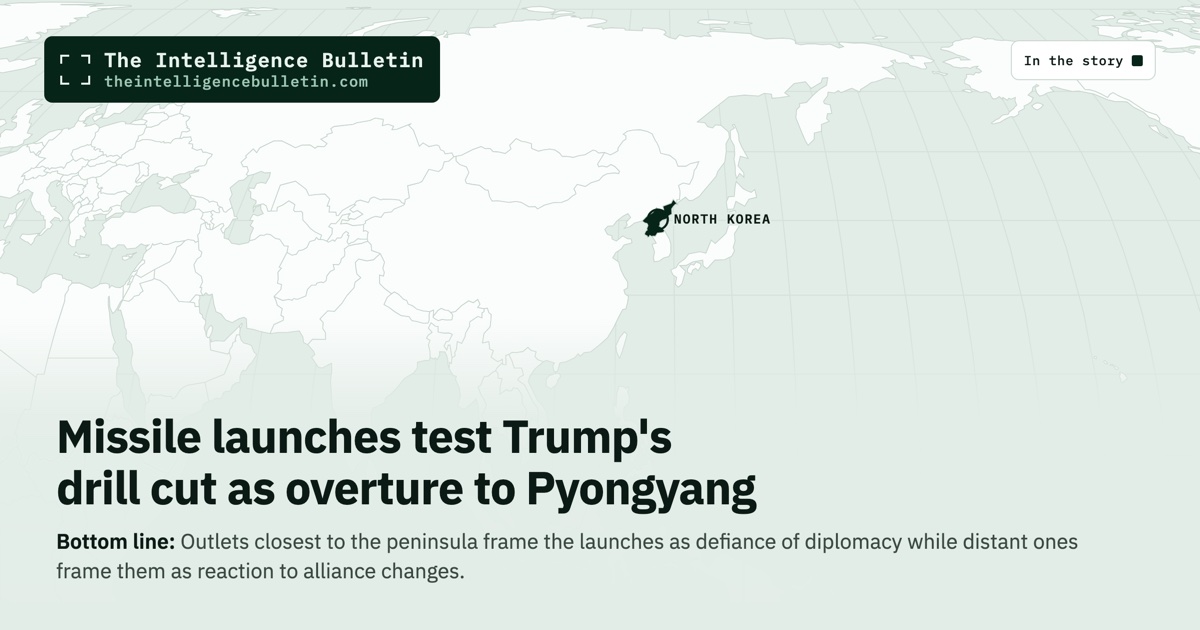
Map of the countries in the story: Missile launches test Trump's drill cut as overture to Pyongyang
South Korea’s Joint Chiefs of Staff reported that North Korea launched roughly 10 short-range ballistic missiles from the Pyongyang area into eastern waters around 5pm local time on August 20. The launches occurred as the annual Ulchi Freedom Shield exercises between the US and South Korea were being cut short at US President Donald Trump’s direction. Trump had framed the reduction as a gesture toward resuming dialogue with North Korean leader Kim Jong-un, but Kim’s sister dismissed the move. South Korea condemned the tests as violations of UN resolutions and coordinated with the US and Japan.

One Story. Many Angles.

🇰🇷
South Korea
Korea Herald
Carries Yonhap reporting
N. Korea fires barrage of short-range ballistic missiles despite Trump overture
Read →
🇦🇺
Australia
ABC News
Carries AP/Reuters reporting
North Korea fires ballistic missiles into sea as South Korea, US hold scaled-back military drills
Read →
🇬🇧
United Kingdom
The Guardian
Carries Associated Press reporting
North Korea fires 10 missiles day after Trump curtails South Korea joint drills
Read →
🇿🇦
South Africa
TimesLIVE
Carries Reuters reporting
North Korea launches 10 ballistic missiles as US-South Korea drills near end
Read →
🇹🇷
Turkey
Anadolu Agency
Original reporting
Japan says North Korea fires suspected ballistic missile amid US-South Korea drill
Read →
5 sources · each independently reported
In Brief

Outlets closest to the peninsula frame the launches as defiance of diplomacy while distant ones frame them as reaction to alliance changes.

The reporting converges on the timing and mechanics of the launches but diverges on emphasis, revealing how proximity shapes the frame. South Korea’s Korea Herald places the barrage squarely against Trump’s overture, quoting Kim Yo-jong’s blunt rejection and underscoring Seoul’s readiness posture as the direct response. Australian, British and South African outlets instead foreground the scaled-back drills themselves as the immediate context, treating the missile firings as a predictable reaction to an alliance adjustment rather than a standalone provocation. Turkey’s Anadolu Agency narrows to Japan’s detection, foregrounding a neighbor’s security alert. This pattern shows that domestic outlets stress defiance toward diplomacy while distant and regional observers embed the event inside US policy shifts. The common thread across independent chains is that no source claims the tests were provoked by the drills’ original scale; all note Pyongyang’s consistent opposition to any joint exercises. The absence of North Korean primary sourcing in the set leaves Kim Yo-jong’s statement as the clearest signal of intent, relayed uniformly but interpreted differently by distance from the peninsula.

Perspective Analysis

North Korea launched roughly 10 short-range ballistic missiles from the Pyongyang area toward eastern waters at around 5 p.m. local time on August 20, according to South Korea’s Joint Chiefs of Staff. The projectiles flew approximately 300 kilometers before landing in the sea. South Korea’s military reported that it had detected the launches, stepped up surveillance for possible follow-on tests, and was sharing information in real time with the United States and Japan while maintaining a full readiness posture. The presidential national security office convened an emergency meeting immediately afterward and issued a statement describing the tests as a grave violation of United Nations Security Council resolutions.

The launches took place on the second day of a sharply reduced annual Ulchi Freedom Shield exercise between South Korea and the United States. The drill, normally scheduled for 11 days, had been cut to five days after President Donald Trump directed the Pentagon to scale back participation. Trump had framed the reduction as a signal that the United States sought improved relations with North Korean leader Kim Jong-un. He stated publicly that he planned to meet Kim later in the year and cited what he described as a good personal relationship between the two leaders. Trump also mentioned a figure of 57 North Korean nuclear weapons in one public appearance, a number he had not used before.

North Korea’s response to the drill reduction came through Kim Yo-jong, the leader’s influential sister. In a statement issued the previous day she said the reduction was “unworthy of comment” and would not alter Pyongyang’s assessment of the exercises as provocative. She noted that the drills’ aggressive character remained unchanged even after the shortening and pointed to other recent allied training activities as well as South Korea’s pursuit of nuclear-powered submarines. At the same time she observed that personal relations between her brother and Trump were “still excellent,” language that avoided the sharper rhetoric Pyongyang has used in past exchanges.

South Korea’s Joint Chiefs of Staff said it was tracking the missiles in coordination with Washington and Tokyo. The Japanese prime minister’s office separately confirmed detection of a suspected ballistic missile launch. Chinese Foreign Minister Wang Yi, who was visiting Seoul that week, urged South Korea to avoid taking sides between Beijing and Washington and called on the United States to drop what he termed its hostile policy toward North Korea. South Korean officials, for their part, continued to stress the defensive nature of the exercises and the need to maintain combined readiness against potential North Korean aggression.

The pattern of reporting across the five outlets shows broad agreement on the core sequence of events but clear differences in emphasis that track the geographic position of each publication. The Korea Herald opened its account by placing the missile barrage directly against Trump’s diplomatic overture, quoting Kim Yo-jong’s rejection and noting that Seoul’s national security office had immediately reviewed the implications for readiness during the ongoing exercise. In contrast, the Australian, British and South African pieces foregrounded the timing of the launches relative to the drill reduction itself. They presented the tests as a response to an alliance adjustment rather than as an independent challenge to the possibility of renewed talks. The Turkish account narrowed further still, highlighting Japan’s detection and the security implications for a neighboring state.

These framing choices are not contradictory on the facts. Every account that addressed the question noted Pyongyang’s long-standing opposition to any joint South Korea–United States military exercises, regardless of scale. None of the five pieces claimed that the original, longer version of the drills had provoked the tests; all located the North Korean reaction inside a consistent pattern of protest against the exercises as such. The single most widely carried detail across independent reporting chains is therefore Kim Yo-jong’s statement rejecting the overture while preserving the possibility of future personal contact between the two leaders.

Because the source set contains no direct North Korean reporting beyond the relayed statement from Kim Yo-jong, the clearest signal of intent available here remains that single on-record comment. Outlets closer to the peninsula used it to underscore defiance. Outlets farther away used it to illustrate that Pyongyang was waiting for larger concessions before engaging. Both readings rest on the same text. The absence of any North Korean primary source in the collected coverage means readers must rely on this one window into Pyongyang’s position, interpreted through the lens of each outlet’s distance from the event.

The most reliable inference supported by the reporting is that the missile launches served as a concrete test of the diplomatic window Trump had attempted to open. The reduction in exercise duration did not produce a reciprocal gesture from Pyongyang. Instead it produced an immediate demonstration that North Korea retains the capacity and the willingness to conduct weapons tests even while exercises are under way and even while the United States signals interest in renewed contact. South Korea’s estimate that North Korea possesses between 80 and 120 nuclear warheads, offered in the same reporting cycle, supplies additional context for why both sides continue to treat even scaled-back drills as high-stakes events.

What to Watch

Looking ahead, the next moves will likely turn on whether Washington offers further adjustments or whether Pyongyang responds with additional tests. The reporting shows that every independent chain agrees on the sequence: the drill cut, the dismissal, and the launches. What remains unsettled is how large a concession would be required to shift that sequence. The coverage from five countries supplies the same factual spine while revealing that proximity continues to shape which part of the sequence receives the strongest emphasis.


Share this story

Tariff pause buys time as LeBlanc and Greer finalize details in Washington

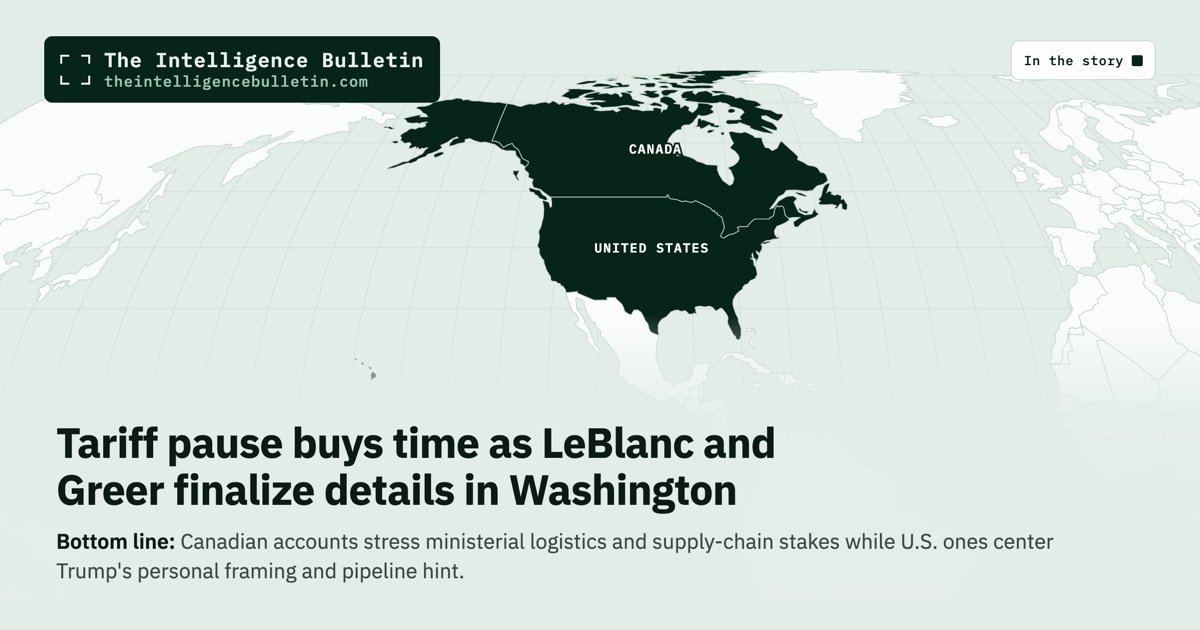
Map of the countries in the story: Tariff pause buys time as LeBlanc and Greer finalize details in Washington
Canada-U.S. Trade Minister Dominic LeBlanc and chief negotiator Janice Charette met U.S. Trade Representative Jamieson Greer in Washington on August 19, 2026. President Trump had announced a three-day pause on 50 percent tariffs affecting about $28-30 billion in Canadian goods the previous evening. Both sides described substantial progress toward resolving trade irritants including dairy access, alcohol bans and vehicle tariffs, with a new deadline of Saturday at midnight. Prime Minister Mark Carney noted ongoing work while provinces were asked to lift U.S. liquor restrictions.

One Story. Many Angles.

🇨🇦
Canada
Medicine Hat News
Canadian Press wire copy
LeBlanc, Charette to meet with U.S. trade officials in Washington as tariffs paused – Medicine Hat NewsMedicine Hat News
Read →
🇺🇸
United States
Newsweek
Original reporting
Trump Says Canada Tariffs Paused, Floats Keystone XL Pipeline Revival
Read →
🇨🇦
Canada
CBC
Original reporting
Canada, U.S. officials signal trade deal in the works after new tariffs paused
Read →
🇺🇸
United States
The Conservative Treehouse
Commentary
USTR Jamieson Greer and Canadian Trade Minister Dominic LeBlanc Give Remarks on Potential Trade Deal
Read →
🇫🇷
France
Sud Ouest
FRENCH
Carries AFP reporting
After the suspension of the new customs duties, the United States and Canada towards a commercial agreement
“Après la suspension des nouveaux droits de douane, les États-Unis et le Canada vers un accord commercial”
Read →
5 sources · 4 independent accounts — some share the same news agency’s report
In Brief

Canadian accounts stress ministerial logistics and supply-chain stakes while U.S. ones center Trump’s personal framing and pipeline hint.

Reporting across the sources converges on the fact of a tariff pause and active talks but diverges sharply in what each treats as the story’s center. Canadian outlets frame the episode as routine high-level diplomacy with LeBlanc and Charette in Washington securing concrete concessions on existing tariffs and market access. U.S. coverage, whether mainstream or conservative, places Trump’s announcement and his Keystone XL suggestion at the center, treating Canadian moves as responses to his leverage. The French regional piece, drawing from wire, registers the pause itself as evidence of movement toward an accord without domestic stakes. The Conservative Treehouse alone supplies verbatim remarks from Greer and LeBlanc, revealing the emphasis both placed on eliminating irritants and finalizing documentation. No independent chain contradicts the pause or the meetings; instead the accounts differ in which actor receives credit for the momentum and which concessions are highlighted. That pattern shows how proximity to the negotiators shapes what counts as the lead fact.

Perspective Analysis

Canadian and American negotiators spent the day of August 19, 2026, in Washington trying to lock in the terms of a trade understanding that had prompted President Donald Trump to delay new 50 percent tariffs on roughly $28 billion to $30 billion worth of Canadian imports. The pause, announced the evening before, bought three days. The new deadline stood at 12:01 a.m. Eastern Time on Saturday. Canada-U.S. Trade Minister Dominic LeBlanc and chief negotiator Janice Charette arrived for an 11:15 a.m. meeting with United States Trade Representative Jamieson Greer. Both governments described the session as part of a push to resolve long-standing irritants that included limited Canadian market access for U.S. dairy, provincial restrictions on American alcohol, and existing tariffs on Canadian steel, aluminum and vehicles.

Trump stated on social media and in remarks that an agreement had been reached subject only to final documentation. He added that the understanding might reopen the possibility of reviving the Keystone XL pipeline project, which had been canceled in 2021. Canadian Prime Minister Mark Carney posted that the two countries were now heading toward an accord after substantial progress, while emphasizing that further work remained. Greer told reporters after the meeting that irritants built up over several years had been eliminated and that the sides were taking a strong step forward, though he stressed that documentation still needed to be prepared for briefing both Trump and Congress. LeBlanc’s public comments aligned with that description of cleared obstacles and forward movement.

The Medicine Hat News carried the Canadian Press account that placed the ministerial schedule and the tariff suspension at the center. It noted the White House proclamation linking the pause to Canada’s commitment to address the listed trade barriers. Carney’s statement on progress appeared in the same dispatch. Sud Ouest, relaying an AFP summary, recorded the same sequence: Trump’s announcement of the three-day delay, Carney’s acknowledgment of progress, and Greer’s statement on CNBC that friction points had been removed. Neither piece supplied further specifics on tariff levels or provincial actions.

CBC reporting added detail drawn from unnamed sources close to the talks and from Carney’s virtual briefing to Canada’s premiers. According to those accounts, the emerging text would lower the U.S. headline tariff on Canadian-made vehicles from 25 percent to 15 percent while preserving an exemption for U.S. content that could bring the effective rate as low as 7.5 percent. Steel and aluminum tariffs were described as moving from 50 percent to 25 percent. Carney asked the premiers to return American alcohol to store shelves and to avoid procurement policies that singled out the United States for exclusion. Alberta and Saskatchewan had already lifted their bans; other provinces had not. The same sources indicated negotiators aimed to complete the package by Friday night, with Charette remaining in Washington after LeBlanc returned to Ottawa.

The Conservative Treehouse published the most direct record of the post-meeting remarks. Greer expressed confidence that the core issues had been settled and that documentation was being assembled. LeBlanc’s statements tracked the same language of resolved irritants. The site also carried Trump’s earlier comments on the pause and the potential pipeline revival. Unlike the wire accounts, it framed the exchange as evidence that the two sides had narrowed their differences enough to move to drafting.

Newsweek placed Trump’s social-media announcement and the Keystone XL reference at the top of its story, describing the pause as resting on a tentative agreement still requiring paperwork. It quoted Carney’s confirmation of progress and noted Greer’s congratulatory post. Background on the pipeline’s earlier cancellation under President Biden and its prior approval under Trump appeared in the same piece.

The accounts agree on the occurrence of the pause, the Washington meeting, and the public statements of movement toward an accord. They diverge on what receives emphasis and on which concessions receive mention. Canadian coverage, particularly CBC’s, foregrounds the domestic coordination required to deliver Canadian concessions on alcohol and procurement while citing specific tariff reductions still under discussion. U.S. outlets, including Newsweek, treat the pause itself as the primary development and locate momentum in Trump’s decision and his pipeline suggestion. The wire dispatches in Medicine Hat News and Sud Ouest record the pause and the leaders’ statements without adding the tariff-rate details or the premiers’ briefing.

These differences track the vantage of each outlet. Proximity to Canadian premiers and to negotiators produced the single-source reports on provincial requests and on vehicle and steel tariff adjustments. Proximity to Trump’s statements produced the emphasis on leverage and on a potential energy project. The Conservative Treehouse’s focus on the negotiators’ own words supplied the clearest record of what Greer and LeBlanc chose to say immediately after their session. No reporting chain disputed the pause or the meeting; the variation lies in which elements of the same sequence are treated as the lead fact.

The Canadian institutional reporting supplies the most concrete picture of what any final text would have to deliver on tariff rates and on internal Canadian policy changes. Those details rest on unnamed sources rather than on public statements, yet they appear only in the outlet that maintained direct contact with the premiers and with negotiators. The U.S. framing correctly captures Trump’s public positioning but leaves the mechanics of the Canadian side less visible. The wire accounts accurately summarize the shared public line without claiming more. A reader limited to one national press would therefore miss either the specific tariff adjustments under discussion or the explicit linkage Trump drew to the pipeline project.

What to Watch

The reporting that stayed closest to the negotiators’ own words and to the domestic steps required on the Canadian side offers the clearest path to judging whether the three-day window produces a signed text by Saturday. The next observable steps are the completion of documentation and any announcement of revised tariff schedules or provincial policy changes. Those steps will determine whether the pause extends into a durable adjustment or collapses back into the original tariff threat.


Share this story

Kyiv reports 12 dead in Russian barrage while Moscow lists military targets hit

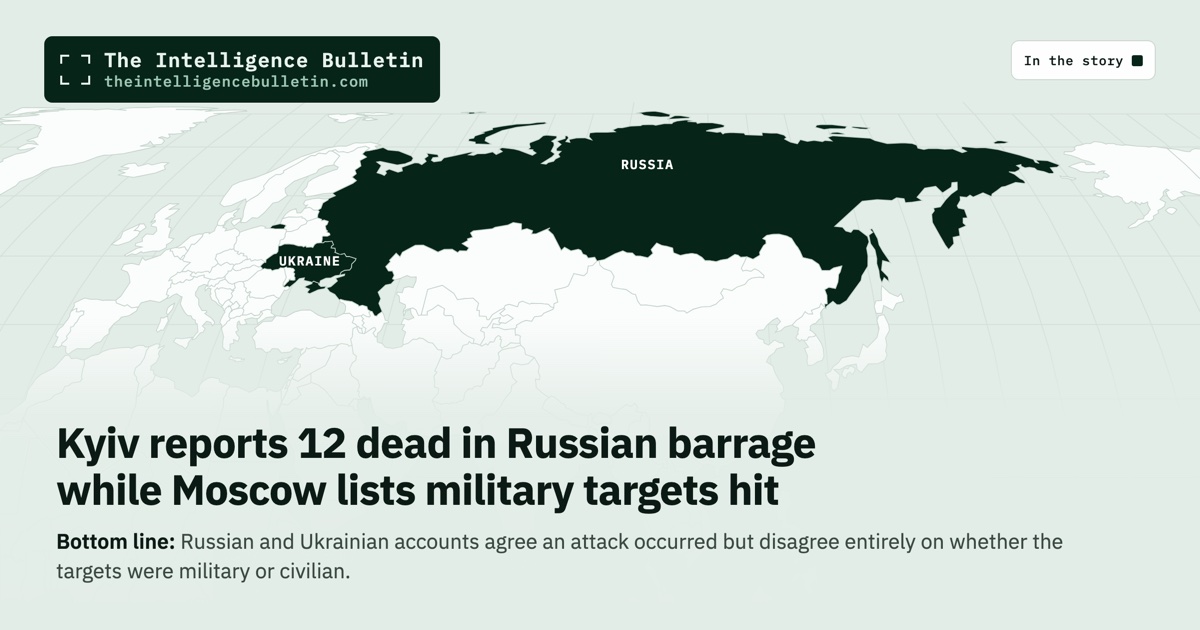
Map of the countries in the story: Kyiv reports 12 dead in Russian barrage while Moscow lists military targets hit
Russian forces launched a large missile and drone attack on Kyiv overnight on 19-20 August 2026. Ukrainian officials reported at least 12 deaths and over 30 injuries in the capital, with damage to homes, a hospital and a school. Russia stated the strikes targeted military-industrial sites and drone production facilities. Kyiv declared a day of mourning.

One Story. Many Angles.

🇺🇦
Ukraine
Kyiv Post
Carries AFP reporting
Kyiv Flea Market Vendors Struggle After Russian Strike
Read →
🇷🇺
Russia
Lenta.ru
RUSSIAN
Original reporting
Russia’s strikes on Kyiv and Kyiv region today: what targets were hit, statement from the Ministry of Defense
“Удары России по Киеву и Киевской области сегодня: какие цели поражены, заявление Минобороны”
Read →
🇨🇭
Switzerland
Watson
GERMAN
Carries keystone / sda / dpa reporting
War Russia Ukraine: 12 deaths in Russian attack on Kyiv
“Krieg Russland Ukraine: 12 Todesopfer bei russischem Angriff auf Kiew”
Read →
🇨🇿
Czech Republic
České noviny
CZECH
Carries ČTK reporting
Russian attack on Kyiv and surroundings killed 13 people, injured dozens, officials said
“Ruský útok na Kyjev a okolí zabil 13 lidí, desítky zranil, uvedli činitelé”
Read →
🇵🇰
Pakistan
Samaa
Original reporting
Russian strikes kill 12 in Kyiv as Ukraine election debate intensifies
Read →
5 sources · each independently reported
In Brief

Russian and Ukrainian accounts agree an attack occurred but disagree entirely on whether the targets were military or civilian.

The reporting splits cleanly on intent and impact. Ukrainian sources and officials describe a deliberate assault on civilian infrastructure that left markets, homes, a children’s hospital and a school damaged or destroyed, with the death toll rising through the morning. Russian state media and the Defence Ministry publish detailed lists of military enterprises struck, framing every hit as precise and legitimate. European outlets such as the Swiss Watson and Czech České noviny relay the Ukrainian casualty figures and mourning announcement while noting Moscow’s competing military-target claim, without endorsing either version. The Pakistani Samaa headline alone ties the strike to Ukraine’s intensifying domestic election debate, an angle absent elsewhere. No outlet examined here carried identical agency copy; the contrast therefore reflects genuine editorial choices rather than syndication overlap. The single corroborated element across independent chains is the occurrence of the attack and the Ukrainian-reported death toll of twelve in Kyiv.

Perspective Analysis

Russian forces struck Kyiv with a barrage of missiles and drones in the early hours of 20 August 2026. Ukrainian mayor Vitali Klitschko reported that the death toll in the capital reached twelve by morning, with more than thirty people injured. One additional person died and seven were wounded in the surrounding Kyiv region. Officials described damage across three districts to residential buildings, including a nine-storey apartment block where a fire broke out, a children’s hospital, a school and warehouses. President Volodymyr Zelensky stated that Russia had prepared the operation for some time with the goal of maximising harm to civilian infrastructure, and that ballistic missiles, cruise missiles and drones had also struck sites in Odesa and Chernihiv regions.

Russian Defence Ministry statements, carried in detail by Lenta.ru, listed the intended targets as military-industrial sites. These included the Fire Point enterprise, described as producing components for strike drones and assembling and storing accelerators for Flamingo cruise missiles; the Ukrspetsystems trading and warehouse complex involved in drone manufacture and storage; the Antonov plant, where manned aircraft and heavy An-196 Lyuty kamikaze drones were said to be developed and assembled; an aviation assembly plant and an ammunition depot holding thermobaric aerial bombs, anti-tank mines and ammunition for Baba-Yaga drones. Further strikes hit the Martusovka transport and logistics centre in Kyiv region, which handled dual-use goods including drone parts, robotic systems and electronic warfare equipment, and a fuel depot in Brovary storing up to eight thousand cubic metres of fuel for Ukrainian armed forces. Additional targets in the ports of Chornomorsk and Yuzhny were reported as military stores.

Kyiv declared 21 August a day of mourning, with flags lowered on municipal buildings and a recommendation for the same on state and private structures. Rescue operations continued at damaged sites, and power outages and fires were recorded in several districts. Ukrainian officials noted that the country faces an acute shortage of Patriot interceptor missiles, which limits its ability to counter ballistic threats.

The accounts diverge most sharply on the purpose of the attack. Ukrainian reporting and statements from Klitschko and Zelensky present the strikes as having hit civilian objects, with the rising death toll and damage to homes, a hospital and a school offered as direct evidence. Russian coverage presents every listed target as a military-industrial or logistics node supporting Ukrainian drone and missile production and operations. The two versions cannot both be accurate about the character of the same sites.

A reader limited to Ukrainian outlets would see the night primarily through its human and economic cost. The Kyiv Post article foregrounds vendors at the Pochaina flea market still trying to sell salvaged goods ten days after an earlier strike destroyed their permanent building, with similar scenes at other markets damaged since 2022. That focus places the latest barrage inside a pattern of repeated disruption to ordinary livelihoods rather than a one-off escalation. A reader limited to Russian sources would encounter only the Ministry of Defence inventory of enterprises and depots, with no mention of civilian casualties or damage to homes and hospitals. European reporting in Watson and České noviny places the Ukrainian casualty figures and mourning declaration first, then records the Russian target list in the same dispatch without reconciling the two. The Czech outlet additionally notes Ukrainian difficulties intercepting ballistic missiles due to ammunition shortages. The Pakistani Samaa piece is the only one among the five to connect the strike in its headline to Ukraine’s intensifying domestic election debate, an angle that does not appear in the actor or European selections.

The corroborated elements across independent reporting chains are the occurrence of the attack, the death toll of twelve in Kyiv and the damage to residential buildings, a children’s hospital and a school. These details reach the reader through Ukrainian officials quoted directly in Watson, České noviny and the Kyiv Post, with the casualty count also referenced in the Samaa headline. The specific Russian target list remains a single-source claim resting on the Ministry of Defence statement. No independent reporting chain in the set examined here verified or contradicted the listed enterprises by name.

What to Watch

The Ukrainian account of civilian impact rests on on-record statements from the Kyiv mayor and the president, repeated across multiple outlets in different countries. The Russian account rests on an official ministry release published in full by one state-aligned outlet. A reader weighing which description is closer to the event therefore has a clearer basis for the civilian-damage side, because that side appears in separate reporting chains that name the same injuries and the same damaged buildings. Moscow has a clear interest in framing the operation as limited to military production, while Kyiv has an interest in highlighting civilian harm to maintain international pressure for air-defence support. The next development most likely to shift the balance is whether subsequent reporting from any independent chain can confirm or refute the specific enterprises named by the Russian ministry, or whether further casualty updates from Ukrainian emergency services alter the death toll.


Share this story

Debt crosses $40 trillion as interest costs eclipse defense in US budget

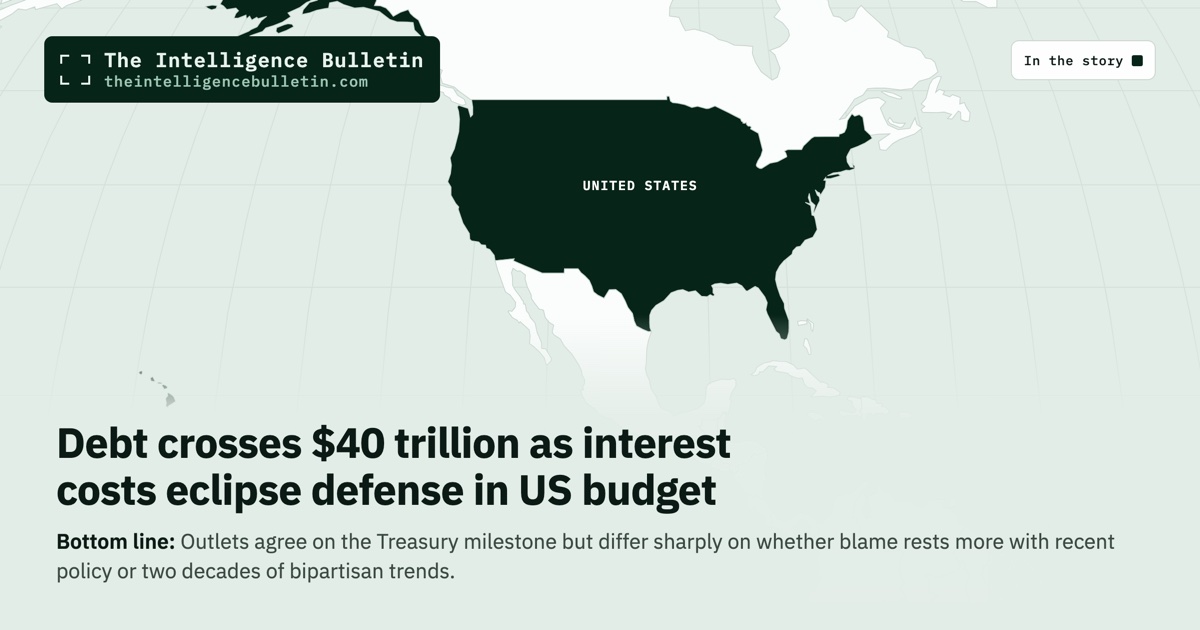
Map of the countries in the story: Debt crosses $40 trillion as interest costs eclipse defense in US budget
The US Treasury reported total public debt outstanding reached $40.047 trillion on Tuesday. The figure doubled from $19.95 trillion at the start of Donald Trump’s first term in 2017, with rapid growth during the COVID-19 pandemic under both Trump and Joe Biden plus subsequent policy choices. Interest payments now rank among the largest budget items behind Social Security. Experts from bipartisan groups warn of higher borrowing costs and unsustainable trajectories, while the White House cites efforts to cut waste and boost growth.

One Story. Many Angles.

🇺🇸
United States
Fox 13 Now
Carries AP reporting
US national debt surpasses record $40 trillion
Read →
🇨🇳
China
China Daily
Xinhua wire copy
US national debt tops $40 trillion for first time in history
Read →
🇶🇦
Qatar
Al Jazeera
Carries Reuters reporting
US national debt passes record $40 trillion
Read →
🇬🇧
United Kingdom
The Independent
Original reporting
US national debt crosses $40 trillion mark after more than doubling in only a decade
Read →
🇮🇳
India
The Hindu Business Line
Carries AP reporting
US national debt crosses $40 trillion amid rising deficit and interest costs
Read →
5 sources · 4 independent accounts — some share the same news agency’s report
In Brief

Outlets agree on the Treasury milestone but differ sharply on whether blame rests more with recent policy or two decades of bipartisan trends.

Coverage converges on Treasury data confirming the $40.047 trillion mark but parts company on emphasis and causation. US outlets and wires frame it as a domestic fiscal pressure point already lifting mortgage and auto rates while the Trump administration attributes prior mismanagement to Biden and promises spending discipline. Chinese state media traces the trajectory explicitly to tax cuts and military outlays since 2017, treating the milestone as evidence of structural weakness. Qatari and UK reporting stress the decade-long doubling across administrations and pandemic borrowing, with added detail on bond yields and foreign investor hesitation. Indian business coverage foregrounds deficit-to-GDP ratios and spillover effects on global debt markets. The shared reliance on the same expert voices from the Bipartisan Policy Center and Committee for a Responsible Federal Budget produces near-identical warnings, yet the geographic lenses reveal distinct stakes: partisan score-settling at home, policy critique from Beijing, regional interest-rate concerns from Doha, long-cycle fiscal decline from London, and emerging-market transmission risks from New Delhi. What unites them is the absence of any administration plan to reverse the path.

Perspective Analysis

The US Treasury’s daily cash and debt statement recorded total public debt outstanding at $40.047 trillion on Tuesday, a figure that includes $32.266 trillion held by the public and $7.782 trillion in intragovernmental holdings. The milestone arrived five months after the debt crossed $39 trillion in March and roughly ten months after it reached $38 trillion in October. Treasury data also showed a fiscal deficit of $1.367 trillion for the first nine months of fiscal year 2026, with net interest payments of $827 billion already exceeding defense outlays of $713 billion and ranking second only to Social Security spending of $1.244 trillion.

The debt stood at $19.95 trillion when Donald Trump took office for the first time in January 2017. It has more than doubled since then. Roughly one-third of the increase occurred during the two years of heavy pandemic borrowing that began in 2020, under both the first Trump administration and the Biden administration that followed. Since Trump returned to office in January 2025 the debt has grown by an additional $3.8 trillion. During Biden’s term it rose by $8.4 trillion, driven by pandemic relief plus infrastructure and clean-energy measures. The Committee for a Responsible Federal Budget estimates that policy choices made under both presidents pushed the debt trajectory higher than it would have been under the spending rules in place when each took office.

Interest costs have climbed with the debt load. In fiscal year 2025 they exceeded Pentagon funding for the first time. In the first ten months of fiscal 2026 they surpassed Medicare outlays and became the second-largest line item behind Social Security. The Treasury reported a $432 billion monthly deficit for July, the fourth-largest on record, after tariff refunds turned customs receipts negative for three straight months. The cumulative deficit for the first ten months of the current fiscal year already exceeds the full-year gap recorded in fiscal 2025.

White House spokesman Kush Desai stated that the Trump administration has concentrated on cutting waste, fraud and abuse while accelerating growth to move the debt-to-GDP ratio in the right direction. Margaret Spellings, president and CEO of the Bipartisan Policy Center, said the federal debt is already raising the cost of living and choking out other spending, and that the trajectory is plainly unsustainable even in the best-case scenario. Maya MacGuineas of the Committee for a Responsible Federal Budget warned that forty trillion dollars of debt finds its way into pocketbooks, exacerbates inflation and leaves the country vulnerable to emergencies. Michael A. Peterson of the Peter G. Peterson Foundation called for lawmakers to place the nation on a more affordable path.

Coverage of the milestone shows clear differences in emphasis. American domestic reporting, including Fox 13 Now, foregrounds immediate effects on household borrowing costs for mortgages and cars and quotes the White House defense of current policy. It also carries the Bipartisan Policy Center estimate that the next statutory debt limit of $41.1 trillion will likely be reached between late winter and mid-summer 2027. Chinese state-linked coverage traces the growth explicitly to tax cuts, pandemic spending and increased military outlays since 2017, presenting the crossing as evidence of structural weakness. Qatari reporting stresses the decade-long doubling across administrations, calculates the per-person burden at roughly $117,000 and per-household burden at $297,000, and notes that the debt now approximates the combined economies of China, Germany, Japan, the United Kingdom and India. UK reporting adds detail on recent Treasury bond sales that cleared at the highest yields since 2021, the doubling of buyback operations for longer-term securities, and signs that foreign investors holding nearly a third of Treasuries have become more selective. Indian business coverage links the threshold directly to rising deficits and interest costs, highlighting potential spillovers into global debt markets and interest-rate effects felt beyond US borders.

These differences matter because a reader limited to one national lens misses the others. US domestic accounts treat the milestone chiefly as a partisan fiscal pressure point already visible in everyday borrowing costs. Chinese accounts locate the cause in policy decisions that began in 2017 and treat the result as a predictable vulnerability. Qatari and UK accounts place the doubling itself at the center and add market data on yields and creditor behavior that the others largely omit. Indian coverage alone foregrounds transmission risks to emerging economies through higher global rates. All five accounts quote the same small set of US think-tank voices and carry Treasury numbers that originated in one primary document, so the factual spine is shared. The divergence lies in what each chooses to place beside those numbers.

The reporting that most accurately captures the event is the set of accounts that place the decade-long doubling and the shift in budget composition at the center rather than the immediate political exchange. The Treasury figures themselves document the scale: interest payments now exceed defense spending in several recent periods and rank second only to Social Security. The Committee for a Responsible Federal Budget and Bipartisan Policy Center statements, carried across independent outlets, supply the on-record assessment that the trajectory is unsustainable without changes to revenue or mandatory spending. The White House position on waste reduction appears in three of the five articles but offers no specific reversal of the interest-cost trend already visible in the Treasury data. Foreign-creditor caution and yield movements reported by the UK outlet add a concrete market signal that the domestic and Chinese accounts do not address.

What to Watch

The absence of any administration plan to alter the path appears consistently across the coverage. Without such a plan the next debt-limit vote, expected within roughly a year, will again test congressional willingness to accommodate further growth or impose adjustments. The global dimension visible in the Indian and UK reporting suggests that higher US borrowing costs will continue to transmit into other economies through benchmark rates, regardless of which domestic narrative prevails.


Share this story

Russia Ukraine swap 103 each as UAE mediation and wounded returns surface in coverage

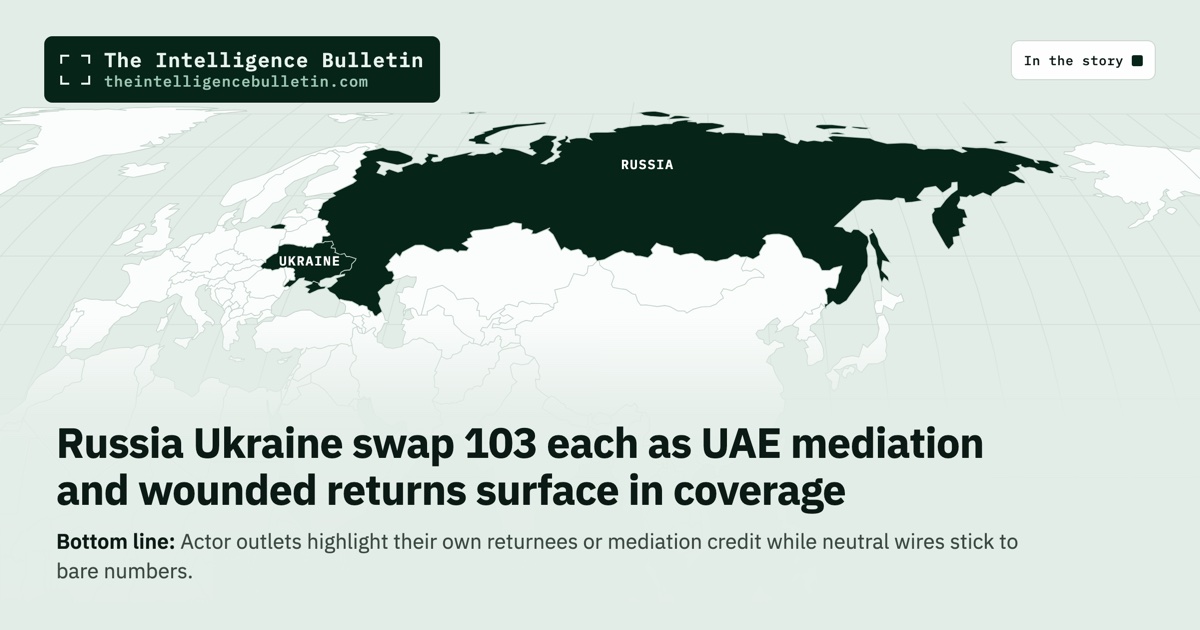
Map of the countries in the story: Russia Ukraine swap 103 each as UAE mediation and wounded returns surface in coverage
Russia and Ukraine conducted a prisoner exchange of 103 each on August 19, 2026, at the Belarus border. Ukrainian President Zelenskiy and Russia’s Defense Ministry confirmed the swap. The UAE facilitated the deal as part of 26 prior mediations. Ukrainian sources highlighted returning servicemen from multiple branches, while Russian reports noted 31 wounded among returnees and the two-month gap since the last exchange.

One Story. Many Angles.

🇦🇪
United Arab Emirates
The National
Original reporting
Russia and Ukraine exchange 206 prisoners after UAE mediation
Read →
🇷🇺
Russia
RuNews24
RUSSIAN
Original reporting
“103 for 103” and 31 wounded: Russia and Ukraine conducted the first prisoner exchange in two months
“«103 на 103» и 31 раненый: Россия и Украина провели первый за два месяца обмен пленными”
Read →
🇺🇦
Ukraine
Liga.net
RUSSIAN
Original reporting
New prisoner exchange on August 19 — Ukraine returned 103 military personnel, photos
“Новый обмен пленными 19 августа — Украина вернула 103 военных, фото”
Read →
🇵🇰
Pakistan
Dunya News
Carries Reuters reporting
Russia and Ukraine swap 103 prisoners of war each
Read →
🇿🇦
South Africa
TimesLIVE
Carries Reuters reporting
Russia and Ukraine in prisoner exchange
Read →
5 sources · 4 independent accounts — some share the same news agency’s report
In Brief

Actor outlets highlight their own returnees or mediation credit while neutral wires stick to bare numbers.

The reporting converges on the raw numbers of the 103-for-103 exchange but diverges sharply on framing and detail. UAE-linked coverage centers the Emirates’ mediation role and cumulative totals, treating the swap as evidence of Abu Dhabi’s diplomatic reach. Russian domestic accounts stress symmetry, the two-month interval, and medical needs of the 31 wounded returnees, while downplaying external facilitators. Ukrainian outlets foreground the return of specific military personnel with photos and personal stories, crediting both the UAE and United States. Reuters-sourced pieces from Pakistan and South Africa remain strictly numerical and quote Ukrainian returnees directly, avoiding mediator or casualty emphasis. These choices reveal how proximity to the event and national interests shape what each chain chooses to foreground or omit, with no outright contradictions in the core facts but clear selectivity in context.

Perspective Analysis

Russia and Ukraine exchanged 103 prisoners each on August 19, 2026. The handover occurred at the Novaya Guta border crossing in Belarus’s Gomel region, according to Russian accounts that placed the Russian returnees on Belarusian soil for initial medical and psychological care before transport to Russian hospitals.

Ukrainian President Volodymyr Zelenskiy announced the returns on Telegram, describing them as servicemen from the Armed Forces, the State Border Guard Service, and the National Guard. The Coordination Headquarters for the Treatment of Prisoners of War added that the group included soldiers, sergeants, and officers who had fought on the Luhansk, Donetsk, Kharkiv, Zaporizhzhia, Kherson, Dnipro, and Sumy fronts. The youngest was born in 2000 and the oldest was 59. Ukrainian military intelligence chief Oleh Ivashchenko stated that a further exchange was expected before the end of the month and that it would prioritize defenders held since the early stages of the war, including those who fought in the defense of Mariupol.

Russian reporting from RuNews24 described the same 103-for-103 formula and noted that Russian human rights ombudsman Yana Lantratova met the returnees at the border. She reported that 31 of the Russian servicemen were wounded. The Russian Defense Ministry confirmed the exchange through state media, and the men were listed on previously published Russian rosters. The account identified the swap as the first in nearly two months, following an earlier round on June 26 that involved 160 on each side.

The UAE played a documented role in arranging the transfer. The National reported that the UAE Foreign Ministry announced the deal and placed the total number of detainees exchanged through its mediation at 7,997 across 26 separate operations. Russian President Vladimir Putin thanked UAE President Sheikh Mohamed for the Emirates’ continued efforts. Ukrainian statements also credited the UAE and the United States for assistance in securing the releases. Earlier exchanges facilitated through the same channel included a 320-person swap announced on June 26 and previous rounds of 185, 205, and 193 prisoners each.

Reuters dispatches carried by Dunya News and TimesLIVE supplied direct testimony from Ukrainian returnees. One 29-year-old identified as Dmytro, held for three years, told Reuters he had returned home without claiming any special status and urged families of those still held to maintain hope. Another, 43-year-old Anton Tymofienko, held for 28 months, said the primary contact with the outside world had been letters from relatives. These accounts described regular prisoner exchanges continuing throughout the war that began with Russia’s full-scale invasion in 2022, while both governments remained far apart on any broader peace settlement.

The five articles examined converge on the central figures of 103 prisoners returned to each side. They also align on the involvement of the UAE in at least some capacity, with explicit references appearing in the UAE, Russian, and Ukrainian pieces. The expectation of a follow-on exchange before the end of August appears in both Ukrainian statements and the Reuters material. The single-source detail that 31 of the Russian returnees were wounded comes exclusively from the Russian ombudsman’s remarks reported by RuNews24 and is not referenced elsewhere in the set.

Differences emerge in emphasis and selection of supporting material. The National builds its narrative around the UAE’s accumulated diplomatic record and quotes Putin’s message of thanks, framing the event as further evidence of Abu Dhabi’s position as a channel between the two sides. RuNews24 highlights the symmetry of the numbers, the medical condition of the Russian returnees, the two-month interval since the previous swap, and the Belarus handover point. Liga.net publishes multiple photographs of the Ukrainian returnees arriving, names the military branches represented, lists the fronts on which they fought, and records thanks to both the UAE and the United States. The two Reuters-based pieces from Pakistan and South Africa limit themselves to the exchange numbers, the quoted comments from Ukrainian servicemen, and the intelligence chief’s remarks on the next planned round, without reference to mediation or specific casualty counts.

These choices reflect the vantage points of the reporting organizations. Outlets tied to one of the warring parties foreground the return of their own personnel and the conditions those personnel faced. The UAE outlet foregrounds its government’s facilitation role. Distant neutral wires reproduce agency copy that captures personal testimony but omits the institutional credits and medical details supplied by the primary actors. No account contradicts the others on the total exchanged or the date. The single-source wounded figure stands alone because no other chain reported it.

The corroborated elements—the 103-for-103 count, the UAE’s mediation across multiple operations, and the branches and service histories of the Ukrainian returnees—rest on statements from both governments and from the UAE Foreign Ministry. The Reuters quotes supply independent corroboration of the human dimension through named individuals. The single-source claim of 31 wounded Russian returnees remains attributable only to the Russian ombudsman and carries the limitation of that chain. Each side has an institutional interest in presenting its own returnees in the most favorable light and in crediting or omitting external facilitators accordingly. The Reuters material, drawn from direct interviews, supplies the least filtered personal evidence in the set.

What to Watch

The pattern indicates that further exchanges will continue on the same humanitarian track. The intelligence chief’s statement that the next round will target longer-held prisoners, including Mariupol defenders, supplies a concrete expectation against which future reporting can be measured. The selectivity already visible shows that readers relying on any single national outlet will receive a narrower slice of the same underlying event.


Share this story