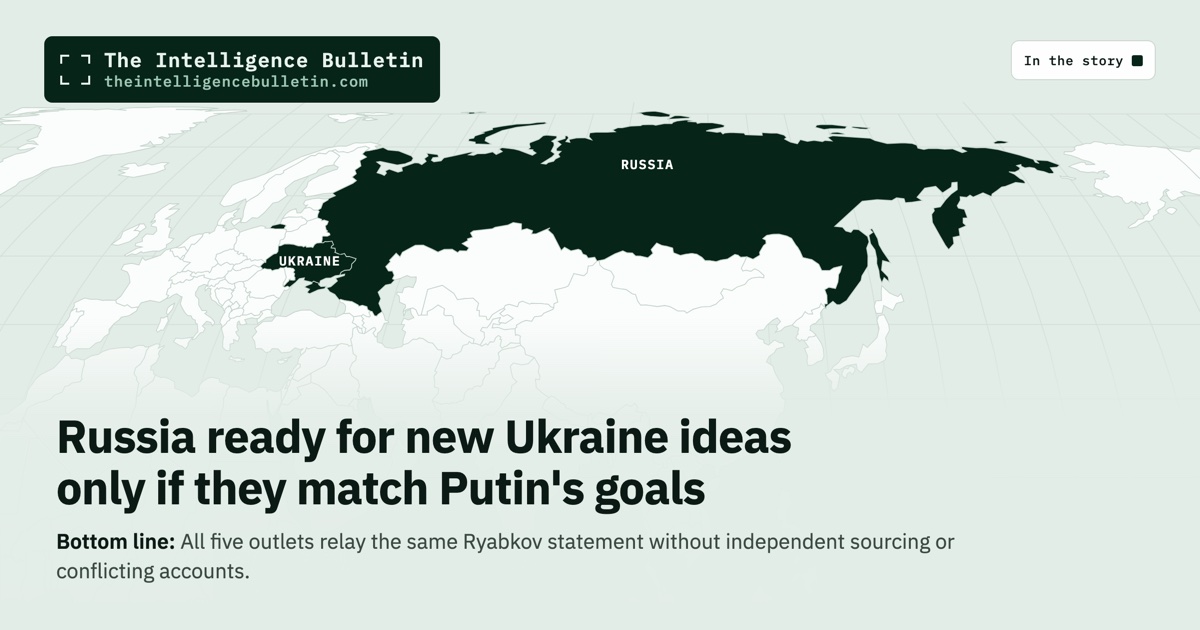
Russia ready for new Ukraine ideas only if they match Putin’s goals

Map of the countries in the story: Russia ready for new Ukraine ideas only if they match Putin's goals
Russian Deputy Foreign Minister Sergei Ryabkov said in a News.ru interview that Moscow will consider new proposals to end the Ukraine war only if they align with President Vladimir Putin’s goals and reflect realities on the ground. He noted US readiness for dialogue but questioned Washington’s ability to influence Kyiv and European allies. Talks remain stalled amid the Iran conflict, with no confirmed plans for further US envoys’ visits. Russia controls about one-fifth of Ukraine’s territory after nearly four and a half years of war.

One Story. Many Angles.

🇧🇬
Bulgaria
bgnes.com
Carries Reuters reporting
Russia ready to consider new proposals to end Ukraine war
Read →
🇶🇦
Qatar
Al Jazeera
Carries Reuters reporting
Russia says ready for ‘new ideas’ on Ukraine war that match Putin’s goals
Read →
🇨🇦
Canada
The Globe and Mail
Carries Reuters reporting
Russia open to new ideas on Ukraine peace, but with conditions, senior diplomat says
Read →
🇨🇾
Cyprus
Cyprus Mail
Carries reuters reporting
Russia open to new US proposals on Ukraine, envoy says
Read →
🇸🇦
Saudi Arabia
Okaz
ARABIC
Translated from Reuters
Russia: We are open to new peace proposals regarding Ukraine
“روسيا: منفتحون على مقترحات سلام جديدة بشأن أوكرانيا”
Read →
5 sources · all sharing one news agency’s report
In Brief

All five outlets relay the same Ryabkov statement without independent sourcing or conflicting accounts.

Every outlet in the set relays the identical core statement from Sergei Ryabkov via News.ru and Reuters framing, creating convergence rather than contrast on the conditionality of Russia’s openness. The Globe and Mail and Cyprus Mail both stress the US proposals angle and stalled talks due to Iran, while Al Jazeera adds Zelenskyy’s recent comments and ongoing attacks on the ground. BGNES inserts a Balkan neutral tone with extra nuclear arms control detail, and Okaz strips away European security references to focus on the raw diplomatic openness. This uniformity across five countries reveals that the selected coverage originates from one primary reporting chain, with outlets layering only minor regional emphases on top of the same dispatch rather than offering independent sourcing or divergent interpretations of what Ryabkov’s remarks actually change.

Perspective Analysis

Russian Deputy Foreign Minister Sergei Ryabkov gave the interview to the Russian news portal News.ru that forms the single originating account carried across the five selected outlets. In it he stated that the Russian Federation stands ready to listen to any reasonable proposals and ideas consistent with the goals set by President Vladimir Putin and that meet the realities on the ground. He added that the United States had shown a readiness for constructive dialogue and a certain understanding of Russia’s position, yet the decisive question remained how far Washington could influence decisions in Kyiv and among European countries that Moscow accuses of still seeking Russia’s strategic defeat.

The same News.ru interview and its Reuters relay supplied every concrete detail that appears in the five published pieces. Ryabkov noted that negotiations between Moscow and Washington have largely stalled amid the wider war involving Iran. The Kremlin, he said, currently possesses no information about a possible future visit to Russia by the US presidential envoys Steve Witkoff and Jared Kushner. US Secretary of State Marco Rubio had reaffirmed Washington’s commitment to ending the war after meeting Russian Foreign Minister Sergei Lavrov in Manila the previous month, though Rubio cautioned that no quick agreement was expected and that the United States was seeking a possible compromise. Ryabkov indicated Moscow remained open to hearing new ideas from Rubio and to continuing dialogue with Washington. After nearly four and a half years of fighting, Russia controls approximately one-fifth of Ukraine’s internationally recognized territory. Moscow has repeatedly declared itself ready for negotiations provided any agreement accounts for what it describes as the new realities on the ground. In the same interview Ryabkov also addressed nuclear arms control, stating that Moscow is interested in continuing dialogue with Washington on strategic stability and nuclear arsenals. The New START treaty, the last remaining bilateral agreement limiting strategic nuclear weapons, expired on 5 February 2026, leaving the two largest nuclear powers without binding quantitative limits or verification mechanisms for the first time in more than half a century. Ryabkov confirmed that Russia remains open to political and diplomatic mechanisms to stabilize the situation regarding strategic nuclear weapons.

Each masthead adapted this single dispatch for its own readership by choosing which elements to foreground in the headline, which additional sentences to insert, and which local framing to apply. BGNES in Bulgaria titled its piece “Russia ready to consider new proposals to end Ukraine war” and placed the nuclear-arms paragraph near the close, after first citing Reuters explicitly and noting the expiration of New START. It framed the remarks as arising amid ongoing US diplomatic efforts without adding any Balkan-specific commentary. Al Jazeera in Qatar led with “Russia says ready for ‘new ideas’ on Ukraine war that match Putin’s goals” and layered its own staff reporting on recent attacks, including Ukrainian drone strikes that damaged an industrial facility in Russia’s Perm region and a military air base in Volgograd, as well as Zelenskyy’s Thursday evening statement that he was preparing decisions within the diplomatic team and that Ukraine needed results. The Globe and Mail in Canada and the Cyprus Mail both used nearly identical Reuters copy under headlines that stressed conditions and US proposals specifically; the Globe and Mail added a link to its own related story on Zelenskyy’s call for Patriot interceptors, while Cyprus Mail attributed the text to “Reuters News Service” and placed the nuclear section under a subhead. Okaz in Saudi Arabia published an Arabic translation whose headline read “Russia: We are open to new peace proposals regarding Ukraine” and omitted references to European security concerns or ground attacks, concentrating instead on the raw diplomatic language and the Rubio-Lavrov meeting.

The uniform origin means the differences visible to readers lie entirely in selection and emphasis rather than in competing facts. BGNES chose to retain the nuclear-stability paragraph that the others either shortened or omitted. Al Jazeera alone inserted independent paragraphs describing recent strikes on both sides and Zelenskyy’s public remarks. The Canadian and Cypriot outlets preserved the wire structure almost unchanged, each adding only a single domestic link or attribution line. Okaz translated the core quotes faithfully but stripped away any mention of European allies or ongoing hostilities, producing the shortest version focused solely on the bilateral US-Russia channel. None of the five pieces introduced new sourcing that contradicted or expanded the original Ryabkov statements.

Because the underlying reporting chain is single, the published record offers no independent verification of whether the United States is in fact demonstrating greater understanding of Russia’s position or whether Washington retains meaningful leverage over Kyiv. What the five mastheads do show is how the same conditional offer travels through different editorial filters. A reader who encounters only the Okaz version receives the diplomatic opening stripped of European context; a reader limited to Al Jazeera receives the same offer embedded in an account of fresh battlefield activity and Ukrainian diplomatic preparations. The Globe and Mail and Cyprus Mail versions present the narrowest slice, limited to the stalled talks and the nuclear note. BGNES supplies the most complete reproduction of the nuclear paragraph while keeping the overall tone neutral.

What to Watch

The single-chain character of the coverage therefore limits what can be concluded about any actual shift in Russian negotiating posture. The published record establishes only that Ryabkov used those precise words in the News.ru interview and that five outlets in five countries chose to carry them under their own headlines with varying degrees of surrounding context. Readers seeking evidence of movement toward negotiations must still weigh the same set of conditional statements against the unchanged territorial and military facts that Ryabkov himself invoked.
Share this story

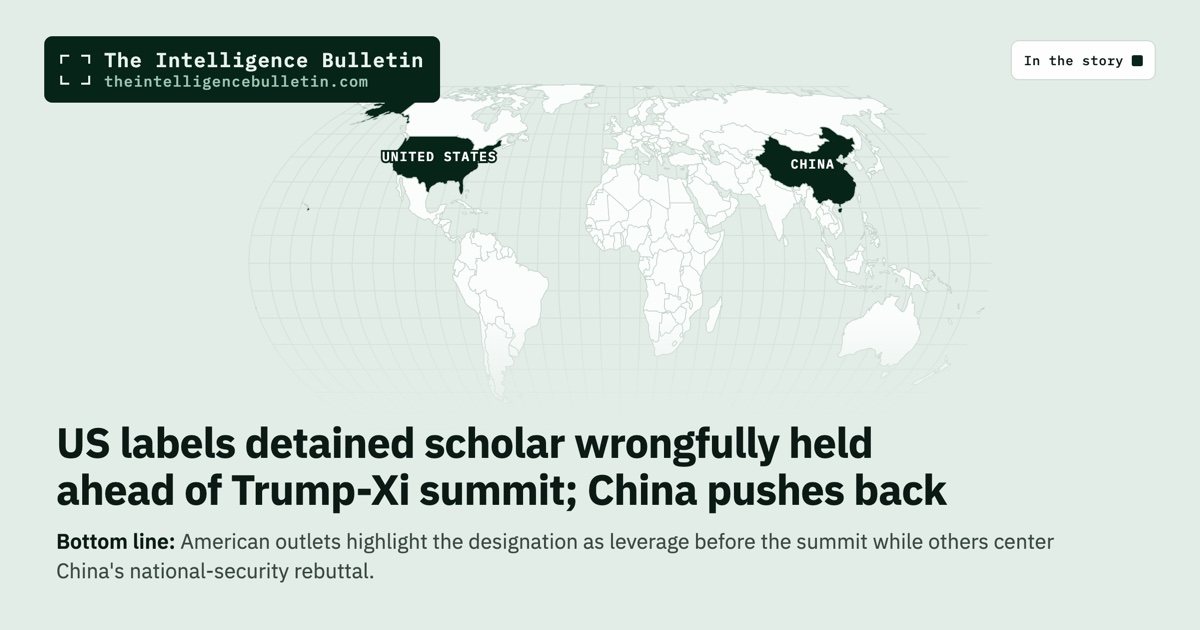
US labels detained scholar wrongfully held ahead of Trump-Xi summit; China pushes back

Map of the countries in the story: US labels detained scholar wrongfully held ahead of Trump-Xi summit; China pushes back
The US State Department designated American scholar Min Zin, a Myanmar analyst, as wrongfully detained in China after his June 3 arrest in Yunnan. He had traveled at Beijing’s invitation for an academic conference. China rejects the designation, stating he is suspected of endangering national security under Chinese law. The move is the second such US designation for a citizen in China and comes ahead of a planned Trump-Xi meeting.

One Story. Many Angles.

🇺🇸
United States
Fox News
Original reporting
Rubio designates US scholar Min Zin wrongfully detained in China
Read →
🇭🇰
Hong Kong
South China Morning Post
Original reporting
US designates academic Min Zin as wrongfully detained in China
Read →
🇶🇦
Qatar
Al Jazeera
Carries AFP reporting
China rejects US claim that Myanmar analyst wrongfully detained
Read →
🇯🇵
Japan
Nikkei Asia
Carries Reuters reporting
China rejects Rubio’s accusation it wrongfully detained US academic
Read →
🇰🇷
South Korea
The Korea Times
KOREAN
Relayed reporting
China ‘arrest of Myanmar-American scholar’ US ‘unjust detention… urge release’
“中 ‘미얀마계 미국 학자 체포’에 美 “부당구금…석방 촉구””
Read →
5 sources · each independently reported
In Brief

American outlets highlight the designation as leverage before the summit while others center China’s national-security rebuttal.

The reporting across these outlets converges on the basic sequence of the US designation and China’s rejection but diverges sharply in emphasis, revealing how national lenses shape the same facts into distinct diplomatic signals. US-focused coverage frames the Rubio decision as a deliberate escalation that elevates the case ahead of the Trump-Xi summit, treating the timing as evidence of Washington’s priority on citizen cases. Regional outlets instead place the Chinese rebuttal at the center, underscoring Beijing’s insistence that the matter follows domestic law and linking the analyst’s Myanmar background to the sensitivities of cross-border security. This pattern shows the event functions less as a shared international incident and more as parallel national stories: one about American leverage before a high-level meeting, the other about resistance to external interference in sovereign legal processes. The absence of direct Chinese-voice reporting in the set leaves the rebuttal visible only through how others relay it, highlighting that the selected coverage captures the US action and the pushback but not Beijing’s own framing of the underlying accusations. The consistent mention of a prior designation for another American citizen further ties this case to an ongoing pattern of consular friction rather than an isolated dispute.

Perspective Analysis

The US State Department announced on August 20 that Secretary Marco Rubio had designated Min Zin, an American scholar of Myanmar origin, as wrongfully detained in China. The determination followed a review of his arrest on June 3 in Yunnan province, where he had arrived to attend an academic conference after receiving an invitation from the Chinese government. Zin had traveled from abroad, and within hours of landing his family and colleagues lost contact with him. Chinese authorities later informed the US Embassy that he was under criminal investigation for allegedly endangering national security.

China’s Foreign Ministry responded the next day by rejecting the designation outright. A spokesman stated that China is a country governed by the rule of law and that there is no such thing as wrongful detention. The ministry added that the individual in question is suspected of engaging in activities that endanger China’s national security and therefore violates Chinese law. The case is being handled according to domestic legal procedures, the spokesman said.

Zin leads the Institute for Strategy and Policy-Myanmar, a think tank that studies the political, resource, and economic dimensions of Myanmar’s civil war after the 2021 military coup. He participated in Myanmar’s 1988 pro-democracy uprising and later sought asylum in the United States. Before his detention he had lived in Thailand and divided time between the US and Myanmar. The arrest marks the second time the State Department has applied the wrongful-detention label to a US citizen held in China; the first concerned Youlin Chen, a Chinese-born seismologist from Boston arrested in November 2024 at Beijing International Airport.

The designation shifts Zin’s case from routine consular handling to the office that manages hostage affairs, bringing additional resources and attention to efforts to secure his release. State Department officials described the safety of US citizens as the department’s top priority and said they would continue to advocate for Zin and for other Americans they describe as arbitrarily detained or exit-banned in China. Reports indicate he has been held in isolation and subjected to repeated interrogation during nearly eleven weeks in custody.

The timing of the announcement places the case weeks before a scheduled September 24 visit by Chinese President Xi Jinping to the White House. Fox News reporting tied the move directly to that upcoming meeting, presenting the designation as an escalation that puts pressure on Beijing in advance of high-level talks. South China Morning Post coverage described the step as adding friction to already strained bilateral relations without centering Secretary Rubio’s personal role.

Al Jazeera and Nikkei Asia, drawing on wire dispatches, led instead with China’s rejection and placed greater weight on Zin’s Myanmar background and the sensitivities of cross-border security issues. The Korea Times headline similarly foregrounded the scholar’s Myanmar-American identity while reporting the US call for release. These accounts treat the Chinese response as the central development rather than the US designation itself.

The selected sources contain no direct reporting from Chinese state media. The Chinese position therefore appears only through the relay of the Foreign Ministry spokesman’s remarks in the other outlets. This leaves the underlying accusations of espionage or national-security violations visible solely in the form Beijing chose to present them to foreign correspondents.

A reader limited to American domestic coverage would encounter the case as evidence of Washington elevating consular priorities before a summit and would see the Chinese rebuttal mentioned only in passing. A reader limited to the regional or wire-heavy accounts would encounter the case primarily as Beijing’s successful pushback against external interference and would receive less detail on the procedural consequences of the US designation or the specific timeline leading to the September meeting. Both framings draw from the same core sequence of events yet produce different impressions of which side holds the initiative.

The corroborated record across independent reporting chains shows that the designation occurred on August 20, that China rejected it the following day on the record, and that the invitation to the conference originated with the Chinese side. The accounts diverge only in which element they place in the foreground. The US decision carries the formal weight of a State Department determination reviewed by the secretary; the Chinese response carries the formal weight of a ministry spokesman speaking for the government. Neither side’s account of the underlying charges has been tested in a third-party forum within the published reporting.

What to Watch

The designation is likely to keep consular and security cases on the bilateral agenda through the September meeting. Beijing’s insistence on handling the matter under Chinese law signals that it will resist any framing that treats the detention as a bargaining chip. The next concrete development will probably be whatever private or public statements emerge from the Trump-Xi encounter itself, where the accumulated weight of multiple citizen cases may surface even if the specific details of Min Zin’s situation remain classified.


Share this story

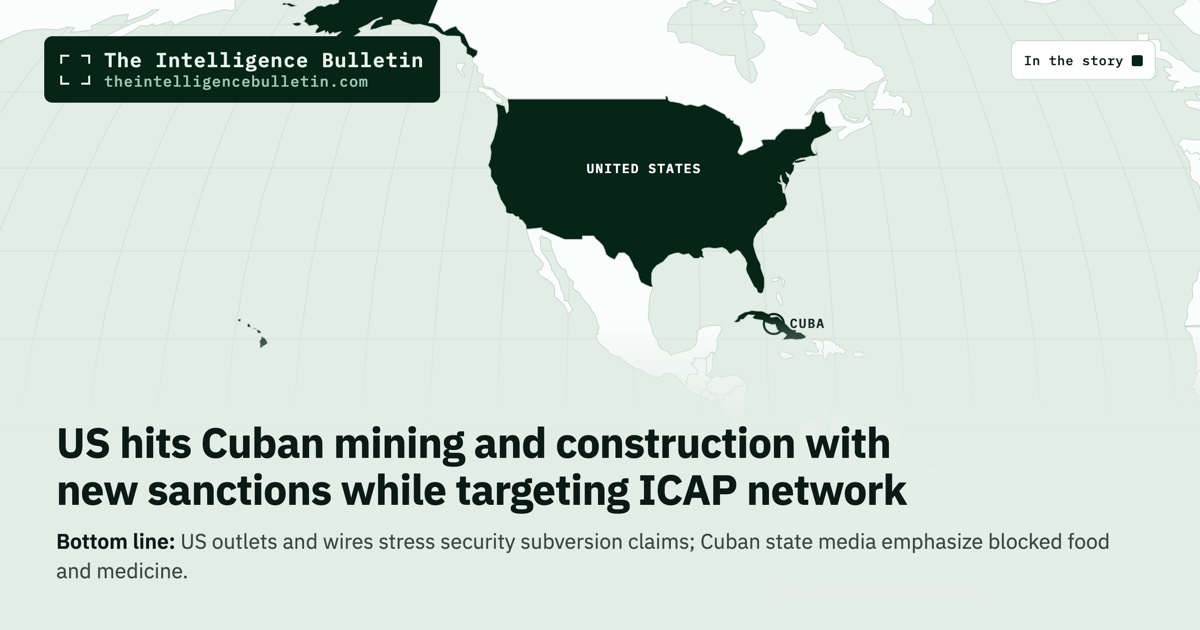
US hits Cuban mining and construction with new sanctions while targeting ICAP network

Map of the countries in the story: US hits Cuban mining and construction with new sanctions while targeting ICAP network
The US Treasury sanctioned nine Cuban state-owned mining, metal and construction companies including the Ministry of Construction and Geominsal, plus three leaders at the Cuban Institute of Friendship with the Peoples. Secretary of State Marco Rubio accused ICAP of directing a subversive network to radicalize Americans. Cuban Foreign Minister Bruno Rodríguez said the measures block food and medicine shipments to private enterprises. The steps continue a Trump administration campaign of maximum pressure that includes enforcement against US travelers returning from Cuba.

One Story. Many Angles.

🇶🇦
Qatar
Al Jazeera
Original reporting
US pummels Cuban economy with new sanctions on mining, construction
Read →
🇨🇺
Cuba
Cuba Headlines
Original reporting
Bruno Rodríguez Criticizes U.S. Sanctions, Blames Rubio for Blocking Food and Medicine to Cuba
Read →
🇪🇸
Spain
Diario de Cuba
SPANISH
Original reporting
Rubio: ‘The Cuban regime has spent decades infiltrating and radicalizing Americans’
“Rubio: ‘El régimen cubano ha pasado décadas infiltrándose y radicalizando estadounidenses’”
Read →
🇬🇧
United Kingdom
The Independent
Carries AP reporting
Trump ramps up Cuba pressure with new sanctions and crackdown on US visitors
Read →
🇯🇲
Jamaica
Jamaica Gleaner
Carries AP reporting
Cuba sanctions tighten, returning Americans face detentions
Read →
5 sources · 4 independent accounts — some share the same news agency’s report
In Brief

US outlets and wires stress security subversion claims; Cuban state media emphasize blocked food and medicine.

The reporting converges on the specific targets and Rubio’s core accusation that ICAP runs a decades-long subversive operation inside the United States, yet parts company sharply on whether those designations serve national security or simply intensify civilian hardship. Al Jazeera and the Jamaica Gleaner both record the nine entities and three ICAP officials while noting UN warnings of energy starvation and rising infant mortality; the Independent adds the Miami airport detentions of returning Americans. Cubaheadlines and Diario de Cuba carry Rodríguez’s and Díaz-Canel’s rebuttals almost verbatim, with the Cuban foreign minister naming Rubio personally and insisting the sanctions obstruct private imports of food and medicine despite US claims of exemptions. Diario de Cuba alone foregrounds Rubio’s language about infiltration and radicalization of US citizens. The Jamaican and British pieces treat the visitor enforcement as the practical new development, while the Cuban outlets omit it. This pattern shows the sanctions themselves are corroborated across independent chains, but the humanitarian versus security framing splits cleanly along national lines and cannot be reconciled from the published accounts.

Perspective Analysis

The United States announced sanctions on August 20, 2026, that added nine Cuban state-owned companies in mining, metals and construction to the Treasury’s SDN list and designated three officials at the Cuban Institute of Friendship with the Peoples. The entities included the Ministry of Construction, Geominsal, the Comandante Ernesto Che Guevara Nickel Company, Metalcuba, Acinox Comercial, Acorec, Coratur, Transimport and Consumimport. The three individuals named were ICAP president Fernando González Llort, first vice president Noemí Ramona Rabaza Fernández and North America director Leima Martínez Freire.

Secretary of State Marco Rubio issued the accompanying statement. He described ICAP as one of the main organizations involved in efforts to infiltrate, corrupt and radicalize Americans, and he linked the designations to recent Cuban activity around the centenary of Fidel Castro. Rubio wrote that the Trump administration would not stand by while a hostile foreign power exploited US freedoms by misleading citizens with lies, spy tradecraft and other malfeasance as part of exporting Marxism, racial resentment and Communist violence. The statement also warned that anyone supporting or providing services to the sanctioned actors risked secondary sanctions themselves.

The measures sit inside a wider campaign that began after the US military operation that removed Venezuelan President Nicolás Maduro in January 2026. That operation cut Cuba’s primary source of subsidized oil from Venezuela. The Trump administration then threatened tariffs on any country shipping fuel to the island, leaving only one Russian tanker to reach Cuban ports since. An executive order signed in May authorized sanctions on those responsible for repression, and Thursday’s designations cited that order. The cumulative effect has included repeated power blackouts across the island and shortages of medicine and other goods.

Cuban Foreign Minister Bruno Rodríguez responded on X that the sanctions were intended to damage the economy and prevent the government from guaranteeing basic services. He said the measures hindered the transport of containers carrying food, medicines and medical devices purchased largely by private small and medium-sized enterprises. Rodríguez defended ICAP as an institution that for more than six decades had promoted friendship, international solidarity, justice and peace, and he called Rubio’s policy corrupt. Cuban President Miguel Díaz-Canel posted that the only offense of the sanctioned people and institutions was serving Cuba and facing what he termed a genocidal blockade, adding that the people would resist and prevail.

The two accounts of purpose stand in direct opposition. Rodríguez maintained that the sanctions block humanitarian supplies despite explicit US claims of exemptions for food, medicine and medical devices. Rubio’s statement framed the same actions as necessary to counter a national-security threat posed by Cuban operations inside the United States. Neither side offered new evidence that would reconcile the two descriptions.

Coverage from outside the United States and Cuba added one further concrete development. Several Americans who had traveled to Cuba for events marking Castro’s centenary were detained briefly at Miami airport upon return for secondary screening by Customs and Border Protection. Some had electronic devices seized for inspection. Officials said the travelers were eventually released but could still face prosecution if found to have violated sanctions that bar transactions with Cuban government-owned entities.

The sanctions themselves appear in every account examined. The nine companies, the three ICAP officials and the core language from Rubio on subversion are recorded by the Treasury notice itself and repeated across the reporting. The Cuban rebuttals from Rodríguez and Díaz-Canel are carried in full by the Cuban state-aligned outlet and quoted at length by the Spanish-language exile publication. The airport detentions surface only in the British and Jamaican pieces, both of which draw from the same underlying dispatch.

A reader limited to Cuban state sources would encounter the personal attribution to Rubio and the claim that private importers of food and medicine are directly affected, but would not see the airport enforcement actions or the explicit US exemption language. A reader limited to the British or Jamaican accounts would learn of the traveler detentions and the scale of the entity list, yet would miss the Cuban government’s direct counter-claim that the sanctions obstruct private humanitarian shipments. The exile outlet alone gives extended space to Rubio’s language on infiltration and radicalization while treating the Cuban responses as secondary.

The sanctions list and the two opposing statements of purpose are the elements that hold across independent reporting chains. The humanitarian-block claim and the security-subversion claim cannot both be true in the form each side presents them. The Treasury notice and Rubio’s on-record statement supply the warrant for the US framing. The Cuban foreign minister’s and president’s public posts supply the warrant for the counter-framing. No additional document or count in the published coverage bridges the gap.

What to Watch

The Trump administration’s interest lies in sustaining the narrative that Cuba poses an active internal threat, which justifies continued economic isolation and secondary enforcement. The Cuban government’s interest lies in sustaining the narrative that the measures deliberately target civilian welfare, which supports its domestic mobilization and international appeals. The next steps most directly implied by the reporting are further designations under the same executive order and continued Cuban public diplomacy framing the sanctions as an attack on ordinary Cubans. The pattern of Thursday announcements suggests the cadence of designations will remain weekly or near-weekly for the remainder of the pressure campaign.


Share this story

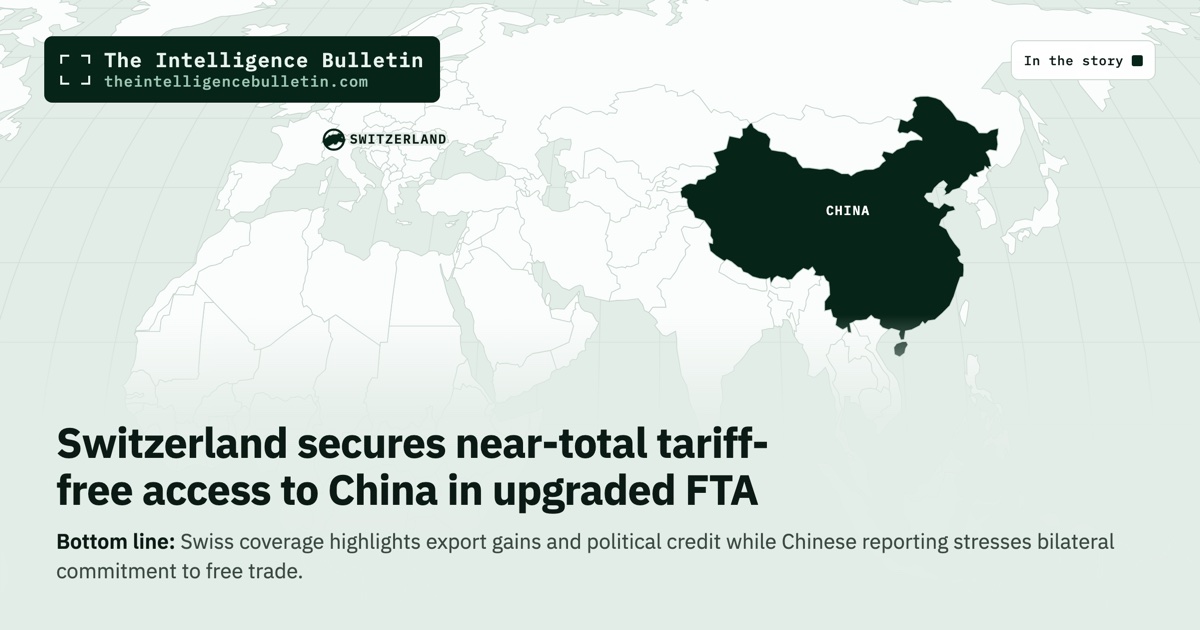
Switzerland secures near-total tariff-free access to China in upgraded FTA

Map of the countries in the story: Switzerland secures near-total tariff-free access to China in upgraded FTA
Switzerland and China announced on August 20, 2026, in Bern the completion of negotiations to upgrade their 2014 free trade agreement. The deal will phase in duty-free access for 99.8% of Swiss exports to China after transition periods, up from roughly half today, while Chinese imports into Switzerland remain largely tariff-free. Swiss Economic Affairs Minister Guy Parmelin and Chinese Commerce Minister Wang Wentao met to seal the agreement, which also covers services, investment, environment and labor rules. The upgrade requires further domestic approvals before formal signing later in 2026.

One Story. Many Angles.

🇨🇳
China
Global Times
Original reporting
China, Switzerland announce completion of FTA upgrade negotiations
Read →
🇨🇭
Switzerland
Weltwoche
GERMAN
Original reporting
Success for Guy Parmelin: Switzerland and China agree on duty-free access for 99.8 percent of Swiss exports in the future
“Erfolg für Guy Parmelin: Schweiz und China einigen sich auf zollfreien Zugang für künftig 99,8 Prozent der Schweizer Exporte”
Read →
🇨🇭
Switzerland
SRF
GERMAN
Commentary
Optimized free trade – China is mainly about geopolitics – or a fig leaf?
“Optimierter Freihandel – China geht es vor allem um Geopolitik – oder um ein Feigenblatt?”
Read →
🇨🇭
Switzerland
Watson
GERMAN
Carries WBF / sda reporting
Almost all tariffs on Swiss exports to China will fall
“Fast alle Zölle auf Schweizer Exporte nach China werden fallen”
Read →
4 sources · 3 independent accounts — some share the same news agency’s report
In Brief

Swiss coverage highlights export gains and political credit while Chinese reporting stresses bilateral commitment to free trade.

The reporting converges on the core announcement of an upgraded China-Switzerland FTA that will eventually clear tariffs from nearly all Swiss exports, yet the outlets diverge sharply on framing and emphasis. Swiss government-aligned pieces stress concrete economic gains and ministerial achievement, while the Chinese state outlet presents the outcome as mutual commitment to certainty in uncertain times. One Swiss outlet alone raises whether Beijing seeks geopolitical cover rather than purely commercial advantage, noting rising global pressure on Chinese exports and questions over enforcement of new labor and environmental clauses. Official Swiss statements and agency copy provide the 99.8 percent figure, industry savings estimates and timeline details that appear consistently across domestic reports. The absence of comparable detail in the Chinese account suggests the upgrade serves different domestic narratives: Swiss readers receive export-specific relief and political credit, Chinese readers receive a bilateral success story amid trade tensions elsewhere. Parliamentary ratification in Switzerland remains an open variable that none of the immediate coverage resolves.

Perspective Analysis

Switzerland and China announced on August 20, 2026, that they had completed negotiations to upgrade the free trade agreement first signed in 2013 and in force since 2014. The two ministers who met in Bern that day, Swiss Economic Affairs Minister Guy Parmelin and Chinese Commerce Minister Wang Wentao, issued statements that described the outcome in nearly identical language as a milestone that would expand two-way trade and investment. The upgrade adds higher-standard rules on goods, services, investment and new chapters covering digital trade, competition and economic cooperation. Once domestic procedures are complete, the protocol is expected to be signed later in 2026.

Under the terms now agreed, 99.8 percent of current Swiss exports to China will eventually enter duty-free after transition periods. Only about half of those shipments enjoy zero tariffs today. Swiss officials calculate that the change will save exporters roughly 244 million Swiss francs in duties once fully phased in. Watches, precision machinery and pharmaceuticals stand to gain the most immediate relief. Food producers receive narrower but still concrete improvements: tariffs on roasted coffee and cheese are scheduled to disappear after a ten-year transition. Chinese imports into Switzerland, already nearly all duty-free under the original agreement, see no major further change.

The original 2014 pact was China’s first free trade deal with any continental European country. China ranks as Switzerland’s third-largest trading partner after the European Union and the United States. In 2025 Swiss exports to China reached 15.2 billion francs while imports stood at 18.3 billion francs. Trade volumes have grown steadily since the first agreement took effect, a trend Swiss reports attribute in part to the existing tariff reductions. The upgrade negotiations themselves began in September 2024 and concluded after five rounds.

Chinese Commerce Minister Wang Wentao told the meeting in Bern that the outcome showed both sides choosing certainty and supporting free trade in an uncertain international environment. He noted that 2026 marks the start of China’s 15th Five-Year Plan and the tenth anniversary of the countries’ innovative strategic partnership. Swiss President and Economic Affairs Minister Parmelin replied that the upgrade supplies more stable, transparent and predictable rules for companies on both sides and sends a positive signal for open cooperation and a rules-based trading system. Both sides committed to finishing domestic approvals quickly so the upgraded agreement can enter into force.

Swiss domestic coverage supplied additional operational detail absent from the Chinese account. One report listed the precise 99.8 percent target, the 244-million-franc savings estimate and the list of sectors expected to benefit most. It also recorded that the new text strengthens provisions on environmental standards and labor rights in addition to the chapters on services and digital commerce. Another Swiss outlet relayed the federal government’s statement that the Swiss side had reached its negotiating goals and that the agreement would give Swiss investors clearer market access in China. These figures and sector breakdowns appear consistently across Swiss government statements and the agency copy that carried them.

The Chinese state-linked account instead presented the result as a bilateral success achieved through joint effort and five rounds of talks. It quoted both ministers on the value of the existing relationship and on the need to implement the leaders’ consensus. It did not repeat the 99.8 percent figure, the savings calculation or the specific industry impacts. The emphasis remained on the political message of continued openness rather than on measurable export relief for one side.

One Swiss public broadcaster added a layer of analysis not present in the other reports. Its economic editor noted that, according to diplomats and experts he had spoken with, China appears to value the deal partly for geopolitical reasons at a moment when many countries are imposing protective measures against Chinese exports. The same piece observed that the democratic Swiss government could be viewed by critics as lending legitimacy to an increasingly authoritarian partner, though it presented this view as one circulating in expert circles rather than as established fact. It also flagged that the final text remains unpublished and that binding, enforceable language on labor rights, human rights and the environment will likely determine how easily the agreement passes the Swiss parliament and any possible popular referendum.

The accounts converge on the date, the location, the two ministers involved, the fact that negotiations ended after five rounds, and the inclusion of new rules on environment, labor, services and digital trade. They diverge on the weight given to concrete Swiss export gains versus the broader political framing. Swiss readers encounter specific tariff percentages, franc savings and sector lists that Chinese readers do not see in the state account. Chinese readers encounter a narrative of mutual commitment to free trade that Swiss domestic pieces treat as background rather than the main story.

The Swiss government statements and the agency copy that reproduced them supply the only detailed, cross-checked numbers on tariff coverage and fiscal impact. Those numbers appear in multiple independent Swiss outlets and rest on an official announcement issued the same day. The Chinese report draws directly from the Ministry of Commerce statement and therefore reflects Beijing’s chosen emphasis. The single analytical piece that raises geopolitical motives draws on unnamed diplomats and experts and stands alone in the source set; no other report examined here makes the same claim or supplies evidence that would contradict it.

What to Watch

The most reliable picture for a reader is therefore the one that begins with the Swiss government’s quantified description of tariff relief and then notes the additional political context supplied by the Chinese statement. The geopolitical speculation remains an open question that the immediate coverage neither confirms nor refutes. What the reporting does establish is that Swiss exporters in watches, machinery and pharmaceuticals now have a concrete path to duty-free access on 99.8 percent of their current shipments to their third-largest market, subject only to final parliamentary approval in Bern.


Share this story

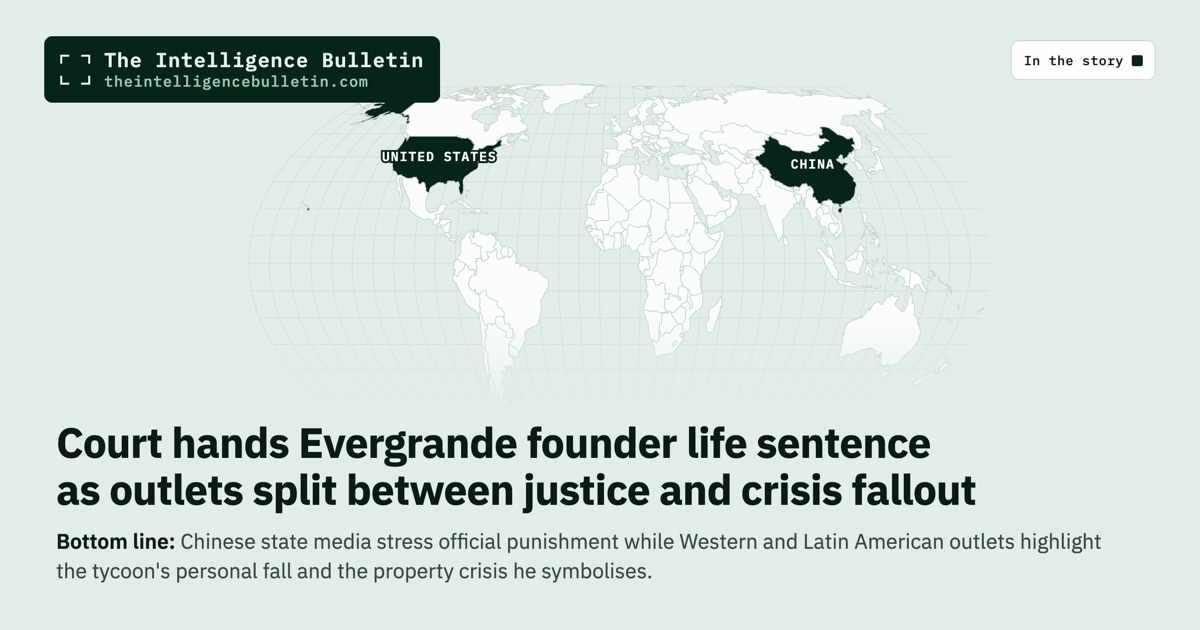
Court hands Evergrande founder life sentence as outlets split between justice and crisis fallout

Map of the countries in the story: Court hands Evergrande founder life sentence as outlets split between justice and crisis fallout
A Shenzhen Intermediate People’s Court sentenced Xu Jiayin, founder of Evergrande Real Estate Group, to life imprisonment on August 20, 2026, for crimes including fundraising fraud, illegal absorption of public deposits, corporate bribery and embezzlement. The court also fined Evergrande Group 8.82 billion yuan and Evergrande Real Estate Group 7 billion yuan, ordered confiscation of Xu’s assets and stripped him of political rights for life. Xu, once Asia’s richest man, had pleaded guilty earlier; the case stems from massive financial irregularities between 2016 and 2021 that contributed to the developer’s collapse and China’s ongoing property crisis. Fifty-six other individuals linked to the case received prison terms.

One Story. Many Angles.

🇨🇳
China
China.org.cn
Carries Xinhua reporting
China sentences former Evergrande boss to life in prison
Read →
🇬🇧
United Kingdom
The Independent
Carries Reuters reporting
From rags to riches to prison: China sentences Hui Ka Yan to life in prison
Read →
🇩🇪
Germany
Manager Magazin
GERMAN
Carries Xinhua reporting
China Evergrande: Real estate tycoon Xu Jiayin sentenced to life imprisonment
“China Evergrande: Immobilientycoon Xu Jiayin zu lebenslanger Haft verurteilt”
Read →
🇨🇱
Chile
La Tercera
SPANISH
Carries Xinhua reporting
The fall from grace of Xu Jiayin: the Evergrande magnate, central figure in China’s real estate crisis, is sentenced to life in prison
“La caída en desgracia de Xu Jiayin: el magnate de Evergrande, figura central de la crisis inmobiliaria en China, es condenado a cadena perpetua”
Read →
🇬🇷
Greece
Lifo
GREEK
Wire copy
China: Life sentence for the founder of Evergrande – He was the richest man in the country
“Κίνα: Ισόβια στον ιδρυτή της Evergrande – Υπήρξε ο πλουσιότερος άνθρωπος στη χώρα”
Read →
5 sources · 3 independent accounts — some share the same news agency’s report
In Brief

Chinese state media stress official punishment while Western and Latin American outlets highlight the tycoon’s personal fall and the property crisis he symbolises.

All reporting chains trace the verdict directly to the Shenzhen court and Xinhua, yet the framing reveals where national priorities sit. China’s state outlet presents the outcome as straightforward punishment for disrupting the socialist market economy and causing enormous losses, with no mention of wider fallout. UK coverage turns the same facts into a personal rags-to-riches-to-prison arc, dwelling on Xu’s rural Henan origins and 2017 peak net worth. German business reporting stresses the symbolic weight of Evergrande’s collapse for China’s property sector and lingering market risks. The Chilean piece adds the Latin American observer’s view of ripple effects on global housing and finance while recounting the same biography. Greek coverage reduces it to the single emblematic detail that the country’s former richest man now faces life. The common thread is that no outlet disputes the sentence or the listed crimes; the divergence lies in whether the story is told as state justice, individual tragedy or systemic warning.

Perspective Analysis

A Shenzhen Intermediate People’s Court sentenced Xu Jiayin, also known as Hui Ka Yan, to life in prison on August 20, 2026. The court convicted him of illegally absorbing public deposits, fundraising fraud, illegally issuing loans, fraudulent issuance of securities, unlawful disclosure of important information, corporate bribery, illegal use of funds and embezzlement. It also found Evergrande Group and Evergrande Real Estate Group guilty of related offenses. The court ordered confiscation of all Xu’s personal assets, stripped him of political rights for life and directed continued recovery of illegal gains. Evergrande Group received a fine of 8.82 billion yuan, equivalent to roughly 1.3 billion dollars, while Evergrande Real Estate Group was fined 7 billion yuan. The court described the offenses as having seriously disrupted the socialist market economy, infringed property rights and undermined official integrity, with exceptionally large sums involved and extraordinarily heavy economic losses.

Xu, 67, had pleaded guilty in April to eight charges and expressed remorse during proceedings. The court noted that between 2016 and 2021 he and the companies inflated assets, concealed liabilities through sustained financial fraud, gained control of financial institutions via bribery and obtained illegal credit and insurance funds. Xu also misappropriated company property under the guise of dividends. Separate judgments that day sentenced 56 other individuals tied to the case to prison terms ranging from 22 months to 18 years.

Xu rose from rural poverty in Henan province. Born in 1958, he lost his mother at age one, grew up eating sweet potatoes and steamed bread, and worked on a farm and as a security guard before studying metallurgy on scholarship. He left a state steel factory in 1992 with 20,000 yuan in savings and moved to Shenzhen to enter real estate. He founded Evergrande in 1996. The developer expanded aggressively through heavy borrowing, sold homes at lower margins for quick turnover and reached 700 billion yuan in annual sales by 2020. At its peak it employed 200,000 people, ran more than 1,300 projects across 280 cities and owned a championship soccer club. In 2017 Xu’s net worth exceeded 42 billion dollars and made him Asia’s richest man. By 2023 it had fallen to an estimated 3 billion dollars.

Chinese regulators began tightening limits on excessive borrowing in 2020. Evergrande defaulted on overseas debts the following year, entered liquidation after a Hong Kong court order in 2024 and saw its shares delisted from the Hong Kong exchange in 2025. Its liabilities stood at 2.39 trillion yuan as of mid-2023. The company’s collapse became a symbol of China’s broader property sector difficulties, where real estate and related industries once accounted for up to 30 percent of GDP. Housing prices have declined for three years and new-home sales fell to their lowest level since 2014.

The Shenzhen court ruling rests on a single primary source: the court’s own findings, distributed through Xinhua. Every outlet that published on the sentencing day carried those core details without contradiction. The accounts differ only in what they place beside the verdict. The Chinese state account foregrounds the court’s language on economic disruption and severe punishment. It lists the crimes and penalties in full but does not connect the case to ongoing market conditions or to Xu’s personal history. British reporting centers the individual’s trajectory, describing his rural origins, 2017 wealth peak, 2021 appearance at Communist Party centenary events in Beijing and the contrast with his grey-haired appearance in court. It notes his workaholic style, poker-club connections with Hong Kong tycoons and past statements crediting the country’s policies for his success. German business coverage emphasizes the sector symbolism and lingering risks, placing the sentence against the timeline of regulatory tightening, default and liquidation. Chilean reporting adds the scale of Evergrande’s operations and the potential for wider effects on consumer confidence and global housing finance, while recounting Xu’s early hardships and luxury tastes. Greek coverage reduces the event to the single emblematic shift from richest man to life prisoner.

A reader limited to the Chinese account would see only state justice applied to clear violations. A reader limited to the British account would encounter a personal rise-and-fall story but little on the company’s debt levels or regulatory backdrop. One limited to the German or Chilean accounts would grasp the economic stakes but might underweight the precise criminal findings. None of the published pieces disputes the sentence, the fines or the guilty plea. The convergence on those facts comes from independent reporting chains that all trace back to the court statement itself.

What to Watch

The court document supplies the strongest warrant for what actually occurred. Outlets that foreground it stay closest to the record. National interests shape the added layers: Chinese coverage aligns with emphasis on market order and official accountability, while international business and regional outlets highlight consequences for growth and investor confidence. The property sector’s weight in the Chinese economy means the verdict functions as a signal of continued regulatory pressure rather than an isolated case. Markets have already priced in years of weakness; further tightening on developers would likely extend that pressure rather than resolve it quickly.


Share this story

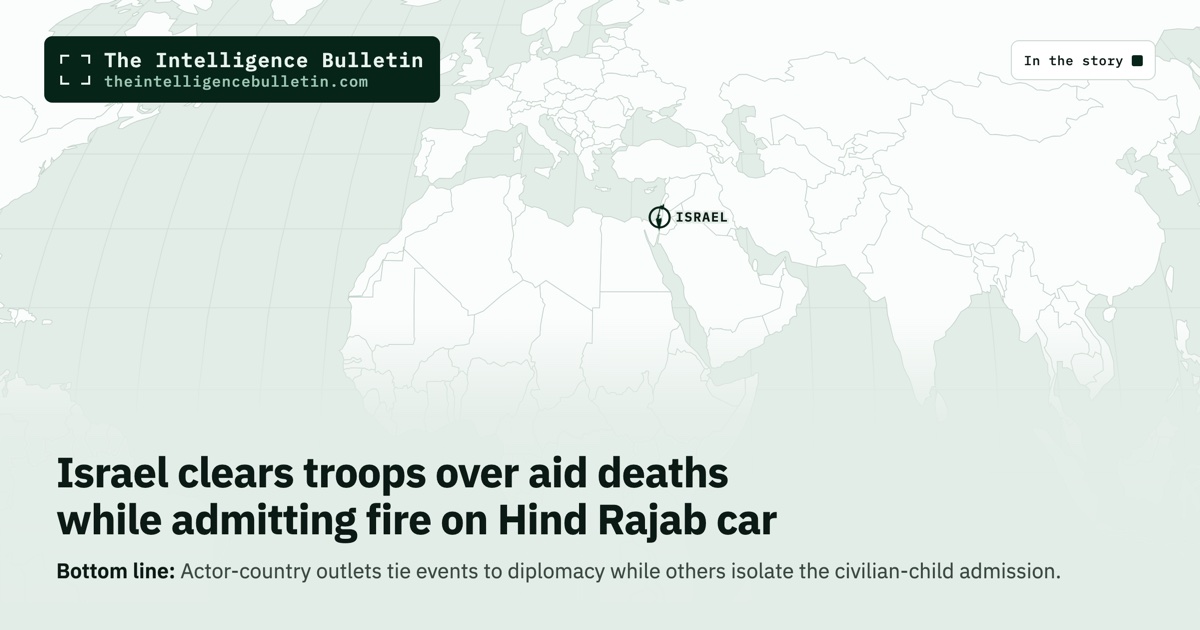
Israel clears troops over aid deaths while admitting fire on Hind Rajab car

Map of the countries in the story: Israel clears troops over aid deaths while admitting fire on Hind Rajab car
Israel’s military cleared soldiers of criminal wrongdoing in the 2024 strike on a World Central Kitchen convoy that killed Australian Zomi Frankcom and six other aid workers, citing mistaken identification of a Hamas fighter but serious procedural failures. It separately admitted for the first time firing on a car carrying five-year-old Hind Rajab in January 2024 and opened a criminal investigation into that killing due to ambulance coordination issues. Australia summoned Israel’s ambassador and expressed outrage over the clearance. The findings combine closure on one incident with a new probe on another.

One Story. Many Angles.

🇦🇺
Australia
ABC News
Original reporting
Israel’s military clears soldiers of criminal wrongdoing in Gaza strike that killed Zomi Frankcom
Read →
🇮🇱
Israel
The Jerusalem Post
Carries REUTERS reporting
Australia outraged after Israel clears soldiers over aid worker deaths
Read →
🇬🇧
United Kingdom
Middle East Eye
Original reporting
Australia summons Israeli ambassador over Gaza aid worker killing
Read →
🇮🇩
Indonesia
Kompas
INDONESIAN
Carries BBC reporting
Israel Admits Its Troops Shot Hind Rajab, The 2024 Gaza Child Death Case Now Being Investigated
“Israel Akui Pasukannya Tembaki Hind Rajab, Kasus Kematian Bocah Gaza 2024 Kini Diselidiki”
Read →
🇶🇦
Qatar
Al Jazeera
Original reporting
Israel admits firing on car carrying Hind Rajab, symbol of Gaza’s suffering
Read →
5 sources · each independently reported
In Brief

Actor-country outlets tie events to diplomacy while others isolate the civilian-child admission.

The clearest signal across the coverage is that Israel can close one high-profile case through internal review while opening another, and national presses respond according to whose citizens or symbols are involved. Australian reporting centers the diplomatic summons and Foreign Minister Penny Wong’s statement that the clearance falls short of expected accountability, framing the WCK outcome as the main development with the Hind Rajab admission noted as an addendum. Israeli coverage, often carrying Reuters copy, records the military’s conclusions on operational failures without criminal intent and the ambassador’s explanation that the convoy deviated from route and carried an armed guard. UK-based Middle East Eye and Al Jazeera instead lead with the Hind Rajab admission as a rare acknowledgment of firing on a civilian vehicle containing a trapped child, placing it against the backdrop of earlier denials and skepticism that military police probes deliver convictions. Indonesian outlet Kompas isolates the Hind Rajab admission and investigation announcement, treating it as the primary event in a Global South lens on Palestinian civilian deaths. The pattern shows convergence on the facts of clearance plus admission, yet divergence in which element receives the headline weight, revealing how actor-country outlets prioritize bilateral pressure while others foreground the Palestinian child’s case as emblematic.

Perspective Analysis

Israel’s military cleared its personnel of criminal wrongdoing in the April 2024 strike on a World Central Kitchen convoy in Gaza that killed seven humanitarian workers, including Australian national Zomi Frankcom. The Israel Defense Forces stated that soldiers had mistakenly identified a Hamas fighter in the vehicles after the convoy deviated from a pre-coordinated route and carried an armed security guard whose presence had not been flagged in advance. The armed man was later described by the IDF as a guard hired to protect the convoy from seizure by armed actors inside Gaza. Despite what the military called serious failures in identification and decision-making, its review concluded that commanders’ actions did not raise reasonable suspicion of criminal misconduct. Two commanders had already been stripped of their ranks as colonel and major, while a colonel, a major general and a brigadier general received reprimands.

Australia responded immediately with diplomatic action. Foreign Minister Penny Wong called the clearance decision “especially insulting” on World Humanitarian Day and said it fell far short of the accountability expected. She directed Australia’s ambassador in Israel to convey Canberra’s views directly to the Israeli government and announced that Israel’s ambassador to Australia would be summoned. Wong added that the government would continue pressing for justice for Frankcom and her colleagues. An earlier Australian government review had already found serious failures to follow procedures and a significant breakdown in situational awareness, though it ruled the strike was not knowingly or deliberately directed against the World Central Kitchen team.

In the same set of findings, the IDF for the first time acknowledged that its forces had fired on a car carrying five-year-old Hind Rajab on 29 January 2024. The girl had been trapped for hours in the wreckage alongside the bodies of six family members after the vehicle came under fire while attempting to follow displacement orders in Gaza City. She had spoken by phone with Palestine Red Crescent Society operators, describing a tank approaching and pleading for rescue. An ambulance dispatched to reach her was also attacked, killing two paramedics. The IDF said it would open a criminal investigation into the incident because of alleged failures in the coordination of the ambulance’s movement. The military had previously denied having troops in the area before later stating it had conducted operations against targets in the vicinity.

The World Central Kitchen organisation rejected the military’s conclusions on its own case. It said the decision was inconsistent with the full truth and deeply offensive, arguing that the IDF had full visual clarity on clearly marked humanitarian vehicles during multiple airstrikes and knew the team posed no threat. The organisation called for an independent international commission of inquiry. Frankcom’s former colleague Josh Phelps told Australian media that the outcome offered little relief, noting that no punishment or real accountability appeared likely for the families.

Coverage of the dual announcements diverged sharply according to national vantage. Australian reporting placed the World Central Kitchen clearance and the resulting diplomatic summons at the centre, treating the Hind Rajab admission largely as context for the broader pattern of Israeli internal reviews. Israeli reporting, drawing on official military statements, emphasised the absence of criminal intent and the operational reasons for the mistaken identification in the aid-worker strike, while recording the ambassador’s explanation that the convoy had carried an armed guard and changed its route. Outlets operating from outside the direct bilateral relationship, including the United Kingdom-based Middle East Eye, foregrounded the Australian summons itself as the immediate diplomatic consequence. Indonesian and Qatari reporting instead led with the Hind Rajab admission as the notable development, framing it against the child’s recorded pleas and earlier Israeli denials of involvement, and noting the limited scope the military attached to the new probe.

A reader limited to any single national press would therefore miss the cross-cutting pattern visible when the accounts are placed side by side. Australian audiences would see primarily a story of bilateral pressure and unmet expectations of justice for one of their own citizens. Israeli audiences would encounter a defence of internal disciplinary measures without criminal liability. Readers of Indonesian or Qatari coverage would receive the clearest account of the first official Israeli admission that its forces had fired on the vehicle carrying Hind Rajab, together with expressions of scepticism that military police investigations produce convictions in such cases. The convergence across all five outlets on the two core outcomes—the clearance decision and the new probe—remains the most reliable shared spine, while the differing weight each outlet assigns to one element over the other tracks the national or regional stake in the story.

What to Watch

The evidence from the reporting chains indicates that the Israeli military’s internal process functions to close certain incidents while selectively opening others, and that external diplomatic pressure from affected states such as Australia targets the closed cases. The Hind Rajab probe carries an explicit rationale tied to ambulance coordination rather than the initial firing itself, a distinction preserved in the military’s wording. Given the documented track record of limited convictions from similar military police investigations, the probe is unlikely to alter the broader accountability dynamic unless external actors, including those already expressing outrage over the World Central Kitchen outcome, sustain coordinated pressure that links the two cases.


Share this story