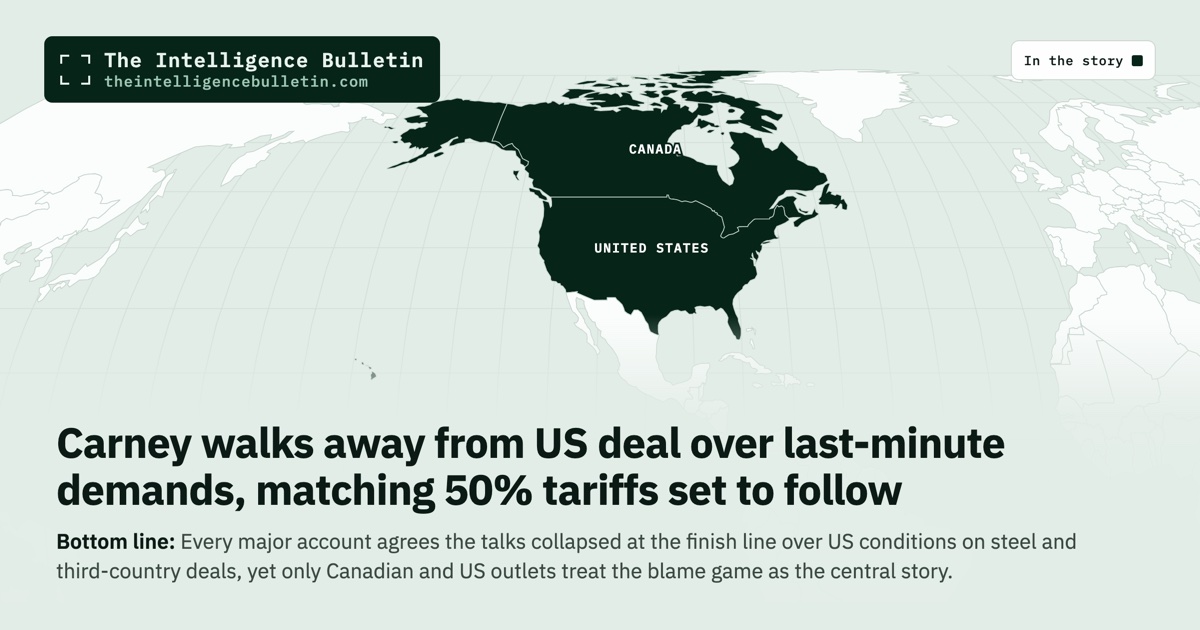
Carney walks away from US deal over last-minute demands, matching 50% tariffs set to follow

Map of the countries in the story: Carney walks away from US deal over last-minute demands, matching 50% tariffs set to follow
US President Donald Trump imposed 50% tariffs on roughly $20-28 billion of Canadian goods including steel, aluminum and autos after three days of talks in Washington failed to produce a deal. Prime Minister Mark Carney suspended negotiations, accusing the US of last-minute unfair changes, and pledged matching retaliatory tariffs to begin after Labour Day. US Trade Representative Jamieson Greer said Canada declined to finalize agreed terms and added new demands. Both sides blame the other for the breakdown of what had appeared close to agreement on tariff relief.

One Story. Many Angles.

🇹🇩
Canada
CBC
Original reporting
New U.S. tariffs in effect after trade talks fail, Carney says Canada plans to match levies
Read →
đŸ‡ș🇾
United States
Daily Caller
Original reporting
US-Canada Trade Deal Falls Apart In Potential Blow To Auto Industry
Read →
🇬🇧
United Kingdom
BBC
Original reporting
Canada says it will match US tariffs ‘dollar for dollar’ as trade talks break down
Read →
🇾🇬
Singapore
The Straits Times
Original reporting
US-Canada trade talks collapse, triggering 50% Trump tariffs
Read →
🇾🇩
Saudi Arabia
Arab News
Original reporting
Canada hits back with new tariffs after trade talks with US fail
Read →
5 sources · each independently reported
In Brief

Every major account agrees the talks collapsed at the finish line over US conditions on steel and third-country deals, yet only Canadian and US outlets treat the blame game as the central story.

The reporting across outlets reveals a consistent factual core—the collapse of talks over last-minute US demands on steel, aluminum, autos and restrictions on Canada’s other trade deals—yet the framing splits along actor-observer lines that expose the limits of any single national lens. Canadian and US actor accounts both detail the mutual recriminations but diverge on emphasis: CBC foregrounds Carney’s charge that Washington asked too much and offered too little while Daily Caller stresses the missed opportunity and risks to the integrated auto sector. BBC and Straits Times treat the breakdown as a diplomatic rupture with wider ripple effects, the latter noting the tariffs hit only 5% of Canadian exports yet complicate USMCA renewal. Arab News adds the regional-stability angle, recording Carney’s warning that relations have changed permanently. The convergence on Carney’s dollar-for-dollar pledge and the absence of any fresh talks scheduled shows the event is already locked into retaliation rather than renewed negotiation; what differs is which country’s domestic costs each outlet chooses to foreground. That pattern means a reader limited to one country’s press would miss how the same sequence of accusations lands differently when viewed from supply-chain exposure in Asia or from Middle East interest in stable North American energy flows.

Perspective Analysis

The United States imposed 50 percent tariffs on roughly $20 billion to $28 billion worth of Canadian goods after three days of negotiations in Washington collapsed on the evening of August 21. The tariffs took effect just after midnight on August 22 and cover items including steel, aluminum, automobiles and lumber. Canadian Prime Minister Mark Carney suspended the talks, recalled his negotiating team and announced that Canada would respond with matching retaliatory tariffs beginning after Labour Day on September 8. US Trade Representative Jamieson Greer stated that Canada had declined to finalize an agreement reached earlier in the week and had introduced new demands and walk-backs.

The two sides offered sharply different accounts of the final hours. Carney told reporters in Ottawa that the United States had made last-minute changes that were unfair and uneconomic. He said the proposals would have restricted Canada’s ability to strike new trade deals with other countries, altered the scope of tariffs on Canadian auto content, and limited protections for language and culture. Carney described the US position as one that asked too much and offered too little, adding that Canada had pursued every opportunity for an agreement before the deadline. He also stated that the United States had already disregarded the existing USMCA free-trade agreement and that relations had changed permanently.

Greer, speaking in a White House briefing, said Canada had declined to finalize the deal under terms agreed earlier that week. He noted that the United States had offered Canada the best tariff treatment of any major exporter to the US market in exchange for concessions on retaliatory tariffs covering dairy and lumber. A senior US official added that Canada had sought additional concessions on steel, aluminum, cars and softwood lumber. Greer described the outcome as a missed opportunity for Canada to partner with the fastest-growing G-7 economy.

The tariffs apply to products that represent just over 5 percent of Canadian exports to the United States. Affected goods include wooden ice hockey sticks, cement and other items that had been targeted in earlier Trump administration threats issued in July and August. The new duties add to existing US tariffs on steel, lumber and automobiles that have already reduced employment in those sectors over the past 18 months. Canadian exports accounted for 23 percent of US steel imports and 53 percent of US aluminum imports in recent data, while roughly 90 percent of Canada’s exports in those categories went to the United States.

The collapse followed an initial three-day pause that Trump had announced on August 18 after stating on social media that a deal was near. Canadian Trade Minister Dominic LeBlanc had conducted the final round of talks with Greer in Washington. Hours before the midnight deadline, sources close to the negotiations indicated that an agreement lowering tariffs on steel, aluminum and cars had appeared within reach, potentially including the return of American alcohol to Canadian liquor stores. Those terms did not hold.

Canadian provincial leaders, including Ontario Premier Doug Ford, expressed support for Carney’s decision to walk away. Ford stated that Trump could not be trusted and that Canada needed a Team Canada approach. Industry groups such as Dairy Farmers of Canada and the Canadian Federation of Independent Business called for swift government support for affected businesses while underscoring the disruption to integrated North American supply chains.

The accounts converge on the core sequence and on Carney’s stated plan for dollar-for-dollar retaliation. They diverge in emphasis. Canadian reporting centers Carney’s charges that Washington sought to limit Canadian sovereignty and other trade relationships. US reporting stresses the lost chance for tariff relief and the risks to domestic auto and steel manufacturing, including potential rises in consumer prices ahead of midterm elections. Observer accounts from Britain, Singapore and Saudi Arabia place the breakdown in a wider diplomatic and supply-chain context, noting complications for future USMCA renewal talks and the limits of any single market dependence.

What to Watch

A reader limited to one national press would miss how the same set of accusations registers differently when the stakes are measured in provincial job losses, in integrated auto production across the border, or in longer-term energy export diversification. The convergence on the absence of scheduled follow-up talks indicates the immediate trajectory is already one of reciprocal tariffs rather than renewed bargaining. The primary on-record statements from both Carney and Greer supply the clearest evidence of where each government places responsibility, and those statements remain the most direct record of the final disagreement over the scope of concessions on steel, aluminum and third-country trade access.
Share this story

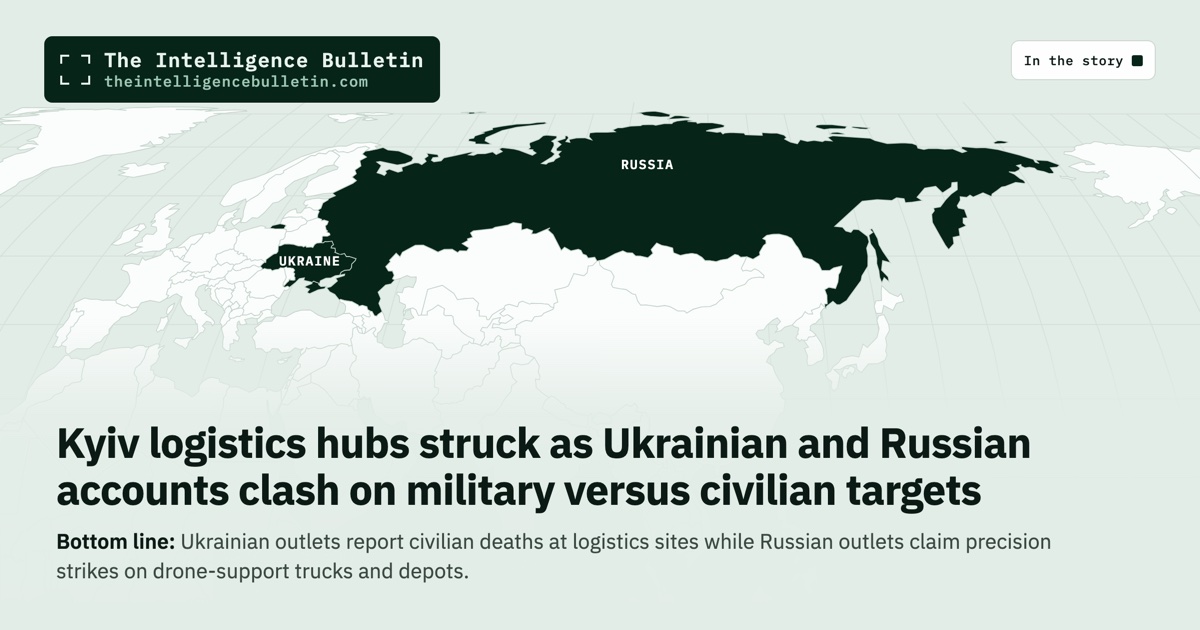
Kyiv logistics hubs struck as Ukrainian and Russian accounts clash on military versus civilian targets

Map of the countries in the story: Kyiv logistics hubs struck as Ukrainian and Russian accounts clash on military versus civilian targets
Russian forces launched ballistic missile and drone strikes on the Kyiv region on August 22, 2026. Ukrainian local authorities reported one death and five injuries from a strike in the Boryspil area that damaged warehouses, vehicles and a gas station. Russian sources claimed an Iskander missile destroyed up to 40 Ukrainian trucks used for drone launches and hit a Nova Poshta logistics center and railway depot used for military supplies. Western and Spanish outlets reported broader barrage casualties reaching at least 16 killed and emphasized damage to civilian economic infrastructure.

One Story. Many Angles.

đŸ‡ș🇩
Ukraine
bug.org.ua
UKRAINIAN
Original reporting
Russia attacked Kyiv region with ballistic missiles: one dead and five injured
“Ń€ĐŸŃŃ–Ń атаĐșуĐČала КоїĐČŃ‰ĐžĐœŃƒ балістОĐșĐŸŃŽ: є загОблОĐč і Đż’ŃŃ‚Đ”Ń€ĐŸ ĐżĐŸŃŃ‚Ń€Đ°Đ¶ĐŽĐ°Đ»ĐžŃ…”
Read →
đŸ‡·đŸ‡ș
Russia
news.mail.ru
RUSSIAN
Carries Russian Ministry of Defence reporting
One ‘Iskander’ destroyed up to 40 Ukrainian Armed Forces trucks for launching drones
“ĐžĐŽĐžĐœ «ИсĐșĐ°ĐœĐŽĐ”Ń€Â» ŃƒĐœĐžŃ‡Ń‚ĐŸĐ¶ĐžĐ» ĐŽĐŸ 40 ĐłŃ€ŃƒĐ·ĐŸĐČĐžĐșĐŸĐČ Đ’ĐĄĐŁ ĐŽĐ»Ń запусĐșа Đ±Đ”ŃĐżĐžĐ»ĐŸŃ‚ĐœĐžĐșĐŸĐČ”
Read →
đŸ‡ș🇾
United States
WTOP
Carries Associated Press reporting
A Russian missile and drone barrage kills at least 16 in Ukraine’s Kyiv region
Read →
đŸ‡Ș🇾
Spain
Negocios.com
SPANISH
Original reporting
Russia attacks Nova Poshta and the Kiev railway
“Rusia ataca Nova Poshta y el ferrocarril de Kiev”
Read →
🇬🇧
United Kingdom
The Independent
Original reporting
Ukraine-Russia war latest: Zelensky vows response to Russia’s ‘terrorist attack’ as strike on mall kills 16
Read →
5 sources · each independently reported
In Brief

Ukrainian outlets report civilian deaths at logistics sites while Russian outlets claim precision strikes on drone-support trucks and depots.

Coverage of the August 22 strikes on Kyiv-area logistics reveals a consistent split between claims of precise military targeting and reports of civilian harm that no single outlet reconciles. Ukrainian local reporting from Bug.org.ua records one confirmed death and five injuries in Boryspil from ballistic impacts on warehouses and a gas station, attributing the damage directly to Russian forces without accepting military-use assertions. Russian coverage on Mail.ru frames the same strikes as destroying Ukrainian drone-launch trucks and a Nova Poshta hub, presenting the targets as legitimate military assets. The Associated Press wire carried by WTOP tallies at least 16 killed across the Kyiv region in the wider barrage and notes Zelenskyy’s appeals for more air defenses while recording Russian claims of hitting industrial drone sites. Spanish outlet Negocios.com adds the economic dimension, detailing hits on the Brovary Nova Poshta complex and Darnitsa railway depot while observing that Kyiv acknowledges damage but rejects the military characterization of the facilities. The Independent live blog records two deaths from the overnight action, including a warehouse fire, and places the strikes inside the cycle of reciprocal long-range attacks on supply infrastructure. The pattern shows every national press accurately reports the physical damage reported in its own capital’s sphere while the attribution of intent—civilian terror versus military necessity—remains irreconcilable across the chains.

Perspective Analysis

Russian forces struck targets across the Kyiv region on August 22 with ballistic missiles and drones. Ukrainian oblast authorities recorded one death and five injuries from a strike in the Boryspil district that damaged a warehouse, a vehicle parking area, private homes, transport vehicles and a gas station. Russian state-aligned reporting described the same action as a single Iskander missile destroying up to forty Ukrainian military trucks configured for drone launches. Separate reporting placed additional impacts on a Nova Poshta sorting complex in Brovary east of the capital and on the Darnitsa locomotive depot inside Kyiv itself.

The Brovary facility belongs to one of Ukraine’s largest private parcel operators. Russian accounts stated it stored drone components and finished systems. Ukrainian authorities confirmed fire and structural damage at the site but offered no confirmation that the complex served military purposes. The Darnitsa depot, a key rail node on the east bank of the Dnieper, was described by Russian sources as holding rolling stock used to move weapons and fuel to front-line units. Ukrainian rail operator statements recorded the loss of one employee in a related warehouse fire but did not address the military-transport claim.

Casualty figures published the same day diverged by geography and scope. The Boryspil report counted one fatality. A wider tally of the overnight barrage across the Kyiv region reached at least sixteen deaths and roughly thirty-three injuries. An overnight update from the capital alone recorded one additional death in a warehouse fire. These counts appeared in local Ukrainian administration releases, in wire reporting distributed across Western outlets, and in live dispatches that also noted Ukrainian drone strikes on Russian oil facilities in Tatarstan and Krasnodar.

The rail and parcel targets sit inside a larger pattern of attacks on Ukrainian supply lines. Russian statements framed the Brovary and Darnitsa sites as nodes in the movement of drone parts, ammunition and fuel to Ukrainian forces. Ukrainian officials described the same strikes as hits on commercial infrastructure whose destruction raises transport costs, disrupts exports and forces rerouting through Romanian ports. Spanish business coverage noted that repeated interruptions to rail and parcel networks compound the effect of earlier strikes on commercial warehouses in the same region earlier in August.

Western wire reporting embedded Russian claims that the strikes also reached an industrial site producing components for Ukrainian Flamingo cruise missiles and a logistics center tied to drone storage. The same accounts recorded Ukrainian President Volodymyr Zelenskyy’s renewed request for additional Patriot interceptors, citing chronic shortages that leave ballistic missiles harder to stop. Ukrainian General Staff statements listed their own long-range strikes on Russian refineries and terminals that same night, including facilities at Nizhnekamsk and Tamanneftegaz.

The physical damage sites align across the published accounts. Nova Poshta’s Brovary complex, the Darnitsa rail depot and warehouses in the Darnytskyi district of Kyiv appear in both Russian Ministry of Defence releases and Ukrainian local confirmations. The disagreement centers on the character of those sites. Russian reporting presents them as integrated military logistics. Ukrainian reporting records the resulting civilian injuries and commercial losses without accepting the military-use designation. Western and Spanish accounts record both sets of statements side by side while adding the downstream effects on Ukrainian export routes and air-defense stocks.

A reader limited to Russian sources would conclude that the strikes removed a measurable slice of Ukraine’s drone-launch capacity with minimal extraneous effect. A reader limited to the Ukrainian local dispatch would see only residential and commercial damage in one district and no discussion of the targets’ possible military role. A reader limited to the Associated Press distribution would hold the higher regional death toll and the reciprocal oil-facility strikes but would lack the granular identification of the Brovary and Darnitsa sites. Spanish economic coverage supplies the supply-chain consequences that neither combatant press foregrounds.

The corroborated physical targets—Nova Poshta in Brovary and the Darnitsa depot—rest on overlapping Russian and Ukrainian statements carried in independent outlets. The single-source casualty counts remain tied to their originating authorities. The military versus commercial characterization of the facilities receives no independent corroboration in the published record. Russian outlets have a direct institutional interest in presenting the strikes as narrowly military. Ukrainian local outlets have a corresponding interest in foregrounding civilian harm. Western wire services aggregate both without endorsing either framing, while Spanish reporting isolates the commercial stakes.

What to Watch

The accounts therefore converge on the locations struck and diverge on the purpose those locations served. That divergence determines how each reader assigns responsibility for the recorded deaths and for the accumulating pressure on Ukrainian internal transport. The next round of strikes will test whether the pattern of targeting rail and parcel nodes continues or shifts back to energy infrastructure on either side.


Share this story

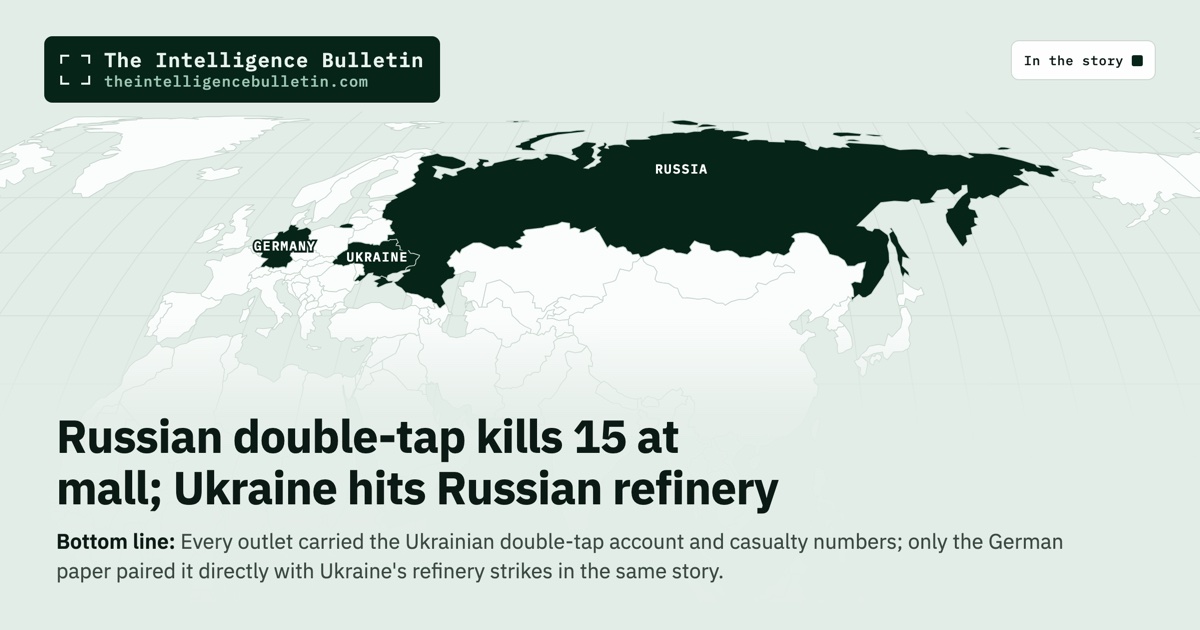
Russian double-tap kills 15 at mall; Ukraine hits Russian refinery

Map of the countries in the story: Russian double-tap kills 15 at mall; Ukraine hits Russian refinery
Russian drones struck a shopping mall in Kryvyi Rih, Ukraine, on August 21, killing at least 15 people and wounding more than 130, including children. Ukrainian officials, including President Zelensky, described a double-tap tactic with a second strike targeting rescuers half an hour later. Ukraine simultaneously attacked Russian oil facilities. The event is reported across international outlets drawing on Ukrainian statements and wire services.

One Story. Many Angles.

🇬🇧
United Kingdom
BBC
Original reporting
Russian double-tap drone strike kills 15 in Ukrainian mall, officials say
Read →
đŸ‡łđŸ‡±
Netherlands
The Moscow Times
Carries Reuters reporting
Russian ‘Double-Tap’ Strike on Shopping Mall in Ukraine Kills 15 and Wounds 130
Read →
đŸ‡¶đŸ‡Š
Qatar
Al Jazeera
Carries AFP and Reuters reporting
Russian drone attack on busy shopping centre kills 15 in Ukraine
Read →
🇩đŸ‡ș
Australia
ABC News
Relayed reporting
Russian ‘double-tap’ strike on shopping centre in Ukraine kills 16
Read →
đŸ‡©đŸ‡Ș
Germany
Kölner Stadt-Anzeiger
GERMAN
Original reporting
Russia uses ‘Double Tap’ against shopping center – Ukraine attacks refinery
“Russland nutzt „Double Tap” gegen Einkaufszentrum – Ukraine greift Raffinerie an”
Read →
5 sources · each independently reported
In Brief

Every outlet carried the Ukrainian double-tap account and casualty numbers; only the German paper paired it directly with Ukraine’s refinery strikes in the same story.

The reporting converges on the core Ukrainian account of a deliberate Russian double-tap on the mall in Zelensky’s hometown, with consistent casualty figures and the second-strike timing across BBC, Al Jazeera, Moscow Times, ABC and Kölner Stadt-Anzeiger. That convergence is the clearest signal the event produced: outlets in the UK, Qatar, the Netherlands, Australia and Germany all carried the same timeline and the same attribution to local governor Hanzha and Zelensky without material contradiction. The German paper alone makes the counter-strike explicit in its headline, pairing the mall attack with Ukraine’s refinery hits and thereby framing escalation as mutual rather than one-sided. The Moscow Times, publishing from exile, adds the sharpest language on intent while still sourcing the same casualty numbers from Ukrainian authorities. Al Jazeera and ABC embed the story in broader context of rising civilian tolls and Ukrainian deep strikes, but none of the five introduces independent verification or Russian denials. The pattern shows how a single set of official Ukrainian claims travels intact through independent reporting chains when no counter-narrative reaches the selected outlets.

Perspective Analysis

Russian drones struck a shopping mall in the central Ukrainian city of Kryvyi Rih on the afternoon of August 21, killing at least 15 people and wounding more than 130 others. Regional governor Oleksandr Hanzha reported that 22 children were among the wounded and that 29 people remained in serious condition, including five children. The city is President Volodymyr Zelensky’s hometown and lies roughly 60 kilometers from the front line. Ukrainian officials described the attack as a double-tap strike in which a second drone arrived about 30 minutes after the first, after fires had broken out and rescue teams had reached the site.

Zelensky called the strike “absolutely cynical and despicable” and said the second drone had deliberately targeted emergency services. He described such attacks as terrorist acts and urged the world to impose real accountability on Russia. Local defense council head Oleksandr Vilkul said the drones hit the city’s largest shopping complex and started a fire. Videos circulating on social media showed smoke rising from the building and rescuers treating people in the street outside. A separate Russian strike the same day in the Mykolaiv region killed four people, including three children, according to Ukraine’s interior minister.

Ukraine carried out its own strikes on Russian territory around the same time. Ukrainian statements reported that drones hit oil refineries, including one in the Perm region more than 1,500 kilometers from the Ukrainian border. Additional targets included a military airfield in the Volgograd region. Zelensky posted that sanctions and long-range strikes were returning the costs of the war to their origin. Russian officials have acknowledged damage to energy infrastructure from Ukrainian attacks and have said the situation remains under control, though fuel shortages have appeared at some Russian filling stations.

The five outlets that covered the mall strike in detail drew their accounts from the same Ukrainian statements and wire services. All five reported the 15-to-16 death toll, the 130 wounded, the presence of children among the casualties, and the half-hour gap between the two drone strikes. The BBC article opened on rescuers digging through wreckage and carried Zelensky’s condemnation in full. Al Jazeera placed the same numbers alongside a note that the UN Human Rights Monitoring Mission recorded 437 civilian deaths in Russian attacks in Ukraine during July, the highest monthly figure since May 2022. The Moscow Times, publishing from exile in Amsterdam, reproduced the casualty figures from Reuters and added Zelensky’s description of the second strike as an attempt to hit responders. ABC News in Australia reported 16 killed and noted Zelensky’s vow to retaliate. Kölner Stadt-Anzeiger in Germany opened its piece with the double-tap tactic and immediately paired it with Ukraine’s refinery strikes in the same paragraph.

No outlet in the set introduced independent verification of the strike sequence or carried on-record Russian denials. The German paper alone made the Ukrainian refinery attacks the second half of its headline and treated the two events as connected parts of the same day’s fighting. The Moscow Times, while using sharper language about Russian responsibility, still sourced its casualty count directly from Ukrainian authorities and the Reuters dispatch. Al Jazeera and ABC added context on Ukrainian long-range strikes against Russian logistics targets but did not alter the timeline or numbers given by Hanzha and Zelensky.

Kryvyi Rih has faced repeated Russian strikes throughout the war because of its industrial importance and proximity to the line of contact. The shopping mall attack occurred on a Friday afternoon when the complex was busy. Ukrainian officials said the second drone arrived after the first had already set the building alight and after people had begun to gather outside. Zelensky posted on Telegram that the timing indicated intent to strike responders rather than an accident of drone flight paths.

The convergence across the five accounts rests on a single reporting chain. Ukrainian regional and national officials supplied the casualty figures, the timing of the two strikes, and the description of the target. Reuters and AFP distributed those details, and the outlets reproduced them with only minor variation in the death count. The German paper’s decision to headline the Ukrainian counter-strikes alongside the mall attack is the clearest departure from that shared base. The Moscow Times, despite its editorial stance as an independent Russian voice operating abroad, aligned with the others on the factual spine and did not introduce separate sourcing.

The pattern that emerges is one in which a detailed Ukrainian account of tactics and civilian casualties moves unchanged through reporting chains in five different countries. Where the outlets diverge is in how much weight they give to the simultaneous Ukrainian strikes on Russian energy targets. The German coverage treats those strikes as an immediate part of the story. The others mention them as background or context but keep the primary focus on the mall and the double-tap claim. No source in the set supplies a competing Russian account of the mall strike itself.

What to Watch

The consistent thread across the coverage is that the mall attack and the refinery strikes occurred on the same day and that Ukrainian officials attributed the former to a deliberate second strike timed to hit rescuers. That attribution appears in every article examined. The German framing makes explicit what the others leave as separate threads: that each side is striking targets the other side values, whether civilian gathering places or energy infrastructure. The absence of any counter-narrative in the selected outlets means readers of these five publications receive one coherent timeline and one set of casualty numbers, regardless of which country’s outlet they open.


Share this story

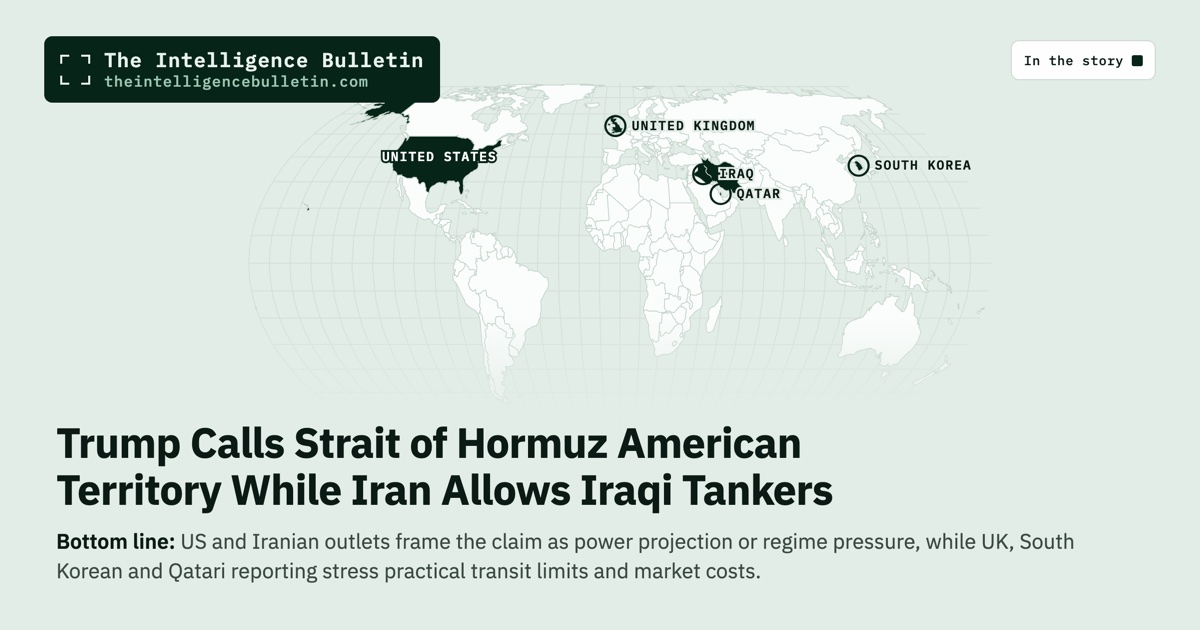
Trump Calls Strait of Hormuz American Territory While Iran Allows Iraqi Tankers

Map of the countries in the story: Trump Calls Strait of Hormuz American Territory While Iran Allows Iraqi Tankers
US President Donald Trump stated at a Myrtle Beach rally that he views the Strait of Hormuz as American territory amid the US naval blockade of Iran. He repeated the claim while joking about further strikes. Iran has allowed some Iraqi oil tankers to transit the strait. Coverage across outlets highlights the declaration’s implications for global energy flows and markets.

One Story. Many Angles.

đŸ‡ș🇾
United States
Political Wire
Carries The Guardian reporting
Trump Says the Strait of Hormuz Is ‘American Territory’
Read →
đŸ‡źđŸ‡·
Iran
NCRI
Carries Reuters reporting
Iran News in Brief – August 21, 2026
Read →
đŸ‡¶đŸ‡Š
Qatar
Al Jazeera
Original reporting
Trump’s ‘economic D-Day’ claims first victim: Not Iran, but US markets
Read →
đŸ‡°đŸ‡·
South Korea
KBS
Original reporting
Trump Again Makes Territorial Claim over Strait of Hormuz
Read →
🇬🇧
United Kingdom
LBC
Original reporting
Iran allows Iraqi tankers through Strait of Hormuz, as Trump calls it ‘American territory’
Read →
5 sources · each independently reported
In Brief

US and Iranian outlets frame the claim as power projection or regime pressure, while UK, South Korean and Qatari reporting stress practical transit limits and market costs.

Trump’s explicit assertion that the Strait of Hormuz constitutes American territory stands out because it moves beyond standard blockade language into a sovereignty claim, and the reporting shows this framing travels differently depending on the outlet’s vantage. Political Wire relayed the Guardian’s account of the rally remarks, treating the statement as an extension of domestic political posturing during an unresolved conflict. KBS World noted the repeat claim alongside prior territorial language, underscoring risks to Asian energy imports without dwelling on US domestic politics. LBC paired the same Trump quotes with Iran’s decision to permit Iraqi tankers, drawing attention to the practical gap between the US blockade and selective Iranian permissions. Al Jazeera instead anchored the episode in immediate US market losses and rising bond yields after the accompanying sanctions threats, presenting the territorial rhetoric as part of an economic campaign whose first effects landed at home. NCRI’s Iran-focused brief embedded references to the blockade and new sanctions within a narrative of regime vulnerability and internal economic strain. The consistent factual core across independent chains is Trump’s rally statement and the Iraqi tanker exception; the divergence lies in whether the story is told as American assertiveness, regional energy risk, market consequence or Iranian resilience.

Perspective Analysis

Donald Trump stood before supporters in Myrtle Beach, South Carolina, on a Friday evening and told them he regards the Strait of Hormuz as American territory. The remark came during remarks on the continuing naval blockade of Iranian ports and shipping lanes. “We don’t even know if we won, because I view the strait of Hormuz as an American territory right now,” he said, according to accounts that reached multiple outlets. He added that the Iranians wanted a deal badly but that Washington did not yet know whether it wanted one. Later in the same appearance he joked about returning to strike Iran again: “It’s a Friday night. We have plenty of time. What the hell do I have to do? Go back and bomb Iran a little bit more?”

The declaration sits inside an active US naval operation that has redirected dozens of commercial vessels and kept most large crude carriers and liquefied natural gas tankers out of the waterway. Before the conflict began, roughly 20 million barrels a day moved through the strait; recent ship-tracking data showed only a handful of commodity ships passing on a typical day, none of them the largest classes. Trump had floated the idea of declaring the strait US territory the previous week and repeated the language at the rally. Iranian officials have not directly addressed the territorial phrasing in the material examined here, but state media reported that Tehran had granted permission for a number of Iraqi oil tankers to transit the route in recent days. Iraqi President Nizar Amedi confirmed that Baghdad had discussed the matter with Iranian officials during a recent visit, and the Iraqi government has sought alternative export routes through Turkey, Syria and Jordan to offset the disruption.

The same day brought fresh US economic pressure. Treasury Secretary Scott Bessent signaled that new sanctions measures against Iran would be announced the following week. Trump had already warned on social media that any country whose banks, businesses or airports provided support to Iran would face “tremendous economic consequences.” Hours after those statements, US equity markets posted their steepest losses in three weeks, with the Dow Jones Industrial Average falling 703.84 points to close at 52,759.21. Brent crude held near $93 a barrel while US crude traded around $86. The 30-year Treasury yield climbed above 5.25 percent, a level not seen in two decades, as investors sold longer-dated debt. US total public debt crossed $40 trillion for the first time.

These elements appear across the reporting, yet the weight each outlet assigns them differs sharply. Outlets focused on American domestic politics placed the territorial language at the center of a narrative about unresolved conflict and presidential rhetoric aimed at a home audience. Reporting that reaches Asian readers foregrounded the risk that selective control of the strait poses to energy imports that have historically supplied a fifth of global oil consumption. Coverage centered on financial markets treated the same remarks as the latest step in an economic campaign whose immediate costs were registering in US bond yields and equity prices rather than in Tehran. An opposition Iranian outlet folded references to the blockade and impending sanctions into accounts of domestic economic hardship, water shortages affecting 40 million people across twelve provinces, and executions that continued even as external pressure mounted.

A reader limited to any single national lens therefore misses the practical tension between the declared blockade and the documented exceptions. The accounts that noted Iraqi tankers passing under Iranian permission also recorded that overall traffic remained far below pre-conflict levels and that ship operators appeared more concerned about Iranian interdiction than about the US naval presence in the same waters. The accounts that tracked market movements recorded that the Federal Reserve cannot easily cut rates to support a slowing economy without adding to the inflation already driven by higher fuel prices. The accounts that emphasized Iranian internal conditions recorded that the regime’s own state-linked media could no longer conceal the scale of power outages and polluted water reaching major cities.

The most consistent factual spine across independent reporting chains is the rally statement itself and the narrow Iraqi tanker permission. The market decline and the selective transit each rest on a single reporting chain and should be treated as such. Where the coverage converges, it is on the narrow point that the strait remains contested space whose partial reopening for one country’s exports does not restore the volume or reliability that existed before the blockade. Where the coverage diverges, it tracks the vantage of the audience each outlet serves: domestic American politics, regional energy security, global financial stability, or the internal stresses inside Iran.

What to Watch

The reporting that pairs the territorial claim with the Iraqi tanker exception comes closest to capturing the operational reality on the water. It shows both the assertion of control and the limits of that control in the same frame, without requiring readers to assemble the pieces from separate national accounts. The next development likely to test that picture is whether the announced sanctions package produces measurable additional pressure on Iranian exports or whether further selective permissions continue to leak through the blockade, a pattern that would matter most to the Asian economies that still depend on Gulf crude and to the US Treasury officials who must calibrate secondary sanctions against third-country buyers.


Share this story

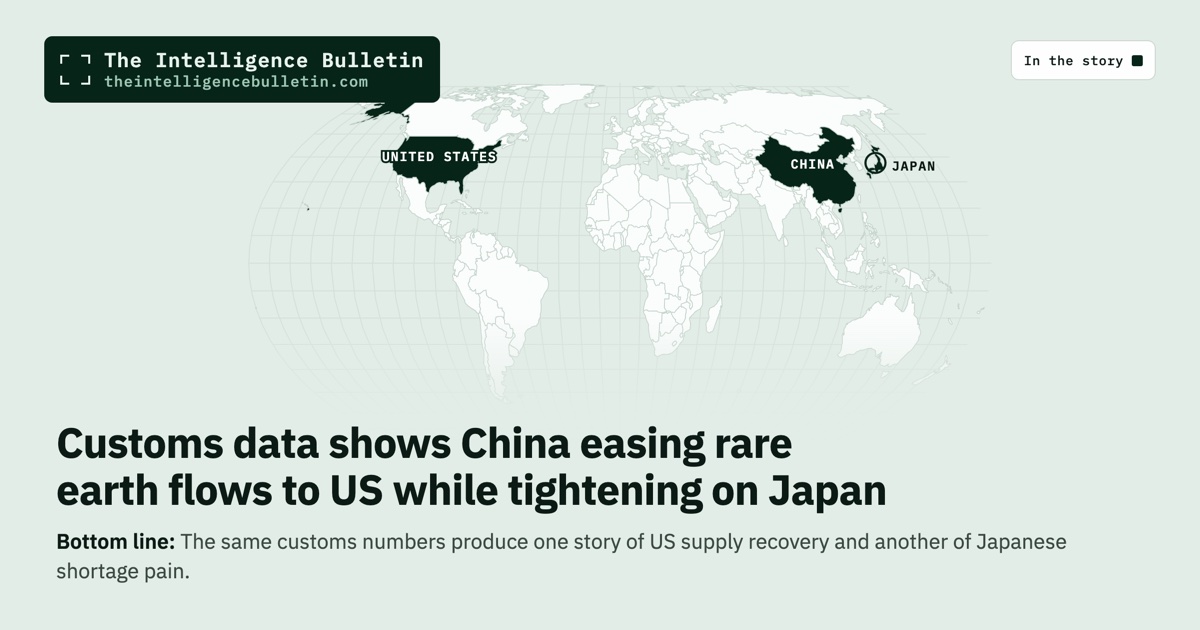
Customs data shows China easing rare earth flows to US while tightening on Japan

Map of the countries in the story: Customs data shows China easing rare earth flows to US while tightening on Japan
Chinese customs data for July 2026 shows rare earth magnet exports to the United States rose 4.6 percent year on year while shipments to Japan fell 52.2 percent to 111 tons. Tungsten carbide exports to Japan stayed at zero for a sixth straight month. The divergence follows Beijing easing some curbs on US-bound materials after trade talks and maintaining tighter controls affecting Japan. Rare earth magnets are critical for electric vehicles, electronics and other manufacturing.

One Story. Many Angles.

đŸ‡ŻđŸ‡”
Japan
News on Japan
Carries ăƒ†ăƒŹæ±BIZ reporting
China’s Rare-Earth Magnet Exports to Japan Halve in July
Read →
🇭🇰
Hong Kong
South China Morning Post
Original reporting
China strategic mineral exports to US rise as Japan shipments plunge
Read →
2 sources · each independently reported
In Brief

The same customs numbers produce one story of US supply recovery and another of Japanese shortage pain.

Chinese customs figures released this week reveal a clear split in how Beijing manages strategic mineral flows. Shipments of rare earth permanent magnets to the United States increased modestly year on year and jumped more than 30 percent month on month, while the same category to Japan dropped by more than half. Tungsten carbide flows to Japan remained blocked for six consecutive months. The South China Morning Post ties the US rebound to eased approvals following bilateral negotiations and notes continued near-zero status for some other materials. News on Japan reports the Japan-specific drops from the same customs source, framing them as immediate national supply pressure on motors and auto parts. The economist quoted by SCMP describes the pattern as geopolitically driven, with Japan already experiencing acute shortages and the United States receiving limited but improved access. Both outlets draw from the identical customs release without contradiction, yet each outlet’s national focus produces distinct emphasis: one on Tokyo’s material security risk, the other on Washington-Beijing realignment. The data therefore documents targeted adjustments rather than uniform export policy.

Perspective Analysis

Chinese customs authorities released their July 2026 trade figures showing sharp differences in shipments of rare earth magnets and other strategic minerals. Both the South China Morning Post and News on Japan built their accounts directly on those figures. The Japanese outlet attributed the data to a report from ăƒ†ăƒŹæ±BIZ, while the Hong Kong paper presented the numbers without naming an intermediate source. The two pieces therefore start from the identical dispatch and then diverge in what they foreground, what they add, and how they position the material for their readers.

News on Japan opened with the headline “China’s Rare-Earth Magnet Exports to Japan Halve in July.” Its lead paragraph stated that shipments of rare earth magnets to Japan totaled 111 tons in July, down 52.2 percent from the same month a year earlier, and that the decline was the steepest since June 2025. The piece immediately added that exports of tungsten carbide to Japan had remained at zero for a sixth consecutive month. It noted that rare earth magnets are used in motors for electric vehicles, home appliances and other products, and that China’s exports of the magnets to the world as a whole fell only 3.6 percent. The article stayed within those bounds. It offered no figures for shipments to any other destination, no policy background, and no commentary on motives or consequences beyond the raw volumes.

The South China Morning Post ran the headline “China strategic mineral exports to US rise as Japan shipments plunge.” Its opening sentence described a divergence: US-bound shipments of rare earth permanent magnets rose 4.6 percent year on year and 32.6 percent month on month, while exports of other rare earth oxides jumped 56.8 percent from a year earlier. The same paragraph contrasted those increases with the Japan numbers—rare earth magnets down 52.2 percent and natural flake graphite down 62 percent—plus the continued zero level for tungsten carbide. The piece then moved beyond the dispatch. It stated that Beijing had eased some restrictions on critical material exports to the United States after trade negotiations and had suspended US-specific curbs on several materials the previous November. It noted that shipments of key gallium and antimony products and most germanium products remained at or near zero. It added that China had tightened controls on dual-use exports to Japanese military users in January and had later added 40 Japanese entities to its export control list.

Only the South China Morning Post supplied an analyst quotation. Alicia Garcia-Herrero, chief economist for Asia-Pacific and the Middle East at Natixis, described the US recovery as “decent growth” but “not impressive” compared with pre-control levels. She said Japan was “already really feeling the pain” and that the pattern was “driven purely by geopolitics.” She concluded that China was “trying very hard to corner Japan” and was “quite likely to continue providing the US with a decent, but not large, amount of critical raw materials, while remaining adamant about restricting supplies to Japan.” The article also mentioned that rare earth magnet shipments to Japan had still been up 3.5 percent year on year over the first seven months of 2026 despite the July drop, and it referenced recent US restrictions on Chinese companies under forced-labor rules as well as Beijing’s sanctions on seven US entities.

The two treatments therefore differ in scope and emphasis rather than in the underlying numbers. News on Japan limited itself to the Japan-specific volumes and their direct industrial uses. It placed the material in its business section and paired it with unrelated domestic stories on the same page. The South China Morning Post embedded the same Japan figures inside a broader account of US-China trade adjustments, added the policy timeline and the analyst assessment, and ran the piece under its China Economy section with a photograph credit and further-reading links on related mineral and trade topics. The Japanese outlet’s framing stays inside a bilateral resource-security lens. The Hong Kong paper’s framing introduces a triangular dynamic and attributes motive and future direction to the pattern.

What to Watch

Both pieces identify the same material uses—electric-vehicle motors, electronics, auto parts—and both note that China dominates global rare earth mining and processing. Neither disputes any figure from the customs release. The difference lies in what each newsroom chose to attach to those figures. One kept the dispatch intact and local. The other expanded it with surrounding policy moves and an external reading of intent. Readers of only the first see a straightforward supply shock for Japanese manufacturers. Readers of the second see that shock placed against a selective easing toward the United States and an explicit claim that the selectivity is geopolitical. The single data release therefore travels as two distinct stories once it leaves the customs office.


Share this story

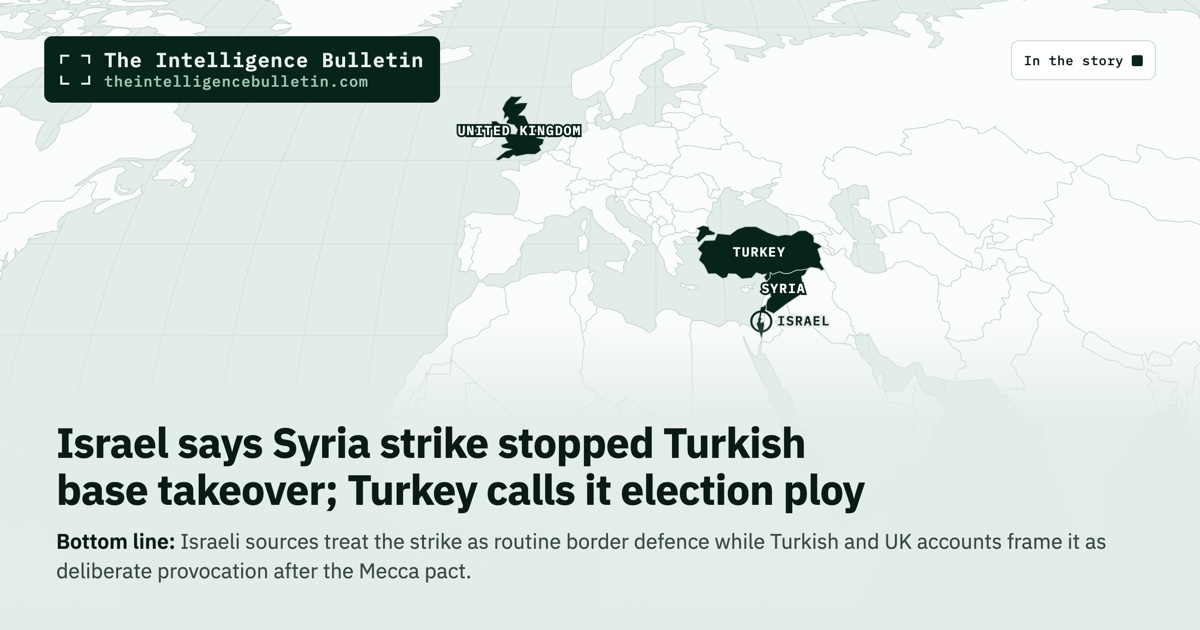
Israel says Syria strike stopped Turkish base takeover; Turkey calls it election ploy

Map of the countries in the story: Israel says Syria strike stopped Turkish base takeover; Turkey calls it election ploy
Israel bombed a Syrian airbase at Abu al-Duhur after warning that Turkey planned to station troops there. Israeli Prime Minister Benjamin Netanyahu and spokesman Doron Spielman said the action stopped a Turkish advance that would threaten Israel’s border, noting Turkey already controls about 5 percent of Syria. Turkey dismissed the claims as an election stunt by Netanyahu and said no military deployment was planned. US envoy Tom Barrack condemned the strike and warned it risked direct confrontation with Turkey.

One Story. Many Angles.

đŸ‡źđŸ‡±
Israel
Ynet
Original reporting
Israel defends Syria strike, warns against Turkish military expansion
Read →
🇬🇧
United Kingdom
Middle East Eye
Original reporting
‘Playing with fire’: Israel’s Syria strike tests Turkey after Mecca defence pact
Read →
🇼🇳
India
Daily Excelsior
Carries UNI reporting
Netanyahu defends Syria strike, warns Turkey against military buildup
Read →
3 sources · each independently reported
In Brief

Israeli sources treat the strike as routine border defence while Turkish and UK accounts frame it as deliberate provocation after the Mecca pact.

Israeli reporting presents the strike as a necessary defensive measure after Syria ignored repeated warnings about Turkish troops at the Abu al-Duhur base, framing Turkey’s existing Syrian presence as fifty times larger than Israel’s limited foothold and linking it to Erdogan’s stated hostility toward Israel. British-based Middle East Eye reporting instead situates the attack immediately after the Mecca defence agreement between Turkey, Saudi Arabia and Pakistan, portraying it as an attempt to undermine Ankara’s credibility in Syria and test the new US-backed government there while downplaying any imminent Turkish threat at the site. Indian coverage relays Netanyahu’s direct warnings on Turkish military expansion without adding independent sourcing, aligning closely with the Israeli account on the core justification. The three accounts converge on the basic sequence of the strike and Netanyahu’s statements but diverge sharply on motivation and risk: Israeli sources emphasise proactive security needs while Turkish sources and the UK outlet stress election timing and provocation. This split shows how the same public Israeli statements are read as routine deterrence in one capital and deliberate escalation in another.

Perspective Analysis

Israel struck a Syrian airbase at Abu al-Duhur early on the morning of 19 August 2026, hitting the runway of the facility roughly 70 kilometres from the Turkish border. Israeli Prime Minister Benjamin Netanyahu and his spokesman Doron Spielman said the operation was meant to stop Turkish forces from taking control of the site and moving farther south. Spielman stated in a video released by the Prime Minister’s Office that Turkey already holds about 5 percent of Syrian territory and that Israel had warned Syria repeatedly not to allow the deployment. He noted that Israel maintains only one-tenth of 1 percent of Syria along its southern border and described the Turkish presence as fifty times larger despite having no comparable threats from groups such as Hezbollah or ISIS.

Spielman added that an understanding reached more than a year earlier between Israel and Syria to keep the border calm had been on the verge of breaking. Israeli intelligence had identified plans to place Turkish troops at the airbase less than 200 miles from Israeli communities. Netanyahu said Israel would not tolerate a Turkish military buildup advancing toward its border and that Syria had ignored prior warnings, forcing Israel to deliver the message another way. He linked the concern to Turkish President Recep Tayyip Erdogan’s past statements calling for Israel’s destruction and criticising the United States.

Turkish officials rejected the premise that any military deployment was imminent. Syrian sources told Middle East Eye that a Turkish technical team had visited the base days earlier only to repair the runway and control tower, with no combat units present. They described Turkish assistance as general support for rebuilding Syrian military facilities rather than a move aimed at Israel. Ankara further described Netanyahu’s account as an election tactic timed ahead of Israeli votes and said the claims formed part of efforts to portray Turkey as a new regional threat.

The strike came days after Turkey, Saudi Arabia and Pakistan signed the Mecca defence agreement. Turkish insiders cited by Middle East Eye viewed the Israeli action as an attempt to undermine Ankara’s credibility as a partner in Syria and to test the new administration in Damascus backed by Washington. They noted that Israel had not used an existing military hotline between the two countries to deconflict operations, raising the chance of miscalculation.

US envoy to Syria and Turkey Tom Barrack condemned the strike in statements carried across the three outlets. He said the action carried a real risk of rapid escalation into direct confrontation between Israel and Turkey and noted that Turkish forces had not been warned in advance. Barrack called for activation of a new deconfliction mechanism involving Syria, Israel and Turkey.

Israeli reporting from Ynet foregrounded Spielman’s video and the comparative territorial figures to present the strike as a limited defensive step that Israel does not seek to expand. Middle East Eye reporting placed the same statements against the backdrop of the Mecca pact and anonymous Turkish assessments that the move was intended to intimidate rather than merely defend. Daily Excelsior relayed Netanyahu’s direct warnings on Turkish expansion and included Barrack’s criticism without introducing independent Turkish or Syrian counter-claims.

The accounts converge on the sequence of the strike, the Israeli justification offered in public statements, and the US envoy’s criticism. They diverge on whether Turkish forces were preparing to occupy the base and on the larger motive. Israeli sources tie the operation to longstanding security concerns and Erdogan’s rhetoric. Turkish sources and the British outlet frame it as provocation timed to domestic Israeli politics and the new defence pact. The Indian outlet stays aligned with the Israeli statements on the stated reason for the action.

Israeli officials have an interest in presenting the strike as proportionate response to an emerging threat, while Turkish officials have an interest in minimising the incident and attributing it to Netanyahu’s campaign calendar. The US envoy’s on-record warning supplies an independent voice that the operation risked broader confrontation. Readers who encounter only the Israeli account will see a straightforward border-security measure. Readers who encounter only the Turkish or British framing will see an unnecessary provocation that ignores an existing deconfliction channel. The three reports together show that both interpretations rest on the same public Israeli statements, with the difference lying in how those statements are situated against the Mecca agreement and domestic timing.

What to Watch

The Israeli account of the strike’s immediate purpose rests on the government’s own statements and is carried without contradiction in all three outlets. The claim that no Turkish military deployment was planned rests on Syrian and Turkish sources cited only in the British reporting. The election-stunt interpretation appears in Turkish statements and Middle East Eye sourcing but is not addressed in the Israeli or Indian pieces. The next development likely to test these accounts is whether Turkish forces move into the base or similar sites in the coming weeks, or whether the existing hotline and any new deconfliction talks produce visible restraint. Either outcome will clarify whether the Israeli action addressed a concrete shift in Turkish positioning or whether it has instead accelerated the very expansion it sought to prevent.


Share this story