Single Iranian official’s remarks to Al Mayadeen fuel reports of Mecca pact invitation to Iran

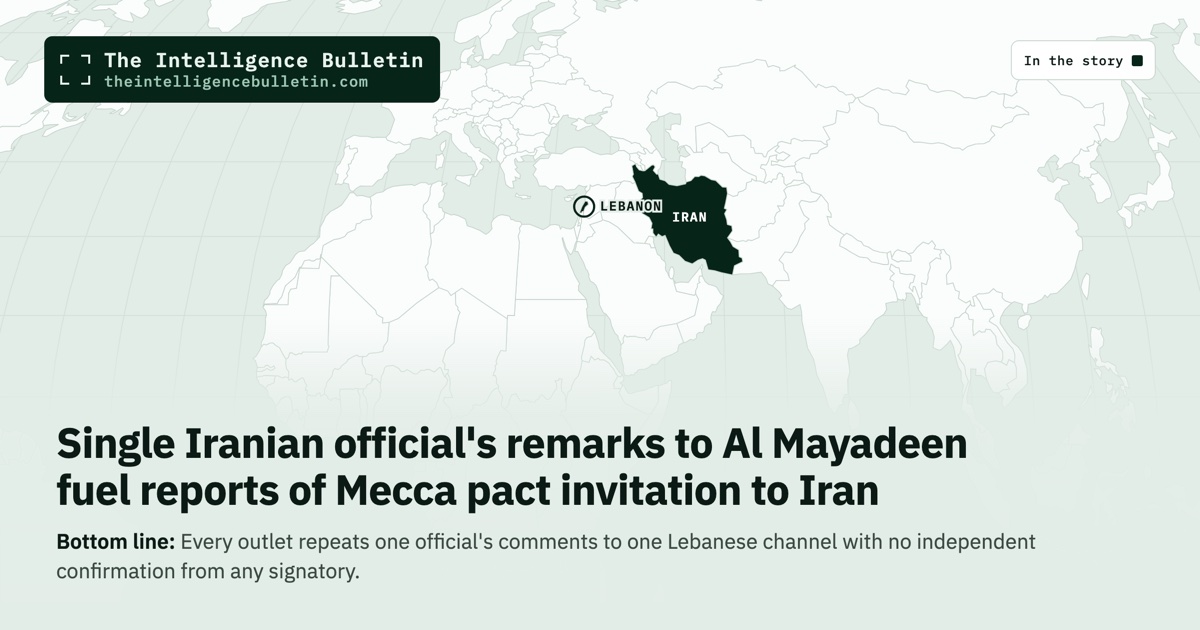
Map of the countries in the story: Single Iranian official's remarks to Al Mayadeen fuel reports of Mecca pact invitation to Iran
Saudi Arabia, Turkey and Pakistan signed a mutual defence agreement in Mecca on August 7. An Iranian parliamentary press official told Al Mayadeen that Iran received an invitation to join and is considering it. The pact treats an attack on one member as an attack on all. No confirmation has come from the signatories or Iran’s foreign ministry. The report has appeared in outlets across Pakistan, India, Azerbaijan, Tunisia and Russia.

One Story. Many Angles.

🇵🇰
Pakistan
Samaa
Carries Al Mayadeen reporting
Iran considers joining Pakistan-Saudi-Türkiye defence pact
Read →
🇮🇳
India
Hindustan Times
Carries Al Mayadeen reporting
Iran ‘invited’ to join Pakistan-Turkey-Saudi Arabia’s Mecca defence pact; report says proposal being ‘considered’
Read →
🇦🇿
Azerbaijan
Azernews
Carries Al Mayadeen reporting
Iran invited to join Mecca collective defense agreement
Read →
🇹🇳
Tunisia
African Manager
FRENCH
Carries Al Mayadeen reporting
Saudi Arabia, Turkey and Pakistan invited Iran to join the Mecca defense pact
“L’Arabie saoudite, la Turquie et le Pakistan ont invité l’Iran à rejoindre le pacte de défense de La Mecque”
Read →
🇷🇺
Russia
Mail.ru
RUSSIAN
Carries Al Mayadeen reporting
Iran may become part of the Meccan agreement: what this means
“Иран может стать частью Мекканского соглашения: что это значит”
Read →
5 sources · all sharing one news agency’s report
In Brief

Every outlet repeats one official’s comments to one Lebanese channel with no independent confirmation from any signatory.

All five selected outlets trace the invitation to the same Al Mayadeen interview with Mehdi Rahimi, director of the Iranian parliament’s Khaneh Mellat press service. Azernews and African Manager both quote Rahimi directly on the proposal being under review and on Iran’s long-standing call for regional security arrangements. African Manager adds that the three signatories have not confirmed the invitation and notes Turkey’s openness to expansion, mentioning Egypt as a possible future member. Samaa and Hindustan Times headlines frame the same development through Pakistan’s cooperative ties and India’s security concerns respectively, while Mail.ru situates it in broader power competition. No outlet reports independent verification from Riyadh, Ankara or Islamabad. The absence of Saudi, Turkish or Pakistani sourcing in any of the pieces leaves the claim resting on one chain of reporting. Where outlets diverge is only in the angle they attach to the identical core statement: regional security logic for some, ripple effects for others.

Perspective Analysis

The report that Iran received an invitation to join the Mecca mutual defence agreement rests on one interview. Mehdi Rahimi, director of the Iranian parliament’s Khaneh Mellat press service, told the Lebanese television channel Al Mayadeen that the invitation had arrived and that Iranian authorities were examining it. He described the proposal as consistent with Tehran’s longstanding advocacy for a regional security arrangement and noted that an attack on any participant would be treated as an attack on all.

That single statement, published on 23 August 2026, supplied the only on-record claim about the invitation. No foreign ministry statement, no comment from Riyadh, Ankara or Islamabad, and no separate reporting chain appeared in any of the five articles examined. The underlying pact itself was signed on 7 August in Mecca by Saudi Crown Prince Mohammed bin Salman, Turkish President Recep Tayyip Erdogan and Pakistani Prime Minister Shehbaz Sharif. Its core clause mirrors the collective-defence language of NATO’s Article 5.

Each outlet that carried the Al Mayadeen interview shaped the same dispatch to its own audience. Azernews placed the story under the headline “Iran invited to join Mecca collective defense agreement” and reproduced Rahimi’s remarks in full, including his criticism that the United States had failed to deliver promised security guarantees to regional states. The piece supplied the August 7 date, the three signatories’ names and the mutual-defence principle without additional sourcing.

African Manager’s French-language account opened with the invitation but immediately recorded the absence of confirmation from Iran’s foreign ministry or the three capitals. It added Turkey’s public indication that the arrangement could be enlarged and mentioned Egypt as one country cited in that context. The article retained Rahimi’s observation that the proposal represented a victory for Iran’s long-expressed preference for collective regional security.

Samaa’s headline foregrounded Pakistan’s position: “Iran considers joining Pakistan-Saudi-Türkiye defence pact.” The framing presented the development as an extension of existing ties rather than an external shock. The short dispatch repeated the core invitation and consideration language but did not quote Rahimi’s remarks on the United States or possible future members.

Hindustan Times led with the invitation in quotation marks and the qualifier that the proposal was “being considered.” Its headline and placement emphasised potential effects on regional balance, directing attention toward India’s security environment without introducing new facts beyond the Al Mayadeen interview.

Mail.ru titled its piece “Iran may become part of the Mecca agreement: what it means” and situated the report inside wider great-power competition. The article retained the same Rahimi quotations and pact details but framed the episode as one move among several that could affect Moscow’s room for manoeuvre.

The shared origin means the factual content across the five pieces is identical. Divergence appears only in headline emphasis, additional context supplied from the same interview, and the local interpretive lens attached to the dispatch. No outlet supplied an independent confirmation or a contradictory account from any signatory government.

The narrow evidentiary base also explains why none of the articles could report reactions from the three capitals or from Iran’s foreign ministry. African Manager alone noted the lack of such confirmation; the others simply relayed Rahimi’s statement without that qualifier. The result is five distinct national renderings of one Lebanese television report rather than five independent assessments of a developing diplomatic initiative.

What the coverage therefore reveals is not movement on the ground but the priorities each masthead brings to the same thin wire of information. A Pakistani reader encounters an account that links the proposal to Islamabad’s existing relationships. An Indian reader sees emphasis on possible realignment. An Azerbaijani reader receives the story inside a discussion of regional security umbrellas. A Tunisian reader learns both the invitation and the absence of official corroboration. A Russian reader is invited to place the episode inside calculations of great-power influence.

What to Watch

Because every concrete claim traces to the same Rahimi interview, the differences lie in selection and framing rather than in additional evidence. The single-chain character of the reporting limits what can be concluded about whether an invitation was in fact extended or whether it will be accepted. The five articles demonstrate how one official’s remarks travel and how each destination adapts them to its own context.
Share this story

All coverage of UK power plant cyber attack traces to single Telegraph report

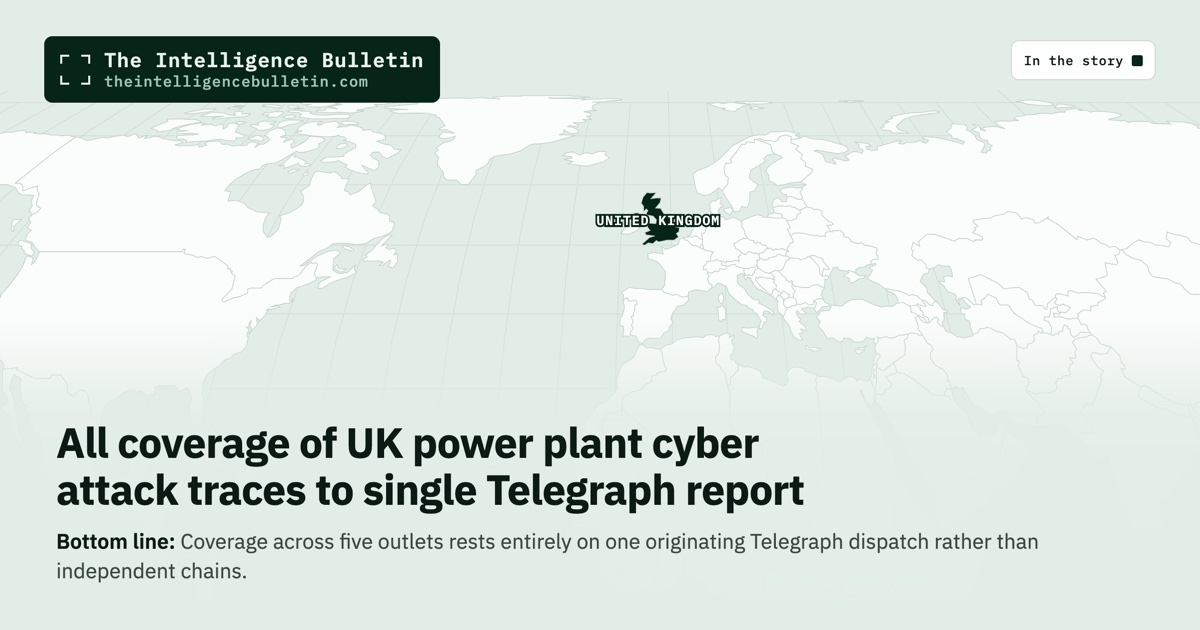
Map of the countries in the story: All coverage of UK power plant cyber attack traces to single Telegraph report
Iran-linked hackers carried out a cyber attack that forced a small UK power plant offline for four days in July 2026. The UK government stated the facility was a small-scale generator posing no risk to the national grid. The incident coincided with reported attacks on US water infrastructure and followed UK permission for US use of British bases against Iran. All coverage derives from a single Sunday Telegraph report.

One Story. Many Angles.

🇬🇧
United Kingdom
The Guardian
Carries Sunday Telegraph reporting
Iran-linked hackers blamed for cyber-attack that shut down UK power plant
Read →
🇬🇧
United Kingdom
Daily Mirror
Carries Sunday Telegraph reporting
UK power plant ‘shut down for four days’ after major Iran-linked cyber attack
Read →
🇬🇧
United Kingdom
Middle East Eye
Carries Sunday Telegraph reporting
Iranian cyber attack shuts down UK power plant for four days, report says
Read →
🇮🇪
Ireland
RTÉ
Carries Sunday Telegraph reporting
Iran-linked hackers ‘shut down’ small power plant in UK
Read →
🇸🇦
Saudi Arabia
Arab News
Carries Sunday Telegraph reporting
UK power plant forced offline after Iran-backed cyberattack
Read →
5 sources · all sharing one news agency’s report
In Brief

Coverage across five outlets rests entirely on one originating Telegraph dispatch rather than independent chains.

Every outlet in this cluster traces the core allegation of an Iran-linked cyber attack shutting down a UK power plant to the same Sunday Telegraph article published the previous day. The Guardian, Middle East Eye and Arab News each add the geopolitical frame of escalation tied to UK bases hosting US operations against Iran, while the Mirror stresses the four-day shutdown and the RTÉ piece keeps the emphasis on the plant’s small scale. Government statements denying any wider risk appear verbatim across all five, confirming the story’s limited operational footprint. No outlet claims its own sourcing or verification of the attack details; the National Cyber Security Centre’s lack of major outage reports is uniformly noted as context rather than contradiction. This pattern reveals a single reporting chain amplified across domestic, regional and neighbouring perspectives rather than independent corroboration, with differences confined to framing and emphasis on the base-usage backstory. The uniformity on the small-plant qualifier and the absence of named facilities or operator comments further underscores how the coverage rests on one originating dispatch.

Perspective Analysis

The Sunday Telegraph reported last month that hackers linked to Iran had carried out a cyber attack on a small British power plant, forcing the facility offline for four days. The newspaper identified the target as a small-scale energy generator whose precise location it withheld for security reasons, and it stated that the shutdown occurred while staff worked to restore operations. No wider impact on the national grid was recorded, and the National Cyber Security Centre received no outage notifications from regulated power-station operators.

The same dispatch noted that the incident took place in July at the same time as a series of cyber attacks on water infrastructure in the United States that affected at least twelve states. British government officials, the Telegraph said, had briefed chief executives of power companies and sent written guidance to businesses in response. A spokesperson for the Department for Energy Security and Net Zero described the site as falling well below thresholds that would require formal notification of cyber activity and characterised the UK energy system as highly resilient.

Every subsequent article that appeared on 23 August traced these details directly to the Telegraph account. The Guardian opened its piece by naming Iran-linked hackers as the party blamed for the attack and immediately situated the event inside the recent decision by the United Kingdom to permit United States forces to conduct operations against Iranian targets from British bases. Middle East Eye likewise led with the Iranian attribution and added detail on the sequence of base-authorisation decisions, noting that permission had originally been limited to defensive actions before being expanded under Prime Minister Andy Burnham to include strikes on active Iranian missile infrastructure threatening shipping in the Strait of Hormuz.

The Daily Mirror placed the four-day duration in its headline and repeated the phrase “while staff fought to bring it back online,” foregrounding the operational disruption at the unnamed site. Arab News, publishing from Saudi Arabia, used the headline “UK power plant forced offline after Iran-backed cyberattack” and inserted references to earlier Iranian cyber campaigns, including a 2015 power outage in Turkey and a 2023 campaign by the group CyberAv3ngers against seventy-five US devices. RTÉ, the Irish public broadcaster, kept the emphasis on scale, headlining the story “Iran-linked hackers ‘shut down’ small power plant in UK” and closing with a statement from the Liberal Democrats foreign affairs spokesperson urging stronger protection of energy infrastructure.

The government statement that the incident involved only a small-scale generator and posed no risk to the wider system appeared in identical wording in every article. The Conservative energy spokesperson Claire Coutinho’s remark that the episode reflected “a new kind of warfare” and required prioritisation of domestic energy production appeared only in the Guardian. The NCSC chief executive Richard Horne’s earlier warning that hostile states including Iran were increasingly targeting UK infrastructure was cited by the Guardian, Arab News and RTÉ but omitted by the Mirror and Middle East Eye.

None of the five outlets reported any additional sourcing or verification of the attack itself. Each reproduced the Telegraph’s description of the plant’s limited size and the absence of regulated-operator notifications. The coincidence with US water-sector incidents was mentioned in every piece but never attributed to any source other than the Telegraph dispatch. Placement of the story varied: the Guardian and Middle East Eye embedded it within ongoing coverage of UK-Iran tensions over base access, while the Mirror and Arab News presented it more as a standalone infrastructure-security alert, and RTÉ treated it as a neighbouring European development.

The uniformity of the factual spine across the five articles therefore reflects the single origin of the reporting rather than independent confirmation from multiple newsrooms. Differences appear only in the contextual material each masthead chose to attach to the shared dispatch. Outlets with established Middle East desks added the base-authorisation timeline and prior Iran-linked operations; the Mirror kept the focus on the outage length; RTÉ preserved a measured tone centred on the plant’s small footprint and official reassurances.

What to Watch

This pattern shows how a single originating account travels through different editorial filters. Readers encountering the story only in one of the five publications would receive the same core facts but a distinct emphasis on either the geopolitical backdrop, the duration of the shutdown, or the limited operational consequences. The absence of any named facility, operator comment, or independent technical assessment remains consistent across the set because none of those details existed in the source dispatch.


Share this story

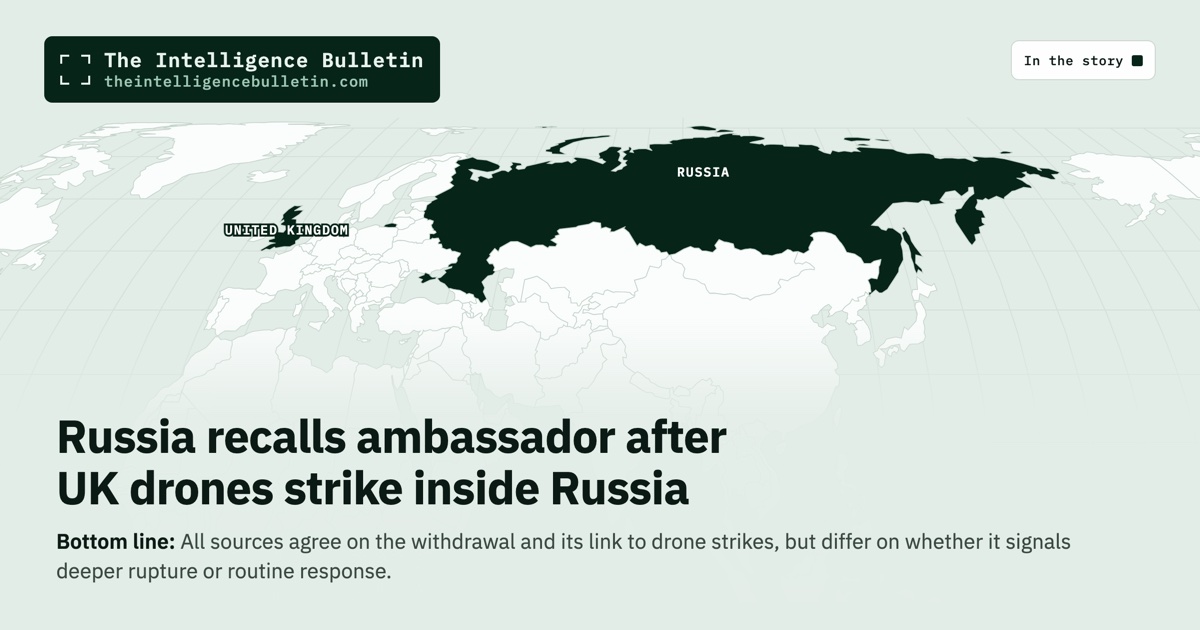
Russia recalls ambassador after UK drones strike inside Russia

Map of the countries in the story: Russia recalls ambassador after UK drones strike inside Russia
Russia has withdrawn its ambassador to the United Kingdom, Andrey Kelin, who left the post in July 2026 with no replacement named. The move follows Russian embassy warnings of consequences after reports that Ukraine used British-made drones to strike targets inside Russia. UK officials said the decision is Russia’s and reaffirmed support for Ukraine’s defense. Bulgarian coverage frames it as a direct reply to London’s Ukraine stance.

One Story. Many Angles.

🇬🇧
United Kingdom
The Guardian
Original reporting
Russia withdraws ambassador to UK as Kremlin ratchets pressure over Ukraine support
Read →
🇬🇧
United Kingdom
Daily Express
Original reporting
Putin withdraws UK ambassador as tensions erupt over Ukraine war
Read →
🇧🇬
Bulgaria
Focus News
BULGARIAN
Carries The Independent reporting
Russia recalled its ambassador from the UK after London’s statements in support of Ukraine
“Русия отзова посланика си от Великобритания след изявленията на Лондон в подкрепа на Украйна”
Read →
3 sources · each independently reported
In Brief

All sources agree on the withdrawal and its link to drone strikes, but differ on whether it signals deeper rupture or routine response.

The reporting across these outlets converges on the same sequence: Kelin departed in July, the embassy accused Britain of choosing confrontation after drone revelations, and no successor has been appointed. What stands out is how little the accounts differ on the mechanics while diverging on tone. The Guardian and Express both tie the recall to recent drone strikes and embassy statements threatening consequences, presenting it as evidence of strained relations without claiming a full break. Focus News, citing The Independent, simply records the Russian accusation and the drone context as the trigger. This pattern shows the story travels as a factual diplomatic signal rather than a disputed narrative. The absence of any outlet in the set from Russia itself means all accounts of Moscow’s intent come through British or third-country relays of embassy remarks. The shared emphasis on the drone issue and the lack of replacement suggests the move is being read as deliberate signaling rather than routine rotation, even as UK sources note communication channels have already deteriorated sharply since 2022.

Perspective Analysis

Russia withdrew its ambassador to the United Kingdom in July 2026, leaving the post vacant with no successor named as of late August. Andrey Kelin, who had served since 2019, concluded his mission on 21 July according to statements from the Russian embassy in London. The embassy described the departure as the end of a seven-year posting and noted that Kelin had sought to maintain communication channels, though relations had reached an “unprecedentedly low level” due to British policy choices.

The timing aligned with fresh accusations from the same embassy over Ukraine’s use of British-supplied drones. Reports emerged that Ukrainian forces had employed drones manufactured in Britain, including the jet-powered Nyan model tested by the Royal Navy, to strike Russian oil refineries near Moscow, in Yaroslavl and Volgograd, and targets near Belgorod. The embassy stated that London was acting as an accomplice in “bloody crimes and terrorist acts” and that its actions would “inevitably carry consequences for which it will have to answer.” A separate comment warned Britain against following a “path of confrontation” and urged reconsideration of its policies toward Russia.

British officials treated the withdrawal as a unilateral Russian decision. A Foreign Office spokesperson said the matter rested with Moscow’s foreign ministry and that Britain maintained its own embassy in the Russian capital to raise concerns. The same statement reaffirmed that Britain would continue to stand with Ukraine, which retained the right to defend itself. Prime Minister Andy Burnham responded to the embassy’s warnings by declaring that Britain would support Ukraine at 100 percent.

The absence of a replacement ambassador has drawn attention because such gaps are not unknown in diplomatic practice. A former British defence attaché, John Foreman, observed that the move could represent a permanent downgrading by default if Moscow chose not to fill the post. The embassy itself later clarified that its remarks did not imply an intention to downgrade formal relations. Kelin had previously appeared in British media repeating official Russian positions, including the assertion that Russia could not lose the war in Ukraine.

Coverage of these events appeared in outlets from Britain and Bulgaria. The Guardian and the Daily Express both placed the recall in the context of the drone strikes and the embassy’s public warnings, describing the episode as evidence of sharply deteriorated ties since the full-scale invasion of Ukraine began. The Bulgarian Focus News outlet, drawing on reporting in The Independent, presented the same sequence as a straightforward Russian reply to London’s continued backing of Kyiv, listing the specific drone models and the targets struck inside Russia without additional commentary on the state of bilateral relations.

The accounts converge on the core sequence and the role of the drone reports as the immediate trigger. All three sources record Kelin’s departure in July, the lack of a named replacement, the embassy’s language about consequences and confrontation, and the British government’s decision to maintain its support for Ukraine. Differences appear mainly in emphasis. The two British publications link the episode to a longer pattern of strained communication that predates the most recent drone claims, while the Bulgarian article keeps the focus narrower on the stated Russian rationale and the prime minister’s reply.

A reader who encountered only the Bulgarian account would see a concise diplomatic exchange without reference to the historical backdrop of ambassadorial relations since 2018. A reader limited to the British articles would encounter additional detail on Kelin’s media appearances and on expert views about whether the vacancy signals a lasting reduction in ties, but would still find the same factual spine as the Bulgarian report. No source in the set contradicted another on the timing, the drone connection, or the content of the embassy statements.

The convergence itself supplies the clearest signal available from the published record. Multiple independent reporting chains, working from the same Russian embassy remarks and British government responses, produced matching accounts of what occurred and why the Russian side said it had acted. That pattern suggests the withdrawal functions as deliberate signaling rather than an unannounced rotation. Because the selected sources contain no direct Russian domestic coverage, every statement attributed to Moscow reaches readers through British or third-country relays of embassy language. The British outlets add context on the pre-existing chill in relations, while the Bulgarian piece registers the event as a discrete response to a specific policy dispute.

What to Watch

The most reliable reading, therefore, is that Moscow chose this moment to register displeasure over the drone supply line and to test whether Britain would adjust course. The lack of a replacement keeps the option open for further adjustment or for a quiet restoration of the post if conditions change. British policy, as stated on the record, shows no sign of alteration. The episode adds one concrete diplomatic marker to the running record of Ukraine-related friction without, on present evidence, closing the remaining channels between the two capitals.


Share this story

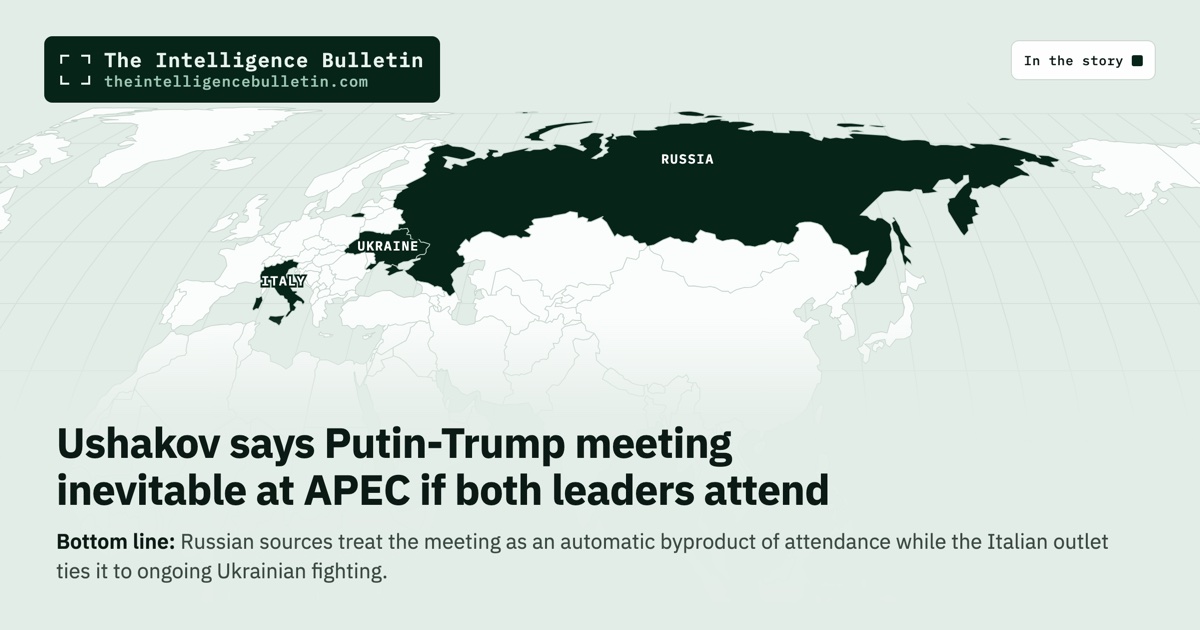
Ushakov says Putin-Trump meeting inevitable at APEC if both leaders attend

Map of the countries in the story: Ushakov says Putin-Trump meeting inevitable at APEC if both leaders attend
Russian presidential aide Yury Ushakov stated that if Vladimir Putin and Donald Trump both attend the APEC summit in Shenzhen, China, on November 18-19, they will inevitably meet and talk. The comment came in an interview with Russian state media. No specific signals or plans for the meeting have been confirmed yet. The summit occurs amid ongoing Russia-Ukraine conflict and recent US statements on resuming related talks.

One Story. Many Angles.

🇹🇷
Turkey
Anadolu Agency
Original reporting
Putin, Trump could meet at APEC summit in China: Kremlin
Read →
🇷🇺
Russia
RT
RUSSIAN
Carries Vesti reporting
Ushakov allowed for a meeting between Putin and Trump at the APEC summit in China
“Ушаков допустил встречу Путина и Трампа на саммите АТЭС в Китае”
Read →
🇷🇺
Russia
Kommersant
RUSSIAN
Carries Vesti reporting
Ushakov: Putin and Trump will meet at the APEC summit with participation
“Ушаков: Путин и Трамп встретятся на саммите АТЭС при участии”
Read →
🇮🇹
Italy
Zazoom
ITALIAN
Carries Quotidiano.net reporting
The Kremlin | Possible Putin-Trump meeting at Apec summit Russian attacks in the Zaporizhzhia region
“Il Cremlino | Possibile incontro Putin-Trump a vertice Apec Attacchi russi nella regione di Zaporizhzhia”
Read →
4 sources · 3 independent accounts — some share the same news agency’s report
In Brief

Russian sources treat the meeting as an automatic byproduct of attendance while the Italian outlet ties it to ongoing Ukrainian fighting.

Russian outlets frame the comment as a straightforward observation from aide Yury Ushakov that any shared event makes a bilateral meeting inevitable, without new diplomatic signals. Anadolu Agency presents it as a Kremlin signal of possible high-level contact. The Italian Zazoom outlet alone links the diplomatic note directly to battlefield developments in Zaporizhzhia, showing how European coverage embeds the possibility inside active conflict reporting rather than treating it as isolated diplomacy. Two Russian sources draw from the same Ushakov interview with Vesti, confirming the core claim originates in Russian state commentary. The absence of any selected Chinese outlet leaves the host nation’s framing unrepresented despite the summit’s location. The reporting converges on the conditional nature of the encounter and the lack of concrete plans three months out, with no contradictions across the set.

Perspective Analysis

Russian presidential aide Yury Ushakov told the state-aligned television service Vesti that if Vladimir Putin and Donald Trump both appear at the Asia-Pacific Economic Cooperation summit in Shenzhen on November 18 and 19, the two leaders will meet and talk as a matter of course. The remark, delivered in an interview with journalist Pavel Zarubin, contained no new proposals, no proposed agenda, and no indication that either side had begun arranging a bilateral session. Ushakov added that three months still remained before the gathering and that no concrete signals had yet arrived.

The same conditional phrasing appeared across the four articles that covered the comment on August 23. Russian state broadcaster RT quoted Ushakov directly: leaders at the same event “will inevitably meet and negotiate.” Business daily Kommersant carried an almost identical passage and added that Ushakov had reminded listeners of the many other international events Russia will host in the coming weeks. Anadolu Agency rendered the statement as a Kremlin signal that a meeting “could” occur. Italian aggregator Zazoom carried the core quote and immediately followed it with a separate paragraph on reported Russian strikes in the Zaporizhzhia region of Ukraine.

The summit itself is a long-scheduled multilateral forum hosted by China. Its dates and location in Shenzhen have been public for months. Ushakov’s intervention did not alter those facts; it merely supplied a Russian official’s assessment of what would follow if both presidents chose to attend. Kommersant noted that Ushakov had previously offered differing assessments of a possible encounter, including one in May when he judged a meeting in China unrealistic. The August 23 comment therefore sits inside a running series of low-stakes Russian observations rather than marking a sudden shift in position.

Two of the four pieces drew from the identical Vesti interview. RT and Kommersant both named Zarubin and the same date of the broadcast. Their accounts therefore constitute a single reporting chain, not independent confirmation. Zazoom attributed its version to Quotidiano.net, which in turn carried the same Ushakov quotation. Anadolu Agency published an English-language headline and lead that mirrored the Russian wording without citing an additional source. No outlet in the set reported any American or Chinese reaction to the remark.

The Italian article alone placed the diplomatic note beside active fighting. Its headline paired the APEC possibility with “Attacchi russi nella regione di Zaporizhzhia.” The body text restated Ushakov’s words and then turned to battlefield developments without claiming any direct connection between the two subjects. The remaining three pieces contained no reference to Ukraine operations on the day they published the Ushakov comment.

No selected source originated in China, the country scheduled to host the summit. The absence leaves the host government’s framing of the remark outside the set. Turkish, Russian, and Italian coverage therefore supplies the only available published accounts.

The core factual spine across the reporting is narrow and consistent: Ushakov described an automatic encounter conditional on attendance, supplied no timetable or agenda, and noted the absence of preparatory signals. Where the pieces diverge is in the surrounding material they chose to attach. Russian outlets stayed inside the official interview and its immediate context of other Russian-hosted events. The Turkish agency foregrounded the international-diplomacy angle. The Italian aggregator inserted the Zaporizhzhia strikes. These choices produce different impressions of the remark’s weight without altering the statement itself.

A reader limited to Russian state media would encounter the comment as routine official commentary on logistics, not as a fresh diplomatic initiative. A reader limited to the Anadolu headline would see a possible bilateral opening between Washington and Moscow. A reader limited to Zazoom would see the same possibility embedded inside daily reports of Russian operations in Ukraine. Each framing is traceable to what that outlet actually published on August 23.

The reporting chains converge on the conditional character of the statement and on the lack of concrete preparations three months before the summit. They diverge on the additional context each outlet elected to supply. No independent chain contradicts the Ushakov quotation or the November dates. The Italian linkage to Zaporizhzhia stands as the clearest departure from the others, yet it does not claim causation; it simply juxtaposes the two subjects on the same page.

What to Watch

The narrowest reading supported by the published texts is therefore the one that stays closest to Ushakov’s recorded words: attendance at the same multilateral event would produce an automatic bilateral contact, and no such contact has been arranged yet. The additional interpretive layers supplied by individual outlets reflect editorial choices rather than competing factual claims.


Share this story

National Outlets Spotlight Own Citizens’ Relief as Judge Voids Trump Visa Freeze

Map of the countries in the story: National Outlets Spotlight Own Citizens’ Relief as Judge Voids Trump Visa Freeze
A federal judge in Manhattan ruled Friday that the Trump administration’s January policy suspending immigrant visas from 75 countries exceeded Secretary of State Marco Rubio’s authority and violated federal law requiring individual assessments rather than nationality-based denials. The policy, justified as preventing public-charge risks based on welfare data from those nations, halted permanent-residence applications but left nonimmigrant visas unaffected. Immigrant-rights groups and affected applicants challenged it; the ruling reverses denials resting solely on the ban and allows appeals.

One Story. Many Angles.

🇺🇸
United States
KCCI
Carries CNN reporting
Trump’s 75-country immigrant visa ban is struck down by judge
Read →
🇳🇬
Nigeria
The Eagle Online
Carries Vanguard News reporting
US judge strikes down Trump visa ban affecting Nigeria, 74 others + Full list
Read →
🇧🇷
Brazil
Veja
PORTUGUESE
Original reporting
US judge annuls order from Trump that barred visas for Brazilians
“Juíza dos EUA anula ordem de Trump que barrava vistos para brasileiros”
Read →
🇲🇦
Morocco
Morocco World News
Carries Reuters reporting
US Court Overturns Trump Policy Suspending Immigrant Visas for Moroccans, 74 Other Nationalities
Read →
🇬🇳
Guinea
Guinéenews
FRENCH
Commentary
United States: justice cancels the immigrant visa freeze targeting 75 countries, including Guinea
“États-Unis : la justice annule le gel des visas d’immigrant visant 75 pays, dont la Guinée – Guinéenews©”
Read →
5 sources · 4 independent accounts — some share the same news agency’s report
In Brief

Each outlet leads with its own nationals’ blocked applications while all agree the policy violated individual-assessment rules.

National outlets converge on the core legal finding that the policy improperly substituted nationality for the required case-by-case public-charge evaluation under immigration law, yet each frames the outcome through its own citizens’ immediate stakes. Brazilian coverage centers relief for applicants previously blocked despite meeting financial criteria, while Nigerian reporting supplies the full country list and stresses household welfare statistics cited by the administration. Moroccan and Guinean accounts similarly isolate their nationals’ blocked family and employment petitions. US domestic framing instead emphasizes the judge’s explicit rebuke of a Rubio cable that predetermined refusals even with contrary evidence, distinguishing it from the 2018 travel-ban precedent. This pattern reveals how the same statutory conflict registers as targeted national relief abroad and institutional overreach at home, with no outlet disputing the judge’s reading of the 1965 nondiscrimination provision or the cable’s language. The convergence on individual-assessment requirements across independent reporting chains underscores that the policy’s design, not merely its goals, drove the uniform judicial outcome.

Perspective Analysis

A federal judge in Manhattan ruled Friday that the Trump administration’s January policy suspending immigrant visas from 75 countries exceeded the statutory authority of Secretary of State Marco Rubio and violated federal immigration law. Judge Jeannette Vargas of the U.S. District Court for the Southern District of New York found that the measure directed consular officers to refuse applications solely on the basis of nationality, even when applicants supplied evidence that they would not become public charges. The ruling reverses any denials that rested exclusively on the policy while leaving intact refusals grounded in other provisions of law. The administration may appeal.

The policy took effect January 21, 2026, after the State Department sent a cable to every diplomatic and consular post. The cable instructed officers to pause issuance of immigrant visas—those leading to permanent residence—for nationals of the designated countries on the ground that applicants from those nations posed a high risk of relying on public benefits. The list drew from Council of Economic Advisers data showing that more than 30 percent of immigrant households from the selected countries had received some form of public assistance. Immigrant visas for family reunification or employment were halted; tourist, student, and other nonimmigrant visas remained available. The cable stated that officers should refuse even applicants who provided additional evidence overcoming the public-charge ground.

Vargas wrote that the outcome under the policy was predetermined. She cited a 1965 statute barring nationality-based discrimination in the issuance of immigrant visas and a separate provision that removes authority over individual consular decisions from the secretary of state. The judge distinguished the case from the 2018 Supreme Court decision upholding the third version of the first-term travel ban, noting that the earlier ruling addressed presidential power to bar entry while this dispute concerned whether a visa could be issued at all. Plaintiffs included six U.S. citizens who had sponsored relatives from Ghana, Jamaica, Guatemala, and Ethiopia, plus five Colombians whose job-based applications had been denied under the policy. The suit was brought by the Catholic Legal Immigration Network and African Communities Together along with the individual petitioners.

The 75 countries span the Caribbean, sub-Saharan Africa, the Balkans, the Middle East, Central Asia, and parts of Southeast Asia and Latin America. They include Nigeria, Brazil, Morocco, Guinea, Colombia, Egypt, Jordan, Haiti, Somalia, Russia, and many others. One published list names Afghanistan, Albania, Algeria, Antigua and Barbuda, Armenia, Azerbaijan, Bahamas, Bangladesh, Barbados, Belarus, Belize, Bhutan, Bosnia-Herzegovina, Brazil, Cambodia, Cameroon, Cape Verde, Colombia, Cuba, Dominica, DR Congo, Egypt, Eritrea, Ethiopia, Fiji, Gambia, Georgia, Ghana, Grenada, Guatemala, Guinea, Haiti, Iran, Iraq, Ivory Coast, Jamaica, Jordan, Kazakhstan, Kosovo, Kuwait, Kyrgyzstan, Laos, Lebanon, Liberia, Libya, Moldova, Mongolia, Montenegro, Morocco, Myanmar, Nepal, Nicaragua, Nigeria, North Macedonia, Pakistan, Republic of Congo, Russia, Rwanda, Saint Kitts and Nevis, Saint Lucia, Senegal, Sierra Leone, Somalia, South Sudan, St. Vincent and the Grenadines, Sudan, Syria, Tanzania, Thailand, Togo, Tunisia, Uganda, Uruguay, Uzbekistan, and Yemen. The administration had argued that the pause allowed time to reassess procedures and prevent exploitation of welfare systems; a State Department spokesperson described the measure as consistent with long-standing authority to deem inadmissible those likely to become public charges.

The judge gave both sides until September 11 to propose how to resolve remaining issues in the case. A separate ruling by Judge Amit Mehta in the District of Columbia on July 31 had reached a similar conclusion on the same policy, reinforcing the view that nationality alone cannot substitute for the individualized financial, age, health, skills, and family assessment required by statute.

Coverage from outlets in the affected countries foregrounded the immediate consequences for their own nationals. Nigerian reporting supplied the complete list of 75 countries and noted that roughly one-third of Nigerian immigrant households had been identified in the administration’s welfare data. Brazilian accounts emphasized that applicants from Brazil who met all other requirements had nevertheless faced automatic refusal. Moroccan coverage listed Morocco alongside Algeria, Tunisia, Egypt, Senegal, Nigeria, Pakistan, Bangladesh, Brazil, Colombia, and Uruguay among the suspended nationalities. Guinean reporting highlighted that Guinea appeared on the list alongside Senegal, Sierra Leone, Côte d’Ivoire, Ghana, Nigeria, Liberia, and Gambia, and stressed that the decision restored the principle of case-by-case evaluation rather than a collective presumption.

United States reporting instead stressed the statutory violations. It quoted the judge’s finding that the cable left no room for consular officers to exercise the discretion Congress had preserved and that the policy ran afoul of the 1965 nondiscrimination provision. It also noted that the administration had prevailed on a narrower procedural point: the policy did not require public notice and comment as a formal rule.

The accounts diverge most clearly in emphasis rather than in the description of the ruling itself. Every source reports the same core holding that the policy improperly replaced individualized review with a nationality-based bar. The divergence appears in what each outlet chooses to place in the foreground: legal mechanics and the text of the cable in one case, the names of blocked applicants and the specific welfare statistics attached to a single country in others. No source disputes the existence of the cable or the judge’s reading of the relevant statutes. The convergence across five independent reporting chains on the requirement of individualized assessment supplies the clearest evidence that the policy’s design, rather than its stated goal of reducing public-charge entries, produced the uniform judicial result.

The most detailed accounts of the statutory conflict come from the outlets that reproduced extended passages from the opinion and the cable. Those passages show that consular officers were directed to refuse applications even when applicants demonstrated they would not rely on benefits, a directive the judge found incompatible with the Immigration and Nationality Act. National outlets correctly identified the relief available to their own citizens and correctly listed the countries on the original suspension, yet they did not contradict the legal analysis. The policy’s reach—75 countries representing a substantial share of potential family-based and employment-based immigration—explains why each affected press treated the ruling as direct national news rather than abstract administrative law.

What to Watch

The accounts that quote the opinion and the cable at length rest on the strongest warrant. Those sources show the precise language that produced the predetermined refusals and the precise statutory provisions the judge invoked. National outlets that supplied the full country list or the Nigeria-specific welfare figure performed a different but complementary service by making concrete which populations stood to regain processing. Because the legal reasoning converges across chains while the national stakes differ, a reader gains the most complete picture by combining the statutory analysis with the country-specific lists rather than relying on either alone. The administration retains the option to appeal to the Second Circuit or seek a stay, which will determine whether the restoration of individualized review takes effect immediately or remains suspended pending higher review.


Share this story

Turkey asks Interpol to enforce arrest warrant against Netanyahu over flotilla

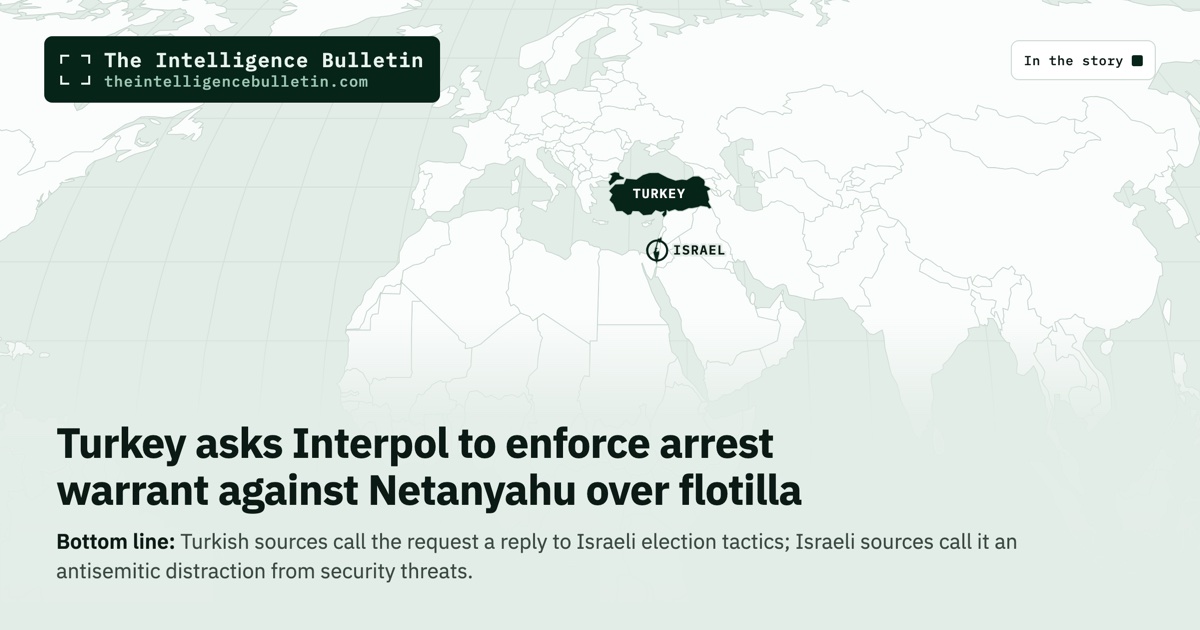
Map of the countries in the story: Turkey asks Interpol to enforce arrest warrant against Netanyahu over flotilla
Turkey’s Justice Ministry requested an Interpol red notice to enforce domestic arrest warrants issued July 14 against Israeli Prime Minister Benjamin Netanyahu and one other on charges including genocide, crimes against humanity and torture. The warrants stem from Israel’s May interception in international waters of the Global Sumud Flotilla carrying aid to Gaza. Netanyahu’s office condemned the move as an antisemitic attempt to intimidate Israel. Turkish officials framed Israeli rhetoric as election-driven posturing ahead of October votes.

One Story. Many Angles.

🇹🇷
Turkey
Daily Sabah
Original reporting
‘Israel’s Netanyahu using Türkiye as threat for cheap election politics’
Read →
🇮🇱
Israel
Haaretz
Carries Reuters reporting
Turkey Asks Interpol to Enforce Arrest Warrant Against Netanyahu
Read →
🇶🇦
Qatar
Al Jazeera
Original reporting
Turkiye accuses Israel’s Netanyahu of ‘genocide’, seeks Interpol warrant
Read →
🇭🇰
Hong Kong
South China Morning Post
Carries Agence France-Presse reporting
Turkey issues ‘genocide’ warrant for Israel’s Netanyahu over Gaza flotilla
Read →
🇨🇦
Canada
Toronto Sun
Carries AFP reporting
Turkey issues ‘genocide’ warrant for Israeli PM Benjamin Netanyahu
Read →
5 sources · each independently reported
In Brief

Turkish sources call the request a reply to Israeli election tactics; Israeli sources call it an antisemitic distraction from security threats.

The reporting reveals two parallel narratives around the same legal filing rather than outright contradiction. Turkish outlets and statements treat the Interpol request as a direct response to Israeli election rhetoric that casts Turkey as a regional threat, while Israeli reporting embeds the Turkish announcement inside a wider security context that includes recent strikes in Syria and prior Turkish warrants against multiple officials. Wire services from AFP and Reuters supply the bare timeline of the flotilla incident and the justice minister’s social-media announcement, leaving the political framing to each national actor. Al Jazeera adds emphasis on prior Turkish accusations of genocide in Gaza and notes proceedings in other countries, aligning closest to the Turkish domestic account. The single point of convergence across every source is the July 14 date of the warrants and the request for an Interpol red notice; everything else—election motives, antisemitism charges, or regional destabilization—remains sourced to one side or the other and is presented without reconciliation. This split shows the event functions less as new evidence of crimes and more as an escalation in the existing diplomatic and legal standoff between Ankara and Jerusalem.

Perspective Analysis

Turkey’s Justice Ministry asked its Interior Ministry on August 21 to issue Interpol red notices enforcing arrest warrants that had been issued domestically on July 14 against Israeli Prime Minister Benjamin Netanyahu and a second individual named Afek Moskovitch. The warrants list charges of genocide, crimes against humanity, torture, aggravated deprivation of liberty, intentional assault and battery, destruction of property, aggravated looting and hijacking of transport vehicles. Turkish Justice Minister Akin Gurlek stated on social media that the action followed from judicial proceedings over an Israeli attack on activists in international waters and that Turkey would use every available legal mechanism to hold Israel accountable for its actions in Gaza.

The underlying case concerns Israel’s interception in May of the Global Sumud Flotilla, a convoy of roughly 50 vessels that departed from Turkey carrying approximately 430 activists and humanitarian supplies bound for Gaza. Israeli forces opened fire on at least two of the boats, detained the passengers, and later deported them after holding them in an Israeli prison. Turkish officials have described the operation as occurring on the high seas. The same warrants also name other Israeli officials in separate filings, and Gurlek noted that Turkey had already issued domestic arrest warrants against 37 senior Israeli figures, including Netanyahu, in November of the previous year.

Netanyahu’s office responded the same day with a statement that called Turkish President Recep Tayyip Erdogan an antisemitic dictator who had massacred Kurds, harbored Hamas terrorists, occupied half of Cyprus and jailed record numbers of journalists and politicians. The statement said Erdogan’s attempt to intimidate Israel’s leaders and soldiers would go nowhere and accused him of extending aggression against Israel into Syria. Israeli reporting placed the Turkish announcement against the background of an Israeli strike earlier that week on the Abu al-Duhur air base in northwestern Syria, which followed a reported visit to the site by a Turkish delegation. Israel had previously warned Ankara that it would not tolerate a Turkish military buildup there.

Turkish officials countered that Netanyahu and his associates were constructing Turkey as a new threat figure as part of cheap domestic politics timed for Israel’s October 27 elections. A Likud billboard in Tel Aviv had placed Erdogan alongside Iranian and Hezbollah figures under the message that they wanted Netanyahu to lose. The Turkish Communications Directorate described the Israeli remarks as an impertinent rant devoid of historical facts and political seriousness, and said they demonstrated how unsettled the Netanyahu government had become by Erdogan’s refusal to remain silent. It warned that pursuing a politics of threats for electoral advantage carried risks for regional and global stability.

Wire-service accounts from Agence France-Presse, carried by the South China Morning Post and the Toronto Sun, supplied the core sequence without additional national framing: the July 14 warrants, the request for red notices, the flotilla interception, and the fact that France, Italy and Australia had also opened judicial proceedings over the same incident. Al Jazeera reporting added that Turkey has been one of the fiercest critics of Israel’s Gaza operations and had repeatedly called for international measures, while noting that Israel denies the charges.

A reader limited to Turkish sources would see the Interpol request primarily as a defensive reply to Israeli electioneering that links Netanyahu’s domestic campaign to his foreign rhetoric. A reader limited to Israeli sources would see it as one more move by an antisemitic Turkish leader already entangled in regional confrontations, including the recent Syrian strike. Wire accounts alone would leave both the election motive and the antisemitism charge unmentioned, presenting only the legal filing and the flotilla background. Al Jazeera’s account aligns more closely with the Turkish emphasis on accountability for Gaza actions while adding the detail of parallel proceedings in other countries.

The single corroborated element across every independent reporting chain is the July 14 date of the warrants and the August 21 request for Interpol red notices. All other interpretive layers—election tactics on one side, antisemitism and regional destabilization on the other—remain attached to statements from one government or the other. The Turkish election claim appears in a single national outlet’s direct quotation of its own government’s communications directorate. The Israeli characterization appears in an on-record statement from Netanyahu’s office carried by two separate outlets.

What to Watch

The filing therefore functions as an escalation within an established diplomatic and legal standoff rather than the introduction of new evidence about events in May. Both governments have clear interests in shaping how the request is understood: Ankara benefits from portraying the move as a measured legal response to provocations, while Jerusalem benefits from casting it as the latest expression of longstanding Turkish hostility. The next practical question is whether any Interpol member state will act on a red notice that does not compel arrests, and whether the filing prompts further coordinated legal steps by the countries already examining the flotilla case.


Share this story