US request to curb Gaza attacks preceded new child deaths reported across outlets

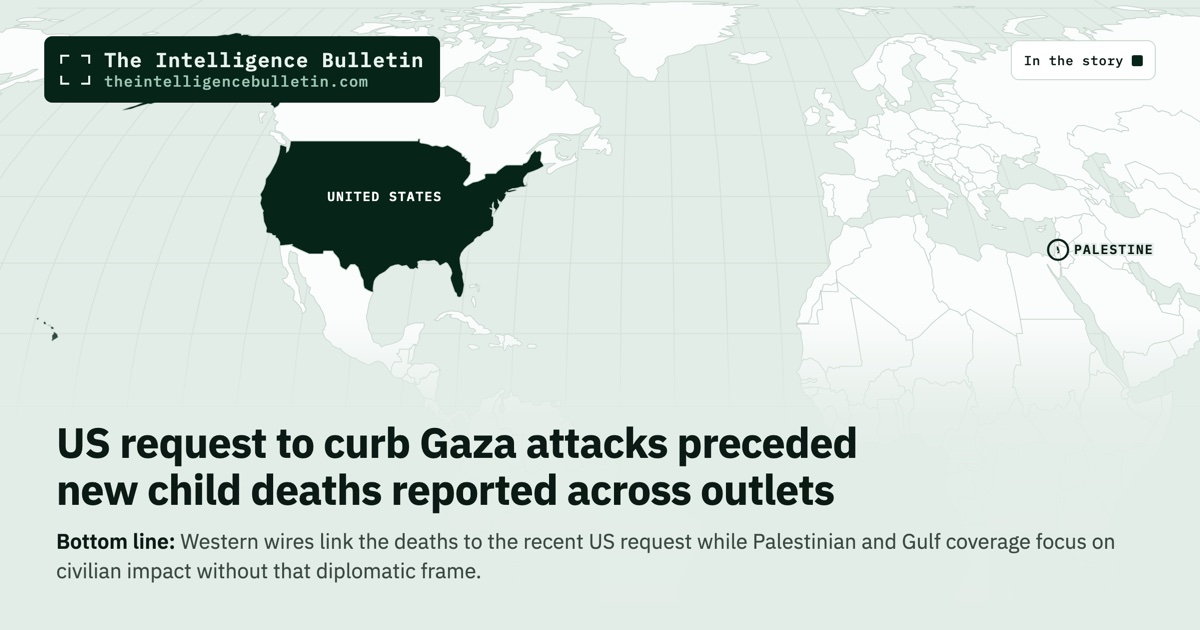
Map of the countries in the story: US request to curb Gaza attacks preceded new child deaths reported across outlets
On August 24, 2026, Israeli airstrikes and tank fire killed at least four Palestinians in Gaza, including a 4-year-old boy in Bureij refugee camp and a 10-year-old girl in Khan Younis. Israel said it targeted Hamas weapons sites and a militant. The incidents occurred a week after a US delegation including Jared Kushner urged Israel to reduce attacks as part of ceasefire implementation efforts. Gaza health officials reported over 1,288 post-ceasefire deaths.

One Story. Many Angles.

🇺🇸
United States
The Morning Call
Associated Press wire copy
2 kids among 4 killed in Gaza after US asked Israel to curb attacks
Read →
🇮🇱
Israel
Middle East Monitor
Carries Anadolu reporting
Child among 3 Palestinians killed in Gaza amid persistent Israeli attacks on civilians
Read →
🌐
Palestinian Territory
Wafa
Original reporting
Palestinian killed, others injured in Israeli strike on displaced persons’ tent in Deir al-Balah
Read →
🇬🇧
United Kingdom
Swindon Advertiser
Carries PA News Agency reporting
Two children among four Gaza dead week after US asked Israel to curb attacks
Read →
🇸🇦
Saudi Arabia
Arab News
Reuters wire copy
Israeli fire kills two young children in Gaza, medics say
Read →
5 sources · each independently reported
In Brief

Western wires link the deaths to the recent US request while Palestinian and Gulf coverage focus on civilian impact without that diplomatic frame.

The reporting reveals a clear split in emphasis rather than disputed facts. US and UK outlets that carried the AP dispatch explicitly frame the four deaths as occurring days after Washington’s direct request to Israel to scale back operations, presenting the timing as evidence that diplomatic pressure produced little immediate restraint. Arab News via Reuters highlights the child victims and medics’ accounts while noting broader US-backed peace efforts but omits the specific Kushner meeting. Wafa, the Palestinian agency, confines itself to one tent strike in Deir al-Balah and the displacement context, supplying no reference to US diplomacy. Middle East Monitor, drawing on Anadolu, stresses ongoing daily violations and aid shortfalls despite the ceasefire, treating the deaths as part of a pattern rather than a diplomatic failure. Israel is described across accounts as claiming strikes hit legitimate military targets inside mosques and displacement areas, yet no independent verification of those targets appears in any report. The contrast shows how proximity to the actors shapes inclusion of the US angle: Western wires tie events to Washington, while direct Palestinian and regional coverage prioritizes local civilian impact and cumulative violations.

Perspective Analysis

On August 24, 2026, Israeli airstrikes and tank fire killed at least four Palestinians in the Gaza Strip, including two children. Hospital officials and medics reported the deaths through multiple independent chains. A four-year-old boy died when a strike hit a building in the Bureij refugee camp after residents received evacuation warnings; his mother and sister were wounded. In Khan Younis, a ten-year-old girl was killed by tank fire east of the city, and another man died in a separate strike there. An earlier strike on a tent sheltering displaced people near Al-Aqsa Martyrs Hospital in Deir al-Balah killed one man, with others wounded. Gaza health officials placed the post-ceasefire death toll at approximately 1,288 Palestinians killed and more than 4,200 injured since October 2025, with 813 additional bodies recovered from rubble. The same officials recorded an overall war toll of roughly 73,422 Palestinians killed since October 2023.

Israel’s military stated that it carried out the strikes after issuing warnings and that it targeted two Hamas weapons storage facilities inside mosques, one in the Shati refugee camp in Gaza City and one in Deir al-Balah. The facilities reportedly contained dozens of Kalashnikov rifles, magazines and other military equipment. The military said one strike in Deir al-Balah killed a combatant affiliated with Hamas’s special forces unit. It added that it was not aware of any incident involving the ten-year-old girl in Khan Younis.

The incidents occurred one week after a United States delegation met with Israeli Prime Minister Benjamin Netanyahu to advance last year’s ceasefire agreement. A person familiar with that meeting said US negotiator Jared Kushner asked Netanyahu to draw down attacks in Gaza. Israel announced strikes on six of the seven days that followed. Palestinian officials reported that strikes had continued to hit homes, police stations and displacement sites. Hamas described the operations as designed to destabilize the territory and block the next steps of the ceasefire, which include demilitarization, reconstruction and deployment of an international stabilization force. Five Israeli soldiers have been killed since the ceasefire took hold, according to Israeli statements carried in the same reporting.

Gaza’s government media office recorded 4,379 ceasefire violations by Israel since the agreement and noted that only 66,607 of 189,000 promised aid trucks had entered the strip. It reported that just 11,759 of 29,800 people scheduled to leave through the Rafah crossing had been allowed to depart. The office called on Egypt, Qatar and Türkiye to press Israel to meet the agreement’s terms.

The accounts converge on the core sequence of strikes, the locations, the child victims and Israel’s stated military rationale. They diverge on how much weight to give the timing relative to the US request and on how to present the broader pattern of post-ceasefire activity. Outlets that carried the full Associated Press dispatch, including The Morning Call and the Swindon Advertiser, opened their pieces by placing the four deaths one week after the Kushner meeting and noted Israel’s continued strikes on six of the following seven days. Arab News, using Reuters copy, led with the two young children killed and medics’ accounts of the ten-year-old girl shot in the back while eating inside a tent; it mentioned broader US-backed peace efforts but did not reference the specific delegation request. Middle East Monitor, drawing on Anadolu Agency reporting, framed the day’s casualties as part of persistent attacks on civilians and displacement tents, adding details on heavy gunfire in Khan Younis’s Satr area and artillery shelling south of the Al-Maghazi refugee camp. It also recorded two additional deaths from earlier wounds and stressed shortfalls in aid and freedom of movement. Wafa reported only the Deir al-Balah tent strike, named the hospital that received the body, and listed cumulative post-ceasefire figures without reference to Washington.

A reader limited to one set of accounts would therefore miss different pieces of context. The AP-derived pieces make the recent US diplomatic contact the immediate frame for the day’s events, presenting the deaths as occurring despite that contact. The Anadolu-based and Palestinian-agency pieces supply granular local detail on displacement sites and aid shortfalls that the wires treat more briefly. Reuters copy centers the child victims and Israeli denials of specific incidents without the diplomatic timeline. No report supplies independent verification of the weapons caches Israel said it struck.

The reporting shows that proximity to the main actors shapes which element receives the lead. Western wires that relay the AP dispatch include the US request because that detail sits in their originating file. Direct Palestinian reporting and Anadolu-sourced pieces foreground the sites struck and the aid figures because those are the numbers their sources on the ground supply. Israeli military statements appear in every chain but receive the same status across them: an on-record claim without attached evidence of the weapons locations.

The single-source attribution for the Kushner request limits how far any account can press the claim that diplomatic pressure produced no visible restraint. That detail appears only in the AP-derived reporting and rests on one unnamed person. The corroborated elements—the four deaths, the child victims, the military targets claimed by Israel, and the 1,288 post-ceasefire figure—stand on multiple independent reporting chains and can be stated without qualification.

What to Watch

The clearest signal in the coverage is therefore the consistent local detail on displacement and aid shortfalls that appears across the Anadolu, Wafa and Reuters accounts but receives less space in the AP-derived pieces. Those shortfalls predate the day’s strikes and continue regardless of the US contact. The day’s events fit inside that longer record rather than marking a discrete failure or success of one diplomatic intervention.
Share this story

Child deaths at Krasnodar center expose split in how outlets weigh drone strikes on Russian logistics

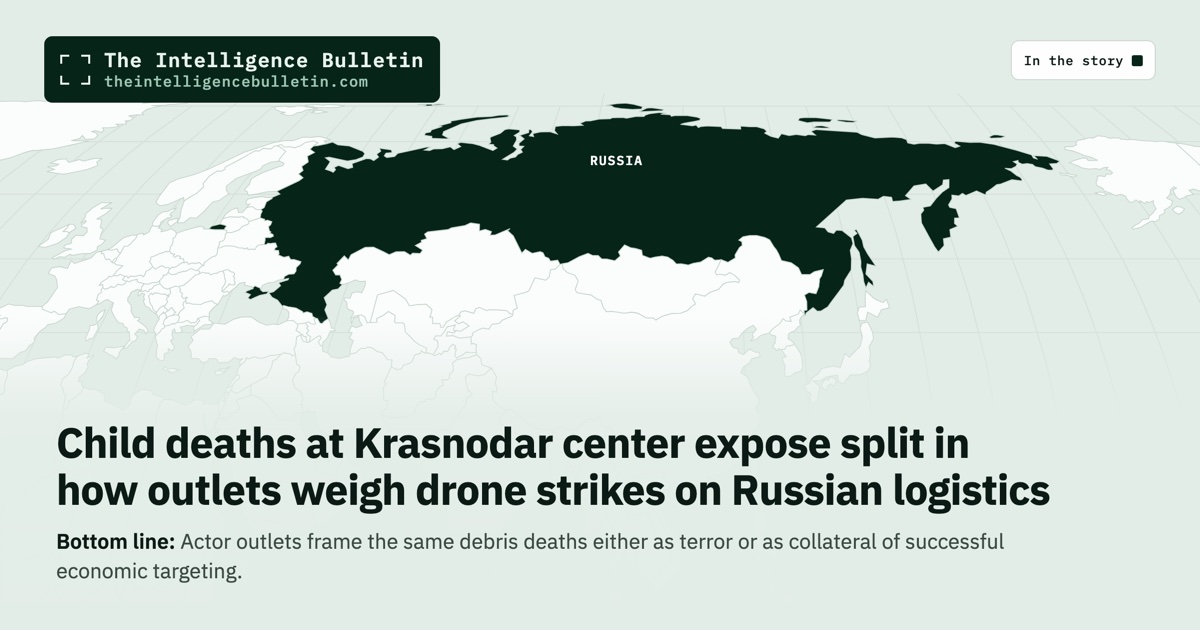
Map of the countries in the story: Child deaths at Krasnodar center expose split in how outlets weigh drone strikes on Russian logistics
Ukrainian drones struck Ozon logistics hubs across southern Russia overnight on August 23-24. Debris hit a private childcare center in Krasnodar, killing two or three children according to local officials and injuring others. Fires broke out at warehouses and nearby buildings. Russian accounts stress civilian deaths and call the strikes terrorism; Ukrainian reporting highlights repeated success against economic targets.

One Story. Many Angles.

🇷🇺
Russia
Lenta.ru
RUSSIAN
Original reporting
VSU strike on Krasnodar on August 24: casualties, consequences, victims
“Удар ВСУ по Краснодару 24 августа: жертвы, последствия, пострадавшие”
Read →
🇺🇦
Ukraine
Kyiv Post
Original reporting
Ukraine Drone Strikes Hit Ozon Warehouses in Russia for Third Straight Night
Read →
🇮🇳
India
The Times of India
Carries Russian regional officials via governor statements reporting
Ukraine drone attack kills 2 children in Russia’s Krasnodar, sets logistics hub ablaze
Read →
🇹🇷
Turkey
Anadolu Agency
Carries Russian regional officials reporting
3 children killed in Ukrainian drone attack on Ozon warehouse in southern Russia
Read →
🇨🇭
Switzerland
watson.ch
GERMAN
Carries TASS reporting
Russia Ukraine war: two dead in Ukrainian attack on Krasnodar
“Krieg Russland Ukraine: zwei Tote bei ukrainischem Angriff auf Krasnodar”
Read →
5 sources · each independently reported
In Brief

Actor outlets frame the same debris deaths either as terror or as collateral of successful economic targeting.

The reporting converges on the same core sequence—Ukrainian drones reached southern Russia, debris struck a Krasnodar childcare center, and an Ozon warehouse burned—yet splits sharply on emphasis and framing. Russian domestic coverage from Lenta.ru centers the child deaths as deliberate terror, quotes Duma deputies linking the attack to Zelensky’s fundraising, and cites Governor Kondratyev’s account of three teenage victims. Kyiv Post treats the same night as the third consecutive success against Ozon hubs, notes the debris incident only in passing, and ties the campaign to retailers allegedly supplying the Russian military. Anadolu Agency and The Times of India record the casualties and fire in plain terms without strategic gloss, while watson.ch relays the Russian governor’s statement through Tass and flags that the figures remain unverified. The fault line is not between countries but between actor outlets that must justify the strike to their audience and distant observers who simply record both the children’s deaths and the warehouse damage. That split reveals how proximity to the event forces every outlet to choose which detail carries the moral weight.

Perspective Analysis

Ukrainian drones reached deep into southern Russia on the night of August 23-24, striking multiple Ozon logistics centers and setting at least one warehouse ablaze in Krasnodar. Debris from the drones fell on a private childcare facility operating around the clock in the city, killing children and injuring others according to the regional governor. Russian authorities reported damage to five private homes and apartment blocks under construction as well. The strikes formed part of a wider series that also hit Ozon sites in Adygea, Stavropol Krai and Dagestan, and coincided with Ukraine marking 35 years since its declaration of independence from the Soviet Union.

Governor Veniamin Kondratyev stated that fragments of the incoming devices landed on the childcare center. Lenta.ru, drawing on his account and subsequent statements, reported that three teenagers aged 13, 15 and 16 died there and that twelve people were injured in total, six of them children. Anadolu Agency placed the death toll at three children. Kyiv Post, The Times of India and watson.ch each recorded two children killed. Kyiv Post added that nine others were injured, seven of them children and two adults. All five outlets noted the fire at the Ozon facility, with Ozon itself confirming no staff casualties at the warehouse. Russian air defenses intercepted some of the drones, according to the governor of Stavropol Krai, though the strikes still produced visible fires at industrial sites.

The same night’s events extended an existing pattern. Ukrainian forces had already targeted Ozon and rival retailer Wildberries hubs in Samara Oblast on August 22 and in Orenburg the following night. Kyiv Post described the campaign as aimed at facilities accused of supplying components to the Russian military, noting that seven of Wildberries’ ten largest centers had been disabled in earlier operations. Russian officials, by contrast, presented the Krasnodar strike as an attack on civilian infrastructure with no military purpose. Lenta.ru quoted State Duma deputy Mikhail Sheremet of Crimea calling the strike on the children’s center a terrorist act. Sheremet linked the timing to Ukrainian setbacks on the front and to President Volodymyr Zelensky’s need to demonstrate victories in order to secure further Western funding.

Background distances place Krasnodar roughly 250 kilometers from occupied Berdiansk and 365 kilometers from Ukrainian-held territory near Orikhiv. The city lies well inside Russian territory, making the debris impact on a childcare center the first reported civilian deaths inside Russia from this particular wave of long-range drone strikes. Russian coverage from Lenta.ru also cited a retired colonel who suggested the drones could have been launched from Donetsk or Zaporizhzhia regions. Ukrainian reporting made no reference to launch points and instead stressed repeated operational success against economic targets.

A reader limited to any single national press would miss the full sequence. Russian domestic accounts alone foreground the child casualties and the political interpretation that the strikes serve Zelensky’s fundraising needs. Ukrainian coverage alone foregrounds the repeated hits on Ozon and the retail chain’s alleged military supply role while treating the childcare-center deaths as a brief aside. The three non-actor outlets record both the deaths and the warehouse fire without attaching either a terrorism label or a military-logistics justification. watson.ch adds the standard qualifier that Russian figures could not be independently verified at the time of publication. The casualty count itself remains disputed across the set: Lenta.ru and Anadolu Agency each state three deaths while the remaining three sources state two.

The core facts that survive every account are the drone strikes on the Ozon network, the resulting fire at the Krasnodar warehouse, and the impact of debris on the childcare center. Those three elements appear in reporting from Russian, Ukrainian, Indian, Turkish and Swiss outlets. The disagreement centers on the precise number of children killed and on the framing that should accompany the event. Russian sources treat the deaths as the central story and label the attack terrorism. Ukrainian sources treat the warehouse strikes as the central story and locate them inside an ongoing economic-pressure campaign. Neutral observers present both elements side by side and note the verification gap.

The neutral framing aligns most closely with the evidence available across independent chains. The corroborated record shows Ukrainian drones reached the Ozon sites and that debris caused deaths and injuries at the childcare center; the precise death toll and the strategic intent remain claims advanced by the parties to the conflict. Russian authorities have an interest in emphasizing civilian suffering inside Russia to shape domestic and international opinion. Ukrainian authorities have an interest in emphasizing damage to Russian economic infrastructure to demonstrate reach and to justify continued Western support. Outlets without those domestic stakes simply record the documented outcomes.

What to Watch

The pattern of targeting retail logistics hubs is likely to continue because both sides view the other’s economic base as a legitimate pressure point. Russian statements already warn that further strikes on such facilities will prompt reciprocal targeting of Ukrainian economic sectors. Each new incident inside Russia will again force every outlet to decide whether the child casualties or the warehouse damage receives the lead emphasis. The split observed here will therefore recur until the underlying campaign itself changes.


Share this story

Moderna-Merck vaccine cuts melanoma recurrence 49% in Phase 3; stock and approval paths diverge by country

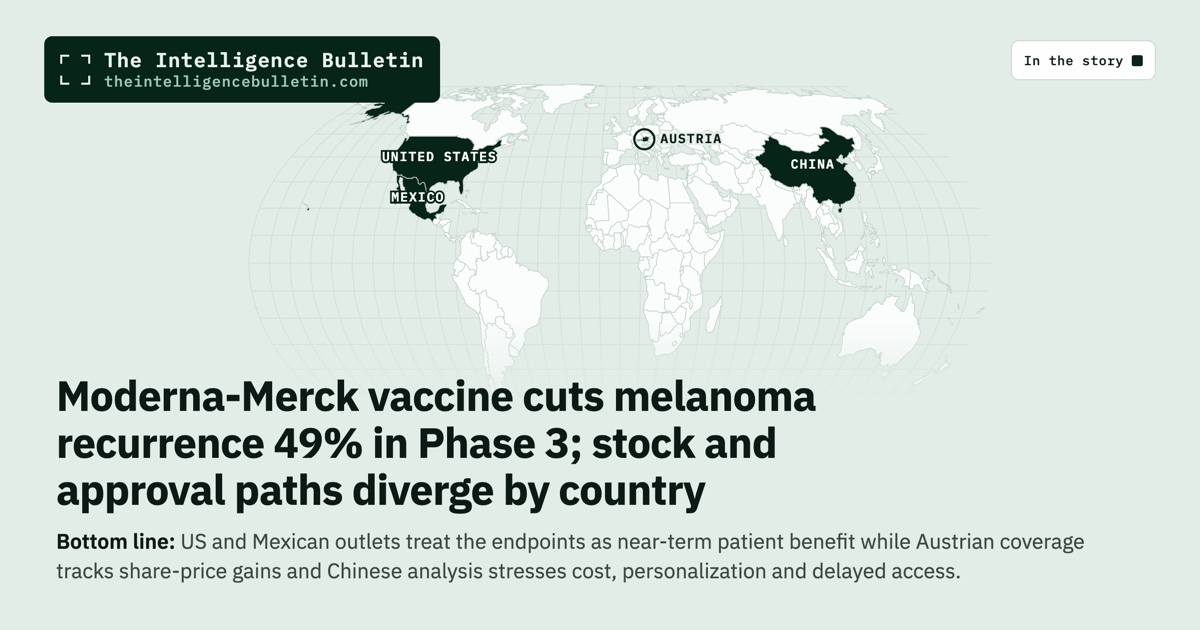
Map of the countries in the story: Moderna-Merck vaccine cuts melanoma recurrence 49% in Phase 3; stock and approval paths diverge by country
Moderna and Merck announced that their personalized mRNA cancer vaccine intismeran autogene plus Keytruda met the primary endpoint of recurrence-free survival and a key secondary endpoint of distant metastasis-free survival in a Phase 3 trial of patients with resected high-risk stage IIB-IV melanoma. The companies plan to share full data at an upcoming medical meeting and discuss regulatory filings. Coverage varies by outlet focus on clinical data, stock impact, patient hopes or caution about personalization, cost and timelines.

One Story. Many Angles.

🇺🇸
United States
KTBB News
Carries ABC News reporting
Personalized mRNA cancer vaccine shows promise in extending lifespan in melanoma trial – KTBB News, Weather, Talk
Read →
🇵🇭
Philippines
The Manila Times
GlobeNewswire wire copy
Moderna and Merck Cancer Vaccine Success Is Good News for CancerVax
Read →
🇲🇽
Mexico
Forbes Mexico
SPANISH
Carries Reuters reporting
Moderna and Merck vaccine reduces melanoma recurrence and spread; raises hope for new treatments
“Vacuna de Moderna y Merck reduce la recurrencia y propagación del melanoma; sube esperanza de nuevos tratamientos”
Read →
🇦🇹
Austria
Boerse Express
GERMAN
Original reporting
Moderna stock: Intismeran reaches Phase-3 targets with Merck
“Moderna Aktie: Intismeran erreicht Phase-3-Ziele mit Merck”
Read →
🇨🇳
China
Huxiu
CHINESE
Commentary
mRNA cancer vaccine ushers in major breakthrough, but don’t get too excited too soon
“mRNA癌症疫苗迎来重大突破,但别高兴太早-虎嗅网”
Read →
5 sources · 4 independent accounts — some share the same news agency’s report
In Brief

US and Mexican outlets treat the endpoints as near-term patient benefit while Austrian coverage tracks share-price gains and Chinese analysis stresses cost, personalization and delayed access.

The reporting converges on the core trial outcome but diverges sharply on stakes and next steps. US coverage from KTBB stresses the 49% reduction in recurrence risk and 59% drop in distant spread after surgery, positioning the combination as the first to extend meaningful benefit beyond Keytruda alone and quoting oncologist expectations of approval by early 2027. Mexican reporting at Forbes echoes the recurrence and spread reductions while highlighting hopes for broader solid-tumor applications and noting Moderna’s stock surge. Austrian financial outlet Boerse Express centers the Phase-3 milestone’s effect on Moderna shares, analyst target upgrades up to $170, and institutional buying. Philippine Manila Times carries a GlobeNewswire release framing the result as validation that de-risks similar LNP-mRNA platforms for smaller firms like CancerVax. Chinese analysis at Huxiu stresses that the vaccine is therapeutic only, personalized and expensive, limited to post-surgical adjuvant use in melanoma, unlikely to reach patients before 2027-2029, and cautions against premature optimism given missing overall-survival data. The split reveals how the same endpoints read as imminent clinical advance in some markets and as a still-distant, high-cost platform proof in others.

Perspective Analysis

Moderna and Merck disclosed on August 19 that their personalized mRNA vaccine intismeran autogene, given with Merck’s Keytruda, met both its primary endpoint of recurrence-free survival and its secondary endpoint of distant metastasis-free survival in the Phase 3 INTerpath-001 trial. The study enrolled 1,137 patients whose high-risk stage IIB-IV melanoma had been completely resected. Participants received up to nine doses of the combination or Keytruda alone for roughly a year. The companies described the improvements as statistically significant and clinically meaningful, though they withheld the full numerical dataset for presentation at an upcoming international medical meeting.

The 49 percent reduction in recurrence risk and 59 percent reduction in distant-metastasis risk versus Keytruda alone come from earlier Phase 2 data that the Phase 3 readout confirmed in direction. KTBB News reported these percentages directly from the trial readout and noted that the regimen is the first to demonstrate a survival-extension benefit beyond Keytruda monotherapy in this setting. Forbes Mexico carried the same reductions and added that the vaccine trains the immune system against patient-specific neoantigens identified through tumor sequencing. Huxiu likewise referenced the 49 percent and 59 percent figures from prior data and confirmed the Phase 3 endpoints had been reached.

The vaccine is manufactured individually for each patient. Tumor and healthy tissue are sequenced, mutations are identified, and an AI tool selects up to 34 neoantigens most likely to trigger an immune response. The corresponding mRNA is then produced and packaged in lipid nanoparticles. This process makes the therapy therapeutic rather than preventive; it can only be administered after a cancer diagnosis and after surgery. No outlet reported overall-survival data, which remains a secondary endpoint still maturing.

Regulatory steps lie ahead. The companies intend to engage the FDA once the complete dataset is submitted. KTBB quoted Dr. Ahmad Tarhini of the H. Lee Moffitt Cancer Center stating that he expects approval and availability to patients by early 2027. Forbes Mexico reported that Moderna president Stephen Hoge said the therapy could reach the market as soon as next year if regulators grant breakthrough designation. Huxiu noted that even an expedited FDA review typically requires at least six months to a year after submission, and the trial’s official completion date listed in company documents is October 2029.

Market reaction appeared in one detailed account. Boerse Express recorded an 8.6 percent single-day gain for Moderna shares on the announcement, bringing the year-to-date advance to 367 percent. Analysts at Bank of America lifted their price target from 40 to 170 dollars, Goldman Sachs raised its target to 120 dollars, and UBS, RBC and Morgan Stanley issued comparable upward revisions. BlackRock disclosed a 7.66 percent stake. The same outlet noted that Moderna remains unprofitable, posting a 782 million dollar net loss on 145 million dollars of revenue in the second quarter.

A separate press release carried by The Manila Times framed the result as validation for other developers using the same lipid-nanoparticle mRNA platform. CancerVax, a preclinical company pursuing an off-the-shelf universal vaccine, stated that the INTerpath-001 readout de-risks the delivery technology it plans to apply to non-personalized candidates.

Accounts diverge on what the result implies for patients and timelines. KTBB and Forbes Mexico foreground near-term clinical utility and the possibility of expanded use against lung, breast and pancreatic cancers. Forbes Mexico quoted Karen Knudsen of the Parker Institute calling the data the start of a new phase in solid-tumor immunotherapy. Boerse Express treats the event principally as a corporate-finance milestone. Huxiu emphasizes constraints that remain unchanged: the vaccine cannot be used prophylactically, cannot be stockpiled because each dose is patient-specific, and carries manufacturing costs comparable to CAR-T therapies. It notes that melanoma incidence in China is low—0.4 per 100,000 men and 1.3 per 100,000 women—and that broader applicability will require additional trials whose completion dates are years away.

The most tightly corroborated elements are the trial endpoints and the magnitude of risk reduction reported in the Phase 2 data now reinforced by Phase 3. Four independent reporting chains—US health coverage, Mexican business reporting, Austrian financial analysis, and Chinese specialist commentary—all state that the combination met recurrence-free and distant-metastasis-free survival targets. The stock-price and analyst-target movements rest on a single detailed chain and are therefore narrower in corroboration. The limitations on use, cost, and timeline receive their most explicit treatment in the Chinese analysis, which draws directly from the trial design and regulatory precedents rather than from market sentiment.

What to Watch

The clinical data therefore stand on firmer ground than either bullish market projections or blanket optimism about rapid patient access. Because the therapy must be manufactured per patient after sequencing, even swift regulatory approval will leave a lag of months between prescription and first dose. The absence of overall-survival results at this interim point means the survival-extension language used in some coverage rests on recurrence and metastasis endpoints rather than direct mortality data. Readers who encounter only the US or Mexican accounts will receive an impression of imminent standard-of-care change that the manufacturing and regulatory realities described elsewhere make less certain. Readers who encounter only the financial or cautionary accounts will miss the concrete risk reductions already observed in more than a thousand patients. The evidence that has converged across chains points to a platform proof-of-concept whose translation into routine practice will be slower and more expensive than the headline endpoints alone suggest.


Share this story

Bessent readies ‘economic D-Day’ sanctions as Iran warns of retaliation

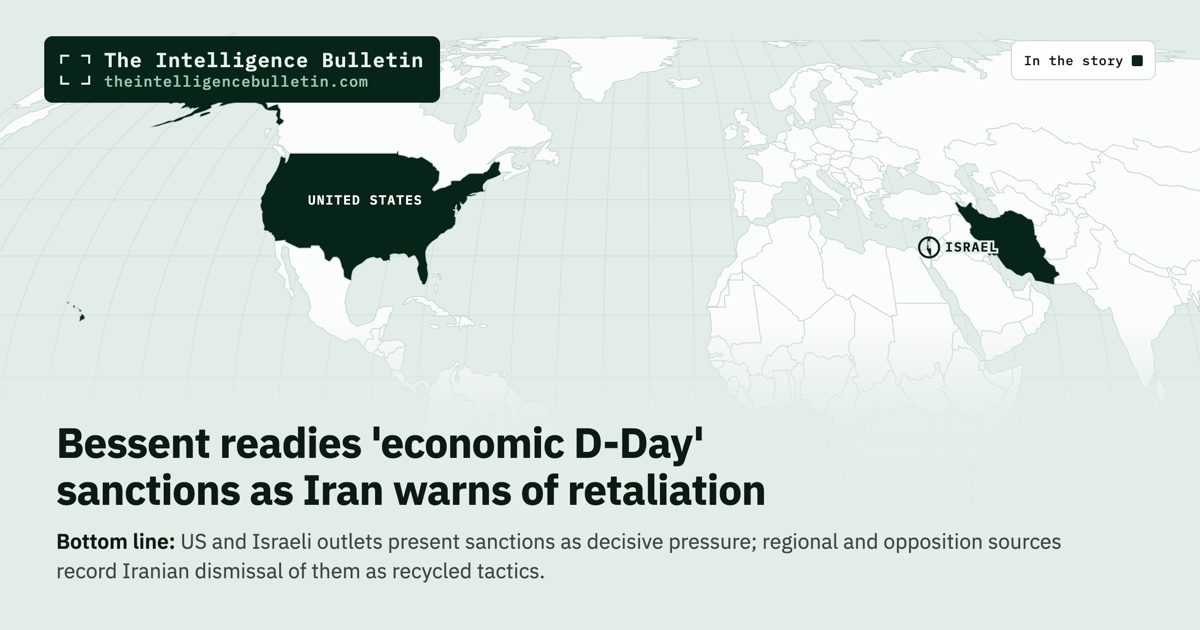
Map of the countries in the story: Bessent readies 'economic D-Day' sanctions as Iran warns of retaliation
US Treasury Secretary Scott Bessent will hold a press conference today to detail new economic measures against Iran, billed as the toughest sanctions in history and an ‘economic D-Day’ targeting trade partners. Iran’s foreign ministry has called the threats desperate and an erosion of sovereignty while warning neighbors of retaliation. The announcement occurs against the backdrop of a stalled six-month war and existing US naval blockade of Iranian ports.

One Story. Many Angles.

🇺🇸
United States
NBC News
Carries Reuters reporting
Trump administration live updates: U.S. expected to announce new sanctions against Iran
Read →
🇮🇷
Iran
NCR Iran
Commentary
Iran News in Brief – August 23, 2026
Read →
🇶🇦
Qatar
Al Jazeera
Original reporting
US threatens toughest sanctions yet against Iran: What we know
Read →
🇩🇪
Germany
Deutsche Welle
Carries AP reporting
US to unveil new Iran sanctions, says war entering ‘endgame’
Read →
🇮🇱
Israel
Jerusalem Post
Carries REUTERS reporting
Donald Trump: Iran ‘completely collapsing’ as Bessent warns of ‘economic D-Day’
Read →
5 sources · 3 independent accounts — some share the same news agency’s report
In Brief

US and Israeli outlets present sanctions as decisive pressure; regional and opposition sources record Iranian dismissal of them as recycled tactics.

All five outlets report the same core sequence: Treasury Secretary Bessent is scheduled to unveil sweeping new sanctions today aimed at isolating Iran economically, with explicit warnings to third countries. NBC News and Deutsche Welle treat the move as the next operational step in a US-led campaign already under way, quoting Bessent directly on an unprecedented financial offensive. Al Jazeera widens the lens to include Tehran’s explicit threats of seismic retaliation and Gulf states’ reluctance to risk further instability. The Jerusalem Post links the sanctions to an imminent collapse narrative, citing Trump’s social-media claims that Iran is already crumbling. NCR Iran, writing from the Iranian opposition, frames intensified sanctions as evidence of the regime’s deepening vulnerability but stresses that only organized internal resistance can produce change. The telling divergence is not over the facts of the announcement but over its likely effect: US and Israeli reporting present it as decisive pressure that can finish the job, while Al Jazeera and NCR Iran record Iranian officials treating it as a familiar and ultimately ineffective escalation. This split tracks each outlet’s geographic proximity to the conflict and its domestic audience’s stake in the outcome.

Perspective Analysis

Treasury Secretary Scott Bessent is scheduled to hold a press conference at 2 p.m. Eastern Time on August 24 to outline new economic measures against Iran. The administration has described the coming steps as the toughest sanctions in history and the single greatest financial offensive ever marshaled against an adversary, part of what President Trump has labeled an economic D-Day. The measures are intended to sever every remaining lifeline that sustains the Iranian government, including oil sales, financial transfers, and third-country support. This announcement arrives while the United States already maintains a naval blockade of Iranian ports aimed at halting oil exports and while a broader conflict that began on February 28 continues without a negotiated end.

Iran’s Foreign Ministry spokesman Esmaeil Baqaei has dismissed the planned sanctions as an assertion of extraterritorial sovereignty that erodes the foundational principles of the United Nations system. Iranian Foreign Minister Abbas Araghchi has said the measures are bound to fail, likening them to earlier episodes of pressure that Tehran has weathered. Supreme National Security Council secretary Mohsen Rezaei has warned that any country joining the United States in these restrictions will be regarded as an enemy and will face seismic retaliation, including the prospect that not a single drop of oil will leave the Persian Gulf by any route. Iranian officials have appealed directly to neighboring states not to participate, framing cooperation with Washington as an act of war.

The sanctions threat sits inside a six-month conflict in which the United States and Israel conducted strikes that killed Supreme Leader Ayatollah Ali Khamenei and destroyed nearly all of Iran’s military factories and its nuclear program, according to statements from Bessent. Negotiations that followed a June memorandum of understanding expired last week without agreement, leaving control of the Strait of Hormuz and the terms of any ceasefire unresolved. The United Arab Emirates, previously a major trading partner, has already suspended all trade with Iran following ballistic-missile incidents. China, which purchased the large majority of Iran’s shipped oil in 2025, has stated that sanctions and pressure do not resolve problems and that it will protect its own interests.

The National Council of Resistance of Iran, an opposition group, has pointed to concrete economic indicators inside the country: inflation near 127 percent against a 60 percent rise in the minimum wage, bread prices up 97 percent, and roughly 22 million people in the labor force without employment. It reports that wages for a family of four cover only about 19 days of the month and that 4,229 protests occurred across different sectors in the Iranian year ending in March 2026. These figures are presented as evidence that external financial pressure compounds existing internal strains that could fuel further unrest if organized resistance networks mobilize.

Coverage of the impending announcement converges on the basic sequence of Bessent’s press conference and the administration’s rhetoric of unprecedented isolation. Four of the five outlets quote or paraphrase the same language of an economic D-Day and the toughest sanctions on record. They also record the Iranian government’s rejection of the measures and its warnings to third countries. The single point of explicit disagreement centers on President Trump’s assertion, carried in two outlets, that Iran is already completely collapsing. Iranian state media and opposition commentary treat this characterization as overstated, while the Jerusalem Post presents it as confirmation that sanctions can finish the job.

A reader limited to United States reporting would see the sanctions as the next scheduled step in an ongoing campaign whose success depends on enforcement against third parties. The same reader would encounter little detail on how Gulf governments calculate the risk of further instability or on Iranian threats to target alternative oil routes. A reader limited to Israeli reporting would encounter the strongest linkage between the sanctions and outright regime collapse, with less emphasis on the diplomatic and economic hurdles that remain. A reader limited to Qatari or German reporting would receive the clearest account of Iranian retaliation warnings and Chinese pushback, along with the observation that many regional actors fear the consequences of sudden regime change more than they fear continued Iranian pressure. An Iranian opposition reader would see the sanctions as accelerating domestic economic hardship that only internal organization can convert into political change, rather than as an external lever capable of producing collapse on its own.

The reporting from Al Jazeera and Deutsche Welle most fully registers the constraints on the United States side: limited leverage over China’s refineries and Russia’s commercial channels, and the reluctance of Gulf states that must live beside Iran regardless of the outcome. The Jerusalem Post and NBC News supply the clearest record of what the administration intends to demand from allies and what it claims to have already achieved militarily. The National Council of Resistance of Iran supplies the only quantitative picture of conditions inside the country that would determine whether external pressure produces internal fracture.

What to Watch

The account that best matches the available evidence is the one that treats the sanctions as a significant escalation whose outcome remains uncertain precisely because third countries retain choices. Multiple independent reporting chains document both the scale of the announced measures and the explicit Iranian counter-threats, while the single-source claim of imminent collapse lacks corroboration from Iranian or regional sources. The administration has an interest in presenting the measures as decisive; Tehran has an interest in deterring partners from joining them. What happens after the 2 p.m. press conference will depend less on the wording of the new rules than on whether China, Russia, and Gulf states calculate that the costs of continued trade with Iran outweigh the costs of American enforcement.


Share this story

Norway sustains $9.2B Ukraine aid into 2027 as Nordic leaders stand with Kyiv

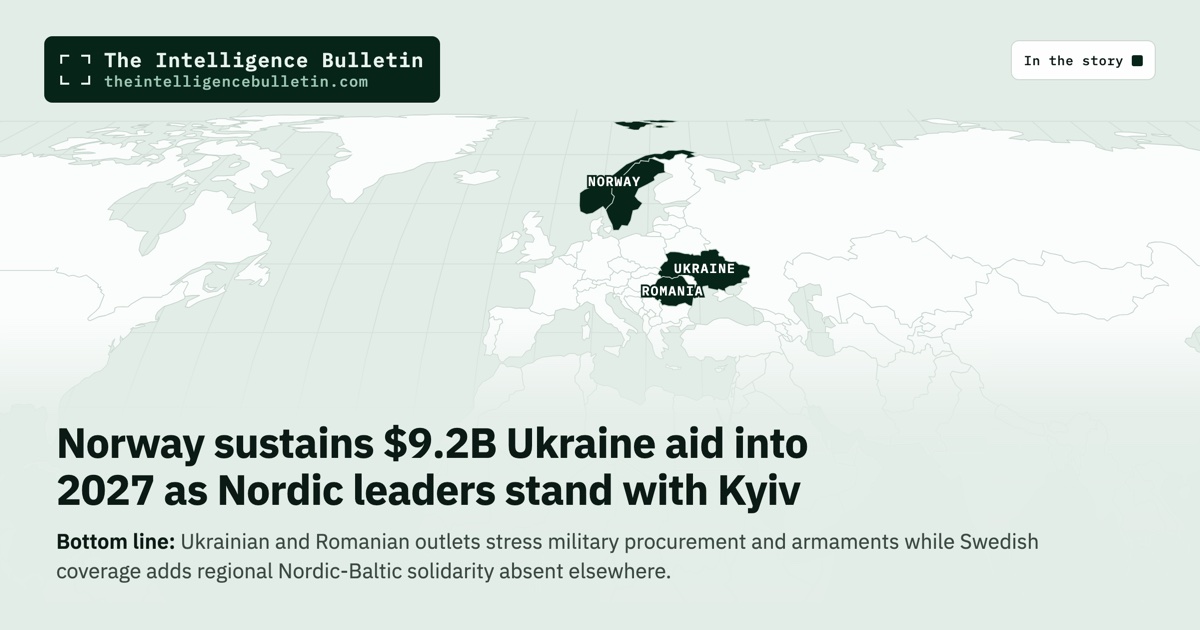
Map of the countries in the story: Norway sustains $9.2B Ukraine aid into 2027 as Nordic leaders stand with Kyiv
Norwegian Prime Minister Jonas Gahr Støre announced plans to provide Ukraine with 85 billion Norwegian kroner ($9.2 billion) in 2027 support, matching 2026 levels under the Nansen programme. He informed President Volodymyr Zelensky during a Kyiv meeting attended by Nordic and Baltic leaders. The funds focus primarily on military assistance, including purchases from Ukraine’s defense industry, with some civilian components. The pledge signals sustained backing amid ongoing conflict with Russia.

One Story. Many Angles.

🇺🇦
Ukraine
Kyiv Post
Original reporting
Norway Pledges $9.2 Billion to Ukraine for 2027
Read →
🇵🇰
Pakistan
The News International
Carries Reuters reporting
Norway pledges over $9B in financial and military support to Ukraine by 2027
Read →
🇦🇫
Afghanistan
Ariana News
Reuters wire copy
Norway to give over $9 billion to Ukraine in 2027
Read →
🇸🇪
Sweden
Göteborgs-Posten
SWEDISH
Carries TT reporting
Norwegian promise of new billions to Ukraine
“Norskt löfte om nya miljarder till Ukraina”
Read →
🇷🇴
Romania
Digi24
ROMANIAN
Carries Kyiv Post reporting
Norway announces huge aid for Ukraine: 9.2 billion dollars in 2027. Most of it destined for armaments
“Norvegia anunță un ajutor uriaș pentru Ucraina: 9,2 miliarde de dolari în 2027. Cea mai mare parte, destinată armamentului”
Read →
5 sources · 4 independent accounts — some share the same news agency’s report
In Brief

Ukrainian and Romanian outlets stress military procurement and armaments while Swedish coverage adds regional Nordic-Baltic solidarity absent elsewhere.

The reporting converges on Norway’s commitment to maintain record-level aid to Ukraine, yet the angles reveal how proximity and stakes shape emphasis. Ukrainian coverage from Kyiv Post highlights direct economic and battlefield relevance, noting procurement from Ukraine’s own industry as a lifeline. Romanian and Pakistani outlets stress the military allocation, with Digi24 specifying that the bulk targets armaments and The News International breaking out $7.5 billion for defense versus civilian uses. Swedish reporting from Göteborgs-Posten stands apart by embedding the pledge in Nordic-Baltic solidarity through the NB8 group, quoting a joint statement on supporting Ukraine until EU and NATO integration. Afghan coverage via Ariana News relays the core announcement with minimal added context, treating it as distant European news amid its own regional focus. This pattern shows how outlets closer to the conflict or region foreground military utility and collective resolve, while distant ones present it as a straightforward continuity pledge without local linkage. The absence of Norwegian domestic sourcing in the set underscores reliance on the Kyiv announcement and wire relays for the global picture.

Perspective Analysis

Norwegian Prime Minister Jonas Gahr Støre announced on August 23 that his government would seek parliamentary approval for 85 billion Norwegian kroner, or roughly 9.2 billion dollars, in support to Ukraine for 2027. The figure matches the level already allocated for 2026 and forms the next installment of the Nansen Support Programme. Støre delivered the news in person to President Volodymyr Zelensky during a meeting in Kyiv attended by leaders from the Nordic and Baltic states. The package is described by the Norwegian government as continuing emergency assistance, with the largest share directed toward military needs and including direct purchases of equipment from Ukrainian defense manufacturers.

The timing placed the pledge inside a broader gathering of the eight Nordic-Baltic countries, known as the NB8 group. Those leaders issued a joint statement committing to support Ukraine for as long as necessary, in coordination with allies, until a just and lasting peace is reached and Ukraine advances toward membership in the European Union and NATO. Støre linked the aid explicitly to continental security, stating that support and reconstruction of Ukraine matter for Europe’s own safety. The announcement came against the backdrop of intensified drone and missile strikes on economic targets by both Russia and Ukraine, with fighting now in its fourth and a half year.

The military component receives consistent emphasis where outlets supply detail. The Norwegian statement, carried in full by Kyiv Post, specifies that the 2027 funds will prioritize military assistance and will feature procurement inside Ukraine itself. Digi24, drawing on the same government text, reports that the largest part of the sum is earmarked for armaments. The News International supplies a further breakdown, attributing 70 billion kroner, or about 7.5 billion dollars, to defense, weapons, and military equipment, with the remaining 15 billion kroner, or roughly 1.6 billion dollars, allocated to civilian reconstruction and humanitarian relief. Earlier Norwegian contributions through NATO’s Prioritized Ukraine Requirements List have already exceeded 12.5 billion kroner, providing context for the scale of the new commitment.

The Swedish coverage from Göteborgs-Posten places the pledge inside the NB8 meeting itself. It records the presence of Denmark’s prime minister, Finland’s president, and other regional leaders, notes Sweden’s participation by video link, and quotes the group’s collective pledge of continued political, military, financial, developmental, and humanitarian cooperation. The account stresses that the aid will flow mainly to Ukraine’s armed forces and frames the step as part of sustained Nordic-Baltic solidarity ahead of a wider coalition meeting on Ukraine scheduled for the following day.

Distant outlets relay the core figures with less elaboration. Ariana News presents the 85-billion-kroner commitment as a straightforward continuation of 2026 levels, situating it within the same Kyiv visit by Nordic and Baltic leaders and noting the parallel escalation of drone campaigns on both sides. Its account stays close to the government statement without additional military or regional framing.

These differences in emphasis produce distinct pictures for readers who encounter only one version. A reader limited to the Ukrainian report receives the strongest stress on direct economic benefit to Kyiv and on the unusual step of buying weapons inside Ukraine, elements presented as immediate battlefield support. A reader of the Romanian account encounters the clearest foregrounding of armaments as the dominant destination of the money. The Swedish reader sees the pledge embedded in an explicit regional consensus that ties aid to long-term goals of Ukrainian integration with Western institutions. The Pakistani reader receives the only numerical split between defense and civilian lines. The Afghan reader encounters the announcement stripped to its headline numbers and placed alongside other distant international stories.

The convergence across independent reporting chains on the headline commitment and its military priority supplies the firmest ground for any assessment. Every outlet that carried the government announcement, whether directly or through relay, records the same total, the same continuity with 2026, and the same primary focus on military use. Where outlets add context, the additions track observable proximity: Ukrainian and Romanian accounts, closest to the conflict, highlight procurement and armaments; Swedish coverage, from a neighboring Nordic state, supplies the regional grouping that the Norwegian statement itself referenced through the presence of those leaders. Outlets farther removed, such as the Afghan one, transmit the announcement without those layers. The set contains no Norwegian domestic reporting, so global readers depend on the Kyiv announcement and subsequent relays for the details that reached them.

What to Watch

The sustained scale of the commitment, now locked in for a second consecutive year at record levels, points to a durable Norwegian policy choice rather than a one-off response. Because the funds flow through an established multi-year programme and include direct support for Ukraine’s own production capacity, they reduce the lag between decision and delivery on the battlefield. Regional statements tying the aid to eventual Ukrainian membership in the European Union and NATO indicate that Oslo and its Nordic-Baltic partners view the assistance as part of a longer political trajectory, not solely as wartime relief. For Ukraine, the continuity matters because it supplies predictable revenue and equipment at a moment when both sides continue to target economic infrastructure far from the front lines. For European security calculations, the pledge reinforces the pattern of bilateral commitments that supplement collective mechanisms such as NATO’s requirements list. The reporting shows that pattern holding steady, with the military component and the regional framing both receiving consistent weight wherever outlets supplied those specifics.


Share this story

Israel hits southern Syria vehicle days after airbase strike; Syria FM thanks Turkey

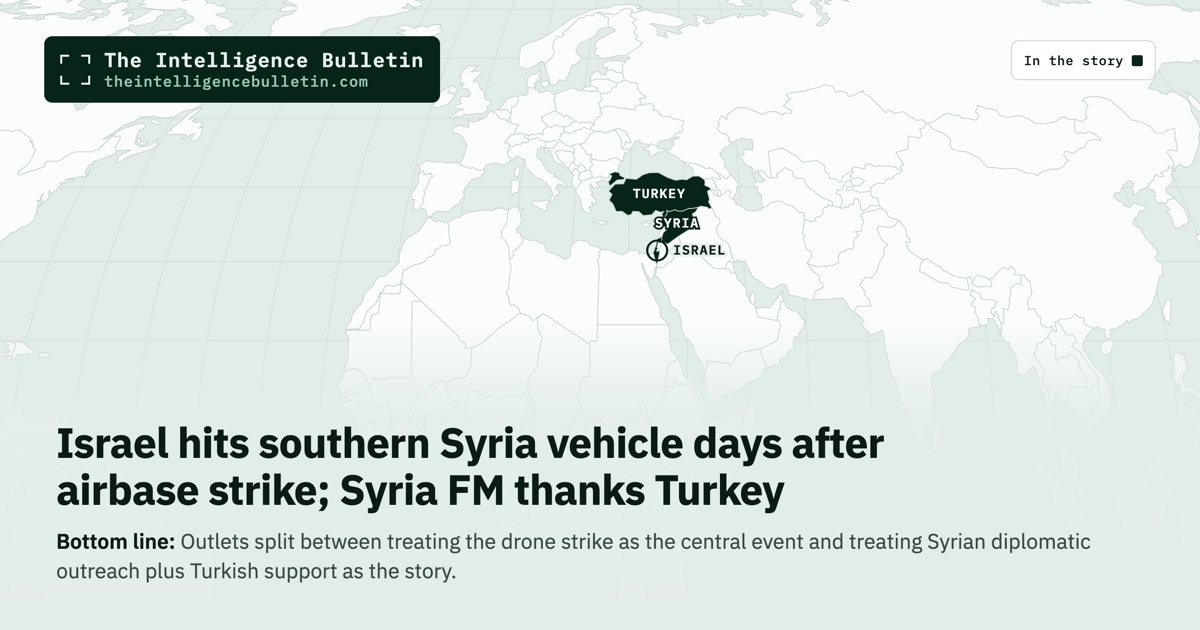
Map of the countries in the story: Israel hits southern Syria vehicle days after airbase strike; Syria FM thanks Turkey
On August 23, 2026, Israel launched a drone strike on a vehicle near Beit Jinn in southwestern Syria, wounding one person. Israel said it targeted a terrorist threat; Syria called it a sovereignty violation. The strike followed Israel’s raid on the Abu al-Duhur airbase, which Israel linked to Turkish military plans denied by both Damascus and Ankara. Syrian Foreign Minister Asaad al-Shaibani expressed gratitude for Turkish military rebuilding support while noting severed contacts with Israel and hopes that US-mediated security talks could resume.

One Story. Many Angles.

🇬🇧
United Kingdom
Morning Star
Original reporting
Israel launches drone attack on Syria
Read →
🇮🇱
Israel
Jewish News Syndicate
Commentary
Inside Israel’s intelligence room: The unfolding drama amid Turkey’s secret military expansion in Syria
Read →
🇹🇷
Turkey
Daily Sabah
Carries Agencies reporting
Not trusting Israel currently, thankful for Turkish support: Syria FM
Read →
🇺🇸
United States
Al-Monitor
Carries Agence France-Presse reporting
Syria says Israel talks addressed de-escalation, staying out of Israel-Turkey tensions
Read →
🇸🇦
Saudi Arabia
Arab News
Carries Reuters reporting
Syria foreign minister sees Israel security talks resuming despite no trust
Read →
5 sources · 4 independent accounts — some share the same news agency’s report
In Brief

Outlets split between treating the drone strike as the central event and treating Syrian diplomatic outreach plus Turkish support as the story.

Reporting across the set converges on a narrow factual core: an Israeli drone strike in southern Syria followed the Abu al-Duhur airbase attack, prompted Syrian condemnation, and drew US criticism from envoy Tom Barrack, while Syria’s foreign minister used a Reuters interview to affirm reliance on Turkish support and openness to renewed security talks despite zero current trust. The accounts diverge sharply on framing and omission. The UK outlet centers the latest strike as the event itself and records both Israeli military claims and Syrian ministry statements without mediation gloss. Israeli analysis frames the entire sequence as defensive intelligence response to Turkish expansion, treating the airbase raid as preemptive. Turkish coverage amplifies the Syrian minister’s explicit thanks to Ankara and rejection of Israeli justifications. US-based and Saudi outlets, carrying AFP and Reuters copy, emphasize the Jordan talks on de-escalation and insulation from Israel-Turkey friction, presenting diplomacy as the through-line even as contacts are described as frozen. No independent chain contradicts the strike or the minister’s quoted remarks; the real split is whether the episode is an unprovoked escalation, a justified counter to Turkish moves, or a temporary setback to US-brokered de-escalation already in motion. The absence of Turkish or Israeli on-the-record rebuttals in most pieces leaves the Syrian account standing as the most widely carried diplomatic voice.

Perspective Analysis

Israel launched a drone strike on a civilian vehicle near the town of Beit Jinn in Syria’s Damascus countryside on August 23, 2026, wounding one man. Syrian state media reported the attack, and Syria’s Ministry of Foreign Affairs condemned it as a flagrant violation of sovereignty and a breach of international law that fit a pattern of repeated strikes on Syrian territory. Israel’s military confirmed the operation and said it had targeted a terrorist whose activities posed an immediate threat to Israeli forces and were in the final stages of preparation for attacks.

The strike came five days after Israel bombed the Abu al-Duhur airbase in Idlib province. Israeli officials described that earlier raid as an effort to prevent Turkey from establishing a military presence at the site. Both Syrian and Turkish officials had denied any such plans before the attack occurred. The airbase strike drew public criticism from United States special envoy Tom Barrack, who called it an unnecessary escalation and suggested it might have been intended to provoke Turkey ahead of Israeli elections. Israeli Defense Minister Israel Katz stated that intelligence had been shared with senior Syrian government figures and with the United States, contradicting Barrack’s claim that no advance warning had been given.

Syrian Foreign Minister Asaad al-Shaibani addressed the broader context in a Reuters interview published on August 23. He said Damascus remained grateful for Turkish assistance in rebuilding its armed forces and would not give up that support. He also said Syria currently had no trust in Israel, that contacts had been cut after the airbase strike, and that negotiations on a security agreement had been frozen since the start of the Iran war. At the same time he expressed the expectation that talks would resume soon, describing diplomacy as a historic opportunity Israel should seize and noting that brute force had not delivered security for Israel in other arenas. The minister added that the priority remained an end to Israeli airstrikes and airspace violations even before any formal agreement.

A separate account of diplomatic activity came from Syrian state media and sources speaking to Agence France-Presse. They reported that a high-level Syrian delegation led by the foreign minister and including the heads of general and military intelligence met an Israeli delegation in Jordan on August 23 under American mediation. The meeting discussed de-escalation after recent strikes, the establishment of a special operations room in Jordan to prevent confrontations involving Turkey, and steps to keep tensions between Israel and Turkey from spilling onto Syrian territory. The same sources described the session as the first high-level contact in several months and said the two sides had previously agreed on paper to most elements of a security arrangement that would include buffer zones and limits on Israeli operations.

These events sit against the background of Israeli operations in Syria since the fall of Bashar al-Assad in December 2024. Israel has conducted hundreds of strikes, deployed troops into the United Nations-patrolled buffer zone on the Golan Heights, and maintained a presence in a southern security zone. Washington has pressed for a formal security deal between Israel and the new Syrian authorities under President Ahmed al-Sharaa, yet implementation has stalled amid mutual suspicions.

The published reporting converges on several points that can be stated without contradiction. Israel carried out the August 23 drone strike near Beit Jinn, Syria condemned it, and the foreign minister used a widely carried interview to praise Turkish military cooperation while stating outright that trust in Israel was absent. Syrian and Turkish officials had rejected Israeli claims about Turkish intentions at Abu al-Duhur before that earlier raid. The single-source account of the Jordan meeting adds a layer of ongoing diplomatic activity that is not contradicted by other material but rests on Syrian state reporting and AFP sourcing.

Where the accounts diverge is in emphasis and framing. One United Kingdom outlet placed the southern drone strike at the center of its story and recorded both the Syrian ministry statement and the Israeli military justification alongside the American envoy’s criticism, without foregrounding intelligence rationales or mediation efforts. An Israeli outlet presented the sequence of strikes as a response to Turkish military expansion, drawing on domestic intelligence assessments that treat the airbase raid as a preemptive step against an emerging threat. A Turkish outlet used the foreign minister’s interview to underscore Syrian gratitude for Ankara’s role and to highlight Damascus’s rejection of Israeli justifications for the raids. Outlets carrying agency copy from the United States and Saudi Arabia gave greater weight to the Jordan talks and the effort to insulate Syria from Israel-Turkey friction, presenting diplomacy as the continuing thread even while noting that direct contacts had been severed.

A reader limited to any single national outlet would therefore miss either the concrete details of the latest strike and the American rebuke, the explicit Israeli linkage to Turkish activity, the Syrian minister’s public thanks to Turkey, or the reported Jordan channel aimed at containing spillover. The Reuters interview itself appears in more than one outlet, so its content on Turkish support and the absence of trust functions as a shared diplomatic statement rather than an isolated view. The Jordan meeting, by contrast, remains tied to one reporting chain and Syrian state confirmation.

The corroborated record shows that Israel conducted the strike, that Syrian and Turkish denials preceded the airbase raid, and that the foreign minister chose to pair criticism of Israel with explicit appreciation for Turkish assistance. The Israeli justification for acting against perceived Turkish moves stands as that government’s on-record position. The Syrian account of severed contacts alongside continued openness to talks is the most widely distributed diplomatic voice. The Jordan meeting, though narrower in sourcing, aligns with the foreign minister’s stated hope that negotiations could restart and with the American envoy’s broader push for de-escalation mechanisms.

What to Watch

The episode therefore registers as an escalation that has not yet closed the diplomatic track. Israel retains the capacity and stated rationale to act against what it sees as Turkish encroachment, while Syria’s public posture combines reliance on Turkish backing with an invitation for renewed security talks under American pressure. The next moves will likely turn on whether the Jordan channel produces visible limits on Israeli operations or whether further strikes test the durability of that channel.


Share this story