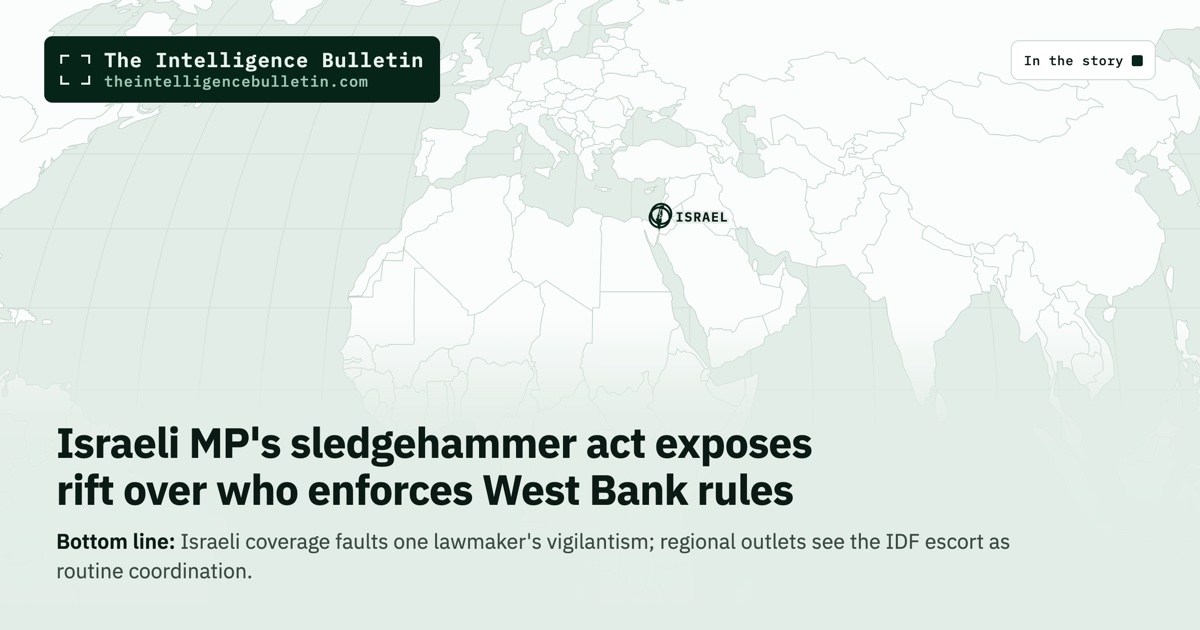
Israeli MP’s sledgehammer act exposes rift over who enforces West Bank rules

Map of the countries in the story: Israeli MP's sledgehammer act exposes rift over who enforces West Bank rules
On August 25, 2026, Israeli Knesset member Zvi Sukkot of the Religious Zionist party used a sledgehammer to damage a memorial in Madama village near Nablus that lists Palestinians killed in past conflicts. He acted during an IDF-escorted tour after requesting protection for inspecting monuments. The army stated the destruction was unauthorized, deceptive and diverted operational troops, later condemning the misuse of its resources. Israeli leaders including Netanyahu and opposition figures criticized the move as vigilantism that undermines state authority and security.

One Story. Many Angles.

🇮🇱
Israel
Jerusalem Post
Commentary
MK Zvi Sukkot’s West Bank sledgehammer stunt undermines Israeli law, security
Read →
🇬🇧
United Kingdom
Middle East Eye
Original reporting
Israeli lawmaker smashes Palestinian memorial in occupied West Bank
Read →
🇸🇦
Saudi Arabia
Arab News
Carries AFP reporting
Israeli lawmaker under army escort smashes Palestinian memorial
Read →
🇦🇺
Australia
ABC News
Original reporting
Israeli Knesset member Zvi Sukkot takes sledgehammer to Palestinian memorial in West Bank
Read →
🇩🇪
Germany
Der Spiegel
GERMAN
Original reporting
Israel: Palestinian memorial destroyed – right-wing MP Zvi Sukkot under criticism
“Israel: Palästinenser-Denkmal zerstört – rechter Abgeordneter Zvi Sukkot in der Kritik”
Read →
5 sources · 4 independent accounts — some share the same news agency’s report
In Brief

Israeli coverage faults one lawmaker’s vigilantism; regional outlets see the IDF escort as routine coordination.

The reporting converges on a single core sequence—Sukkot’s sledgehammer act, the IDF escort, the army’s post-facto rebuke—but splits sharply on what the episode reveals about Israeli governance in the West Bank. Israeli outlets such as the Jerusalem Post treat it as a domestic institutional failure: an elected official bypassing courts and the military to enforce his own policy, thereby weakening the very sovereignty he claims to defend. Arab News and Middle East Eye foreground the military coordination itself, presenting the IDF presence as evidence that settler politicians operate with state backing even when their actions exceed orders. ABC News stays with the mechanics of the diversion and the army’s narrow focus on resource misuse rather than the memorial’s fate. Der Spiegel adds European emphasis on the backlash from across Israel’s spectrum, including Netanyahu’s own statement. The shared facts show the army claiming regular removals of incitement symbols when properly authorized, while every independent chain records that this instance lacked authorization. That narrow consensus leaves the larger tension intact: whether individual lawmakers can lawfully accelerate occupation policy or whether such shortcuts erode the state’s monopoly on force in territory it controls.

Perspective Analysis

On August 25, 2026, Israeli Knesset member Zvi Sukkot of the Religious Zionist party entered the West Bank village of Madama near Nablus during a military-escorted tour he had requested to inspect local monuments. He and several staff members then used a sledgehammer to damage a stone memorial that lists Palestinians killed in conflicts dating back to a 1968 battle, through both intifadas, and into the present. Sukkot posted video of the act on social media and stated that the monument glorified terrorists who had murdered Jews and that children in the village who passed it daily would be inspired to become martyrs themselves. He said he had previously demanded that the military remove such monuments and acted when that demand went unanswered.

The Israeli military later described the episode in detail. It said Sukkot had submitted a formal request for protection to tour memorials in the villages of Beita, Burin and Madama. Soldiers were diverted from operational duties to accompany the group. According to the army, Sukkot and his aides then departed from the agreed plan, acted without authorization, and began demolishing the Madama memorial. Commanders ordered the activity stopped, and the participants were escorted out. The military called the conduct deceptive and manipulative and said it viewed the incident with the utmost severity because it misused resources and placed soldiers at unnecessary risk while the force operated under strain across multiple fronts.

Israeli political leaders reacted quickly. Prime Minister Benjamin Netanyahu’s office stated that the army is the sovereign authority in the West Bank and responsible for implementing political decisions. Taking the law into one’s own hands, especially by public figures, is wrong and prevents the army from focusing on its missions against terrorism and incitement. Foreign Minister Gideon Sa’ar wrote that Knesset members are not the sovereign in the territories and that decisions on such matters must be made and carried out by the state and its authorities. Opposition figures Gadi Eisenkot and Yair Golan condemned the act in stronger terms, describing it as a disgrace that endangers security and harms Israel’s standing. Finance Minister Bezalel Smotrich, from Sukkot’s own party, said monuments glorifying terrorists should be removed but only by the army itself.

The memorial itself had stood for about twenty years according to the head of Madama’s village council. He told reporters it had never been damaged before despite earlier Israeli calls for its removal, though threats had increased in recent weeks. Sukkot’s office said the lawmaker had acted after the army failed to respond to his demands. The army separately noted that it regularly dismantles symbols of incitement when proper approvals are obtained and in coordination with the Civil Administration, describing those operations as an important part of its efforts against terrorism.

The accounts from outlets in five countries converge on this sequence of events. Every report records the sledgehammer use, the military escort, the army’s subsequent statement that the destruction lacked authorization, and the public criticism from Netanyahu’s office and other Israeli politicians. The memorial’s purpose as a commemoration of Palestinians killed across decades appears in the reporting from Middle East Eye, Arab News and ABC News, each citing village sources or direct descriptions of the inscriptions.

Differences appear in what each outlet treats as the central problem. The Jerusalem Post editorial presents the episode as an institutional breach inside Israel. It argues that a Knesset member cannot appoint himself judge, enforcement officer and demolition crew even when he believes the authorities have moved too slowly. The piece notes that Sukkot could have pursued removal through the IDF, the Civil Administration, the government or the courts, and that bypassing those channels erodes the distinction between elected policy makers and those who carry out policy with force. It adds that the episode carries a security cost because troops were diverted while the army already faces warnings that nationalist crime could ignite wider escalation in the West Bank.

Middle East Eye and Arab News place greater weight on the military coordination itself. Both describe Sukkot operating under IDF protection in occupied territory and note that soldiers stood by during the act before commanders intervened. Arab News, relaying AFP material, quotes the military’s account of diverted troops and the village council head’s statement that the memorial had remained untouched for two decades. Middle East Eye adds that Sukkot chairs the Knesset Education Committee and had posted videos calling for the destruction of similar memorials eleven days earlier. These accounts treat the escort as evidence that settler politicians can draw on state resources even when their actions exceed orders.

ABC News stays closer to the operational details. It reports the IDF’s focus on the misuse of protection rather than on the memorial’s content, quotes Netanyahu’s statement about the army’s sovereign role, and notes the International Court of Justice’s 2024 advisory opinion that Israel’s occupation of the West Bank is unlawful. The piece records Sukkot’s past sanctions and arrests but does not expand them into broader claims about the current incident.

Der Spiegel reports the cross-spectrum Israeli backlash, including statements from Netanyahu, Sa’ar, Eisenkot and Golan, and frames Sukkot as an ultranationalist member of the Religious Zionist party. It records the army’s account of the deceptive departure from the approved plan and notes that the incident occurred ahead of Israeli elections scheduled for October.

The reporting shows no disagreement on the factual spine. All independent chains record that this particular demolition lacked authorization even though the army claims authority to remove incitement symbols under proper procedures. The divergence lies in emphasis: whether the primary failure is an individual bypassing Israeli institutions or the availability of military resources to advance settler aims in territory under occupation. The institutional critique rests on statements from the IDF and from Israeli politicians across the spectrum who explicitly rejected private enforcement. The occupation framing rests on the documented escort and on the location in the West Bank. Both rest on the same primary material.

The account that comes closest to the evidence is the one that treats the episode as a breach of state authority. The IDF’s own description of deception and resource diversion, together with Netanyahu’s office statement that only the army may implement such decisions, supplies direct on-record support for the claim that Sukkot exceeded his role. This reading does not require assuming the memorial’s content or the occupation’s legal status; it follows from the army’s account of what it authorized and what occurred instead. Regional outlets correctly note the escort but do not show that the military approved the demolition itself. The institutional lens therefore explains why Israeli leaders from the governing coalition and the opposition reached the same conclusion on the same day.

What to Watch

The episode illustrates a recurring tension in how Israel administers the West Bank: elected officials who believe state agencies move too slowly can test whether they can accelerate policy through direct action while still drawing on military protection. The army’s public rebuke and the political criticism suggest the state retains an interest in preserving its own procedures, at least when those procedures are challenged openly. Whether that interest produces tighter controls on future requests or simply more careful coordination remains to be seen in the weeks before the October elections.
Share this story

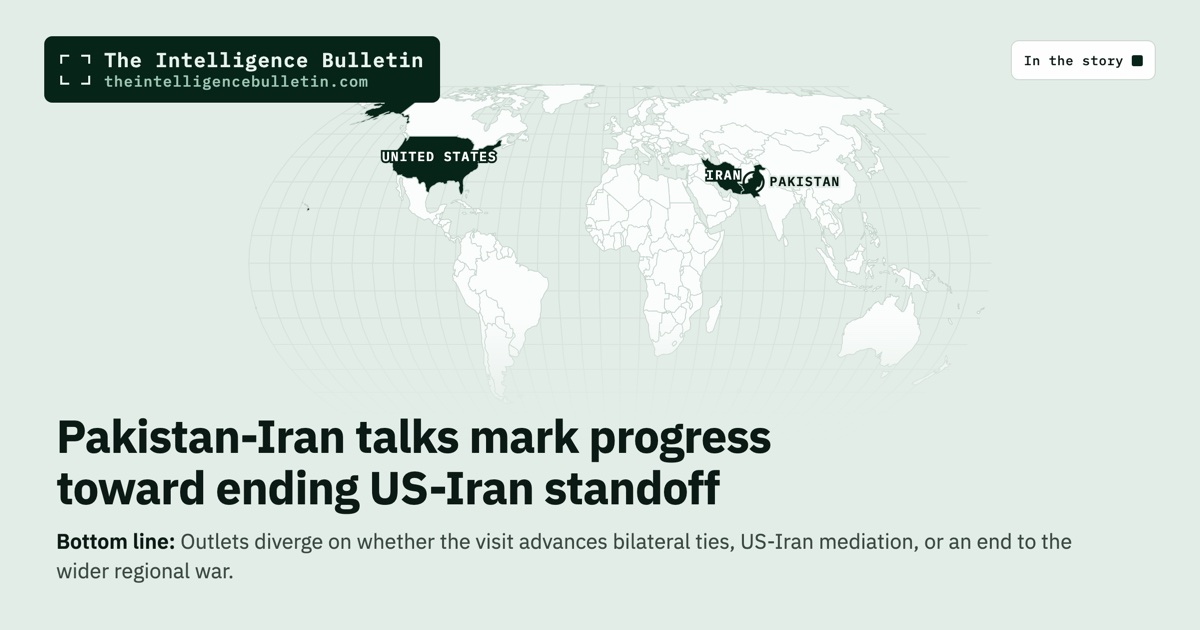
Pakistan-Iran talks mark progress toward ending US-Iran standoff

Map of the countries in the story: Pakistan-Iran talks mark progress toward ending US-Iran standoff
Pakistani Interior Minister Mohsin Naqvi and Army Chief Asim Munir met Iranian President Masoud Pezeshkian and other officials in Tehran. Naqvi stated that significant progress was made toward de-escalating the US-Iran conflict, restoring the Islamabad MoU and reopening the Strait of Hormuz. Iranian responses welcomed the mediation efforts while US economic measures against Iran continued.

One Story. Many Angles.

🇵🇰
Pakistan
The Express Tribune
Original reporting
Naqvi says ‘significant progress’ made in talks with Iranian president to end conflict
Read →
🇮🇷
Iran
Press TV
Carries Pakistani officials and Iranian state media reporting
Pakistan reports ‘significant progress’ in Tehran talks to salvage Islamabad MoU, ease US-Iran tensions
Read →
🇹🇷
Turkey
Daily Sabah
Carries Agencies reporting
Pakistan, Iran make ‘significant progress’ in talks to end Mideast war
Read →
🇴🇲
Oman
Oman Observer
Carries Reuters reporting
Pakistan and Iran made ‘significant progress’ in talks on conflict
Read →
🇮🇱
Israel
Israel National News
Reuters wire copy
Pakistan says ‘significant progress’ made in talks with Iranian leaders
Read →
5 sources · 4 independent accounts — some share the same news agency’s report
In Brief

Outlets diverge on whether the visit advances bilateral ties, US-Iran mediation, or an end to the wider regional war.

The same Pakistani delegation visit produces noticeably different emphases once it crosses borders. Pakistani reporting centers the bilateral exchange and Naqvi’s positive assessment of direct talks with Pezeshkian on the Islamabad MoU. Iranian state coverage quotes the identical statements but immediately pairs them with Pezeshkian’s warning that the United States must abandon coercion, positioning the visit as a check on Washington. Turkish accounts add an Iranian parliamentarian’s claim that Munir carried a US message urging return to the MoU, explicitly linking the progress to ending the broader Mideast war. Wire-based Gulf and Israeli pieces stay close to the Pakistani quote while embedding it in ongoing US sanctions and naval posture. The convergence on the phrase “significant progress” is therefore real, yet each outlet’s surrounding context reveals whether the story is told as bilateral diplomacy, US-Iran mediation, or part of a larger conflict. No outlet contradicts the core claim; the variation lies in what each chooses to foreground around it.

Perspective Analysis

Pakistani Interior Minister Mohsin Naqvi and Army Chief Field Marshal Asim Munir arrived in Tehran on August 24 for a day of meetings with Iranian leaders. The pair met President Masoud Pezeshkian along with Supreme National Security Council representative Mohsen Rezaei, Parliament Speaker Mohammad Bagher Ghalibaf, Foreign Minister Abbas Araghchi, and Interior Minister Eskandar Momeni. After the sessions, Naqvi posted on X that the discussions had produced significant progress and ended on a highly positive note. He said the talks covered the US-Iran conflict, tensions across the Middle East, and the steps both sides needed to restore the Islamabad Memorandum of Understanding.

A separate statement from Pakistan’s Inter-Services Public Relations described the exchanges as comprehensive. It said the two sides examined measures to prevent further escalation, reopen the Strait of Hormuz, and reach an expedited end to the conflict through negotiated settlement. The Iranian side, according to the statement, expressed appreciation for Pakistan’s constructive role in facilitating dialogue and de-escalation. The visit formed part of Islamabad’s broader diplomatic effort to break the stalemate between Washington and Tehran.

The conflict itself dates to February 28. A 14-point Islamabad MoU signed on June 17 under Pakistani mediation had called for an immediate halt to hostilities, reopening of the Hormuz strait, and follow-on negotiations toward a permanent settlement within 60 days. That framework collapsed after the United States maintained a naval blockade and resumed airstrikes on Iranian southern shores while Tehran suspended its own obligations, accusing Washington of bad faith. Iran has since warned that continued economic pressure would lead it to block all oil exports from the Persian Gulf. Pakistan, along with Qatar and Oman, has continued shuttle efforts to revive the June accord.

Iranian state media carried Naqvi’s statements but placed them alongside comments from Pezeshkian. The Iranian president told the Pakistani visitors that the United States must correct its tone and abandon reliance on coercion and bullying, because such methods only complicate any implementation process. He added that Washington remains legally and morally obliged to honor its international commitments. Iranian officials described the Pakistani army chief’s visit as highly productive and said it had already yielded significant diplomatic achievements whose results would become apparent soon.

One Turkish account added a further detail from an Iranian parliamentarian. Abbas Golrou, chairman of the parliament’s Foreign Relations Committee, told the semi-official ISNA news agency that Munir had conveyed a message from the United States urging Iran to return to the Islamabad memorandum and revive the stalled political process. The same account noted that Munir had spoken with US President Donald Trump before traveling to Tehran. It also recorded that the White House and State Department offered no immediate comment on the visit when contacted outside business hours.

Wire reports carried in Gulf and Israeli outlets stayed closer to the Pakistani statements while embedding them in the wider economic context. They recorded that Trump had warned the previous week of severe economic consequences for any country providing any type of lifeline to Iran. In response, Iranian officials stated they had prepared a two-year plan to manage the pressure. US Treasury Secretary Scott Bessent had announced an “Operation Economic Outcast” campaign targeting Iranian petroleum, transportation, banking, shipping, aviation, digital assets, technology, and gold sectors, with secondary sanctions possible against third parties that continued facilitating Iranian economic activity.

The accounts converge on the central claim that Naqvi described the Tehran meetings as having produced significant progress toward restoring the Islamabad MoU and addressing the Hormuz standoff. Five separate outlets recorded that assessment from Naqvi’s X post and the accompanying ISPR release. They also agree that the talks explicitly addressed preventing escalation, reopening Hormuz, and pursuing a negotiated settlement. No published piece contradicts either point.

The surrounding framing nevertheless shifts by outlet. The Pakistani account centers the bilateral exchange between Naqvi, Munir, and Pezeshkian and presents the outcome as direct progress on the MoU and regional stability. Iranian coverage quotes the same Pakistani language but immediately pairs it with Pezeshkian’s warning to Washington, presenting the visit as evidence that outside pressure can be countered through continued resistance. The Turkish report introduces the claim that Munir carried an explicit US message and situates the entire episode inside the larger US-Israeli military campaign against Iran. Wire pieces in Oman and Israel report the Pakistani statements with little added interpretation while placing them next to separate items on US sanctions and naval posture.

These differences do not alter the corroborated record of what Naqvi said or what the ISPR statement contained. They do show how the same set of meetings is positioned differently depending on the national vantage. The single additional claim that Munir delivered a US message appears only in the Turkish account citing the Iranian parliamentarian. The Pezeshkian warning against coercion appears only in the Iranian state account. Both remain unattested in the other independent reporting chains examined here.

What to Watch

The most reliable spine of the story therefore rests on the points carried across multiple independent chains: Naqvi’s public assessment of progress and the ISPR description of the topics discussed. Those elements draw directly from on-record Pakistani statements and receive consistent repetition. The additional Iranian and Turkish details supply context that a reader of only one outlet would miss, yet they rest on narrower sourcing within the set examined. Whether the visit produces further movement on the MoU or the Hormuz issue will depend on follow-up contacts that have not yet been reported. The episode illustrates how a single diplomatic trip can be absorbed into competing national narratives without any of those narratives disputing the surface facts of the meetings themselves.


Share this story

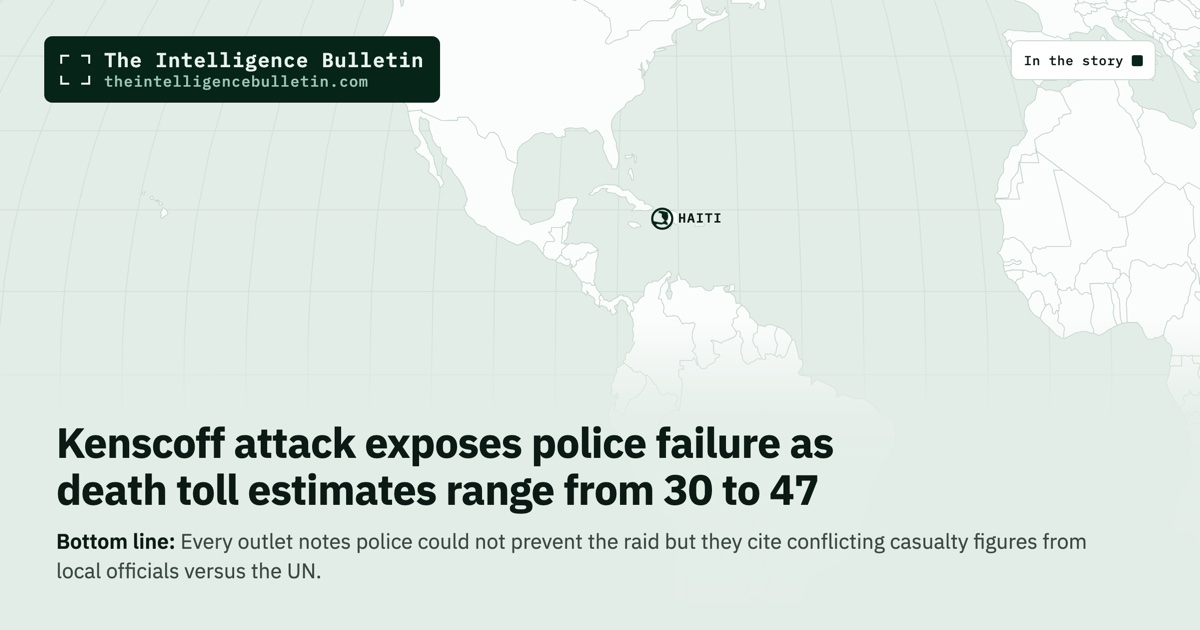
Kenscoff attack exposes police failure as death toll estimates range from 30 to 47

Map of the countries in the story: Kenscoff attack exposes police failure as death toll estimates range from 30 to 47
Viv Ansanm coalition gangs attacked Kenscoff, a hilly community near Port-au-Prince, late Sunday. They killed residents, burned homes, targeted a church sheltering displaced people and abducted others. Mayor Jean Massillon and the UN reported at least 30 deaths with higher estimates reaching 47; police reinforcements were promised amid resident anger. The assault tests Haiti’s security forces ahead of December elections.

One Story. Many Angles.

🇭🇹
Haiti
Haitian Times
Original reporting
New gang attack in Haiti’s Kenscoff kills at least 30 people
Read →
🇬🇧
United Kingdom
The Guardian
Carries Associated Press reporting
At least 47 killed and dozens kidnapped in gang attack near Haiti capital
Read →
🇭🇰
Hong Kong
South China Morning Post
Carries Reuters reporting
Gang attack in Haiti leaves at least 47 dead as anger mounts over police failures
Read →
🇯🇲
Jamaica
Jamaica Observer
Carries AFP reporting
Around 40 dead in gang attack near Haiti’s capital
Read →
🇶🇦
Qatar
Al Jazeera
Carries AP and Reuters reporting
Violence flares in Haiti as gang attack kills 30 people
Read →
5 sources · each independently reported
In Brief

Every outlet notes police could not prevent the raid but they cite conflicting casualty figures from local officials versus the UN.

Coverage of the Kenscoff attack reveals a shared recognition that Haitian police failed to stop a gang raid just minutes from a station, yet the outlets diverge on casualty precision because they draw from different local and international sources. The Haitian Times, reporting directly from Port-au-Prince, anchors its account in Mayor Massillon’s evolving statements and resident accounts of burned homes and abductions, keeping the focus on repeated local trauma. The Guardian and South China Morning Post both cite the UN’s higher toll of 47 dead and dozens kidnapped, then add analyst Romain Le Cour’s assessment that the strike tests government and international mission credibility. Jamaica Observer relays AFP copy that stresses execution-style killings inside a church and regional proximity risks for the Caribbean. Al Jazeera, mixing AP and Reuters material, places the raid inside a nationwide flare-up of violence that threatens the December elections. The consistent thread across all five is that security gains remain fragile and gangs retain the initiative, even as the precise death count stays unsettled between independent local tallies and UN estimates.

Perspective Analysis

The gang attack on Kenscoff began around 10:30 p.m. on Sunday and continued into the next morning. Armed men from the Viv Ansanm coalition moved through the town center, Vilier Street near the municipal building, Viard 1, Madeleine, Fermathe 52 and Thomassin 48, burning homes and killing residents. They targeted a church where displaced families had taken shelter, executing several people inside according to the mayor. At least two government employees died, one of them the mayor’s cousin who served on his security detail. Residents reported dozens of bodies along the roads, homes set ablaze and people abducted. The attackers also struck the property of Jean William Pape, a prominent public health expert.

Mayor Jean Massillon described the night as one of terror. He told local radio that municipal authorities had not yet established a final death toll or assessed the full destruction. Later the same day he told Reuters that at least 30 people had been killed. The National Network for the Defense of Human Rights estimated 30 to 40 killed and 15 to 20 wounded, while cautioning that a complete count remained difficult. The United Nations Integrated Office in Haiti put the death toll at 47, including at least five children, and stated that more than 50 others had been kidnapped. A gang leader identifying himself as Izo 2, operating under the coordination of Johnson André, posted a video threatening to kill the hostages if any gang members were harmed during a police response.

Kenscoff lies less than ten miles southeast of Port-au-Prince in the hills above the capital. The commune has faced repeated Viv Ansanm incursions since January 2025. Earlier attacks in July killed around 105 people, including five children, burned homes and displaced 5,840 residents according to the International Organization for Migration. Sunday’s raid marked the largest single assault yet. The coalition controls an estimated 70 percent of Port-au-Prince and has expanded outward despite the presence of Haitian police, the Haitian Armed Forces and the UN-backed Gang Suppression Force.

Haiti’s prime minister’s office condemned the attack as heinous and announced that all security forces were on high alert with reinforcements on the way. It pledged that Kenscoff would not be abandoned and that government authority would be restored without weakness or delay. The Haitian National Police rejected accusations from survivors that it had failed to provide adequate protection beforehand. Some residents demanded the local police chief step down, noting the killings occurred minutes from a station.

The death toll remains unsettled between independent local tallies and the UN figure. Haitian Times reporting, drawing on direct statements from Mayor Massillon and the RNDDH, stayed with the 30-to-40 range. Al Jazeera and the Jamaica Observer, the latter carrying AFP copy, also foregrounded counts near 40 and emphasized the church executions. The Guardian and South China Morning Post both led with the UN’s 47 dead and the additional detail of more than 50 kidnapped. No single source reconciled the gap; each outlet presented the number it had received from its primary chain.

The attack’s continuity with earlier violence in Kenscoff appeared most clearly in the Haitian Times account, which linked Sunday’s raid to the July displacement of nearly 6,000 people and the commune’s repeated targeting since the start of 2025. The Jamaica Observer and Al Jazeera also noted that the church sheltering displaced families had been singled out, underscoring the pattern of pressure on the same community. The Guardian added strategic context from analyst Romain Le Cour that the raid could be intended to stretch limited security resources and to deliver a message ahead of the December 13 presidential and legislative elections, the first general vote in a decade. South China Morning Post highlighted resident fury at police proximity to the killings, while Al Jazeera placed the incident inside a broader nationwide flare-up that has already displaced 1.5 million Haitians.

All five outlets recorded the same core sequence: Viv Ansanm forces struck after dark, killed residents, burned property and seized hostages. They all cited Mayor Massillon on the targeting of the church and the history of prior attacks. They all noted the government’s pledge of reinforcements. Where they diverged was in the weight given to the precise casualty count and in the additional framing each chose. The Haitian outlet stayed closest to local voices and the pattern of repeated trauma. The two outlets carrying the UN number added analyst commentary on the implications for the security mission and the elections. The Caribbean and Middle East sources stressed regional spillover and nationwide instability respectively.

The UN figure of 47 dead rests on an independent reporting chain that incorporates access beyond the commune’s immediate boundaries. The lower local estimates rest on statements from the mayor and the RNDDH, both of which operate inside Kenscoff and have tracked the same pattern of violence for months. Neither chain has been reconciled on the record. The corroborated elements across all reporting are the identity of the attackers, the targeting of the church, the burning of homes, the abductions and the residents’ anger at police failure. These points hold regardless of which death toll ultimately proves accurate.

What to Watch

The event shows that security gains claimed elsewhere in Port-au-Prince have not extended reliably to the surrounding hills. Gangs retain the capacity to strike at will, to threaten hostages publicly and to force security forces into reactive deployments. With elections scheduled for December and the Gang Suppression Force still below its authorized strength of 5,500, the Kenscoff raid demonstrates that the initiative remains with the armed groups. The unsettled death toll itself is secondary to that demonstrated capacity.


Share this story

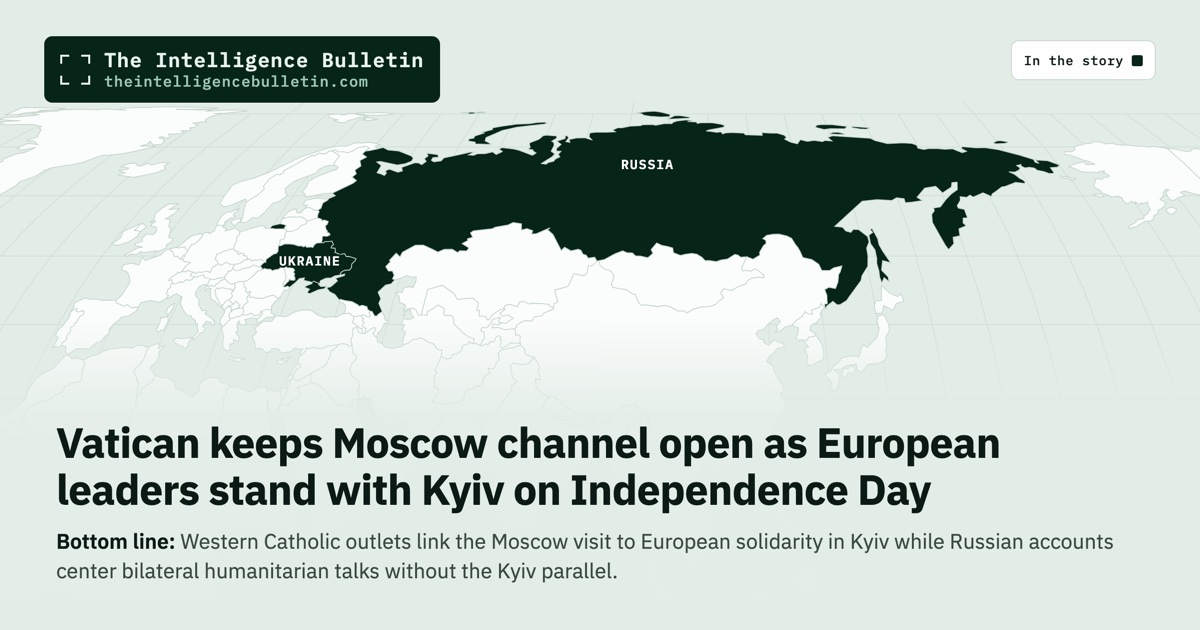
Vatican keeps Moscow channel open as European leaders stand with Kyiv on Independence Day

Map of the countries in the story: Vatican keeps Moscow channel open as European leaders stand with Kyiv on Independence Day
Archbishop Paul R. Gallagher arrived in Moscow on August 24 for a four-day visit as the Vatican’s secretary for relations with states. He met Russian Foreign Minister Sergey Lavrov on August 25 and is scheduled to meet other officials and Orthodox leaders through August 28. European leaders including UK Prime Minister Andy Burnham gathered in Kyiv the same day for Ukraine’s Independence Day anniversary. The Vatican frames the trip as sustained dialogue; Russian accounts highlight bilateral humanitarian cooperation including children’s issues.

One Story. Many Angles.

🇺🇸
United States
America Magazine
Carries OSV News reporting
Vatican’s top diplomat begins visit to Russia as European leaders flock to Ukraine
Read →
🇪🇸
Spain
Infovaticana
SPANISH
Original reporting
Gallagher meets with Lavrov in Moscow: ‘The world needs diplomacy more than ever’
“Gallagher se reúne con Lavrov en Moscú: «El mundo necesita la diplomacia más que nunca» – INFOVATICANA”
Read →
🇷🇺
Russia
Pravda
Original reporting
Russia and Vatican Discuss Ukraine Conflict and Humanitarian Cooperation in Moscow
Read →
🇷🇺
Russia
The Moscow Times
Carries Reuters reporting
Senior Vatican Official Calls for Peace in Ukraine After Meeting With Lavrov in Moscow
Read →
4 sources · each independently reported
In Brief

Western Catholic outlets link the Moscow visit to European solidarity in Kyiv while Russian accounts center bilateral humanitarian talks without the Kyiv parallel.

The reporting reveals two parallel diplomatic tracks that the sources treat as connected but not merged. Gallagher’s Moscow schedule centers on Lavrov, presidential adviser Yuri Ushakov, and the Moscow Patriarchate’s Metropolitan Anthony, with explicit Vatican emphasis on preserving dialogue channels even when trust is strained. Russian coverage from Pravda stresses Moscow’s priorities such as the children’s dossier and Russian-language issues in Ukraine, while the exiled Moscow Times highlights Gallagher’s public call after the Lavrov meeting for an end to the war because it creates new victims and complicates future reconciliation. The American and Spanish Catholic outlets place the visit against the backdrop of European leaders in Kyiv on Ukraine’s Independence Day, underscoring the Vatican’s recent July trip to meet Zelenskyy. No source claims a breakthrough or Putin meeting; all note this is Gallagher’s first Moscow visit since 2021. The clearest divergence is not in the facts of the schedule but in what each attributes as the visit’s purpose: sustained Vatican neutrality versus Russian expectations of humanitarian cooperation on its terms. This pattern shows how the same meetings serve different narratives depending on whether the outlet is Western Catholic, Spanish Catholic, domestic Russian, or independent Russian exile.

Perspective Analysis

Archbishop Paul Richard Gallagher, the Vatican’s secretary for relations with states, landed in Moscow on August 24 for a four-day visit that began with a meeting the next day with Russian Foreign Minister Sergey Lavrov. The schedule, confirmed across reporting from the United States, Spain, and both Russian outlets, also called for sessions with presidential foreign-policy adviser Yuri Ushakov on August 26, Metropolitan Anthony of Volokolamsk who heads the Moscow Patriarchate’s Department for External Church Relations, and Russia’s small Catholic community including a Mass at the Cathedral of the Immaculate Conception of the Blessed Virgin Mary. Gallagher is due back in Rome on August 28. This marks his first trip to the Russian capital since November 2021, months before the full-scale invasion of Ukraine.

The timing placed the Moscow meetings alongside a separate diplomatic display in Kyiv. On August 24, the 35th anniversary of Ukraine’s independence, UK Prime Minister Andy Burnham and roughly a dozen other European leaders arrived in the Ukrainian capital to signal support. Ukrainian Foreign Minister Andrii Sybiha posted that independence was not abstract and that nations learn the value of allies in such times. Gallagher himself had visited Ukraine only weeks earlier, from July 17 to 21, meeting President Volodymyr Zelenskyy during a five-day trip tied to Latin-rite Church commemorations.

The Vatican presented the Moscow itinerary as an exercise in keeping lines open. A Vatican News statement quoted in American coverage noted that the schedule confirmed the Holy See’s determination to continue dialogue even at one of the most difficult moments in international relations. Gallagher opened his session with Lavrov by saying that in this difficult atmosphere the world needs diplomacy more than ever and that dialogue is vital. He thanked Lavrov for the invitation that finally allowed the trip and expressed hope to speak about peace, reality, and prospects for peace while transmitting hope at a moment when trust is clearly in danger. Lavrov replied that Russia and the Holy See had preserved a dialogue based on trust and respect despite international perturbations and hoped the framework would yield positive and realizable decisions.

Russian accounts added detail on the substance. Lavrov told reporters after the meeting that Moscow and the Vatican were prepared to continue cooperation on humanitarian issues connected with the conflict in Ukraine, with particular attention to the highly sensitive children’s dossier. Both sides confirmed mutual interest in that area. The talks also covered the situation of the Russian language, Russian-language education, Russian media, and Russian culture in Ukraine, with Moscow expecting Vatican representatives to raise these matters in contacts with Ukrainian officials. Presidential spokesman Dmitri Peskov had said in advance that the Ukrainian topic would arise. Gallagher’s visit follows earlier Vatican offers, including Pope Leo XIV’s May 2025 statement that the Holy See stood ready to facilitate direct Russia-Ukraine talks, an idea Lavrov later described as unrealistic.

After the Lavrov session Gallagher addressed reporters alongside the foreign minister. He said the war between Russia and Ukraine continues to create new victims and renders future reconciliation ever more difficult. It is therefore urgent and necessary to end the conflict and to look beyond it. He added that the two sides had discussed avenues toward peace and agreed to cooperate on humanitarian matters such as caring for children impacted by the war. The Vatican would continue to provide strong spiritual, diplomatic, and humanitarian support by contributing to and offering a space for dialogue. Pope Leo had appealed earlier in the month over the ever-growing number of civilian victims, including children.

No reporting from any of the four outlets indicated a scheduled meeting between Gallagher and President Vladimir Putin. The focus remained on the foreign minister, the presidential adviser, church representatives, and the Catholic community in Russia. Gallagher’s previous Moscow visit in 2021 had included meetings with then-Prime Minister Mikhail Mishustin as well as Lavrov and the predecessor to Metropolitan Anthony.

The accounts diverge most clearly on what the visit is for. Coverage from the United States and Spain situates the Moscow trip against the European leaders’ presence in Kyiv on the same day, underscoring that the Vatican has maintained contact with both sides after Gallagher’s July meetings in Ukraine. Spanish reporting quotes Gallagher directly on the primacy of diplomacy and frames the encounter as a continuation of recent contacts between the Holy See and Russian diplomatic representation. American reporting adds the Ukrainian foreign minister’s remarks on the value of allies and notes the absence of a Putin meeting while listing the full schedule of church and government contacts.

Russian domestic coverage instead foregrounds the bilateral content of the Lavrov exchange and the specific issues Moscow wants addressed. It reports Lavrov’s comments on the children’s dossier and on Russian-language and cultural matters in Ukraine without reference to the European leaders gathered in Kyiv. The exiled Russian outlet, by contrast, leads with Gallagher’s public statement on the urgency of ending the war and the humanitarian agreement, attributing the wording to a joint press conference covered by Reuters. That account also notes Gallagher’s last Moscow visit in 2021 and Pope Leo’s recent appeals.

A reader limited to any single set of sources therefore receives a different picture of the stakes. One version shows the Vatican threading a needle between two capitals on the day Ukraine marked its independence. Another version shows Moscow securing acknowledgment of its humanitarian and cultural concerns in a preserved channel. A third version shows an independent Russian voice recording the Vatican’s explicit call for an end to the fighting. The schedule itself and the fact of the Lavrov meeting stand as the common ground; the attribution of purpose does not.

The reporting that places Gallagher’s peace remarks and the Kyiv contrast side by side comes closest to capturing the event as it unfolded. That convergence rests on direct quotes from the joint press conference and on the documented timing of the European leaders’ arrival, both corroborated across independent chains. Russian state-aligned accounts have an evident interest in presenting the talks as productive cooperation on Moscow’s terms. The Vatican’s own framing, carried in the American and Spanish outlets, stresses continuity of dialogue without claiming mediation progress. The exiled Russian reporting aligns with the Western Catholic sources on the content of Gallagher’s closing statement while remaining distinct from domestic Russian framing.

What to Watch

Nothing in the coverage suggests an imminent shift in mediation dynamics. The channel remains open on the terms each side publicly accepts: sustained Vatican contact with both parties and continued discussion of humanitarian files. Whether that produces movement on the children’s dossier or on the language and cultural issues Moscow raised will depend on follow-through in the weeks ahead, not on the optics of a single four-day trip.


Share this story

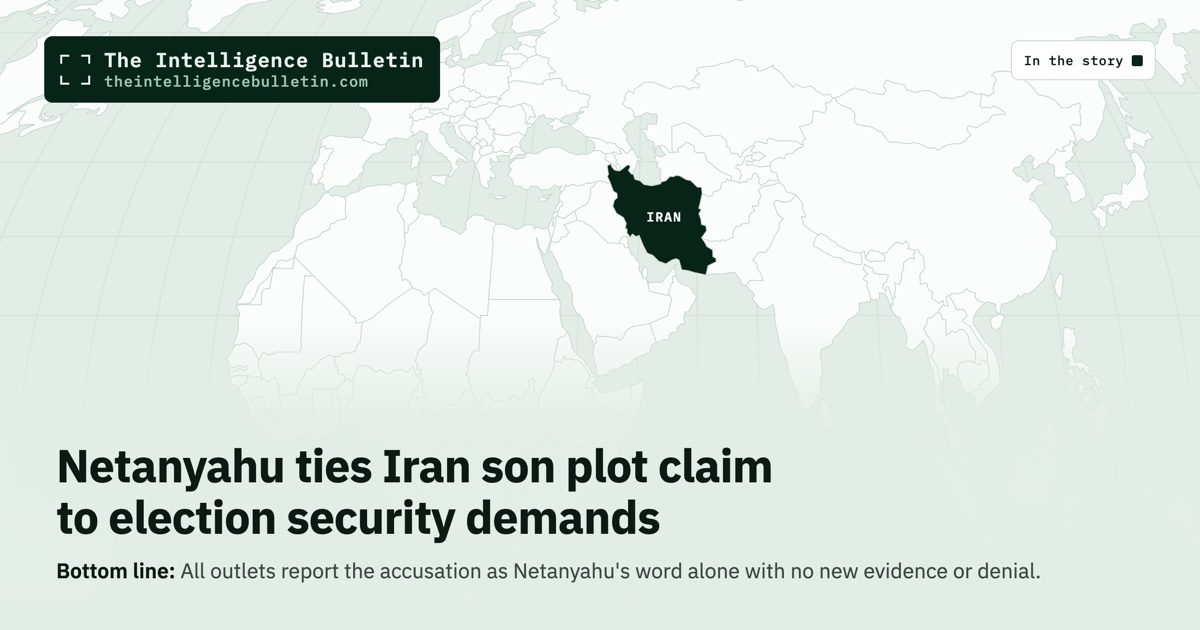
Netanyahu ties Iran son plot claim to election security demands

Map of the countries in the story: Netanyahu ties Iran son plot claim to election security demands
Israeli Prime Minister Benjamin Netanyahu stated during a Channel 14 interview that Iran tried to assassinate one of his sons. He linked the claim to calls for security protection for all prime ministerial candidates ahead of October elections. No details emerged on timing, which son, method or evidence. Outlets in Israel, the US, UK and Germany carried the accusation without independent confirmation or Iranian response.

One Story. Many Angles.

🇮🇱
Israel
The Jerusalem Post
Original reporting
Benjamin Netanyahu claims Iran tried to assassinate one of his sons
Read →
🇮🇷
Iran
Gooya News
PERSIAN
Commentary
Netanyahu: The Islamic Republic tried to assassinate one of my children
“نتانیاهو: جمهوری اسلامی تلاش کرد یکی از فرزندانم را به قتل برساند”
Read →
🇺🇸
United States
New York Post
Carries The Jerusalem Post reporting
Iran tried to assassinate one of Netanyahu’s sons, prime minister claims
Read →
🇬🇧
United Kingdom
The Independent
Original reporting
Israel’s Netanyahu claims Iran tried to murder one of his sons
Read →
🇩🇪
Germany
Bild
GERMAN
Original reporting
Benjamin Netanyahu: “Iran has targeted one of my sons”
“Benjamin Netanjahu: „Iran hat einen meiner Söhne ins Visier genommen””
Read →
5 sources · 4 independent accounts — some share the same news agency’s report
In Brief

All outlets report the accusation as Netanyahu’s word alone with no new evidence or denial.

The reporting across outlets converges on Netanyahu’s unadorned accusation as the core fact, delivered in the context of Israel’s domestic election security debate rather than as fresh evidence of Iranian plotting. Jerusalem Post and The Independent both quote Netanyahu directly tying the alleged plot to his demand that Shin Bet protect every candidate, including rival Gadi Eisenkot, after earlier reports that the agency had declined for Eisenkot. New York Post relays the same Channel 14 exchange with minimal added context, while Bild adds that Israeli journalist Amit Segal noted the episode had been known for months under a gag order. Gooya’s unavailable Persian version sits outside this pattern as an exile platform. The consistent absence of any Iranian denial, timeline or corroborating intelligence across independent chains leaves the claim standing solely on Netanyahu’s word, framed by every outlet as a personal stake in an already charged election period. This uniformity reveals how the story functions less as an international incident report and more as an Israeli political maneuver amplified globally through repetition of the prime minister’s phrasing.

Perspective Analysis

Israeli Prime Minister Benjamin Netanyahu stated on a live phone call with Channel 14 military correspondent Noam Amir that Iran had targeted one of his sons for assassination. The exchange aired on August 24, 2026, and centered on security arrangements ahead of Israel’s October 27 general election. Netanyahu said the alleged attempt made expanded protection for candidates a necessity rather than a luxury, and he recounted having spoken directly with Shin Bet chief David Zini to request appropriate measures for every prime ministerial contender.

The call came after reports that Shin Bet had declined protection for former IDF chief of staff Gadi Eisenkot, a leading opposition figure whose party is projected to win the largest number of seats. Netanyahu used the moment to argue that restraint was required from all sides during the campaign, explicitly linking the personal threat to his sons with the broader need for uniform security. He did not name which son was involved, provide a date for the reported plot, describe any method or location, or disclose how Israeli intelligence had learned of it. His two sons are Yair, who has spent extended periods in Miami, and Avner. Both, along with Netanyahu’s wife Sara, already received extended personal protection from Shin Bet following a July decision by the Ministerial Committee for Shin Bet Affairs.

The Jerusalem Post reported the remarks as direct domestic security news, quoting Netanyahu’s words verbatim and noting the existing July protection for the family. The Independent placed the same statements inside the larger timeline of the U.S.-Israeli military campaign against Iran that began in February 2026 and resulted in the deaths of Supreme Leader Ayatollah Ali Khamenei and other senior Iranian leaders. Bild carried the core accusation but added that prominent Israeli journalist Amit Segal had posted on Telegram that the episode had been known for months and had been subject to a news blackout. The New York Post relayed the Channel 14 exchange with little elaboration beyond the quotes and the July protection detail. No outlet reported any response from Iranian officials, including Iran’s UN mission in New York, which The Independent noted had not replied to a request for comment.

The single-source nature of the assassination claim is consistent across the published record. Netanyahu alone is cited as the origin of the assertion that Iran attempted the killing. The two corroborated elements—the call for Shin Bet protection for all candidates including Eisenkot and the July approval of family protection—are reported by multiple independent outlets drawing from the same interview and prior government action. No contradictory accounts appear in the coverage.

A reader limited to Israeli sources would encounter the episode strictly as an internal security and election issue, with the focus remaining on Netanyahu’s exchange with Channel 14 and the Shin Bet mechanics. A reader limited to The Independent would additionally see the claim embedded in the February 2026 war that killed Khamenei, a framing absent from the Israeli and U.S. pieces. Bild alone supplied the detail that the matter had reportedly been known for months under a gag order. The New York Post version offers the least additional context, functioning essentially as a straight relay of the Jerusalem Post account. Gooya News, an exile Persian-language portal, was unavailable for direct reading, but its listed stance indicates an opposition-oriented presentation that questions regime calculations rather than treating the accusation as settled fact.

The coverage therefore converges on the fact that Netanyahu made the accusation on the record during the Channel 14 interview and immediately connected it to his demand for candidate security. It diverges on the surrounding frame: domestic election mechanics in the Israeli press, regional war context in the British piece, and prior knowledge in the German tabloid. No independent reporting chain supplies corroboration for the assassination attempt itself, and no Iranian denial or alternative account is recorded in any of the articles.

What to Watch

Netanyahu’s account of the plot therefore rests on his single statement, offered in service of an explicit domestic political argument about protection for himself and his rivals. The outlets that carried the claim did so without new evidence, timelines, or Iranian rebuttal, and the pieces that added context did so by reference to already-public events such as the February 2026 war and the July security decision. This pattern indicates the accusation functions primarily as leverage inside Israel’s pre-election security debate rather than as a newly disclosed international incident. The absence of any second reporting chain or Iranian response leaves the claim standing solely on Netanyahu’s word, with the corroboration limited to the surrounding details of how he deployed that word.


Share this story

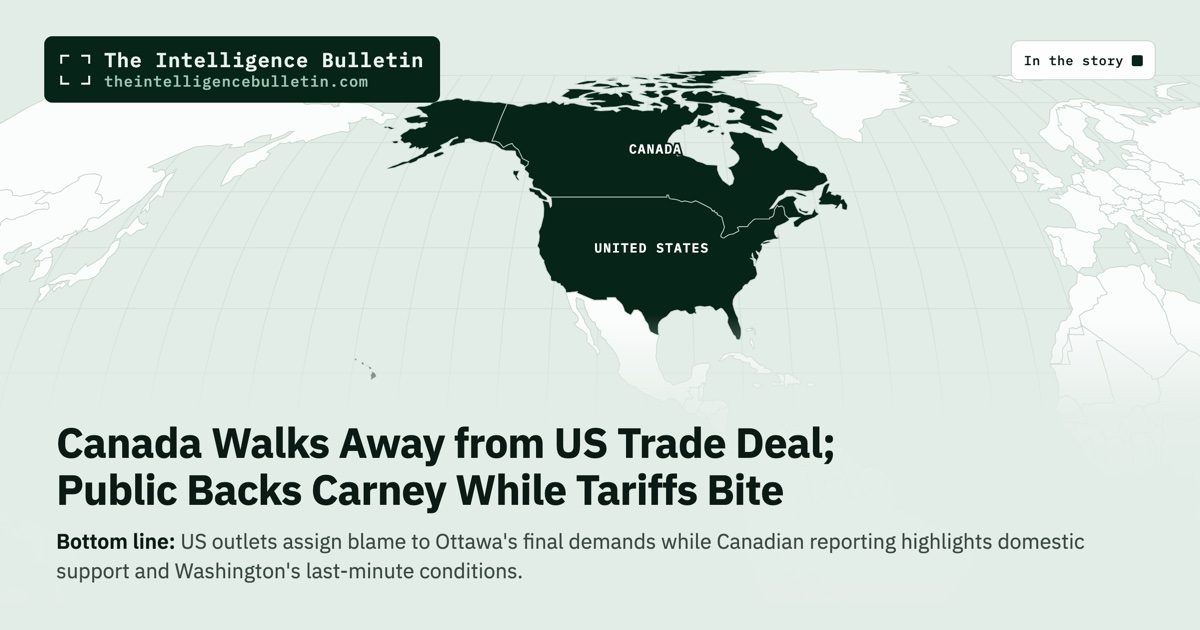
Canada Walks Away from US Trade Deal; Public Backs Carney While Tariffs Bite

Map of the countries in the story: Canada Walks Away from US Trade Deal; Public Backs Carney While Tariffs Bite
US-Canada trade negotiations collapsed on August 23, 2026. US Trade Representative Jamieson Greer blamed Canada for introducing new demands in the final hours. Canadian Prime Minister Mark Carney accused Washington of last-minute changes that threatened Canadian sovereignty and other trade deals. The US imposed 50% tariffs on about $20 billion of Canadian goods; Ottawa announced matching retaliatory tariffs on US steel, dairy, electronics and other sectors starting September 8.

One Story. Many Angles.

🇺🇸
United States
International Business Times
Original reporting
U.S.-Canada Trade Talks Have Collapsed. Washington’s Trade Representative Says Ottawa Is To Blame.
Read →
🇨🇦
Canada
National Post
Original reporting
Most Canadians say Ottawa did right on trade talks, but fear aftermath
Read →
🇺🇸
United States
Breitbart
Original reporting
Mark Carney Says Canada ‘at War’ After Failed U.S. Trade Talks
Read →
🇶🇦
Qatar
Al Jazeera
Original reporting
Canada to hit US with retaliatory tariffs as trade war escalates
Read →
🇭🇰
Hong Kong
South China Morning Post
Carries Bloomberg reporting
Mexico ‘optimistic’ on US trade deal after Canada talks collapse
Read →
5 sources · each independently reported
In Brief

US outlets assign blame to Ottawa’s final demands while Canadian reporting highlights domestic support and Washington’s last-minute conditions.

US reporting centers on Washington’s account of Canadian walk-backs while Canadian coverage stresses public backing for Carney’s refusal of what Ottawa called unacceptable terms. This split reveals the core tension: Greer described a near-complete deal undone by Ottawa’s extra asks, whereas Carney and his envoy detailed US additions restricting future deals and touching Quebec culture. International outlets add that both economies face rising costs and that Mexico sees opportunity in its separate talks. The most consistent thread across chains is the sequence of tariffs and counter-tariffs now locked in, with Canadian polling showing domestic resolve even as fears of higher prices and job losses run high. No source claims the collapse was inevitable from the start; instead each attributes the final break to the other’s last-hour moves, leaving the integrated auto, steel and agricultural supply chains exposed on both sides of the border.

Perspective Analysis

The US-Canada trade talks that had reached the point of near-announcement collapsed in the final hours of August 23, 2026. US Trade Representative Jamieson Greer stated that negotiators had secured sufficient agreement for a formal announcement when Canada introduced fresh demands that overturned prior commitments. Canadian Prime Minister Mark Carney described the breakdown differently, saying the United States added conditions that were uneconomic, unfair, and undermined the reliability of any deal by restricting Canada’s freedom to negotiate with third countries. Those added terms included language that Carney said threatened French language protections and Quebec culture.

The immediate result was the activation of 50 percent US tariffs on roughly 20 billion dollars of Canadian exports, covering dairy, wine, wood products, furniture, cement, ceramics and related goods. Carney responded by confirming that Canada would impose matching retaliatory tariffs on US steel, dairy, agricultural equipment, paper, electronics and other categories beginning September 8. He framed the US measures as an attack that left Canada “at war,” adding that the country had understood earlier than many that Washington would use economic integration as leverage and that American signatures on agreements could prove written in pencil. Carney’s envoy to Washington, Mark Wiseman, said the final draft differed in multiple respects from what Canadian negotiators had understood to be agreed, with particular problems around tariffs on medium and heavy vehicles that Ottawa viewed as essential to preserving its auto assembly industry.

Background to the rupture includes the broader pattern of US tariff actions this year. The administration had earlier applied similar duties under the 1977 International Emergency Economic Powers Act, only to see the US Supreme Court rule that the statute contained no reference to tariffs or duties and required clearer congressional authorization. That decision forced refunds of tens of billions of dollars. The current round of 50 percent duties on Canadian goods followed an extension period granted by President Trump before the higher rates took effect. Trump posted that Canada had long imposed high tariffs on US farm products and run a 60 billion dollar bilateral deficit that was no longer sustainable. He later announced that tariffs on all cars, trucks and automotive parts would rise to 50 percent on January 1, 2027.

Canadian public reaction showed strong support for the decision to walk away. A poll conducted over the preceding weekend found 76 percent of respondents believed Ottawa had done the right thing by refusing the offered terms rather than accepting a bad deal. Only 13 percent said the government should have made the necessary compromises. Support crossed party lines but was highest in Atlantic Canada and Quebec at 84 and 85 percent respectively and lowest in Alberta and Saskatchewan at 67 and 65 percent. Even among Conservative voters, 53 percent backed the refusal. Sixty-two percent also viewed the planned dollar-for-dollar retaliation as appropriate. At the same time, 89 percent expressed concern about higher costs for goods and services, 87 percent worried about the national economy, and 78 percent feared effects on their province. Almost half lacked confidence that a new agreement would be reached soon, though 64 percent believed Canada would emerge stronger over the long term.

Coverage patterns show a clear division in emphasis. US reporting foregrounds Greer’s account of Canadian last-minute additions that undid progress, presenting the collapse as Ottawa’s responsibility. Canadian reporting centers on the domestic polling that endorses Carney’s stance and on the specific US conditions deemed unacceptable, including restrictions on other trade relationships. International accounts from outside the two countries note that both economies will absorb higher prices and that Mexico sees separate room for progress with Washington on steel, aluminum and auto tariffs, with its negotiator remaining in the capital for further talks. One US outlet quotes opposition figures in Canada calling for release of the draft text so the public can judge the rejected terms, while another frames Carney’s “at war” language as evidence of an aggressive posture.

The accounts diverge most sharply on the sequence of the final breakdown. Greer maintained that the US offer contained significant tariff reductions on steel, aluminum, autos and lumber plus coordination on export controls, critical minerals and forced-labor enforcement. Carney and Wiseman maintained that the document presented at the end differed substantially from earlier understandings and contained elements that would have limited Canada’s commercial options. These two versions cannot both be accurate on the details of what changed between the near-agreement and the final text. No independent primary document has been released by either side to resolve the discrepancy.

The most consistent elements across all reporting are the imposition of the 50 percent US tariffs on 20 billion dollars of Canadian goods and Ottawa’s confirmed plan for matching retaliation from September 8. Those measures directly affect integrated supply chains in autos, steel and agriculture that cross the border daily. Mexican statements of optimism for its own negotiations sit alongside this sequence without contradiction, since they address a separate bilateral track within the same USMCA framework.

The US account of Canadian walk-backs rests on statements by Greer that appear in multiple US outlets. The Canadian account of unacceptable US additions rests on statements by Carney and Wiseman that appear in Canadian and international coverage. The single-source polling figure of 76 percent support for the refusal comes from one Canadian outlet’s survey and cannot be weighed against competing data in the current set. Interests are straightforward: Washington seeks to portray the breakdown as Ottawa’s choice to preserve leverage for future pressure, while Ottawa seeks to demonstrate domestic unity behind a refusal of terms that would constrain its wider trade policy.

What to Watch

The next concrete step is the September 8 activation of Canadian tariffs. Supply-chain participants on both sides of the border will absorb the duties on the specified goods, with knock-on effects on prices and production volumes that the polling already shows Canadians anticipate. Further negotiation remains possible but will occur against the backdrop of these measures rather than in their absence. The record shows that each side attributes the final impasse to the other’s last-hour moves; that mutual attribution, rather than any single narrative of blame, is what the published reporting supports.


Share this story