 AI-generated analysis published under the editorial responsibility of Rohit Sinnas. How it works →
Press quoted
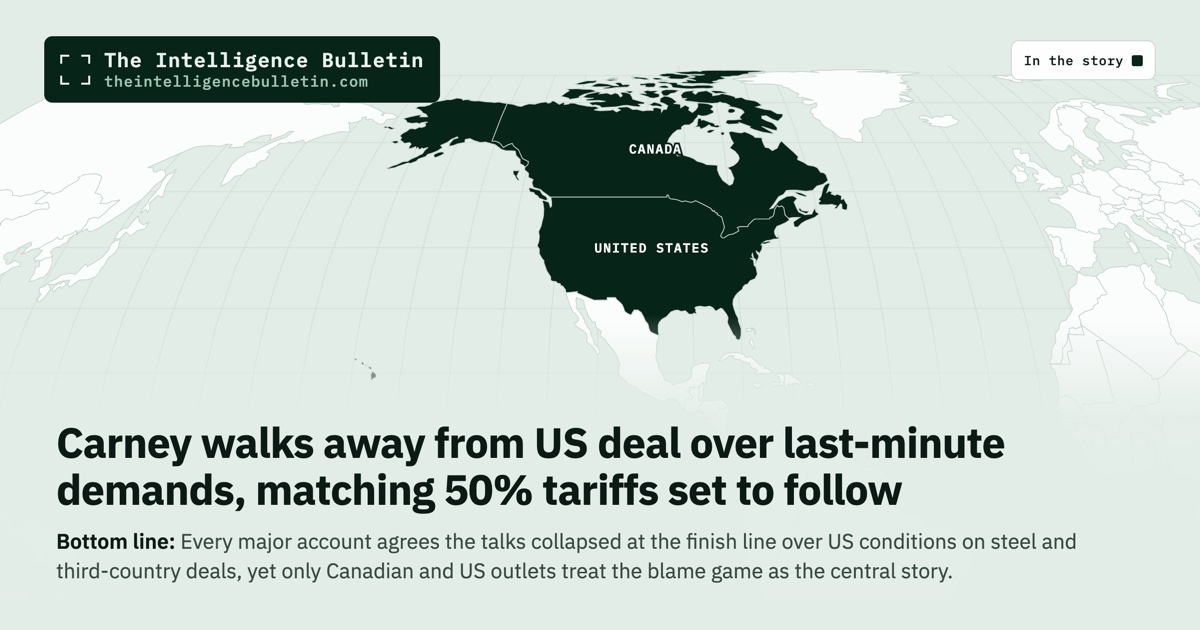
Every major account agrees the talks collapsed at the finish line over US conditions on steel and third-country deals, yet only Canadian and US outlets treat the blame game as the central story.
The reporting across outlets reveals a consistent factual core—the collapse of talks over last-minute US demands on steel, aluminum, autos and restrictions on Canada’s other trade deals—yet the framing splits along actor-observer lines that expose the limits of any single national lens. Canadian and US actor accounts both detail the mutual recriminations but diverge on emphasis: CBC foregrounds Carney’s charge that Washington asked too much and offered too little while Daily Caller stresses the missed opportunity and risks to the integrated auto sector. BBC and Straits Times treat the breakdown as a diplomatic rupture with wider ripple effects, the latter noting the tariffs hit only 5% of Canadian exports yet complicate USMCA renewal. Arab News adds the regional-stability angle, recording Carney’s warning that relations have changed permanently. The convergence on Carney’s dollar-for-dollar pledge and the absence of any fresh talks scheduled shows the event is already locked into retaliation rather than renewed negotiation; what differs is which country’s domestic costs each outlet chooses to foreground. That pattern means a reader limited to one country’s press would miss how the same sequence of accusations lands differently when viewed from supply-chain exposure in Asia or from Middle East interest in stable North American energy flows.
Full analysis
The United States imposed 50 percent tariffs on roughly $20 billion to $28 billion worth of Canadian goods after three days of negotiations in Washington collapsed on the evening of August 21. The tariffs took effect just after midnight on August 22 and cover items including steel, aluminum, automobiles and lumber. Canadian Prime Minister Mark Carney suspended the talks, recalled his negotiating team and announced that Canada would respond with matching retaliatory tariffs beginning after Labour Day on September 8. US Trade Representative Jamieson Greer stated that Canada had declined to finalize an agreement reached earlier in the week and had introduced new demands and walk-backs.
The two sides offered sharply different accounts of the final hours. Carney told reporters in Ottawa that the United States had made last-minute changes that were unfair and uneconomic. He said the proposals would have restricted Canada’s ability to strike new trade deals with other countries, altered the scope of tariffs on Canadian auto content, and limited protections for language and culture. Carney described the US position as one that asked too much and offered too little, adding that Canada had pursued every opportunity for an agreement before the deadline. He also stated that the United States had already disregarded the existing USMCA free-trade agreement and that relations had changed permanently.
Greer, speaking in a White House briefing, said Canada had declined to finalize the deal under terms agreed earlier that week. He noted that the United States had offered Canada the best tariff treatment of any major exporter to the US market in exchange for concessions on retaliatory tariffs covering dairy and lumber. A senior US official added that Canada had sought additional concessions on steel, aluminum, cars and softwood lumber. Greer described the outcome as a missed opportunity for Canada to partner with the fastest-growing G-7 economy.
The tariffs apply to products that represent just over 5 percent of Canadian exports to the United States. Affected goods include wooden ice hockey sticks, cement and other items that had been targeted in earlier Trump administration threats issued in July and August. The new duties add to existing US tariffs on steel, lumber and automobiles that have already reduced employment in those sectors over the past 18 months. Canadian exports accounted for 23 percent of US steel imports and 53 percent of US aluminum imports in recent data, while roughly 90 percent of Canada’s exports in those categories went to the United States.
The collapse followed an initial three-day pause that Trump had announced on August 18 after stating on social media that a deal was near. Canadian Trade Minister Dominic LeBlanc had conducted the final round of talks with Greer in Washington. Hours before the midnight deadline, sources close to the negotiations indicated that an agreement lowering tariffs on steel, aluminum and cars had appeared within reach, potentially including the return of American alcohol to Canadian liquor stores. Those terms did not hold.
Canadian provincial leaders, including Ontario Premier Doug Ford, expressed support for Carney’s decision to walk away. Ford stated that Trump could not be trusted and that Canada needed a Team Canada approach. Industry groups such as Dairy Farmers of Canada and the Canadian Federation of Independent Business called for swift government support for affected businesses while underscoring the disruption to integrated North American supply chains.
The accounts converge on the core sequence and on Carney’s stated plan for dollar-for-dollar retaliation. They diverge in emphasis. Canadian reporting centers Carney’s charges that Washington sought to limit Canadian sovereignty and other trade relationships. US reporting stresses the lost chance for tariff relief and the risks to domestic auto and steel manufacturing, including potential rises in consumer prices ahead of midterm elections. Observer accounts from Britain, Singapore and Saudi Arabia place the breakdown in a wider diplomatic and supply-chain context, noting complications for future USMCA renewal talks and the limits of any single market dependence.
What to Watch
A reader limited to one national press would miss how the same set of accusations registers differently when the stakes are measured in provincial job losses, in integrated auto production across the border, or in longer-term energy export diversification. The convergence on the absence of scheduled follow-up talks indicates the immediate trajectory is already one of reciprocal tariffs rather than renewed bargaining. The primary on-record statements from both Carney and Greer supply the clearest evidence of where each government places responsibility, and those statements remain the most direct record of the final disagreement over the scope of concessions on steel, aluminum and third-country trade access.
That’s how the world told the story.
Get our daily open-source intelligence on world events in your inbox — one email a day, up to six stories.
Subscribe freeNo spam. One-click unsubscribe. See the latest email →