 AI-generated analysis published under the editorial responsibility of Rohit Sinnas. How it works →
Press quoted
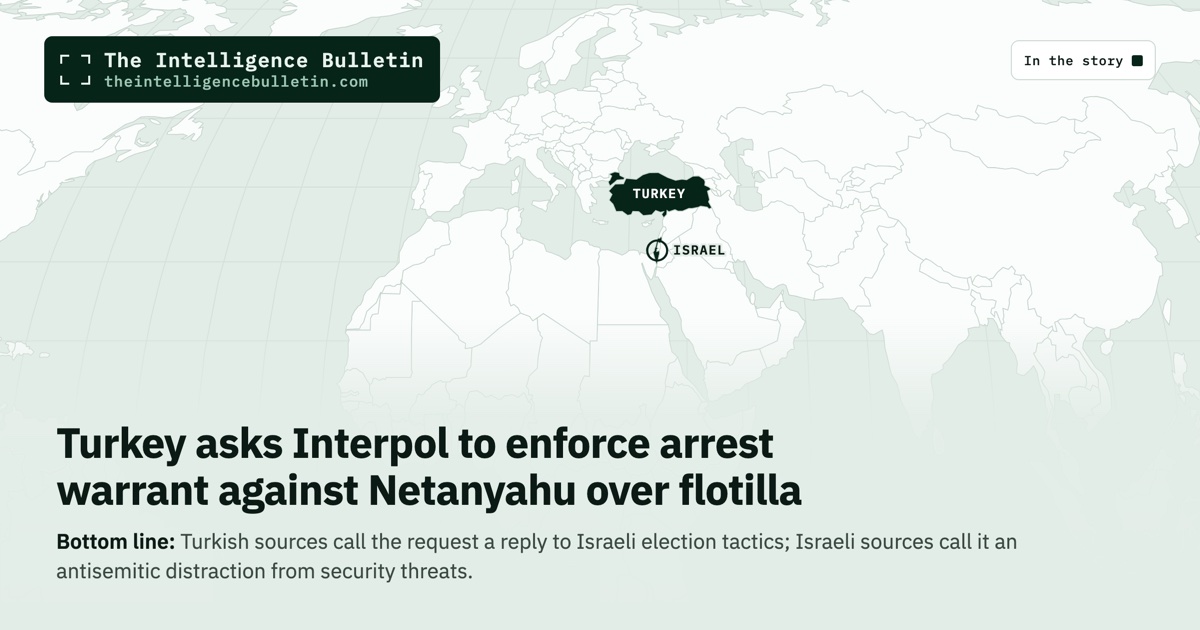
Turkish sources call the request a reply to Israeli election tactics; Israeli sources call it an antisemitic distraction from security threats.
The reporting reveals two parallel narratives around the same legal filing rather than outright contradiction. Turkish outlets and statements treat the Interpol request as a direct response to Israeli election rhetoric that casts Turkey as a regional threat, while Israeli reporting embeds the Turkish announcement inside a wider security context that includes recent strikes in Syria and prior Turkish warrants against multiple officials. Wire services from AFP and Reuters supply the bare timeline of the flotilla incident and the justice minister’s social-media announcement, leaving the political framing to each national actor. Al Jazeera adds emphasis on prior Turkish accusations of genocide in Gaza and notes proceedings in other countries, aligning closest to the Turkish domestic account. The single point of convergence across every source is the July 14 date of the warrants and the request for an Interpol red notice; everything else—election motives, antisemitism charges, or regional destabilization—remains sourced to one side or the other and is presented without reconciliation. This split shows the event functions less as new evidence of crimes and more as an escalation in the existing diplomatic and legal standoff between Ankara and Jerusalem.
Full analysis
Turkey’s Justice Ministry asked its Interior Ministry on August 21 to issue Interpol red notices enforcing arrest warrants that had been issued domestically on July 14 against Israeli Prime Minister Benjamin Netanyahu and a second individual named Afek Moskovitch. The warrants list charges of genocide, crimes against humanity, torture, aggravated deprivation of liberty, intentional assault and battery, destruction of property, aggravated looting and hijacking of transport vehicles. Turkish Justice Minister Akin Gurlek stated on social media that the action followed from judicial proceedings over an Israeli attack on activists in international waters and that Turkey would use every available legal mechanism to hold Israel accountable for its actions in Gaza.
The underlying case concerns Israel’s interception in May of the Global Sumud Flotilla, a convoy of roughly 50 vessels that departed from Turkey carrying approximately 430 activists and humanitarian supplies bound for Gaza. Israeli forces opened fire on at least two of the boats, detained the passengers, and later deported them after holding them in an Israeli prison. Turkish officials have described the operation as occurring on the high seas. The same warrants also name other Israeli officials in separate filings, and Gurlek noted that Turkey had already issued domestic arrest warrants against 37 senior Israeli figures, including Netanyahu, in November of the previous year.
Netanyahu’s office responded the same day with a statement that called Turkish President Recep Tayyip Erdogan an antisemitic dictator who had massacred Kurds, harbored Hamas terrorists, occupied half of Cyprus and jailed record numbers of journalists and politicians. The statement said Erdogan’s attempt to intimidate Israel’s leaders and soldiers would go nowhere and accused him of extending aggression against Israel into Syria. Israeli reporting placed the Turkish announcement against the background of an Israeli strike earlier that week on the Abu al-Duhur air base in northwestern Syria, which followed a reported visit to the site by a Turkish delegation. Israel had previously warned Ankara that it would not tolerate a Turkish military buildup there.
Turkish officials countered that Netanyahu and his associates were constructing Turkey as a new threat figure as part of cheap domestic politics timed for Israel’s October 27 elections. A Likud billboard in Tel Aviv had placed Erdogan alongside Iranian and Hezbollah figures under the message that they wanted Netanyahu to lose. The Turkish Communications Directorate described the Israeli remarks as an impertinent rant devoid of historical facts and political seriousness, and said they demonstrated how unsettled the Netanyahu government had become by Erdogan’s refusal to remain silent. It warned that pursuing a politics of threats for electoral advantage carried risks for regional and global stability.
Wire-service accounts from Agence France-Presse, carried by the South China Morning Post and the Toronto Sun, supplied the core sequence without additional national framing: the July 14 warrants, the request for red notices, the flotilla interception, and the fact that France, Italy and Australia had also opened judicial proceedings over the same incident. Al Jazeera reporting added that Turkey has been one of the fiercest critics of Israel’s Gaza operations and had repeatedly called for international measures, while noting that Israel denies the charges.
A reader limited to Turkish sources would see the Interpol request primarily as a defensive reply to Israeli electioneering that links Netanyahu’s domestic campaign to his foreign rhetoric. A reader limited to Israeli sources would see it as one more move by an antisemitic Turkish leader already entangled in regional confrontations, including the recent Syrian strike. Wire accounts alone would leave both the election motive and the antisemitism charge unmentioned, presenting only the legal filing and the flotilla background. Al Jazeera’s account aligns more closely with the Turkish emphasis on accountability for Gaza actions while adding the detail of parallel proceedings in other countries.
The single corroborated element across every independent reporting chain is the July 14 date of the warrants and the August 21 request for Interpol red notices. All other interpretive layers—election tactics on one side, antisemitism and regional destabilization on the other—remain attached to statements from one government or the other. The Turkish election claim appears in a single national outlet’s direct quotation of its own government’s communications directorate. The Israeli characterization appears in an on-record statement from Netanyahu’s office carried by two separate outlets.
What to Watch
The filing therefore functions as an escalation within an established diplomatic and legal standoff rather than the introduction of new evidence about events in May. Both governments have clear interests in shaping how the request is understood: Ankara benefits from portraying the move as a measured legal response to provocations, while Jerusalem benefits from casting it as the latest expression of longstanding Turkish hostility. The next practical question is whether any Interpol member state will act on a red notice that does not compel arrests, and whether the filing prompts further coordinated legal steps by the countries already examining the flotilla case.
That’s how the world told the story.
Get our daily open-source intelligence on world events in your inbox — one email a day, up to six stories.
Subscribe freeNo spam. One-click unsubscribe. See the latest email →