 AI-generated analysis published under the editorial responsibility of Rohit Sinnas. How it works →
Press quoted
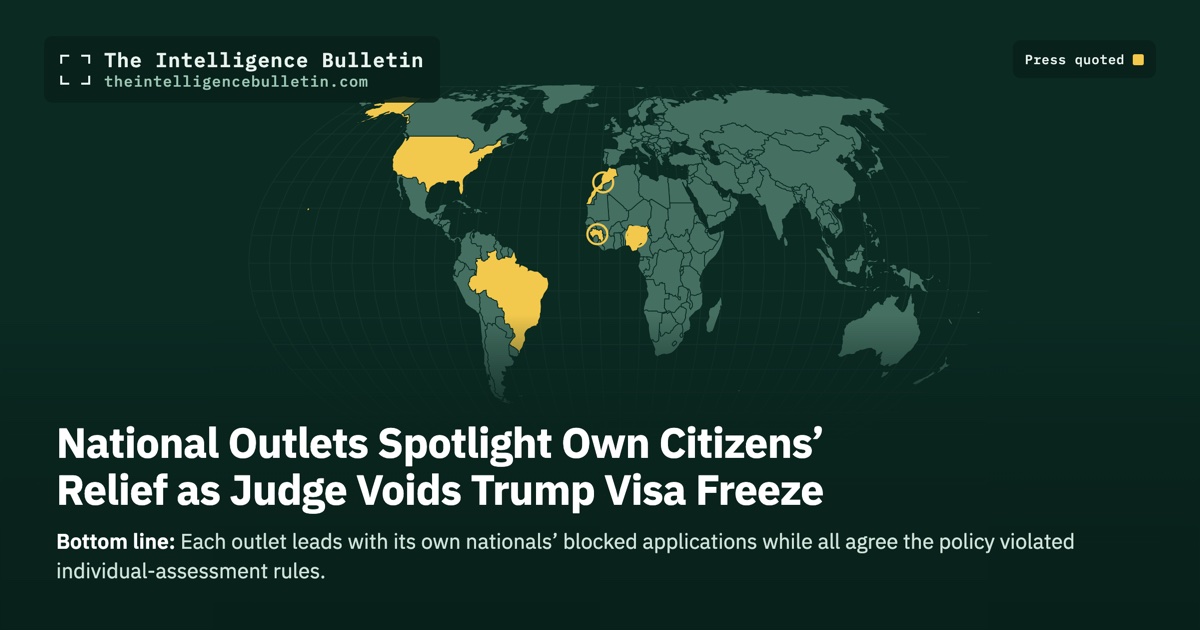
Each outlet leads with its own nationals’ blocked applications while all agree the policy violated individual-assessment rules.
National outlets converge on the core legal finding that the policy improperly substituted nationality for the required case-by-case public-charge evaluation under immigration law, yet each frames the outcome through its own citizens’ immediate stakes. Brazilian coverage centers relief for applicants previously blocked despite meeting financial criteria, while Nigerian reporting supplies the full country list and stresses household welfare statistics cited by the administration. Moroccan and Guinean accounts similarly isolate their nationals’ blocked family and employment petitions. US domestic framing instead emphasizes the judge’s explicit rebuke of a Rubio cable that predetermined refusals even with contrary evidence, distinguishing it from the 2018 travel-ban precedent. This pattern reveals how the same statutory conflict registers as targeted national relief abroad and institutional overreach at home, with no outlet disputing the judge’s reading of the 1965 nondiscrimination provision or the cable’s language. The convergence on individual-assessment requirements across independent reporting chains underscores that the policy’s design, not merely its goals, drove the uniform judicial outcome.
Full analysis
A federal judge in Manhattan ruled Friday that the Trump administration’s January policy suspending immigrant visas from 75 countries exceeded the statutory authority of Secretary of State Marco Rubio and violated federal immigration law. Judge Jeannette Vargas of the U.S. District Court for the Southern District of New York found that the measure directed consular officers to refuse applications solely on the basis of nationality, even when applicants supplied evidence that they would not become public charges. The ruling reverses any denials that rested exclusively on the policy while leaving intact refusals grounded in other provisions of law. The administration may appeal.
The policy took effect January 21, 2026, after the State Department sent a cable to every diplomatic and consular post. The cable instructed officers to pause issuance of immigrant visas—those leading to permanent residence—for nationals of the designated countries on the ground that applicants from those nations posed a high risk of relying on public benefits. The list drew from Council of Economic Advisers data showing that more than 30 percent of immigrant households from the selected countries had received some form of public assistance. Immigrant visas for family reunification or employment were halted; tourist, student, and other nonimmigrant visas remained available. The cable stated that officers should refuse even applicants who provided additional evidence overcoming the public-charge ground.
Vargas wrote that the outcome under the policy was predetermined. She cited a 1965 statute barring nationality-based discrimination in the issuance of immigrant visas and a separate provision that removes authority over individual consular decisions from the secretary of state. The judge distinguished the case from the 2018 Supreme Court decision upholding the third version of the first-term travel ban, noting that the earlier ruling addressed presidential power to bar entry while this dispute concerned whether a visa could be issued at all. Plaintiffs included six U.S. citizens who had sponsored relatives from Ghana, Jamaica, Guatemala, and Ethiopia, plus five Colombians whose job-based applications had been denied under the policy. The suit was brought by the Catholic Legal Immigration Network and African Communities Together along with the individual petitioners.
The 75 countries span the Caribbean, sub-Saharan Africa, the Balkans, the Middle East, Central Asia, and parts of Southeast Asia and Latin America. They include Nigeria, Brazil, Morocco, Guinea, Colombia, Egypt, Jordan, Haiti, Somalia, Russia, and many others. One published list names Afghanistan, Albania, Algeria, Antigua and Barbuda, Armenia, Azerbaijan, Bahamas, Bangladesh, Barbados, Belarus, Belize, Bhutan, Bosnia-Herzegovina, Brazil, Cambodia, Cameroon, Cape Verde, Colombia, Cuba, Dominica, DR Congo, Egypt, Eritrea, Ethiopia, Fiji, Gambia, Georgia, Ghana, Grenada, Guatemala, Guinea, Haiti, Iran, Iraq, Ivory Coast, Jamaica, Jordan, Kazakhstan, Kosovo, Kuwait, Kyrgyzstan, Laos, Lebanon, Liberia, Libya, Moldova, Mongolia, Montenegro, Morocco, Myanmar, Nepal, Nicaragua, Nigeria, North Macedonia, Pakistan, Republic of Congo, Russia, Rwanda, Saint Kitts and Nevis, Saint Lucia, Senegal, Sierra Leone, Somalia, South Sudan, St. Vincent and the Grenadines, Sudan, Syria, Tanzania, Thailand, Togo, Tunisia, Uganda, Uruguay, Uzbekistan, and Yemen. The administration had argued that the pause allowed time to reassess procedures and prevent exploitation of welfare systems; a State Department spokesperson described the measure as consistent with long-standing authority to deem inadmissible those likely to become public charges.
The judge gave both sides until September 11 to propose how to resolve remaining issues in the case. A separate ruling by Judge Amit Mehta in the District of Columbia on July 31 had reached a similar conclusion on the same policy, reinforcing the view that nationality alone cannot substitute for the individualized financial, age, health, skills, and family assessment required by statute.
Coverage from outlets in the affected countries foregrounded the immediate consequences for their own nationals. Nigerian reporting supplied the complete list of 75 countries and noted that roughly one-third of Nigerian immigrant households had been identified in the administration’s welfare data. Brazilian accounts emphasized that applicants from Brazil who met all other requirements had nevertheless faced automatic refusal. Moroccan coverage listed Morocco alongside Algeria, Tunisia, Egypt, Senegal, Nigeria, Pakistan, Bangladesh, Brazil, Colombia, and Uruguay among the suspended nationalities. Guinean reporting highlighted that Guinea appeared on the list alongside Senegal, Sierra Leone, Côte d’Ivoire, Ghana, Nigeria, Liberia, and Gambia, and stressed that the decision restored the principle of case-by-case evaluation rather than a collective presumption.
United States reporting instead stressed the statutory violations. It quoted the judge’s finding that the cable left no room for consular officers to exercise the discretion Congress had preserved and that the policy ran afoul of the 1965 nondiscrimination provision. It also noted that the administration had prevailed on a narrower procedural point: the policy did not require public notice and comment as a formal rule.
The accounts diverge most clearly in emphasis rather than in the description of the ruling itself. Every source reports the same core holding that the policy improperly replaced individualized review with a nationality-based bar. The divergence appears in what each outlet chooses to place in the foreground: legal mechanics and the text of the cable in one case, the names of blocked applicants and the specific welfare statistics attached to a single country in others. No source disputes the existence of the cable or the judge’s reading of the relevant statutes. The convergence across five independent reporting chains on the requirement of individualized assessment supplies the clearest evidence that the policy’s design, rather than its stated goal of reducing public-charge entries, produced the uniform judicial result.
The most detailed accounts of the statutory conflict come from the outlets that reproduced extended passages from the opinion and the cable. Those passages show that consular officers were directed to refuse applications even when applicants demonstrated they would not rely on benefits, a directive the judge found incompatible with the Immigration and Nationality Act. National outlets correctly identified the relief available to their own citizens and correctly listed the countries on the original suspension, yet they did not contradict the legal analysis. The policy’s reach—75 countries representing a substantial share of potential family-based and employment-based immigration—explains why each affected press treated the ruling as direct national news rather than abstract administrative law.
What to Watch
The accounts that quote the opinion and the cable at length rest on the strongest warrant. Those sources show the precise language that produced the predetermined refusals and the precise statutory provisions the judge invoked. National outlets that supplied the full country list or the Nigeria-specific welfare figure performed a different but complementary service by making concrete which populations stood to regain processing. Because the legal reasoning converges across chains while the national stakes differ, a reader gains the most complete picture by combining the statutory analysis with the country-specific lists rather than relying on either alone. The administration retains the option to appeal to the Second Circuit or seek a stay, which will determine whether the restoration of individualized review takes effect immediately or remains suspended pending higher review.
That’s how the world told the story.
Get our daily open-source intelligence on world events in your inbox — one email a day, up to six stories.
Subscribe freeNo spam. One-click unsubscribe. See the latest email →