 AI-generated analysis published under the editorial responsibility of Rohit Sinnas. How it works →
Press quoted
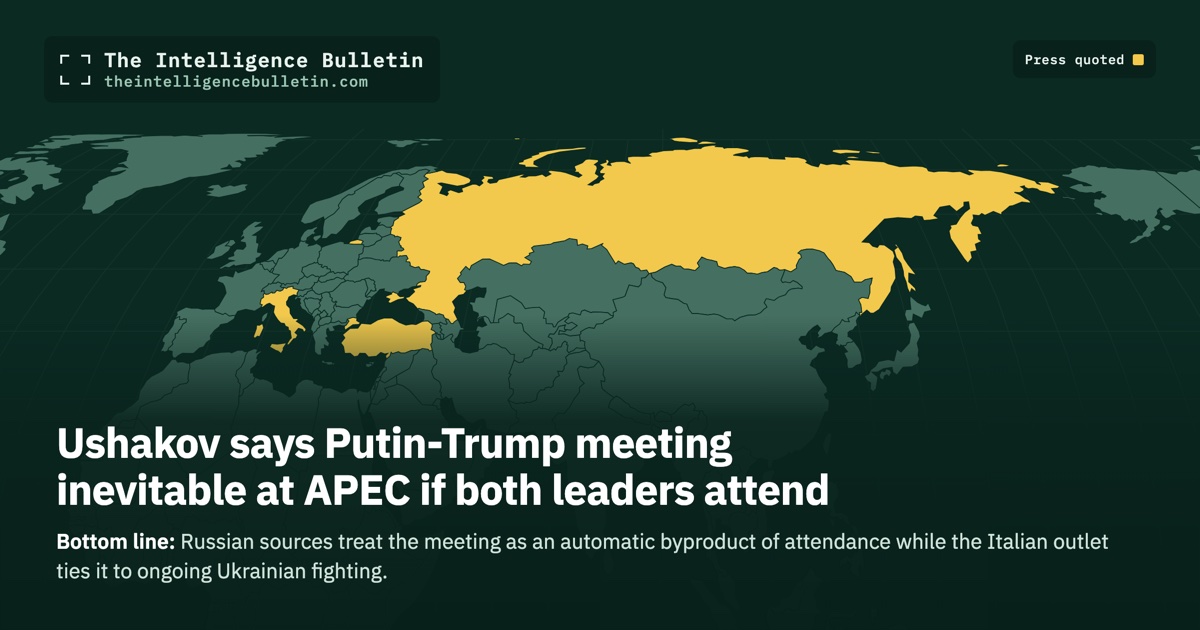
Russian sources treat the meeting as an automatic byproduct of attendance while the Italian outlet ties it to ongoing Ukrainian fighting.
Russian outlets frame the comment as a straightforward observation from aide Yury Ushakov that any shared event makes a bilateral meeting inevitable, without new diplomatic signals. Anadolu Agency presents it as a Kremlin signal of possible high-level contact. The Italian Zazoom outlet alone links the diplomatic note directly to battlefield developments in Zaporizhzhia, showing how European coverage embeds the possibility inside active conflict reporting rather than treating it as isolated diplomacy. Two Russian sources draw from the same Ushakov interview with Vesti, confirming the core claim originates in Russian state commentary. The absence of any selected Chinese outlet leaves the host nation’s framing unrepresented despite the summit’s location. The reporting converges on the conditional nature of the encounter and the lack of concrete plans three months out, with no contradictions across the set.
Full analysis
Russian presidential aide Yury Ushakov told the state-aligned television service Vesti that if Vladimir Putin and Donald Trump both appear at the Asia-Pacific Economic Cooperation summit in Shenzhen on November 18 and 19, the two leaders will meet and talk as a matter of course. The remark, delivered in an interview with journalist Pavel Zarubin, contained no new proposals, no proposed agenda, and no indication that either side had begun arranging a bilateral session. Ushakov added that three months still remained before the gathering and that no concrete signals had yet arrived.
The same conditional phrasing appeared across the four articles that covered the comment on August 23. Russian state broadcaster RT quoted Ushakov directly: leaders at the same event “will inevitably meet and negotiate.” Business daily Kommersant carried an almost identical passage and added that Ushakov had reminded listeners of the many other international events Russia will host in the coming weeks. Anadolu Agency rendered the statement as a Kremlin signal that a meeting “could” occur. Italian aggregator Zazoom carried the core quote and immediately followed it with a separate paragraph on reported Russian strikes in the Zaporizhzhia region of Ukraine.
The summit itself is a long-scheduled multilateral forum hosted by China. Its dates and location in Shenzhen have been public for months. Ushakov’s intervention did not alter those facts; it merely supplied a Russian official’s assessment of what would follow if both presidents chose to attend. Kommersant noted that Ushakov had previously offered differing assessments of a possible encounter, including one in May when he judged a meeting in China unrealistic. The August 23 comment therefore sits inside a running series of low-stakes Russian observations rather than marking a sudden shift in position.
Two of the four pieces drew from the identical Vesti interview. RT and Kommersant both named Zarubin and the same date of the broadcast. Their accounts therefore constitute a single reporting chain, not independent confirmation. Zazoom attributed its version to Quotidiano.net, which in turn carried the same Ushakov quotation. Anadolu Agency published an English-language headline and lead that mirrored the Russian wording without citing an additional source. No outlet in the set reported any American or Chinese reaction to the remark.
The Italian article alone placed the diplomatic note beside active fighting. Its headline paired the APEC possibility with “Attacchi russi nella regione di Zaporizhzhia.” The body text restated Ushakov’s words and then turned to battlefield developments without claiming any direct connection between the two subjects. The remaining three pieces contained no reference to Ukraine operations on the day they published the Ushakov comment.
No selected source originated in China, the country scheduled to host the summit. The absence leaves the host government’s framing of the remark outside the set. Turkish, Russian, and Italian coverage therefore supplies the only available published accounts.
The core factual spine across the reporting is narrow and consistent: Ushakov described an automatic encounter conditional on attendance, supplied no timetable or agenda, and noted the absence of preparatory signals. Where the pieces diverge is in the surrounding material they chose to attach. Russian outlets stayed inside the official interview and its immediate context of other Russian-hosted events. The Turkish agency foregrounded the international-diplomacy angle. The Italian aggregator inserted the Zaporizhzhia strikes. These choices produce different impressions of the remark’s weight without altering the statement itself.
A reader limited to Russian state media would encounter the comment as routine official commentary on logistics, not as a fresh diplomatic initiative. A reader limited to the Anadolu headline would see a possible bilateral opening between Washington and Moscow. A reader limited to Zazoom would see the same possibility embedded inside daily reports of Russian operations in Ukraine. Each framing is traceable to what that outlet actually published on August 23.
The reporting chains converge on the conditional character of the statement and on the lack of concrete preparations three months before the summit. They diverge on the additional context each outlet elected to supply. No independent chain contradicts the Ushakov quotation or the November dates. The Italian linkage to Zaporizhzhia stands as the clearest departure from the others, yet it does not claim causation; it simply juxtaposes the two subjects on the same page.
What to Watch
The narrowest reading supported by the published texts is therefore the one that stays closest to Ushakov’s recorded words: attendance at the same multilateral event would produce an automatic bilateral contact, and no such contact has been arranged yet. The additional interpretive layers supplied by individual outlets reflect editorial choices rather than competing factual claims.
That’s how the world told the story.
Get our daily open-source intelligence on world events in your inbox — one email a day, up to six stories.
Subscribe freeNo spam. One-click unsubscribe. See the latest email →