 AI-generated analysis published under the editorial responsibility of Rohit Sinnas. How it works →
Press quoted
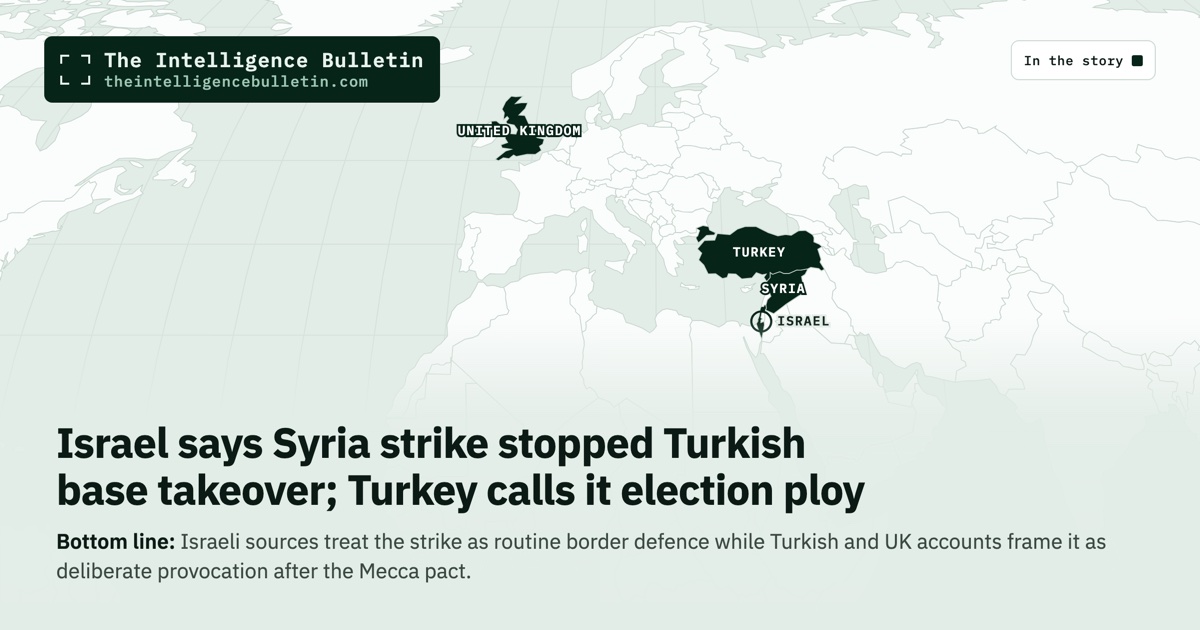
Israeli sources treat the strike as routine border defence while Turkish and UK accounts frame it as deliberate provocation after the Mecca pact.
Israeli reporting presents the strike as a necessary defensive measure after Syria ignored repeated warnings about Turkish troops at the Abu al-Duhur base, framing Turkey’s existing Syrian presence as fifty times larger than Israel’s limited foothold and linking it to Erdogan’s stated hostility toward Israel. British-based Middle East Eye reporting instead situates the attack immediately after the Mecca defence agreement between Turkey, Saudi Arabia and Pakistan, portraying it as an attempt to undermine Ankara’s credibility in Syria and test the new US-backed government there while downplaying any imminent Turkish threat at the site. Indian coverage relays Netanyahu’s direct warnings on Turkish military expansion without adding independent sourcing, aligning closely with the Israeli account on the core justification. The three accounts converge on the basic sequence of the strike and Netanyahu’s statements but diverge sharply on motivation and risk: Israeli sources emphasise proactive security needs while Turkish sources and the UK outlet stress election timing and provocation. This split shows how the same public Israeli statements are read as routine deterrence in one capital and deliberate escalation in another.
Full analysis
Israel struck a Syrian airbase at Abu al-Duhur early on the morning of 19 August 2026, hitting the runway of the facility roughly 70 kilometres from the Turkish border. Israeli Prime Minister Benjamin Netanyahu and his spokesman Doron Spielman said the operation was meant to stop Turkish forces from taking control of the site and moving farther south. Spielman stated in a video released by the Prime Minister’s Office that Turkey already holds about 5 percent of Syrian territory and that Israel had warned Syria repeatedly not to allow the deployment. He noted that Israel maintains only one-tenth of 1 percent of Syria along its southern border and described the Turkish presence as fifty times larger despite having no comparable threats from groups such as Hezbollah or ISIS.
Spielman added that an understanding reached more than a year earlier between Israel and Syria to keep the border calm had been on the verge of breaking. Israeli intelligence had identified plans to place Turkish troops at the airbase less than 200 miles from Israeli communities. Netanyahu said Israel would not tolerate a Turkish military buildup advancing toward its border and that Syria had ignored prior warnings, forcing Israel to deliver the message another way. He linked the concern to Turkish President Recep Tayyip Erdogan’s past statements calling for Israel’s destruction and criticising the United States.
Turkish officials rejected the premise that any military deployment was imminent. Syrian sources told Middle East Eye that a Turkish technical team had visited the base days earlier only to repair the runway and control tower, with no combat units present. They described Turkish assistance as general support for rebuilding Syrian military facilities rather than a move aimed at Israel. Ankara further described Netanyahu’s account as an election tactic timed ahead of Israeli votes and said the claims formed part of efforts to portray Turkey as a new regional threat.
The strike came days after Turkey, Saudi Arabia and Pakistan signed the Mecca defence agreement. Turkish insiders cited by Middle East Eye viewed the Israeli action as an attempt to undermine Ankara’s credibility as a partner in Syria and to test the new administration in Damascus backed by Washington. They noted that Israel had not used an existing military hotline between the two countries to deconflict operations, raising the chance of miscalculation.
US envoy to Syria and Turkey Tom Barrack condemned the strike in statements carried across the three outlets. He said the action carried a real risk of rapid escalation into direct confrontation between Israel and Turkey and noted that Turkish forces had not been warned in advance. Barrack called for activation of a new deconfliction mechanism involving Syria, Israel and Turkey.
Israeli reporting from Ynet foregrounded Spielman’s video and the comparative territorial figures to present the strike as a limited defensive step that Israel does not seek to expand. Middle East Eye reporting placed the same statements against the backdrop of the Mecca pact and anonymous Turkish assessments that the move was intended to intimidate rather than merely defend. Daily Excelsior relayed Netanyahu’s direct warnings on Turkish expansion and included Barrack’s criticism without introducing independent Turkish or Syrian counter-claims.
The accounts converge on the sequence of the strike, the Israeli justification offered in public statements, and the US envoy’s criticism. They diverge on whether Turkish forces were preparing to occupy the base and on the larger motive. Israeli sources tie the operation to longstanding security concerns and Erdogan’s rhetoric. Turkish sources and the British outlet frame it as provocation timed to domestic Israeli politics and the new defence pact. The Indian outlet stays aligned with the Israeli statements on the stated reason for the action.
Israeli officials have an interest in presenting the strike as proportionate response to an emerging threat, while Turkish officials have an interest in minimising the incident and attributing it to Netanyahu’s campaign calendar. The US envoy’s on-record warning supplies an independent voice that the operation risked broader confrontation. Readers who encounter only the Israeli account will see a straightforward border-security measure. Readers who encounter only the Turkish or British framing will see an unnecessary provocation that ignores an existing deconfliction channel. The three reports together show that both interpretations rest on the same public Israeli statements, with the difference lying in how those statements are situated against the Mecca agreement and domestic timing.
What to Watch
The Israeli account of the strike’s immediate purpose rests on the government’s own statements and is carried without contradiction in all three outlets. The claim that no Turkish military deployment was planned rests on Syrian and Turkish sources cited only in the British reporting. The election-stunt interpretation appears in Turkish statements and Middle East Eye sourcing but is not addressed in the Israeli or Indian pieces. The next development likely to test these accounts is whether Turkish forces move into the base or similar sites in the coming weeks, or whether the existing hotline and any new deconfliction talks produce visible restraint. Either outcome will clarify whether the Israeli action addressed a concrete shift in Turkish positioning or whether it has instead accelerated the very expansion it sought to prevent.
That’s how the world told the story.
Get our daily open-source intelligence on world events in your inbox — one email a day, up to six stories.
Subscribe freeNo spam. One-click unsubscribe. See the latest email →