 AI-generated analysis published under the editorial responsibility of Rohit Sinnas. How it works →
Press quoted
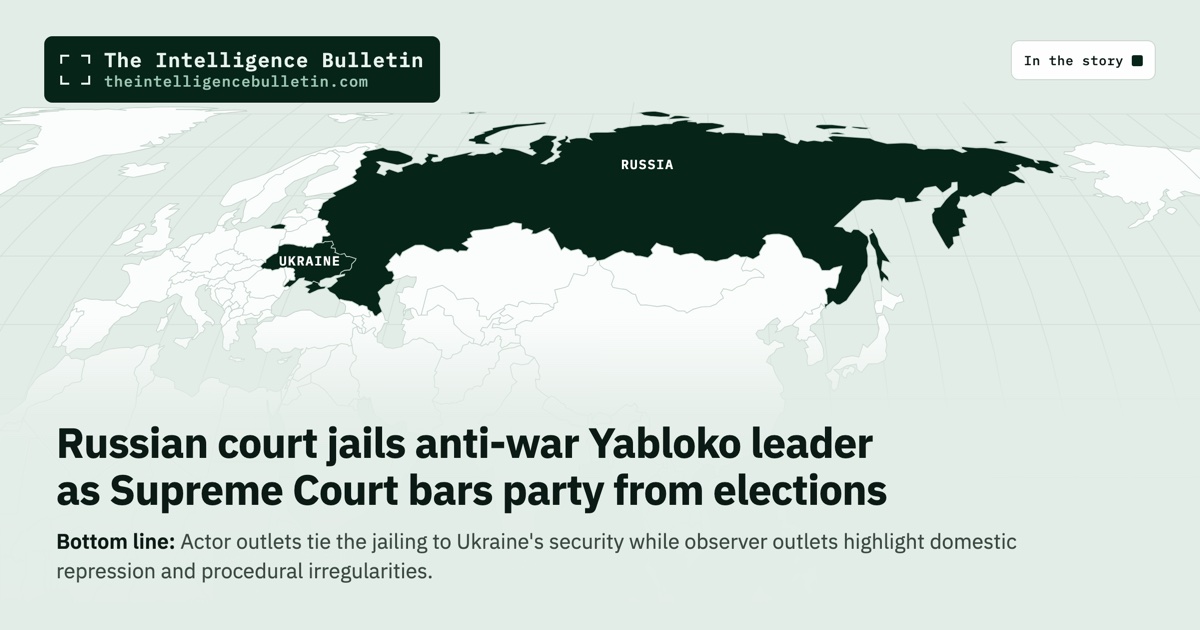
Actor outlets tie the jailing to Ukraine’s security while observer outlets highlight domestic repression and procedural irregularities.
The reporting converges on the sentence and the simultaneous election ban as coordinated pressure on the sole registered party openly opposing the war, yet the angles diverge sharply in what each outlet chooses to foreground. Ukrainian coverage from Kyiv Post frames both moves as direct threats to Ukraine’s security and evidence of Kremlin efforts to eliminate anti-war voices ahead of the vote. Western and Gulf outlets emphasize the human cost and procedural flaws inside Russia itself. The Moscow Times details irregularities such as the judge refusing to question Shlosberg directly and appointing a state lawyer after defense attorneys were absent. The Independent and Al Jazeera quote Shlosberg’s defiant courtroom speech about mounting Russian casualties and label the case part of a wider pattern that previously targeted Navalny and Orlov. Dutch public broadcaster NOS stresses the penal-colony sentence as emblematic of authoritarian rule and connects it to earlier high-profile cases. All accounts draw heavily from the same Russian independent sources, producing an unusually consistent factual core across borders while still revealing distinct national priorities in emphasis and context.
Full analysis
A Pskov court handed Lev Shlosberg, deputy chairman of the liberal Yabloko party, an 11-year-and-one-month sentence in a general-regime penal colony on August 17. Prosecutors had asked for 12 years and one month. The charges combined accusations of discrediting the Russian armed forces with spreading false information about their actions. Both counts drew on wartime laws enacted after the February 2022 full-scale invasion of Ukraine. The sentence incorporated a prior November 2025 conviction that had required 420 hours of community service for violating the foreign-agent statute.
The first count rested on a February 25, 2022, Telegram repost of a Daily Mirror front page that paired an image of President Vladimir Putin with a photograph of a bloodied woman under the headline “Her blood… His hands.” Shlosberg told the court the post predated the new censorship statutes. The second count arose from remarks in a January 2025 public debate in which he called for the swiftest possible ceasefire in Ukraine. Prosecutors attributed the statements to him; he maintained that his debate opponent had made them and that he had never published video of the exchange.
Shlosberg entered a not-guilty plea and used his final statement to declare the entire proceeding unlawful. “I am an innocent man, against whom criminal charges have been unlawfully brought,” he said. Four of the five outlets that covered the verdict recorded this passage. The judge, according to accounts in The Moscow Times and Kyiv Post, declined to question Shlosberg directly and instead read transcripts from earlier hearings. Three defense attorneys missed sessions because of illness or scheduling conflicts; the court appointed a state lawyer whose request for time to review the file was denied.
On the same day the Pskov verdict was delivered, Russia’s Supreme Court rejected Yabloko’s appeal against the cancellation of its federal candidate list for the September parliamentary elections. The party had been the only registered political organization in Russia that campaigned openly for an end to the war. The initial ban had followed a lawsuit filed by the small nationalist Rodina party, which accused Yabloko of receiving foreign funding and promoting extremism. Yabloko leaders rejected both claims, stating that the party received only domestic donations and answered to Russian voters. Party leader Nikolay Rybakov described the detentions of supporters outside the Supreme Court building as intimidation.
Shlosberg’s closing courtroom remarks went beyond the narrow charges. He described the war as a catastrophe for Russia, noting that cemeteries were expanding faster than maternity wards, kindergartens, and schools. The Independent and Al Jazeera both carried extended excerpts in which he predicted that the full death toll, once published with names, would shock the nation. Independent Russian outlets Mediazona and the BBC Russian service have documented at least 239,354 named Russian service members killed since the invasion; by examining excess mortality through estate records, they estimate the true figure exceeds 350,000. Those casualty compilations appeared in coverage of Shlosberg’s statement.
The sources agree on the core sequence and the legal basis for the charges. They also converge on the fact that Yabloko was the sole registered anti-war party on the ballot and that the election ban and prison sentence were announced together. The Moscow Times supplied the most detailed record of trial procedure, including the judge’s refusal to question the defendant and the appointment of replacement counsel. Kyiv Post placed both rulings in the context of threats to Ukraine’s security and the elimination of organized domestic opposition before the vote. The Independent and Al Jazeera foregrounded Shlosberg’s own words about casualties and placed the case inside a longer pattern that includes the imprisonment of human-rights advocate Oleg Orlov and the death of Alexei Navalny in a penal colony. NOS, writing for a Dutch audience, emphasized the penal-colony sentence itself and connected it explicitly to those earlier cases.
No outlet in the set carried a Russian state-media account that disputed the sentence or the election ruling. All five drew the factual spine from the same two independent Russian reporting chains: Mediazona for the trial details and Novaya Gazeta for courtroom observations. Where the accounts diverge is in emphasis rather than in the events reported. Ukrainian coverage alone tied the rulings directly to battlefield implications for Kyiv. The exiled Moscow Times supplied granular procedural evidence that the others summarized. British and Qatari reporting lingered on the content of Shlosberg’s speech and the human stakes. The Dutch public broadcaster framed the outcome as a textbook illustration of authoritarian consolidation.
What to Watch
The consistent factual core across five independent national outlets rests on primary Russian sources that operate outside state control. That convergence supplies the strongest available warrant for the sentence length, the charges, and the simultaneous election decision. Ukrainian reporting adds the necessary reminder that these domestic moves occur inside an active war whose front lines the Yabloko leadership has proposed freezing. The exiled Moscow Times account of courtroom mechanics offers the clearest window into how such cases are conducted when defense counsel and direct testimony are restricted. Readers limited to any single national lens would miss either the Ukrainian security stakes, the procedural texture inside Russia, or the explicit linkage to prior high-profile dissent cases. The combined record shows a tightening of political space ahead of September elections that leaves no registered party able to campaign for an immediate ceasefire.
That’s how the world told the story.
Get our daily open-source intelligence on world events in your inbox — one email a day, up to six stories.
Subscribe freeNo spam. One-click unsubscribe. See the latest email →