 AI-generated analysis published under the editorial responsibility of Rohit Sinnas. How it works →
Press quoted
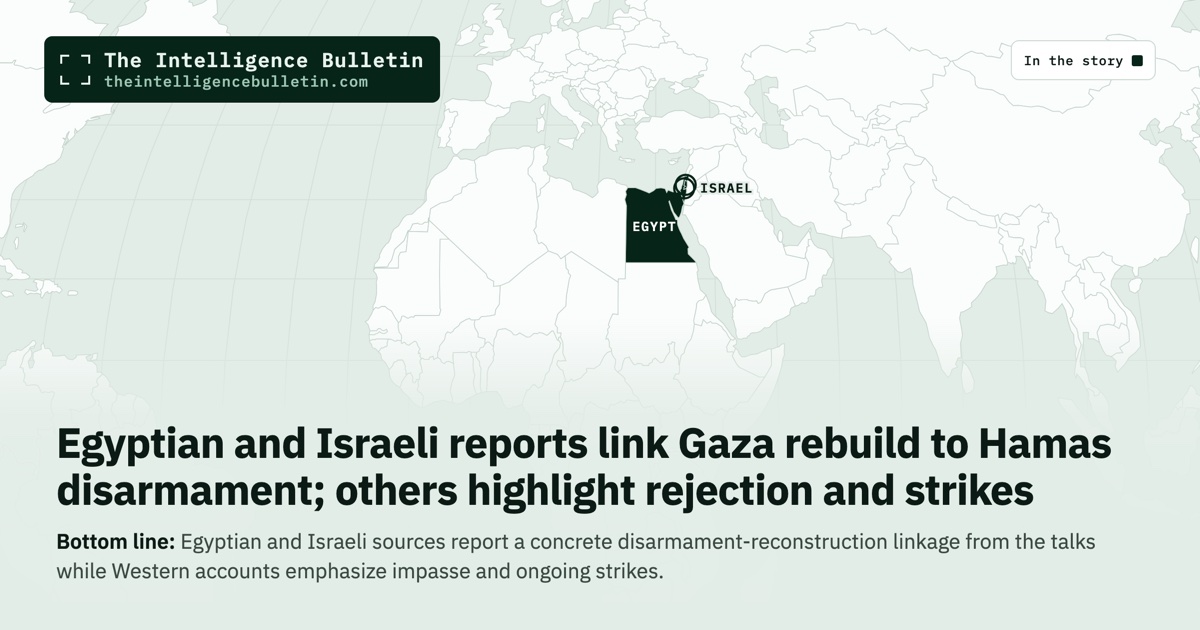
Egyptian and Israeli sources report a concrete disarmament-reconstruction linkage from the talks while Western accounts emphasize impasse and ongoing strikes.
Egyptian and Israeli reporting converges on a specific bargain tying Gaza reconstruction to complete Hamas disarmament, a linkage absent or downplayed elsewhere. Shorouk News and The Algemeiner both cite Israeli Channel 12 and officials for this agreement, including arms handover under US supervision and Israeli military freedom of action, framing the Netanyahu-Kushner session as productive on that narrow point. In contrast, The Guardian, Al Jazeera, and HNGN lead with the rarity of the Kushner-Hamas contact and stress Netanyahu’s prior public rejection of the full 15-point roadmap, resumed Israeli strikes, and regional Arab pressure on Washington to enforce compliance. This split reflects sourcing: Egyptian and Israeli outlets draw from Israeli political channels emphasizing preconditions, while the others relay Hamas statements, mediator accounts, and casualty figures from Palestinian sources. The absence of Palestinian-territory outlets leaves Hamas positions visible only through Qatari, British, and US filters. The pattern shows how domestic priorities shape emphasis—reconstruction sequencing for Cairo and Jerusalem, diplomatic impasse and violence for London, Doha, and New York—without any outlet bridging the sequencing gap into a unified account.
Full analysis
Jared Kushner, the US envoy and son-in-law of President Donald Trump, met Hamas political chief Khalil al-Hayya in Egypt on August 16. The session lasted more than two hours and included officials from Egypt, Qatar and Turkey. Kushner pressed for concrete steps under the 15-point roadmap unveiled by Trump on July 31, which calls for phased Hamas disarmament followed by Israeli withdrawal and reconstruction of Gaza under a new Palestinian technocratic administration. Al-Hayya attended alongside Board of Peace members Nickolay Mladenov and Tony Blair. Hamas later stated it remained committed to the roadmap but insisted Israel must first halt attacks, withdraw to the yellow line established in the October 2025 ceasefire, and meet other obligations before disarmament could begin.
The next day, August 17, Kushner flew to Jerusalem for several hours of talks with Prime Minister Benjamin Netanyahu. Mladenov and Blair joined that closed-door session as well. Israeli officials described the meeting as long and focused. Two separate accounts, one carried by Shorouk News from Israeli Channel 12 and another reported by The Algemeiner drawing on Israeli officials and Reuters, stated that Netanyahu and Kushner reached agreement on one narrow point: reconstruction of Gaza would not begin until Hamas handed over all its weapons for destruction under US supervision, including light arms. The Israeli side also secured confirmation of its military freedom of action in Gaza and joint work on public-health measures to prevent disease spread.
Netanyahu had already rejected the full 15-point roadmap in public statements the previous week. His government maintains that Israeli forces will not withdraw from positions beyond the yellow line, nor permit large-scale reconstruction, until Hamas is completely disarmed. Israeli sources noted that Netanyahu faces an October 27 election and a coalition that includes ministers opposed to any withdrawal before full disarmament. A senior Israeli official told reporters there was no breakthrough on the broader sequencing dispute.
Hamas, for its part, described the Egyptian meeting as an opportunity to remind mediators of Israeli violations since the October 2025 ceasefire. Palestinian sources cited across The Guardian, Al Jazeera and HNGN reported more than 1,200 Palestinian deaths from Israeli fire in Gaza since that ceasefire took effect, with strikes continuing into the weekend of August 16-17. Hamas called on the Board of Peace and mediating countries to compel Israel to stop the operations and accept the roadmap timetable. Regional foreign ministers from Egypt, the United Arab Emirates, Qatar, Jordan, Saudi Arabia and others issued a joint statement condemning the Israeli rejection of the plan and urging Washington to enforce compliance.
The same sources recorded that Israeli forces have expanded control to roughly 60 percent of Gaza territory since the ceasefire, moving beyond the original yellow line. Netanyahu’s office characterized the Jerusalem meeting as deep and constructive, while a Board of Peace official described it as in-depth and productive without providing further detail. Neither side claimed resolution of the core sequencing conflict: Israel requires full disarmament first; Hamas requires Israeli withdrawal and attack cessation first.
Accounts diverge sharply on what the two days of meetings actually produced. Shorouk News and The Algemeiner both foreground an Israeli-reported agreement that reconstruction is now explicitly conditioned on complete Hamas disarmament, with arms to be destroyed under the supervision of a US general. Those two outlets, drawing from Israeli political channels, present the Netanyahu-Kushner session as having advanced at least that precondition. The Guardian, Al Jazeera and HNGN instead open with the rarity of the direct Kushner-Hamas contact and emphasize Netanyahu’s public rejection of the roadmap, the continuation of Israeli strikes, and statements from Arab capitals pressing the United States to act. These three outlets relay Hamas demands for prior Israeli compliance and casualty figures from Palestinian health authorities; none of them records the specific reconstruction-disarmament linkage reported by the Egyptian and Israeli pieces.
The split tracks sourcing patterns. Egyptian and Israeli coverage rests on statements from Israeli officials and Hebrew media. The British, Qatari and American pieces rely more heavily on Hamas statements, mediator accounts and regional condemnations. No outlet in the set bridges the gap by presenting both the reported precondition agreement and the rejection language in the same frame. Palestinian-territory outlets are absent from the coverage pool entirely, so Hamas positions reach readers only through Qatari, British and US filters.
The two independent reporting chains that carry the reconstruction-disarmament linkage—Shorouk via Channel 12 and The Algemeiner via Israeli officials—supply the strongest warrant for treating that narrow agreement as the most concrete outcome on the table. Both chains originate in Israeli political sources rather than a single wire dispatch. The broader rejection of the roadmap and the continuation of strikes appear across three additional independent chains, but those elements describe the surrounding impasse rather than what the August 16-17 meetings themselves produced. Hamas demands for prior Israeli steps remain single-sourced through the outlets that quote them directly.
Domestic priorities explain the differing emphases. Egyptian reporting aligns with Cairo’s interest in eventual stability and reconstruction on its border. Israeli coverage foregrounds security guarantees ahead of an election. Western and Qatari accounts reflect greater distance from the bilateral US-Israeli channel and closer attention to Arab diplomatic pressure and on-the-ground violence. The pattern leaves readers of any single outlet with an incomplete picture of the narrow procedural step that Israeli sources claim was secured.
What to Watch
The most reliable reading is therefore that the meetings produced one limited, explicitly conditioned agreement on reconstruction sequencing while leaving the larger roadmap unresolved. Netanyahu retains domestic incentives to maintain the public rejection stance through the October vote, yet the private channel with Kushner and the Board of Peace remains open. The next measurable development will be whether any working groups on disarmament or public health actually convene, and whether Israeli operations in Gaza continue at the recent pace. Civilian conditions in the territory, already marked by more than 1,200 deaths since the ceasefire and control of 60 percent of the land by Israeli forces, will continue to hinge on which side’s sequencing prevails.
That’s how the world told the story.
Get our daily open-source intelligence on world events in your inbox — one email a day, up to six stories.
Subscribe freeNo spam. One-click unsubscribe. See the latest email →