 AI-generated analysis published under the editorial responsibility of Rohit Sinnas. How it works →
Press quoted
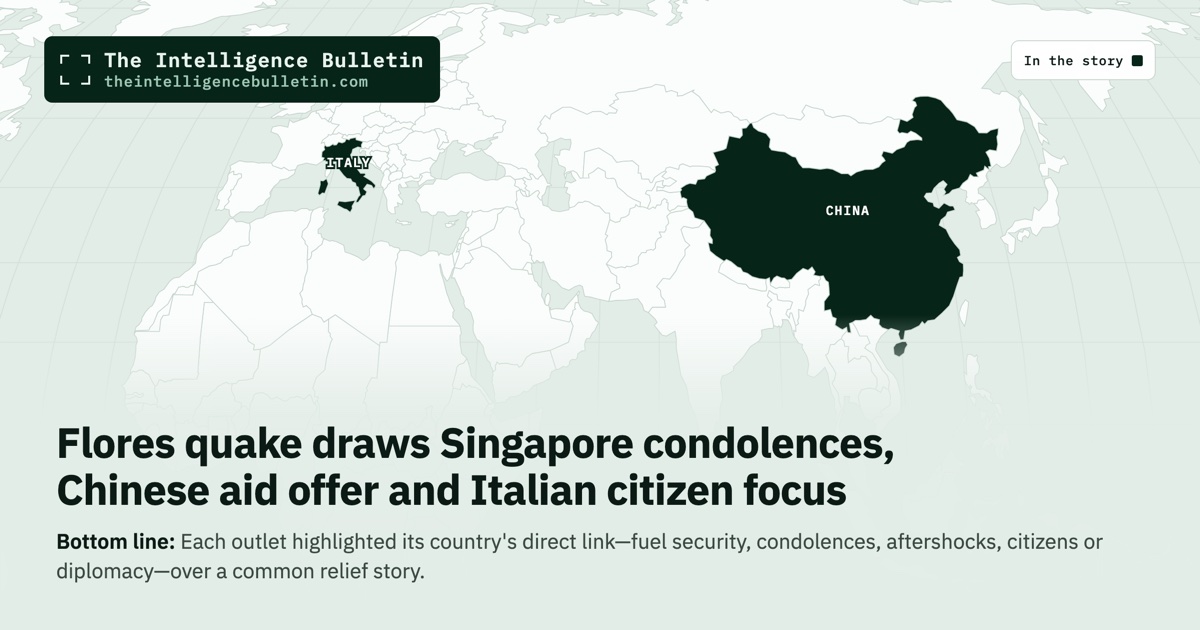
Each outlet highlighted its country’s direct link—fuel security, condolences, aftershocks, citizens or diplomacy—over a common relief story.
National outlets framed the Flores quake through their own connections rather than a shared international picture. Indonesian reporting centered on Pertamina’s CEO touring the site to restore fuel distribution and aid delivery, treating the disaster as an operational challenge for a state company. Singapore’s coverage highlighted Prime Minister Wong’s condolences to President Prabowo, underscoring regional neighborly ties without deeper operational detail. Australia’s brief bulletin stressed ongoing aftershocks and rescue work from a monitoring neighbor’s vantage. Italy’s account raised the death toll to 68 and spotlighted 700 stranded Italian tourists plus embassy flight assistance, a citizen-protection lens absent elsewhere. China’s piece emphasized the foreign ministry’s readiness to provide aid and noted injured Chinese nationals, casting the event as an opening for state-level diplomacy. These angles diverge on casualties and priorities yet converge on the basic facts of the main shock and displacement, revealing how proximity, tourism links and great-power positioning shape each account more than any single wire narrative.
Full analysis
A 7.7-magnitude earthquake struck off the coast of Flores Island in eastern Indonesia early on August 15. Indonesian authorities recorded at least 53 deaths, 135 injuries, and hundreds of damaged buildings, with roughly 5,000 people fleeing their homes. Nearly 1,000 aftershocks followed in the first hours, and a separate 5.6-magnitude event occurred the next night roughly 175 kilometers east of Labuan Bajo at a depth of 18 kilometers, though that later shock produced no reported damage or casualties.
Relief workers reported urgent shortfalls in tents, food, medicine, clean water, and generators for the displaced. Pertamina, the state energy company, responded by sending its chief executive Simon Aloysius Mantiri directly to the affected areas of Nusa Tenggara Timur. He inspected operations at the Fuel Terminal in Reo, oversaw the reopening of 47 service stations across Flores, and directed supplies of diesel for heavy equipment clearing landslides on the Trans-Flores road between Ende and Bajawa. The company also distributed tents, medicines, and basic foodstuffs under its Pertamina Peduli program while maintaining LPG and aviation fuel stocks at the airports in Labuan Bajo and Maumere.
Singapore’s Prime Minister Lawrence Wong wrote to Indonesian President Prabowo Subianto on August 16 to express condolences on behalf of the Singapore government. Wong noted the loss of life and the work of emergency teams, framing the message as one of regional solidarity. Australia’s reporting focused on the continuing seismic sequence and the immediate work of rescue teams digging through rubble from the initial quake. Italy’s foreign ministry tracked roughly 700 Italian tourists and non-residents on the island, most of them unharmed, and coordinated with the embassy in Jakarta over limited flight availability out of the main airports. China’s foreign ministry stated that Beijing stood ready to provide assistance matched to Indonesian requirements and confirmed that its consulate in Denpasar had activated emergency procedures after some Chinese citizens sustained injuries.
The same basic sequence of the main shock on August 15, the scale of building damage, and the need for emergency shelter and supplies appears across the accounts that cite Indonesian disaster-management figures. Where the reports diverge is in the precision of the human cost and in the element each outlet chooses to foreground. Indonesian coverage centers on the state company’s logistics and fuel continuity. Singapore’s piece records an official expression of sympathy from its own head of government. Australia’s bulletin records the aftershock pattern and ongoing search activity. Italy’s account raises the death toll to 68, the injury count to 213, and the displaced figure to 12,800 while devoting sustained attention to consular arrangements for its nationals. China’s statement emphasizes both the offer of state-level aid and the activation of consular support for its own citizens.
These differences are not contradictions on the core event but on the boundary of what each government or outlet treats as newsworthy. The 53-death count carried by Indonesian authorities and relayed in Singapore reporting stands as the figure repeated in more than one independent chain. The higher Italian tally rests on a single foreign-ministry source and is not echoed elsewhere in the set. The relief requirements for shelter, food, water, and power are described in similar language wherever they appear, but only the Singapore account quantifies the initial flight from homes at 5,000 while the Italian report gives the larger displaced total. No outlet in the group claims to have conducted its own field verification; each transmits or expands upon statements from its own national authorities or the Indonesian disaster agency.
The pattern that emerges is therefore one of parallel national attachments rather than a unified international ledger. Proximity shapes the Australian emphasis on seismic monitoring. Tourism and consular responsibility shape the Italian focus on stranded citizens and flight bottlenecks. Energy infrastructure and domestic corporate reach shape the Indonesian emphasis on fuel terminals and service stations. Diplomatic signaling shapes the Chinese offer of assistance and the Singaporean message of sympathy. Each frame is internally consistent with the outlet’s access and mandate, yet none supplies the full set of numbers or the full set of operational responses that a reader would need to assemble an integrated picture from any single source.
What to Watch
The most durable elements are the timing and magnitude of the main shock, the fact of widespread displacement, and the shared recognition that external aid would be required. The points of friction lie in casualty counts that have not yet converged and in the absence of any cross-border coordination details beyond the separate national statements. A reader limited to one country’s press would therefore miss either the operational detail supplied by the Indonesian energy company, the consular dimension supplied by Italy, or the diplomatic posture supplied by China. The coverage as a whole shows that seismic events in eastern Indonesia continue to trigger responses calibrated to each actor’s existing stakes in the archipelago rather than to a single shared relief ledger.
That’s how the world told the story.
Get our daily open-source intelligence on world events in your inbox — one email a day, up to six stories.
Subscribe freeNo spam. One-click unsubscribe. See the latest email →