 AI-generated analysis published under the editorial responsibility of Rohit Sinnas. How it works →
Press quoted
All outlets quote the same Trump post but split on whether the reduction signals friendship, alliance strain, or hostility.
Trump’s Truth Social post on August 16 framed the order as a personal diplomatic gesture rooted in his rapport with Kim Jong Un, while also highlighting expense and the drills’ signaling effect; multiple outlets reproduced the exact language without contradiction. US reporting centered the announcement as a policy directive from the president to the Pentagon. South Korean coverage relayed the Korean-language quotes and added context about alliance implications for Seoul, including the reported exchange with President Lee Jae Myung over Iran. The North Korean outlet echoed Trump’s phrasing in its headline to underscore the move as an inappropriate hostile signal to Pyongyang, while attributing the details to an Indian agency dispatch. BBC presented a concise operational account focused on scaling rather than motivation. The only clear divergence is tonal framing of intent, not the underlying facts of the post itself; no independent reporting chain disputes the existence or content of Trump’s statement. This convergence across actor-origin and observer outlets shows the story rests on a single primary source—the presidential post—amplified differently according to each outlet’s audience and national vantage.
Full analysis
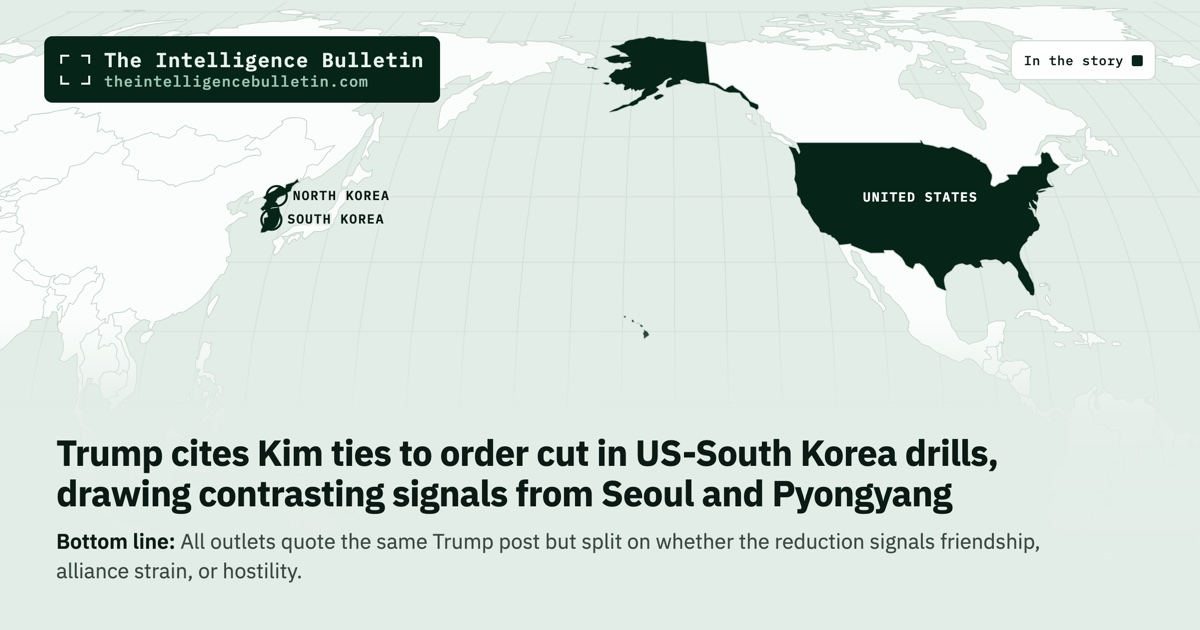
On August 16, 2026, President Donald Trump posted on Truth Social that he had instructed Secretary of War Pete Hegseth to substantially reduce joint military exercises between the United States and South Korea. He tied the decision directly to his assessment of relations with North Korean leader Kim Jong Un, the financial burden on Washington, and the message the drills conveyed to Pyongyang.
Trump wrote that his “very good relationship with Kim Jong Un” left him unhappy that the United States had long agreed to participate in the exercises. The drills were not only costly, with much of the expense borne by the United States, but they also sent “a signal that is totally inappropriate and hostile” to a country that, during his presidency, had remained “unthreatening and respectful.” Because it was too late to cancel the exercises outright, he directed Hegseth to cut their scale.
Two of the reports placed an additional detail alongside the main announcement. Trump mentioned a recent conversation in which he asked South Korean President Lee Jae Myung whether Seoul would join the United States in pursuing the denuclearization of Iran. According to the account, Lee replied that South Korea would not.
The exercises in question were identified in one dispatch as the Ulchi Freedom Shield drills, set to run from August 17 through August 27 and focused on countering drones, GPS disruption, and cyberattacks. North Korea had already criticized the planned maneuvers, describing them as actions that would heighten tensions on the peninsula.
American coverage presented the post as a presidential directive to the Pentagon, emphasizing the relationship with Kim and the cost argument as the stated rationale. South Korean reporting carried the Korean-language rendering of the same statements and added the detail about the exchange with Lee Jae Myung, placing the announcement in the context of alliance management for Seoul. The North Korean outlet reproduced Trump’s phrasing in its headline and lead, underscoring the characterization of the drills as an inappropriate hostile signal, while sourcing the underlying facts to an Indian agency dispatch. British reporting stayed with the operational fact of reduced exercises and avoided discussion of motive or regional signaling.
The four accounts that addressed the post reproduced its core language without disagreement on what Trump had written or instructed. No independent reporting chain supplied a conflicting version of the statement itself or of the conversation with Lee Jae Myung. The single point of variation was emphasis: one framing highlighted improved ties and expense, another added the Iran exchange and alliance implications, a third foregrounded the hostile-signal language for a North Korean readership, and the fourth confined itself to the scaling decision.
Because the underlying document was a single presidential post, the convergence across outlets in different countries shows that the event reached readers through one originating text rather than through separate investigations or on-the-ground sourcing. Outlets then selected which sentences to quote and which context to supply. The South Korean report that included the Iran exchange did so because that detail appeared in the post; the North Korean report that led with the hostile-signal phrasing did so because the same sentences were available for quotation. Where an outlet omitted the Iran reference, it was simply not foregrounded in that piece, not because the sentence was absent from the source document.
The practical effect of the order remains to be seen in the conduct of the Ulchi Freedom Shield exercise itself. The post gave no numerical target for the reduction, only the instruction to scale the drills back substantially. Whether that change alters the exercise’s scope, duration, or participation levels will be visible only once the maneuvers begin. For South Korea the announcement arrives against the background of an existing security relationship in which joint training has been a routine component; any sustained reduction would require adjustment in planning and in the division of costs that Trump described as historically borne by the United States. For North Korea the same announcement supplies language that can be cited as evidence of a shift in Washington’s posture, regardless of whether the exercises proceed at a lower tempo.
What to Watch
The reporting therefore supplies a clear record of what the president stated on August 16 and shows that the statement reached audiences in the United States, South Korea, and North Korea through direct quotation of the same text. The differences that appear are differences of selection and framing, not of disputed facts. A reader limited to any single national outlet would receive the identical presidential language but would encounter it embedded in a different set of surrounding references—cost and diplomacy in one case, alliance management and the Iran exchange in another, or the hostile-signal characterization in the third. The cross-border record makes those choices visible and shows that they rest on the same short document rather than on independent confirmation or contradiction.
Correction — August 17, 2026
One of the five sources listed under “One Story. Many Angles.” did not report this story. The entry credited to The Hankyoreh was a business feature about shared kitchens in South Korea’s food and beverage industry, published in February 2019 and unrelated to the reduction in joint military exercises. It has been removed and the source count corrected from five to four.
The four remaining sources — The Epoch Times, North Korea Times, Edaily and the BBC — all report this story, and South Korea’s own coverage remains represented by Edaily. The bulletin’s account of what President Trump posted is unchanged, and so is the analysis, which was written from the four reporting sources and had already described them as four.
The article entered the source pool through a fault in the automated search that assembles candidate coverage, not through an editorial judgment that it belonged.
Previously: “5 sources · each independently reported”
Now: “4 sources · each independently reported”
Previously: “South Korea — The Hankyoreh — “Shared kitchens increasing in prominence in South Korea’s F&B industry”, listed as a source on the story.”
Now: “Removed. The South Korean source on this bulletin is Edaily, whose report does cover the story.”
That’s how the world told the story.
Get our daily open-source intelligence on world events in your inbox — one email a day, up to six stories.
Subscribe freeNo spam. One-click unsubscribe. See the latest email →