 AI-generated analysis published under the editorial responsibility of Rohit Sinnas. How it works →
Press quoted
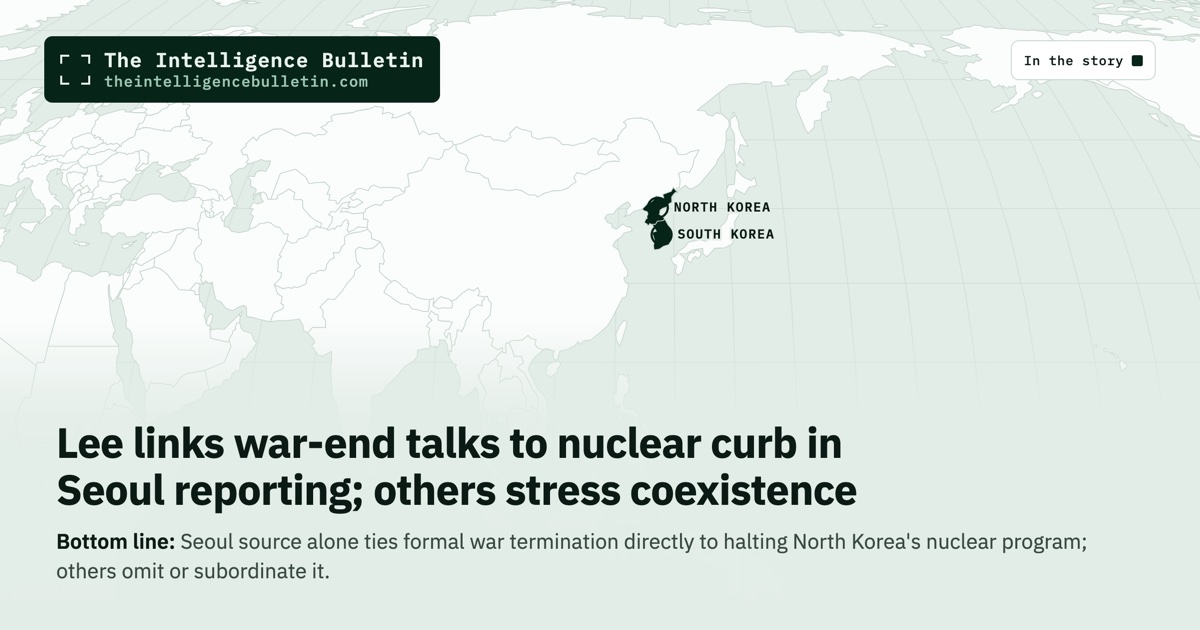
Seoul source alone ties formal war termination directly to halting North Korea’s nuclear program; others omit or subordinate it.
The reporting converges on the core proposal but splits on emphasis in ways that track national or institutional priorities rather than facts on the ground. South Korea’s Korea Times alone pairs the war-ending talks directly with halting Pyongyang’s nuclear program as a single linked step. Chinese state-linked coverage via Xinhua drops the nuclear reference entirely and instead highlights mutual respect, shared growth and peaceful coexistence. Indian and Irish wires carry the nuclear angle but frame it as a possible secondary outcome of discussions, while the UK Independent echoes the coexistence phrasing yet adds explicit reference to Kim Jong Un. These choices are not random: outlets closest to the proposing government foreground concrete security outcomes, while others present a broader stability gesture. No source claims North Korean acceptance or verification of any element. The absence of direct North Korean sourcing in the set leaves the initiative as a South Korean initiative viewed through external lenses, with the nuclear dimension appearing in four of five accounts but subordinated or omitted where regional stability is the priority narrative.
Full analysis
South Korean President Lee Jae Myung used his August 15, 2026 address marking the 81st anniversary of Korea’s liberation from Japanese colonial rule to propose direct talks with North Korea aimed at formally ending the Korean War. The 1950-53 conflict concluded with an armistice rather than a peace treaty, leaving the two sides technically at war. Lee called for the directly concerned parties to sit down and replace the armistice with a peace regime, adding that the discussions could also explore measures to halt the advancement of North Korea’s nuclear capabilities. He urged both sides to set aside intentions to threaten each other and described peaceful coexistence as a duty rather than a choice.
The proposal built on pledges Lee made at the previous year’s Liberation Day ceremony, where he said Seoul would respect North Korea’s system, rule out unification by absorption, and refrain from hostile acts. In the new speech he outlined steps to implement those principles, including mechanisms to manage tensions and safeguards against escalation. He also called for a comprehensive assessment of the security environment around the peninsula and proactive peace measures. The address came days before scheduled annual US-South Korea military exercises that North Korea has condemned as provocative. Washington maintains roughly 28,500 troops in South Korea as part of its security commitment.
North Korea has not responded to the overture. Pyongyang continues to assert its status as an irreversible nuclear state, a position it adopted after the 2019 summit between its leader Kim Jong Un and then-US President Donald Trump in Hanoi collapsed over disagreements on denuclearization and sanctions relief. North Korea has strengthened military ties with Russia, receiving financial support, food, energy and military technology in exchange for supplying troops and ammunition for Russia’s war in Ukraine. Analysts note that North Korean forces have gained combat experience in that conflict and brought lessons back to the peninsula. Kim has labeled South Korea its most hostile state and ordered stronger frontline defenses.
Coverage of the speech converged on the basic facts of the proposal and the historical context of the unresolved armistice. Four of the five outlets reported Lee’s suggestion that the talks could address North Korea’s nuclear capabilities. The Korea Times presented that linkage as a central element of the initiative, framing the proposal as concrete steps that would both end the war and curb Pyongyang’s program. The Times of India, RTÉ and The Independent carried the same suggestion but treated it as a possible additional topic rather than the primary outcome. RTÉ, drawing from an AFP dispatch, noted the nuclear point in a concise factual summary focused on replacing the armistice. The Independent included it while foregrounding the pursuit of peaceful coexistence and naming Kim Jong Un explicitly.
China.org.cn, relaying Xinhua copy, omitted any reference to nuclear capabilities. Its account emphasized mutual respect, avoidance of unnecessary confrontation, shared growth and the transformation of the armistice into a peace regime through dialogue among directly concerned parties. It described the move as part of a roadmap for peaceful coexistence without the security-specific linkage found elsewhere.
These differences in framing track institutional and national vantage points rather than conflicting facts. The Korea Times, as South Korea’s main English-language domestic outlet, aligned its account with Seoul’s longstanding priority on denuclearization as a non-negotiable security requirement. Outlets farther from the peninsula presented a broader stability gesture, either by dropping the nuclear reference or by subordinating it. The absence of any North Korean-sourced reporting in the set means the initiative appears only through external lenses, with no direct statement of Pyongyang’s reaction or counter-position.
The nuclear dimension carries weight because it appears across four independent reporting chains while the pure coexistence framing appears in fewer. Readers limited to Chinese state-linked coverage would miss the specific security outcome that four other accounts, including South Korea’s own, attached to the same speech. Readers limited to the South Korean account would see a tighter linkage than the broader diplomatic process described in the Indian, Irish and British pieces. No outlet claimed North Korean acceptance or verification of any element, and the corroboration stops at what Lee said on the record.
What to Watch
The account that best matches the full set of reporting is the one that includes both the war-termination proposal and the possibility of nuclear discussion as a potential byproduct. That version appears in the majority of the sources and rests on the direct text of Lee’s address rather than on interpretive additions. South Korea has an obvious interest in presenting its initiative as advancing concrete security goals, while China has an interest in presenting regional moves as steps toward stability without pressure on its neighbor. North Korea’s silence and its deepening Russia relationship suggest the proposal will not produce immediate movement. Upcoming joint military exercises add immediate friction that could further delay any response. The initiative therefore stands as a South Korean diplomatic opening whose reception will depend on whether Pyongyang sees value in returning to talks after years of treating South Korea as its primary adversary.
That’s how the world told the story.
Get our daily open-source intelligence on world events in your inbox — one email a day, up to six stories.
Subscribe freeNo spam. One-click unsubscribe. See the latest email →