Italian plant blast raises questions over European arms production for Ukraine

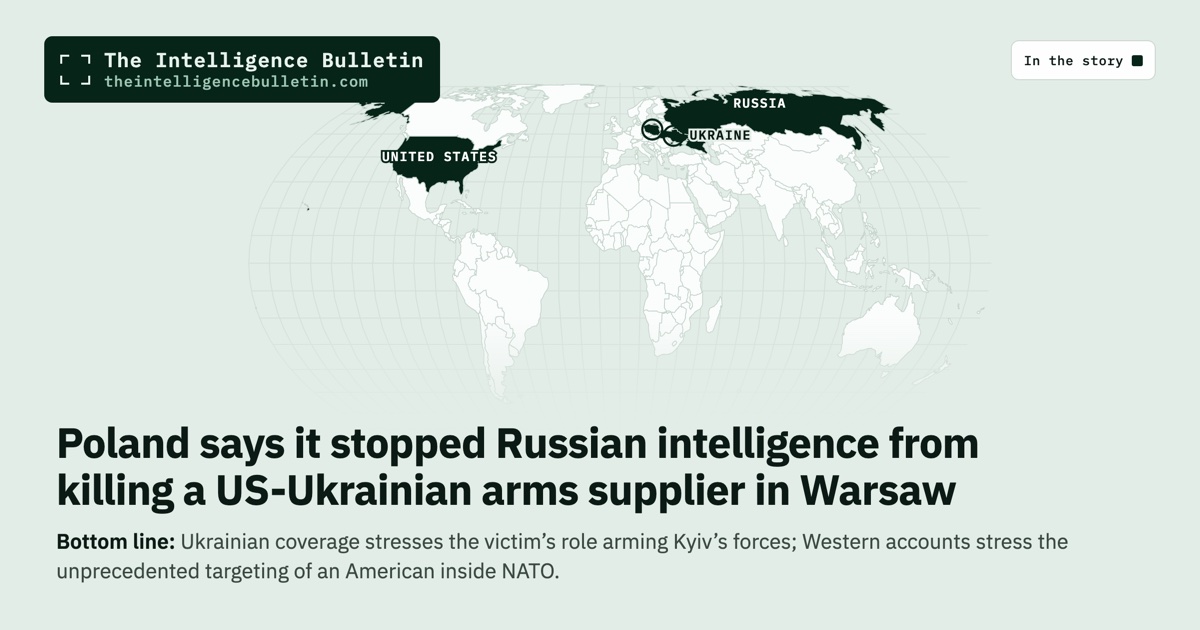
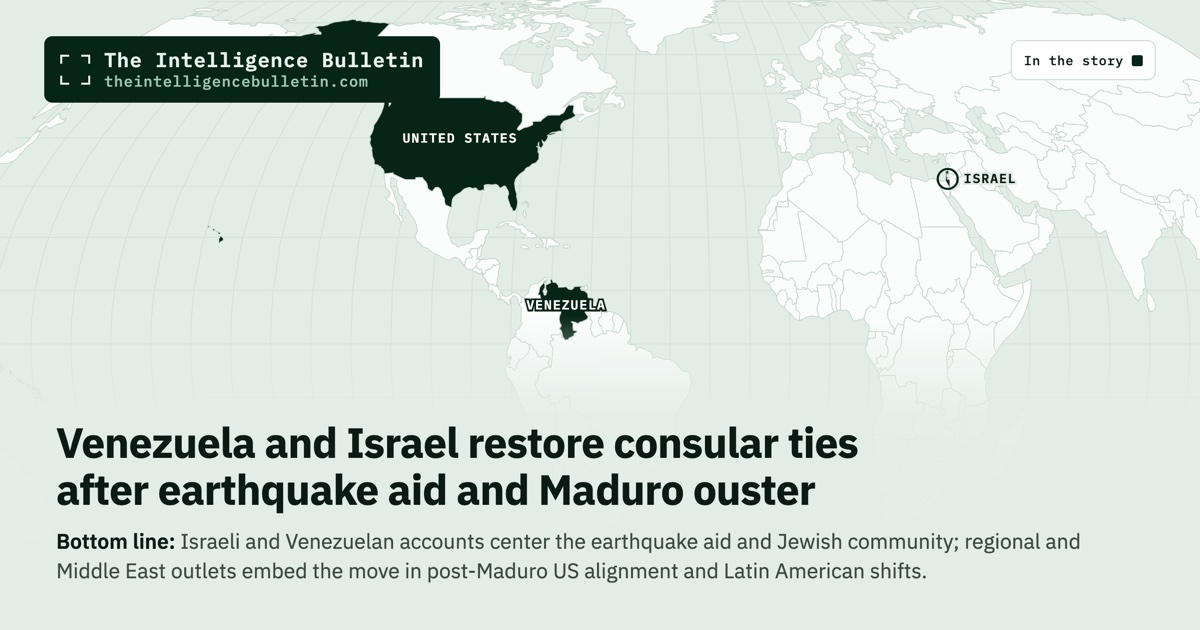
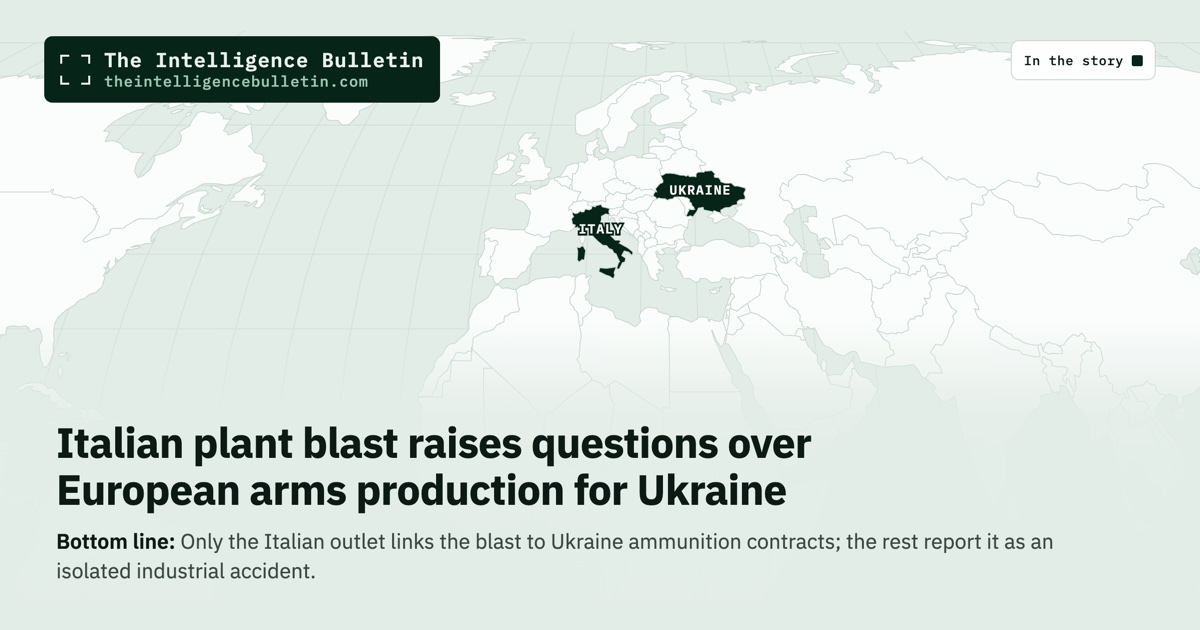
Map of the countries in the story: Italian plant blast raises questions over European arms production for Ukraine
An explosion followed a fire at the KNDS Ammo Italy plant in Colleferro, 40 km southeast of Rome, on 13 August 2026. The facility produces medium- and large-caliber ammunition including 155 mm shells. No injuries occurred; the blast was heard several kilometres away and operations remain complex. Causes are under investigation with no public evidence of sabotage.

One Story. Many Angles.

🇶🇦
Qatar
The Peninsula
AFP wire copy
Explosion rocks ammunition factory near Rome
Read →
🇳🇴
Norway
NRK
NORWEGIAN
Carries Rai and Corriere della Sera reporting
Explosion at ammunition factory near Rome
“Eksplosjon på ammunisjonsfabrikk nær Roma”
Read →
🇮🇹
Italy
Today.it
ITALIAN
Original reporting
The strange explosion of the arms factory in Colleferro: a case that is anything but isolated
“La strana esplosione della fabbrica di armi a Colleferro: un caso tutt’altro che isolato”
Read →
🇨🇳
China
China.com
CHINESE
Carries Guancha.cn / Reuters / AP reporting
Military factory near Rome, Italy catches fire and explodes
“意大利罗马附近一军工厂起火爆炸_军事频道_中华网”
Read →
4 sources · each independently reported
In Brief

Only the Italian outlet links the blast to Ukraine ammunition contracts; the rest report it as an isolated industrial accident.

The selected outlets converge on the bare facts of the Colleferro blast yet diverge sharply on context. Italian reporting alone embeds the incident inside European rearmament for Ukraine, naming 155 mm contracts, the European Defence Agency and a recent permit for a new explosives line at a nearby site. The other three sources stay at the incident level, citing police statements and local media without the contract angle. This split is not accidental: the Italian piece is an authored dossier that explicitly questions whether the event is isolated, while the Qatari and Chinese articles relay agency copy and the Norwegian one summarises Rai and Corriere della Sera. The absence of a German voice in the set leaves KNDS ownership noted but unexamined from the company’s home perspective. The reporting therefore shows a common event described through two distinct lenses—one domestic and contract-focused, the others neutral and incident-focused—without contradiction on the physical facts themselves.

Perspective Analysis

An explosion ripped through the KNDS Ammo Italy plant in Colleferro on the afternoon of 13 August 2026. The site lies roughly 40 kilometres southeast of Rome. A fire broke out first, then triggered a violent blast in the powder-pressing department. The detonation could be heard several kilometres away, and residents reported seeing a tall column of smoke and flame. Firefighters and carabinieri were already on the ground when the explosion occurred. They described the subsequent operations as complex because flames continued to block access to parts of the facility.

The plant belongs to KNDS, the defence group formed by the merger of France’s Nexter and Germany’s Krauss-Maffei Wegmann. It had previously operated under the Italian name Simmel Difesa before the 2014 acquisition. The facility manufactures medium- and large-calibre ammunition for both land and naval systems, including the 155-millimetre shells that have become the standard NATO artillery round supplied to Ukraine. Company records show the Italian division posted a profit of 16.9 million euros in its most recent reporting period, and the group as a whole distributed roughly one billion euros in dividends in 2025. Its order backlog for the Italian unit rose from 199.8 million euros at the end of 2023 to 466.3 million euros a year later, with more than 105 million euros tied to European Defence Agency frameworks for 155-millimetre projectiles and modular charges.

No workers were injured. Roughly twenty employees were present at the time; all were accounted for and moved to safety. The facility had been operating at reduced capacity during the summer holiday period. Local officials noted that a full shift would have turned the event into a far larger tragedy. Authorities stated immediately that there was no public evidence pointing to sabotage or attack. Investigations by police and judicial teams continue, focused on the precise sequence that began with the fire.

The same basic sequence appears in every account examined. Italian police and firefighters confirmed the fire-then-explosion progression. Video released by the public broadcaster Rai showed flames followed by a large detonation. Corriere della Sera reported the sound carrying across several kilometres. The French-German ownership and the plant’s product range were stated consistently. The European Defence Agency contracts for 155-millimetre ammunition were noted in more than one dispatch, though the depth of surrounding detail varied.

The Italian coverage placed the blast inside a longer pattern of incidents at European munitions plants. It listed earlier explosions at the same Colleferro site in 2007 and 2017. It also recorded a string of more recent events: a vehicle fire that spread to a munitions depot in Belitsa, Bulgaria, on 10 August 2026; an arson investigation at a Czech component factory in Pardubice in March 2026; an explosion that injured six people at a Rheinmetall site in Spain in January 2025; a fatal blast at the Mesko plant in Poland in June 2024; and an earlier incident at a BAE Systems site in Wales in April 2024. The same Italian report noted that KNDS had just received final regulatory approval in June 2026 for a new nitrogelatin production line at a nearby site in Anagni, part of an effort to expand propellant capacity under the EU’s Act in Support of Ammunition Production programme. Local committees had objected to the concentration of explosives handling in the Valle del Sacco.

Other reporting stayed closer to the immediate facts of the Colleferro blast itself. One account relayed police statements that operations remained complex and that only one section of the plant was affected. Another summarised Italian television footage and local newspaper descriptions without adding contract or historical context. A third carried agency copy that mentioned the European Defence Agency framework but did not examine the surrounding industrial or political background.

The absence of any German-sourced article in the set leaves the perspective of the plant’s co-owner unrepresented on the page. KNDS is headquartered in a joint Franco-German structure, and the group’s German division produces Leopard tanks and other systems that rely on the ammunition lines now under discussion. No outlet from that country appears among the reports examined, so any assessment of how German media weighed the safety implications or the Ukraine-related production surge rests outside the available record.

The physical facts of the 13 August event stand on multiple independent chains: local emergency services, company statements, and on-the-ground video. The contract details and the pattern of prior incidents rest primarily on the Italian analysis that drew directly from company filings, European Defence Agency documents and regional permitting records. No source contradicted the claim of no injuries or the absence of sabotage evidence. The divergence therefore lies not in disputed facts but in the decision of which surrounding circumstances to include.

That choice matters because the 155-millimetre production line sits at the centre of European efforts to replenish stocks depleted by deliveries to Ukraine and to build new capacity under NATO-standard requirements. The financial figures show the scale of the shift: the order book more than doubled in a single year. The new Anagni facility would have extended that capacity further by bringing propellant manufacturing closer to the assembly line. Whether the Colleferro blast was a random industrial accident or part of a wider set of stresses on an industry running at elevated tempo is the question the Italian reporting raises and the others leave open.

What to Watch

The reporting that supplies the contract numbers and the list of earlier incidents supplies the context needed to judge whether this single blast is likely to remain an isolated footnote. The narrower accounts reliably establish that the immediate human and operational damage stayed limited. Both layers of information sit side by side without contradiction, yet only together do they show the full stakes for European arms production at a moment when demand has risen sharply and new facilities are still coming online.
Share this story

UN data shows July deadliest for Ukrainian civilians since May 2022 amid Russian strikes

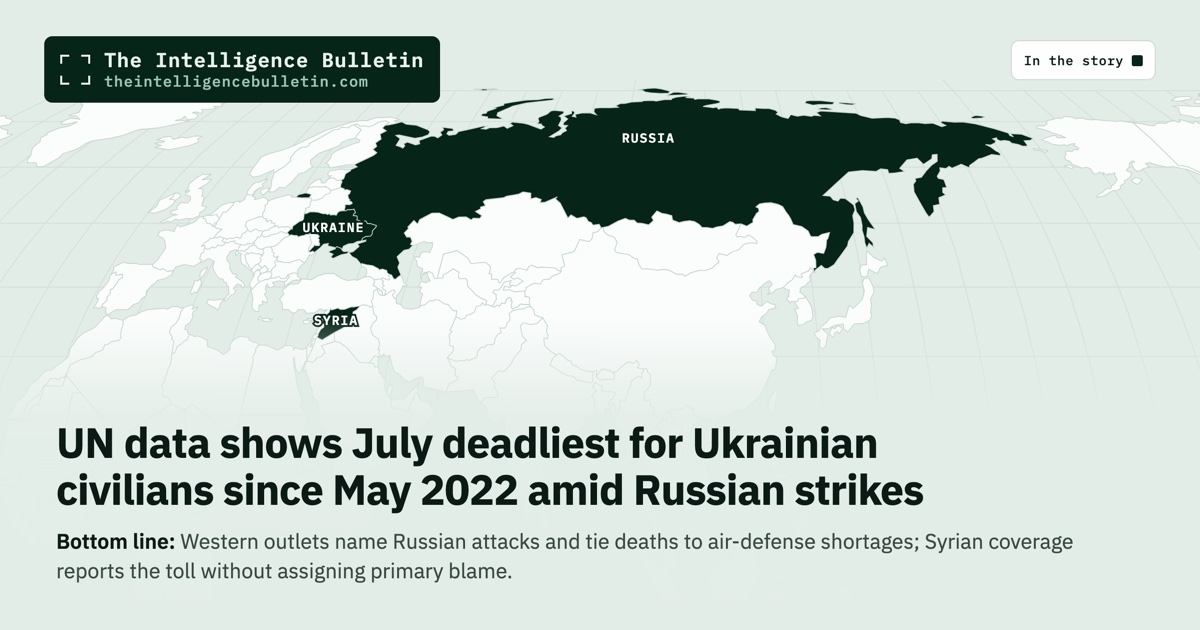
Map of the countries in the story: UN data shows July deadliest for Ukrainian civilians since May 2022 amid Russian strikes
The UN Human Rights Monitoring Mission reported at least 437 civilians killed and 2,610 injured in Ukraine during July, the highest monthly toll since May 2022 and up 30 percent from June. The increase was attributed to escalated Russian ballistic and cruise missile strikes, drones and glide bombs, with Kyiv hit hardest. Verified deaths since the 2022 invasion reached 16,874. Outlets varied in naming the perpetrator and linking to Ukrainian calls for more air defense aid.

One Story. Many Angles.

🇺🇸
United States
Yahoo News
Carries DPA reporting
UN says July was deadliest month in years for civilians in Ukraine
Read →
🇩🇪
Germany
Deutschlandfunk
GERMAN
Original reporting
Attacks by Russia – July was the deadliest month for civilians in Ukraine in years
“Angriffe durch Russland – Juli war tödlichster Monat für Zivilisten in Ukraine seit Jahren”
Read →
🇸🇾
Syria
SANA
Carries AFP reporting
UN says 437 civilians killed in Ukraine in July, highest monthly toll since 2022
Read →
🇸🇬
Singapore
The Straits Times
Carries AFP reporting
Civilian deaths in Ukraine hit highest level since May 2022 in July: UN
Read →
🇮🇹
Italy
Olbia Notizie
ITALIAN
Carries Adnkronos reporting
Ukraine, Russian drone on train: 2 dead in Odessa. UN: “In July record number of civilian victims”
“Ucraina, drone russo su treno: 2 morti a Odessa. Onu: “A luglio numero record di vittime civili””
Read →
5 sources · 4 independent accounts — some share the same news agency’s report
In Brief

Western outlets name Russian attacks and tie deaths to air-defense shortages; Syrian coverage reports the toll without assigning primary blame.

Coverage of the UN July casualty figures reveals a clear split in how outlets assign responsibility and connect the data to the wider war. Western European and US sources, including Deutschlandfunk and Yahoo, explicitly tie the 437 deaths to Russian attacks and note Ukraine’s shortage of Patriot interceptors, framing the toll as evidence of Moscow’s escalation. Singapore’s Straits Times and the US Yahoo piece stay closer to the raw UN numbers and verified totals, while relaying AFP or DPA wires. Italy’s Olbia Notizie adds a specific recent Odessa drone strike on a passenger train, using the UN report to underscore immediate civilian impact and Zelensky’s appeal for US missiles. Syria’s SANA, relaying AFP, mentions intensified Russian missile use but avoids direct aggressor language in its lead and situates the figures within ongoing mutual strikes. All sources agree on the 437 killed, the 30 and 70 percent rises, and Kyiv’s 54 deaths, yet only the German and Italian outlets foreground accountability and the defense-aid debate. The absence of direct Russian or Ukrainian national outlets in the set leaves the UN figures as the sole common anchor, with attribution choices revealing each outlet’s editorial priorities rather than conflicting facts.

Perspective Analysis

The United Nations Human Rights Monitoring Mission in Ukraine recorded at least 437 civilian deaths and 2,610 injuries during July. This marked the highest monthly civilian toll since May 2022, with the total representing a 30 percent increase over June and a 70 percent rise compared with July the previous year. Long-range weapons drove the spike, according to the mission, killing 183 people and wounding 967 others. Kyiv suffered particularly heavy losses, with 54 civilians killed and more than 200 injured in the capital alone. The mission noted that actual numbers were likely higher, as verification of reports remained ongoing and access to some areas was restricted.

The same UN assessment placed the cumulative verified civilian deaths since the full-scale invasion began in February 2022 at 16,874, including 820 children, with total injuries reaching 51,273. Russian authorities separately reported 79 civilian deaths and more than 600 injuries on their side of the border during July, though the mission stated it could not independently verify those figures to its standards due to limited access and information restrictions. The mission also recorded the highest child casualties since April 2022, with 17 children killed and 166 injured.

Multiple outlets carrying the UN figures described the rise as tied to intensified Russian use of ballistic and cruise missiles, drones and glide bombs. One account noted that Russia launched a record number of missiles during the month, according to analysis of Ukrainian air force data. Ukrainian President Volodymyr Zelensky linked the pattern to shortages of interceptor missiles for Patriot systems, stating in one interview that Ukraine possessed only one-tenth of the stock needed and that even 5 percent of current United States holdings would allow the country to survive the winter. He added that 10 percent would enable the destruction of all incoming Russian ballistic missiles.

Coverage differed in how directly it connected the UN numbers to Russian responsibility and to Ukrainian requests for additional air defense support. One German public broadcaster article opened by naming Russian attacks as the cause of the deaths and highlighted Ukraine’s ongoing complaints about insufficient Patriot interceptors. An Italian regional outlet tied the UN record directly to a Russian drone strike on a passenger train locomotive near Odessa that killed the driver and assistant on August 13, with 340 passengers aboard, and quoted Zelensky appealing for more Western air defense aid alongside the casualty data. A Singapore newspaper presented the figures and the record Russian missile launches alongside Kyiv’s impact but omitted any reference to Ukrainian aid requests. A United States outlet relayed a German agency dispatch that included both the Ukrainian complaints about Patriot shortages and the Russian-side casualty reports. A Syrian state news agency carried an AFP dispatch that noted intensified Russian missile use yet situated the toll within continued escalation involving strikes on both sides without foregrounding one party’s actions in the lead.

All five sources converged on the core UN statistics of 437 killed, the 30 and 70 percent increases, and the 54 deaths in Kyiv. Three of them reported the Kyiv-specific figure. The same three also relayed the Ukrainian appeal for Patriot missiles. Only the German and Italian pieces placed accountability and the defense-aid question at the center of their framing. The Syrian piece alone avoided naming Russia as the primary driver in its opening sentence while still including the mission’s reference to Russian long-range weapons later in the text.

The UN figures supply the single consistent baseline across the reporting. Outlets operating from Western European and United States perspectives used that baseline to connect the toll to Russian escalation and to Ukrainian shortfalls in air defense, a linkage supported by the mission’s own attribution of the increase to long-range weapons and by separate Ukrainian statements on interceptor needs. The Syrian framing reflects a state-aligned editorial choice to embed the numbers in a description of mutual strikes rather than to isolate one side’s actions. The Singapore account stayed with the verified counts and the missile-launch record without extending into policy implications. Because the set contains no direct reporting from Russian or Ukrainian national outlets, the UN mission remains the sole shared anchor, and differences in emphasis track each outlet’s location and editorial priorities rather than any factual disagreement on the mission’s numbers themselves.

What to Watch

The Western European and United States accounts sit closest to the mission’s own wording on the source of the increase and therefore offer the most direct reading of the data for a reader seeking to understand the immediate drivers of the July toll. Their inclusion of Ukrainian statements on air defense shortages follows logically from the mission’s observation that long-range weapons were the leading cause, and those statements appear on the record from Zelensky. The pattern of coverage suggests that future monthly UN releases will continue to serve as reference points for assessing whether the escalation in long-range strikes persists and whether additional air defense deliveries alter the casualty trajectory.


Share this story

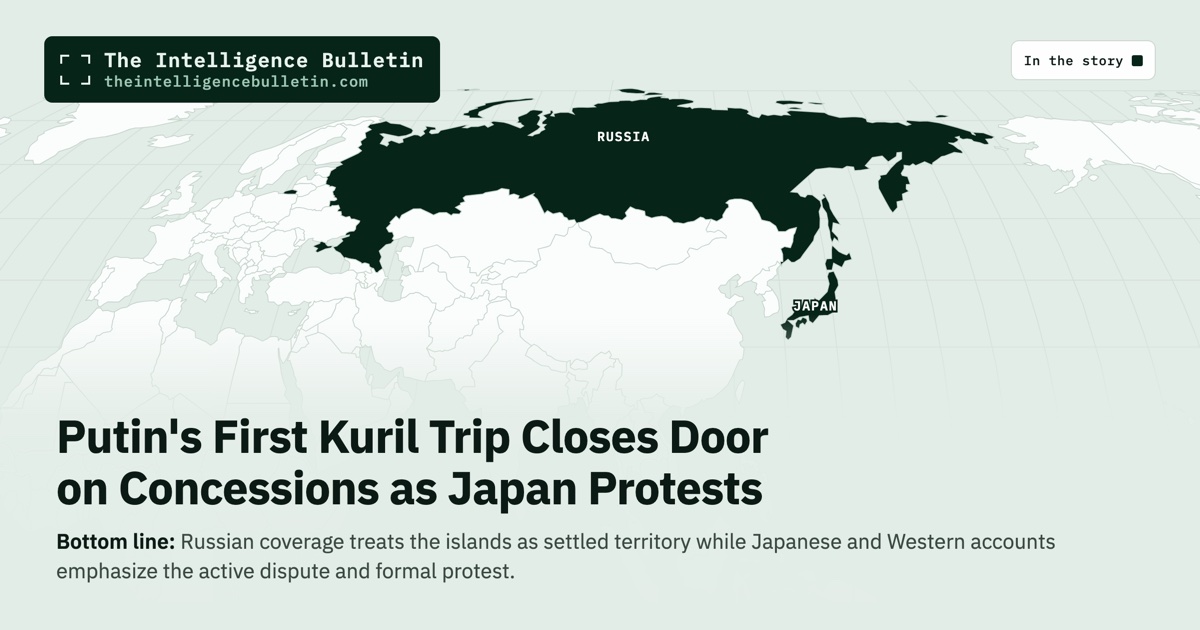
Putin’s First Kuril Trip Closes Door on Concessions as Japan Protests

Map of the countries in the story: Putin's First Kuril Trip Closes Door on Concessions as Japan Protests
Russian President Vladimir Putin visited Iturup island in the Kuril chain on August 13, inspecting a fish plant and meeting residents. Japan claims the four southern islands as its Northern Territories seized by the Soviet Union in 1945 and summoned the Russian ambassador to protest the visit as unacceptable. The move comes as bilateral ties remain frozen over Russia’s Ukraine invasion and sanctions, with no peace treaty ever signed.

One Story. Many Angles.

🇯🇵
Japan
Japan Today
Carries AFP reporting
Putin visits Kuril islands claimed by Japan
Read →
🇷🇺
Russia
Vedomosti
RUSSIAN
Commentary
What Putin’s first trip to the Kuril Islands means
“Что значит первая поездка Владимира Путина на Курильские острова”
Read →
🇳🇱
Netherlands
The Moscow Times
Carries AFP reporting
Putin Makes First Visit to Disputed Kuril Islands Amid Protests From Japan
Read →
🇩🇪
Germany
Deutsche Welle
Carries Reuters, AFP reporting
Russia’s Putin angers Japan with 1st visit to Kuril Islands
Read →
🇮🇳
India
The Times of India
Original reporting
Why Putin’s first Kuril Islands visit matters as Russia-Japan ties hit new low
Read →
5 sources · 3 independent accounts — some share the same news agency’s report
In Brief

Russian coverage treats the islands as settled territory while Japanese and Western accounts emphasize the active dispute and formal protest.

Russian domestic reporting presents the visit as a straightforward affirmation of sovereignty with the territorial question settled by postwar realities, while Japanese and most international accounts frame it as a deliberate diplomatic slight that hardens an already closed dispute. Vedomosti stresses that Moscow sees no near-term prospect of renewed talks given Tokyo’s sanctions and current leadership, treating the islands unambiguously as Russian. In contrast, Japan Today, Deutsche Welle and the Moscow Times all lead with the formal protest by Foreign Minister Motegi and Prime Minister Takaichi’s statement that the visit offends Japanese sentiments and damages long-term relations. The Times of India widens the lens to regional power balances and energy implications without altering the core facts. Across independent chains the reporting converges on the absence of any Russian concession signal; the visit followed Pacific Fleet drills and coincided with continued criticism of Japanese policy, confirming that both sides’ positions remain entrenched rather than fluid.

Perspective Analysis

Russian President Vladimir Putin arrived on Iturup island in the Kuril chain on August 13, the first such visit of his presidency. Russian state media reported that he inspected the Yasny fish-processing plant, examined local catches including tuna and halibut, sampled fish roe, and spoke with residents. One exchange captured in footage showed him remarking on the weather to locals: “What lovely weather you have there, just like a resort!” The trip followed his attendance at the final stage of Pacific Fleet exercises on nearby Sakhalin island, where he had discussed security for Russia’s eastern borders.

Japan immediately registered its objection. Foreign Minister Toshimitsu Motegi summoned Russian ambassador Nikolai Nozdrev and delivered a formal protest, stating that the Northern Territories, including Etorofu, constitute Japan’s inherent territory both historically and under international law. Prime Minister Sanae Takaichi later told reporters that the visit “offends the sentiments of the Japanese people and is absolutely unacceptable,” adding that it would make restoring relations more difficult in the medium to long term. The islands in question—Iturup, Kunashir, Shikotan and the Habomai group—have remained under Russian administration since Soviet forces took them in the final days of World War II in 1945. No peace treaty between Russia and Japan has ever been concluded, leaving the territorial status unresolved.

Putin used the Sakhalin stop to address the broader context directly. He described Japanese sanctions imposed after the 2022 invasion of Ukraine as unprovoked and noted that Japanese defense documents now list Russia among primary threats, despite what he called the absence of any Russian territorial claims against Japan. He recalled the 1956 Soviet-Japanese joint declaration that had opened a path toward a peace treaty and observed that earlier periods, including under former prime minister Shinzo Abe, had allowed constructive engagement. Russian accounts framed the current Japanese position as a unilateral shift that closed off further discussion.

The visit itself received coverage that diverged sharply in emphasis. Japanese reporting centered on the protest statements and the long-standing claim to the four islands. International outlets carrying agency material similarly foregrounded Tokyo’s diplomatic response and the historical seizure. Russian domestic analysis, by contrast, presented the islands as settled Russian territory whose status derives from the outcome of the Second World War and treated the Japanese reaction as predictable given the sanctions environment. One Russian outlet quoted experts who concluded that the current Japanese leadership would not make the concessions needed for renewed talks and that Moscow therefore saw no near-term prospect of stabilization.

The exiled Russian newsroom publishing from Amsterdam placed greater weight on the ambassadorial summons and the prime minister’s remarks about damaged long-term prospects, aligning in tone with the Japanese and European accounts rather than with domestic Russian framing. German coverage situated the episode within the wider pattern of sanctions-era tensions and the absence of progress on any peace treaty. Indian reporting noted the visit’s timing against the backdrop of Pacific Fleet drills and deepening military cooperation between Russia and North Korea, while underscoring the potential effects on energy and regional power balances.

Across the independent reporting chains the same core sequence appears without contradiction: Putin conducted the inspection on Iturup after the Sakhalin exercises, Japan lodged its protest through the ambassador and public statements by the foreign minister and prime minister, and Russian commentary described the territorial question as closed. No source reported any accompanying Russian offer of talks or concession. The 2010 precedent of a visit by then-president Dmitry Medvedev is noted uniformly as the last occasion a Russian leader had set foot on the disputed islands.

The reporting therefore converges on one concrete outcome. The visit supplied a visible demonstration that Moscow intends to maintain full administrative control and sees no immediate utility in reopening negotiations under present conditions. Japanese statements make equally clear that Tokyo continues to regard the islands as its sovereign territory and will register objections to any Russian leader’s presence there. The sanctions imposed after 2022 remain in place on one side and are described by Moscow as unprovoked on the other, with neither side indicating movement toward compromise.

What to Watch

The account that best matches the observed actions is the one that registers both the protest and the absence of any Russian signal of flexibility. Japanese and European reporting document the diplomatic steps Tokyo took on the day; Russian domestic analysis records the Kremlin’s view that the matter is settled. The two descriptions sit alongside each other without reconciliation because the underlying positions have not changed. Future movement would require either a shift in Japanese sanctions policy or a Russian willingness to revisit the 1956 declaration framework—neither of which the present coverage indicates is under consideration.


Share this story

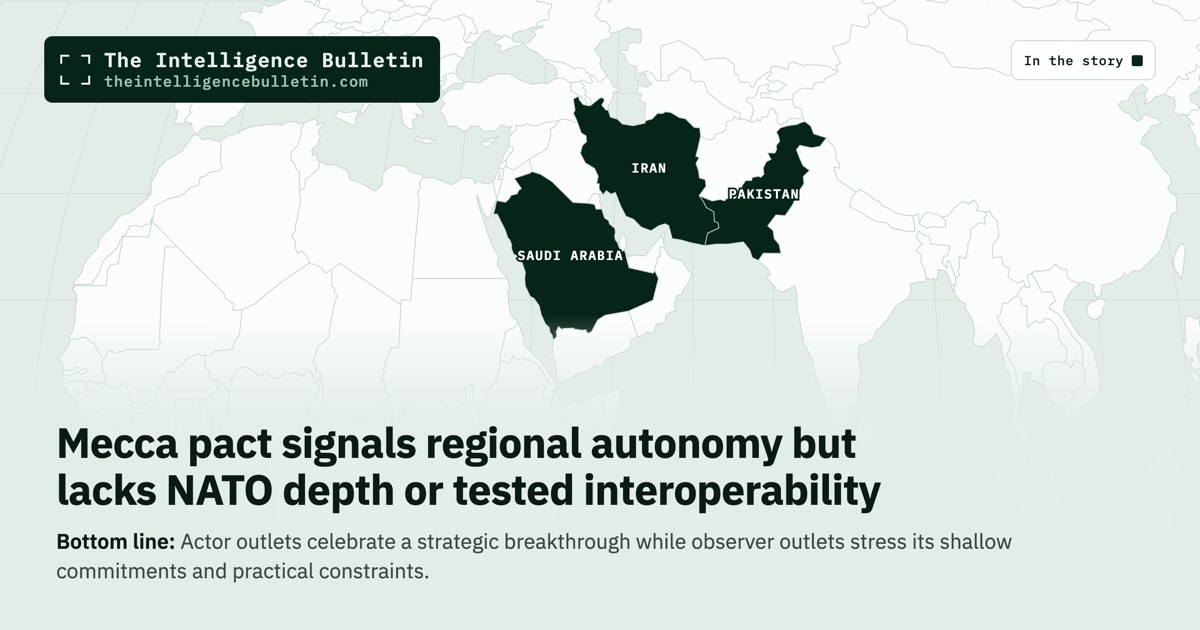
Mecca pact signals regional autonomy but lacks NATO depth or tested interoperability

Map of the countries in the story: Mecca pact signals regional autonomy but lacks NATO depth or tested interoperability
Saudi Arabia, Pakistan and Turkey signed the Mecca Joint Defense Agreement in early August 2026, committing that an armed attack on one would be treated as an attack on all. The pact was announced after leaders prayed together in Mecca and includes pledges for joint exercises and defense industry cooperation. Signatories state it is not directed at Iran or any other state. Observers note the agreement falls short of NATO-style integration due to differing threat perceptions and limited interoperability among the three militaries.

One Story. Many Angles.

🇵🇰
Pakistan
Pakistan Observer
Commentary
The real secret of the Makkah Defence Pact – Pakistan Observer
Read →
🇹🇷
Turkey
Anadolu Agency
TURKISH
Original reporting
Vice President Yılmaz: Turkey Supports Pakistan’s Legitimate Sensitivities in the Security Field
“Cumhurbaşkanı Yardımcısı Yılmaz: Türkiye, Pakistan’ın güvenlik alanındaki meşru hassasiyetlerini desteklemektedir”
Read →
🇭🇰
Hong Kong
South China Morning Post
Original reporting
Saudi-Turkey-Pakistan Mecca pact ‘far from’ Nato-style defence alliance
Read →
🇬🇧
United Kingdom
Middle East Eye
Original reporting
‘Agility vs depth’: How the Mecca pact stacks up against the UAE-Israel alliance
Read →
🇺🇸
United States
The Diplomat
Commentary
The Mecca Pact and America’s Reduced Leverage in West Asia – The Diplomat
Read →
5 sources · 3 independent accounts — some share the same news agency’s report
In Brief

Actor outlets celebrate a strategic breakthrough while observer outlets stress its shallow commitments and practical constraints.

The reporting across these outlets reveals a pact that exists more as a public political statement than a ready military instrument. Pakistani commentary presents it as a historic pivot allowing Muslim states to chart their own course after US involvement in regional war proved inadequate. Turkish official statements frame Ankara’s role as steady support for Pakistan’s security priorities without naming adversaries. Hong Kong and UK-based analysis highlight practical limits: diverging interests between the partners, Pakistan’s China ties clashing with others’ US systems, and the immediate test of non-response to Houthi strikes on Saudi territory. US-focused commentary sees the exclusion of Washington as evidence of eroding leverage, yet notes American officials have not opposed the deal. The most consistent thread is that the three capitals have codified existing bilateral ties rather than created new operational capacity, leaving the agreement’s activation clause untested and its expansion uncertain.

Perspective Analysis

The Mecca Joint Defense Agreement was signed in the first week of August 2026 by Saudi Arabia, Pakistan and Turkey. Its central clause states that an armed attack on any one signatory will be regarded as an attack on all three. The three leaders marked the occasion by praying together in Mecca, an event the agreement’s name recalls. Turkish statements immediately after the signing described the pact as support for Pakistan’s legitimate security concerns and a framework for coordination that would not target any third party. Saudi officials later told reporters the accord was not intended to create a military axis or sectarian bloc and carried no link to nuclear ambitions. Iranian officials, briefed by Pakistan’s foreign minister, described the arrangement as evidence that regional states now recognize security cannot rest on reliance on outside powers.

The agreement builds on long-standing bilateral ties rather than creating them from scratch. Saudi Arabia and Pakistan have maintained close military links for decades, with the kingdom providing financial support during Pakistan’s nuclear program and Pakistani personnel serving in Saudi forces. Turkey and Pakistan have collaborated on naval corvettes and the Kaan fighter jet project. Saudi Arabia recently concluded a large contract with Turkey’s Baykar for Akinci drones that includes technology transfer and local assembly inside the kingdom. The new trilateral text adds a mutual-defense commitment and pledges for joint military exercises plus expanded defense-industry cooperation, yet it leaves the precise triggers for collective action unspecified.

The pact emerged against the backdrop of the recent US-Iran conflict that began in February. Saudi Arabia had faced Iranian missile and drone strikes on its territory; the American security umbrella did not prevent those attacks and in some views drew the kingdom deeper into the fighting. Riyadh conveyed to Washington that the original purposes of the US presence had not been met. The Mecca agreement’s signatories have presented their move as a response to that experience and to Israel’s conduct in Gaza, which they say has eroded confidence in external guarantees. At the same time, the text explicitly avoids naming Iran as an adversary, and Iranian officials have expressed appreciation for the briefing they received.

Reporting from the three capitals and from outside observers diverges sharply on what the agreement actually delivers in practice. Pakistani commentary presents the pact as a historic pivot that allows the Muslim world to make its own decisions about its destiny after decades of external division. It credits Pakistan’s civil and military leadership with a pivotal role in wresting the outcome from adversaries and portrays the arrangement as opening space for a new strategic order that could reshape the wider global balance. Turkish official remarks stay narrower, stressing Ankara’s readiness to back Pakistan’s security priorities through established coordination mechanisms. Neither account dwells on immediate operational tests.

Outside reporting raises concrete questions about capacity and interoperability. Observers note that Pakistan’s main arms supplier is China while Saudi Arabia has long relied on US systems and Turkey fields its own platforms alongside NATO-standard equipment. These differences create practical barriers to rapid integration. The same reporting records that Houthis attacked a Saudi refinery at Jazan shortly after the signing and that neither Pakistan nor Turkey provided a military response. Analysts comparing the Mecca arrangement with the UAE-Israel partnership point out that the latter produced visible operational cooperation, including Israeli air-defense batteries sent to the Gulf and joint strikes, whereas the Mecca text remains untested in any comparable crisis.

The accounts also differ on the pact’s relationship to the United States. One line of analysis holds that the exclusion of Washington from the new framework chips away at American leverage over arms sales, basing rights and crisis management in the region, even if US officials have not opposed the deal and view it as compatible with burden-sharing goals. Another line emphasizes that the three signatories already maintain deep individual ties with Washington, so the pact does not create a clean break. Iranian commentary welcomes the development as validation of its long-standing argument that regional security is indivisible and should rest on local arrangements rather than foreign guarantees.

A reader who follows only Pakistani sources would conclude that the agreement marks a decisive shift toward Muslim-world autonomy with Pakistan at its center. A reader limited to Turkish official statements would see a measured defensive partnership focused on one ally’s concerns. A reader of Hong Kong or UK-based coverage would instead absorb repeated cautions about diverging threat perceptions, mismatched equipment and the absence of demonstrated mutual defense in the first real test. US-focused analysis would foreground the implications for Washington’s regional role while noting that American officials have refrained from objection.

The evidence that most directly addresses these differences lies in the documented non-response to the Jazan attack and in the explicit descriptions of incompatible military supply chains. Those details appear in reporting that draws on multiple regional and Western analysts rather than on any single government narrative. Existing bilateral projects between the three countries are real and long-standing, yet the addition of a collective-defense clause has not yet produced joint action or resolved the technical mismatches that would be required for it to function at scale. The pact therefore codifies political convergence that already existed and sets a framework whose operational content remains to be filled.

What to Watch

The most reliable reading is that the agreement functions primarily as a public political statement rather than an immediately usable military instrument. The absence of any coordinated response to the refinery attack, the acknowledged differences in weapons systems, and the repeated insistence by signatories that the pact threatens no one all point in the same direction. The three governments have an interest in presenting the text as a significant achievement, while outside observers have an interest in testing whether the headline commitment survives contact with the next crisis. The next several months will show whether the planned exercises and industry cooperation produce measurable integration or whether the clause on collective defense stays dormant.


Share this story

Poland says it stopped Russian intelligence from killing a US-Ukrainian arms supplier in Warsaw

Map of the countries in the story: Poland says it stopped Russian intelligence from killing a US-Ukrainian arms supplier in Warsaw
On August 7, Polish Internal Security Agency officers with police and US help detained a 29-year-old Russian man in Warsaw. He had been recruited by Russian intelligence to assassinate a dual US-Ukrainian citizen described as a weapons supplier to Ukraine’s forces. Polish Prime Minister Donald Tusk announced the foiled plot on August 13, calling it the first known Russian attempt to target an American inside a NATO country. The suspect faces three months’ detention; officials provided no name for the intended victim.

One Story. Many Angles.

🇺🇦
Ukraine
Kyiv Post
Original reporting
Poland Uncovers Russian Plot to Kill US-Ukrainian Citizen in Warsaw
Read →
🇺🇦
Ukraine
Dzerkalo Tyzhnia
UKRAINIAN
Carries Money.pl reporting
Assassination attempt in Warsaw – Russian planned murder of businessman – world news
“Замах у Варшаві – росіянин планував убивство бізнесмена – новини світу”
Read →
🇬🇧
United Kingdom
The Guardian
Carries Associated Press reporting
Russian plot to kill Ukrainian American thwarted in Warsaw, says Polish PM
Read →
🇮🇱
Israel
The Jerusalem Post
Carries REUTERS reporting
Poland says it arrested Russian hired to kill Ukrainian-American citizen
Read →
🇺🇸
United States
The Philadelphia Inquirer
Associated Press wire copy
Poland says it thwarted a Russian plot to kill an American citizen in Warsaw
Read →
5 sources · each independently reported
In Brief

Ukrainian coverage stresses the victim’s role arming Kyiv’s forces; Western accounts stress the unprecedented targeting of an American inside NATO.

Ukrainian outlets alone name the intended victim’s role supplying weapons to Ukrainian forces as the reason he became a target, a detail that anchors the story in Kyiv’s war effort rather than abstract security threats. Western reporting instead leads with the Polish prime minister’s statement that this marks the first Russian-directed attack on a US citizen inside NATO territory and stresses the joint Polish-US operation that stopped it. The Jerusalem Post and Philadelphia Inquirer carry Reuters and AP dispatches that repeat Tusk’s words almost verbatim while adding only the broader context of prior Russian plots across Europe. The Guardian expands on that history with references to Litvinenko, Skripal and other cases, yet still treats the Polish announcement as the central new fact. No source in the set carries a Russian rebuttal or independent confirmation of the suspect’s recruitment; all rest on the same Polish government account. The resulting picture shows how the same announcement travels through different national lenses: one set foregrounds direct support for Ukraine’s battlefield needs, the other foregrounds alliance vulnerability and transatlantic cooperation.

Perspective Analysis

Polish security officers detained a 29-year-old Russian citizen on a Warsaw street on August 7 after he left his apartment. The man had been recruited by Russian intelligence services to carry out an assassination, according to statements from Polish Prime Minister Donald Tusk. Officers from the Internal Security Agency, supported by police and a counter-terrorism unit, made the arrest on Woloska Street before the attack could proceed. Tusk revealed the details six days later at a press conference, describing the target as a dual US-Ukrainian citizen whom the Putin regime viewed as inconvenient. The suspect now faces three months in custody at a Warsaw detention facility while prosecutors treat the case as a politically motivated contract killing.

Tusk stated that the operation marked the first known instance in which Russia had ordered an attack on an American citizen inside another NATO country. He credited the Internal Security Agency and American services with stopping the plot at the last moment. Tomasz Siemoniak, Poland’s coordinator for special services, confirmed on X that the assassination was planned to occur in Warsaw itself. Tusk added that Polish authorities must assume the Russian regime will continue attempting to eliminate people it finds inconvenient in various parts of the world and that Poland is preparing for further attempts.

Ukrainian reporting supplies one additional detail absent from the English-language accounts. Both the Kyiv Post and Dzerkalo Tyzhnia identify the intended victim as a businessman who supplies weapons to Ukraine’s armed forces. The Ukrainian-language Dzerkalo Tyzhnia piece, drawing on Polish media reports, notes that the target originates from the Donbas region and stresses his role in arming Ukrainian troops. The Kyiv Post similarly frames the plot as Russian targeting of someone providing direct material support to Kyiv’s war effort. These outlets present the arrest as evidence that Russian operations reach into the Ukrainian diaspora and supply networks even inside NATO territory.

English-language coverage centers instead on the unprecedented nature of the target and the intelligence cooperation that thwarted it. The Guardian reports Tusk’s claim that this was the first Russian-directed attack on a US citizen in a NATO country and places the incident inside a longer pattern of Russian sabotage and assassination attempts across Europe. It references the 2006 killing of Alexander Litvinenko in London, the 2018 Salisbury novichok attack on Sergei Skripal, the 2019 Berlin shooting of Zelimkhan Khangoshvili, and a June 2026 killing of a Russian artist critical of Putin in eastern Poland. The Philadelphia Inquirer, carrying Associated Press copy, leads with the American citizen angle and notes the joint Polish-US operation while recording that the US State Department acknowledged the reports but offered no further information. The Jerusalem Post, relaying Reuters, repeats Tusk’s description of the victim as “inconvenient to the Putin regime” and records that the Russian embassy in Warsaw did not respond to requests for comment.

All five outlets rest on the same Polish government statements. None contains independent confirmation of the suspect’s recruitment or of the target’s identity beyond the details Tusk and Siemoniak supplied. No outlet in the set carries a Russian government response or denial. The Russian Foreign Ministry did not reply to inquiries from the Guardian or the Inquirer. Previous Russian plots receive mention only in the Guardian and Inquirer pieces as background, not as new evidence in this case.

A reader who encounters only the Ukrainian sources will correctly understand that the intended victim supplied arms to Ukrainian forces and will therefore see the plot as an attempt to disrupt Kyiv’s battlefield logistics. That reader will not learn from those articles that Polish officials presented the incident as the first Russian attack on an American inside NATO territory. A reader limited to the Guardian or the Inquirer will absorb the NATO-security framing and the historical context of earlier Russian operations, yet will miss the explicit connection to weapons supplies for Ukrainian troops that the two Ukrainian outlets foreground. The wire-service accounts in the Jerusalem Post and Philadelphia Inquirer stay closest to Tusk’s original wording and add little beyond the standard note that Moscow routinely dismisses such accusations as Western paranoia.

The core factual spine remains the Polish account: a Russian national was detained on August 7 after recruitment by Russian intelligence to kill a dual US-Ukrainian citizen, and Polish officials described the case as unprecedented. That account is corroborated across every outlet examined because each one relays the same statements from Tusk and Siemoniak. The additional detail that the victim supplied weapons to Ukrainian forces appears only in the two Ukrainian sources and therefore stands as single-source reporting. No contradictory claims exist in the set; the differences lie in emphasis rather than in disputed facts.

What to Watch

Polish officials have an obvious interest in presenting the operation as a successful joint effort with the United States that protects both NATO territory and a US citizen. Ukrainian outlets have an interest in underscoring any threat to the supply lines that sustain their country’s defense. Western outlets have an interest in framing the episode inside the larger narrative of Russian hybrid operations against European support for Ukraine. The absence of any Russian-sourced material in the set means readers receive no competing narrative from Moscow on this specific incident. The next development most likely to test these accounts will be whatever details emerge from the Polish investigation or from any future similar operations Polish authorities choose to disclose.


Share this story

Venezuela and Israel restore consular ties after earthquake aid and Maduro ouster

Map of the countries in the story: Venezuela and Israel restore consular ties after earthquake aid and Maduro ouster
Venezuela and Israel announced the restoration of consular relations on August 12, 2026, after a 17-year rupture that began in 2009 under Hugo Chávez. The move followed Israeli humanitarian and technical aid after a June double earthquake that killed over 6,000 people. Acting President Delcy Rodríguez’s government and Israeli Foreign Minister Gideon Saar issued statements establishing a coordination mechanism for consular services and continued cooperation, while recognizing the Venezuelan Jewish community as a historic bridge. Full diplomatic relations remain pending.

One Story. Many Angles.

🇮🇱
Israel
Jerusalem Post
Original reporting
Israel, Venezuela begin rebuilding ties after 17-year diplomatic rupture
Read →
🇻🇪
Venezuela
Correo del Caroní
SPANISH
Original reporting
Venezuela and Israel agree to reestablish consular relations after 17 years of rupture
“Venezuela e Israel acuerdan restablecer relaciones consulares tras 17 años de ruptura – Correo del Caroní”
Read →
🇬🇧
United Kingdom
Middle East Eye
Original reporting
Israel and Venezuela restore diplomatic relations after years of severed ties
Read →
🇦🇷
Argentina
Ámbito
SPANISH
Original reporting
Venezuela and Israel reestablished their consular relations after 17 years
“Venezuela e Israel restablecieron sus relaciones consulares tras 17 años”
Read →
🇨🇴
Colombia
El Tiempo
SPANISH
Carries EFE reporting
Israel and Venezuela resume consular relations after 17 years, following Israeli aid for the double Venezuelan earthquake
“Israel y Venezuela reanudan relaciones consulares tras 17 años, luego de la ayuda israelí por el doble terremoto venezolano”
Read →
5 sources · each independently reported
In Brief

Israeli and Venezuelan accounts center the earthquake aid and Jewish community; regional and Middle East outlets embed the move in post-Maduro US alignment and Latin American shifts.

The reporting converges on the earthquake aid as the immediate trigger and on the statements from the two foreign ministers, yet the outlets differ sharply in what larger story they attach to those facts. Israeli coverage frames the step as the start of rebuilding trust through humanitarian action after years of quiet channels, placing the emphasis on practical services for citizens and the Jewish community. Venezuelan reporting stresses the official announcement and the value of the local Jewish population as a bridge, while situating the decision inside post-Maduro realignment and gratitude for the aid. Regional Latin American accounts, including Argentine and Colombian, tie the development to Caracas’s broader pivot away from Iran and toward Washington after Maduro’s capture, and they note the aid as the catalyst that made formal contact possible again. Middle East-focused coverage widens the lens further, linking the move to a wave of right-leaning Latin American governments normalizing with Israel even as other regional dynamics continue. The shared factual core is narrow and consistent; the divergence lies in whether the story is told as bilateral humanitarian progress, Venezuelan domestic realignment, or part of shifting hemispheric alignments. No outlet disputes the sequence of the aid, the 2009 break, or the limited consular scope of the new agreement.

Perspective Analysis

Venezuela and Israel announced on August 12, 2026, that they had agreed to restore consular relations after a 17-year break that began when Hugo Chávez severed ties on January 15, 2009. The immediate trigger was Israeli humanitarian assistance sent after a double earthquake struck Venezuela on June 24. Israeli statements described a coordination mechanism that would provide consular services to citizens of both countries and continue technical cooperation already under way in the earthquake zone. Venezuelan statements made the same points and added that the two governments recognized the importance of the link between the State of Israel and the Jewish community resident in Venezuela, which they called an important historic bridge of friendship.

The 2009 rupture occurred one week after Chávez expelled the Israeli ambassador, an action taken in solidarity with Palestinians during Israel’s military operation in Gaza. For the next seventeen years Caracas maintained a critical posture toward Israel and strengthened ties with countries at odds with it, including Iran. The new arrangement does not restore full diplomatic relations or reopen embassies. It is confined to consular services and the continuation of post-disaster technical work.

Israeli reporting placed the heaviest weight on the humanitarian sequence that produced the agreement. A Jerusalem Post opinion piece described how Israeli delegations, including teams from ZAKA, NATAN and IsraAID, arrived after the quakes, worked alongside Venezuelan officials, and recovered bodies and delivered aid in La Guaira and elsewhere. It noted that a preliminary Israeli team reached Venezuela on July 1 and that Prime Minister Benjamin Netanyahu had publicly linked the delegations to the rebuilding of both physical ruins and bilateral relations. The same account recalled years of quiet contacts maintained by Rabbi Isaac Cohen, chief rabbi of the Israelite Association of Venezuela, who delivered a letter to Foreign Minister Félix Plasencia on August 9 requesting the restoration of ties. Reactions from former Venezuelan ambassador Milos Alcalay and the last Israeli counselor in Caracas, Eldad Golan, were presented as evidence that the step enjoyed support across political lines inside Venezuela.

Venezuelan coverage, as carried by Correo del Caroní, reproduced the government’s communiqué almost verbatim. It emphasized that the agreement followed the arrival of the Israeli humanitarian delegation and that both sides had pledged to maintain technical cooperation on damage assessment, structural evaluation and contingency planning. The piece highlighted the strategic value the Venezuelan Foreign Ministry attached to the local Jewish community as a bridge and placed the development inside the broader context of post-earthquake recovery under acting President Delcy Rodríguez.

Regional and external outlets attached additional political context. Ámbito in Argentina described the consular step as part of Caracas’s shift away from Iran and toward alignment with Washington after the January 3 capture of Nicolás Maduro by U.S. forces. It noted that the new channel remained limited to consular matters but quoted analysts who viewed it as a possible starting point for fuller normalization. Middle East Eye placed the announcement inside a wider pattern of right-leaning Latin American governments restoring or strengthening ties with Israel. It referenced earlier unofficial contacts, including a February report of Venezuelan crude reaching Israel, and placed the move alongside Colombia’s recognition of Israeli sovereignty over the Golan Heights and Honduras’s return of an ambassador. El Tiempo in Colombia, relying on EFE and AFP dispatches, centered the earthquake aid itself: the composition of the Israeli team of civil engineers, the role of Israeli Defense Forces officer Elad Edri in advising on debris management, and Rodríguez’s July expression of gratitude for the mission.

The accounts converge on the sequence of the aid, the date of the 2009 break, the names of the two foreign ministers who issued statements, and the strictly consular scope of the new arrangement. They diverge in the larger frame they supply. Israeli coverage treats the development primarily as the reopening of practical services and the resumption of people-to-people contact after a period of quiet diplomacy. Venezuelan coverage stays close to the official text and stresses the role of the local Jewish population. Argentine and Colombian reporting foreground the earthquake as the catalyst while noting the post-Maduro foreign-policy turn. Middle East Eye widens the lens to a regional diplomatic trend.

The narrowest, most consistently corroborated account across the five outlets is the one that stays inside the two governments’ statements: an agreement limited to consular services and continued technical cooperation that followed Israeli aid after the June earthquakes. That core is carried by the actor-country pieces and by the wire material reproduced in El Tiempo. The additional political framing—Maduro’s capture, the pivot away from Iran, the pattern of other Latin American governments—appears in the Argentine, Colombian and Middle East Eye reporting but is absent from the Israeli and Venezuelan accounts. Those external frames are not contradicted by the primary statements; they simply add interpretive layers drawn from each outlet’s larger vantage.

What to Watch

The Israeli and Venezuelan reporting therefore sits closest to the documentary record of the announcements themselves. Both countries have an interest in presenting the step as a practical, humanitarian outcome rather than a geopolitical realignment. Regional and Middle East outlets, by contrast, have an interest in reading the move as evidence of shifting alignments. The next concrete development to watch is whether the consular channel produces visible services for citizens or remains largely symbolic. The earthquake recovery work already under way supplies a measurable test: if joint technical teams continue and report results, the limited agreement will have produced tangible activity even without full diplomatic restoration.


Share this story