Jordan shoots down Iranian missiles while Tehran courts its citizens directly

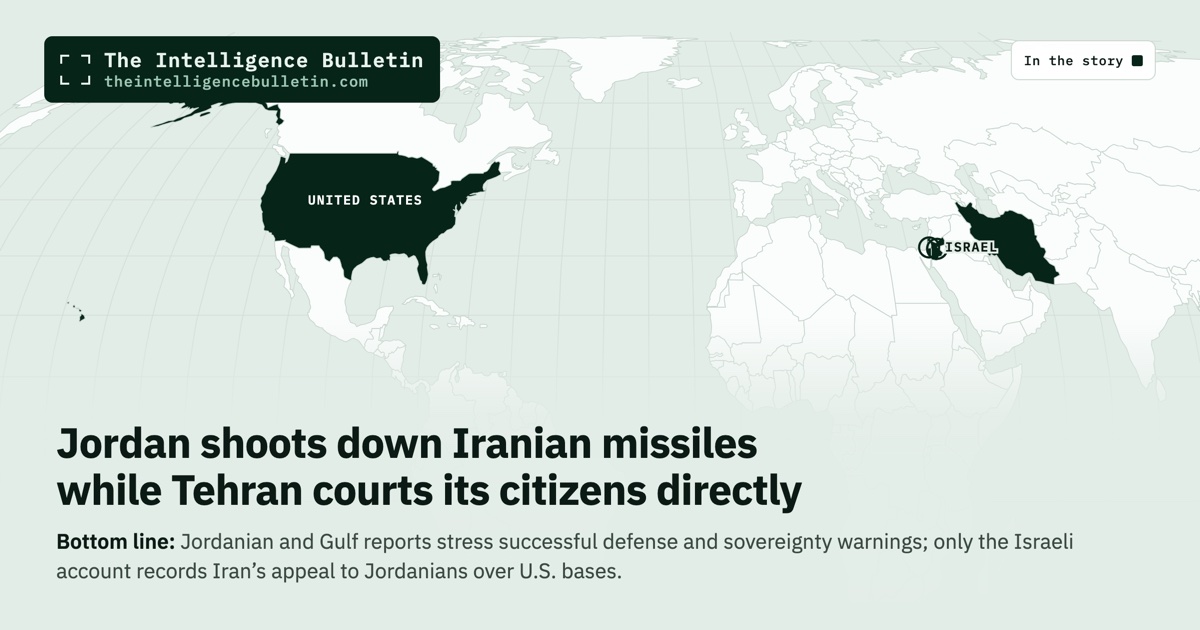
Map of the countries in the story: Jordan shoots down Iranian missiles while Tehran courts its citizens directly
On July 13 2026 Jordan’s armed forces intercepted and downed four missiles that entered its airspace from Iran. Royal Engineering teams cleared debris at multiple sites. No casualties or property damage occurred. The military warned that any future violation of sovereignty would face a firm response.

One Story. Many Angles.

🇯🇴
Jordan
Al Mamlaka TV
ARABIC
Army: Interception and downing of 4 missiles that entered Jordanian airspace coming from Iran
“الجيش: اعتراض وإسقاط 4 صواريخ دخلت المجال الجوي الأردني قادمة من إيران”
Read →
🇷🇺
Russia
RT Arabic
ARABIC
Jordan: Interception of 4 missiles that entered airspace from Iran’s direction
“الأردن: اعتراض 4 صواريخ دخلت المجال الجوي من جهة إيران”
Read →
🇮🇱
Israel
Ynetnews
Iran fires missiles at Jordan , then appeals to the Jordanian people
Read →
🇶🇦
Qatar
The Peninsula
Jordan intercepts four missiles launched from Iran
Read →
🇹🇷
Turkey
Anadolu Agency
Jordan says its air defenses intercepted 4 missiles fired from Iran
Read →
In Brief

Jordanian and Gulf reports stress successful defense and sovereignty warnings; only the Israeli account records Iran’s appeal to Jordanians over U.S. bases.

Jordanian state media and its reprints in Russian and Turkish outlets present the incident as a straightforward success for national air defenses, quoting the military at length on readiness, debris clearance and warnings against future incursions. Qatari coverage echoes the same official facts in a brief regional-security note. Israeli reporting alone adds that Iran’s Revolutionary Guard appealed directly to the Jordanian people to press for removal of U.S. bases, while noting Amman’s unusually restrained diplomatic language and omission of the attacks in some foreign-ministry statements. That contrast reveals Jordan’s priority: neutralize the immediate threat quietly and avoid rhetorical escalation that could turn its territory into an active arena in the wider U.S.-Iran confrontation.

Perspective Analysis

Jordan’s interception of four Iranian missiles on July 13, 2026, demonstrated the effectiveness of its air defenses, yet the real significance lies in how Amman chose to handle the incident: through swift operational success paired with deliberate diplomatic restraint. This approach reveals a calculated priority to neutralize immediate threats to its territory without turning the kingdom into an open arena in the escalating U.S.-Iran confrontation. By focusing public messaging strictly on defense readiness and sovereignty while limiting broader commentary, Jordanian authorities signaled that protecting national security takes precedence over joining rhetorical exchanges that could invite further attacks or complicate relations with multiple regional powers.

The Jordanian Armed Forces statement, carried in full by the state broadcaster Al Mamlaka TV, described the interception as executed with high efficiency under established procedures to safeguard the kingdom, its citizens, and airspace. Four missiles entered from Iranian territory early on Tuesday and were brought down without causing injuries or material damage. Royal Engineering Corps teams promptly cleared debris at multiple sites according to standard technical and security protocols. The military emphasized ongoing high readiness, monitoring of developments, and a firm commitment that any future violation of sovereignty would meet a determined response within approved rules of engagement. Citizens were urged to rely only on official sources. This account formed the core factual record across most reporting.

Reprints in outlets such as RT Arabic and Anadolu Agency stayed close to that official Jordanian text. RT Arabic published the military statement nearly verbatim, embedding it within wider coverage of U.S.-Iran tensions without adding Iranian or Russian interpretive layers. Anadolu issued a short factual note confirming the air-defense success and the absence of harm. Qatari coverage in The Peninsula echoed the same core details in a brief regional-security dispatch, noting the high alert status and warning of firm responses to any sovereignty breach while citing Jordanian official sources. These accounts treated the event primarily as a successful defensive action rather than an invitation to broader political analysis.

Israeli reporting from Ynetnews alone expanded the picture by documenting repeated Iranian launches in preceding days, including an earlier set of four missiles and three others that had exploded inside Jordan with only minor damage. It also highlighted an appeal issued directly by Iran’s Revolutionary Guard Corps to the Jordanian people. The message stated that Tehran was not hostile to Jordan, appreciated its population, and urged citizens—aware of Palestinian suffering—to press for the removal of U.S. military bases as a step toward regional security. The report contrasted this outreach with Amman’s notably restrained public posture. Jordan’s Foreign Ministry statements condemned Iranian attacks on other Gulf states as violations of sovereignty and international law but omitted any reference to the strikes on Jordanian territory itself. Readouts from calls by Foreign Minister Ayman Safadi with counterparts similarly avoided direct mention of the incidents affecting Jordan, even when other parties referenced them.

This divergence in coverage reflects Jordan’s underlying calculation. The kingdom sits geographically exposed, with U.S. forces operating from bases on its soil that place it within Iran’s declared retaliatory targeting logic. Public escalation risks drawing additional salvos or turning Jordanian airspace into a regular corridor for exchanges. Instead, the military handled the physical threat through interception and debris management while political statements remained measured, underscoring sovereignty without naming Tehran explicitly in every forum. An analyst quoted in the Israeli account noted that Jordan typically acts quietly on sensitive files involving Iran, preferring diplomatic balance and defense of core interests over heightened rhetoric that could carry economic or security costs.

What to Watch

The pattern carries implications for how the confrontation may unfold. Jordan’s demonstrated capacity to intercept incoming missiles without casualties reduces the immediate incentive for domestic pressure on U.S. basing arrangements, even as Tehran seeks to cultivate such pressure through direct appeals. At the same time, the absence of inflammatory language from Amman preserves space for continued coordination with Gulf partners and Western allies without locking the kingdom into a more confrontational posture. Should further launches occur, the same combination of operational firmness and rhetorical caution is likely to persist, allowing Jordan to manage spillover risks while signaling that its territory will not serve as an uncontested battleground. This stance matters because it illustrates how smaller states navigate great-power clashes by prioritizing tangible defense outcomes over public positioning that could escalate the conflict onto their soil.
Share this story

Israel sets full-term October 27 vote while Arab press calls it Netanyahu’s war referendum

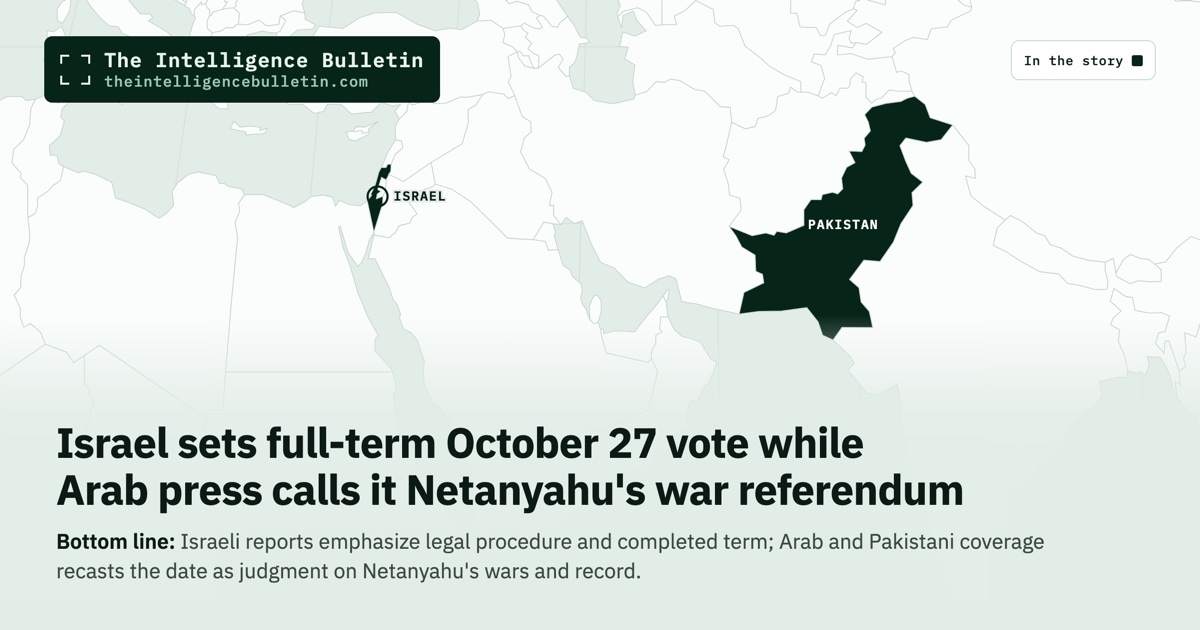
Map of the countries in the story: Israel sets full-term October 27 vote while Arab press calls it Netanyahu's war referendum
On July 12, 2026, coalition head Ofir Katz told Israel’s Knesset House Committee that elections would proceed on the original October 27 date set by law. The Knesset had voted in May to disband, raising the possibility of an earlier vote. Polls indicate Netanyahu’s coalition is likely to lose, though he has survived repeated predictions of his political demise. This marks the first full four-year term since 1988.

One Story. Many Angles.

🇮🇱
Israel
Jerusalem Post
Israeli government sets October 27 as Knesset election date
Read →
🇮🇱
Israel
Haaretz
A Digital Forever War on Democracy
Read →
🇮🇱
Israel
Al-Monitor
Israel election will be held on October 27, coalition head says
Read →
🇸🇦
Saudi Arabia
Arab News
Israel Netanyahu: architect of wars, master of survival
Read →
🇵🇰
Pakistan
Dawn
Architect of war: Netanyahu gears for what could be his political life defining contest
Read →
In Brief

Israeli reports emphasize legal procedure and completed term; Arab and Pakistani coverage recasts the date as judgment on Netanyahu’s wars and record.

Israeli coverage from the Jerusalem Post and Al-Monitor treats the announcement as a straightforward procedural victory: the government completed its full term, the legal date stands, and coalition whip Ofir Katz praised nine budgets passed. Haaretz shifts focus to a podcast on mutual Iranian and pro-Netanyahu online disinformation campaigns ahead of the vote. In contrast, Arab News and Dawn run near-identical profiles labeling Netanyahu the ‘architect of wars’ and ‘master of survival,’ detailing October 7 failures, Gaza casualties, and the election as the potential end of his career. The shared wire text between the Saudi and Pakistani outlets shows how the same critical narrative travels across Muslim-world English press, while Israeli domestic reporting stays inside Knesset rules and survival mechanics.

Perspective Analysis

The coverage of Israel’s confirmed October 27 election date exposes a sharp divide between institutional domestic reporting and regional judgment on Benjamin Netanyahu’s leadership. Israeli outlets treat the announcement as evidence of parliamentary continuity after years of instability, while Arab and Pakistani English-language press present the vote as a direct referendum on the prime minister’s record of initiating and managing multiple wars since October 2023. This split matters because the election arrives at the end of Israel’s first full four-year Knesset term since 1988, a rare moment of procedural closure that coincides with unresolved conflicts across Gaza, Lebanon, and Iran.

On July 12, 2026, coalition head Ofir Katz informed the Knesset House Committee that the original legal date would stand despite the May dissolution vote that had opened the door to an earlier ballot. Katz noted the government had passed nine budgets and hundreds of laws, framing the outcome as a straightforward completion of the term. The Jerusalem Post reported the decision through this procedural lens, quoting Katz directly on the rarity of finishing a full term and including statements from legal adviser Sagit Afik that no dissolution law was needed. Opposition voices appeared only briefly, with Yisrael Beytenu leader Avigdor Liberman predicting victory and a new government. Al-Monitor, drawing on Reuters reporting, echoed the same timeline confirmation while adding poll context that Netanyahu’s nationalist-religious coalition faces likely defeat, though rivals lack a clear alternative path.

These accounts stay inside Knesset mechanics and coalition survival tactics. They register the milestone of completing four years without early collapse but give little space to the security failures or regional fallout that dominate external views. Haaretz departs from this pattern by using the fixed date to examine online disinformation campaigns. Its election podcast highlighted how Iranian influence operations and pro-Netanyahu efforts both amplify division in the months ahead, noting the difficulty of distinguishing the two in a digital environment supercharged by artificial intelligence. The piece connects the timeline to broader threats against democratic debate rather than treating the election as routine procedure.

Arab News and Dawn, by contrast, run near-identical profiles that cast Netanyahu as the “architect of wars” and “master of survival” heading into what could be his defining contest. Both outlets detail the October 7, 2023, Hamas attacks that killed more than 1,200 Israelis and shattered his long-cultivated image as “Mr. Security.” They describe the subsequent campaigns in Gaza that left tens of thousands dead, the spread of fighting to Hezbollah, the Houthis, and direct confrontations with Iran, and Netanyahu’s international arrest warrant over alleged war crimes. The pieces trace his biography from commando service and the 1973 war through decades in power, his alliance with U.S. President Donald Trump, and repeated defiance of predictions of his downfall, most recently in the 2022 comeback backed by far-right allies. Polls showing public desire for his removal appear alongside criticism that he has used the conflicts to delay accountability.

The identical wording across the Saudi and Pakistani outlets indicates shared wire sourcing rather than independent reporting, extending a consistent regional critique into English-language Muslim-world coverage. This framing positions the October 27 vote around legacy and human costs rather than Knesset rules, treating the ballot as the potential endpoint of policies that have reshaped the Middle East’s strategic landscape without delivering stated goals such as eliminating Hamas.

The procedural emphasis in Israeli establishment reporting aligns most closely with verifiable parliamentary events on July 12. It accurately records the legal date and the absence of an early-election push from the coalition. Yet it underplays the substantive stakes that the Arab accounts foreground: the multi-front wars, Gaza casualties, and Netanyahu’s personal legal and political vulnerabilities. Those elements are not invented for the profiles; they draw from the same timeline of events that Israeli voters will weigh. The Arab press risks flattening Israeli domestic dynamics into a single indictment, but it correctly identifies the election’s regional resonance as a judgment on wartime leadership rather than a technical exercise in term completion.

What to Watch

Netanyahu has stated his intention to win, and his history of outlasting crises suggests the outcome remains uncertain despite unfavorable polls. The real test lies in whether voters treat the full term as proof of stability or as insufficient compensation for security lapses and prolonged conflict. A change in government would likely shift Israel’s approach to Gaza reconstruction, Iran negotiations, and West Bank policy in ways that affect neighboring states and international actors far beyond Knesset procedure. The coverage gap itself signals how differently those stakes register inside and outside Israel.


Share this story

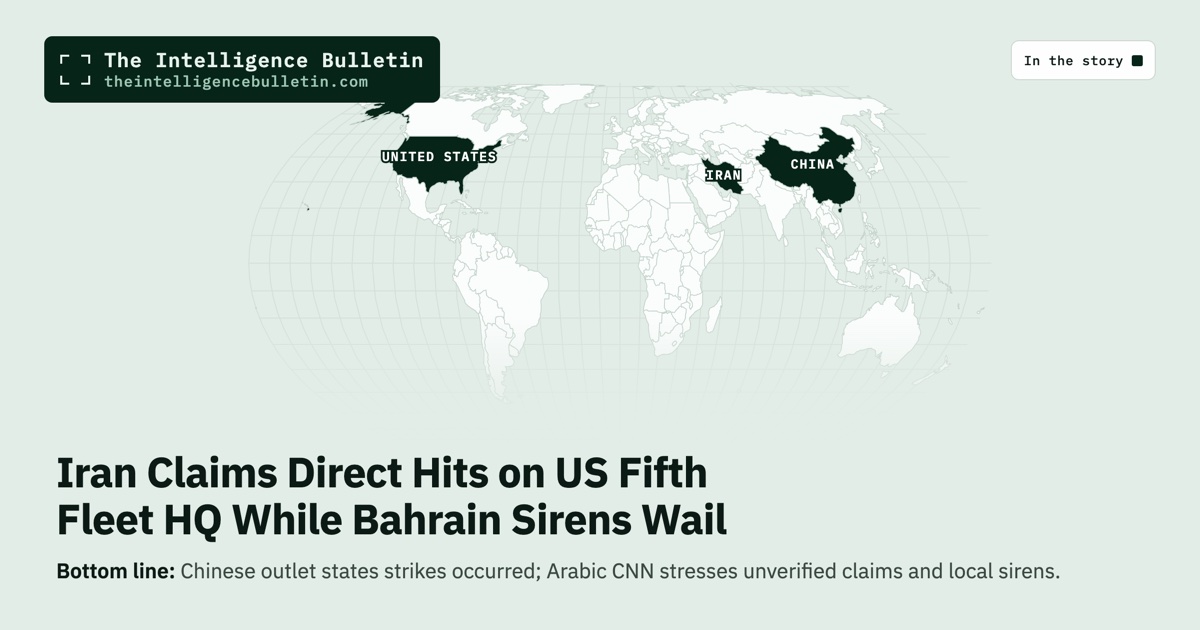
Iran Claims Direct Hits on US Fifth Fleet HQ While Bahrain Sirens Wail

Map of the countries in the story: Iran Claims Direct Hits on US Fifth Fleet HQ While Bahrain Sirens Wail
On July 14 2026 the IRGC claimed missile and drone strikes on the US Fifth Fleet headquarters in Manama Bahrain. Reports cited burning fuel depots and destroyed radar systems including a Patriot unit though no deaths were reported. Bahrain’s interior ministry confirmed air raid sirens had sounded twice.

One Story. Many Angles.

🇨🇳
China
Global Times
Iran strikes U.S. Fifth Fleet headquarters in Bahrain: media
Read →
🇬🇧
United Kingdom
Middle East Eye
IRGC attacks target US Fifth Fleet in Bahrain
Read →
🇺🇸
United States
CNN Arabic
ARABIC
Air raid sirens sound in Bahrain.. and Iran claims destruction of targets
“Air raid sirens sound in Bahrain and Iran claims destruction of targets”
Read →
In Brief

Chinese outlet states strikes occurred; Arabic CNN stresses unverified claims and local sirens.

Iranian state media presented the operation as a direct hit on the US Fifth Fleet headquarters while British-based Middle East Eye relayed detailed IRGC claims of destroyed radars and fuel depots without independent confirmation. CNN Arabic led instead with the repeated sounding of sirens across Bahrain and explicitly noted that Iranian assertions of destruction often lack supporting evidence. The three accounts converge on the core facts of claimed strikes and local alerts yet diverge sharply on emphasis: one treats success as given, another catalogs operational detail, and the third flags verification gaps. This pattern shows outlets balancing Iranian assertions against the absence of confirmed damage or casualties in a region already tense from prior US-Iran exchanges. The shared silence on any US or Bahraini response statements underscores how quickly the story rests on one side’s claims alone.

Perspective Analysis

Iran’s Islamic Revolutionary Guard Corps has asserted that its missiles and drones struck the headquarters of the U.S. Fifth Fleet in Manama, Bahrain, igniting fuel depots and disabling multiple radar installations including a Patriot system. Bahrain’s interior ministry confirmed that air raid sirens sounded twice across the country on July 14, 2026, prompting residents to seek shelter. No deaths or independent verification of damage have surfaced in any reporting, yet the episode underscores how quickly unconfirmed Iranian claims can shape perceptions of American military vulnerability in the Gulf at a moment when U.S. forces have already conducted fresh strikes inside Iran itself.

The pattern of coverage across major outlets illustrates the difficulty of reporting kinetic claims in a fast-moving confrontation where one side’s assertions travel farther than any confirmed results. Iranian state-linked reporting and its echoes treat the strikes as accomplished fact, listing specific systems taken out and declaring that operations continue. British-based coverage relays those operational details at length, framing the action as a sustained campaign against U.S. naval infrastructure without inserting immediate caveats about proof. Arabic-language reporting from a major U.S. network instead opens with the local experience of sirens and explicitly reminds readers that Iranian announcements of destroyed American facilities have frequently lacked corroboration in prior rounds of exchanges. These choices are not neutral; they reflect institutional priorities about whose voice sets the baseline for understanding an attack whose physical consequences remain invisible.

The broader context makes such choices consequential. The IRGC statements came after the U.S. Central Command completed a five-hour wave of strikes on Iranian military sites in Bushehr, Jask, Konarak, Abu Musa, and Bandar Abbas, aimed at degrading Iran’s ability to threaten commercial shipping. Those American operations followed President Trump’s public signals that additional strikes were planned, even as negotiations between the two countries had resumed the previous week. In that environment, any Iranian claim of successful retaliation carries immediate political weight, regardless of whether fuel depots actually burned or radars went dark. Outlets that present the claims as reported fact effectively amplify the narrative of successful pushback against U.S. power projection. Those that foreground sirens and verification shortfalls keep the emphasis on the absence of visible proof and the civilian alerts that accompanied the episode.

The divergence matters because the Fifth Fleet’s presence in Bahrain has long symbolized the U.S. security umbrella for Gulf states and the protection of energy transit routes through the Strait of Hormuz. When Iranian media or aligned outlets describe the destruction of a control center for unmanned surface vessels alongside air-defense radars, they are signaling not merely tactical success but an ability to reach and degrade American forward-operating capabilities directly. Absent satellite imagery, on-site reporting, or statements from U.S. or Bahraini authorities confirming or denying the hits, that signal rests entirely on the IRGC’s own description. The silence from Washington and Manama on the specific allegations leaves the claims unchallenged in the immediate news cycle, allowing them to circulate as the primary account of what occurred.

Regional audiences receive different impressions depending on which account they encounter first. Readers of detailed operational lists may conclude that Iranian forces achieved measurable degradation of U.S. defenses. Readers steered toward the sounding of sirens and the historical pattern of unverified Iranian assertions may instead register the episode as another round of rhetorical escalation without demonstrated effect. Both readings are plausible given the information released so far, yet they point to sharply different assessments of risk for shipping, basing agreements, and the durability of the current U.S. posture in the Gulf.

What to Watch

What happens next will likely turn less on whether any particular radar was destroyed and more on whether either side chooses to treat the claims as sufficient justification for further action. The IRGC’s statement that the operation continues already frames the Bahrain episode as one phase in a longer sequence rather than an isolated event. U.S. Central Command’s announcement that its own strikes had concluded does not preclude additional responses if American commanders assess that Iranian capabilities remain intact. In the absence of independent damage assessments, both sides retain maximum flexibility to interpret events in ways that serve their immediate objectives, whether that means declaring victory, demanding restraint, or preparing the next round of strikes. The coverage pattern simply reproduces that same uncertainty at the level of public information.


Share this story

US Pledges to Dismantle ICC While Allies Stay Silent

Map of the countries in the story: US Pledges to Dismantle ICC While Allies Stay Silent
On July 13, 2026, US Secretary of State Marco Rubio announced a campaign to dismantle the International Criminal Court, including sanctions, visa bans and diplomatic pressure on other nations. The US, which never joined the Rome Statute, called the Hague tribunal an intolerable threat to American sovereignty and law enforcement. The move escalates prior sanctions and draws on Rubio’s op-ed and video statements.

One Story. Many Angles.

🇺🇸
United States
Townhall
Marco Rubio Just Declared War on International Criminal Court and International Law
Read →
🇺🇸
United States
Truthout
Marco Rubio Threatens to Teach the ICC the Full Meaning of American Resolve
Read →
🇬🇧
United Kingdom
The Guardian
Marco Rubio launches campaign to dismantle International criminal court
Read →
🇨🇳
China
South China Morning Post
US vows campaign to end ICC intolerable threat to American sovereignty
Read →
🇩🇪
Germany
Deutsche Welle
RUSSIAN
US threatens to deprive the ICC of the opportunity to continue its work
“США грозят лишить МУС возможности продолжать работу”
Read →
In Brief

US domestic outlets split on the move’s merit; international reports uniformly note the direct threat to the court’s operations.

All five outlets reported the same core facts from Washington: Rubio’s vow to systematically disable the ICC through sanctions, travel restrictions and pressure on allies. Townhall treated the statements as a necessary defense of US independence from foreign judges. Truthout portrayed them as a bid for impunity, quoting critics who called the effort hypocritical and obstructive of justice. The Guardian added legal experts noting the ICC only acts on territory of member states and highlighted US inconsistency over Ukraine cases. SCMP stuck to the sovereignty framing without criticism. DW’s Russian service emphasized the direct operational threat to the court’s continued work. The shared factual base reveals a US move that isolates Washington from the 120-plus member states without triggering bloc-style outrage elsewhere.

Perspective Analysis

US Secretary of State Marco Rubio’s July 13 announcement of a campaign to dismantle the International Criminal Court marks a sharp escalation in Washington’s long-standing refusal to accept any external check on its military and law enforcement actions abroad. The move, centered in Washington, deploys sanctions, visa bans, travel restrictions, and diplomatic pressure on other governments to isolate the Hague-based court. It reveals a United States willing to treat an institution created to address genocide, war crimes, and crimes against humanity as an existential threat when its own personnel face scrutiny, while the court’s 120-plus member states and traditional US allies register no coordinated response.

The United States has never joined the Rome Statute that established the ICC in 2002. Successive administrations have argued that the court lacks jurisdiction over American citizens because the country never consented to its authority. Rubio’s statements on July 13 built directly on that position. In a video and a Wall Street Journal op-ed, he described the ICC as waging “a war against our country, not with bullets or missiles, but with statutes, compacts and the force of so-called international law.” He warned that border patrol agents, Marines, and prosecutors could face foreign judges for actions taken in defense of the United States, invoking the Declaration of Independence’s rejection of trials in distant courts. The State Department statement accompanying the announcement said the effort would “systematically disable the ICC’s ability to operate, target American servicemen or officials, or otherwise threaten American sovereignty.”

These measures extend actions already taken. In February 2025, President Trump issued an executive order declaring a national emergency over the ICC and imposing sanctions on court officials, including judges and prosecutors involved in cases touching US personnel in Afghanistan and Israeli actions in Gaza. The ICC had issued arrest warrants for Israeli Prime Minister Benjamin Netanyahu and Defense Minister Yoav Gallant in November 2024 for alleged war crimes in the Gaza Strip. Rubio’s new campaign adds explicit calls for other nations to reject the court’s authority or face US scrutiny, including potential loss of assistance.

Reporting across outlets shows the same core facts but diverges sharply on what the campaign means. One American conservative publication presented Rubio’s words as a necessary assertion of independence from unelected global bureaucrats, quoting his claim that Americans “choose our own leaders” and “determine our own laws.” It framed the ICC as a radical departure from its original promise to act only as a narrow backstop when national courts fail. Progressive American coverage, by contrast, quoted human rights advocates who described the effort as a direct bid for impunity. Raed Jarrar of Democracy for the Arab World Now called it an attempt to dismantle “the rules-based international order that grew out of the ashes of World War II,” while noting that obstruction of justice itself violates the Rome Statute. Kenneth Roth, former executive director of Human Rights Watch, pointed out that the ICC acts only on crimes committed on the territory of states that have accepted its jurisdiction, not on US soil, and accused Rubio of misrepresenting the court’s limited reach to shield potential American violations.

British reporting added legal context that the others largely omitted. Experts there noted the ICC’s jurisdiction is confined to member states’ territory and highlighted inconsistency in the US position: the same administration welcomed ICC scrutiny of Russian actions in Ukraine, a Rome Statute party, while rejecting any parallel accountability for its own forces or allies. Chinese coverage stayed close to the official US rationale, describing the ICC as an “intolerable threat to American sovereignty” without adding criticism or legal rebuttals. German public broadcaster coverage, in its Russian service, stressed the concrete operational threat, detailing planned visa revocations, expanded sanctions, and diplomatic isolation that could hinder the court’s ability to function at all.

Allies have stayed silent. None of the reports record statements of support or condemnation from European capitals, despite the ICC’s heavy European membership and funding base. The absence is notable given prior US sanctions on court officials, which drew muted European criticism but no reversal of support for the institution. Rubio’s plan explicitly contemplates pressuring non-member states that still rely on US security assistance, raising the possibility of bilateral friction that has not yet surfaced in public.

The factual record shows the United States is acting alone to weaken an institution it never joined, using tools calibrated to its economic and diplomatic leverage rather than seeking multilateral reform. The sovereignty argument rests on a straightforward refusal to submit American personnel to any external court. Critics counter that this stance allows powerful states to commit crimes on the territory of weaker states that have voluntarily accepted ICC jurisdiction, while the court has no power inside the United States itself. The coverage split tracks these positions: one side celebrates the defense of national control, the other sees selective exemption from rules the United States helped shape after 1945.

What to Watch

What happens next is likely to be incremental pressure rather than dramatic collapse. The ICC will continue its existing investigations where member states cooperate, but new US sanctions and diplomatic arm-twisting could complicate staff travel, funding flows, and cooperation from governments wary of losing American support. For readers in ICC member states, the episode demonstrates that the world’s largest economy and military power still views international criminal justice as optional when its own interests are at stake. The silence from allies suggests they calculate that confronting Washington directly carries higher costs than tolerating a campaign aimed at one institution. That calculation preserves short-term relations but leaves the court’s long-term authority more dependent on the willingness of mid-sized and smaller states to resist US inducements.


Share this story

Germany’s unanimity rule blocks EU ministers from banning settlement trade

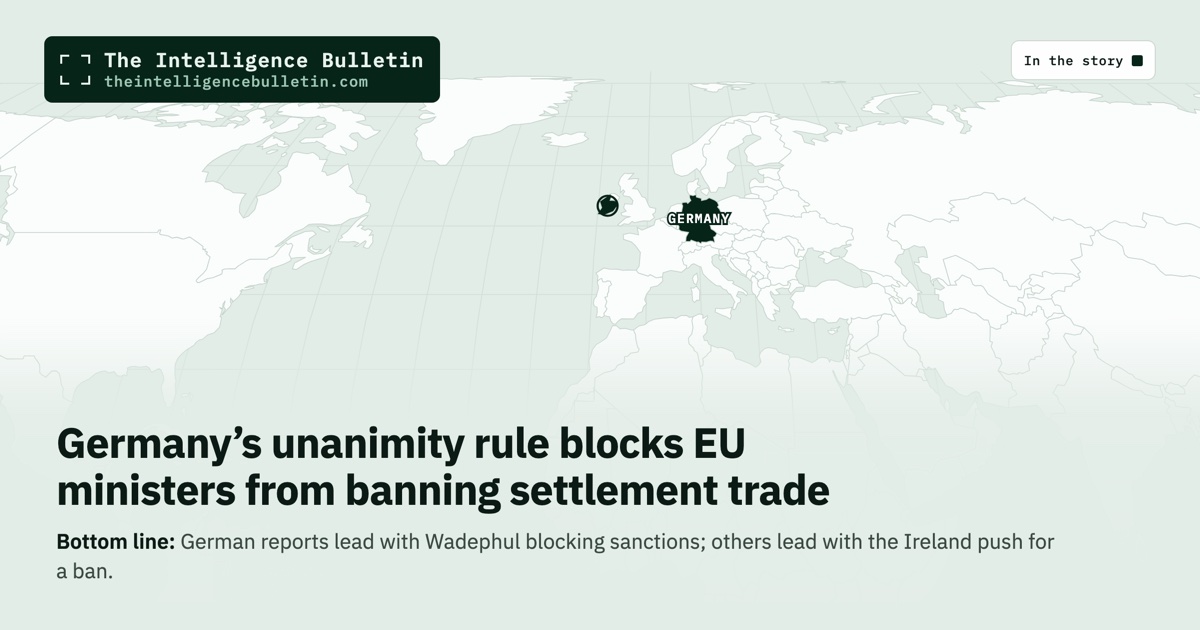
Map of the countries in the story: Germany’s unanimity rule blocks EU ministers from banning settlement trade
On July 13, 2026, EU foreign ministers met in Brussels to discuss options for restricting trade with Israeli settlements in the West Bank, including licensing, tariffs or an outright ban. Ireland, Spain, the Netherlands, Belgium and Luxembourg argued the measures could pass by qualified majority vote. German Foreign Minister Johann Wadephul stated that unanimity among all 27 members is legally required and that dialogue with Israel remains the better approach.

One Story. Many Angles.

🇧🇪
Belgium
European Jewish Press
At EU Foreign Ministers meeting, Ireland pushes for total ban on trade from Israeli communities in Judea and Samaria
Read →
🇭🇰
Hong Kong
South China Morning Post
EU countries push for trade ban with Israeli settlements
Read →
🇷🇺
Russia
RT Arabic
ARABIC
Germany opposes new European sanctions on Israel and calls for dialogue
Read →
🇧🇦
Bosnia and Herzegovina
Faktor
BOSNIAN
Germany blocks EU move for ban on trade with illegal Israeli settlements
Read →
🇺🇸
United States
Yahoo News
What is the EU’s plan to cut trade with illegal Israeli settlements?
Read →
In Brief

German reports lead with Wadephul blocking sanctions; others lead with the Ireland push for a ban.

The reporting reveals a clear split inside the EU that Germany is willing to enforce through procedural rules. Outlets covering the Ireland-led push, such as European Jewish Press and South China Morning Post, quote ministers calling the West Bank situation intolerable and note growing frustration with the Commission’s options paper. In contrast, RT Arabic and Faktor lead directly with Wadephul’s arrival statement that Berlin prefers continued dialogue and that any import limits must be unanimous, framing the German position as the decisive obstacle. The Yahoo explainer sidesteps the actor clash altogether and simply details the three technical options on the table. This pattern shows that the story’s real content is not the proposal itself but whether Germany will allow a vote at all, a point verified across every full article read.

Perspective Analysis

Germany’s insistence that any trade restrictions on Israeli settlements require unanimous approval among all 27 EU members has turned a policy discussion into a procedural dead end. On July 13, 2026, foreign ministers gathered in Brussels to review three Commission options for curbing imports from the West Bank—import licensing, punitive tariffs, or an outright ban. A clear majority of ministers argued these were ordinary trade measures that could pass with a qualified majority vote, yet Germany’s position ensured no vote would occur. The outcome underscores that the EU’s ability to respond to settlement expansion now hinges less on the merits of the proposals and more on whether one member state can force every decision through the narrowest procedural gate.

Irish Foreign Minister Helen McEntee arrived stating that legal advice from the EU Council confirmed qualified majority voting would suffice. Spain, the Netherlands, Belgium, and Luxembourg echoed the view that the measures qualified as trade policy rather than sanctions. Belgian minister Maxime Prévot described the Commission’s paper as “more of a bone to chew on than a genuine willingness to move forward,” while his Luxembourg counterpart Xavier Bettel questioned whether the bloc was simply waiting for Israel’s October elections to avoid action. EU foreign policy chief Kaja Kallas noted broad agreement that the West Bank situation was “intolerable” and undermined the two-state solution, adding that the options targeted illegal settlements, not Israel itself.[[1]](https://ejpress.org/at-eu-foreign-ministers-meeting-ireland-pushes-for-total-ban-on-trade-from-israeli-communities-in-judea-and-samaria/)

German Foreign Minister Johann Wadephul countered directly that Berlin preferred continued dialogue with the Israeli government over restrictive measures and that any limits on settlement imports would require unanimity. Italy aligned with the same legal reading, describing the step as a political choice rather than a commercial one. These two positions aligned with the Commission’s own assessment that the tiny volume of settlement trade made the issue inherently political. Reports from the meeting showed at least twenty member states had earlier pressed the Commission for concrete proposals, yet the unanimity demand effectively sidelined that pressure.[[2]](https://arabic.rt.com/world/1810039-%D8%A3%D9%84%D9%85%D8%A7%D9%86%D9%8A%D8%A7-%D8%AA%D8%B9%D8%A7%D8%B1%D8%B6-%D8%B9%D9%82%D9%88%D8%A8%D8%A7%D8%AA-%D8%A3%D9%88%D8%B1%D9%88%D8%A8%D9%8A%D8%A9-%D8%AC%D8%AF%D9%8A%D8%AF%D8%A9-%D8%B9%D9%84%D9%89-%D8%A5%D8%B3%D8%B1%D8%A7%D8%A6%D9%8A%D9%84-%D9%88%D8%AA%D8%AF%D8%B9%D9%88-%D8%A5%D9%84%D9%89-%D8%A7%D9%84%D8%AD%D9%88%D8%A7%D8%B1/)

Coverage patterns across outlets reflect these fault lines without exaggeration. European-focused reporting gave prominent space to the Irish-led argument for a qualified majority and the frustration with Commission delay. Regional perspectives from Asia framed the episode as another illustration of EU difficulty translating international law concerns into collective action. Outlets closer to Russian and Balkan audiences opened with Wadephul’s arrival statement and the unanimity barrier, presenting German resistance as the decisive development. A U.S. wire explainer stayed strictly with the three technical options and background on settlement growth, avoiding any single capital’s stance. The variation confirms the story’s core is not the substance of the Commission paper but the procedural choke point Germany chose to activate.

Settlement expansion data cited in the coverage adds concrete stakes. More than 500,000 Israeli settlers live in the West Bank outside East Jerusalem. Recent approvals include plans for thirteen new settlements in the central area, with annual outpost numbers rising sharply from an average of eight between 2012 and 2022 to 86 in 2025. Violence linked to settlers reached its highest recorded level in a decade according to monitoring groups. The International Court of Justice’s 2024 advisory opinion had already called on states to avoid trade relations that sustain the occupation. Several individual EU countries already apply their own import restrictions, yet scaling those steps to the full bloc collides with the unanimity requirement Germany has now invoked.

What to Watch

The immediate consequence is stasis. Ambassadors received instructions to continue technical work, and ministers left open the possibility of an extraordinary meeting, but no pathway exists around the unanimity objection without a change in German or Italian policy. Future attempts to revisit the file will face the same legal argument unless a qualified majority coalition tests the Council’s legal service position in court or through a formal vote that forces the issue. For readers tracking EU foreign policy credibility, the episode demonstrates how a single member’s procedural preference can neutralize majority sentiment on questions already framed as violations of international law. The next test will come when the ambassadors’ follow-up work returns to ministers; absent a shift in Berlin, the pattern of dialogue over measures is likely to persist.


Share this story

India’s national mourning joins Turkish and Syrian tributes to Qatar’s late emir

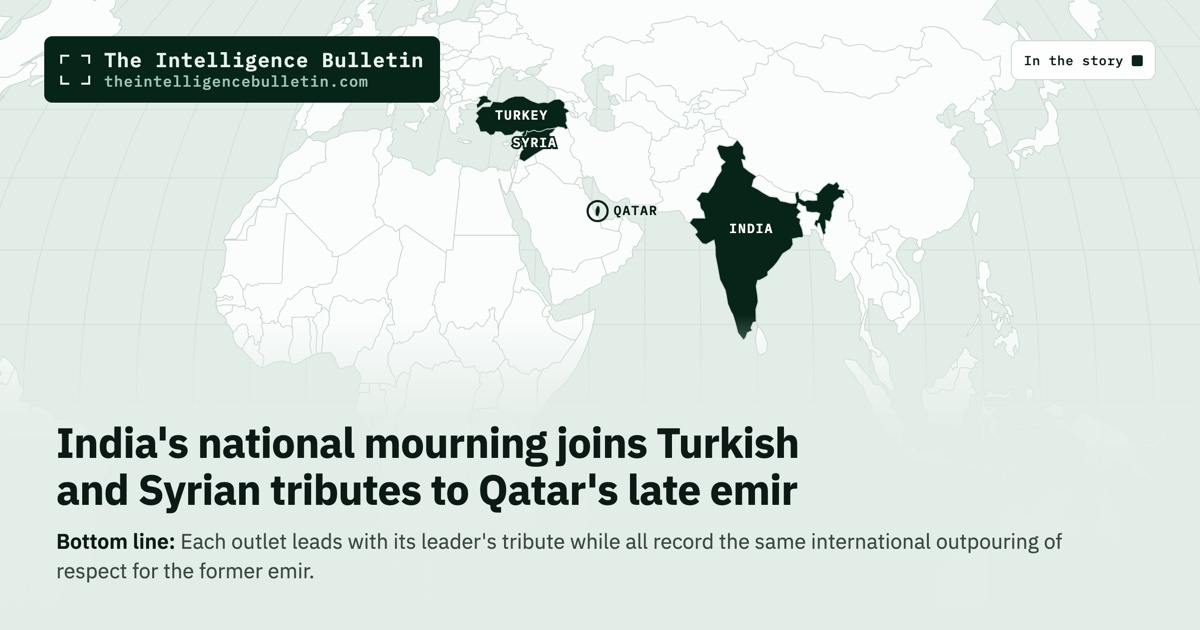
Map of the countries in the story: India's national mourning joins Turkish and Syrian tributes to Qatar's late emir
Former Qatari emir Sheikh Hamad bin Khalifa Al Thani died at 74. Syrian President Ahmad Al-Sharaa, Turkish President Erdogan and Indian Prime Minister Modi sent condolences. India declared one day of national mourning. Outlets in each country emphasized their leader’s message and bilateral ties.

One Story. Many Angles.

🇸🇾
Syria
SANA
SPANISH
Syrian President expresses condolences to Qatar over death of former emir
“Presidente sirio expresa condolencias a Qatar por fallecimiento del ex emir”
Read →
🇶🇦
Qatar
The Peninsula
World leaders salute Father Amir, architect of Qatar renaissance
Read →
🇹🇷
Turkey
Daily Sabah
Erdoğan offers condolences after death of Qatar’s former emir
Read →
🇮🇳
India
Times of India
India declares one-day national mourning for former Qatar emir Sheikh Hamad bin Khalifa Al Thani
Read →
🇹🇷
Turkey
Anadolu Agency
Turkish President Erdogan offers condolences on death of former Qatari emir
Read →
In Brief

Each outlet leads with its leader’s tribute while all record the same international outpouring of respect for the former emir.

The death of Qatar’s former emir drew a strikingly consistent set of tributes that each national outlet promptly turned into a story about its own head of state. Syrian state media SANA reported only Al-Sharaa’s message posted from Damascus, presenting it as official outreach from the new leadership. The Peninsula in Qatar compiled dozens of messages from across the Gulf, Europe and Asia, framing them as global recognition of Hamad’s role in building modern Qatar. Turkish outlets Daily Sabah and Anadolu Agency both centered Erdogan’s personal recollection of close cooperation that lifted bilateral military and trade links. Times of India led with New Delhi’s decision to fly the flag at half-mast and Modi’s reference to their 2024 meeting. The shared factual core—condolences from three otherwise distant capitals—reveals how even a ceremonial event becomes domestic proof of diplomatic weight. No outlet omitted the others’ messages; each simply placed its own leader first.

Perspective Analysis

The death of Qatar’s former emir has produced a uniform set of official condolences from distant capitals that each country’s main outlets immediately recast as evidence of their own leader’s diplomatic reach. Syrian state media, Turkish pro-government papers, and India’s largest English daily all treated the July 12 passing of Sheikh Hamad bin Khalifa Al Thani at age 74 as fresh proof that their head of state commands respect in the Gulf. The pattern shows how a single ceremonial event becomes raw material for separate claims of influence, with little room left for the shared regional context that produced the messages in the first place.

Sheikh Hamad ruled Qatar from 1995 until he stepped aside in 2013 in favor of his son, the current emir Sheikh Tamim bin Hamad Al Thani. The Qatari Amiri Diwan announced his death and four days of national mourning. Within hours, leaders from Syria, Turkey, and India issued statements. Syrian President Ahmad Al-Sharaa posted on X that he offered “deepest condolences” to Sheikh Tamim, the Qatari government, and people, praying for mercy on the deceased and patience for the family. Turkish President Recep Tayyip Erdoğan recalled working closely with Sheikh Hamad as prime minister to raise political, commercial, military, humanitarian, and cultural ties, calling the late emir a sincere partner for Islamic-world peace and regional stability. Indian Prime Minister Narendra Modi described him as a “visionary leader” who lifted Qatar’s development and noted their meeting during Modi’s February 2024 visit to Doha. India’s external affairs ministry then declared July 13 a day of national mourning, with the national flag at half-mast and no official entertainment.

Syrian state news agency SANA carried only Al-Sharaa’s message, framed as official outreach from Damascus on the day it was posted. The report gave no space to statements from Ankara or New Delhi and instead placed the new Syrian president at the center of regional protocol. This narrow presentation aligns with the priorities of a leadership still consolidating power after years of isolation: every public message to a Gulf capital counts as proof of restored diplomatic footing. Turkish coverage took the opposite route. Daily Sabah led with Erdoğan’s personal recollection of joint work that “elevated” bilateral relations to their present level and printed the full text of his X post. Anadolu Agency ran a shorter institutional version that stressed state-to-state condolences without the personal anecdotes. Both accounts treated the Turkish president’s words as the authoritative record of the Turkey-Qatar relationship, an emphasis that fits a government long invested in close military and energy cooperation with Doha.

The Peninsula in Qatar collected messages from more than a dozen heads of state and organizations, ranging from the UAE president and Jordan’s king to the French president, the Italian prime minister, and leaders from Pakistan, Malaysia, and the Maldives. The compilation presented Sheikh Hamad as the architect of Qatar’s modern institutions and international profile, with foreign tributes serving mainly to illustrate that legacy. Indian reporting in the Times of India opened with the government’s mourning order and Modi’s reference to their 2024 meeting before noting the former emir’s voluntary abdication in 2013. The piece treated the half-mast flag order as the clearest signal of New Delhi’s regard, a detail absent from the Turkish and Syrian accounts.

The factual core across these reports remains identical: three leaders sent condolences after the Amiri Diwan’s announcement. No outlet contradicted the timing or the basic content of the messages. What differs is placement. Syrian coverage positions Al-Sharaa’s outreach as the lead story of the day. Turkish outlets foreground Erdoğan’s history of cooperation. Indian coverage highlights domestic protocol and Modi’s personal contact. Each choice converts the same event into domestic validation that the country’s leadership still matters in a crowded diplomatic field. The Qatari paper’s broader list simply records the volume of recognition without elevating any single foreign voice above the others.

This selective emphasis is not new, yet it carries concrete consequences in a period when Gulf states are recalibrating partnerships with actors once sidelined by sanctions or conflict. Syria’s new government gains immediate visibility by appearing alongside Turkey and India in the same condolence cycle. Turkey reinforces an existing axis of military and investment ties at a moment when both countries face overlapping regional pressures. India signals continuity with a major energy supplier and diaspora destination through an official mourning gesture that registers in Qatari state channels. None of these moves alters the balance of power, but each adds a small increment to the ledger of recognized influence that leaders later cite in budget debates or alliance talks.

What to Watch

The next comparable death or succession in the Gulf will almost certainly produce the same pattern. Outlets tied to each capital will again lead with their own leader’s message, cite bilateral history where it exists, and omit or bury parallel statements from elsewhere. Readers in Damascus, Ankara, and New Delhi will therefore encounter three separate stories about the same death rather than one account of converging diplomatic traffic. That fragmentation matters because it shapes what policymakers and publics count as evidence of leverage: not the substance of the condolence itself, but whether their own side placed it first.


Share this story