 AI-generated analysis published under the editorial responsibility of Rohit Sinnas. How it works →
Press quoted
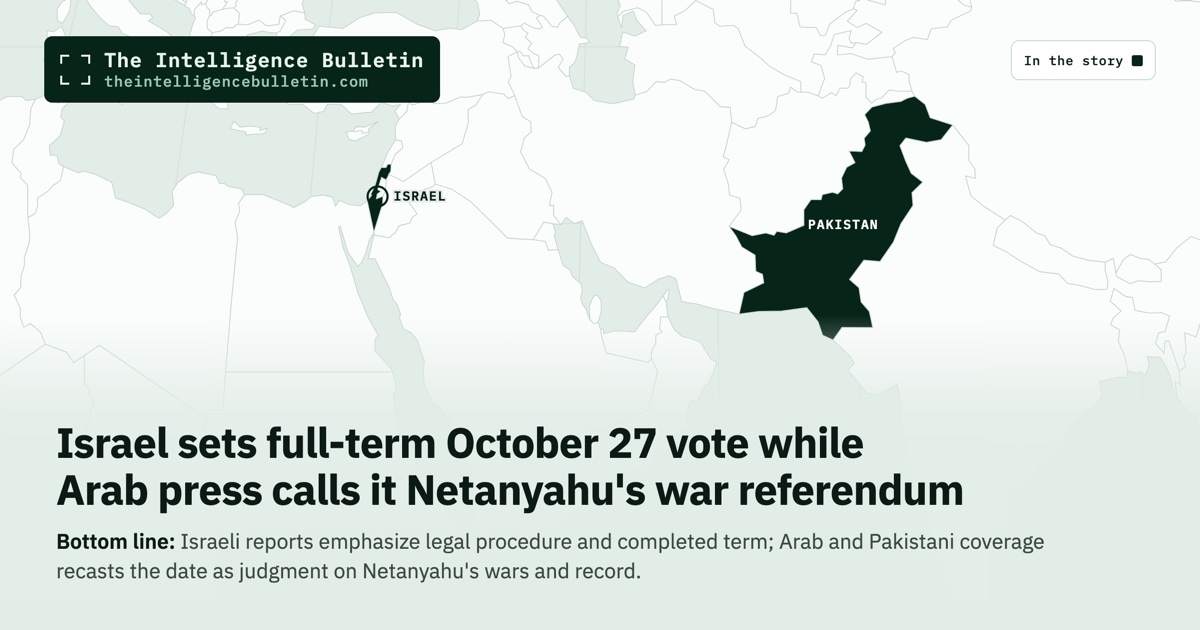
Israeli reports emphasize legal procedure and completed term; Arab and Pakistani coverage recasts the date as judgment on Netanyahu’s wars and record.
Israeli coverage from the Jerusalem Post and Al-Monitor treats the announcement as a straightforward procedural victory: the government completed its full term, the legal date stands, and coalition whip Ofir Katz praised nine budgets passed. Haaretz shifts focus to a podcast on mutual Iranian and pro-Netanyahu online disinformation campaigns ahead of the vote. In contrast, Arab News and Dawn run near-identical profiles labeling Netanyahu the ‘architect of wars’ and ‘master of survival,’ detailing October 7 failures, Gaza casualties, and the election as the potential end of his career. The shared wire text between the Saudi and Pakistani outlets shows how the same critical narrative travels across Muslim-world English press, while Israeli domestic reporting stays inside Knesset rules and survival mechanics.
Full analysis
The coverage of Israel’s confirmed October 27 election date exposes a sharp divide between institutional domestic reporting and regional judgment on Benjamin Netanyahu’s leadership. Israeli outlets treat the announcement as evidence of parliamentary continuity after years of instability, while Arab and Pakistani English-language press present the vote as a direct referendum on the prime minister’s record of initiating and managing multiple wars since October 2023. This split matters because the election arrives at the end of Israel’s first full four-year Knesset term since 1988, a rare moment of procedural closure that coincides with unresolved conflicts across Gaza, Lebanon, and Iran.
On July 12, 2026, coalition head Ofir Katz informed the Knesset House Committee that the original legal date would stand despite the May dissolution vote that had opened the door to an earlier ballot. Katz noted the government had passed nine budgets and hundreds of laws, framing the outcome as a straightforward completion of the term. The Jerusalem Post reported the decision through this procedural lens, quoting Katz directly on the rarity of finishing a full term and including statements from legal adviser Sagit Afik that no dissolution law was needed. Opposition voices appeared only briefly, with Yisrael Beytenu leader Avigdor Liberman predicting victory and a new government. Al-Monitor, drawing on Reuters reporting, echoed the same timeline confirmation while adding poll context that Netanyahu’s nationalist-religious coalition faces likely defeat, though rivals lack a clear alternative path.
These accounts stay inside Knesset mechanics and coalition survival tactics. They register the milestone of completing four years without early collapse but give little space to the security failures or regional fallout that dominate external views. Haaretz departs from this pattern by using the fixed date to examine online disinformation campaigns. Its election podcast highlighted how Iranian influence operations and pro-Netanyahu efforts both amplify division in the months ahead, noting the difficulty of distinguishing the two in a digital environment supercharged by artificial intelligence. The piece connects the timeline to broader threats against democratic debate rather than treating the election as routine procedure.
Arab News and Dawn, by contrast, run near-identical profiles that cast Netanyahu as the “architect of wars” and “master of survival” heading into what could be his defining contest. Both outlets detail the October 7, 2023, Hamas attacks that killed more than 1,200 Israelis and shattered his long-cultivated image as “Mr. Security.” They describe the subsequent campaigns in Gaza that left tens of thousands dead, the spread of fighting to Hezbollah, the Houthis, and direct confrontations with Iran, and Netanyahu’s international arrest warrant over alleged war crimes. The pieces trace his biography from commando service and the 1973 war through decades in power, his alliance with U.S. President Donald Trump, and repeated defiance of predictions of his downfall, most recently in the 2022 comeback backed by far-right allies. Polls showing public desire for his removal appear alongside criticism that he has used the conflicts to delay accountability.
The identical wording across the Saudi and Pakistani outlets indicates shared wire sourcing rather than independent reporting, extending a consistent regional critique into English-language Muslim-world coverage. This framing positions the October 27 vote around legacy and human costs rather than Knesset rules, treating the ballot as the potential endpoint of policies that have reshaped the Middle East’s strategic landscape without delivering stated goals such as eliminating Hamas.
The procedural emphasis in Israeli establishment reporting aligns most closely with verifiable parliamentary events on July 12. It accurately records the legal date and the absence of an early-election push from the coalition. Yet it underplays the substantive stakes that the Arab accounts foreground: the multi-front wars, Gaza casualties, and Netanyahu’s personal legal and political vulnerabilities. Those elements are not invented for the profiles; they draw from the same timeline of events that Israeli voters will weigh. The Arab press risks flattening Israeli domestic dynamics into a single indictment, but it correctly identifies the election’s regional resonance as a judgment on wartime leadership rather than a technical exercise in term completion.
What to Watch
Netanyahu has stated his intention to win, and his history of outlasting crises suggests the outcome remains uncertain despite unfavorable polls. The real test lies in whether voters treat the full term as proof of stability or as insufficient compensation for security lapses and prolonged conflict. A change in government would likely shift Israel’s approach to Gaza reconstruction, Iran negotiations, and West Bank policy in ways that affect neighboring states and international actors far beyond Knesset procedure. The coverage gap itself signals how differently those stakes register inside and outside Israel.
That’s how the world told the story.
Get our daily open-source intelligence on world events in your inbox — one email a day, up to six stories.
Subscribe freeNo spam. One-click unsubscribe. See the latest email →