 AI-generated analysis published under the editorial responsibility of Rohit Sinnas. How it works →
Press quoted
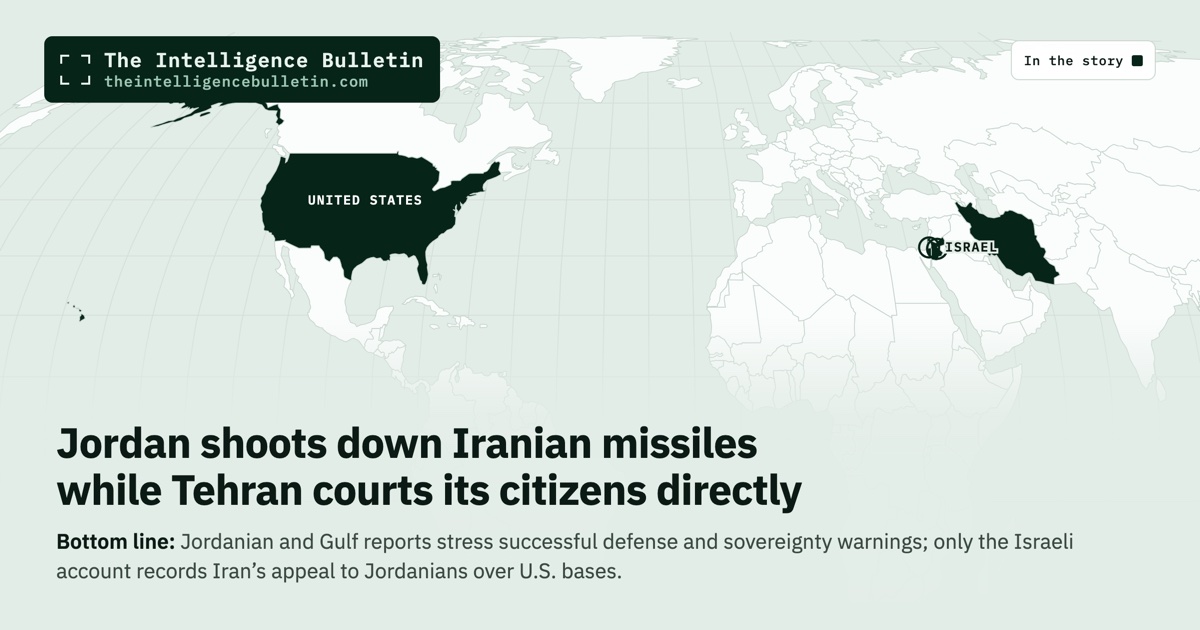
Jordanian and Gulf reports stress successful defense and sovereignty warnings; only the Israeli account records Iran’s appeal to Jordanians over U.S. bases.
Jordanian state media and its reprints in Russian and Turkish outlets present the incident as a straightforward success for national air defenses, quoting the military at length on readiness, debris clearance and warnings against future incursions. Qatari coverage echoes the same official facts in a brief regional-security note. Israeli reporting alone adds that Iran’s Revolutionary Guard appealed directly to the Jordanian people to press for removal of U.S. bases, while noting Amman’s unusually restrained diplomatic language and omission of the attacks in some foreign-ministry statements. That contrast reveals Jordan’s priority: neutralize the immediate threat quietly and avoid rhetorical escalation that could turn its territory into an active arena in the wider U.S.-Iran confrontation.
Full analysis
Jordan’s interception of four Iranian missiles on July 13, 2026, demonstrated the effectiveness of its air defenses, yet the real significance lies in how Amman chose to handle the incident: through swift operational success paired with deliberate diplomatic restraint. This approach reveals a calculated priority to neutralize immediate threats to its territory without turning the kingdom into an open arena in the escalating U.S.-Iran confrontation. By focusing public messaging strictly on defense readiness and sovereignty while limiting broader commentary, Jordanian authorities signaled that protecting national security takes precedence over joining rhetorical exchanges that could invite further attacks or complicate relations with multiple regional powers.
The Jordanian Armed Forces statement, carried in full by the state broadcaster Al Mamlaka TV, described the interception as executed with high efficiency under established procedures to safeguard the kingdom, its citizens, and airspace. Four missiles entered from Iranian territory early on Tuesday and were brought down without causing injuries or material damage. Royal Engineering Corps teams promptly cleared debris at multiple sites according to standard technical and security protocols. The military emphasized ongoing high readiness, monitoring of developments, and a firm commitment that any future violation of sovereignty would meet a determined response within approved rules of engagement. Citizens were urged to rely only on official sources. This account formed the core factual record across most reporting.
Reprints in outlets such as RT Arabic and Anadolu Agency stayed close to that official Jordanian text. RT Arabic published the military statement nearly verbatim, embedding it within wider coverage of U.S.-Iran tensions without adding Iranian or Russian interpretive layers. Anadolu issued a short factual note confirming the air-defense success and the absence of harm. Qatari coverage in The Peninsula echoed the same core details in a brief regional-security dispatch, noting the high alert status and warning of firm responses to any sovereignty breach while citing Jordanian official sources. These accounts treated the event primarily as a successful defensive action rather than an invitation to broader political analysis.
Israeli reporting from Ynetnews alone expanded the picture by documenting repeated Iranian launches in preceding days, including an earlier set of four missiles and three others that had exploded inside Jordan with only minor damage. It also highlighted an appeal issued directly by Iran’s Revolutionary Guard Corps to the Jordanian people. The message stated that Tehran was not hostile to Jordan, appreciated its population, and urged citizens—aware of Palestinian suffering—to press for the removal of U.S. military bases as a step toward regional security. The report contrasted this outreach with Amman’s notably restrained public posture. Jordan’s Foreign Ministry statements condemned Iranian attacks on other Gulf states as violations of sovereignty and international law but omitted any reference to the strikes on Jordanian territory itself. Readouts from calls by Foreign Minister Ayman Safadi with counterparts similarly avoided direct mention of the incidents affecting Jordan, even when other parties referenced them.
This divergence in coverage reflects Jordan’s underlying calculation. The kingdom sits geographically exposed, with U.S. forces operating from bases on its soil that place it within Iran’s declared retaliatory targeting logic. Public escalation risks drawing additional salvos or turning Jordanian airspace into a regular corridor for exchanges. Instead, the military handled the physical threat through interception and debris management while political statements remained measured, underscoring sovereignty without naming Tehran explicitly in every forum. An analyst quoted in the Israeli account noted that Jordan typically acts quietly on sensitive files involving Iran, preferring diplomatic balance and defense of core interests over heightened rhetoric that could carry economic or security costs.
What to Watch
The pattern carries implications for how the confrontation may unfold. Jordan’s demonstrated capacity to intercept incoming missiles without casualties reduces the immediate incentive for domestic pressure on U.S. basing arrangements, even as Tehran seeks to cultivate such pressure through direct appeals. At the same time, the absence of inflammatory language from Amman preserves space for continued coordination with Gulf partners and Western allies without locking the kingdom into a more confrontational posture. Should further launches occur, the same combination of operational firmness and rhetorical caution is likely to persist, allowing Jordan to manage spillover risks while signaling that its territory will not serve as an uncontested battleground. This stance matters because it illustrates how smaller states navigate great-power clashes by prioritizing tangible defense outcomes over public positioning that could escalate the conflict onto their soil.
That’s how the world told the story.
Get our daily open-source intelligence on world events in your inbox — one email a day, up to six stories.
Subscribe freeNo spam. One-click unsubscribe. See the latest email →