 AI-generated analysis published under the editorial responsibility of Rohit Sinnas. How it works →
Press quoted
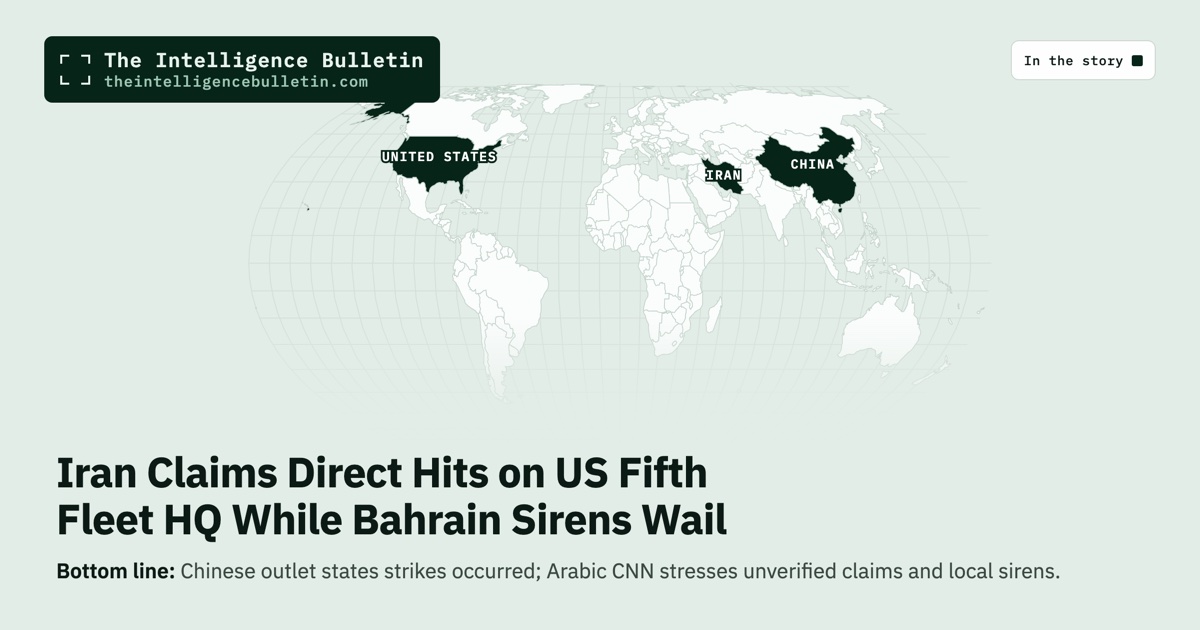
Chinese outlet states strikes occurred; Arabic CNN stresses unverified claims and local sirens.
Iranian state media presented the operation as a direct hit on the US Fifth Fleet headquarters while British-based Middle East Eye relayed detailed IRGC claims of destroyed radars and fuel depots without independent confirmation. CNN Arabic led instead with the repeated sounding of sirens across Bahrain and explicitly noted that Iranian assertions of destruction often lack supporting evidence. The three accounts converge on the core facts of claimed strikes and local alerts yet diverge sharply on emphasis: one treats success as given, another catalogs operational detail, and the third flags verification gaps. This pattern shows outlets balancing Iranian assertions against the absence of confirmed damage or casualties in a region already tense from prior US-Iran exchanges. The shared silence on any US or Bahraini response statements underscores how quickly the story rests on one side’s claims alone.
Full analysis
Iran’s Islamic Revolutionary Guard Corps has asserted that its missiles and drones struck the headquarters of the U.S. Fifth Fleet in Manama, Bahrain, igniting fuel depots and disabling multiple radar installations including a Patriot system. Bahrain’s interior ministry confirmed that air raid sirens sounded twice across the country on July 14, 2026, prompting residents to seek shelter. No deaths or independent verification of damage have surfaced in any reporting, yet the episode underscores how quickly unconfirmed Iranian claims can shape perceptions of American military vulnerability in the Gulf at a moment when U.S. forces have already conducted fresh strikes inside Iran itself.
The pattern of coverage across major outlets illustrates the difficulty of reporting kinetic claims in a fast-moving confrontation where one side’s assertions travel farther than any confirmed results. Iranian state-linked reporting and its echoes treat the strikes as accomplished fact, listing specific systems taken out and declaring that operations continue. British-based coverage relays those operational details at length, framing the action as a sustained campaign against U.S. naval infrastructure without inserting immediate caveats about proof. Arabic-language reporting from a major U.S. network instead opens with the local experience of sirens and explicitly reminds readers that Iranian announcements of destroyed American facilities have frequently lacked corroboration in prior rounds of exchanges. These choices are not neutral; they reflect institutional priorities about whose voice sets the baseline for understanding an attack whose physical consequences remain invisible.
The broader context makes such choices consequential. The IRGC statements came after the U.S. Central Command completed a five-hour wave of strikes on Iranian military sites in Bushehr, Jask, Konarak, Abu Musa, and Bandar Abbas, aimed at degrading Iran’s ability to threaten commercial shipping. Those American operations followed President Trump’s public signals that additional strikes were planned, even as negotiations between the two countries had resumed the previous week. In that environment, any Iranian claim of successful retaliation carries immediate political weight, regardless of whether fuel depots actually burned or radars went dark. Outlets that present the claims as reported fact effectively amplify the narrative of successful pushback against U.S. power projection. Those that foreground sirens and verification shortfalls keep the emphasis on the absence of visible proof and the civilian alerts that accompanied the episode.
The divergence matters because the Fifth Fleet’s presence in Bahrain has long symbolized the U.S. security umbrella for Gulf states and the protection of energy transit routes through the Strait of Hormuz. When Iranian media or aligned outlets describe the destruction of a control center for unmanned surface vessels alongside air-defense radars, they are signaling not merely tactical success but an ability to reach and degrade American forward-operating capabilities directly. Absent satellite imagery, on-site reporting, or statements from U.S. or Bahraini authorities confirming or denying the hits, that signal rests entirely on the IRGC’s own description. The silence from Washington and Manama on the specific allegations leaves the claims unchallenged in the immediate news cycle, allowing them to circulate as the primary account of what occurred.
Regional audiences receive different impressions depending on which account they encounter first. Readers of detailed operational lists may conclude that Iranian forces achieved measurable degradation of U.S. defenses. Readers steered toward the sounding of sirens and the historical pattern of unverified Iranian assertions may instead register the episode as another round of rhetorical escalation without demonstrated effect. Both readings are plausible given the information released so far, yet they point to sharply different assessments of risk for shipping, basing agreements, and the durability of the current U.S. posture in the Gulf.
What to Watch
What happens next will likely turn less on whether any particular radar was destroyed and more on whether either side chooses to treat the claims as sufficient justification for further action. The IRGC’s statement that the operation continues already frames the Bahrain episode as one phase in a longer sequence rather than an isolated event. U.S. Central Command’s announcement that its own strikes had concluded does not preclude additional responses if American commanders assess that Iranian capabilities remain intact. In the absence of independent damage assessments, both sides retain maximum flexibility to interpret events in ways that serve their immediate objectives, whether that means declaring victory, demanding restraint, or preparing the next round of strikes. The coverage pattern simply reproduces that same uncertainty at the level of public information.
That’s how the world told the story.
Get our daily open-source intelligence on world events in your inbox — one email a day, up to six stories.
Subscribe freeNo spam. One-click unsubscribe. See the latest email →