 AI-generated analysis published under the editorial responsibility of Rohit Sinnas. How it works →
Press quoted
Each outlet leads with its leader’s tribute while all record the same international outpouring of respect for the former emir.
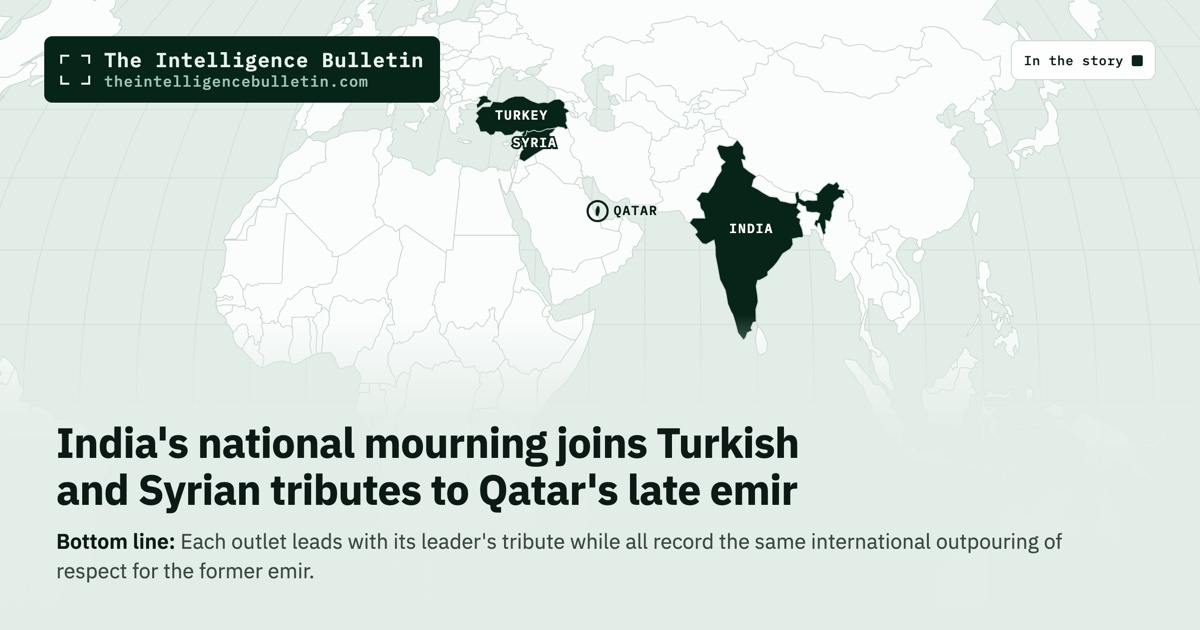
The death of Qatar’s former emir drew a strikingly consistent set of tributes that each national outlet promptly turned into a story about its own head of state. Syrian state media SANA reported only Al-Sharaa’s message posted from Damascus, presenting it as official outreach from the new leadership. The Peninsula in Qatar compiled dozens of messages from across the Gulf, Europe and Asia, framing them as global recognition of Hamad’s role in building modern Qatar. Turkish outlets Daily Sabah and Anadolu Agency both centered Erdogan’s personal recollection of close cooperation that lifted bilateral military and trade links. Times of India led with New Delhi’s decision to fly the flag at half-mast and Modi’s reference to their 2024 meeting. The shared factual core—condolences from three otherwise distant capitals—reveals how even a ceremonial event becomes domestic proof of diplomatic weight. No outlet omitted the others’ messages; each simply placed its own leader first.
Full analysis
The death of Qatar’s former emir has produced a uniform set of official condolences from distant capitals that each country’s main outlets immediately recast as evidence of their own leader’s diplomatic reach. Syrian state media, Turkish pro-government papers, and India’s largest English daily all treated the July 12 passing of Sheikh Hamad bin Khalifa Al Thani at age 74 as fresh proof that their head of state commands respect in the Gulf. The pattern shows how a single ceremonial event becomes raw material for separate claims of influence, with little room left for the shared regional context that produced the messages in the first place.
Sheikh Hamad ruled Qatar from 1995 until he stepped aside in 2013 in favor of his son, the current emir Sheikh Tamim bin Hamad Al Thani. The Qatari Amiri Diwan announced his death and four days of national mourning. Within hours, leaders from Syria, Turkey, and India issued statements. Syrian President Ahmad Al-Sharaa posted on X that he offered “deepest condolences” to Sheikh Tamim, the Qatari government, and people, praying for mercy on the deceased and patience for the family. Turkish President Recep Tayyip Erdoğan recalled working closely with Sheikh Hamad as prime minister to raise political, commercial, military, humanitarian, and cultural ties, calling the late emir a sincere partner for Islamic-world peace and regional stability. Indian Prime Minister Narendra Modi described him as a “visionary leader” who lifted Qatar’s development and noted their meeting during Modi’s February 2024 visit to Doha. India’s external affairs ministry then declared July 13 a day of national mourning, with the national flag at half-mast and no official entertainment.
Syrian state news agency SANA carried only Al-Sharaa’s message, framed as official outreach from Damascus on the day it was posted. The report gave no space to statements from Ankara or New Delhi and instead placed the new Syrian president at the center of regional protocol. This narrow presentation aligns with the priorities of a leadership still consolidating power after years of isolation: every public message to a Gulf capital counts as proof of restored diplomatic footing. Turkish coverage took the opposite route. Daily Sabah led with Erdoğan’s personal recollection of joint work that “elevated” bilateral relations to their present level and printed the full text of his X post. Anadolu Agency ran a shorter institutional version that stressed state-to-state condolences without the personal anecdotes. Both accounts treated the Turkish president’s words as the authoritative record of the Turkey-Qatar relationship, an emphasis that fits a government long invested in close military and energy cooperation with Doha.
The Peninsula in Qatar collected messages from more than a dozen heads of state and organizations, ranging from the UAE president and Jordan’s king to the French president, the Italian prime minister, and leaders from Pakistan, Malaysia, and the Maldives. The compilation presented Sheikh Hamad as the architect of Qatar’s modern institutions and international profile, with foreign tributes serving mainly to illustrate that legacy. Indian reporting in the Times of India opened with the government’s mourning order and Modi’s reference to their 2024 meeting before noting the former emir’s voluntary abdication in 2013. The piece treated the half-mast flag order as the clearest signal of New Delhi’s regard, a detail absent from the Turkish and Syrian accounts.
The factual core across these reports remains identical: three leaders sent condolences after the Amiri Diwan’s announcement. No outlet contradicted the timing or the basic content of the messages. What differs is placement. Syrian coverage positions Al-Sharaa’s outreach as the lead story of the day. Turkish outlets foreground Erdoğan’s history of cooperation. Indian coverage highlights domestic protocol and Modi’s personal contact. Each choice converts the same event into domestic validation that the country’s leadership still matters in a crowded diplomatic field. The Qatari paper’s broader list simply records the volume of recognition without elevating any single foreign voice above the others.
This selective emphasis is not new, yet it carries concrete consequences in a period when Gulf states are recalibrating partnerships with actors once sidelined by sanctions or conflict. Syria’s new government gains immediate visibility by appearing alongside Turkey and India in the same condolence cycle. Turkey reinforces an existing axis of military and investment ties at a moment when both countries face overlapping regional pressures. India signals continuity with a major energy supplier and diaspora destination through an official mourning gesture that registers in Qatari state channels. None of these moves alters the balance of power, but each adds a small increment to the ledger of recognized influence that leaders later cite in budget debates or alliance talks.
What to Watch
The next comparable death or succession in the Gulf will almost certainly produce the same pattern. Outlets tied to each capital will again lead with their own leader’s message, cite bilateral history where it exists, and omit or bury parallel statements from elsewhere. Readers in Damascus, Ankara, and New Delhi will therefore encounter three separate stories about the same death rather than one account of converging diplomatic traffic. That fragmentation matters because it shapes what policymakers and publics count as evidence of leverage: not the substance of the condolence itself, but whether their own side placed it first.
That’s how the world told the story.
Get our daily open-source intelligence on world events in your inbox — one email a day, up to six stories.
Subscribe freeNo spam. One-click unsubscribe. See the latest email →