 AI-generated analysis published under the editorial responsibility of Rohit Sinnas. How it works →
Press quoted
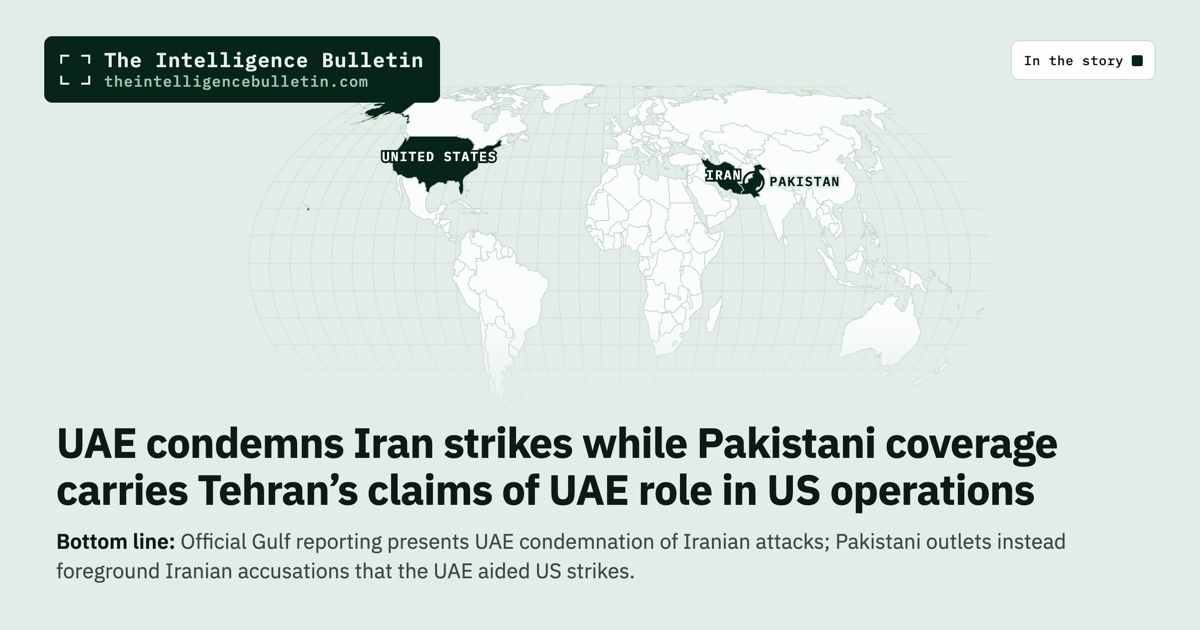
Official Gulf reporting presents UAE condemnation of Iranian attacks; Pakistani outlets instead foreground Iranian accusations that the UAE aided US strikes.
The clearest split runs between the official UAE statement carried verbatim by Gulf News and the US aggregator Big News Network, which treat the condemnation as a straightforward defense of Gulf sovereignty, and the Pakistani reports that immediately pivot to Iranian accusations of UAE complicity in American strikes. ProPakistani and Jang both quote Iran’s deputy foreign minister demanding accountability for what Tehran calls a “disgraceful record” of support for Operation Epic Fury, complete with US rewards in the form of eased technology export rules. SANA, the Syrian state outlet, widens the lens further by listing Kuwaiti, Omani and Indian condemnations and tying the episode to American airstrikes and threats to shipping, rather than foregrounding the UAE position at all. The wire copy from WAM remains the factual baseline; everything else is an editorial choice about whether this is a defensive Arab statement or evidence of deeper Emirati alignment with Washington against Tehran.
Full analysis
The coverage of the July 12, 2026, Iranian missile and drone attacks on Bahrain, Kuwait, Qatar, Jordan, and Oman exposes a sharp divergence in how outlets assign responsibility amid the broader US-Iran confrontation. Gulf and American aggregators treat the United Arab Emirates foreign ministry statement as a direct defense of Arab sovereignty, reproducing its language without qualification. Pakistani outlets, by contrast, immediately foreground Iranian claims that the UAE actively supported American operations against Tehran in exchange for eased US export controls on defense technology. Syrian state media sidesteps the UAE position altogether, emphasizing condemnations from Kuwait, Oman, and India while linking the strikes to American airstrikes and threats to commercial shipping. This pattern shows how editorial choices frame the same event as either a routine assertion of Gulf security or evidence of deeper Emirati alignment with Washington.
The UAE Ministry of Foreign Affairs issued its condemnation in Abu Dhabi on July 12. The statement described the attacks as a blatant violation of the sovereignty of the targeted states and a serious threat to their security and stability. It reaffirmed full solidarity with Bahrain, Kuwait, Qatar, Jordan, and Oman while supporting all measures to safeguard their security. Gulf News published the remarks almost verbatim, identifying the ministry as the source and presenting the attacks as renewed hostile actions against brotherly nations. The Big News Network carried near-identical text from the Emirates News Agency wire, attributing the condemnation directly to the ministry and noting the flagrant violation of sovereignty without additional commentary or context from other capitals.
Pakistani reporting shifted the focus to Tehran’s counter-accusations. ProPakistani detailed statements from Iranian Deputy Foreign Minister for Legal and International Affairs Kazem Gharibabadi, who pointed to a US Department of Commerce announcement upgrading the UAE’s export status. Gharibabadi described the policy change, which removed several export restrictions and expanded access to advanced computing equipment and military dual-use technologies, as an official admission and a disgraceful record for the UAE. He argued that the document proved Abu Dhabi’s support for Operation Epic Fury and carried legal and political consequences, insisting the UAE must be held accountable. The outlet noted that the UAE had not publicly responded to the remarks.
Jang reported the same Iranian position in Urdu, quoting Gharibabadi’s demand that the UAE face accountability for supporting US aggression against Iran. The article tied the US Commerce Department decision directly to the relaxation of export controls as a reward for that support, framing the change as evidence of collusion. Both Pakistani outlets presented the Iranian deputy minister’s X post and the US policy document as the central development, treating the UAE condemnation itself as secondary or unmentioned.
SANA, the Syrian state news agency, adopted a wider regional lens. Its July 12 report led with condemnations from Kuwait, Oman, and India while situating the strikes inside the escalating US-Iran military confrontation. It referenced US Central Command airstrikes against Iranian targets in response to an attack on a commercial vessel in the Strait of Hormuz, noted Iranian claims of firing a warning shot at a vessel on an unauthorized route, and highlighted concerns over commercial shipping and civilian infrastructure. The piece quoted Kuwait’s foreign ministry warning of repeated hostile approaches that violated international law and UN Security Council resolutions, Oman’s security source describing measures to protect northern governorates, and India’s foreign ministry expressing alarm over an attack on the container ship Galaxy that left one Indian national missing. No reference appeared to the UAE statement.
These reporting decisions reflect institutional alignments. Outlets based in the Gulf or drawing from official Emirati wires anchor the story in the sovereignty violation claim. Pakistani publications, carrying Iranian official statements on bilateral military ties, present the episode as proof of Emirati complicity. Syrian state coverage prioritizes non-GCC voices and the US role in the escalation, consistent with Damascus’s position in the wider confrontation. The factual baseline remains the WAM wire text reproduced by Gulf News and the Big News Network; every other account represents a deliberate choice about which actor’s narrative deserves prominence.
What to Watch
The split matters because it shapes how regional audiences interpret the UAE’s position in the ongoing conflict. Tehran’s accusations, amplified in Pakistani coverage, seek to isolate Abu Dhabi diplomatically by linking it to American strikes. Gulf reporting reinforces the narrative of Iranian aggression against multiple Arab states. Syrian emphasis on maritime threats and calls for de-escalation from additional capitals dilutes focus on any single Gulf actor. As the exchanges continue, audiences in different countries will encounter fundamentally different accounts of who bears responsibility, likely hardening alignments rather than clarifying the sequence of events.
That’s how the world told the story.
Get our daily open-source intelligence on world events in your inbox — one email a day, up to six stories.
Subscribe freeNo spam. One-click unsubscribe. See the latest email →