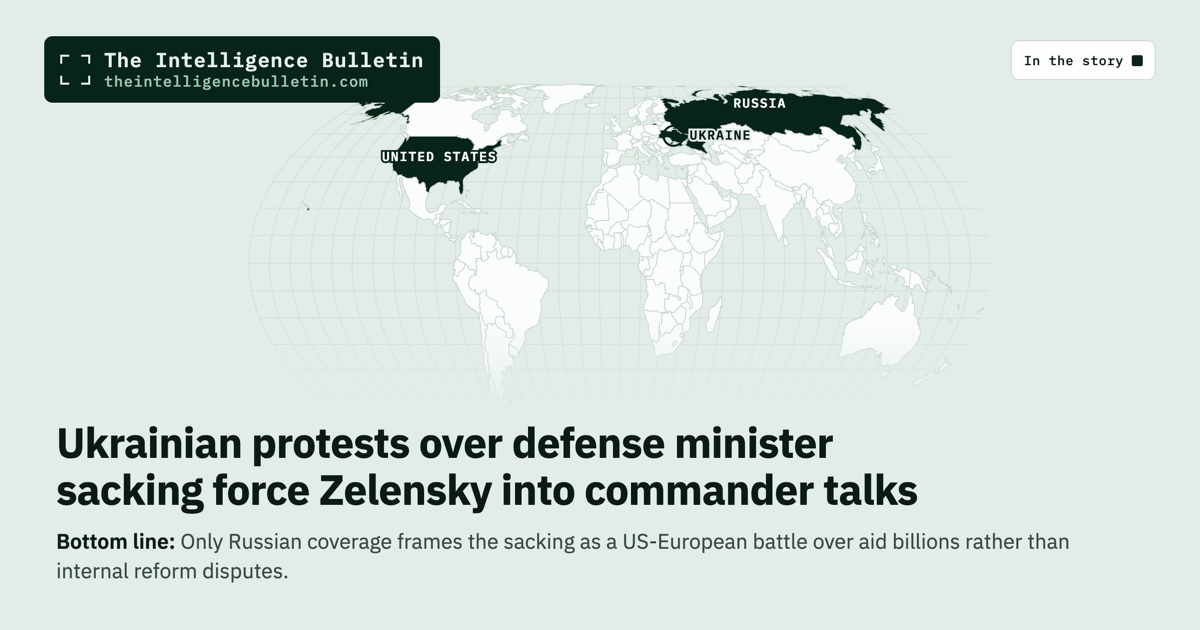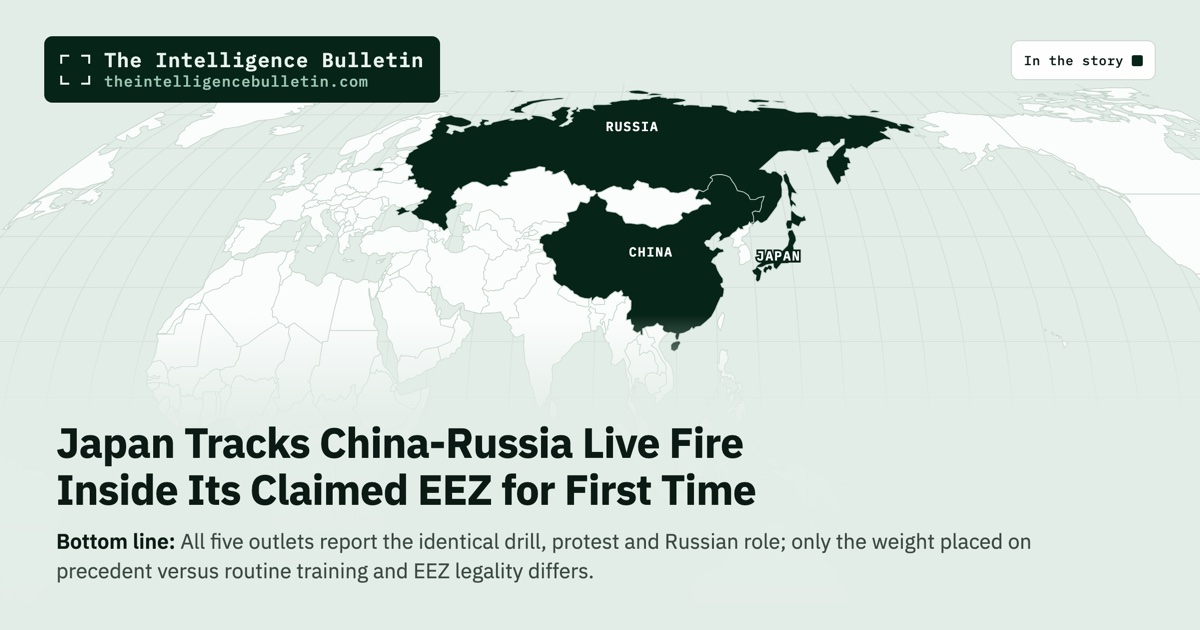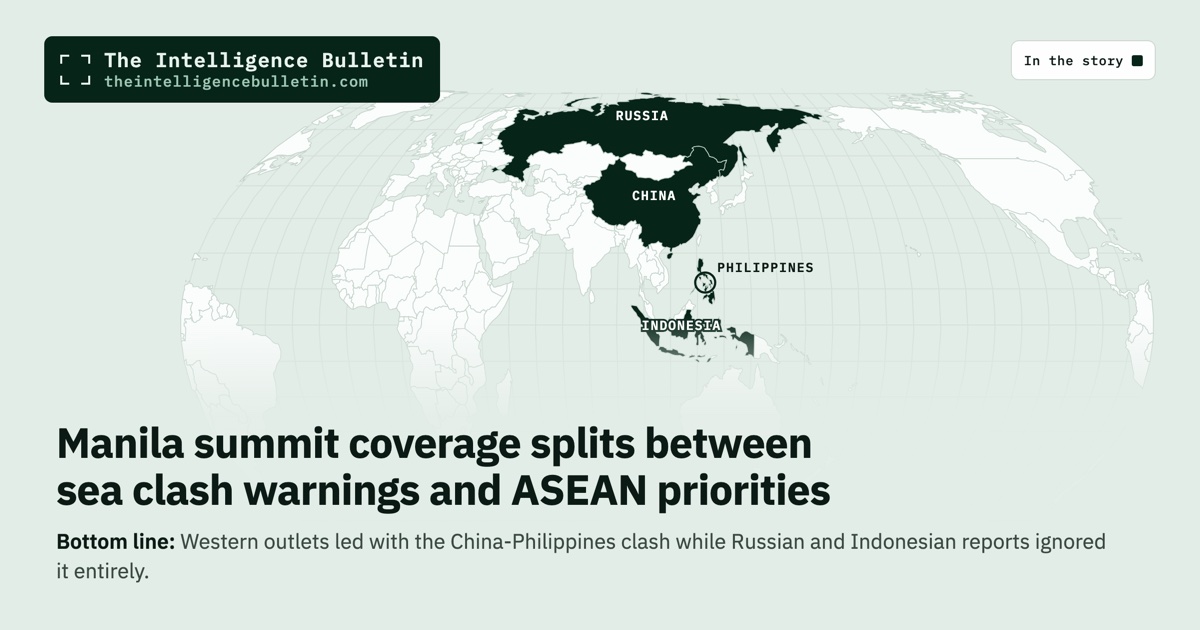
Manila summit coverage splits between sea clash warnings and ASEAN priorities

Map of the countries in the story: Manila summit coverage splits between sea clash warnings and ASEAN priorities
On 21 July 2026 Russian Foreign Minister Sergey Lavrov arrived in Manila for the 59th ASEAN Foreign Ministers’ Meeting and related summits. US Secretary of State Marco Rubio also attended. Philippine and Chinese vessels clashed near Second Thomas Shoal days earlier, with each side accusing the other of provocation. Rubio publicly reaffirmed support for freedom of navigation and the 2016 arbitration ruling while saying he remained open to side meetings with his Russian and Chinese counterparts.

One Story. Many Angles.

🇮🇩
Indonesia
RRI
IND
Indonesian FM attends series of 59th ASEAN foreign ministers meetings in Manila
“Menlu RI Hadiri Rangkaian Pertemuan Menlu ASEAN ke-59 di Manila”
Read →
🇷🇺
Russia
RT Arabic
ARABIC
Lavrov arrives in Manila to participate in ASEAN events
“لافروف يصل إلى مانيلا للمشاركة في فعاليات “آسيان””
Read →
🇬🇧
United Kingdom
The Independent
Marco Rubio vows to stand up to China at crucial Asia summit
Read →
🇩🇪
Germany
Deutsche Welle
China, Philippines clash ahead of ASEAN meeting
Read →
🇧🇩
Bangladesh
BSS
Rubio open to Russia, China meets on Philippines visit
Read →
In Brief

Western outlets led with the China-Philippines clash while Russian and Indonesian reports ignored it entirely.

Western reporting from London and Berlin placed the fresh Philippine-Chinese naval confrontation at the centre of the Manila gathering, treating it as the defining context for Rubio’s arrival and his pledge to resist Chinese pressure in the South China Sea. Russian state media, by contrast, limited itself to the factual record of Lavrov’s schedule and Russia-ASEAN consultations, omitting any mention of the clash. Indonesia’s public broadcaster framed the same days as an opportunity for ASEAN mechanisms to deliver concrete gains on food, energy and trade, underscoring the bloc’s desire to set its own agenda rather than react to external powers. Bangladesh’s wire service highlighted Rubio’s stated willingness to meet both Wang Yi and Lavrov, presenting the summit as a venue for quiet diplomacy rather than public confrontation. The pattern shows that the meeting’s meaning depends on whose capital is speaking: for ASEAN insiders the priority is institutional cohesion; for Moscow it is presence; for Western capitals it is the immediate risk of escalation with Beijing.

Perspective Analysis

The coverage of the Manila summits reveals a deeper divide than any single clash: capitals read the same gathering as confirmation of their own priorities, whether institutional self-reliance for Southeast Asian states, sustained diplomatic footprint for Moscow, or urgent containment of Chinese maritime pressure for Western governments. On July 21, 2026, Russian Foreign Minister Sergey Lavrov landed in Manila for the 59th ASEAN Foreign Ministers’ Meeting and linked forums, including Russia-ASEAN consultations, the East Asia Summit, and the ASEAN Regional Forum. US Secretary of State Marco Rubio arrived the same day. Days earlier, Philippine and Chinese vessels had confronted each other near Second Thomas Shoal, with Manila reporting that Chinese coast guard personnel struck one of its sailors with a baton and Beijing countering that Philippine forces provoked the encounter first. Rubio used the occasion to restate American backing for freedom of navigation and the 2016 arbitral ruling against expansive Chinese claims, while signaling openness to private talks with both Chinese Foreign Minister Wang Yi and Lavrov.

Indonesian state radio framed the gathering around ASEAN’s internal work. Its report on the Indonesian foreign minister’s schedule stressed the push for concrete outcomes in food security, energy, health, trade, and the digital economy. The outlet described Indonesia’s goal of making ASEAN mechanisms operate more coherently so they deliver visible benefits to citizens, rather than serving as a stage for outside powers. It listed twenty-one meetings plus ceremonial events, underscoring the value of regional ownership and the “good neighbor” posture that keeps ASEAN central. That emphasis matches the bloc’s long-standing preference for managing its own agenda even when external tensions rise.

Russian Arabic-language state media stayed strictly within the bounds of Lavrov’s itinerary. The dispatch recorded his arrival and participation in the Russia-ASEAN format, the East Asia Summit, and the regional security forum without any reference to the recent naval incident or to Rubio’s presence. The piece instead noted the membership of ASEAN and the broad agenda of the East Asia Summit, presenting the events as routine opportunities for dialogue. This narrow focus aligns with Moscow’s interest in demonstrating continued relevance in Southeast Asia despite its other commitments, treating the summit as proof of diplomatic access rather than a venue defined by any single dispute.

British and German reporting placed the Philippine-Chinese confrontation at the center. One account opened with Rubio’s vow to resist Chinese pressure and tied his arrival directly to the fresh incident at Second Thomas Shoal, repeating Manila’s account of the baton strike and noting US condemnation of what it called a troubling pattern of aggressive actions. The same report referenced the 2016 ruling and warned of risks to shipping lanes if they fell under the control of a power willing to weaponize commerce. German coverage similarly led with the clash details, the mutual accusations, and the immediate international reactions from Washington and Canberra, presenting the violence as the immediate backdrop that would shape the ministerial talks. These accounts treat the South China Sea as the dominant security question that external partners must address.

Bangladeshi wire reporting took a different cut, highlighting Rubio’s explicit willingness to meet both Wang and Lavrov on the sidelines. It described the statement as an expression of openness to bilateral contacts during the ASEAN meetings and noted past encounters between the US and Chinese ministers. The piece placed the Philippines visit in the context of broader regional engagement without foregrounding the naval clash or any public confrontation. That framing treats the summit primarily as a site for quiet, flexible diplomacy among the major powers rather than a platform for open warnings.

These differences are not accidental. Indonesian coverage reflects a foreign ministry that wants ASEAN to set its own priorities and deliver practical results on issues that affect daily life across member states. Russian reporting preserves the appearance of normal great-power participation without importing disputes that could complicate Moscow’s position. Western outlets, drawing on allied statements and the immediate facts of the shoal incident, present the gathering as a test of resolve against Chinese actions that affect navigation and treaty commitments. The Bangladeshi account, from a capital without direct stakes in the Spratlys, records the diplomatic mechanics as they stand.

What to Watch

The pattern will likely persist in the days ahead. ASEAN members will continue to steer discussions toward shared economic and functional cooperation, using the chairmanship to demonstrate that the bloc can manage its own calendar. Russia will register attendance and consultations as evidence of enduring ties. Western capitals will track whether side meetings occur and whether any language on maritime conduct emerges from the larger forums. The real test for readers lies in recognizing that each capital’s account is shaped by what it most needs the summit to confirm: autonomy for ASEAN, access for Moscow, or deterrence for Washington and its partners. The next round of statements from Manila will show which of those readings gains the most traction inside the meetings themselves.
Share this story

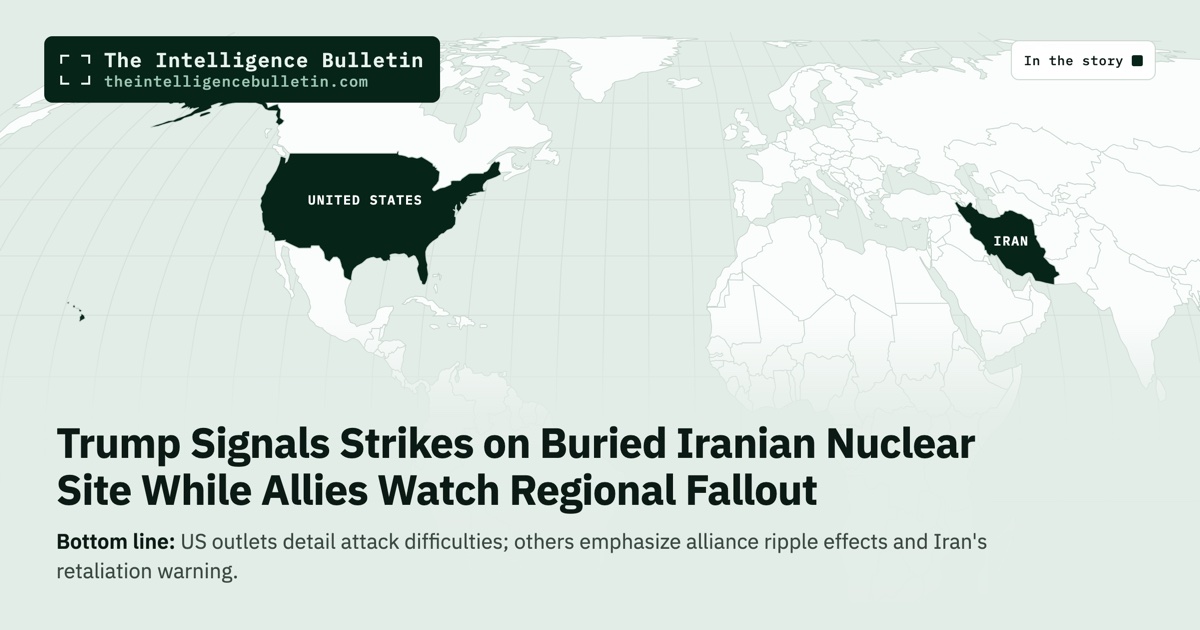
Trump Signals Strikes on Buried Iranian Nuclear Site While Allies Watch Regional Fallout

Map of the countries in the story: Trump Signals Strikes on Buried Iranian Nuclear Site While Allies Watch Regional Fallout
On July 21, 2026, President Donald Trump stated at the White House that the United States would hit Iran’s Pickaxe Mountain underground nuclear site ‘pretty soon’ and ‘very heavily.’ The site, under construction near Natanz, is believed to house centrifuges possibly moved there last fall, according to Israeli intelligence cited in the Wall Street Journal. Trump spoke during a meeting with Lebanese President Joseph Aoun as the US-Iran conflict continues with recent strikes on both sides. Outlets across countries reported the threat alongside details of the facility’s depth and Iran’s nuclear program status.

One Story. Many Angles.

🇺🇸
United States
ABC News
What is Pickaxe Mountain? Trump says US will hit Iranian nuclear site ‘pretty soon’
Read →
🇺🇸
United States
The Epoch Times
Trump Says US Will Strike Iran’s Pickaxe Mountain Nuclear Site ‘Very Heavily’
Read →
🇹🇷
Turkey
Anadolu Agency
EXPLAINER – What is Pickaxe Mountain, the Iranian site Trump has threatened to strike?
Read →
🇮🇹
Italy
Il Fatto Quotidiano
ITA
Pickaxe Mountain: why Trump threatens Iran’s nuclear bunker
“Pickaxe Mountain: perché Trump minaccia il bunker nucleare dell’Iran”
Read →
🇦🇺
Australia
ABC News
Trump says US will target Iran’s Pickaxe Mountain underground complex ‘pretty soon’
Read →
In Brief

US outlets detail attack difficulties; others emphasize alliance ripple effects and Iran’s retaliation warning.

Trump’s explicit vow to strike Pickaxe Mountain reveals a US administration confident enough to telegraph targets in an active war, yet the coverage shows outlets prioritizing different practical questions. American reports from ABC and The Epoch Times detail the site’s construction timeline, satellite evidence of ongoing work, and the limits of even the largest US bunker-busters against 100-plus meters of granite, while quoting experts who note the facility was spared in prior strikes. The Australian ABC stresses Trump’s line that the US is ‘not finished’ and links the threat to wider regional attacks on US allies, framing it as reassurance for partners facing Iranian drones and missiles. Turkey’s Anadolu Agency delivers a straight technical explainer on tunnel entrances and centrifuge assembly claims without operational speculation. Italy’s Il Fatto Quotidiano connects the site directly to Natanz, highlights Iran’s threatened ‘devastating’ response targeting US soldiers, and questions whether massive ordnance penetrators could reach chambers 600 meters down. The shared factual core — a fortified mountain facility still incomplete — underscores that the immediate military question is not whether Washington can announce the strike but whether any air-delivered weapon can finish it before Iran disperses components further.

Perspective Analysis

Trump’s decision to publicly name Pickaxe Mountain as a coming target shows an administration willing to broadcast specific aims during an active campaign against Iran’s nuclear infrastructure. That openness stems from assessments that the site remains incomplete and its entrances vulnerable even if the deepest chambers lie beyond current bunker-busters. Coverage from five outlets reveals the practical questions that follow: how deep the granite runs, whether centrifuges or material have already arrived, and what limits even the largest air-delivered weapons face against a mountain facility that escaped earlier rounds of strikes.

The July 21 statement came during a White House meeting with Lebanese President Joseph Aoun. Trump told reporters the United States would hit the area “pretty soon, and very heavily.” He repeated a warning issued in prior weeks and declined to confirm Israeli intelligence reports that centrifuges had been moved there last fall, while noting that material, not equipment alone, determines the threat. The facility, known in Iran as Kūh-e Kolang or Mount Kolang, sits roughly 1.5 kilometers south of the Natanz enrichment complex in Isfahan province. Iran declared it a centrifuge assembly plant in 2021 after earlier strikes damaged similar infrastructure at Natanz. Satellite imagery reviewed by analysts shows ongoing construction, with vehicles visible at tunnel entrances as recently as late June.

American reporting supplies the most granular operational detail on those physical constraints. The site lies approximately 100 meters beneath the surface according to one assessment, though other estimates place internal chambers closer to 600 meters under hard granite. Even the U.S. military’s most powerful penetrator, the massive ordnance penetrator, offers no guarantee of reaching the lowest levels. Experts noted that prior U.S. and Israeli operations in June 2025 and subsequent strikes this year left the mountain untouched, suggesting intelligence did not yet view it as an imminent operational threat. Collapsing the tunnel entrances could still disrupt construction and create visible rebuilding activity for future monitoring, but ground forces or sabotage would likely be required for full neutralization.

Conservative U.S. coverage frames the same facts around demonstrated resolve. Trump’s language of striking “very heavily” is presented as part of a broader campaign that already damaged Iran’s program last summer and continues to target command centers, missile sites, and air defenses. The remarks occurred alongside fresh U.S. strikes on Iranian capabilities used to attack shipping in the Strait of Hormuz, reinforcing the message that the administration sees no pause in the effort to prevent reconstitution of enrichment capacity.

Australian reporting connects the threat directly to reassurance for regional partners. Trump’s assertion that the United States is “not finished” is linked to ongoing Iranian drone and missile attacks on U.S. allies in Jordan, Bahrain, and Kuwait. The emphasis falls on alliance commitments rather than technical details of granite depth or centrifuge counts. This framing positions the Pickaxe threat as continuation of efforts to degrade Iran’s ability to project force beyond its borders while the nuclear program remains under pressure.

Turkish coverage stays strictly technical. It describes the tunnel entrances, the security perimeter linking the site to Natanz, and Iran’s public claim that the facility exists solely for advanced centrifuge production. No speculation appears on strike timing or weapon effectiveness. The piece supplies background on the mountain’s elevation and access roads without assessing whether air power can reach the interior.

Italian reporting adds the Iranian warning of a “devastating” response aimed at U.S. soldiers and regional partners. It notes the site’s proximity to Natanz and questions whether any current penetrator can reach the lowest chambers. The account highlights uncertainties about Iran’s roughly 440 kilograms of highly enriched uranium and the possibility that components have already been dispersed across multiple undeclared sites. This produces a more skeptical tone on military outcomes than the U.S. pieces.

The common factual thread across all accounts is an unfinished, deeply buried complex that has so far escaped direct attack. Construction continues, satellite evidence shows activity at the entrances, and inspectors from the International Atomic Energy Agency have been barred from Iran since early in the current conflict. That combination leaves open the question of whether announced strikes will reach stored centrifuges or enriched material before Iran moves them again. Defense Secretary Pete Hegseth stated that U.S. forces can reach any target on Earth, yet independent analysts assess the present configuration as better suited to ground operations than air strikes alone.

What to Watch

The pattern of coverage therefore points to a narrowing window. Public identification of the target signals confidence that dispersal has not yet rendered the site irrelevant. At the same time, repeated emphasis on depth limits and prior restraint indicates that success will be measured less by total destruction than by further delays and visible disruption. Iran has already threatened retaliation focused on U.S. personnel. Any strike that fails to collapse access or locate material risks accelerating dispersal across the estimated twenty centrifuge production facilities that existed before the latest campaign. The next phase will test whether repeated entrance attacks or other measures can keep components from being reassembled faster than monitoring can track them.


Share this story

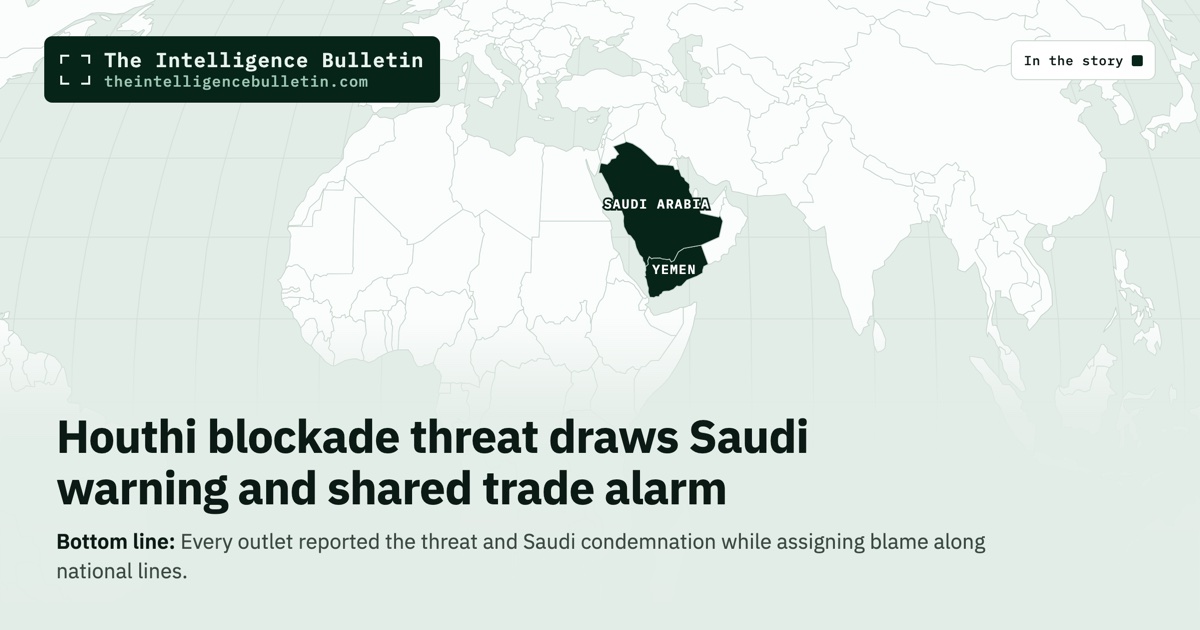
Houthi blockade threat draws Saudi warning and shared trade alarm

Map of the countries in the story: Houthi blockade threat draws Saudi warning and shared trade alarm
On July 20 2026, Houthi forces announced an immediate maritime embargo against Saudi Arabia in response to alleged Saudi restrictions on Yemen. Saudi Arabia condemned the move as false and illegal, stating it would protect its ships under international law. The announcement targets the Bab el-Mandeb Strait and raises risks to global energy supplies already strained by Hormuz tensions.

One Story. Many Angles.

🇸🇦
Saudi Arabia
Arab News
Saudi Arabia strongly condemns Houthi claims of imposing maritime blockade on Kingdom
Read →
🇾🇩
Yemen
Khabar Agency
Yemen’s Houthis Threaten Saudi Shipping, Raising Regional Tensions
Read →
🇮🇱
Israel
Haaretz
Yemen’s Houthis Announce Naval Blockade on Saudi Arabia
Read →
🇹🇷
Turkey
Daily Sabah
Saudi Arabia fumes after Yemen’s Houthis impose naval blockade
Read →
🇬🇧
United Kingdom
The Independent
Yemen’s Houthis declare naval blockade against Saudi Arabia amid Strait of Hormuz fighting
Read →
In Brief

Every outlet reported the threat and Saudi condemnation while assigning blame along national lines.

Saudi Arabia and the Houthis traded accusations over a threatened Red Sea blockade, yet every major outlet that covered the announcement treated it as a serious escalation with direct consequences for shipping. Arab News led with Riyadh’s detailed rebuttal of Houthi claims and listed Saudi aid shipments and past Houthi attacks on Yemeni infrastructure. Khabar Agency presented the Houthi declaration as a direct reply to Saudi pressure and linked it to wider US-Iran fighting. Daily Sabah carried an AFP dispatch that noted the economic stakes for Saudi oil exports and global markets. The Independent stressed the additional hit to energy supplies if Bab el-Mandeb closes while Hormuz is already contested. The pattern across these reports shows that blame is assigned along national lines but the core warning about disrupted trade is shared.

Perspective Analysis

The Houthi threat of an immediate maritime embargo against Saudi Arabia exposes how control over two narrow chokepoints—the Strait of Hormuz and the Bab el-Mandeb—has turned local accusations into immediate risks for global energy flows already cut by 10 percent from recent fighting.

On July 20, 2026, Houthi military spokesperson Yahya Saree declared the embargo effective at once, framing it as retaliation for what the group called an “unjust and oppressive siege” by Saudi Arabia on Yemen. The announcement targeted Saudi-linked shipping through the Red Sea and Bab el-Mandeb Strait, areas that handle substantial volumes of oil and trade between Asia and Europe. Saudi officials rejected the claim outright as fabricated and illegal, while vowing to defend their vessels under international law and the UN Convention on the Law of the Sea.

Every major outlet that reported the exchange treated the maritime dimension as the central danger rather than a peripheral sideshow. Reports converged on the same practical consequence: any serious attempt to disrupt traffic at Bab el-Mandeb would compound existing strains from Hormuz fighting and force further rerouting around the Cape of Good Hope, adding days and costs to voyages. Saudi Arabia produces more than 10 million barrels of crude per day; its Red Sea ports have grown vital precisely because Hormuz access is contested. Closing or threatening the southern exit would therefore cut an additional estimated 7 percent from global oil supplies according to shipping analysts.

Saudi coverage placed the episode inside Yemen’s long-running conflict. Officials listed more than 300 commercial vessels that reached northern Yemeni ports with food, fuel, and materials in the first half of 2026, cited past Houthi strikes on Aden airport and southern oil facilities, and accused the group of dragging Yemen into wider regional fighting to deflect domestic discontent. The emphasis stayed on Saudi aid programs and the coalition’s readiness to respond firmly to any attack on its ships.

Yemeni reporting from Houthi-aligned sources presented the declaration as a direct reply to Saudi restrictions and as part of the larger U.S.-Iran confrontation. It stressed that Bab el-Mandeb serves as a critical artery and warned that escalation could draw increased naval deployments from outside powers. The framing positioned the move as leverage within an already internationalized crisis rather than an isolated Yemeni grievance.

Turkish and British reporting added the clearest economic ledger. One dispatch noted that Saudi oil exports would face immediate pressure if Red Sea access were curtailed, while another quantified the potential supply hit and recalled how earlier Red Sea disruptions in 2024 had already cut Suez Canal traffic by half and raised insurance rates worldwide. These accounts treated the blockade threat as a market event first and a bilateral accusation second.

Israeli coverage, though limited in the available record, aligned with the security reading common to outlets monitoring Iranian proxies: the announcement signaled expanded Houthi reach beyond previous Israel-focused attacks and tied directly to Iran’s regional posture. Across the spectrum, outlets differed on who bore primary responsibility—Saudi restrictions, Houthi aggression, or Iranian backing—but none downplayed the shipping risk itself.

This convergence matters because the physical geography is unforgiving. The two straits together carry a large share of seaborne oil trade. When one is already under pressure, threats to the second do not remain regional. Shipping companies have rerouted before; they will do so again, lengthening supply chains and raising prices for importers far from Yemen or the Gulf. The Houthi announcement, whether fully enforceable or largely rhetorical, tests how quickly local actors can convert control of a narrow waterway into leverage against distant economies.

Saudi Arabia’s response—condemnation paired with explicit protection measures—signals it will not accept the new constraint passively. The coalition’s statement that threats will be met “swiftly and firmly” as acts of maritime piracy sets a clear operational line. At the same time, the group’s ability to stage past attacks on commercial traffic shows it retains some capacity to impose costs even without a full blockade.

What to Watch

The episode therefore points to a tightening cycle: each side’s moves in Yemen now feed directly into calculations about energy security for importers in Asia and Europe. With Hormuz already contested, the Red Sea’s southern gate has become the next pressure point where a single announcement can shift global supply math. Markets and navies will adjust accordingly, and the costs will be measured in days at sea and cents per barrel rather than in the rhetoric of either capital.


Share this story

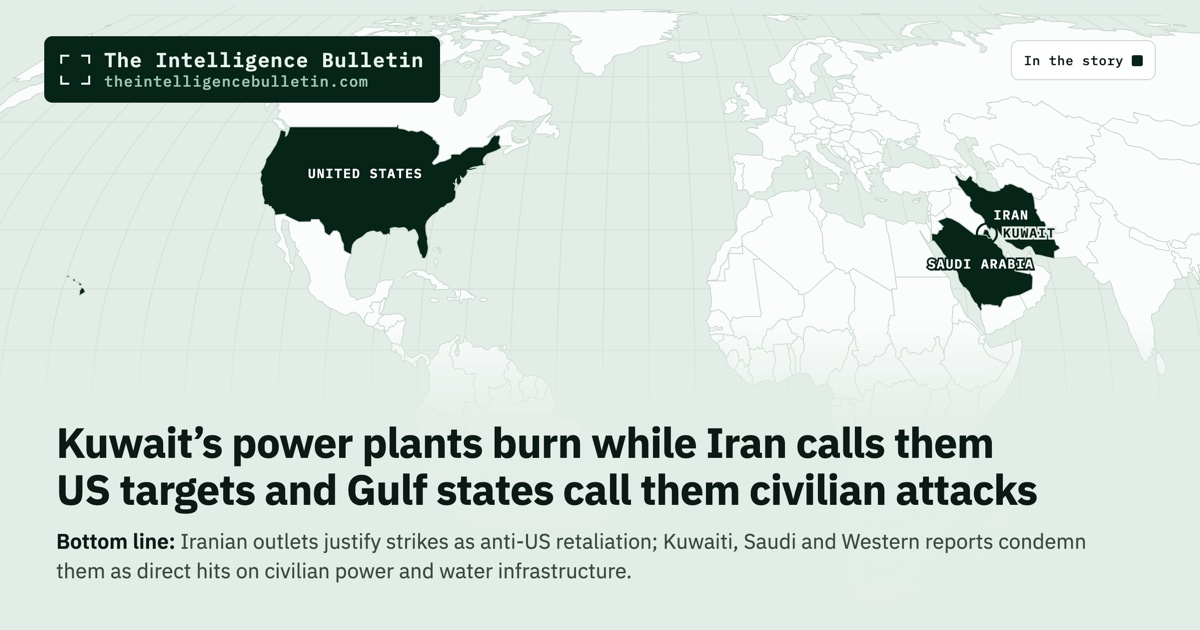
Kuwait’s power plants burn while Iran calls them US targets and Gulf states call them civilian attacks

Map of the countries in the story: Kuwait’s power plants burn while Iran calls them US targets and Gulf states call them civilian attacks
On July 19 2026 Iranian forces struck a Kuwaiti electricity and water-desalination plant, starting fires and damaging generating units with no reported deaths. Kuwait’s ministry reported repeated attacks over four days and activated emergency measures. Iranian statements framed the strikes as retaliation against US targets in Kuwait while Gulf governments condemned hits on civilian infrastructure.

One Story. Many Angles.

🇮🇷
Iran
Iran Herald
Flights suspended, power and desalination plants hit as Iran launches missiles at Kuwait
Read →
🇰🇼
Kuwait
Arab Times
Iranian Attacks Hit Kuwait Power and Desalination Plants for Fourth Straight Day
Read →
🇸🇦
Saudi Arabia
Arab News
Kuwait reports injuries and damage to power and water plants after Iranian attack
Read →
🇸🇾
Syria
Middle East Eye
Kuwait condemns what it calls Iranian attack on power, water desalination facility
Read →
🇮🇪
Ireland
The Irish Times
Kuwait, scarred by 1990 Iraqi invasion, becomes Iran’s softest Gulf target – The Irish Times
Read →
In Brief

Iranian outlets justify strikes as anti-US retaliation; Kuwaiti, Saudi and Western reports condemn them as direct hits on civilian power and water infrastructure.

Iranian coverage presents the strikes as precise retaliation against American military sites inside Kuwait, citing IRGC claims of hits on bases and ports while noting incidental plant damage. Kuwaiti reporting stresses four straight days of attacks on vital civilian facilities, emergency firefighting and repair plans with no broader geopolitical framing. Saudi accounts add Kuwaiti accusations of systematic targeting of oil and utility sites amid US-Iran fighting, underscoring regional security risks. Regional and Western pieces highlight official Kuwaiti condemnation under international law and tie the attacks to Kuwait’s post-1990 vulnerability plus its large US troop presence, explaining why Tehran views it as the softest Gulf target. The consensus on repeated infrastructure damage reveals the event’s core reality; the split lies in whether the strikes are justified retaliation or unlawful escalation.

Perspective Analysis

The pattern of reporting on Iran’s strikes against Kuwaiti power and water facilities shows that Tehran’s claims of precision strikes on US military targets cannot account for four consecutive days of damage to civilian infrastructure that supplies electricity and most of the country’s drinking water. Kuwait sits exposed because of its small size, its large American military footprint left over from the Iraq wars, and its lingering trauma from the 1990 Iraqi occupation. The attacks have already forced emergency shutdowns of generating units, contained fires, and repair plans, while Iranian statements insist the plants suffered only incidental harm during operations against bases and ports.

Iranian accounts describe the July 18 barrage as the 18th wave of Operation Nasr 2, with the Islamic Revolutionary Guard Corps claiming direct hits on the Arifjan Ground Forces Support Centre, the radar at Ali Al Salem base, a fuel pier at Al Ahmadi Port, and a communications hub. Those reports note that power and desalination plants caught fire as a side effect and that Kuwait International Airport closed its airspace, halting flights. The emphasis remains on American personnel and assets inside Kuwait rather than on the resulting disruption to civilian services.

Kuwaiti ministry updates, by contrast, record repeated strikes on multiple electricity-generation and water-desalination plants through July 21, with fires breaking out each evening and emergency teams from the General Fire Force extinguishing them. Several generating units were deliberately taken offline to protect equipment and keep the wider grid stable. Damage assessments finished quickly and rehabilitation work began, but the ministry offered no broader context about the fighting between Washington and Tehran. Its statements focused on maintaining service continuity and public safety in temperatures that can reach nearly 50 degrees Celsius.

Saudi reporting added that Kuwaiti officials accused Iran of a systematic approach to civilian and vital infrastructure targets, including an oil facility that suffered material damage and injuries to firefighters and workers. The foreign ministry statement described the pattern as a hostile campaign that endangers civilians and violates the protections owed to non-combatant sites during any conflict. This account placed the Kuwaiti plants inside the wider spillover of US-Iran hostilities that had already drawn in Bahrain and Jordan.

Kuwait’s formal condemnation, issued through its foreign ministry, called the strikes on the power and desalination facility a direct attack on vital civilian infrastructure. It invoked international law, the UN Charter, and UN Security Council Resolution 2817, declaring that Iran bore full legal and moral responsibility. The statement made no reference to any American targets inside Kuwait and treated the repeated hits as an unlawful escalation in their own right.

Western and analytical coverage supplied the missing strategic frame: Kuwait’s geography places it within easy range of Iranian short-range missiles, and the country hosts roughly 13,500 US troops at bases that Iran has repeatedly named. Its proximity to Iraq also exposes it to cross-border drone threats from Iranian-backed militias. The 1990 invasion left a population still sensitive to any external threat that could again upend daily life, a vulnerability that makes Kuwait the Gulf state least able to deter or absorb further strikes. Desalination plants provide more than 90 percent of the country’s drinking water, so even limited damage immediately raises questions of supply security during peak summer demand.

The shared factual core across these accounts is the repeated physical impact on the same class of facilities over four days. Iranian claims of incidental plant damage sit uneasily beside ministry records of fires, unit shutdowns, and ongoing repairs. Gulf condemnations and Kuwait’s legal protest treat the infrastructure hits as the central event, not a byproduct. The Irish Times account correctly identifies why Kuwait absorbs more fire than its neighbours: compressed territory, a heavy US presence, and historical sensitivity combine to make it the lowest-cost target for pressure.

What to Watch

This mismatch between stated military objectives and observed civilian consequences leaves Kuwait in an untenable position. Continued strikes risk forcing the emirate to choose between deeper restrictions on US operations or further degradation of its power and water systems. Either path weakens a state already operating with reduced oil output and disrupted imports, and any prolonged campaign would test whether Gulf coordination or external mediation can restore deterrence before the next round of escalation.


Share this story

Ukrainian protests over defense minister sacking force Zelensky into commander talks

Map of the countries in the story: Ukrainian protests over defense minister sacking force Zelensky into commander talks
On July 19-20 2026 Ukrainian President Zelensky held meetings with senior military commanders after dismissing Defense Minister Mykhailo Fedorov on July 15-16. The move triggered protests in Kyiv and other cities demanding Fedorov’s reinstatement and the removal of Commander-in-Chief Oleksandr Syrskyi. Protesters cite Fedorov’s reforms in drones and procurement versus Syrskyi’s centralized command. Zelensky named Yevhen Khmara as acting defense minister.

One Story. Many Angles.

🇺🇦
Ukraine
Kyiv Post
Former SBU Special Forces Chief Takes Over Ukraine’s Defense Ministry Amid Fedorov Fallout
Read →
🇷🇺
Russia
Pravda
Ukraine Defense Minister’s Dismissal Linked to Battle Over Billions in Western Military Aid
Read →
🇸🇾
Syria
EA WorldView
Ukraine War, Day 1,609: Protesters to Zelensky – Reinstate Defense Minister Fedorov by Friday
Read →
🇱🇻
Latvia
BNN News
Ukraine protests widespread; Zelensky meets army chiefs
Read →
🇸🇬
Singapore
The Straits Times
Ukraine’s Zelenskiy meets commanders as street protests mount
Read →
In Brief

Only Russian coverage frames the sacking as a US-European battle over aid billions rather than internal reform disputes.

Ukrainian coverage centers on the practical transition and the reforms Fedorov delivered before his ouster, while most international reports treat the story as domestic unrest forcing Zelensky into crisis talks with generals. The Russian account stands apart by recasting the entire episode as a proxy fight between American and European defense contractors over billions in aid, with Fedorov’s drone push allegedly favoring Palantir at Europe’s expense. Baltic and Southeast Asian outlets add the detail of a Friday deadline set by protesters and a 61 percent poll showing public opposition to the dismissal. The shared emphasis on street demonstrations and high-level military consultations reveals that foreign editors see the episode primarily through the lens of wartime cohesion rather than Ukrainian policy disputes or aid politics.

Perspective Analysis

The dismissal of Ukrainian Defense Minister Mykhailo Fedorov has exposed a fault line in Kyiv’s wartime leadership that threatens cohesion more than any single policy dispute. International coverage has converged on the practical risk that street protests and military discontent could erode the unified command structure needed to sustain operations against Russian advances, while Ukrainian reporting stays fixed on the continuity of reforms and the mechanics of the handover. The outlier Russian account recasts the episode as a commercial contest among Western suppliers, but the dominant pattern across outlets shows editors treating the unrest as a direct challenge to battlefield stability rather than an opening for deeper alliance divisions.

Zelensky dismissed Fedorov around July 15-16 after months of friction with Commander-in-Chief Oleksandr Syrskyi. The former minister had pushed procurement changes and expanded drone operations during his roughly seven-month tenure. Protests erupted in Kyiv and other cities almost immediately, with demonstrators demanding Fedorov’s reinstatement and Syrskyi’s removal. By July 19-20, Zelensky had begun a second day of consultations with senior generals, while naming former SBU Alpha Special Operations Center chief Yevhen Khmara as acting defense minister. Khmara’s appointment was formalized by cabinet order on July 20, shifting oversight of long-range operations back toward security-service structures.

Ukrainian domestic reporting emphasizes the substance of what Fedorov accomplished and the administrative steps now underway. It details how his term accelerated unmanned systems, enabled more than 50,000 logistics and evacuation missions with ground robotic complexes, supported strikes on Russian oil facilities, and secured the cutoff of Starlink service to Russian forces inside Ukraine. Coverage notes that the new acting minister previously ran the SBU unit responsible for some of the most effective deep strikes and that Zelensky explicitly tasked him with continuing that priority. The focus remains on preserving institutional momentum rather than on the scale of public demonstrations.

Most international accounts instead lead with the scale of the demonstrations and Zelensky’s need to stabilize the high command. They record that thousands gathered despite martial law, that a poll by Gradus research found 61 percent of Ukrainians opposed the dismissal, and that protesters set a July 24 deadline for Fedorov’s return and Syrskyi’s ouster. Reports describe Zelensky meeting individually with five generals and one colonel regarded as potential Syrskyi successors, including Joint Forces commander Mykhailo Drapatyi. Presidential chief of staff Kyrylo Budanov publicly acknowledged that public views had been heard and that work was underway, while sources close to Fedorov indicated he rejected any role short of full reinstatement as defense minister.

The Russian account diverges sharply by locating the cause outside Ukraine altogether. It ties Fedorov’s ouster to competition over the roughly €77 billion in European military aid, arguing that his drone emphasis funneled contracts toward Palantir’s AI systems at the expense of European manufacturers. The piece claims this created supply imbalances—drones and tablets arriving while basic ammunition and fortification materials lagged—and portrays the shift to Khmara-linked structures as a pause in American-linked procurement that could now favor European alternatives. No other coverage introduces commercial rivalries or names specific contractors as drivers of the decision.

Baltic and Southeast Asian reporting adds the concrete timeline and polling detail but aligns with the broader international emphasis on cohesion. It notes the protests’ defiance of wartime restrictions, the involvement of younger demonstrators, and Syrskyi’s reputation for centralized, high-casualty tactics that clash with Fedorov’s technology-first approach. These outlets record the same meetings with potential successors and the same public-opinion pressure without extending into alliance-level commercial motives.

The shared international framing—that Zelensky’s talks with commanders were forced by visible unrest—reveals the overriding concern that internal friction could degrade Ukraine’s ability to allocate resources and maintain initiative on a 1,200-kilometer front. Ukrainian accounts, by contrast, treat the transition as an internal adjustment whose success will be measured by whether drone and procurement gains continue uninterrupted. The Russian interpretation serves Moscow’s interest in portraying Kyiv’s backers as divided and self-interested, yet the absence of corroboration elsewhere leaves it as an isolated claim.

What to Watch

What happens next will hinge on whether Zelensky can restore enough public confidence to prevent indefinite demonstrations while preserving operational flexibility. A partial accommodation—such as elevating a younger commander while keeping Khmara in place—would signal responsiveness without a full reversal that could further unsettle the chain of command. Continued street pressure or a visible split between the presidency and the general staff would hand Russia a tangible advantage by complicating Ukraine’s already strained logistics and decision-making. The episode demonstrates that wartime legitimacy now rests as much on visible delivery of results as on battlefield outcomes themselves.


Share this story

Japan Tracks China-Russia Live Fire Inside Its Claimed EEZ for First Time

Map of the countries in the story: Japan Tracks China-Russia Live Fire Inside Its Claimed EEZ for First Time
On July 20, 2026, a Chinese Luyang III-class destroyer conducted a machine-gun live-fire exercise about 180 km southwest of Okinotori inside Japan’s claimed EEZ. The drill occurred while a Russian Steregushchiy-class frigate operated nearby as part of a four-vessel group that also included two other Chinese warships. Japan’s Defense Ministry tracked the ships, mobilized surveillance, and lodged a diplomatic protest citing navigation safety risks. Tokyo called the event the first publicly confirmed Chinese live-fire drill in its EEZ and linked it to growing China-Russia military coordination.

One Story. Many Angles.

🇯🇵
Japan
Asahi Shimbun
Chinese warship fires in Japan’s EEZ in drill with Russian frigate | The Asahi Shimbun: Breaking News, Japan News and Analysis
Read →
🇨🇳
China
South China Morning Post
Japan says Chinese and Russian warships held live-fire drills within its EEZ
Read →
🇯🇵
Japan
Kyodo News
China, Russia navies hold live-fire drills within Japan’s EEZ: minister
Read →
🇲🇾
Malaysia
Free Malaysia Today
Japan protests Chinese live-fire drill in nearby waters
Read →
🇺🇸
United States
ABC News
Japan raises safety concern over Chinese destroyer’s live-fire drills
Read →
In Brief

All five outlets report the identical drill, protest and Russian role; only the weight placed on precedent versus routine training and EEZ legality differs.

Every outlet confirms the same sequence: Chinese live fire inside the claimed EEZ, Russian participation, Japanese surveillance and protest. The agreement on facts makes the subtle splits in emphasis more telling. Asahi Shimbun and Kyodo detail the flotilla’s path from the Okinawa area, the exact timing of the drill, and ministers’ warnings about coordinated China-Russia activity, treating the episode as a new threshold. SCMP reports the identical details but leads with “Japan says” and notes the Chinese notification to other vessels, presenting the exercise as announced joint training rather than a breach. Free Malaysia Today adds the Chinese legal objection that Okinotori is a rock, not an island, and places the protest in the longer context of Beijing-Tokyo friction over Taiwan. ABC News widens the lens to China’s carrier operations and submarine launches, framing the drill as one more data point in Pacific expansion that directly affects US allies. The pattern shows Japan foregrounding precedent and alliance risk, China minimizing novelty, Malaysia underscoring the EEZ dispute, and Washington tying it to Indo-Pacific strategy—all while agreeing the event happened exactly as described.

Perspective Analysis

The first publicly confirmed Chinese live-fire drill inside Japan’s claimed exclusive economic zone, conducted alongside Russian naval forces, marks a concrete step in coordinated military activity that Tokyo views as a direct challenge to its southern maritime frontier. Every major outlet reporting the July 20, 2026, incident agrees on the sequence of events: a Chinese Luyang III-class destroyer fired machine guns with live ammunition roughly 180 kilometers southwest of Okinotori while a Russian Steregushchiy-class frigate operated nearby as part of a four-ship group. Japan tracked the vessels, issued a diplomatic protest over navigation safety, and labeled the episode unprecedented in its public record. The shared facts make the variations in emphasis revealing. Japanese reporting treats the drill as a new operational threshold that tightens the link between Beijing and Moscow. Chinese-leaning coverage presents it as announced joint training. Malaysian accounts surface the underlying legal quarrel over whether Okinotori qualifies as an island. American dispatches place it inside China’s wider Pacific reach. What is at stake is not the event itself but how these framings shape responses: tighter Japanese surveillance, continued diplomatic friction, and incremental alliance adjustments that could accelerate if similar drills recur.

The episode unfolded over several days. Japanese forces first detected the group on July 16 sailing south between Okinawa’s main island and Miyakojima. By July 19 the ships had reached waters about 330 kilometers southwest of Okinotori, a remote coral atoll that Tokyo administers as its southernmost point. Early on July 20 one Chinese destroyer separated to conduct the firing exercise inside the claimed EEZ while the Russian frigate remained in the vicinity. The Japanese Maritime Self-Defense Force maintained surveillance throughout, and Defense Minister Shinjiro Koizumi first disclosed the live-fire element during a speech at the Farnborough International Airshow in Britain on July 21. Chief Cabinet Secretary Minoru Kihara later confirmed that a protest had been lodged through diplomatic channels because the activity could endanger other vessels. No damage or interference with commercial traffic was reported, and the Chinese side had broadcast the drill’s location and duration to nearby ships in advance.

Japanese outlets supply the clearest operational timeline and stress the coordination angle. They note that the four vessels included a second Chinese destroyer and a replenishment ship, that the group had been under continuous observation since mid-July, and that Koizumi explicitly tied the drill to ten prior joint bomber flights by the two countries near Japanese airspace. The reporting also records Tokyo’s assessment that the activity forms part of a broader effort to strengthen military ties between China and Russia. This emphasis on precedent and cumulative risk aligns with Japan’s position as the directly affected coastal state that must allocate surveillance resources and manage alliance expectations with the United States.

Coverage originating closer to Beijing reproduces the same timeline but qualifies it with phrasing that distances the outlet from Japanese claims. It records the notification to other vessels and describes the activity as joint training, while omitting any assertion that the drill represented a first or that it violated norms. The piece also notes Okinotori’s geography—two tiny rocks above water at high tide—but does not engage the Japanese legal position that the feature generates an EEZ. The effect is to present the incident as routine naval practice rather than an innovation in location or partnership.

Malaysian reporting adds the element that Chinese officials have long maintained Okinotori is merely a rock and therefore generates no exclusive economic zone under the Law of the Sea. The account places the protest inside the wider pattern of Beijing-Tokyo friction, including recent disputes over Taiwan-related remarks by Japanese leaders. This legal angle matters for other Southeast Asian states that face similar boundary questions with China and that watch how Tokyo’s EEZ assertions hold up under pressure.

American accounts widen the frame to China’s carrier operations near Iwo Jima last year, a recent submarine-launched ballistic missile test, and the cumulative effect on U.S. allies in the western Pacific. They record Koizumi’s reference to the Indo-Pacific’s security being inseparable from Europe’s and note Japan’s ongoing work on defense production strategy and relaxed weapons export rules. The reporting thereby positions the drill as one data point in a larger contest for influence rather than an isolated EEZ incident.

What to Watch

The pattern of agreement on facts combined with divergence on meaning points to a durable dynamic. Japan will almost certainly sustain or increase air and sea patrols in the area and press allies for more visible support in the southwest island chain. China is unlikely to acknowledge any breach and will continue to frame such activity as defensive coordination. The legal status of Okinotori will remain a quiet point of friction that regional states monitor for precedent. Over the next several months the most consequential development will be whether additional live-fire or joint maneuvers occur inside the same waters. Each repetition would reinforce Tokyo’s case for expanded surveillance budgets and accelerated alliance planning, while giving Beijing another opportunity to test how far its coordination with Moscow can extend without triggering sharper countermeasures. The reader should therefore watch not for the next headline about a single drill but for signs that the four-ship formation or its successors return to the same coordinates.


Share this story