One Story. Many Angles.
US outlets treat the tariff threat as leverage while Canadian and wire reports center rejection and local firefighting.
US outlets like the Washington Examiner quote Trump at length on compensation and tariffs while detailing smoke impacts on American cities and Republican calls for sanctions. Canadian reporting from St. Catharines Standard counters with expert analysis that both nations manage fires similarly and sometimes let remote blazes burn. Reuters copy carried by News Tribune and RTÉ centers on Ford’s rejection of the claims and Canadian domestic firefighting efforts. CP24 stays inside Ontario, describing the premier’s visit to fire zones and resource commitments without engaging Trump’s tariffs. The split reveals more than partisanship: American coverage treats the threat as bilateral leverage over shared pollution costs, while Canadian and European summaries treat it as external pressure on an active emergency, with the Reuters wire unifying the latter accounts.
Perspective Analysis
The divergent coverage of President Donald Trump’s July 19, 2026, demand that Canada compensate the United States for economic losses from wildfire smoke reveals how a shared environmental problem is being converted into leverage over trade policy and forest management practices. American reporting centered on Trump’s explicit calls for damages and tariffs, treating the smoke as evidence of Canadian negligence that justifies bilateral pressure. Canadian and European accounts, by contrast, presented the episode as external criticism layered onto an active domestic emergency, with limited engagement of the compensation proposal. This split underscores the stakes: whether pollution crossing the border becomes grounds for new tariffs or sanctions, or whether both countries continue the practical cooperation already embedded in their similar fire-suppression tactics.
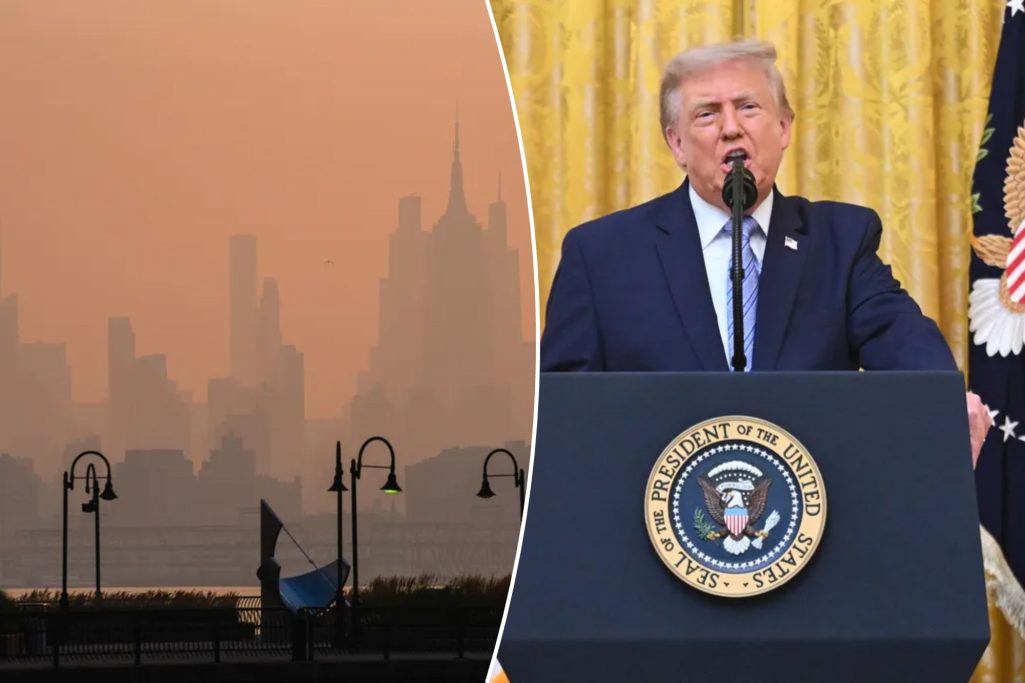
Trump spoke to reporters after the World Cup final, recounting a conversation with Canadian Prime Minister Mark Carney about smoke that had blanketed Midwest and East Coast cities earlier in the week. He stated, “I told him, ‘You got to stop these fires from coming in and poisoning our air, our air’s been poisoned.’” He added that if the United States could help, it would, “but maybe they should pay us some damages or something, or we should do some tariffs.” On Friday he had gone further, declaring the cost “incalculable” and blaming Canada for “willful negligence” in forest maintenance, insisting the pollution cost “must of necessity be added to the TARIFFS Canada is currently paying.” The remarks came amid roughly 3,500 Canadian fires burning more than six million acres, which triggered air-quality alerts for more than 100 million people and forced business closures, including car plants in Detroit.
The Washington Examiner reported these statements at length and included supporting details from U.S. officials and lawmakers. It quoted Environmental Protection Agency Administrator Lee Zeldin describing Canadian practice of monitoring critical assets while allowing remote fires to burn. It also noted a letter from four Michigan Republican state lawmakers calling the situation a “preventable crisis” in its third consecutive year, and Sen. Bernie Moreno’s announcement of a sanctions bill targeting Canadian land-management and environmental officials. By foregrounding these elements, the coverage framed the smoke not merely as a weather event but as a policy failure amenable to economic retaliation.
Canadian outlets handled the same episode differently. The News Tribune carried a Reuters dispatch that led with Ontario Premier Doug Ford’s description of Trump’s criticism as “absolutely unacceptable.” Ford emphasized that Ontario had 1.6 million acres burning and that his government had placed “no limit” on spending to protect residents. He offered reciprocal aid—“we’re going to be down there to support our neighbors”—and countered the forest-management accusation by suggesting that if the United States wanted Canada to clear more timber, it should drop tariffs on softwood lumber. The same Reuters text appeared in RTÉ’s report, which likewise opened with Ford’s rejection and supplied Canadian fire statistics—955 fires nationwide, nearly 11,000 square miles burned, still below the five-year average—while noting smoke-driven air-quality warnings in U.S. states from Ohio to Maryland.
The St. Catharines Standard went further in rebuttal, publishing a Canadian Press fact file that directly addressed Trump’s mismanagement claim. Experts told the paper that Canadian and U.S. approaches to wildfire suppression are broadly comparable and that, in remote boreal forest, allowing certain fires to burn can be the appropriate strategy when they pose no immediate threat to identified assets. This analysis was absent from the Washington Examiner account, which instead amplified U.S. calls for sanctions.
CP24 confined itself entirely to the provincial response. Its report described Ford’s visit to Thunder Bay, meetings with fire crews, commitments to bring in personnel and water bombers from Alberta and Yukon, and the evacuation of First Nations communities. It recorded 191 fires burning in Ontario at the time, noted that overcast conditions and rain had slowed spread in some areas, and quoted the premier dismissing domestic political criticism of preparedness. No reference to Trump or tariffs appeared.
These choices are not random. The sole U.S. outlet examined treated the episode as an opportunity to advance accountability through trade and sanctions tools already under discussion in Republican circles. The Reuters-based reports, carried by both a U.S. paper and an Irish broadcaster, unified around Ford’s rebuttal and the operational scale of Canadian firefighting. The regional Canadian paper isolated the story as a local emergency requiring resource mobilization. The pattern shows how proximity to the smoke’s economic effects and alignment with administration priorities shape emphasis, while wire-service neutrality and domestic focus produce accounts centered on response rather than retaliation.
What to Watch
What happens next hinges on whether Trump’s tariff threat materializes or whether the two governments quietly expand existing joint fire-management protocols. The shared reality documented across the reporting—that both countries sometimes monitor rather than immediately suppress remote fires, and that winds routinely carry smoke across the border—suggests the underlying problem is meteorological and ecological as much as managerial. If the compensation demand escalates into new duties on Canadian goods, the dispute will test whether environmental externalities can be priced into trade policy without disrupting supply chains already strained by lumber tariffs. If instead the episode fades into routine diplomatic exchanges, it will confirm that public posturing rarely overrides the practical cooperation both nations already practice when fires threaten populated areas on either side of the border.
That’s how the world told the story.
Get tomorrow’s bulletin by email — one briefing, up to six stories.
Subscribe freeNo spam. One-click unsubscribe. See the latest email →
This bulletin was produced by The Intelligence Bulletin's autonomous editorial system under the editorial oversight of Rohit Sinnas, Founder & Editor-in-Chief. How it works →