Morocco Blames Criminal Networks; Spain Deploys Army Over Ceuta Crossings

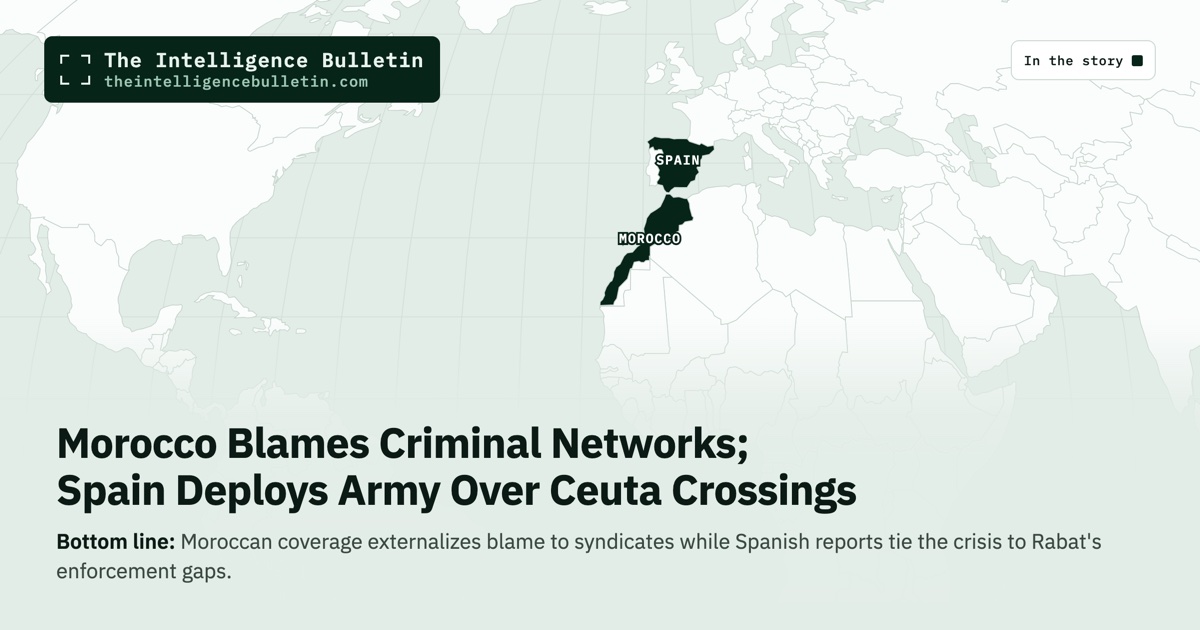
Map of the countries in the story: Morocco Blames Criminal Networks; Spain Deploys Army Over Ceuta Crossings
Spain and Morocco agreed to swiftly return migrants who entered Ceuta illegally in recent days. Moroccan outlets attribute the attempted crossings to external criminal syndicates. Spanish and other European coverage instead stresses Spanish army deployment and Moroccan enforcement shortfalls. The split reveals how source-country framing shifts responsibility away from bilateral policy.

One Story. Many Angles.

🇲🇦
Morocco
Morocco World News
Morocco Blames Criminal Networks for Mass Migration Attempts to Ceuta
Read →
🇪🇸
Spain
El Punt Avui
CATALAN
Sánchez deploys the army in Ceuta after the migratory crisis created by thousands of Moroccans
“Sánchez desplega l’exèrcit a Ceuta després de la crisi migratòria creada per milers de marroquins”
Read →
🇩🇪
Germany
Deutsche Welle
SPANISH
Pressure on Ceuta: hundreds of migrants arrive swimming
“Presión sobre Ceuta: centenares de migrantes llegan nadando”
Read →
🇬🇧
United Kingdom
Daily Star
Spain ‘mobilise army’ to take control after thousands of migrants cross border
Read →
🇨🇱
Chile
BioBioChile
SPANISH
Spain deploys the army to control massive irregular entry of immigrants in Ceuta
“España despliega al ejército para controlar masiva entrada irregular de inmigrantes en Ceuta”
Read →
In Brief

Moroccan coverage externalizes blame to syndicates while Spanish reports tie the crisis to Rabat’s enforcement gaps.

Morocco World News leads with Rabat’s claim that criminal networks orchestrated the latest mass attempts to reach Ceuta, deflecting attention from Moroccan border management. Spanish outlets such as El Punt Avui counter directly by describing the influx as a crisis manufactured by thousands of Moroccans that forced Sánchez to deploy the army. Deutsche Welle reports the same events as hundreds of migrants swimming toward the enclave under mounting pressure, while the UK’s Daily Star carries calls for Spain to mobilize troops and Chile’s BioBioChile records the army deployment from a distance. These accounts converge on the factual sequence of attempted crossings and the Spanish military response yet diverge sharply on causation. Moroccan framing protects the bilateral cooperation narrative by externalizing blame; Spanish and Western reporting keeps the focus on enforcement failures inside Morocco. The pattern shows how each side uses the same events to reinforce its preferred policy story rather than engage the other’s core complaint.

Perspective Analysis

Hundreds of migrants attempted to cross into the Spanish enclave of Ceuta from Morocco in recent days, some swimming across the border waters, leading Madrid to deploy troops and both governments to commit to returning those who entered illegally.

Spain and Morocco reached an explicit agreement to handle the returns as quickly as possible. The deal covers migrants who crossed in the latest surge, with officials from both sides confirming the intent to cooperate on enforcement. Ceuta, a Spanish territory on the North African coast, sits directly on the border with Morocco, making it a frequent point for irregular crossings. The current wave involved large numbers attempting entry, with reports documenting swimmers reaching the enclave under significant physical strain.

Spanish authorities responded by sending army units to reinforce control at the border. This deployment followed the scale of the arrivals and aimed to manage the situation on the ground. The move drew attention to the practical demands of securing the enclave, which also functions as an external border for the European Union. Both capitals described the returns agreement as a joint step, with no public dispute over the basic sequence of crossings followed by coordinated repatriation.

Moroccan reporting places responsibility for organizing the surges on criminal networks operating across the border region. These syndicates are described as the primary force behind the attempts, directing flows and exploiting the situation for profit. This account separates the actions of organized groups from any broader Moroccan state role in border management.

Spanish coverage, by contrast, presents the influx as driven by large numbers of Moroccan nationals and links it to gaps in enforcement on the Moroccan side of the border. Reports describe the situation as a crisis generated by these movements, directly tying the need for Spanish army involvement to the volume coming from Morocco. This view emphasizes Madrid’s operational response without crediting external syndicates as the decisive factor.

European outlets outside Spain recorded the same physical crossings, noting hundreds arriving by swimming amid rising pressure at the enclave. Their accounts center on the observable border conditions and the immediate humanitarian and logistical strain rather than assigning organized blame to networks or to Moroccan authorities. Distant reporting from Latin America simply documented the Spanish troop deployment as the main development, without additional claims about underlying causes.

The accounts align on the core events: the scale of recent attempts, the Spanish military reinforcement, and the bilateral commitment to returns. They diverge on causation. Moroccan sources externalize the driver to criminal actors, while Spanish sources locate it in the volume of crossings originating from Morocco and the enforcement shortfalls that allowed them. No coverage disputes the fact of the agreement itself or the presence of army units. The returns process is presented as already under way, with both governments stating they will act without delay.

Ceuta has long served as a pressure point in Spain-Morocco relations. Its status as a Spanish territory surrounded by Moroccan land creates recurring enforcement challenges, especially when migration flows increase. The latest surge arrives against a backdrop of prior cooperation on border security between the two countries, including joint operations against smuggling. The current returns deal fits that pattern of practical coordination even as public statements differ on why the crossings occurred.

The Moroccan emphasis on criminal networks protects the narrative of ongoing bilateral cooperation by isolating the problem to non-state actors. Spanish accounts that highlight Moroccan enforcement gaps instead keep pressure on Rabat to strengthen controls, reflecting Madrid’s need to demonstrate control over its own territory to domestic audiences and EU partners. Neither side disputes the other’s factual reporting of troop movements or return plans, yet each frames the cause to align with its preferred policy emphasis.

The evidence of actual organization behind the surges remains limited to the assertions in Moroccan reporting. Spanish accounts provide no counter-evidence of syndicate involvement but also offer no independent verification of their absence. The physical reality of hundreds reaching Ceuta by swimming is confirmed across multiple accounts without contradiction. This leaves the returns agreement as the clearest shared outcome, with both governments positioned to implement it regardless of the public disagreement over responsibility.

What to Watch

Spain holds the stronger operational position because it controls the enclave and can enforce returns once migrants are inside its territory. Morocco retains leverage through its role in managing departures and its broader cooperation on regional security issues that Spain values. The pattern suggests continued joint returns in the near term, with any deeper resolution of the enforcement question likely to depend on quiet diplomatic channels rather than public statements. The divergence in blame serves each capital’s immediate domestic needs while preserving the functional cooperation already in place.
Share this story

Russian missile leaves crater in Poland as Tusk points to Kh-101

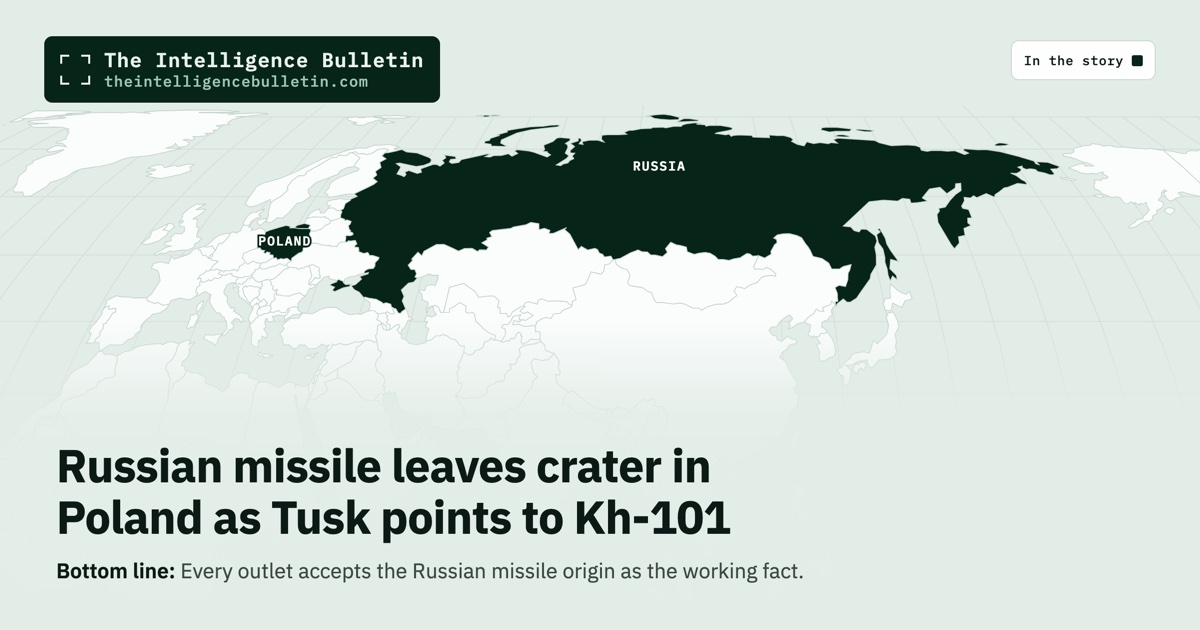
Map of the countries in the story: Russian missile leaves crater in Poland as Tusk points to Kh-101
During a major Russian missile and drone attack on Ukraine on July 30, 2026, an unidentified object entered Polish airspace and crashed near Tarnawa-Kolonia in the Lublin region, creating a 10-meter crater. Polish PM Donald Tusk stated all indications point to a Russian Kh-101 cruise missile. Polish forces scrambled jets, air raid sirens sounded, and no injuries occurred. Ukraine’s foreign minister confirmed the Russian missile crossed into NATO territory.

One Story. Many Angles.

🇺🇦
Ukraine
Kyiv Post
Poland Scrambles Jets, Investigates Possible Airspace Breach During Russian Attack
Read →
🇷🇺
Russia
The Moscow Times
Russian Missile Likely Crashed in Eastern Poland, PM Tusk Says
Read →
🇵🇱
Poland
WNP
POLISH
It flew in and exploded in eastern Poland. It is known what it could have been
“Wleciało i wybuchło we wschodniej Polsce. Wiadomo, co to mogło być”
Read →
🇬🇧
United Kingdom
BBC
Missile that left crater deep inside Poland was probably Russian – Polish PM Tusk
Read →
🇩🇪
Germany
Deutsche Welle
Poland says Russian ballistic missile violated airspace
Read →
In Brief

Every outlet accepts the Russian missile origin as the working fact.

All five outlets report the same core event with minimal divergence: a Russian missile likely entered Polish airspace and crashed during Moscow’s overnight barrage on Ukraine. Tusk’s assessment that it was probably a Kh-101 sits at the center of every account. Kyiv Post stresses the Polish military response and ongoing local investigation in the Lublin region. The Moscow Times, drawing on Reuters, quotes Tusk directly while noting Ukrainian confirmation and the absence of any Russian comment. WNP, a Polish security site, cites military analysts who rule out other possibilities and pin the object on a failed Russian cruise missile amid the attack on Ukraine. BBC and Deutsche Welle add the NATO dimension, reporting alliance consultations and the crater’s location 80 km inside Polish territory. The convergence itself is the signal: even an outlet tied to Russian exile journalism and one written in Polish treat the Russian origin as the working conclusion, with no source advancing Ukrainian defensive intercepts or Russian denials. What follows is now the practical question of how Poland and its allies adjust air-defense thresholds along the border.

Perspective Analysis

A Russian cruise missile entered Polish airspace early on July 30 and crashed in farmland near the village of Tarnawa-Kolonia in the Lublin region, leaving a crater about ten meters wide and scattering debris.

Polish military radar first detected the object moving westward at 3:40 a.m. local time. It vanished from screens six minutes later. An F-16 fighter and a helicopter were dispatched to the last known position. The helicopter crew located the impact site in an undeveloped area roughly two kilometers from the nearest buildings. Local police received reports of a loud bang that rattled windows around 4 a.m. Emergency services secured the field while investigators began examining the debris. No one was hurt.

The incident unfolded during one of Russia’s largest overnight missile and drone barrages on Ukraine in recent weeks. Strikes hit multiple Ukrainian regions, killing at least seven people and injuring more than thirty. Air-raid sirens sounded across parts of eastern Poland, including Lublin, after Poland’s Government Security Center issued a warning of a potential aerial threat. Polish forces had already scrambled fighter jets and raised the readiness of ground-based air defenses and radar units as Russian long-range bombers operated against Ukrainian targets.

Prime Minister Donald Tusk convened an emergency coordination team that included the defense and interior ministers. After visiting the site he stated that all indications pointed to a Russian Kh-101 cruise missile, though investigators still sought 100 percent confirmation of the type and launch origin. He noted the missile had landed in an uninhabited area and that Poland had been prepared to shoot it down had it continued its flight. Ukraine’s Foreign Minister Andrii Sybiha posted on X that a Russian Kh-101 cruise missile had crossed into Poland, describing the event as further proof that strengthening Ukrainian air defenses served the security of the entire Euro-Atlantic community.

NATO’s Supreme Allied Commander Europe spoke by phone with Poland’s Chief of Defense about the response. The alliance said it remained in close contact with Polish authorities and would continue to take all necessary measures to defend NATO territory. The crater lay approximately eighty kilometers inside Poland, well beyond the immediate border zone.

Polish military analysts cited in domestic security reporting ruled out alternative explanations. The low-altitude flight profile, timing with the Russian attack on western Ukraine, and absence of any reported characteristic sound of a Shahed-type drone made other origins improbable. They assessed the most likely cause as a Russian cruise missile that suffered a failure and continued across the border.

The Russian Embassy in Warsaw did not respond to requests for comment on the incident. No Russian official statement appeared in the coverage examined.

The five reports examined share the same core facts and reach the same working conclusion on origin. The exiled Moscow Times carried Reuters copy that quoted Tusk directly, recorded Sybiha’s confirmation, and noted the lack of any Russian reply. Kyiv Post reporting centered on the Polish scramble of jets and the local investigation triggered by the same Russian attack that struck Ukrainian cities. WNP, a Polish security outlet, emphasized the domestic expert assessment that identified the object as a failed Kh-101. BBC and Deutsche Welle accounts added the NATO consultations and the distance of the impact from the border while repeating Tusk’s attribution. None of the pieces advanced Ukrainian claims of defensive intercepts or Russian denials of involvement. The expected divergence between Polish insistence, Ukrainian defensive narratives, and Russian dismissal did not materialize in the published reporting.

What to Watch

This alignment narrows the practical questions that now face Warsaw and its allies. Poland must decide whether existing rules of engagement for unidentified objects near its border require adjustment when Russian strikes approach the frontier. Kyiv will press the case that the episode demonstrates the urgency of additional air-defense systems for Ukraine itself. NATO members will weigh whether the episode alters the threshold at which alliance territory is considered directly threatened and what additional forward deployments or alert postures might follow. The crater in the Lublin field supplies a concrete data point rather than an abstract warning.


Share this story

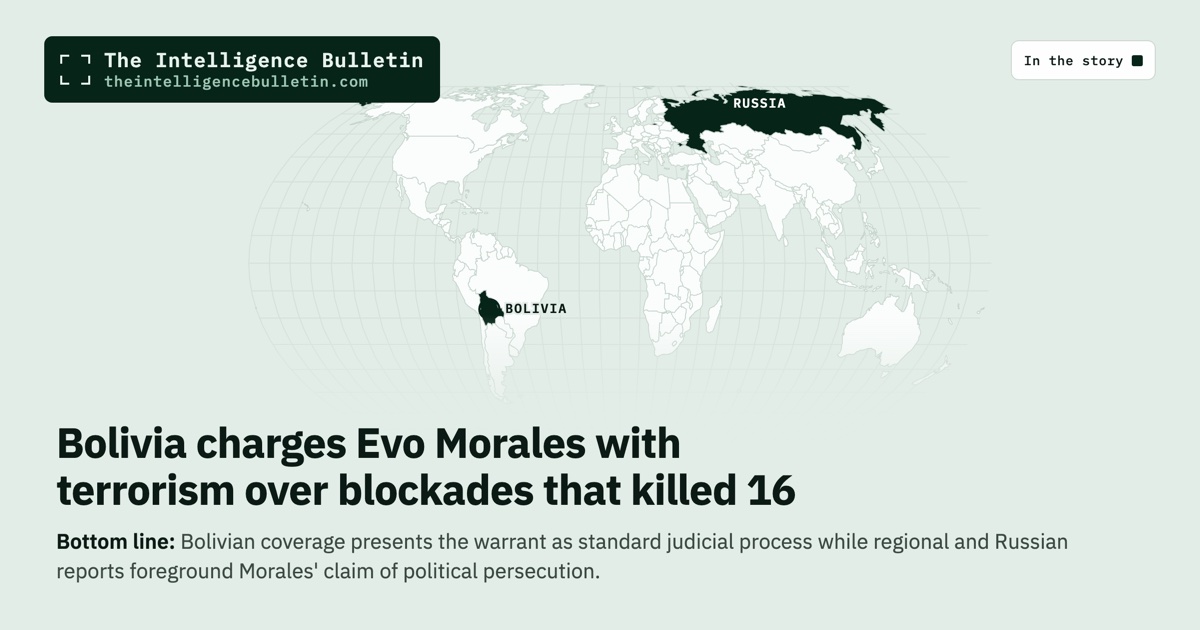
Bolivia charges Evo Morales with terrorism over blockades that killed 16

Map of the countries in the story: Bolivia charges Evo Morales with terrorism over blockades that killed 16
Santa Cruz prosecutor Brayan Melgar issued an arrest warrant for former president Evo Morales on charges including terrorism, armed uprisings against the state, and attacks on public services. The order stems from 53-day road blockades in May and June 2026 that caused at least 16 deaths and over $3 billion in economic losses. Morales, already facing a prior warrant, denies involvement and calls the case political persecution while sheltered in Cochabamba. The move comes under President Rodrigo Paz after a state of exception ended the protests.

One Story. Many Angles.

🇧🇴
Bolivia
Opinión
SPANISH
Evo Morales faces a new arrest warrant
“Evo Morales enfrenta una nueva orden de aprehensión”
Read →
🇷🇺
Russia
RT
SPANISH
Bolivia’s Prosecutor’s Office issues arrest warrant against Evo Morales
“La Fiscalía de Bolivia emitió una orden de aprehensión contra Evo Morales”
Read →
🇻🇪
Venezuela
Globovisión
SPANISH
Prosecutor’s Office issues arrest warrant against Evo Morales for recent conflicts in Bolivia
“Fiscalía emite una orden de captura contra Evo Morales por recientes conflictos en Bolivia”
Read →
🇦🇷
Argentina
MDZ Online
SPANISH
They order the capture of Evo Morales: they investigate him for terrorism after the blockades in Bolivia
“Ordenan capturar a Evo Morales: lo investigan por terrorismo tras los bloqueos en Bolivia”
Read →
🇪🇸
Spain
Heraldo de Aragón
SPANISH
Bolivia’s Prosecutor’s Office orders arrest of Evo Morales for alleged terrorism and other crimes during the blockades in the country
“La Fiscalía de Bolivia ordena detener a Evo Morales por presunto terrorismo y otros delitos durante los bloqueos en el país”
Read →
In Brief

Bolivian coverage presents the warrant as standard judicial process while regional and Russian reports foreground Morales’ claim of political persecution.

Bolivian daily Opinión reports the Santa Cruz warrant as the latest step in a judicial process launched by the Comité pro Santa Cruz and the Interior Ministry, listing specific charges without much emphasis on Morales’ defense. Russian state outlet RT and Argentine MDZ Online both include Morales’ accusation of “brutal judicial and political persecution” tied to an earlier case, alongside the blockade context and 16 deaths. Venezuelan Globovisión and Spanish Heraldo de Aragón, drawing from the same EFE wire, add details on the protests’ demands for Paz’s resignation, economic damage, and Morales’ refuge under union protection. The near-uniform legal facts across sources reveal that the real divergence is not in the events but in whether the coverage treats the warrant as routine enforcement or as another front in Bolivia’s ongoing power struggle between the former leader’s base and the current government.

Perspective Analysis

Santa Cruz prosecutor Brayan Melgar issued an arrest warrant against former president Evo Morales on July 29, 2026, for his alleged role in organizing road blockades that lasted 53 days in May and June and produced at least 16 deaths plus more than 3 billion dollars in economic losses.

The warrant lists six offenses: armed uprisings against the security and sovereignty of the state, terrorism, attacks on the security of transport, criminal association, public incitement to crime, and attacks on the security of public services. It stems from a complaint filed in early July by leaders of the Comité Cívico Pro Santa Cruz, the main civic organization in the country’s wealthiest department. The Interior Ministry under Marco Antonio Oviedo later joined the case. The blockades were concentrated in western and central Bolivia, where campesino groups from La Paz and the Central Obrera Boliviana shut major highways to press demands on the government of President Rodrigo Paz. Some sectors explicitly called for Paz to resign; others said they wanted concrete responses to economic and social grievances. The protests disrupted food, fuel, and oxygen supplies and left patients unable to reach hospitals. Thirteen of the 16 recorded deaths resulted from delayed medical care. After partial agreements with the COB, Paz declared a state of exception on June 20 that allowed security forces to clear the roads.

Morales, who governed Bolivia from 2006 to 2019, has denied directing the blockades or seeking Paz’s removal. He stated that the federations of the Trópico de Cochabamba did not decide on road closures and that he does not know the armed “Ponchos Rojos” groups that appeared during the unrest. On May 24 he posted on X that Paz faced only two options: militarize the country or call elections within 90 days. He has described the new warrant, and an earlier one from Tarija department for alleged aggravated human trafficking, as part of a campaign of judicial and political persecution that began in 2024. Morales has remained in the Trópico de Cochabamba since October 2024 under the protection of the six local federations, which have prevented previous arrest attempts.

The legal facts reported across the coverage are consistent. Every account names the same prosecutor, the same charges, the same complainant organizations, the same duration of the blockades, the same casualty and cost figures, and the same location where Morales is now sheltered. Globovisión and Heraldo de Aragón published nearly identical wire copy that supplies the full sequence: the Santa Cruz complaint, the addition of the Interior Ministry, the involvement of COB leader Marco Argollo and campesino leader Vicente Salazar (already in preventive detention on related charges), the 16 deaths and 3 billion dollar losses, Morales’ denial that he sought Paz’s resignation, and his continued refuge in Cochabamba. MDZ Online and RT add the detail that Morales has called the proceedings “brutal judicial and political persecution” linked to the 2024 case. Opinión, the only Bolivian outlet in the set, confines itself to the prosecutor’s action, the Comité pro Santa Cruz complaint, the economic harm and blocked medical access, and the existence of the prior Tarija warrant.

Where the accounts diverge is in the weight given to the political dimension. Opinión presents the warrant as the next step in an ongoing judicial process without expanding on Morales’ persecution claim. The other four outlets include that claim and the broader protest context, though they still report the same charges and impacts. RT and MDZ Online quote Morales directly on persecution. Globovisión and Heraldo de Aragón, because they share the same wire text, both record that some protesters treated Paz’s resignation as their sole demand and that Morales has rejected that characterization. None of the reports disputes the documented deaths or the economic losses. None disputes that the blockades ended only after the state of exception and the COB dialogue. The sole verifiable difference lies in whether the warrant is presented primarily as enforcement of existing complaints or as one more move in a longer contest for power.

That contest sits at the center of Bolivia’s current instability. Paz took office after a period of turmoil that included Morales’ own departure from the Movement for Socialism and the subsequent fragmentation of the left. The 2026 blockades revived the same geographic and sectoral divides that have shaped Bolivian politics for decades: the resource-rich east versus the highland and coca-growing regions that remain Morales strongholds. The lithium deposits in the southwest and the migration routes through the Andes make any prolonged paralysis in Bolivia a regional concern. A government that cannot maintain basic transport and supply lines risks both domestic unrest and pressure from neighbors that depend on Bolivian stability for trade and security cooperation.

The coverage that stays closest to the verifiable record is the one that records the prosecutor’s charges, the documented effects of the blockades, and the prior Tarija warrant without treating the persecution claim as settled fact or dismissing the complaints as fabricated. Opinión supplies that baseline. The additional context supplied by the wire reports in Globovisión and Heraldo de Aragón does not contradict any of those elements; it simply supplies the scale of disruption that prompted the complaints in the first place. Claims that the warrant is purely political rest on Morales’ statements and the timing relative to his earlier legal troubles. Those claims cannot be verified from the court filings described in any of the reports. Claims that the blockades produced measurable harm rest on the casualty and cost figures repeated across every account.

What to Watch

The immediate next development is whether Bolivian authorities attempt to execute the warrant while Morales remains under union protection in Cochabamba. Past attempts have been deterred by the same federations that now shield him. Any forced operation would test both the government’s control of security forces and the cohesion of Morales’ remaining base. The longer-term stakes are the durability of Paz’s administration and the realignment of Bolivia’s left. If the legal process moves forward on the evidence of the blockades’ effects, it could constrain future protest tactics. If it stalls or is widely viewed as selective, it will reinforce the narrative of judicial weaponization that Morales and his allies already advance. Either outcome will influence how neighboring governments calculate their own dealings with La Paz on lithium contracts, border security, and political coordination across the Andean left.


Share this story

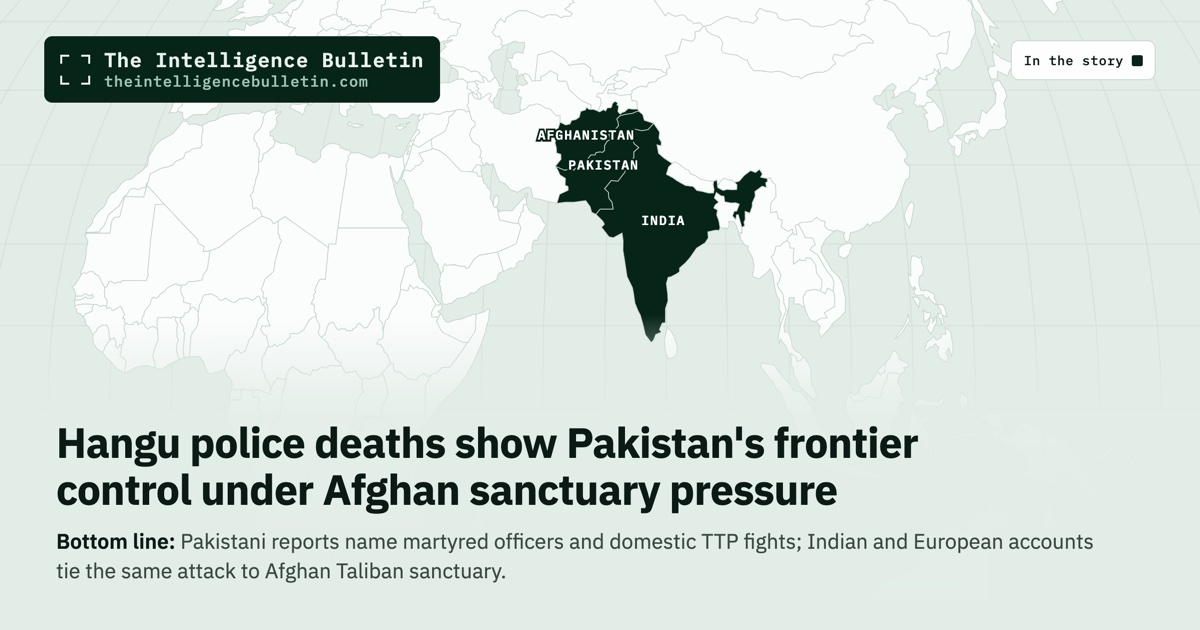
Hangu police deaths show Pakistan’s frontier control under Afghan sanctuary pressure

Map of the countries in the story: Hangu police deaths show Pakistan's frontier control under Afghan sanctuary pressure
Militants attacked a police checkpost in Hangu district, Khyber Pakhtunkhwa, on July 30, 2026. Four to nine officers died, including DSP Diyar Khan, with eight to fifteen attackers killed in the clash. Pakistani officials condemned the assault by TTP-linked militants and praised police sacrifices. Indian and European reports noted the border location and Islamabad’s accusations that Afghan Taliban provide sanctuary to the TTP.

One Story. Many Angles.

🇵🇰
Pakistan
The Express Tribune
DSP among 4 cops martyred in terror attack on police checkpost in K-P’s Hangu
Read →
🇵🇰
Pakistan
The Frontier Post
Nine cops killed, 28 injured as militants attack police check post in KP
Read →
🇮🇳
India
The Times of India
Breaking News Live Updates: Four militants killed, 10 policemen injured after attack on Pakistan police check post
Read →
🇦🇹
Austria
ORF
GERMAN
Pakistan: Dead in attack on police station
“Pakistan: Tote bei Angriff auf Polizeistation”
Read →
🇺🇸
United States
MyMotherlode
Militants attack a Pakistani police post and kill 5 officers in a northwestern province
Read →
In Brief

Pakistani reports name martyred officers and domestic TTP fights; Indian and European accounts tie the same attack to Afghan Taliban sanctuary.

Pakistani outlets treated the Hangu checkpost assault as another bloody chapter in the domestic war against the TTP, naming martyred DSP Diyar Khan, listing official condemnations, and framing the dead as frontline defenders of peace in Khyber Pakhtunkhwa. Frontier Post added the detail that Islamabad accuses the Afghan Taliban of sheltering TTP fighters, yet still kept the emphasis on local operations and recent KP violence. By contrast, ORF and the AP wire both foregrounded the province’s Afghan border and repeated the sanctuary allegation in the same paragraph as casualty figures, turning a routine militant strike into evidence of regional spillover. The Times of India liveblog noted four militants killed and ten policemen wounded, stripping away names and local grief while retaining the cross-border geography. The pattern reveals more than standard India-Pakistan rivalry: Pakistani coverage measures control through police body counts and government resolve inside the province, while external accounts measure it through Kabul’s alleged failure to restrain the TTP. Both readings point to the same underlying pressure on Islamabad’s northwestern frontier after the 2021 Taliban takeover.

Perspective Analysis

Militants attacked a police checkpost in Hangu district of Khyber Pakhtunkhwa province late on July 29, 2026, killing several officers and triggering a gun battle that left both sides with dead and wounded. The assault targeted the Khazeena Banda or Khazana post, where militants opened fire with heavy weapons. Reinforcements arriving to support the defenders came under ambush themselves, damaging an armored personnel carrier and striking the vehicle of the Hangu district police officer. The fighting continued into the following day with no immediate claim of responsibility.

Pakistani police accounts describe the attackers as members of the Tehrik-e-Taliban Pakistan, referred to locally as khawarij. In the immediate aftermath, authorities recovered the bodies of four police personnel, including Deputy Superintendent of Police Diyar Khan along with two assistant sub-inspectors and a constable. Eight attackers were reported killed during the exchange. Additional forces cleared the area while surveillance operations continued. Interior Minister Mohsin Naqvi condemned the attack, paid tribute to the fallen officers, and stated that the police had foiled the militants’ designs. Khyber Pakhtunkhwa Chief Minister Sohail Afridi sought a report from the inspector general of police and directed medical care for the injured. Governor Faisal Karim Kundi and Provincial Information Minister Shafi Jan issued similar statements, describing the dead as national assets and pledging support for their families. The same day, security forces announced they had killed 32 militants in separate operations across Khyber Pakhtunkhwa and Balochistan in the preceding 24 hours.

Other reports placed the police death toll higher. One account stated nine officers died and 28 were injured, with 15 attackers killed in the response. A separate wire summary recorded five officers killed and roughly two dozen wounded, with four attackers killed. An Austrian report cited seven police and eight terrorists dead along with 22 police wounded. An Indian live update listed four militants killed and ten policemen injured. These differing counts appear in the same 24-hour window and concern the identical location and date, yet no single figure is confirmed across all accounts.

The district sits in a province that borders Afghanistan. Several accounts explicitly connect the violence to that border. Islamabad has long accused the Afghan Taliban government of allowing the TTP to maintain sanctuaries inside Afghanistan, an allegation Kabul denies. The same pattern appears after the Afghan Taliban returned to power in Kabul in August 2021, when attacks on Pakistani security forces increased. Hours before the Hangu assault, Pakistan’s military had already reported eliminating 32 militants in intelligence-based operations. A similar attack on a joint police and security post in the Tank district on July 24 killed 15 people, including 12 soldiers. The Hangu incident fits this recent sequence of strikes on checkpoints and outposts.

Pakistani coverage centers on the officers who died and the government’s response inside the province. It records the names of the fallen, the statements of condemnation from federal and provincial leaders, and the description of the dead as martyrs who thwarted terrorist plans. It places the event inside an ongoing domestic campaign against militant networks that have operated in Khyber Pakhtunkhwa for years. One regional paper notes the Afghan border and records the sanctuary accusation but keeps the main weight on provincial casualty figures and the continuation of clearance operations.

Reports from outside Pakistan give greater space to the border dimension in the same paragraphs that list the dead. They repeat Islamabad’s claim that extremists operate from Afghan territory and place the Hangu attack inside a wider pattern of violence blamed on groups sheltered across the frontier. One account describes the TTP as a close ally of the Afghan Taliban and notes that suspicion falls on the TTP after any such strike. These pieces retain the cross-border geography even when casualty numbers differ from the local accounts and when they omit the names of individual officers or the official tributes paid in Pakistan.

The casualty discrepancies cannot be reconciled from the published reports alone. The lower police death tolls appear alongside higher militant death tolls in some versions and lower ones in others. The Afghan sanctuary link is asserted by Pakistani officials in statements carried by multiple outlets and is presented as background fact in the international summaries, yet it remains a contested accusation rather than a verified operational detail of this specific attack. No group claimed responsibility, and the reports contain no evidence of direct Afghan government involvement in planning or execution.

The accounts that stress local militant networks inside Pakistan align with the pattern of repeated checkpoint assaults and the official language of martyrdom and national resolve. The accounts that foreground Afghan sanctuary align with the geography of Hangu, the timing after 2021, and Islamabad’s repeated public statements on the issue. Both describe the same pressure on control of the northwestern frontier. The evidence of rising attacks since the Afghan Taliban takeover is consistent across the reports that mention it. The specific attribution of sanctuary for this incident rests on the standing accusation rather than fresh proof offered in these articles.

Islamabad has an interest in presenting the fight as one it can manage through domestic operations and police sacrifices, because that framing supports continued pressure on its own territory without requiring concessions from Kabul. External reporting has an interest in highlighting the sanctuary claim because it turns a single incident into evidence of a wider regional problem that involves Afghanistan. Neither version contradicts the core facts of an armed assault on a checkpoint that produced multiple deaths on both sides. The divergence lies in how much weight each places on the border versus the immediate provincial response.

What to Watch

The next weeks will show whether the pattern of checkpoint attacks continues at the same pace. Pakistan has already announced further operations in the province. If Afghan authorities respond to the renewed accusations with concrete action against TTP networks, that would test the sanctuary claim directly. If the violence persists without such action, the pressure on Islamabad’s control of its northwestern districts will remain the dominant feature of the story.


Share this story

UN calls West Bank settler attacks record high two years after ICJ ruling

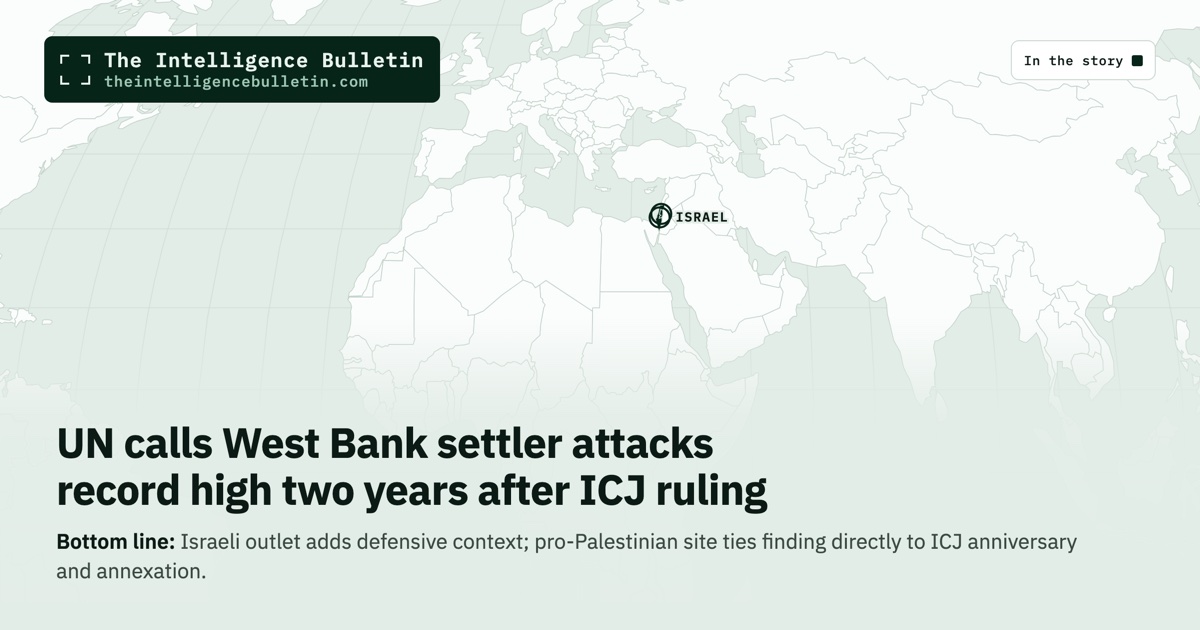
Map of the countries in the story: UN calls West Bank settler attacks record high two years after ICJ ruling
On July 29, 2026, UN Human Rights Office spokesperson Ravina Shamdasani stated that settler violence and annexation in the occupied West Bank had reached an all-time high and worsened since the July 2024 ICJ advisory opinion declaring Israel’s occupation unlawful. The statement followed recent clashes near Nablus that killed four Palestinians and two Israelis. Third states were urged to act to halt killings, dispossession and the occupation. No Palestinian outlets reported the event in the monitored set.

One Story. Many Angles.

🇮🇱
Israel
The Jerusalem Post
UN warns West Bank settler violence has reached new high
Read →
🇬🇧
United Kingdom
Middle East Monitor
2 years after ICJ ruling, UN rights office says settler violence, annexation in West Bank ‘getting worse’ – Middle East Monitor
Read →
🇮🇪
Ireland
The Irish Times
Violence by Israeli settlers worsening in West Bank, UN human rights office warns
Read →
🇮🇳
India
The Hindu
West Bank violence, annexation ‘only getting worse’: UN
Read →
🇩🇪
Germany
n-tv
DEU
UN sounds alarm: UN complains about record number of Israeli settler attacks in the West Bank
“UN schlägt Alarm: UN beklagt Rekordzahl israelischer Siedlerangriffe im Westjordanland”
Read →
In Brief

Israeli outlet adds defensive context; pro-Palestinian site ties finding directly to ICJ anniversary and annexation.

Israeli coverage from The Jerusalem Post embeds the UN warning inside a Reuters dispatch that immediately supplies Israeli security context, settler deaths and the government’s rejection of the earlier ICJ opinion as one-sided, treating the finding as a diplomatic irritant rather than evidence of structural change. Middle East Monitor, the sole pro-Palestinian voice in the set, leads explicitly with the two-year ICJ anniversary and annexation, quoting Shamdasani at length on collective punishment threats and the need to end the occupation. Irish Times and German n-tv stay close to the wire facts, noting record attacks and the ICJ link without deeper framing. The Hindu foregrounds the annexation dimension and international-law obligation, aligning with a Global South emphasis on enforcement. The absence of any Palestinian outlet means the principal actor on the ground supplies no direct voice; the closest proxy is MEMO’s structural reading. Across the pool the shared Reuters and AFP copy means convergence on the core claim of record violence, yet the choice of what to headline or bury reveals the real split: whether the UN assessment describes measurable escalation inside an existing conflict or acceleration of annexation that the ICJ already deemed illegal.

Perspective Analysis

The United Nations human rights office stated on July 29 that violence by Israeli settlers and actions amounting to annexation in the West Bank had reached an all-time high and had grown worse in the two years since the International Court of Justice issued its July 2024 advisory opinion that Israel’s occupation of Palestinian territory was unlawful and should end. Spokesperson Ravina Shamdasani described settlers and Israeli security forces, often acting together, attacking communities, assaulting families, destroying and confiscating property, and burning mosques. She reported tighter movement restrictions that block Palestinians from essential services and noted recent open calls by Israeli leaders for revenge and collective punishment, including threats to turn the West Bank into another Gaza. Since the previous Thursday, eight Palestinians including a boy and two Israeli military personnel had been killed in the West Bank, she said. Third states must act urgently and in unison to halt the killing and dispossession and to end the occupation, Shamdasani added.

The statement came days after clashes near the village of Tal southwest of Nablus in which four Palestinians and two Israelis died. One of the Israelis served as a security coordinator for a nearby settlement. Palestinian officials described armed settlers approaching the village and clashing with residents; Israeli accounts said the incident began when civilians entered Palestinian Authority-controlled territory and a Palestinian seized a rifle and opened fire. Palestinian figures put the total killed by settlers since the start of 2026 at least 20, while UN data recorded 18 such deaths compared with 17 for all of 2025. Overnight on July 26, Palestinian officials said settlers set fire to two mosques. Israel’s security cabinet earlier in July approved funding for 34 new settlements, a step Finance Minister Bezalel Smotrich called historic. Roughly 700,000 Israeli settlers live among 2.7 million Palestinians in the West Bank and East Jerusalem. Violence across the West Bank has risen sharply since the October 2023 start of the Gaza war, with daily settler attacks and military raids reported by multiple parties.

The core facts reported across the coverage converge on the same wire accounts from Reuters and AFP. The UN described record levels of settler attacks and settlement expansion. The ICJ’s 2024 opinion declared the occupation illegal and required Israel to withdraw. Recent deadly clashes occurred near Nablus. Third states received an explicit call to intervene. Palestinian casualty counts from official sources range between 18 and 20 for the year to date, with one additional Israeli military death and one civilian death noted in the same incidents. Israeli officials rejected the earlier ICJ opinion as fundamentally wrong and one-sided at the time it was issued. Israel maintains that the territory is disputed rather than occupied and cites biblical and historical ties to the land. No coverage disputed the UN’s tally of record settler attacks or the direct link drawn to the two-year mark since the court ruling.

Accounts diverge on whether the UN assessment describes an incremental rise inside an ongoing conflict or acceleration of a structural process already deemed unlawful. The Jerusalem Post report placed the UN warning inside a dispatch that immediately supplied Israeli casualties from the Nablus-area clashes, details of the IDF response, and the government’s prior rejection of the ICJ finding, along with the Israeli view that the land is disputed. Middle East Monitor opened its account by tying the UN statement directly to the ICJ anniversary and annexation, quoting Shamdasani on threats of collective punishment and the need to end the occupation. The Irish Times reproduced the Reuters text with minimal additions, recording both Palestinian and Israeli deaths and noting that the Israeli government and military offered no immediate comment. The Hindu version, drawn from AFP, added the international-law obligation on third states and referenced the broader death toll since October 2023 of at least 1,097 Palestinians and 48 Israelis. The German n-tv ticker highlighted the record number of settler attacks as measurable data without further elaboration on annexation or the court ruling’s anniversary.

No outlet from Palestinian Territory appeared in the monitored coverage. That absence leaves the principal party on the ground without a direct reporting voice in the set. Middle East Monitor, a UK-based outlet with a pro-Palestinian editorial stance, supplies the closest proxy through its emphasis on the ICJ timeline and annexation.

What to Watch

The UN statement itself supplies the clearest benchmark. It asserts that both violence and annexation have worsened since the court ruling and reached unprecedented levels. The sources that embed Israeli security context or mutual-casualty details treat the finding as one data point within a wider conflict. The source that foregrounds the ICJ anniversary and annexation treats the same statement as confirmation of a structural trajectory already rejected by the court. The remaining accounts stay with the record numbers and the call for third-state action without assigning broader legal weight. The interest in portraying the violence as mutual lies with the party whose settlement project the court already deemed unlawful. The interest in underscoring the legal continuity lies with the party seeking enforcement of the earlier opinion. What happens next depends on whether third states treat the UN assessment as another incremental report or as evidence that the situation has crossed a threshold already identified by the International Court of Justice.


Share this story

France expels pro-Kremlin commentator Xenia Fedorova for disinformation

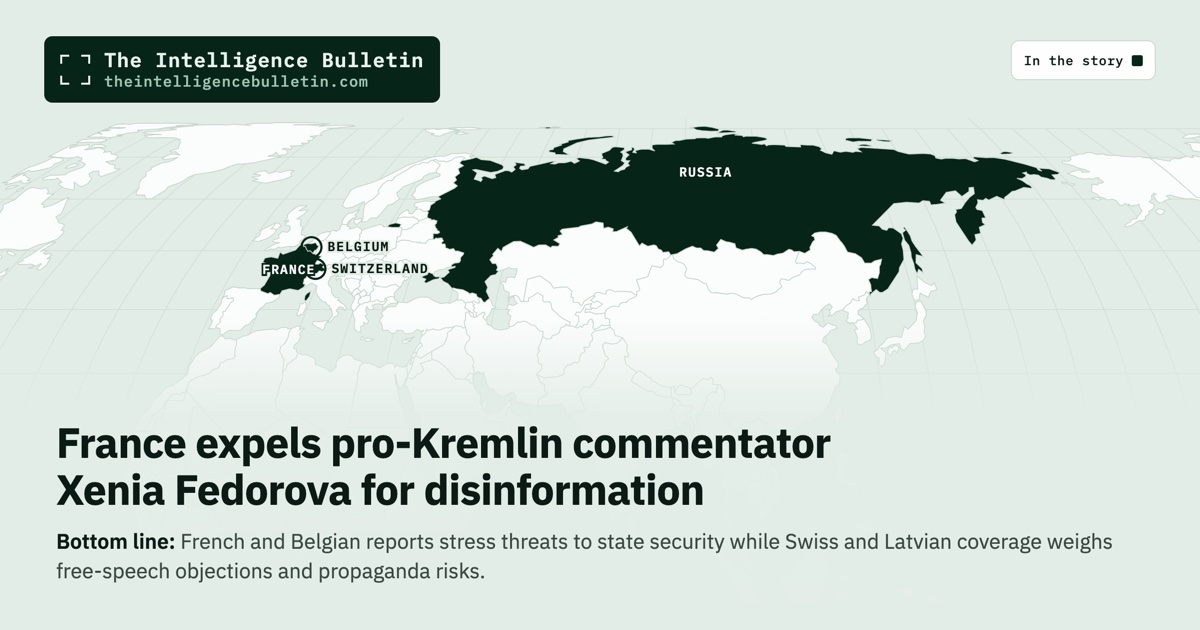
Map of the countries in the story: France expels pro-Kremlin commentator Xenia Fedorova for disinformation
France issued an expulsion order on July 29, 2026, against Russian commentator Xenia Fedorova, former RT France editor now working for Vincent Bolloré media outlets. The Interior Ministry cited her role relaying Kremlin disinformation campaigns to destabilize public order and threaten state interests. She plans to contest the order with support from Canal+ and Lagardère, who invoked press freedom; she is already banned from Germany.

One Story. Many Angles.

🇫🇷
France
Radio France
FRA
Kremlin propagandist in France, Russian commentator Xenia Fedorova targeted by expulsion order
“”Propagandiste” du Kremlin en France, la chroniqueuse russe Xenia Fedorova visée par un arrêté d’expulsion”
Read →
🇷🇺
Russia
The Moscow Times
France Orders Expulsion of Former RT Editor Ksenia Fedorova
Read →
🇧🇪
Belgium
La Libre
FRA
A pro-Russian commentator targeted by an expulsion order in France: Her behavior undermines the fundamental interests of the State
“Une chroniqueuse prorusse visée par un arrêté d’expulsion en France : “Son comportement porte atteinte aux intérêts fondamentaux de l’Etat””
Read →
🇨🇭
Switzerland
Le Temps
FRA
The pro-Russian commentator Xenia Fedorova targeted by an expulsion order for disinformation
“La chroniqueuse pro-russe Xenia Fedorova visée par un arrêté d’expulsion pour «désinformation»”
Read →
🇱🇻
Latvia
LSM
LAV
France will expel former Russia Today journalist; accused of spreading Russian propaganda
“Francija izraidīs bijušo «Russia Today» žurnālisti; apsūdz Krievijas propagandas izplatīšanā”
Read →
In Brief

French and Belgian reports stress threats to state security while Swiss and Latvian coverage weighs free-speech objections and propaganda risks.

France is drawing a harder line against Russian influence operations inside its borders. All five outlets describe the same expulsion order against Xenia Fedorova for acting as a conduit for Kremlin disinformation on French airwaves, yet their emphasis reveals how European states are calibrating the balance between security and expression. French Radio France and Belgian La Libre quote the ministry directly on threats to public order and fundamental state interests. Swiss Le Temps notes the employers’ free-speech objections and her assigned-residence status. Latvian LSM highlights the propaganda risk ahead of France’s 2027 presidential vote. The Moscow Times, an exiled Russian outlet, sticks to the facts of her past at RT and current Bolloré roles without adding persecution framing. The convergence shows the measure is treated as routine administrative action across Western Europe rather than a dramatic escalation, underscoring that governments now treat sustained pro-Kremlin commentary by non-citizens as a direct security issue.

Perspective Analysis

France ordered the expulsion of Russian commentator Xenia Fedorova on July 29, 2026, after the Interior Ministry determined that her work on French television and radio served as a conduit for Kremlin-orchestrated disinformation aimed at destabilizing public order. The order, first reported by Libération and confirmed by the ministry to AFP, states that her behavior “porte atteinte aux intérêts fondamentaux de l’Etat” and that her continued presence constitutes “une menace particulièrement grave et actuelle pour l’ordre public.” Fedorova, 45, previously led RT France until the European Union banned the channel in March 2022 following Russia’s full-scale invasion of Ukraine. She remained in France and secured regular appearances as a commentator on CNews and Europe 1, plus a column in Le Journal du Dimanche, all part of the media holdings of conservative billionaire Vincent Bolloré.

The ministry accused her of deploying narratives that relayed Russian authorities’ disinformation campaigns, manipulated public opinion, and undermined French and European citizens’ confidence in their institutions. The document explicitly links these activities to efforts to destabilize order inside France. Fedorova is already barred from Germany, according to a source close to the case. Since the order took effect she has been placed under house arrest and must report daily to a police station, which prevents her from working normally. Her lawyer, Emmanuel Piwnica, announced an immediate appeal and described the decision as a serious infringement on the freedom of expression of a journalist who had always conducted her work properly. Canal+ and Lagardère issued a joint statement supporting her and warning of “une atteinte particulièrement grave à la liberté d’expression et au pluralisme des opinions.”

This measure sits inside a longer pattern of European restrictions on Russian state media. RT France was shut down in 2023 after the initial EU-wide ban. Fedorova’s continued access to French airwaves through private channels had already drawn scrutiny. In May 2026 a controversy erupted over the ten-year renewal of her residence permit, with reports that she had gained influence inside the Bolloré group. Interior Minister Laurent Nuñez at the time said such renewals occur routinely for foreigners who meet the legal conditions and denied any special intervention. French President Emmanuel Macron and government spokespeople have repeatedly labeled her a “propagandiste” of the Kremlin. Eurodeputies from the Renew group have called for EU-level sanctions against her, citing her dissemination of “narratifs grossièrement manipulatoires” on the war in Ukraine and the European Union.

Fedorova’s defenders portray the expulsion as an attack on journalistic pluralism rather than a response to foreign interference. Her appearances have included claims that the West decided to prolong the Ukraine conflict and that Europe risks going to war with Russia. Several of her statements on CNews prompted complaints to France’s media regulator, which are still under review. The government has distinguished her activities from outright espionage but has drawn a line at content that it says harms fundamental national interests. The expulsion order does not accuse her of direct coordination with Russian intelligence services; it rests on the cumulative effect of her public commentary.

The five outlets that covered the story in the first 24 hours reported the same core sequence of events and quoted the same passages from the ministerial order. Radio France described her as the “propagandiste” du Kremlin whose expulsion would remove one of Russia’s main influence relays inside France. La Libre led with the order’s language on threats to state interests and added the detail of her existing German ban. Le Temps reported the disinformation charges alongside the house-arrest conditions and the employers’ objections. LSM stressed the propaganda risk and her potential influence ahead of France’s 2027 presidential election. The Moscow Times, an independent Russian newsroom operating in exile from Amsterdam, confined itself to the facts of the order, her past role at RT France, and her subsequent positions in the Bolloré outlets without additional editorial characterization.

No outlet in this set claimed that the French government fabricated the residence-permit renewal or that Fedorova faced criminal charges beyond the administrative expulsion. None disputed that she continues to appear on French media defending Russian positions on Ukraine. The accounts converge on treating the measure as an administrative action under existing immigration and public-order powers rather than a novel legal innovation. Minor differences appear only in emphasis: French and Belgian reporting foreground the security justification contained in the order itself, while the Swiss report gives equal weight to the free-expression objections raised by her employers and lawyer. The Latvian report adds context about upcoming French elections and regional concerns over Russian information operations. The exiled Moscow Times avoids both the security rhetoric and the persecution framing that state-controlled Russian media have used in other cases.

The French government’s account aligns most closely with the documented record. The ministerial order supplies explicit language tying Fedorova’s commentary to destabilization efforts, and her employment history at a banned state-funded network followed by continued pro-Kremlin commentary on private French outlets supplies the factual predicate. European states have already removed Russian state media from their airwaves and coordinated sanctions; extending administrative removal to individual non-citizen commentators who sustain the same line represents a logical next step in hardening information boundaries. Employers’ objections correctly note that the decision curtails her ability to speak on French media, yet they do not contest the accuracy of the ministry’s description of her content. The measure carries low political cost inside France and high demonstrative value toward Moscow, signaling that sustained foreign propaganda operations by non-citizens will no longer be tolerated even when routed through domestic private platforms.

What to Watch

Fedorova’s appeal will test whether French courts accept the government’s characterization of her work as a current and serious threat. If the order stands, it will likely encourage similar administrative actions elsewhere in the European Union against other non-citizen commentators who maintain close alignment with Kremlin narratives. The episode shows European governments moving beyond broadcast bans and financial sanctions to direct removal of individuals who function as persistent vectors of foreign information operations.


Share this story