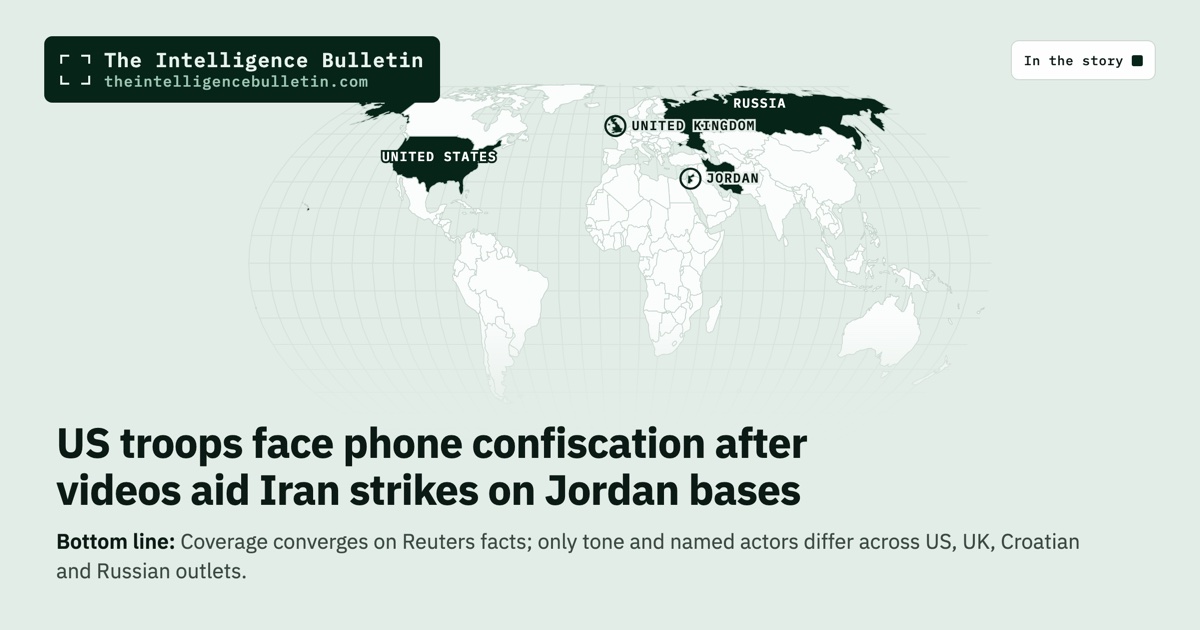
US troops face phone confiscation after videos aid Iran strikes on Jordan bases

Map of the countries in the story: US troops face phone confiscation after videos aid Iran strikes on Jordan bases
US Central Command chief Adm. Brad Cooper warned troops that videos from their phones posted online allow Iran to judge strike success in near real time. Sources say some personnel in Jordan may soon be ordered to hand over devices. The measure follows Iranian attacks on bases including Muwaffaq Salti Air Base and comes amid 18 US deaths since fighting resumed in February.

One Story. Many Angles.

🇺🇸
United States
Air Force Times
US military may require some troops in Mideast to surrender cell phones, sources say
Read →
🇬🇧
United Kingdom
Daily Mail
Trump’s top general has chilling message for US troops using their cellphones on Middle East bases
Read →
🇭🇷
Croatia
Dnevnik
BOS
Strict ban in US bases: Soldiers’ phones taken so they don’t help the enemy
“Stroga zabrana u američkim bazama: Vojnicima oduzimaju mobitele kako ne bi pomagali protivniku”
Read →
🇷🇺
Russia
RIA Novosti
RUS
US military in the Middle East may soon lose phones, media write
“Военные США на Ближнем Востоке вскоре могут лишиться телефонов, пишут СМИ”
Read →
In Brief

Coverage converges on Reuters facts; only tone and named actors differ across US, UK, Croatian and Russian outlets.

All four outlets rest on the identical Reuters dispatch detailing Adm. Brad Cooper’s July 28 letter and the Jordan phone-confiscation reports. Air Force Times delivers the plain operational-security facts. Daily Mail adds Trump’s name and calls the warning chilling. Dnevnik stresses how footage directly aids Iranian targeting. RIA Novosti frames it as Western media reporting without local stakes. The convergence shows the story’s core is uncontested open-source intelligence risk rather than routine force protection, yet the absence of any Iranian or Jordanian outlet leaves the adversary perspective and base-host reaction unvoiced in this pool.

Perspective Analysis

The top U.S. commander for the Middle East has told troops that videos from their cell phones, once posted online, let Iran judge in near real time whether its strikes on American bases succeeded or missed. Adm. Brad Cooper, head of U.S. Central Command, made the warning in a July 28 letter obtained by Reuters. He noted that Iran normally struggles to assess damage because of U.S. electronic jamming and other battlefield tactics. Without those countermeasures working perfectly against open-source material, Iranian forces receive free battle-damage assessments from news reports, social-media posts, and footage shot by service members themselves.

Cooper pointed to one concrete case. A video recorded on Meta smart glasses during an Iranian missile and drone attack on Muwaffaq Salti Air Base in Jordan on July 17 showed troops running for shelter and entering a bunker. The clip appeared on Instagram. Cooper wrote that such footage reveals exactly where and how personnel evacuated, information that lets Iran calibrate follow-on strikes. He added that detailed public lists of what was hit perform Iran’s battle-damage assessment for free. Any secondary wave of attacks enabled by that information, he said, carries a direct cost in American lives and in the safety of civilians in targeted Gulf countries. The letter called on troops to redouble operational-security efforts but did not spell out new rules at that stage.

Sources familiar with the matter told Reuters that in Jordan, already a frequent target of Iranian strikes, some troops have been notified that their phones will be confiscated in the coming days. A third source said the possibility is under consideration across the region because of the same security concerns. Rules on personal devices have long varied by unit and mission. Special-operations forces already lock phones away on sensitive tasks. What is new is the prospect of broader, preemptive seizure tied to real-time intelligence leaks in an ongoing conflict.

That conflict began on February 28. Eighteen U.S. troops have been killed and more than 600 wounded. Public support inside the United States stands at roughly one in three Americans. Families of deployed personnel already receive Iranian claims of successful strikes on bases across the Middle East; the added prospect of losing phone contact has increased their anxiety, according to the same sources. Officials have warned for years that fitness apps and other location-data services on commercial phones can be harvested by adversaries. Cooper’s letter now links that long-standing technical vulnerability to the immediate problem of strike assessment.

The measure, if carried out, changes the baseline assumption that troops in the theater can maintain routine contact with home while deployed. Many rely on phones for occasional messages that reassure families they are safe. Removing those devices adds friction to daily life in forward positions and signals that open-source intelligence has become a measurable factor in Iranian targeting cycles.

All four published accounts rest on the identical Reuters dispatch that first reported Cooper’s letter and the Jordan confiscation reports. They share the same core details: the July 28 date of the letter, the Meta-glasses video from the July 17 Jordan attack, the 18 deaths and 600-plus wounded, and the warning that public disclosures perform battle-damage assessment for Iran at no cost. Where the accounts differ is in the additional framing each outlet chose to attach to that shared material. One outlet inserted references to President Trump and described the general’s message as chilling while noting family unease. Another stressed the direct benefit to Iranian targeting and headlined the risk that footage helps the opponent. A third presented the development as Western media reporting on U.S. measures and supplied extra background on the conflict’s recent resumption after a June ceasefire collapsed. The fourth stayed closest to the original dispatch without those additions.

The convergence itself is the clearest signal. No outlet disputes the existence of the letter, the specific video example, the Jordan confiscation reports, or the mechanism by which open-source material aids Iranian assessment. The differences lie in tone and in which secondary elements each outlet chose to highlight, not in competing versions of what happened. Because every account traces back to the same Reuters reporting, none supplies an independent verification or contradiction. The absence of any Iranian or Jordanian outlet in the selected coverage leaves the receiving side’s perspective on the measure unrepresented here.

What to Watch

The Reuters-sourced account is the one closest to the operational record because it originates with the commander who issued the warning and with sources inside the affected commands. Outlets that add political references or dramatic adjectives layer interpretation on top of that record without altering its substance. The practical next step is likely implementation of phone restrictions at the highest-risk sites first, beginning with Jordan bases that have already been struck. That step will test whether the loss of routine personal communication measurably reduces the flow of useful imagery to Iranian planners. If the pattern of strikes continues, similar restrictions could spread to other locations in the theater. The episode shows how commercial devices and public platforms have become active variables in targeting decisions rather than background noise.
Share this story

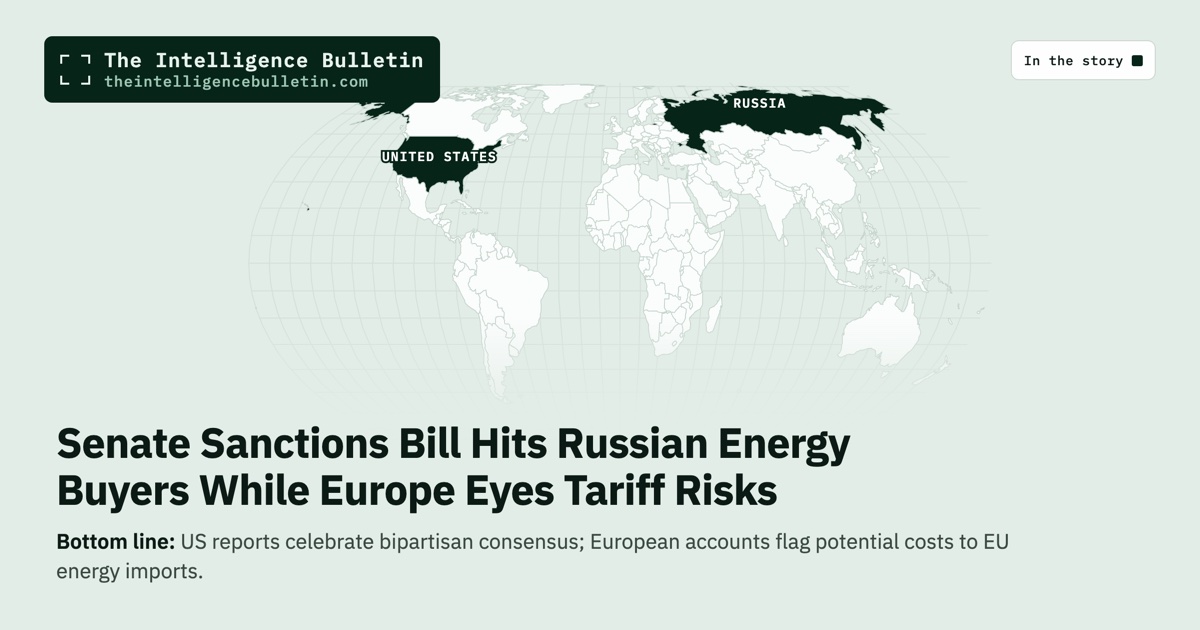
Senate Sanctions Bill Hits Russian Energy Buyers While Europe Eyes Tariff Risks

Map of the countries in the story: Senate Sanctions Bill Hits Russian Energy Buyers While Europe Eyes Tariff Risks
The US Senate voted 86-12 on July 28 to advance the Lindsey Graham Russia sanctions bill during Ukrainian President Zelenskyy’s Washington visit for the late senator’s funeral. The measure authorizes tariffs up to 100 percent on top purchasers of Russian oil and gas, including China and India, plus expanded sanctions on Moscow’s financial networks and shadow fleet. Trump backed the bill after Iran provisions were added. The vote remains a procedural step before final passage and House action.

One Story. Many Angles.

🇺🇦
Ukraine
Kyiv Post
US Senate Votes on Graham Russia Sanctions Bill During Zelensky Visit
Read →
🇺🇸
United States
Radio Free Europe/Radio Liberty
US Senate Backs Landmark Russia Sanctions Bill After Zelenskyy’s Capitol Appeal
Read →
🇮🇪
Ireland
RTÉ
US Senate advances Russia sanctions as Zelensky visits
Read →
🇺🇸
United States
EA WorldView
Ukraine War, Day 1,617: US Senate Advances Russia Sanctions Bill
Read →
🇩🇪
Germany
taz
DEU
Zelenskyy and Netanyahu in Washington: Mixed Feelings
“Selenskyj und Netanjahu in Washington: Gemischte Gefühle”
Read →
In Brief

US reports celebrate bipartisan consensus; European accounts flag potential costs to EU energy imports.

The Senate’s 86-12 procedural vote on the Graham sanctions package reveals unusually broad US backing for tightening economic pressure on Russia exactly when Zelenskyy was in town to press for battlefield support and air defense. US outlets such as RFE/RL and EA WorldView stress the bipartisan consensus and the bill’s potential to cut Moscow’s war revenues more effectively than frontline moves, framing it as a tribute to Graham that pairs sanctions with ongoing Patriot talks. Kyiv Post ties the timing directly to Zelenskyy’s presence and the bill’s role as a lifeline for Ukraine’s defense industry. European reporting diverges in emphasis: RTÉ flags the tariff authority’s possible bite on EU energy buyers, while taz places the vote inside a wider Washington visit that also featured Netanyahu and notes Europe’s heavier lifting on Ukraine aid compared with shifting US priorities. The shared factual core across all five pieces is that the bill now targets the largest Russian energy customers to starve Putin’s finances, yet only the European sources surface the downstream risk to transatlantic energy flows.

Perspective Analysis

The US Senate voted 86 to 12 on July 28 to move forward with legislation that would authorize tariffs as high as 100 percent on the largest remaining buyers of Russian oil and gas. The measure, now called the Lindsey O. Graham Sanctioning Russia and Iran Act of 2026, targets the revenues that continue to finance Moscow’s war effort more than four years after the full-scale invasion of Ukraine. It also expands sanctions on Russian officials, oligarchs, banks, financial institutions and the vessels in the so-called shadow fleet that evade existing restrictions. The vote occurred on the same day as the funeral of Senator Lindsey Graham, the bill’s chief architect, who died on July 11, and while Ukrainian President Volodymyr Zelenskyy was in Washington for that service and meetings with US officials.

Zelenskyy attended the closed-door session with more than 60 senators before watching the procedural vote from the chamber. He described the legislation as important both for the money it would deny Russia and for the signal it would send to Europe and to Ukraine itself. Earlier that day he met President Donald Trump in the Oval Office and discussed licenses for domestic production of Patriot air-defense interceptors along with other ideas to strengthen Ukraine’s defense industry. Trump had backed the sanctions package once provisions extending sanctions authority against Iran through 2031 were added. The revised bill gives the president authority to impose the steep tariffs on the five largest importers of Russian crude or natural gas and on the top five countries that help Russia evade energy sanctions. China and India are repeatedly identified as the principal targets. A separate provision would allow duties up to 500 percent on goods imported directly from Russia.

The Senate action remains only a first procedural hurdle. Lawmakers must still clear additional votes on the measure itself, after which the House would need to act. The House is not scheduled to resume regular business until September. Senators from both parties presented the 86-12 tally as evidence of rare bipartisan agreement that economic pressure remains one of the strongest available tools against Moscow. Republican Jim Risch, chairman of the Senate Foreign Relations Committee, said the legislation had been negotiated with the White House and that both Zelenskyy and Finnish President Alexander Stubb told senators it could have an impact equal to or greater than developments on the battlefield. Democratic Senator Richard Blumenthal called the vote a solid demonstration that Ukraine’s fight is America’s fight and warned Putin that his days of war are numbered. Other senators, including Jeanne Shaheen and Katie Britt, framed the step as both a tribute to Graham and a practical effort to stop foreign purchases of Russian energy from funding the war machine.

The legislation narrows earlier drafts that would have applied even steeper tariffs more broadly. Backers said the current text is crafted to avoid punishing US allies while concentrating pressure on the main purchasers that still generate revenue for Moscow. Recent US tariffs on India were cited as evidence that the approach can reduce purchases. At the same time, some Democrats have expressed concern that the broad tariff authority granted to the president could raise costs for American consumers and affect trading partners that still rely in part on Russian energy supplies. Representative Gregory Meeks warned that the bill functions more as backdoor tariff authority than as a straightforward sanctions measure.

European reporting on the same events notes the same core provisions but places greater weight on the downstream consequences for energy buyers that include EU member states. The tariff language leaves the president discretion to adjust or lift the duties depending on whether targeted countries reduce their Russian energy purchases. This flexibility is presented as carrying risks for European energy security at a time when the continent has already worked to diversify away from Russian supplies. Coverage from Germany situates the Senate vote inside Zelenskyy’s wider Washington schedule, which also included a meeting with Israeli Prime Minister Benjamin Netanyahu, and observes that Europe continues to supply the bulk of Ukraine’s financial and military assistance packages even as US policy toward the conflict shows signs of recalibration.

The same sources record that Zelenskyy used his Senate meeting to stress Ukraine’s urgent need for additional air-defense systems capable of countering ballistic missiles, alongside expanded production of weapons to defeat Iranian-made Shahed drones and Russian unmanned aircraft. He met separately with representatives of Lockheed Martin, one of the manufacturers of the Patriot system, to discuss joint production possibilities. These military discussions occurred against the backdrop of the sanctions vote and were presented as complementary tracks: one aimed at cutting Russian funding and the other at strengthening Ukraine’s own defensive capacity.

Coverage across the outlets converges on the factual sequence and on the bill’s stated purpose of depriving Moscow of energy revenues. The 86-12 margin, the timing with Graham’s funeral, the addition of Iran provisions, the identification of China and India as primary targets, and Zelenskyy’s presence are reported consistently. No account disputes that the legislation still faces further Senate and House steps or that the tariff authority is discretionary rather than automatic. Where the accounts differ is in the relative prominence given to potential effects on European energy costs versus the domestic political significance of the bipartisan tally. Reports from Ireland and Germany explicitly flag the possibility that tariffs could reach EU trading partners and note Democratic reservations on that point. US-based accounts give more space to senators’ statements that the measure represents a strategic escalation capable of influencing negotiations and to the procedural momentum it creates ahead of the House recess.

What to Watch

The European emphasis tracks the bill text itself, which grants the president unilateral authority over tariffs that could be applied to any of the listed major purchasers, including countries inside or aligned with the EU. The US emphasis tracks the actual vote count and the repeated bipartisan statements that the legislation honors Graham while advancing a shared goal of increasing the economic cost of Russia’s campaign. Both sets of observations are grounded in the same legislative language and the same public remarks by senators and Zelenskyy. The next concrete development will be whether the measure clears its remaining Senate hurdles before the August recess and whether House leadership schedules it promptly in September. If it reaches the president’s desk in its current form, the discretionary tariff power it creates will determine how sharply it affects both Russian energy income and the energy costs faced by major purchasers outside Russia.


Share this story

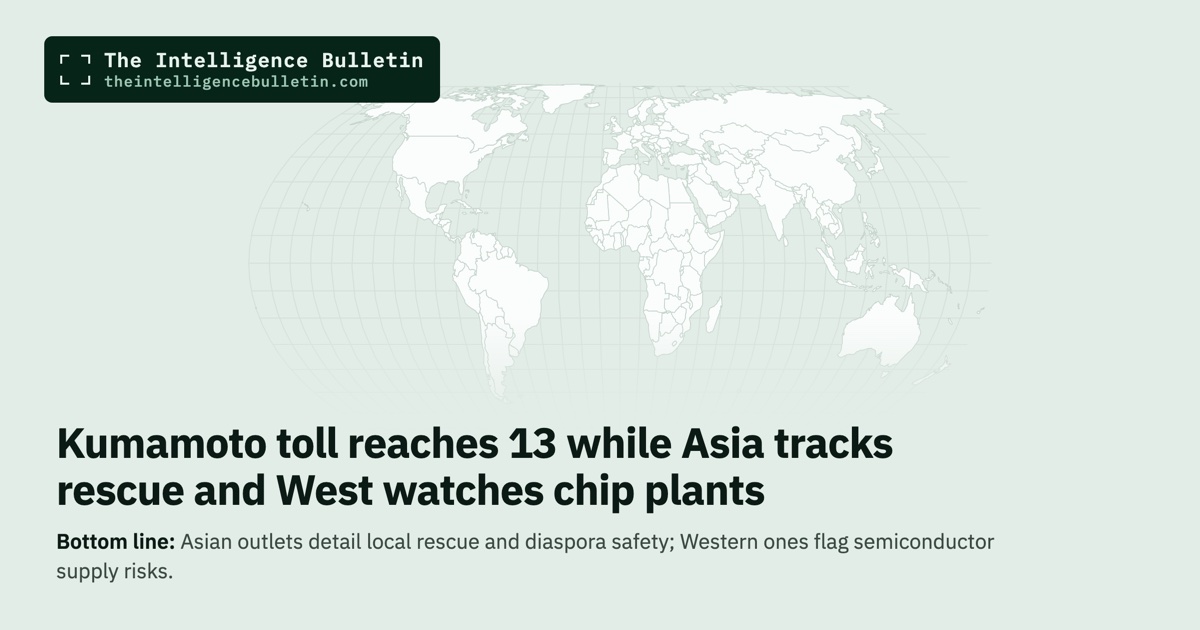
Kumamoto toll reaches 13 while Asia tracks rescue and West watches chip plants

Map of the countries in the story: Kumamoto toll reaches 13 while Asia tracks rescue and West watches chip plants
A magnitude 7.1 earthquake struck Kumamoto Prefecture on July 28, 2026, killing at least 13 people including two women in an Aeon mall explosion and one in a building collapse. Rescuers searched the mall and a paper factory for survivors while over 300,000 people evacuated amid aftershocks and power outages. Prime Minister Sanae Takaichi coordinated the response as factories of Toyota, Honda, Sony and TSMC halted operations.

One Story. Many Angles.

🇯🇵
Japan
The Asahi Shimbun
Japan quake kills at least two after blast at Kumamoto mall, one in building collapse | The Asahi Shimbun: Breaking News, Japan News and Analysis
Read →
🇬🇧
United Kingdom
The Guardian
Japan earthquake injures 50 and traps ‘many people’ inside shopping mall | Asia Pacific
Read →
🇩🇪
Germany
Deutsche Welle
Japan: Rescuers ‘race against time’ after deadly earthquake
Read →
🇹🇼
Taiwan
Taipei Times
Japan 7.1 quake: Many feared trapped in mall
Read →
🇻🇳
Vietnam
Vietnam News
Vietnamese community remains safe after Japan quake
Read →
In Brief

Asian outlets detail local rescue and diaspora safety; Western ones flag semiconductor supply risks.

Japanese and regional outlets zero in on the mechanics of recovery inside an earthquake-hardened nation still scarred by the 2016 Kumamoto disaster. Asahi details joint fire, police and SDF operations at the Aeon mall and Yatsushiro factory, Prime Minister Takaichi’s Tokyo briefings and the absence of nuclear-plant problems. Taipei Times records Taiwan’s foreign ministry confirming no nationals harmed and offering relief help, underscoring neighbor-to-neighbor preparedness. Vietnam News reports its embassy confirming 1,330 workers and students safe. Western coverage adds a different layer: Deutsche Welle calls the effort a ‘race against time’ and flags Sony and TSMC plants, while The Guardian notes evacuations at those same sites without deeper economic follow-through. The pattern shows Asia-Pacific media treating the quake as a domestic test of systems already in place; Western reports treat the same facts as a potential global supply-chain alert.

Perspective Analysis

A magnitude 7.1 earthquake struck Kumamoto Prefecture on July 28, 2026, at 4:27 p.m. local time, killing at least 13 people and leaving others trapped under rubble at an Aeon shopping mall and a paper factory. The epicenter lay about 20 kilometers south of Kumamoto city on the southern island of Kyushu. Japanese authorities recorded the highest intensity of 7 on the national shindo scale, with the tremor felt across multiple prefectures and followed by more than 60 aftershocks, one of them magnitude 6.1.

Prime Minister Sanae Takaichi convened a disaster-response task force the same evening and told reporters that damage assessments were ongoing. She noted injuries, power outages, fires, collapsed buildings, and disrupted roads and bridges. By the next morning her government reported that rescuers had pulled eight people from the Aeon mall in Kashima town after an explosion tore away one side of the structure. Two women in their twenties died there; a third person was found in cardiopulmonary arrest. One additional death occurred in a separate building collapse near the epicenter. At the Nippon Paper Industries factory in Yatsushiro, a chimney collapsed and trapped eleven workers; two were later confirmed without vital signs. Hospitals in the region treated more than one hundred injured people, some with burns and fractures.

More than 300,000 residents received orders to evacuate, and by dawn on July 29 roughly 9,000 people had reached 506 designated centers across five prefectures. Kyushu Electric Power reported 45,000 to 48,000 households without electricity. Rail services, including bullet trains, halted, a train derailed at Yatsushiro station, and Kumamoto airport closed its runway before reopening later that night. Stone walls at the historic Kumamoto Castle sustained further damage on top of repairs still underway from the 2016 quakes that killed 273 people in the same region.

Rescue teams from fire departments, police, and the Self-Defense Forces concentrated on areas inside the mall where calls for help had been heard. The explosion followed the initial shaking; mall staff reported smelling gas before the blast, and investigators treated a possible gas leak as the leading explanation. At the paper factory, operations stopped immediately. Toyota suspended production at three Kyushu plants for safety checks and planned to resume the following day. Honda and Nippon Paper also halted work. Sony, Fujifilm, and TSMC evacuated employees from their facilities; TSMC later stated its site sustained no damage and began gradual resumption. Tokyo Electron suspended operations at its two Kumamoto plants through July 29. No irregularities appeared at nearby nuclear power stations, according to the Nuclear Regulation Authority.

The Japan Meteorological Agency warned residents to remain alert for strong aftershocks and landslides for roughly one week. Temperatures were forecast to reach 34 degrees Celsius the next day, raising heatstroke risks for those in evacuation centers. A brief tsunami advisory was issued and lifted within hours because the quake occurred inland.

Taiwan’s Ministry of Foreign Affairs reported that its office in Fukuoka had contacted all known Taiwanese nationals in the affected area and confirmed none were injured or required assistance. The ministry stated it stood ready to provide post-disaster relief if requested. Vietnam’s embassy in Tokyo contacted labor unions and companies employing about 1,330 Vietnamese workers and trainees in Kumamoto and nearby prefectures; none reported casualties or serious damage. Vietnamese students in the region likewise remained in contact with one another and confirmed their safety.

The accounts diverge most clearly on what the event reveals beyond immediate casualties and rescues. Deutsche Welle described the operation as a race against time and explicitly named Sony and TSMC plants among the industrial facilities at stake, framing the disruption in terms of global semiconductor supply. The Guardian noted evacuations at the same plants but did not develop the economic angle further. Asahi Shimbun provided the most detailed local sequence of rescue deployments, exact casualty figures from the mall and factory, and repeated assurances about nuclear facilities. Taipei Times recorded the Taiwanese foreign ministry’s statements on citizen welfare and the offer of assistance, along with comparisons to the 2016 disaster. Vietnam News limited its reporting to embassy confirmation that Vietnamese nationals were unharmed and made no reference to broader rescue operations or industrial impacts.

These differences are not contradictions on the facts themselves. Every source reported the same core sequence of the mall explosion, the factory collapse, the prime minister’s public statements, and the absence of nuclear problems. The divergence lies in emphasis once those facts are established. Japanese and Taiwanese reporting stays inside the mechanics of government coordination, military mobilization of 3,600 personnel and 20 aircraft, and neighbor-state diplomatic readiness. Vietnamese coverage stays inside the embassy’s consular checklist. Western European outlets add the observation that several of the halted factories produce components central to global electronics supply.

The Japanese account supplies the most complete operational picture of how a major economy with repeated seismic experience actually moves resources on the ground. It records joint command at the mall, specific evacuation-center counts, and the precise status of power restoration and rail suspension. Western reports correctly identify the semiconductor plants but do not contradict or add new operational details; they simply place the same verified shutdowns inside a supply-chain frame. The Taiwanese and Vietnamese pieces correctly document the absence of harm to their nationals and the diplomatic posture that follows, facts that do not appear in the other accounts but do not conflict with them.

What to Watch

The next phase will test whether the systems described in the Japanese reporting hold under aftershocks and summer heat. Factories that suspended operations will resume only after safety inspections; any prolonged delay at the semiconductor sites will register in global chip markets. Residents ordered to evacuate will decide whether to return or remain in centers once the immediate danger assessment is complete. The pattern of coverage already shows that readers relying solely on one national press will miss either the granular domestic command structure or the downstream economic exposure that follows from the same physical damage.


Share this story

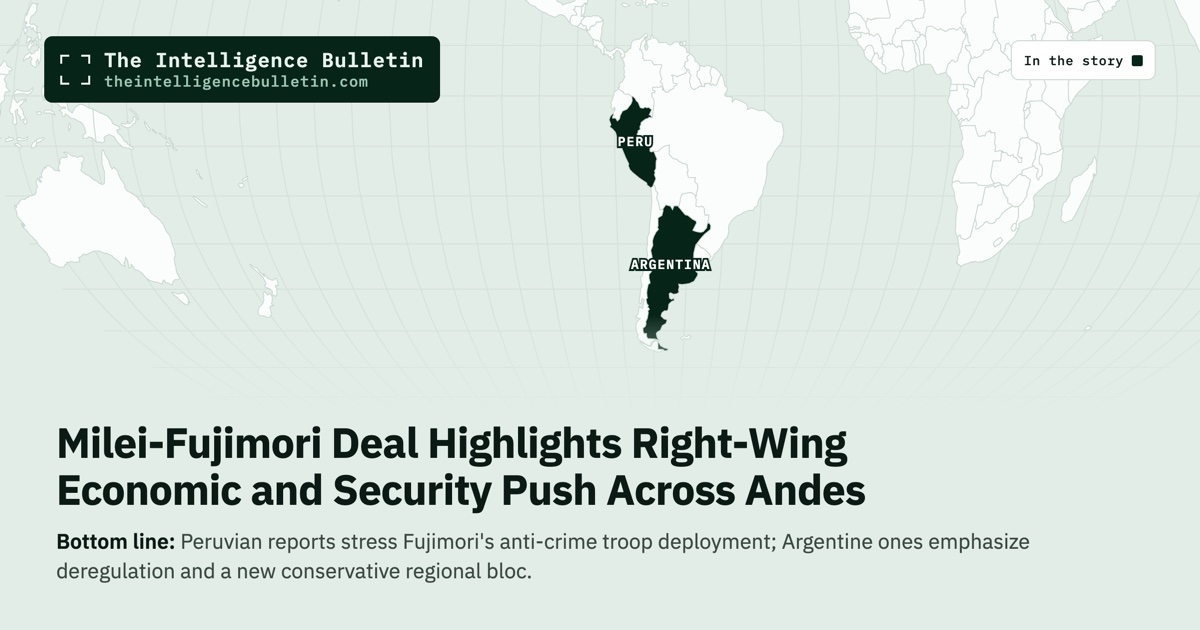
Milei-Fujimori Deal Highlights Right-Wing Economic and Security Push Across Andes

Map of the countries in the story: Milei-Fujimori Deal Highlights Right-Wing Economic and Security Push Across Andes
Argentine President Javier Milei met Peru’s incoming President Keiko Fujimori in Lima on July 28, 2026, before her inauguration. They agreed to deepen bilateral ties in economy, security, science and technology. Fujimori later announced armed forces would help fight crime during emergencies. The encounter occurred amid a diplomatic spat between Argentina and Brazil.

One Story. Many Angles.

🇵🇪
Peru
La República
SPA
Milei seeks to be the regional right-wing leader after meeting with Keiko Fujimori: this is how the Argentine press reacts to the inauguration in Peru
“”Milei busca ser el líder de la derecha regional” tras reunirse con Keiko Fujimori: así reacciona la prensa argentina a la investidura en Perú | acuerdos de reunión entre Milei y Keiko Fujimori en Lima | nuevo gabinete de keiko fujimori | Mundo”
Read →
🇦🇷
Argentina
MercoPress
Milei and Fujimori meet in Lima and agree to strengthen economic and security cooperation
Read →
🇦🇷
Argentina
El Día
SPA
Javier Milei held a bilateral meeting with Keiko Fujimori, the president-elect of Peru
“Javier Milei mantuvo una reunión bilateral con Keiko Fujimori, la presidenta electa del Perú”
Read →
🇦🇷
Argentina
La Verdad Online
SPA
Javier Milei met in Lima with Fujimori on the eve of the presidential inauguration
“Javier Milei se reunió en Lima con Fujimori en la antesala de la asunción presidencial”
Read →
🇵🇪
Peru
Gestión
SPA
Keiko Fujimori assumes one of the riskiest political positions in Latin America as Peru’s new president, by Bloomberg
“Keiko Fujimori asume uno de los cargos políticos más riesgosos de América Latina como nueva presidenta de Perú, por Bloomberg | PERU”
Read →
In Brief

Peruvian reports stress Fujimori’s anti-crime troop deployment; Argentine ones emphasize deregulation and a new conservative regional bloc.

The meeting between Milei and Fujimori produced a concrete agreement on economic and security cooperation that Argentine outlets like MercoPress presented as the start of a right-wing regional grouping. Peruvian coverage in Gestión instead stressed the high political risks Fujimori faces and her pledges to deploy troops against organized crime. La República, also Peruvian, tracked how Argentine media portrayed Milei as seeking leadership of a conservative Latin American bloc to counter Lula. Argentine domestic reports from El Día and La Verdad Online focused on the pre-inauguration timing and Milei’s goal of tighter bilateral links while listing other conservative presidents present. The pattern shows genuine convergence on right-wing coordination rather than uniform Western dismissal, with the clearest split inside Peru between domestic risk warnings and the regional-leadership lens applied to Milei’s visit.

Perspective Analysis

Argentine President Javier Milei met Peru’s incoming president Keiko Fujimori in Lima on July 28, 2026, hours before her inauguration, and the two leaders reached an explicit agreement to strengthen bilateral cooperation in the economy, security, science, technology and innovation. The encounter took place at the Torre Tagle Palace, Peru’s foreign ministry headquarters, and marked their first official contact. Milei traveled with his sister and presidential secretary general Karina Milei plus Foreign Minister Pablo Quirno. On the Peruvian side Foreign Minister Carlos Espá joined the talks. According to Peru’s Foreign Ministry the leaders highlighted deep historical ties between the two countries and identified the listed areas as strategic priorities for joint work.

Fujimori had won election in June by fewer than 50,000 votes over her left-wing opponent. She took office for the 2026-2031 term after four previous attempts. In her address to Congress she set citizen security and preparation for the El Niño phenomenon as top priorities and announced that the armed forces would temporarily assume internal control during states of emergency to confront organized crime. The inauguration drew presidents from Uruguay, Chile, Paraguay, Bolivia, Ecuador, Panama and Honduras along with Spain’s King Felipe VI and the United States Deputy Secretary of State. Mexico, Brazil and Venezuela sent no high-level representatives. The previous evening Fujimori hosted a private dinner at the Larco Museum attended by several regional conservative figures and former presidents.

The meeting occurred while Milei faced a diplomatic crisis with Brazil. His participation days earlier in an event backing Senator Flávio Bolsonaro’s presidential candidacy prompted Brazil to recall its ambassador in Buenos Aires and summon Argentina’s representative in Brasília. Within Milei’s circle the possibility of building a regional grouping of right-wing governments was discussed, drawing on Fujimori’s victory and the upcoming inauguration of another conservative leader in Colombia. One official source compared the aspiration to a possible revival of the Lima Group, though no formal initiative was announced. Milei had previously referred to a “blue wave” across the continent.

Fujimori’s narrow victory and the presence of multiple conservative heads of state gave the Lima gathering the character of an informal summit of like-minded leaders. Milei and Fujimori exchanged cordial remarks during the session, with Fujimori telling Milei it was an honor to receive him and Milei replying that they had many friends in common. Argentine coverage recorded Milei describing Fujimori as an inspiration. The Argentine leader’s delegation also attended the formal handover ceremony and related events, including a distinction awarded to Milei by a Peruvian university.

The core bilateral outcome—an agreement to expand cooperation across economy and security—received direct confirmation in multiple accounts. Fujimori’s subsequent public commitment to deploy the armed forces against crime aligned with the security dimension of the talks. Milei’s trip took place against the backdrop of his own economic program in Argentina, which emphasized deregulation and market reforms. Peruvian reporting noted Fujimori’s selection of an ex-central bank official as economy minister and the improved investor sentiment that followed her election.

Coverage from the two countries converged on the existence of the cooperation agreement and on the broader pattern of right-leaning electoral results in the region. Multiple Argentine reports described the encounter as part of an effort to consolidate a conservative network that could counterbalance left-leaning governments, particularly Brazil under Luiz Inácio Lula da Silva. They listed the attending conservative presidents and noted the absence of high-level Brazilian, Mexican and Venezuelan representation. Peruvian reporting, by contrast, placed greater weight on the domestic challenges Fujimori inherits, including a polarized Congress where her party secured a slim majority in the upper house but faces an opposition-controlled lower house. It emphasized the historical pattern of Peruvian presidents facing removal, imprisonment or investigation and highlighted Fujimori’s campaign pledges on border control and deportation of criminal migrants.

Two Argentine outlets published near-identical accounts that focused on the pre-inauguration timing and Milei’s stated goal of tightening bilateral links while positioning himself among regional conservative leaders. A separate Argentine English-language service reported the explicit cooperation agreement and added context on the possible right-wing grouping. A Peruvian business outlet reproduced an analysis that stressed the political risks of Fujimori’s position, her narrow electoral margin and the need for alliances in a fragmented legislature. Another Peruvian outlet examined how Argentine media interpreted the meeting as Milei accelerating a project to lead a regional right-wing bloc.

The accounts differ most clearly on emphasis rather than on contested facts. No report disputed the holding of the meeting, the listed areas of cooperation, Fujimori’s announcement on military involvement in security, or the attendance list of conservative presidents. The Peruvian business analysis foregrounded governance risks and Fujimori’s security agenda without detailing the bilateral agreement language. Argentine reporting foregrounded the agreement language and the regional right-wing attendance pattern while treating the Brazil dispute as relevant context for Milei’s positioning. The Peruvian outlet that tracked Argentine media reactions recorded phrases such as Milei seeking to become “the leader of the regional right” and efforts to “fortify the Latin American right,” without endorsing or contesting those characterizations.

The reports that recorded the specific cooperation commitments and the presence of other conservative presidents align most closely with the verifiable bilateral outcome and the documented pattern of attendance. Those details come from the foreign ministry statement and the inauguration guest list, both of which multiple independent accounts reproduced without contradiction. Peruvian domestic reporting that centers Fujimori’s troop-deployment pledge and economic-minister choice captures real local stakes in a country that has seen repeated presidential turnover. Yet that focus leaves the cross-border coordination element less developed even though the same Peruvian sources acknowledge the meeting occurred and listed the same cooperation areas. Argentine reporting that places the agreement inside a wider right-wing network draws on the same guest list and the same official statements about possible future groupings.

What to Watch

The agreement itself supplies the clearest evidence that coordination is under way. Milei and Fujimori identified concrete fields for joint work at a moment when both governments pursue market-oriented policies and stricter security measures. The pattern of conservative presidents traveling to Lima while Brazil, Mexico and Venezuela stayed away indicates a realignment that existing left-leaning regional structures have not contained. US representation at deputy-secretary level rather than presidential level further distances the event from any simple US-centric script. What happens next depends on whether the Lima Group-style initiative discussed in Argentine circles moves from aspiration to formal steps and whether Fujimori can assemble the congressional majorities needed to advance the security and economic measures she outlined on inauguration day.


Share this story

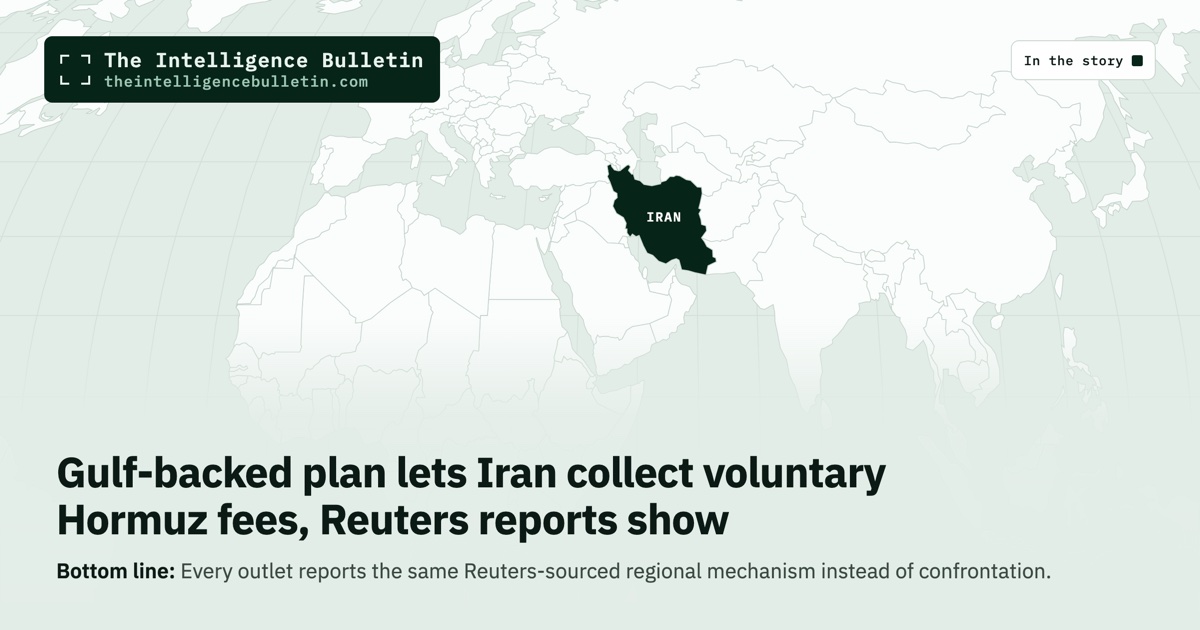
Gulf-backed plan lets Iran collect voluntary Hormuz fees, Reuters reports show

Map of the countries in the story: Gulf-backed plan lets Iran collect voluntary Hormuz fees, Reuters reports show
Oman proposed a joint regional mechanism for the Strait of Hormuz involving Iran and Gulf states, with voluntary service fees modeled on the Malacca Strait. The plan has Gulf backing and aims to manage navigation, security and environmental costs without granting Iran sole control. Iran has not yet responded. The proposal emerges amid ongoing US-Iran tensions and shipping disruptions.

One Story. Many Angles.

🇴🇲
Oman
Muscat Daily
Regional consortium proposed to manage Strait of Hormuz
Read →
🇸🇦
Saudi Arabia
Arab News
Oman proposes regional mechanism with voluntary fees to manage Strait of Hormuz
Read →
🇮🇱
Israel
Ynet News
Gulf-backed Oman plan would let Iran collect ‘voluntary fees’ in Hormuz, sources say
Read →
🇺🇸
United States
Al-Monitor
Explainer-Why is Oman proposing a new plan to manage the Strait of Hormuz?
Read →
🇵🇰
Pakistan
The Express Tribune
Oman presents Iran with Gulf-backed plan for voluntary fees to use Hormuz
Read →
In Brief

Every outlet reports the same Reuters-sourced regional mechanism instead of confrontation.

Reuters wire reporting dominates every account in this set, producing near-identical core facts: Oman delivered the plan over the weekend, Gulf states endorse it, fees remain voluntary and Iran has yet to reply. That uniformity itself signals the story. Omani and Saudi outlets frame the move as a pragmatic regional success that keeps the waterway under littoral control rather than unilateral Iranian authority. The Israeli account stresses the same point but foregrounds the loss of Tehran’s sole grip and the sanctions-evasion risks any revenue stream might create. Al-Monitor adds legal and historical context on why Oman revived the Malacca precedent and what each side actually demands. Pakistani coverage stays with the diplomatic handoff and energy-route stability. Across the board the expected clash narrative gives way to a quiet diplomatic track that treats fees as a service charge, not leverage or sanctions relief.

Perspective Analysis

Oman presented Iran last weekend with a Gulf-endorsed plan to place the Strait of Hormuz under a regional consortium that would collect only voluntary service fees from transiting ships. The mechanism would divide the waterway into three navigation corridors—one through Iranian territorial waters, one through Omani waters, and one international shipping lane—while leaving the strait itself toll-free. Ships would be invited, not required, to pay contributions to fund navigation safety, environmental protection, and search-and-rescue operations, modeled directly on the existing arrangement in the Strait of Malacca operated by Indonesia, Malaysia, and Singapore. Iran would assume responsibility for mine-clearance operations along the international corridor, though technical details remain under negotiation. A senior Gulf source briefed on the talks told Reuters that the proposal explicitly prevents Iran from exercising sole control over the waterway.

The plan reached Tehran during multiple rounds of Omani-Iranian discussions held there on Friday and Saturday. Iranian Foreign Minister Abbas Araghchi spoke by telephone with his Omani counterpart, Sayyid Badr bin Hamad Al Busaidi, and with Saudi Foreign Minister Faisal bin Farhan on the same subject. Iran’s foreign ministry statement described the conversations as focused on strengthening cooperation to restore stability and remove what it called insecurity imposed on the strait by United States actions. A senior Iranian source confirmed to Reuters that Oman had tabled new ideas but that Tehran had not yet formulated a reply. GCC foreign ministers held a videoconference the same week to coordinate positions on freedom of navigation, rights of passage, and the need for political and diplomatic approaches that preserve the sovereign rights of all littoral states.

The proposal arrives against the backdrop of a war that began on February 28 when United States and Israeli strikes killed Iran’s Supreme Leader Ayatollah Ali Khamenei. Iran responded by closing the strait to all vessels except its own. A June interim agreement between Washington and Tehran partially reopened the waterway, yet that deal collapsed in early July after Iranian forces fired on ships using a channel Tehran had not approved. Iran has since insisted on managing the strait jointly with Oman and on levying service fees calibrated to vessel type, size, cargo, and other conditions. Washington has maintained that any mandatory charges would violate international law and has sought a return to free passage. President Donald Trump suspended a fresh bombing campaign over the weekend, stating there were “good talks” under way, while warning that strikes would resume if negotiations failed. Oil prices fell roughly 8 percent on Monday after the suspension and continued declining on Tuesday.

Under the Omani plan, the consortium would operate without granting Tehran exclusive authority. The three-corridor structure and voluntary-fee system aim to satisfy Gulf states’ concerns about their own energy exports while addressing Iran’s desire for revenue and a formal role. Iran has already established a Persian Gulf Strait Authority to administer transit, and the new proposal would integrate that body into a broader regional framework rather than replace it outright. The arrangement would also align with the 1968 traffic scheme agreed by Iran and Oman under International Maritime Organization auspices, though recent Iranian mine-laying has rendered the central lanes unsafe.

The reporting that appeared across the selected outlets rests almost entirely on the same Reuters dispatch and its supporting details. Every account records the weekend delivery of the plan, the voluntary character of the fees, the Malacca precedent, the three-corridor design, Iran’s prospective mine-clearance role, and the absence of an Iranian reply. None disputes the core sequence or the identity of the principal actors. Differences appear only in the weight given to secondary elements already present in the shared source material: one account foregrounds the GCC ministers’ videoconference and Oman’s diplomatic initiative, another stresses the explicit exclusion of sole Iranian control, and a third supplies additional legal context on UNCLOS provisions that permit limited service charges but prohibit general transit tolls. A fourth notes the South Asian interest in uninterrupted energy routes. These variations do not alter the underlying facts or introduce conflicting claims about what the proposal contains.

The uniformity across the coverage indicates that the proposal itself is being treated as a concrete diplomatic step rather than a contested assertion. No outlet in the set reports Iranian rejection or acceptance, nor does any claim that the fees would function as sanctions relief or as new leverage for Tehran. The articles instead present the fees as contributions for defined services, consistent with the Malacca model and with the language used by the Gulf source who briefed Reuters. Background on earlier Iranian demands for mandatory charges and on Trump’s fluctuating public statements about possible U.S. fees appears only where it illuminates why Oman revived the voluntary-contribution precedent.

What to Watch

The accounts that treat the plan as a pragmatic regional initiative align most closely with the verified details. They correctly record the Gulf states’ endorsement, the voluntary nature of the payments, and the structural limits placed on Iranian authority. Those elements are corroborated across multiple independent briefings to Reuters and match the GDELT record of an appeal between Iran and Oman carrying a positive Goldstein score. Claims that the mechanism would deliver meaningful sanctions relief or new Iranian leverage lack support in the reporting itself and would require evidence of mandatory collection or Iranian veto power that the plan explicitly avoids. The next development will turn on whether Iran accepts the three-corridor structure and the voluntary-fee limit or insists on sole control and compulsory charges. Either response will determine whether shipping volumes through the strait, which carried roughly one-fifth of global oil and liquefied natural gas before the conflict, can stabilize without further military intervention.


Share this story

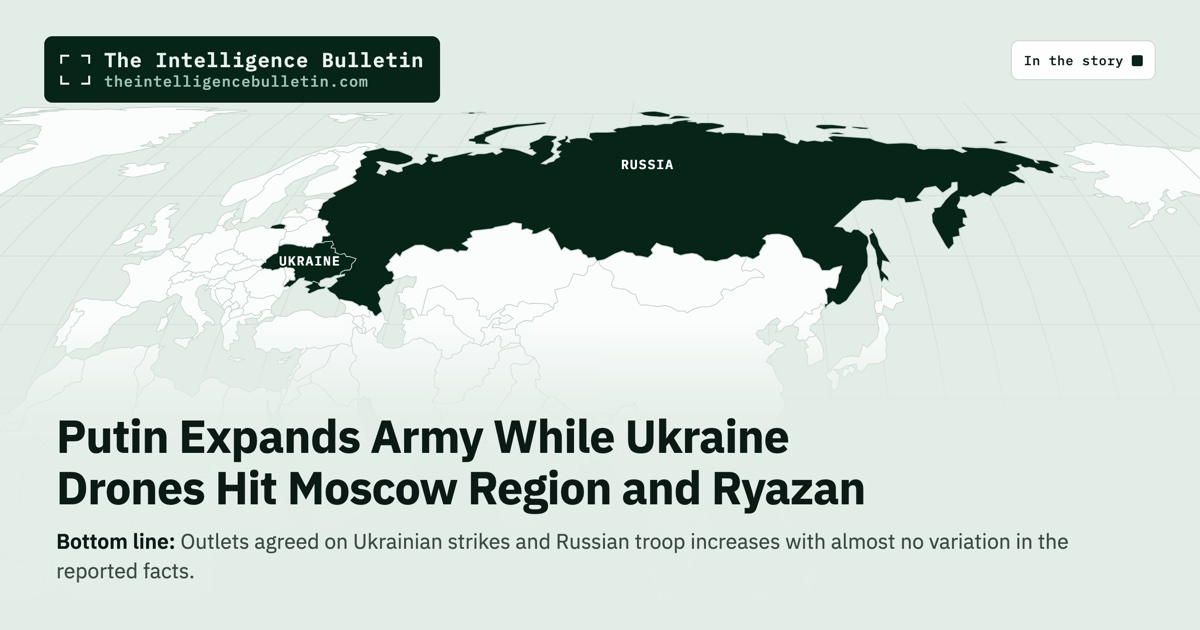
Putin Expands Army While Ukraine Drones Hit Moscow Region and Ryazan

Map of the countries in the story: Putin Expands Army While Ukraine Drones Hit Moscow Region and Ryazan
Russian President Vladimir Putin signed a decree increasing armed forces to over 2.4 million personnel effective August. Ukrainian drone attacks hit the Moscow region, Ryazan and other areas, with Russian claims of dozens of civilian deaths including children from recent strikes. Russian officials accused the West of enabling the attacks through arms supplies.

One Story. Many Angles.

🇮🇱
Israel
alquds.com
ARA
Putin raises the size of the Russian army and bloody attacks in Ukraine
“بوتين يرفع قوام الجيش الروسي وهجمات دموية في أوكرانيا”
Read →
🇱🇻
Latvia
nra.lv
LAV
Why did Putin oligarch Melnichenko’s publication appear in The Economist magazine
“Kāpēc parādījās Putina oligarha Meļņičenko publikācija žurnālā “The Economist””
Read →
🇨🇳
China
xinhuanet.com
SPA
Attacks in Kiev kill 86 Russian civilians in nine days, spokesperson reports
“Ataques en Kiev matan a 86 civiles rusos en nueve días, informa vocera”
Read →
🇵🇪
Peru
larepublica.pe
SPA
The world’s largest lake, rich in oil and gas, becomes a new war scenario between Russia, Ukraine and Iran
“El lago más grande del mundo, rico en petróleo y gas, se convierte en un nuevo escenario de guerra entre Rusia, Ucrania e Irán | ultimas noticias conflicto rusia ucrania | ultima hora iran vs eeuu en medio oriente | reservas de petroleo y oro en el mundo y américa latina | Mundo”
Read →
🇩🇪
Germany
dw.com
SPA
Massive drone attack reported on the Moscow region
“Reportan ataque masivo con drones sobre la región de Moscú”
Read →
🇷🇴
Romania
adevarul.ro
RON
Putin’s ‘Waterloo’. The crash of an Su-57 near Moscow could mark the beginning of the end for the Kremlin leader
“”Waterloo-ul” lui Putin. Prăbușirea unui Su-57 lângă Moscova ar putea marca începutul sfârșitului pentru liderul de la Kremlin”
Read →
🇪🇬
Egypt
shorouknews.com
ARA
Russian Defense Ministry: 356 Ukrainian drones shot down overnight
“وزارة الدفاع الروسية: إسقاط 356 طائرة مسيرة أوكرانية خلال الليل”
Read →
🇬🇧
United Kingdom
bbc.com
UKR
Massive drone attack on Russia: where were the explosions in the Moscow region
“Масована атака дронів на Росію: де були вибухи у Підмосков’ї”
Read →
🇺🇸
United States
euronews.com
POR
Ukraine maintains long-range attacks against Russian exports and oil
“Ucrânia mantém ataques de longo alcance contra exportações e petróleo russos”
Read →
🇺🇦
Ukraine
blackseanews.net
UKR
Drone attack on Moscow region: fires at factory and warehouses / Video
“BlackSeaNews | Атака дронів на Підмосков’я: пожежі на заводі та складах / Відео”
Read →
🇬🇷
Greece
bankingnews.gr
CIA and Ukrainian Intelligence plan total air war against Russia
Read →
🇷🇺
Russia
aif.ru
RUS
It became known where the UAVs were launched for the attack on Ryazan
“Стало известно, откуда запустили БПЛА для атаки на Рязань”
Read →
In Brief

Outlets agreed on Ukrainian strikes and Russian troop increases with almost no variation in the reported facts.

Coverage across outlets from Beijing to the Arab world converged on the same core events: Ukrainian long-range drone strikes deep inside Russia and Putin’s formal order to enlarge the military. Chinese state media quoted Russian diplomats detailing 86 civilian deaths in nine days and framed Western weapons supplies as direct complicity. Palestinian and Egyptian Arabic outlets paired the army expansion with Russian strikes inside Ukraine, treating both as routine escalation. Latvian analysis shifted focus to Russian oligarchs fleeing capital controls and using Western platforms to signal elite discontent. The shared emphasis on hardware and body counts, rather than any single narrative of victory or defeat, reveals how the conflict’s grinding material attrition now registers as the dominant daily story even in distant capitals.

Perspective Analysis

Russian President Vladimir Putin signed a decree raising the authorized strength of the Russian armed forces above 2.4 million personnel, with the increase taking effect in August and adding roughly 27,000 new positions. The measure brings the total authorized force to more than 2.426 million, including 1.535 million actual military personnel and the remainder civilian support staff. Russian state information systems recorded the change as the latest in a series of expansions that began last year and now reflect the sustained demands of operations in Ukraine.

Ukrainian forces conducted repeated long-range drone strikes into Russian territory during the same period. Russian officials reported explosions and fires at industrial sites in the Moscow region and in Ryazan, with Ukrainian sources confirming strikes that set ablaze a factory and warehouses. Russian air defenses claimed to have intercepted 356 Ukrainian drones in a single night. Separate reporting placed launch points for the Ryazan attack at specific Ukrainian locations, though those details originated from Russian domestic accounts.

Russian Foreign Ministry spokeswoman Maria Zakharova stated that Ukrainian attacks between 15 and 24 July killed 86 Russian civilians, including six children, and wounded 409 others, including 12 children. She added that more than 240 children have died in such attacks since 2014. Zakharova described Western weapons supplies as direct participation in strikes on civilians and said those responsible would face consequences from Russian forces and law-enforcement agencies.

On the Ukrainian side of the front, Russian artillery and loitering munitions struck the Dnipropetrovsk region more than fifty times in one day, killing three civilians and wounding six near the towns of Nikopol and Synelnykove. The strikes concentrated on five major districts along the northern bank of the Dnipro River. Russian forces have conducted similar barrages for months, drawing on a mix of regular troops, contract soldiers and volunteers.

The decree on force levels follows an earlier June order that set the target at 2.39 million. Official Russian statistics from the end of last year already counted more than 700,000 personnel committed to the Ukraine theater. The newest increase is framed in Moscow as necessary to maintain operational tempo and replace losses, with the added personnel entering service starting 1 August.

Coverage in outlets distant from the battlefield treated these developments as routine updates rather than decisive turns. Chinese state reporting quoted Zakharova directly on the civilian death toll and placed responsibility on Western arms deliveries. Arabic-language accounts from the region paired the Russian army expansion with continued Russian strikes inside Ukraine, presenting both as parallel elements of ongoing attrition. European and Ukrainian reports focused on the locations of drone impacts and resulting fires at production facilities. Russian domestic accounts emphasized successful interceptions and traced specific launch sites.

One Latvian publication examined a separate but related development: Russian oligarchs transferring assets abroad and, in at least one case, publishing warnings in Western journals about the risks of prolonged confrontation. The piece detailed capital flight through cryptocurrency and real-estate purchases in the Gulf and elsewhere, driven by fears of asset seizures and an anticipated banking crisis. It noted that the same elite figures whose factories supply the war effort are now hedging against internal political risks.

A Peruvian outlet linked the conflict to energy competition in the Caspian Sea, describing it as an emerging arena involving Russia, Ukraine and Iran. Romanian commentary speculated that the reported downing of a Russian Su-57 near Moscow could foreshadow deeper instability for the Kremlin leadership. These angles did not contradict the core military facts reported elsewhere; they simply attached different longer-term implications to the same sequence of strikes and force adjustments.

The accounts align on the material record: Putin’s government is increasing its authorized military manpower while Ukrainian drones reach industrial targets inside Russia and Russian artillery continues to hit Ukrainian cities. Russian casualty figures for civilians come from official statements that Western and Ukrainian sources do not directly refute in the published pieces. Ukrainian operational claims about successful strikes rest on video and reporting that Russian accounts counter only with interception totals, not outright denial of impacts. No source examined disputes the existence of the decree or the occurrence of recent drone activity over the Moscow region.

Where the pieces diverge is in emphasis and context. Chinese reporting foregrounded the 86 civilian deaths and the accusation of Western complicity. Egyptian accounts stayed close to Russian Defense Ministry statements on drone interceptions. Latvian analysis moved away from the battlefield to elite capital flight and public signaling by figures close to the Kremlin. Peruvian coverage introduced the Caspian as a potential new theater. Romanian writing ventured into speculation about regime durability that other outlets did not repeat. These differences reflect national vantage points and editorial priorities rather than conflicting facts on the ground.

What to Watch

The consistent thread across the reports is the conflict’s daily mechanics of manpower, munitions and infrastructure strikes. Putin’s decree supplies the numbers needed to sustain operations. Ukrainian drones demonstrate reach against rear-area targets. Russian air defenses record partial success in limiting damage. Civilian casualties on Russian territory and continued fighting inside Ukraine appear in the same dispatches, presented as simultaneous realities rather than mutually exclusive claims. The material pressure on both sides continues without any single report suggesting an imminent break in that pattern.


Share this story