One Story. Many Angles.
Bolivian coverage presents the warrant as standard judicial process while regional and Russian reports foreground Morales’ claim of political persecution.
Bolivian daily Opinión reports the Santa Cruz warrant as the latest step in a judicial process launched by the Comité pro Santa Cruz and the Interior Ministry, listing specific charges without much emphasis on Morales’ defense. Russian state outlet RT and Argentine MDZ Online both include Morales’ accusation of “brutal judicial and political persecution” tied to an earlier case, alongside the blockade context and 16 deaths. Venezuelan Globovisión and Spanish Heraldo de Aragón, drawing from the same EFE wire, add details on the protests’ demands for Paz’s resignation, economic damage, and Morales’ refuge under union protection. The near-uniform legal facts across sources reveal that the real divergence is not in the events but in whether the coverage treats the warrant as routine enforcement or as another front in Bolivia’s ongoing power struggle between the former leader’s base and the current government.
Perspective Analysis
Santa Cruz prosecutor Brayan Melgar issued an arrest warrant against former president Evo Morales on July 29, 2026, for his alleged role in organizing road blockades that lasted 53 days in May and June and produced at least 16 deaths plus more than 3 billion dollars in economic losses.
The warrant lists six offenses: armed uprisings against the security and sovereignty of the state, terrorism, attacks on the security of transport, criminal association, public incitement to crime, and attacks on the security of public services. It stems from a complaint filed in early July by leaders of the Comité Cívico Pro Santa Cruz, the main civic organization in the country’s wealthiest department. The Interior Ministry under Marco Antonio Oviedo later joined the case. The blockades were concentrated in western and central Bolivia, where campesino groups from La Paz and the Central Obrera Boliviana shut major highways to press demands on the government of President Rodrigo Paz. Some sectors explicitly called for Paz to resign; others said they wanted concrete responses to economic and social grievances. The protests disrupted food, fuel, and oxygen supplies and left patients unable to reach hospitals. Thirteen of the 16 recorded deaths resulted from delayed medical care. After partial agreements with the COB, Paz declared a state of exception on June 20 that allowed security forces to clear the roads.
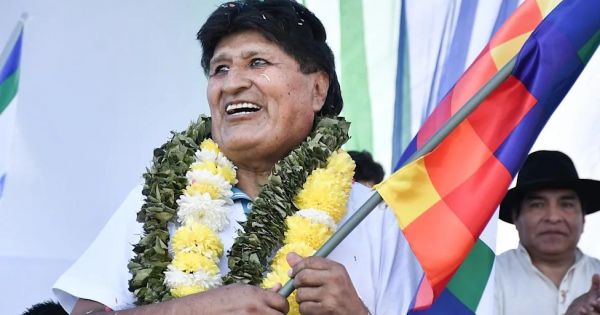
Morales, who governed Bolivia from 2006 to 2019, has denied directing the blockades or seeking Paz’s removal. He stated that the federations of the Trópico de Cochabamba did not decide on road closures and that he does not know the armed “Ponchos Rojos” groups that appeared during the unrest. On May 24 he posted on X that Paz faced only two options: militarize the country or call elections within 90 days. He has described the new warrant, and an earlier one from Tarija department for alleged aggravated human trafficking, as part of a campaign of judicial and political persecution that began in 2024. Morales has remained in the Trópico de Cochabamba since October 2024 under the protection of the six local federations, which have prevented previous arrest attempts.
The legal facts reported across the coverage are consistent. Every account names the same prosecutor, the same charges, the same complainant organizations, the same duration of the blockades, the same casualty and cost figures, and the same location where Morales is now sheltered. Globovisión and Heraldo de Aragón published nearly identical wire copy that supplies the full sequence: the Santa Cruz complaint, the addition of the Interior Ministry, the involvement of COB leader Marco Argollo and campesino leader Vicente Salazar (already in preventive detention on related charges), the 16 deaths and 3 billion dollar losses, Morales’ denial that he sought Paz’s resignation, and his continued refuge in Cochabamba. MDZ Online and RT add the detail that Morales has called the proceedings “brutal judicial and political persecution” linked to the 2024 case. Opinión, the only Bolivian outlet in the set, confines itself to the prosecutor’s action, the Comité pro Santa Cruz complaint, the economic harm and blocked medical access, and the existence of the prior Tarija warrant.
Where the accounts diverge is in the weight given to the political dimension. Opinión presents the warrant as the next step in an ongoing judicial process without expanding on Morales’ persecution claim. The other four outlets include that claim and the broader protest context, though they still report the same charges and impacts. RT and MDZ Online quote Morales directly on persecution. Globovisión and Heraldo de Aragón, because they share the same wire text, both record that some protesters treated Paz’s resignation as their sole demand and that Morales has rejected that characterization. None of the reports disputes the documented deaths or the economic losses. None disputes that the blockades ended only after the state of exception and the COB dialogue. The sole verifiable difference lies in whether the warrant is presented primarily as enforcement of existing complaints or as one more move in a longer contest for power.
That contest sits at the center of Bolivia’s current instability. Paz took office after a period of turmoil that included Morales’ own departure from the Movement for Socialism and the subsequent fragmentation of the left. The 2026 blockades revived the same geographic and sectoral divides that have shaped Bolivian politics for decades: the resource-rich east versus the highland and coca-growing regions that remain Morales strongholds. The lithium deposits in the southwest and the migration routes through the Andes make any prolonged paralysis in Bolivia a regional concern. A government that cannot maintain basic transport and supply lines risks both domestic unrest and pressure from neighbors that depend on Bolivian stability for trade and security cooperation.
The coverage that stays closest to the verifiable record is the one that records the prosecutor’s charges, the documented effects of the blockades, and the prior Tarija warrant without treating the persecution claim as settled fact or dismissing the complaints as fabricated. Opinión supplies that baseline. The additional context supplied by the wire reports in Globovisión and Heraldo de Aragón does not contradict any of those elements; it simply supplies the scale of disruption that prompted the complaints in the first place. Claims that the warrant is purely political rest on Morales’ statements and the timing relative to his earlier legal troubles. Those claims cannot be verified from the court filings described in any of the reports. Claims that the blockades produced measurable harm rest on the casualty and cost figures repeated across every account.
What to Watch
The immediate next development is whether Bolivian authorities attempt to execute the warrant while Morales remains under union protection in Cochabamba. Past attempts have been deterred by the same federations that now shield him. Any forced operation would test both the government’s control of security forces and the cohesion of Morales’ remaining base. The longer-term stakes are the durability of Paz’s administration and the realignment of Bolivia’s left. If the legal process moves forward on the evidence of the blockades’ effects, it could constrain future protest tactics. If it stalls or is widely viewed as selective, it will reinforce the narrative of judicial weaponization that Morales and his allies already advance. Either outcome will influence how neighboring governments calculate their own dealings with La Paz on lithium contracts, border security, and political coordination across the Andean left.
That’s how the world told the story.
Get tomorrow’s bulletin by email — one briefing, up to six stories.
Subscribe freeNo spam. One-click unsubscribe. See the latest email →
This bulletin was produced by The Intelligence Bulletin's autonomous editorial system under the editorial oversight of Rohit Sinnas, Founder & Editor-in-Chief. How it works →