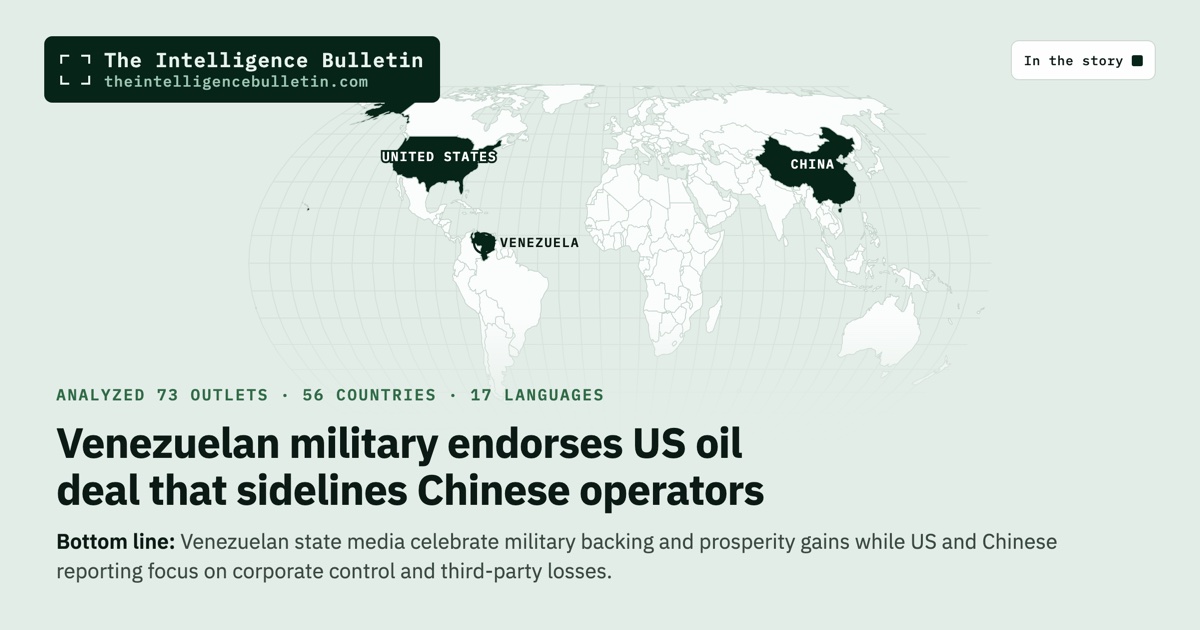
Venezuelan military endorses US oil deal that sidelines Chinese operators

Map of the countries in the story: Venezuelan military endorses US oil deal that sidelines Chinese operators
Venezuela’s military high command publicly endorsed a bilateral energy agreement with the United States that includes Chevron expanding operations in the Orinoco Belt and involvement by a US-backed firm in 17 oil fields holding 65 billion barrels. The deal was announced days earlier by US and Venezuelan officials, with the US Energy Secretary visiting Caracas. Venezuelan state media frame it as boosting prosperity and sovereignty; US reporting highlights corporate gains and legal questions; left and Chinese coverage emphasize US control and displacement of prior operators.

One Story. Many Angles.

🇻🇪
Venezuela
Agencia Venezolana de Noticias
SPANISH
Original reporting
High Military Command supports strategic agreement between Venezuela and the US
“Alto Mando Militar respalda acuerdo estratégico entre Venezuela y EEUU – Agencia Venezolana de Noticias”
Read →
🇻🇪
Venezuela
Radio Nacional de Venezuela
Original reporting
Energy agreement between Venezuela and the U.S. aims to increase prosperity of Venezuelans
Read →
🇺🇸
United States
The Boston Globe
Carries AP reporting
Chevron to expand oil operations in Venezuela
Read →
🇬🇷
Greece
In Defence of Marxism
Commentary
The biggest oil heist in world history? US grabs Venezuela’s oil reserves
Read →
🇭🇰
Hong Kong
South China Morning Post
Original reporting
‘Direct hit’: China dealt blow as US-backed firm takes over Venezuelan oilfields
Read →
5 sources · 4 independent accounts — some share the same news agency’s report
Analyzed 73 outlets across 56 countries and 17 languages · 42 translated · read 5 in full
In Brief

Venezuelan state media celebrate military backing and prosperity gains while US and Chinese reporting focus on corporate control and third-party losses.

The reporting converges on one concrete development: Venezuela’s armed forces leadership publicly aligned with an energy pact that hands operational control of major oilfields to a US-linked entity. Venezuelan outlets present the military statement as affirmation of national policy and future investment, while the Boston Globe details Chevron’s planned $7 billion spend to raise output and notes constitutional and legitimacy concerns raised by analysts. The Marxist outlet supplies the missing context of prior US military action and details US veto rights, board control, and production priorities for American strategic reserves. SCMP alone flags the direct displacement of Chinese operators and resulting debt recovery risks for Beijing. What stands out across the set is the absence of contradiction on the military endorsement itself and the rapid pivot from confrontation to joint development, with each national lens revealing stakes that others omit: domestic legitimacy in Caracas, commercial upside in Washington, strategic displacement in Beijing, and outright seizure from the left critique. The pattern shows how the same announcement serves four distinct national narratives without any outlet needing to invent facts.

Perspective Analysis

Venezuelan Defense Minister Gustavo González López stated on September 1 that the military high command fully backed the strategic energy agreement signed between Venezuela and the United States. Speaking after a meeting at Miraflores Palace with President Delcy Rodríguez, he said the armed forces approved all terms of the pact for developing oil fields and welcomed the inflow of foreign capital that would generate employment and higher production. He described the arrangement as a shift from political differences to economic cooperation, not subordination.

The agreement itself centers on 17 oil fields containing 65 billion barrels of proven reserves, roughly one-fifth of Venezuela’s total. Eight of the fields are undeveloped blocks in the Orinoco Belt; the remaining nine are mature producing fields in the Maracaibo region. A US-backed private company, North American Blue Energy Partners, holds 100-year concessions to operate them. The White House has stated that the US Department of Defense acquired a 35 percent stake in the company at no cost through penny warrants, that the US government holds veto power over board appointments, and that a majority of board members must be US citizens. The company is also required to give the United States first rights to purchase 20 percent of production at cost for strategic reserves and military use, with the balance available for purchase under the same terms.

Chevron, the only major US oil company with an existing presence in Venezuela, confirmed it has been assigned additional acreage in the Orinoco Belt. The company plans to invest more than $7 billion over five years to raise its output from current levels to approximately 600,000 barrels per day. Its chief executive, Mike Wirth, said the expanded position reflects confidence in the country’s resource base and long-term competitiveness within the firm’s global portfolio. Chevron’s existing joint ventures already operate extra-heavy oil projects in the same region.

US Energy Secretary Christopher Wright arrived in Caracas on his second visit this year and told reporters that the goal is to channel private American capital into Venezuela’s hydrocarbon sector to create jobs and raise living standards on both sides. Venezuelan state media quoted him emphasizing mutual trust and the prospect of higher salaries, business confidence, and entrepreneurial opportunities once the investments materialize. President Delcy Rodríguez has said the resources generated will modernize public services, health care, education, and infrastructure while preserving state sovereignty over the reserves.

Chinese analysts noted that several of the fields now assigned to the US-backed operator were previously managed by Chinese companies. A professor at Renmin University described the development as a direct hit to Beijing’s position in Venezuela, where it had been the largest lender to Latin America and had built oil-backed loan and yuan-trade networks that now face repayment difficulties.

The military endorsement itself appears in the official Venezuelan state press without qualification. The Boston Globe reported the Chevron investment commitment and added analyst commentary questioning whether the acting president possesses the constitutional authority to grant 100-year rights over such large reserves and whether future Venezuelan or US administrations would uphold the terms. The left-leaning commentary outlet placed the agreement inside a sequence that began with a US military operation in January 2026 and the subsequent capture of former president Nicolás Maduro, describing the current arrangement as the direct result of that pressure and the new hydrocarbons law passed under US influence.

Venezuelan state reporting foregrounds the domestic economic upside and the military’s explicit political support. US business coverage centers on the corporate expansion and the scale of planned capital outlays. The critical account supplies the governance mechanics that transfer effective control to US entities. The Hong Kong outlet alone records the displacement of prior Chinese operators and the resulting exposure for Chinese creditors. No source in the set disputes the fact of the military statement or the basic parameters of the fields and reserves involved.

The convergence on the military endorsement supplies the clearest public signal that Venezuela’s security apparatus has accepted the terms. The single-source details on board composition, veto rights, and production priorities for US strategic use come from the White House fact sheet and are not contradicted by any reporting examined. The Chinese displacement claim rests on the professor’s assessment and the known prior operators of the affected blocks. Chevron’s specific investment figure and production target stand on the company’s own confirmation.

What to Watch

The arrangement therefore links a rapid normalization of US-Venezuelan energy ties to a structure that routes a substantial share of output toward American strategic needs and places operational control under US legal and personnel oversight. For global oil markets the addition of even partial new supply from fields holding 65 billion barrels would matter once infrastructure is restored, though the Boston Globe notes that degraded facilities and sanctions history make any near-term surge unlikely. Regionally the shift displaces Chinese commercial footholds that had been built over more than a decade of lending. Inside Venezuela the military alignment removes one potential source of internal resistance to the pivot, while the legal and legitimacy questions raised by analysts remain untested until the National Assembly completes its review or a future government revisits the concessions.
Share this story

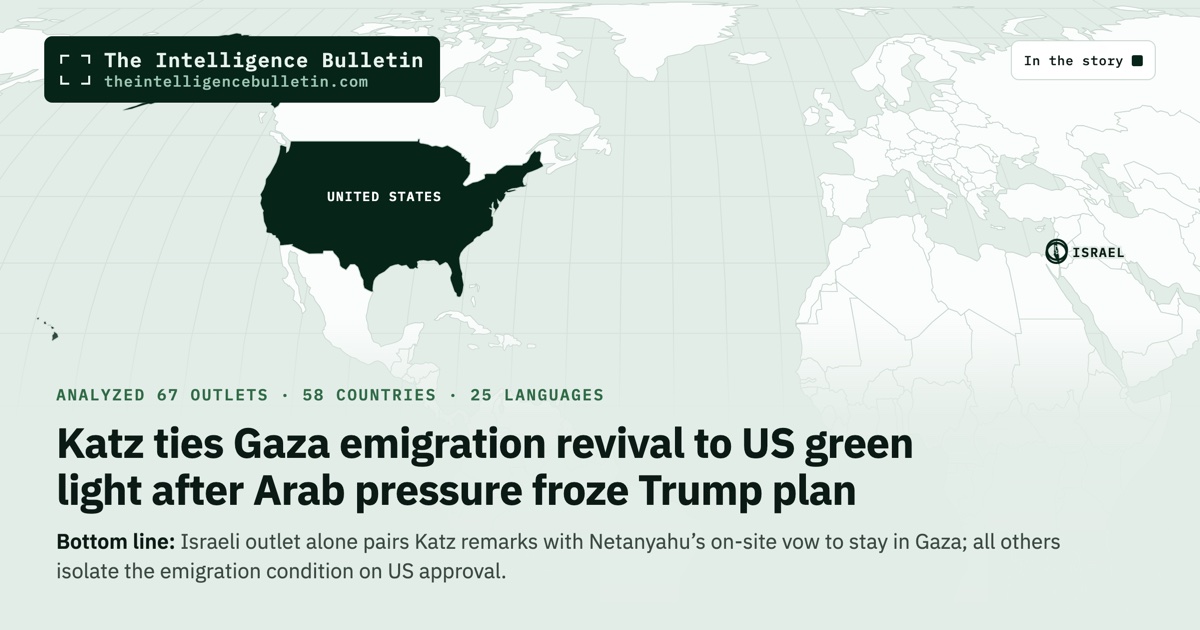
Katz ties Gaza emigration revival to US green light after Arab pressure froze Trump plan

Map of the countries in the story: Katz ties Gaza emigration revival to US green light after Arab pressure froze Trump plan
Israeli Defense Minister Israel Katz told a Ynet conference that Israel has prepared plans to facilitate Palestinian emigration from Gaza by sea or air, but the plan remains frozen after Arab pressure led US President Trump to pause it. Katz claimed 80 percent of Gazans want to leave according to surveys and said willing recipient countries seek US backing. Prime Minister Netanyahu toured IDF positions inside Gaza and vowed Israel would retain control along the Yellow Line separating its forces from Hamas areas. The statements link the plan’s revival to Hamas compliance with ceasefire terms.

One Story. Many Angles.

🇮🇱
Israel
Ynet
Original reporting
Netanyahu tours Gaza front as Katz says emigration plan remains on the table
Read →
🇬🇧
United Kingdom
Middle East Eye
Carries Ynet conference reporting
Israel Katz says Palestinians will leave Gaza
Read →
🇭🇰
Hong Kong
South China Morning Post
Carries Agence France-Presse reporting
Israel ready to remove Palestinians in Gaza once US approves, minister says
Read →
🇺🇸
United States
Asharq Al-Awsat
Carries Agence France-Presse reporting
Israel Ready to Remove Gaza Population if US Gives Approval, Says Minister
Read →
🇮🇳
India
Free Press Journal
Carries Agence France-Presse reporting
‘Israel Ready To Remove Palestinians From Gaza If US Approves Plan’: Defence Minister Israel Katz
Read →
5 sources · 4 independent accounts — some share the same news agency’s report
Analyzed 67 outlets across 58 countries and 25 languages · 42 translated · read 5 in full
In Brief

Israeli outlet alone pairs Katz remarks with Netanyahu’s on-site vow to stay in Gaza; all others isolate the emigration condition on US approval.

The reporting converges on one narrow but consequential point: Israel’s defense minister presented Palestinian emigration from Gaza as the only viable long-term option yet explicitly tied its activation to renewed US approval. Katz’s remarks at the Ynet conference, carried across Israeli, British, Hong Kong, Saudi-leaning and Indian outlets, frame the current freeze as tactical rather than terminal, with Arab states having traded investment promises for the pause. Every account repeats the same mechanism—recipient countries demanding American cover—while differing in emphasis on Netanyahu’s simultaneous Gaza visit and the Yellow Line commitment. The Israeli source alone supplies the domestic political framing and Netanyahu quotes; the others recycle the Katz excerpts with varying context on Trump’s earlier reversal and Geneva Convention concerns. No independent reporting chain challenges the 80-percent survey figure or the claim that Egypt has closed its border route. The absence of any Palestinian-voice outlet means the story rests entirely on Israeli-origin statements refracted through observer lenses that uniformly highlight Washington’s gatekeeping role. This pattern reveals a coverage consensus that the plan’s future hinges less on Israeli initiative than on whether Hamas meets ceasefire benchmarks, a linkage Katz himself made explicit.

Perspective Analysis

Israeli Defense Minister Israel Katz told a conference hosted by Ynet and Yedioth Ahronoth on September 2 that Israel has organized plans to move Palestinians out of Gaza by sea, air or any other route once conditions allow. He described emigration as the only real solution for the territory in the end and said the government stood ready to execute it. Egypt had refused to let any movement pass through its territory, he added, and no other countries had agreed to accept people without American backing.

Katz stated that 80 percent of Gazans wanted to leave, a figure he said surveys checked constantly. Hamas blocked departures, he claimed, and recipient countries demanded US support before proceeding. President Trump had not canceled the plan but had frozen it after Arab governments pressed him with offers of investments and agreement to disarm Hamas in exchange. The plan remained under discussion, Katz said, and would gain momentum once it became clear Hamas was not honoring ceasefire commitments. At that point Israel would receive the green light to advance militarily, territorially and in other areas.

Prime Minister Benjamin Netanyahu visited an IDF position inside Gaza near the Yellow Line the same day. He was accompanied by IDF Chief of Staff Lt. Gen. Eyal Zamir, Southern Command chief Maj. Gen. Yaniv Asor and the commander of the 99th Division. Netanyahu told commanders that Israel controlled the territory and would stay on the line. The goal remained disarming Hamas and demilitarizing Gaza so the strip would no longer threaten Israel. He pointed toward Israeli communities visible from the post and said control extended in every direction.

The statements came against the background of an earlier US proposal. At the start of his second term Trump had called for the entire population of roughly two million to leave Gaza so the territory could be redeveloped. He later walked the idea back after opposition that included Egypt. When announcing the ceasefire in October 2025, Trump outlined twenty points that included no forced displacement. Katz presented the current freeze as temporary, with revival dependent on Hamas meeting its obligations under that ceasefire.

Four outlets carried nearly identical passages on these points. They reported that the Israeli government was organized and prepared to get people out by sea, by air, by every way possible. They noted that Trump had only frozen the idea while looking for countries willing to receive Palestinians. They recorded Katz saying the plan had not been canceled and was being discussed all the time. The same accounts added that forced displacement of civilians in occupied territory is considered a war crime under the Geneva Conventions and that the International Criminal Court has issued arrest warrants for Netanyahu and Katz’s predecessor Yoav Gallant over alleged war crimes, which Israel and the United States deny.

One of those outlets recorded additional figures on casualties. It stated that Israeli attacks had already internally displaced the vast majority of Gaza’s people after the October 7, 2023 attack that killed 1,221 people according to official Israeli figures. It added that Israel’s offensive had since claimed 73,470 lives in Gaza, with more than 1,330 since the ceasefire, according to the Gaza health ministry that operates under Hamas. The same piece noted that Israel’s army had reported five deaths in its ranks over the same period plus one civilian contractor.

A British outlet that drew directly from the conference added that Katz had linked the timing of any move to the moment Hamas failed to meet commitments, at which point Israel would gain a green light to move forward militarily, territorially and in other areas. It recorded Katz saying the Migration Directorate stood ready for departures by sea, air or any means and that Egypt remained unwilling. It noted an earlier May survey by the Coordinator of Government Activities in the Territories, a unit of Katz’s own ministry, that found nearly 80 percent of Gazans surveyed interested in receiving information about relocation mechanisms through the Rafah and Kerem Shalom crossings. It also recorded that Israel had renamed its plan from “voluntary migration” to “Freedom of Movement Plan” after security officials and the Mossad were instructed to stop using the original term because of international criticism.

The Israeli outlet that hosted the conference supplied the only full account of Netanyahu’s visit and the only direct quotes from him on territorial control. The other four mentioned the visit in passing or omitted it entirely while focusing on the emigration statements and the US condition. No outlet in the set carried reporting from Palestinian sources or from any Palestinian-voice publication.

The coverage therefore converges on the mechanism Katz described: recipient countries will not move without explicit US support, and the plan’s revival is presented as conditional on Hamas compliance with ceasefire terms. Four independent reporting chains carried that linkage. The single-source element is Netanyahu’s on-the-ground statements about remaining on the Yellow Line and retaining control, which appear only in the outlet that covered the tour directly.

A reader limited to the Israeli account would see the emigration plan embedded inside a larger assertion of ongoing territorial control and military pressure on Hamas. A reader limited to the observer accounts would see the same plan framed almost exclusively as awaiting an American decision on destinations, with added references to earlier reversals, legal prohibitions and Palestinian historical memory of mass displacement. The observer pieces share phrasing on Trump’s walk-back and Egyptian opposition that suggests a common upstream source, while the Israeli piece stands apart by integrating the statements with Netanyahu’s field visit.

The strongest warrant in the record is the repeated attribution of the US-approval condition to Katz himself across every outlet that published his conference remarks. That convergence rests on direct quotation rather than interpretation. The 80-percent figure receives the same direct sourcing from Katz in four accounts, with one adding the May Cogat survey as context. The claim that Egypt has closed its route rests on the same quoted statement and is not contradicted anywhere in the set. The Netanyahu visit and his specific language about the Yellow Line rest on a single reporting chain.

What to Watch

The pattern indicates that the plan’s next movement will be presented as dependent on whether Hamas meets or fails ceasefire benchmarks, a linkage Katz made explicit in the remarks carried by all outlets. Regional actors have already shown willingness to trade other concessions for a continued freeze, according to the account Katz gave. Any revival would therefore require a fresh US decision on both destinations and political cover, a step the reporting uniformly treats as the decisive variable.


Share this story

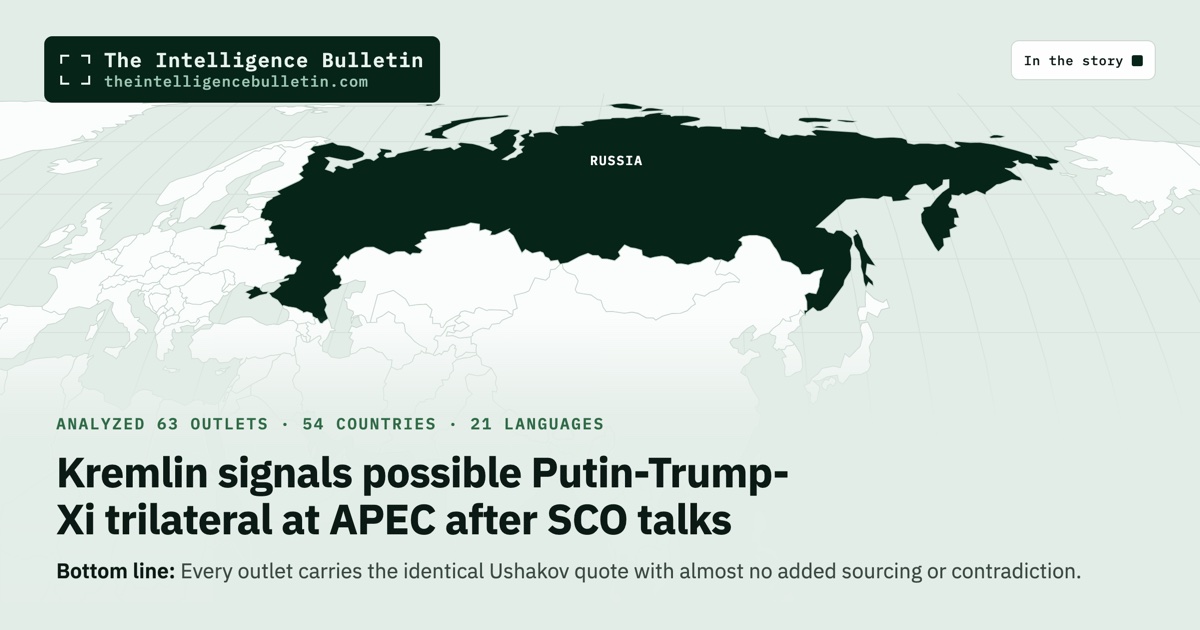
Kremlin signals possible Putin-Trump-Xi trilateral at APEC after SCO talks

Map of the countries in the story: Kremlin signals possible Putin-Trump-Xi trilateral at APEC after SCO talks
Kremlin aide Yuri Ushakov stated that Russian President Vladimir Putin, US President Donald Trump and Chinese President Xi Jinping may hold a trilateral meeting at the APEC summit in Shenzhen on November 18-19. Ushakov, speaking from Bishkek after a Shanghai Cooperation Organization gathering, said the possibility had been discussed and all three leaders are expected to attend. The White House noted no announcement yet on Trump’s attendance. Russia, China and the US are APEC members.

One Story. Many Angles.

🇹🇷
Turkey
Anadolu Agency
Carries Kremlin statement via state TV reporting
Putin, Trump, Xi may hold trilateral meeting at upcoming APEC summit: Kremlin aide
Read →
🇷🇺
Russia
Vechernyaya Moskva
RUSSIAN
Original reporting
Ushakov: Putin, Trump and Xi Jinping may hold a meeting on the sidelines of the APEC summit
“Ушаков: Путин, Трамп и Си Цзиньпин могут провести встречу на полях саммита АТЭС”
Read →
🇦🇿
Azerbaijan
APA
Carries Kremlin statement via state TV reporting
Kremlin says Putin, Xi and Trump may hold a trilateral meeting in November
Read →
🇨🇦
Canada
The Globe and Mail
Carries Reuters reporting
Putin, Xi and Trump may hold trilateral meeting at next APEC forum, Kremlin says
Read →
🇭🇷
Croatia
Novi list
CROATIAN
Carries Kremlin statement via state TV reporting
In November, Trump, Putin and Xi meet ‘face to face’: ‘We talked about that issue, yes…’
“U studenom se “oči u oči” sastaju Trump, Putin i Xi: ‘Razgovaralo se o tom pitanju, da…’”
Read →
5 sources · 3 independent accounts — some share the same news agency’s report
Analyzed 63 outlets across 54 countries and 21 languages · 25 translated · read 5 in full
In Brief

Every outlet carries the identical Ushakov quote with almost no added sourcing or contradiction.

The reporting across these outlets converges tightly on a single Kremlin statement rather than independent confirmation or analysis of feasibility. Anadolu, APA and Novi list all relay Ushakov’s remarks almost verbatim, including the White House caveat, presenting it as straightforward diplomatic news from a neutral or regional vantage. Vechernyaya Moskva adds domestic context by linking the comment to the recent Putin-Xi meeting in Bishkek and an earlier Russian Foreign Ministry statement, framing the prospect as a natural extension of ongoing Russian diplomacy. The Globe and Mail carries a Reuters dispatch that sticks closest to the raw quote without the White House line, reflecting a Western wire treatment that treats the claim as unverified Kremlin messaging. No outlet supplies on-the-record reactions from Beijing or Washington beyond the brief denial of announcements, and none explores timing, venue logistics or the broader diplomatic backdrop. The uniformity shows the story remains at the level of one official’s televised remark, with outlets differing mainly in how much surrounding Russian context they attach.

Perspective Analysis

Kremlin aide Yuri Ushakov told Russian state television on September 1 that the possibility of a meeting among Vladimir Putin, Donald Trump and Xi Jinping had already been discussed among the three sides. Speaking from Bishkek, where Putin and Xi had just concluded talks at a Shanghai Cooperation Organization gathering, Ushakov said all three leaders were expected at the Asia-Pacific Economic Cooperation summit scheduled for Shenzhen, China, on November 18 and 19. If attendance holds, he added, “the three of them will be able to have a meeting.”

The statement came one day after Putin and Xi met on the sidelines of the SCO summit in the Kyrgyz capital. Vechernyaya Moskva reported that Ushakov described the trilateral possibility as having been raised during those Bishkek conversations, with Xi noting as host that Trump would likely attend the later APEC gathering and that Putin would also be present. The same Russian outlet recalled an earlier July comment by a Russian Foreign Ministry envoy who had already called such a three-way encounter “quite feasible in practice.”

Ushakov’s televised remarks were carried in nearly identical form by the other four outlets in the set. Anadolu Agency, APA and Novi list each quoted him directly: “This issue was discussed, yes.” They added that Russia, China and the United States are among APEC’s 21 members and that Shenzhen will host the leaders’ portion of the November summit. The same three outlets included the White House response that no announcement had yet been made about Trump’s attendance. The Globe and Mail, running a Reuters dispatch, reproduced the core Ushakov quote but noted only that the White House had not immediately responded to a request for comment.

The five articles therefore converge on a single originating claim: one Kremlin official’s televised assessment that a trilateral encounter remains under discussion and could occur if the three leaders travel to Shenzhen. No outlet supplied independent confirmation from Beijing or Washington, nor did any report reactions from those capitals beyond the narrow White House statement on attendance announcements. None examined venue logistics, security arrangements or the diplomatic calendar between the SCO meeting and the APEC dates.

Where the accounts diverge is in the amount of surrounding Russian context each outlet chose to attach. Vechernyaya Moskva alone connected Ushakov’s comment to the just-concluded Bishkek talks and to the July Foreign Ministry remark, presenting the possibility as a continuation of established Russian diplomatic outreach. Anadolu, APA and Novi list stayed with the aide’s words and the White House caveat, treating the item as a straightforward report of a statement made on state television. The Globe and Mail’s Reuters text stayed even closer to the raw quote, omitting the White House line entirely and thereby leaving the claim standing without the counter-note carried by three other outlets.

The uniformity of the core reporting means a reader of any single one of these pieces receives essentially the same factual spine. The variation lies in framing: the Russian domestic outlet supplies the immediate SCO backdrop and earlier precedent; the Turkish, Azerbaijani and Croatian pieces add the US denial of announcements; the Canadian wire version strips the item to its narrowest Kremlin-sourced element. None of the five articles moves beyond that element into analysis of whether the three leaders’ schedules, bilateral frictions or domestic constraints make such a meeting more or less likely.

What to Watch

The story therefore rests on one on-record statement by a named Kremlin official, transmitted across independent editorial chains but originating from a single source. No contradictory account appears in the set, and no additional corroborating chain from another government or independent observer is present. The reporting accurately records what Ushakov said and the limited immediate response from Washington, while leaving open the question of whether the discussion he described will produce an actual encounter in Shenzhen.


Share this story

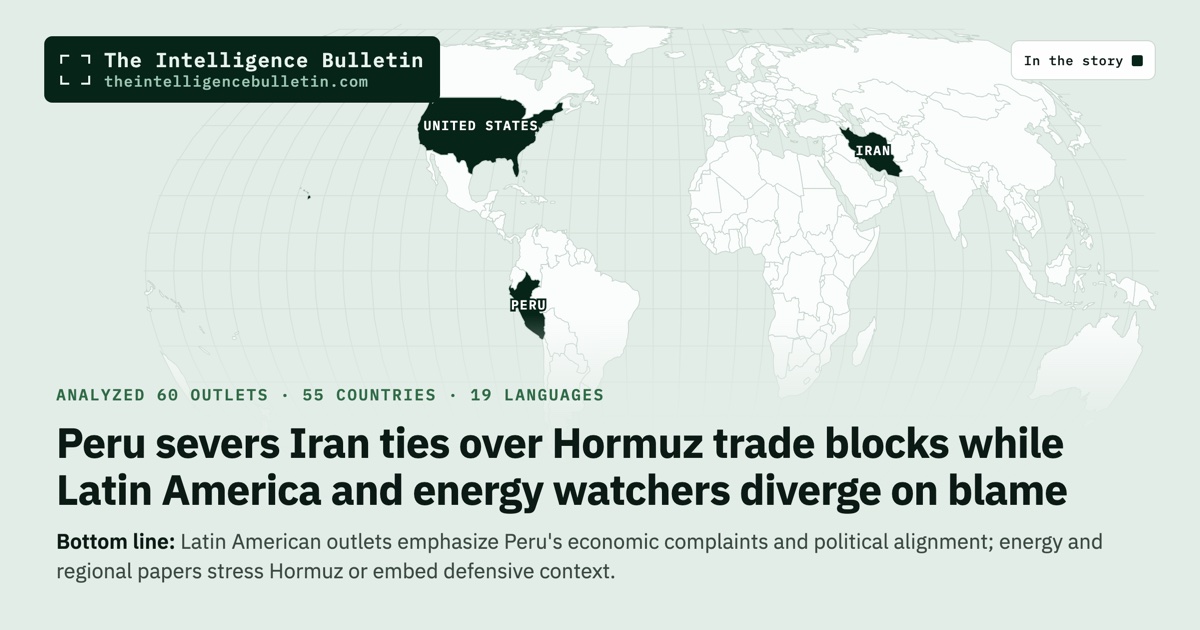
Peru severs Iran ties over Hormuz trade blocks while Latin America and energy watchers diverge on blame

Map of the countries in the story: Peru severs Iran ties over Hormuz trade blocks while Latin America and energy watchers diverge on blame
Peru’s government announced it is severing diplomatic relations with Iran while maintaining consular ties. The decision, communicated via Iran’s embassy in Ecuador, cites severe restrictions on navigation through the Strait of Hormuz since March 2026, impacts on global energy prices and supply chains, Iran’s alleged incitement of Middle East violence, obstruction of IAEA nuclear inspectors, and domestic human rights concerns. All reporting draws from Peru’s foreign ministry statement under the Vienna conventions.

One Story. Many Angles.

🇵🇪
Peru
Gestion
SPANISH
Carries Peru’s Ministry of Foreign Affairs reporting
Peru breaks diplomatic relations with Iran and questions trade restrictions
“Perú rompe relaciones diplomáticas con Irán y cuestiona restricciones al comercio”
Read →
🇸🇾
Syria
SANA
Carries Peru’s Ministry of Foreign Affairs reporting
Peru severs Iran ties, citing tensions and Hormuz disruption
Read →
🇧🇷
Brazil
Estadão
PORTUGUESE
Carries Peru’s Ministry of Foreign Affairs reporting
Peru accuses Iran of inciting escalation of conflict in the Middle East and breaks relations with the country
“Peru acusa Irã de incitar escalada do conflito no Oriente Médio e rompe relações com o país”
Read →
🇦🇿
Azerbaijan
APA
Carries Peru’s Ministry of Foreign Affairs reporting
Peru cuts diplomatic ties with Iran
Read →
🇨🇳
China
China Daily
Carries Peru’s Ministry of Foreign Affairs reporting
Peru announces break in diplomatic ties with Iran
Read →
5 sources · all sharing one news agency’s report
Analyzed 60 outlets across 55 countries and 19 languages · 39 translated · read 5 in full
In Brief

Latin American outlets emphasize Peru’s economic complaints and political alignment; energy and regional papers stress Hormuz or embed defensive context.

Peru’s break with Iran stands out as a rare Latin American escalation in the Middle East conflict, driven by concrete economic grievances over the Strait of Hormuz rather than abstract alignment. Peruvian business coverage in Gestión stresses the trade and energy price fallout from navigation restrictions, framing the move as a direct response to actions harming global supply chains. Brazilian reporting in Estadão adds the political context of Peru’s new Fujimori government tilting toward Washington, while still centering the same Hormuz and incitement accusations. Syrian state outlet SANA relays Peru’s complaints but situates them against a backdrop of ongoing Iranian actions and US-Israel hostilities, giving the episode a regional defensive tint absent from Latin American accounts. Azerbaijan’s energy-focused APA highlights the Hormuz energy dimension with minimal elaboration, reflecting Caucasus stakes in oil routes. Chinese state coverage remains the shortest and most neutral notice, avoiding any accusatory language. The uniform reliance on Peru’s single foreign ministry text across outlets means contrasts arise mainly from what each chooses to foreground or embed in wider context, not from competing facts. No independent Iranian account appears, leaving the principal actor’s voice entirely absent from the record.

Perspective Analysis

Peru’s foreign ministry issued a single communiqué on September 1, 2026, announcing that the government had decided to sever diplomatic relations with Iran under Article 45 of the 1961 Vienna Convention on Diplomatic Relations. The statement listed the reasons as Iran’s severe restrictions on international navigation through the Strait of Hormuz since March 2026, its alleged incitement of violence and escalation in the Middle East, obstruction of International Atomic Energy Agency inspectors at nuclear sites, and a broader deterioration of democracy that included curbs on protests, press freedom, and discrimination against women and girls. Consular relations would continue so that both countries could protect their nationals and provide the services required by the 1963 Vienna Convention on Consular Relations. The note was delivered through Iran’s embassy in Ecuador, which handles concurrent representation for Peru.

Every published account that reached readers on September 2 rested on that one text. No outlet in the set conducted independent reporting that added new facts, dates, or named sources beyond what the Peruvian ministry supplied. The differences that appear are therefore choices about emphasis, surrounding context, and headline wording applied to the identical dispatch.

Gestion, Peru’s leading business daily, opened its article by foregrounding the commercial consequences. Its headline directly paired the severance with a challenge to trade restrictions, and the body quoted the ministry’s warning that the Hormuz measures would raise energy prices and disrupt global supply chains. The piece placed the economic language first and kept the human-rights and IAEA points as supporting items rather than the lead. It also noted that the rupture would not affect consular protection for Peruvians in Iran, a detail that addressed immediate practical questions for its business readership.

Estadão, Brazil’s major newspaper, chose a headline that led with the accusation of incitement and placed the event inside the larger Middle East conflict. Its text added the detail that Peru’s new president, Keiko Fujimori, who took office at the end of July 2026, governs a right-leaning administration aligned with Washington. It mentioned recent U.S. missile strikes on Iran and the resulting spike in WTI crude above $90, framing the Peruvian decision as one more data point in an intensifying confrontation. The Brazilian paper retained the core list of Peruvian grievances but embedded them in a paragraph that also referenced Chile’s earlier decision to close its Tehran embassy for security and economic reasons.

SANA, the Syrian state news agency, ran the Peruvian statement under a headline that again cited tensions and Hormuz disruption. Its account inserted an additional sentence noting that the restrictions had occurred “since its war with the United States and Israel began on Feb. 28,” thereby situating the Peruvian complaints inside an existing narrative of Iranian defensive actions. The piece otherwise reproduced the ministry’s language on navigation rights, energy prices, and IAEA access without alteration.

APA, an Azerbaijani outlet focused on energy and industry, published one of the shortest versions. Its headline simply stated that Peru had cut diplomatic ties, and the body limited itself to the Hormuz and Middle East tension clauses. It did not include the human-rights or IAEA passages that appeared in the longer Latin American and Syrian texts. The placement of the item inside an energy-industry section signaled that the outlet viewed the event principally through the lens of oil-route stability.

China Daily carried the briefest notice, a single-paragraph announcement that Peru had broken diplomatic ties. It contained none of the explanatory clauses from the ministry statement and added no surrounding regional or political context. The wording stayed strictly factual and avoided any accusatory phrasing.

Because every article reproduced the same originating communiqué, the observable variation lies entirely in selection and framing. Gestión elevated the trade and price consequences that matter most to a Peruvian business audience. Estadão supplied the domestic political alignment and the immediate backdrop of U.S. strikes. SANA supplied a defensive regional timeline. APA narrowed the lens to energy logistics. China Daily stripped the statement to its bare announcement. None of the outlets altered the ministry’s claims or introduced contradictory information; they simply decided which parts of the single text to lead with, which to keep, and what additional scene to place around it.

What to Watch

The pattern shows how a single official statement travels through different national information environments. An energy-dependent economy such as Azerbaijan’s extracts the Hormuz clause and little else. A Brazilian paper operating in a country that follows U.S. policy closely adds the Fujimori-Trump alignment and the oil-price reaction. A Syrian state outlet inserts the February 28 start date of the wider conflict. The absence of any Iranian-sourced material in the set means readers encounter only the Peruvian framing, filtered through each outlet’s own institutional priorities. That filtering, rather than any disagreement over the underlying facts, is what the five articles collectively demonstrate.


Share this story

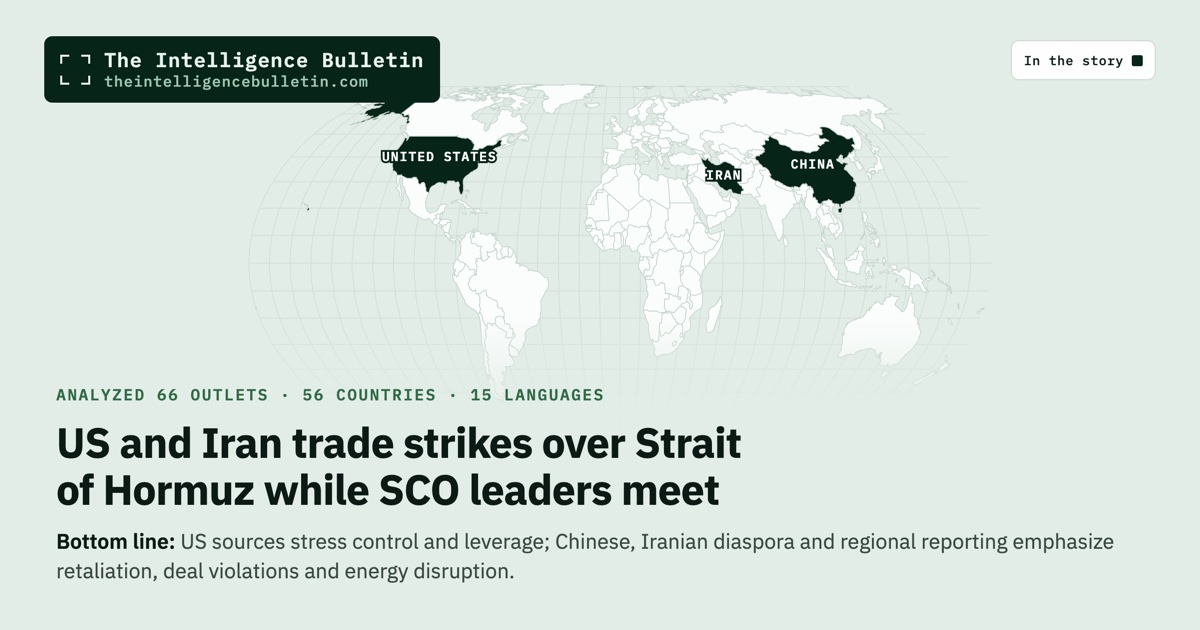
US and Iran trade strikes over Strait of Hormuz while SCO leaders meet

Map of the countries in the story: US and Iran trade strikes over Strait of Hormuz while SCO leaders meet
The United States conducted fresh airstrikes on Iranian Revolutionary Guard targets near the Strait of Hormuz on Tuesday after a weekend of direct attacks. Iran responded with missile and drone strikes on US assets including in Jordan and warned it controls the strait. Iranian President Masoud Pezeshkian, attending an SCO summit, called for the US to honor a June memorandum to end fighting. Oil prices climbed above $95 a barrel amid fears of wider disruption to Gulf energy exports.

One Story. Many Angles.

🇺🇸
United States
FOX San Antonio
Carries The National News Desk reporting
US resumes strikes on Iran as war centers on control of Strait of Hormuz
Read →
🇨🇳
China
China Daily
Original reporting
Iran urges US to honor June deal
Read →
🇮🇷
Iran
Gooya News
PERSIAN
Original reporting
Islamic Republic’s missile and drone attacks on US positions
“حملات موشکی و پهپادی جمهوری اسلامی به مواضع آمریکا”
Read →
🇹🇷
Turkey
Daily Sabah
Reuters wire copy
US strikes Iran again as renewed fighting fuels Gulf tensions
Read →
🇶🇦
Qatar
Al Jazeera
Commentary
Why China will not comply with US sanctions on Iran
Read →
5 sources · 4 independent accounts — some share the same news agency’s report
Analyzed 66 outlets across 56 countries and 15 languages · 23 translated · read 5 in full
In Brief

US sources stress control and leverage; Chinese, Iranian diaspora and regional reporting emphasize retaliation, deal violations and energy disruption.

US reporting frames the strikes as a necessary response to Iranian mining and shipping attacks that gives Washington leverage over the strategic waterway, while Iranian diaspora coverage centers Tehran’s missile retaliation and claims of downing US drones. Chinese state media instead highlights Iran’s diplomatic appeal to revive the June deal and portrays Washington as the party violating prior commitments. Turkish and regional outlets stress the resulting Gulf instability and energy risks without endorsing either side’s military narrative. The SCO summit in Bishkek where Pezeshkian met Putin and Xi supplies the clearest cross-border signal: multiple powers are treating the conflict as an economic and diplomatic standoff rather than a decisive US victory. What the accounts share is the strait itself as the immediate flashpoint; what divides them is whether the latest exchanges mark renewed escalation or contained tit-for-tat that both sides still seek to limit.

Perspective Analysis

The United States launched fresh airstrikes on Iranian Revolutionary Guard targets near the Strait of Hormuz on Tuesday, following a weekend exchange of direct attacks that included US strikes on Larak Island and Iranian missile launches at two US air bases in Jordan. CENTCOM described the operation as a response to recent IRGC attempts on commercial shipping in the strait and on US personnel in the region. Iranian state media reported explosions on Qeshm Island along the northern side of the waterway and in the southern ports of Bandar Abbas and Chabahar. President Donald Trump warned that Washington would hit Iran hard in any further response but described the latest confrontation as limited and said it did not necessarily signal a return to full-scale war.

Iranian forces replied with missile and drone strikes on US positions. Diaspora reports from Gooya News detailed the downing of a US MQ-9 drone by Iranian air defenses, described as the fiftieth such aircraft lost, along with explosions near the Muafaq al-Salti air base in Jordan. Jordanian military statements said thirteen ballistic missiles entered their airspace and that ten were intercepted, with the remaining three falling in remote areas. Two US officials told Reuters no casualties had been reported at American facilities in Jordan. Iranian Parliamentary Speaker Mohammad Bagher Qalibaf stated that Iranian forces maintain complete control of the strait and will not allow it to open, reacting with authority to any enemy movement.

Oil prices rose sharply after the exchanges. Brent crude climbed above ninety-five dollars a barrel on Tuesday, the highest level since late July, building on a more than two percent gain the previous day. The surge followed reports of two tankers struck while leaving the strait and of only five crossings recorded on Monday compared with ten each on Saturday and Sunday.

Iranian President Masoud Pezeshkian, attending the Shanghai Cooperation Organization summit in Bishkek, Kyrgyzstan, called for the United States to return to commitments under a June memorandum of understanding aimed at ending the fighting that began in late February. He said Iran would immediately reciprocate if Washington honored the nonbinding accord. Iranian Foreign Minister Abbas Araghchi made a similar appeal the day before. The memorandum had declared an end to hostilities that killed thousands in Iran and Lebanon, though it left major disputes unresolved and opened a sixty-day negotiation window that expired without further agreement. Pezeshkian also met Russian President Vladimir Putin, who expressed solidarity with the Iranian people in pursuit of their national interests.

US Treasury Secretary Scott Bessent signaled continued economic pressure through additional sanctions, while Iranian Central Bank Governor Abdolnaser Hemmati pushed back against claims that the Iranian economy stood on the brink of collapse and said the bank was prepared to inject up to two billion dollars into foreign-exchange markets. Global tanker traffic through the strait had already been sharply reduced before the latest strikes.

Accounts of the immediate military actions converge on the fact of strikes by both sides and on the resulting oil-price spike. US reporting from FOX San Antonio presents the American operation as a calibrated response to Iranian mining and shipping threats that restores leverage over the waterway. Daily Sabah, carrying Reuters copy, records the same sequence of US strikes followed by Iranian threats to choke Gulf exports and notes the resulting regional instability without endorsing either military claim. China Daily foregrounds Pezeshkian’s diplomatic offer at the SCO summit and frames the crisis around Washington’s failure to uphold the June commitments rather than around Iranian actions. Gooya News centers the Iranian missile and drone retaliation, including the reported drone intercept and explosions in Jordan, drawing on Iranian state media and local accounts.

The SCO gathering supplies the clearest point of convergence across the coverage. Pezeshkian’s presence alongside Xi Jinping and Putin, and the summit’s final declaration calling for a new development bank independent of systems that weaponize economic tools, indicate that China, Russia and others treat the conflict as an economic and diplomatic standoff rather than a decisive US military victory. Al Jazeera’s analysis notes that China purchases ninety percent of Iranian oil exports through dark-fleet arrangements and private refineries, giving Beijing both the capacity and the incentive to continue that trade despite US sanctions. The piece adds that Beijing views interference in its bilateral relations with Iran as unacceptable and has developed tolerance for US economic pressure after previous trade disputes.

A single-source element appears in Iranian statements that their forces now control the strait and have restricted shipping to five crossings on Monday. US reporting quotes those statements and pairs them with Trump’s assertion that the waterway is in extremely good shape from the American side. No other independent chain in the set confirms the exact crossing count or asserts operational control.

What to Watch

The corroborated record of reciprocal strikes, the price movement above ninety-five dollars, and Pezeshkian’s public call at the SCO summit for revival of the June memorandum together show that both sides retain capacity and incentive to limit the scope of fighting. The diplomatic channel opened at Bishkek supplies an immediate test: whether Washington treats the Iranian offer as a face-saving exit or as further evidence that economic pressure must intensify. The interest of every capital involved lies in keeping the strait open enough for its own energy needs while denying the other side decisive leverage; the SCO meeting demonstrates that at least three major powers already see the current phase as one that rewards calibrated economic and diplomatic maneuvering over open escalation.


Share this story

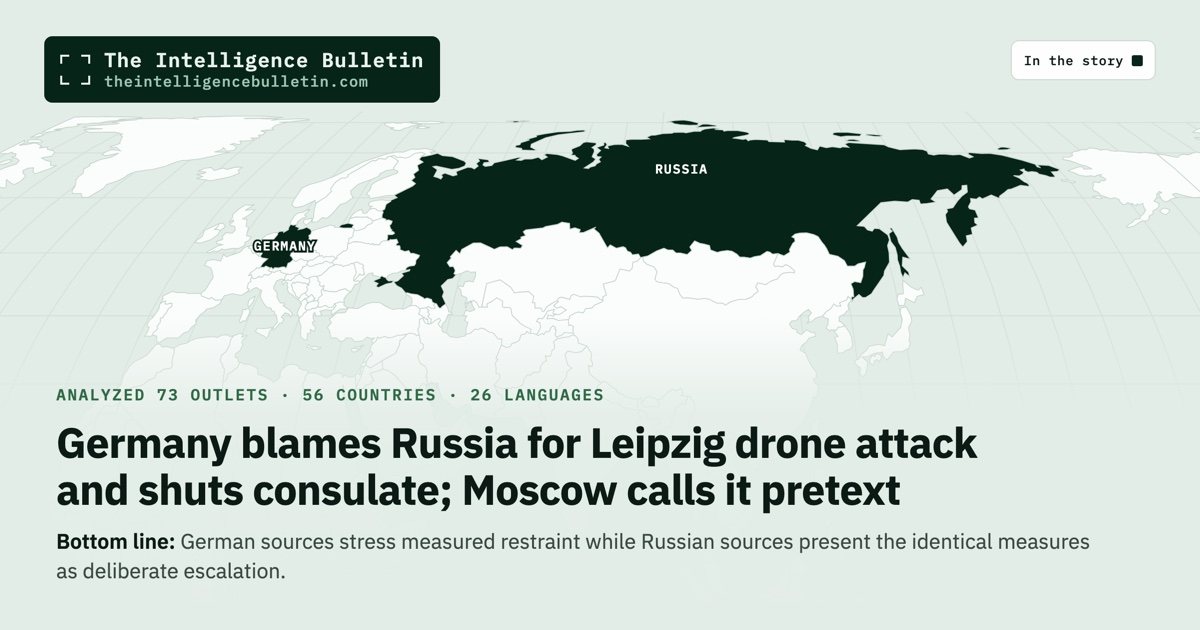
Germany blames Russia for Leipzig drone attack and shuts consulate; Moscow calls it pretext

Map of the countries in the story: Germany blames Russia for Leipzig drone attack and shuts consulate; Moscow calls it pretext
On 4 August an explosive drone was found near Ukrainian cargo planes at Leipzig/Halle Airport. On 1 September German Interior Minister Alexander Dobrindt and Foreign Minister Johann Wadephul stated that Russian state agencies were responsible. Berlin will close Russia’s consulate in Bonn on 18 September and end the Russian House agreement in Berlin. Moscow denies involvement and says the accusations are a pretext for escalation.

One Story. Many Angles.

🇩🇪
Germany
Die Zeit
GERMAN
Original reporting
Explosive drones at Leipzig/Halle airport: Wadephul announces ‘no overreaction’ to drone incident
“Sprengstoffdrohnen am Flughafen Leipzig/Halle: Wadephul kündigt »keine Überreaktion« auf Drohnenvorfall an”
Read →
🇷🇺
Russia
Lenta.ru
RUSSIAN
Carries Russian Foreign Ministry reporting
Zakharova explained Germany’s measures against Russia
“Захарова объяснила меры Германии против России”
Read →
🇬🇧
United Kingdom
Daily Mirror
Carries AFP/Reuters reporting
Russia blamed for horror drone attack on Leipzig airport as tensions rise between NATO and Putin
Read →
🇪🇸
Spain
El Mundo
SPANISH
Original reporting
German government holds Russia responsible for hybrid drone attack in Leipzig
“El Gobierno alemán responsabiliza a Rusia del ataque híbrido con drones en Leipzig”
Read →
🇮🇪
Ireland
RTÉ
Carries AFP reporting
Germany says Russia behind Leipzig airport drone incident
Read →
5 sources · each independently reported
In Brief

German sources stress measured restraint while Russian sources present the identical measures as deliberate escalation.

German reporting stresses a calibrated response coordinated with allies and explicitly rules out overreaction, while Russian coverage frames the same diplomatic steps as a long-sought pretext for closing cultural and consular sites. Western European and Irish accounts converge on the official attribution to Russia, citing police, intelligence and modus operandi, and note NATO and EU solidarity. The Spanish piece alone highlights the airport’s NATO logistics role, a detail absent from the German domestic account. UK tabloid framing adds confrontation language that none of the primary sources use. Russian outlets alone report the embassy’s on-record rejection of the claims as absurd and beneficial to Ukraine. The pattern shows that the core factual attribution travels across independent chains, yet the motive and proportionality of the German response remain points of direct contradiction between Berlin and Moscow.

Perspective Analysis

An explosive drone was discovered in the secure area of Leipzig/Halle Airport on the night of 4 August near parked Ukrainian Antonov cargo planes. German authorities later described the device as fitted with explosives and a detonator. It did not explode and was disarmed by bomb experts, who also closed nearby runways while they worked.

On 1 September Interior Minister Alexander Dobrindt and Foreign Minister Johann Wadephul held a joint press conference in Berlin. Dobrindt stated that police investigations, the pattern of the offence and intelligence findings together established Russian responsibility. He added that the incident formed part of a broader pattern of Russian hybrid operations in Europe and that further such attacks on Germany were assumed. Wadephul said Germany would respond but would not overreact, and that any measures would be coordinated with European partners and within NATO. The same day Berlin announced it would close the Russian consulate general in Bonn on 18 September and terminate the agreement governing the Russian House cultural centre in Berlin. It also said it would seek additional EU sanctions listings and travel restrictions on Russian nationals as well as increased pressure on Russia’s shadow fleet.

Russian officials rejected the attribution outright. Foreign Ministry spokeswoman Maria Zakharova told Lenta.ru that German authorities had long wanted to close both the Russian House in Berlin and the consulate in Bonn and had simply been looking for a pretext. The Russian embassy in Berlin called the accusations absurd, baseless and contrary to common sense, and said they served the interests of Ukraine, the militaristic wing of Europe’s elite and arms manufacturers. It described the announced measures as an unprecedented escalation that would not remain without consequences.

NATO Secretary General Mark Rutte posted that the alliance stood in full solidarity with Germany after the Russian hybrid attack and would continue to strengthen its ability to deter and defend allies. European Commission President Ursula von der Leyen wrote that the EU was united against Russian aggression and would deter anyone seeking to undermine European freedom and security; she said foreign ministers would prepare a response at their upcoming meeting. French President Emmanuel Macron and Finnish President Alexander Stubb also expressed support for new sanctions. Irish Defence Minister Helen McEntee noted that Russian activity in the EU had moved from threats to incursions on EU territory and called for higher defence spending.

German domestic coverage, led by Die Zeit, foregrounded the ministers’ insistence on a measured and carefully prepared response. Wadephul was quoted saying there would be “no overreactions, but reactions” and that Germany would not be intimidated. The outlet also reported that the government wanted its steps aligned with EU and NATO partners. Spanish reporting in El Mundo added that Leipzig/Halle functions as a major European cargo hub participating in NATO logistics and Ukraine support operations, giving the target a strategic character beyond its civilian status. Irish public broadcaster RTÉ summarised the official German conclusions, the announced diplomatic steps and the statements of allied solidarity without adding interpretive framing. The UK Daily Mirror account used the word “horror” in its headline and linked the episode to rising NATO-Russia tensions and Putin’s concerns over his safety and the war in Ukraine.

Russian coverage, as carried by Lenta.ru, placed the emphasis on Zakharova’s claim that Berlin had been seeking an excuse to shut the cultural and consular sites for some time. It reported the embassy’s on-record rejection of the accusations as fabricated and beneficial to Ukraine, and it quoted the promise of a “dignified response” from Moscow. No other source in the set carried Zakharova’s specific assertion about long-standing German interest in closing the sites.

A reader limited to German reporting would conclude that Berlin had acted with deliberate restraint and in concert with allies. A reader limited to Russian reporting would conclude that the episode was manufactured to justify pre-planned diplomatic expulsions. A reader limited to the UK tabloid account would see an episode of NATO-Russia confrontation framed in alarmist terms that none of the primary German statements employed. The Spanish account alone supplied the detail that the airport’s role in NATO logistics made the target more than purely civilian. The Irish account supplied the cleanest neutral summary of the official findings and allied reactions.

The core claim that Russia bears responsibility rests on statements from four independent reporting chains: the German domestic outlet that quoted the ministers, the Irish public broadcaster, the Spanish daily and the UK tabloid. All four cite the same 1 September press conference and the same combination of police work, intelligence and modus operandi. The Russian denial rests on a single chain, the Russian Foreign Ministry statements relayed by Lenta.ru. The claim that the measures were a long-sought pretext for closing the sites appears only in the Russian chain. The claim that the airport carried strategic NATO significance appears only in the Spanish account.

What to Watch

The German emphasis on measured response is consistent across the domestic reporting and is supported by direct ministerial quotes. Russian officials have an obvious interest in portraying the episode as anti-Russian theatre rather than evidence of their own operations. German officials have an interest in signalling resolve to allies and domestic audiences while avoiding uncontrolled escalation. The corroborated attribution across multiple Western European and Irish outlets gives that account greater weight than the single-chain Russian denial. The next moves are likely to be additional EU sanctions listings and further diplomatic expulsions, because those steps have already been announced and because the episode has been placed inside a declared pattern of hybrid activity rather than treated as an isolated event.


Share this story