 AI-generated analysis published under the editorial responsibility of Rohit Sinnas. How it works →
Press quoted
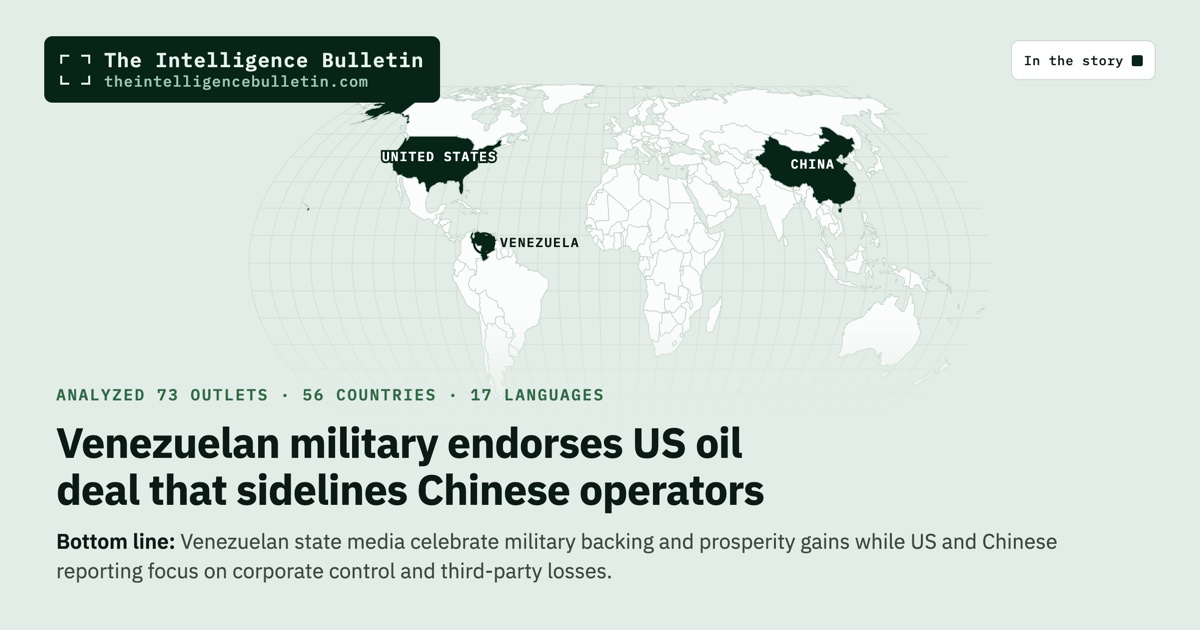
Venezuelan state media celebrate military backing and prosperity gains while US and Chinese reporting focus on corporate control and third-party losses.
The reporting converges on one concrete development: Venezuela’s armed forces leadership publicly aligned with an energy pact that hands operational control of major oilfields to a US-linked entity. Venezuelan outlets present the military statement as affirmation of national policy and future investment, while the Boston Globe details Chevron’s planned $7 billion spend to raise output and notes constitutional and legitimacy concerns raised by analysts. The Marxist outlet supplies the missing context of prior US military action and details US veto rights, board control, and production priorities for American strategic reserves. SCMP alone flags the direct displacement of Chinese operators and resulting debt recovery risks for Beijing. What stands out across the set is the absence of contradiction on the military endorsement itself and the rapid pivot from confrontation to joint development, with each national lens revealing stakes that others omit: domestic legitimacy in Caracas, commercial upside in Washington, strategic displacement in Beijing, and outright seizure from the left critique. The pattern shows how the same announcement serves four distinct national narratives without any outlet needing to invent facts.
Full analysis
Venezuelan Defense Minister Gustavo González López stated on September 1 that the military high command fully backed the strategic energy agreement signed between Venezuela and the United States. Speaking after a meeting at Miraflores Palace with President Delcy Rodríguez, he said the armed forces approved all terms of the pact for developing oil fields and welcomed the inflow of foreign capital that would generate employment and higher production. He described the arrangement as a shift from political differences to economic cooperation, not subordination.
The agreement itself centers on 17 oil fields containing 65 billion barrels of proven reserves, roughly one-fifth of Venezuela’s total. Eight of the fields are undeveloped blocks in the Orinoco Belt; the remaining nine are mature producing fields in the Maracaibo region. A US-backed private company, North American Blue Energy Partners, holds 100-year concessions to operate them. The White House has stated that the US Department of Defense acquired a 35 percent stake in the company at no cost through penny warrants, that the US government holds veto power over board appointments, and that a majority of board members must be US citizens. The company is also required to give the United States first rights to purchase 20 percent of production at cost for strategic reserves and military use, with the balance available for purchase under the same terms.
Chevron, the only major US oil company with an existing presence in Venezuela, confirmed it has been assigned additional acreage in the Orinoco Belt. The company plans to invest more than $7 billion over five years to raise its output from current levels to approximately 600,000 barrels per day. Its chief executive, Mike Wirth, said the expanded position reflects confidence in the country’s resource base and long-term competitiveness within the firm’s global portfolio. Chevron’s existing joint ventures already operate extra-heavy oil projects in the same region.
US Energy Secretary Christopher Wright arrived in Caracas on his second visit this year and told reporters that the goal is to channel private American capital into Venezuela’s hydrocarbon sector to create jobs and raise living standards on both sides. Venezuelan state media quoted him emphasizing mutual trust and the prospect of higher salaries, business confidence, and entrepreneurial opportunities once the investments materialize. President Delcy Rodríguez has said the resources generated will modernize public services, health care, education, and infrastructure while preserving state sovereignty over the reserves.
Chinese analysts noted that several of the fields now assigned to the US-backed operator were previously managed by Chinese companies. A professor at Renmin University described the development as a direct hit to Beijing’s position in Venezuela, where it had been the largest lender to Latin America and had built oil-backed loan and yuan-trade networks that now face repayment difficulties.
The military endorsement itself appears in the official Venezuelan state press without qualification. The Boston Globe reported the Chevron investment commitment and added analyst commentary questioning whether the acting president possesses the constitutional authority to grant 100-year rights over such large reserves and whether future Venezuelan or US administrations would uphold the terms. The left-leaning commentary outlet placed the agreement inside a sequence that began with a US military operation in January 2026 and the subsequent capture of former president Nicolás Maduro, describing the current arrangement as the direct result of that pressure and the new hydrocarbons law passed under US influence.
Venezuelan state reporting foregrounds the domestic economic upside and the military’s explicit political support. US business coverage centers on the corporate expansion and the scale of planned capital outlays. The critical account supplies the governance mechanics that transfer effective control to US entities. The Hong Kong outlet alone records the displacement of prior Chinese operators and the resulting exposure for Chinese creditors. No source in the set disputes the fact of the military statement or the basic parameters of the fields and reserves involved.
The convergence on the military endorsement supplies the clearest public signal that Venezuela’s security apparatus has accepted the terms. The single-source details on board composition, veto rights, and production priorities for US strategic use come from the White House fact sheet and are not contradicted by any reporting examined. The Chinese displacement claim rests on the professor’s assessment and the known prior operators of the affected blocks. Chevron’s specific investment figure and production target stand on the company’s own confirmation.
What to Watch
The arrangement therefore links a rapid normalization of US-Venezuelan energy ties to a structure that routes a substantial share of output toward American strategic needs and places operational control under US legal and personnel oversight. For global oil markets the addition of even partial new supply from fields holding 65 billion barrels would matter once infrastructure is restored, though the Boston Globe notes that degraded facilities and sanctions history make any near-term surge unlikely. Regionally the shift displaces Chinese commercial footholds that had been built over more than a decade of lending. Inside Venezuela the military alignment removes one potential source of internal resistance to the pivot, while the legal and legitimacy questions raised by analysts remain untested until the National Assembly completes its review or a future government revisits the concessions.
That’s how the world told the story.
Get our daily open-source intelligence on world events in your inbox — one email a day, up to six stories.
Subscribe freeNo spam. One-click unsubscribe. See the latest email →