 AI-generated analysis published under the editorial responsibility of Rohit Sinnas. How it works →
Press quoted
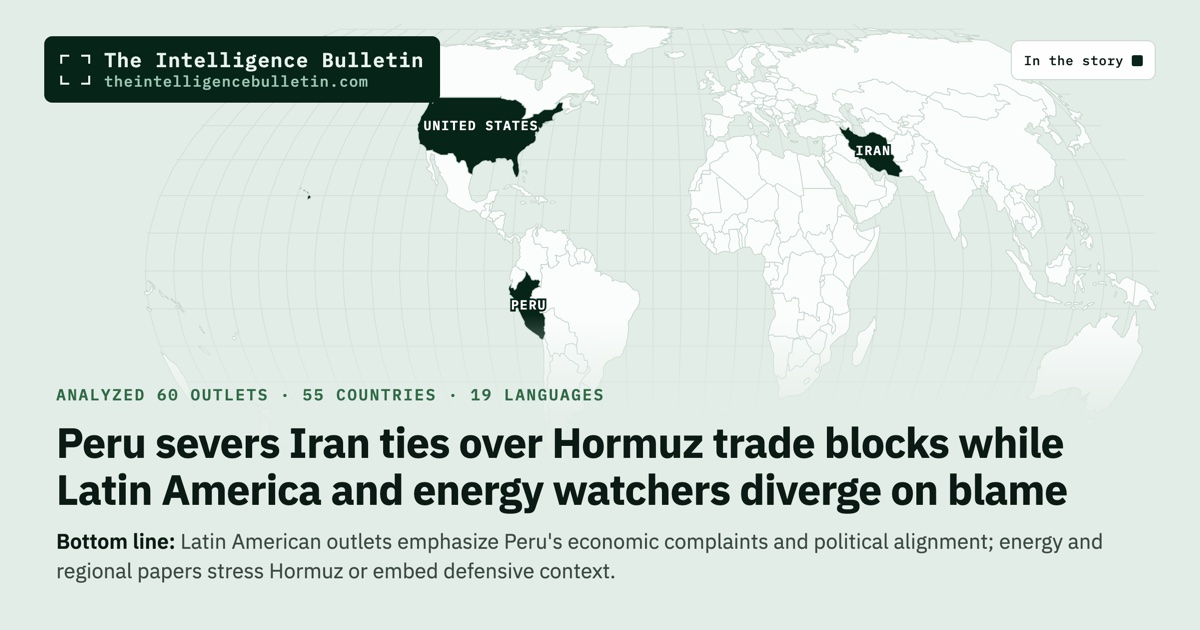
Latin American outlets emphasize Peru’s economic complaints and political alignment; energy and regional papers stress Hormuz or embed defensive context.
Peru’s break with Iran stands out as a rare Latin American escalation in the Middle East conflict, driven by concrete economic grievances over the Strait of Hormuz rather than abstract alignment. Peruvian business coverage in Gestión stresses the trade and energy price fallout from navigation restrictions, framing the move as a direct response to actions harming global supply chains. Brazilian reporting in Estadão adds the political context of Peru’s new Fujimori government tilting toward Washington, while still centering the same Hormuz and incitement accusations. Syrian state outlet SANA relays Peru’s complaints but situates them against a backdrop of ongoing Iranian actions and US-Israel hostilities, giving the episode a regional defensive tint absent from Latin American accounts. Azerbaijan’s energy-focused APA highlights the Hormuz energy dimension with minimal elaboration, reflecting Caucasus stakes in oil routes. Chinese state coverage remains the shortest and most neutral notice, avoiding any accusatory language. The uniform reliance on Peru’s single foreign ministry text across outlets means contrasts arise mainly from what each chooses to foreground or embed in wider context, not from competing facts. No independent Iranian account appears, leaving the principal actor’s voice entirely absent from the record.
Full analysis
Peru’s foreign ministry issued a single communiqué on September 1, 2026, announcing that the government had decided to sever diplomatic relations with Iran under Article 45 of the 1961 Vienna Convention on Diplomatic Relations. The statement listed the reasons as Iran’s severe restrictions on international navigation through the Strait of Hormuz since March 2026, its alleged incitement of violence and escalation in the Middle East, obstruction of International Atomic Energy Agency inspectors at nuclear sites, and a broader deterioration of democracy that included curbs on protests, press freedom, and discrimination against women and girls. Consular relations would continue so that both countries could protect their nationals and provide the services required by the 1963 Vienna Convention on Consular Relations. The note was delivered through Iran’s embassy in Ecuador, which handles concurrent representation for Peru.
Every published account that reached readers on September 2 rested on that one text. No outlet in the set conducted independent reporting that added new facts, dates, or named sources beyond what the Peruvian ministry supplied. The differences that appear are therefore choices about emphasis, surrounding context, and headline wording applied to the identical dispatch.
Gestion, Peru’s leading business daily, opened its article by foregrounding the commercial consequences. Its headline directly paired the severance with a challenge to trade restrictions, and the body quoted the ministry’s warning that the Hormuz measures would raise energy prices and disrupt global supply chains. The piece placed the economic language first and kept the human-rights and IAEA points as supporting items rather than the lead. It also noted that the rupture would not affect consular protection for Peruvians in Iran, a detail that addressed immediate practical questions for its business readership.
Estadão, Brazil’s major newspaper, chose a headline that led with the accusation of incitement and placed the event inside the larger Middle East conflict. Its text added the detail that Peru’s new president, Keiko Fujimori, who took office at the end of July 2026, governs a right-leaning administration aligned with Washington. It mentioned recent U.S. missile strikes on Iran and the resulting spike in WTI crude above $90, framing the Peruvian decision as one more data point in an intensifying confrontation. The Brazilian paper retained the core list of Peruvian grievances but embedded them in a paragraph that also referenced Chile’s earlier decision to close its Tehran embassy for security and economic reasons.
SANA, the Syrian state news agency, ran the Peruvian statement under a headline that again cited tensions and Hormuz disruption. Its account inserted an additional sentence noting that the restrictions had occurred “since its war with the United States and Israel began on Feb. 28,” thereby situating the Peruvian complaints inside an existing narrative of Iranian defensive actions. The piece otherwise reproduced the ministry’s language on navigation rights, energy prices, and IAEA access without alteration.
APA, an Azerbaijani outlet focused on energy and industry, published one of the shortest versions. Its headline simply stated that Peru had cut diplomatic ties, and the body limited itself to the Hormuz and Middle East tension clauses. It did not include the human-rights or IAEA passages that appeared in the longer Latin American and Syrian texts. The placement of the item inside an energy-industry section signaled that the outlet viewed the event principally through the lens of oil-route stability.
China Daily carried the briefest notice, a single-paragraph announcement that Peru had broken diplomatic ties. It contained none of the explanatory clauses from the ministry statement and added no surrounding regional or political context. The wording stayed strictly factual and avoided any accusatory phrasing.
Because every article reproduced the same originating communiqué, the observable variation lies entirely in selection and framing. Gestión elevated the trade and price consequences that matter most to a Peruvian business audience. Estadão supplied the domestic political alignment and the immediate backdrop of U.S. strikes. SANA supplied a defensive regional timeline. APA narrowed the lens to energy logistics. China Daily stripped the statement to its bare announcement. None of the outlets altered the ministry’s claims or introduced contradictory information; they simply decided which parts of the single text to lead with, which to keep, and what additional scene to place around it.
What to Watch
The pattern shows how a single official statement travels through different national information environments. An energy-dependent economy such as Azerbaijan’s extracts the Hormuz clause and little else. A Brazilian paper operating in a country that follows U.S. policy closely adds the Fujimori-Trump alignment and the oil-price reaction. A Syrian state outlet inserts the February 28 start date of the wider conflict. The absence of any Iranian-sourced material in the set means readers encounter only the Peruvian framing, filtered through each outlet’s own institutional priorities. That filtering, rather than any disagreement over the underlying facts, is what the five articles collectively demonstrate.
That’s how the world told the story.
Get our daily open-source intelligence on world events in your inbox — one email a day, up to six stories.
Subscribe freeNo spam. One-click unsubscribe. See the latest email →