 AI-generated analysis published under the editorial responsibility of Rohit Sinnas. How it works →
Press quoted
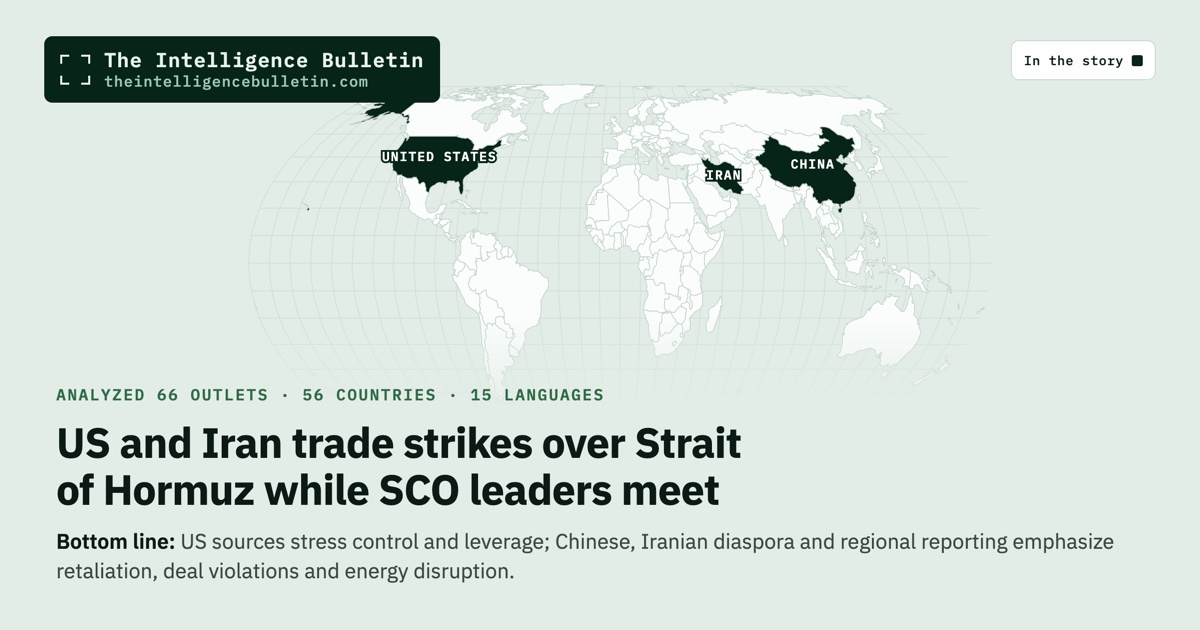
US sources stress control and leverage; Chinese, Iranian diaspora and regional reporting emphasize retaliation, deal violations and energy disruption.
US reporting frames the strikes as a necessary response to Iranian mining and shipping attacks that gives Washington leverage over the strategic waterway, while Iranian diaspora coverage centers Tehran’s missile retaliation and claims of downing US drones. Chinese state media instead highlights Iran’s diplomatic appeal to revive the June deal and portrays Washington as the party violating prior commitments. Turkish and regional outlets stress the resulting Gulf instability and energy risks without endorsing either side’s military narrative. The SCO summit in Bishkek where Pezeshkian met Putin and Xi supplies the clearest cross-border signal: multiple powers are treating the conflict as an economic and diplomatic standoff rather than a decisive US victory. What the accounts share is the strait itself as the immediate flashpoint; what divides them is whether the latest exchanges mark renewed escalation or contained tit-for-tat that both sides still seek to limit.
Full analysis
The United States launched fresh airstrikes on Iranian Revolutionary Guard targets near the Strait of Hormuz on Tuesday, following a weekend exchange of direct attacks that included US strikes on Larak Island and Iranian missile launches at two US air bases in Jordan. CENTCOM described the operation as a response to recent IRGC attempts on commercial shipping in the strait and on US personnel in the region. Iranian state media reported explosions on Qeshm Island along the northern side of the waterway and in the southern ports of Bandar Abbas and Chabahar. President Donald Trump warned that Washington would hit Iran hard in any further response but described the latest confrontation as limited and said it did not necessarily signal a return to full-scale war.
Iranian forces replied with missile and drone strikes on US positions. Diaspora reports from Gooya News detailed the downing of a US MQ-9 drone by Iranian air defenses, described as the fiftieth such aircraft lost, along with explosions near the Muafaq al-Salti air base in Jordan. Jordanian military statements said thirteen ballistic missiles entered their airspace and that ten were intercepted, with the remaining three falling in remote areas. Two US officials told Reuters no casualties had been reported at American facilities in Jordan. Iranian Parliamentary Speaker Mohammad Bagher Qalibaf stated that Iranian forces maintain complete control of the strait and will not allow it to open, reacting with authority to any enemy movement.
Oil prices rose sharply after the exchanges. Brent crude climbed above ninety-five dollars a barrel on Tuesday, the highest level since late July, building on a more than two percent gain the previous day. The surge followed reports of two tankers struck while leaving the strait and of only five crossings recorded on Monday compared with ten each on Saturday and Sunday.
Iranian President Masoud Pezeshkian, attending the Shanghai Cooperation Organization summit in Bishkek, Kyrgyzstan, called for the United States to return to commitments under a June memorandum of understanding aimed at ending the fighting that began in late February. He said Iran would immediately reciprocate if Washington honored the nonbinding accord. Iranian Foreign Minister Abbas Araghchi made a similar appeal the day before. The memorandum had declared an end to hostilities that killed thousands in Iran and Lebanon, though it left major disputes unresolved and opened a sixty-day negotiation window that expired without further agreement. Pezeshkian also met Russian President Vladimir Putin, who expressed solidarity with the Iranian people in pursuit of their national interests.
US Treasury Secretary Scott Bessent signaled continued economic pressure through additional sanctions, while Iranian Central Bank Governor Abdolnaser Hemmati pushed back against claims that the Iranian economy stood on the brink of collapse and said the bank was prepared to inject up to two billion dollars into foreign-exchange markets. Global tanker traffic through the strait had already been sharply reduced before the latest strikes.
Accounts of the immediate military actions converge on the fact of strikes by both sides and on the resulting oil-price spike. US reporting from FOX San Antonio presents the American operation as a calibrated response to Iranian mining and shipping threats that restores leverage over the waterway. Daily Sabah, carrying Reuters copy, records the same sequence of US strikes followed by Iranian threats to choke Gulf exports and notes the resulting regional instability without endorsing either military claim. China Daily foregrounds Pezeshkian’s diplomatic offer at the SCO summit and frames the crisis around Washington’s failure to uphold the June commitments rather than around Iranian actions. Gooya News centers the Iranian missile and drone retaliation, including the reported drone intercept and explosions in Jordan, drawing on Iranian state media and local accounts.
The SCO gathering supplies the clearest point of convergence across the coverage. Pezeshkian’s presence alongside Xi Jinping and Putin, and the summit’s final declaration calling for a new development bank independent of systems that weaponize economic tools, indicate that China, Russia and others treat the conflict as an economic and diplomatic standoff rather than a decisive US military victory. Al Jazeera’s analysis notes that China purchases ninety percent of Iranian oil exports through dark-fleet arrangements and private refineries, giving Beijing both the capacity and the incentive to continue that trade despite US sanctions. The piece adds that Beijing views interference in its bilateral relations with Iran as unacceptable and has developed tolerance for US economic pressure after previous trade disputes.
A single-source element appears in Iranian statements that their forces now control the strait and have restricted shipping to five crossings on Monday. US reporting quotes those statements and pairs them with Trump’s assertion that the waterway is in extremely good shape from the American side. No other independent chain in the set confirms the exact crossing count or asserts operational control.
What to Watch
The corroborated record of reciprocal strikes, the price movement above ninety-five dollars, and Pezeshkian’s public call at the SCO summit for revival of the June memorandum together show that both sides retain capacity and incentive to limit the scope of fighting. The diplomatic channel opened at Bishkek supplies an immediate test: whether Washington treats the Iranian offer as a face-saving exit or as further evidence that economic pressure must intensify. The interest of every capital involved lies in keeping the strait open enough for its own energy needs while denying the other side decisive leverage; the SCO meeting demonstrates that at least three major powers already see the current phase as one that rewards calibrated economic and diplomatic maneuvering over open escalation.
That’s how the world told the story.
Get our daily open-source intelligence on world events in your inbox — one email a day, up to six stories.
Subscribe freeNo spam. One-click unsubscribe. See the latest email →